Guy Delisle a suivi sa compagne durant 14 mois en Birmanie alors qu'elle y collaborait avec Médecins sans Frontières. Il raconte son expérience du pays, comment il a fini par apprivoiser son environnement, et petit à petit, comment il a découvert la réalité politique, sanitaire et sociale de ce pays
Born in Quebec, Canada, Guy Delisle studied animation at Sheridan College. Delisle has worked for numerous animation studios around the world, including CinéGroupe in Montreal.
Drawing from his experience at animation studios in China and North Korea, Delisle's graphic novels Shenzen and Pyongyang depict these two countries from a Westerner's perspective. A third graphic novel, Chroniques Birmanes, recounts his time spent in Myanmar with his wife, a Médecins Sans Frontières administrator.
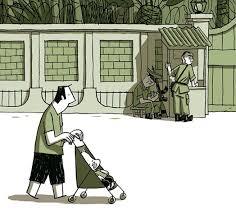
Il disegno in copertina. Sottotitolo: datemi un passeggino, e vi disegnerò il mondo.
Non all’altezza delle cronache di Gerusalemme, che secondo me rimane la sua vetta. Ma sempre divertenti acute e interessanti. Il disegno è semplificato, asciutto, semplice, i fronzoli grafici ridotti all’essenziale, probabilmente per la difficoltà di reperire materiale da disegno in loco (considerato anche caldo e umidità: c’è un momento divertente nel quale il protagonista guardando il meteo alla tivvu esplode in urla di gioia e festeggiamenti, perché essendo nato in Québec ed essendo in quel momento in Birmania, poteva dire d’essere nato nel posto più freddo della terra e di abitare in quello più caldo).
Cosa manca, almeno per me, rispetto alle Cronache da Gerusalemme? Manca la profondità dello sguardo, che qui rimane più superficiale, da turista, per quanto privilegiato. E perché manca quella profondità di sguardo? Probabilmente per la stessa ragione che Israele è una realtà più complessa, stratificata, di maggior difficoltà di comprensione e approfondimento di quella della Birmania, bieca dittatura militare da ormai più di cinquanta anni, alla fin fine più semplice da interpretare e ‘scoprire’, più simile a tutte le altre dittature (per esempio Corea del Nord).
Data la rigidità della dittatura, Delisle trascorre più tempo che a Gerusalemme con connazionali, europei e operatori umanitari in genere, finendo col raccontare momenti di vita che rimandano alla letteratura dell’epoca coloniale (se poi quell’epoca si è davvero mai conclusa): feste, cocktail, cene, escursioni, club, sport...
Rimane che Delisle fa un uso creativo del giornalismo a fumetti, il graphic o comix journalism: riesce a essere fresco, al limite del naïf, pur affrontando argomenti scottanti come una dittatura, trattando realtà drammatiche come quella birmana (oltre la dittatura, povertà, droga, AIDS, malaria…) in modo inusuale. Irriverente.
Anche qui, come già in Shenzheni (2001), Pyongyang (2003) e poi in Cronache di Gerusalemme (2011), il protagonista Guy, fumettista e disegnatore di professione, si trasferisce a vivere all’estero per un periodo di tempo (in questo caso poco più di un anno) al seguito della moglie che lavora per MSF.
L’alloggio, l’insediamento, l’asilo dell’unico figlio, i collaboratori domestici eccetera: attraverso aneddoti di vita quotidiana ci racconta la vita sotto una dittatura militare, in un paese molto religioso (non solo buddismo), molto povero, oggetto di embargo…
È menzionata anche la donna birmana più famosa Aung San Suu Kyi, premio Nobel per la Pace nel 1991, addirittura sua vicina di casa, ma invisibile perché agli arresti domiciliari, paragonata al Voldemort di Harry Potter dato che nessuno nel paese osa pronunciarne il nome, e molti preferiscono citarla con l’appellativo di The Lady (titolo del film di Luc Besson a lei dedicato).
So here's what sums up why this book failed to impress me:
Halfway through, Delisle is showing a western journalist/illustrator around Burma/Myanmar. He points out how people carry their umbrellas stuffed into the back of their longyis (or lungis as we call them in India) and also sometimes hanging from the backs of their shirt collars - which he calls 'weird'. I don't know man. Walking through crowded chaotic streets - makes sense you'd want your hands free. But because that's not how they do it back in Canafrancadapolis, it's 'weird'.
A few pages later, Delisle and the other white guy are stuck under a tree in a rural area, stranded in the rains. A villager comes running up to them twice, to bring an umbrella each for them. He then invites them back to his house to warm up and eat something. Someone who speaks English is found to interpret. Delisle explains that a government worker also has to be present to report on their conversations.
In all this, Delilsle fails to note the selfless compassion shown by a man who at least once walked back to his home without an umbrella to help out two grown men who were incapable of making their way through the same rain. In fact, looking at the drawings (in Delisle's crude but moderately effective style), it is clear that their host never used an umbrella himself.
You know what's 'weird' Delisle? The fact that you take this incredible act of gallantry totally for granted. that's fucking weird.
این کتاب رو بیشتر از پیونگ یانگ و شنژن دوست داشتم و کمتر از سرزمین مقدس. به نظرم کارهای دولیل که بعد از ازدواج و بچهدار شدنش هست پختگی و طنز بیشتری داره و نوع شخصیتپردازی و تصاویر به یه ایدهآلی رسیده که توی کارهای چین و کرهشمالی دیده نمیشد. همینطور درگیریهای بچهداری به طنز سفر خیلی اضافه میکنه به خاطر روحیات خود نویسنده و همینطور شغل همسرش، به مکانهایی سفر میکنه که موضوعات نابی برای افراد خارجی به روایت میکنه، برای همین شاید سفرنامههای گرافیکی گای دولیل خیلی به خواننده کمک میکنه تا مقصد رو بیشتر و همراه با تصویر بشناسه. میانمار هم سوژه جالبی بود و اون موقع که دولیل رفته بود اونجا همزمان با حصر آنگسانسوچی بوده و زمانی که برنده جایزه نوبل شده و کلی صحبت و تبلیغ در موردش هستش. نمیدونم اگه الان سفر کنه همچنان همون تعاریف رو از خانم میکنه یا نه؟! چند صفحه آخر کتاب هم در مورد تجربه نویسنده از یه دوره مراقبه چند روزه هستش که برای من جالب بود.
Being a Burmese myself, I am always more than willing to lend my pair of ears to what the expatriates have to say about my country, Burma. Of course, this book immediately caught my eye while I was browsing the French section at Kinokuniya Bookstore. It turned out to be so entertaining and gripping that I managed to finish it right at the aisle there within like forty minutes or something, standing and flipping the pages and suppressing my little chuckles. This little French graphic novel(reads more like a travelogue by the way) by Guy Delisle who works as an administrator at Doctors Without Borders(Myanmar) accounts his day-to-day vignettes of life in Burma/Myanmar with a toddler boy growing up who seems to have an immense interest in his surroundings(the city of Yangon of course). With cool illustrations, quirky and satirical humor targeting the military regime(this book was published in 2010, prior to the release of the democracy beacon, Daw Aung San Suu Kyi) and all the little annoying things such as frequent electricity black-outs and even the hot weather of Yangon etc, 'Burma Chronicles' is an amazing read which will delight you even though it's not about delightful pleasant stuffs as you will learn about the brutal and oppressive activities of the military regime. A must read for any foreigner who's interested in Myanmar/Burma(both for visiting and working) as he/she can take away so many things about the country within a short amount of time from this little graphic novel gem. Highly recommended.
Leí "Pyongyang" hace cierto tiempo, y desde entonces, me quedé con ganas de leer más de este autor. Lógicamente, este es un libro más extenso, toda vez que Delisle pasó apenas dos meses en Corea del Norte, mientras que vivió un año entero en Birmania, acompañando a su pareja en su misión de Médicos Sin Fronteras. A lo largo del cómic, nos presenta un relato costumbrista de la vida en el país, sin omitir ni negar la cruda realidad a la que están sometidos los birmanos: oprimidos por una brutal dictadura militar que ha conseguido mantenerse en el poder a fuerza de represión y censura. Un gobierno que publica una propaganda tan burda que nadie en su sano juicio podría creerla, y que está tan desprestigiado que ha llevado al país al aislamiento y a su pueblo a la desesperación. Un gobierno que es cómplice del tráfico de drogas, que tiene los dedos metidos en todos los negocios del país y que prácticamente desconoce la noción de derechos humanos. A pesar de ello, el tono no es sombrío. Personalmente, solo tenía una idea muy vaga de Birmania antes de leer el libro-sabía que los militares volvieron a tomar el poder en 2021 y que llevan adelante campañas de exterminio contra las minorías étnicas, pero eso era todo-y Delisle no se queda en la política. Describe también las creencias religiosas, los hábitos alimenticios, y hasta curiosidades como las normas de tránsito que pueden parecer nimiedades sin importancia pero que nos recuerdan lo muchísimo que puede cambiar lo que conocemos como "civilización" de un país a otro. El estilo de arte es sencillo, cuasi-minimalista, y la lectura es rápida.
Really interesting to see the political state of Myanmar and also to see how the country copes with it. Also to see how the humanitarian work and ngos work out there. A deep dive into Myanmar. Highly recommended. Would like to read other books by the author
I like it when travel writers show me a country that I'll probably never see in my lifetime. Burma, also known as Myanmar, has been under military control since a coup in 1962, and it has a reputation of being one of the worst dictatorships on the planet. In 2005, President George W. Bush called Burma one of six "outposts of tyranny," along with North Korea, Cuba, Iran, Zimbabwe and Belarus.
Guy Delisle and his family spent a year living in Burma while his wife worked for Doctors Without Borders. This graphic novel is similar to his other travelogues I've read, Pyongyang and Jerusalem, in that he draws his day-to-day life and his experiences in the region. As a Westerner who doesn't speak the native language, his main source of social contact comes from other expatriates, mostly people who work for nonprofit agencies.
Since Guy receives limited outside information -- government censors strictly control the news -- there's an amusing section when he first hears a World Health Organization employee talking about bird flu and he spends a month panicking about a potential epidemic. His biggest fear is if he and his family were to be quarantined in Burma and wouldn't be allowed to return home to France. Guy obsesses about getting enough doses of Tamiflu, until another worker points out that it probably wouldn't work anyway because it was prescribed to treat the seasonal flu, which is a different strain of the virus. One of the charms of Delisle's comics are the frames where it's just him looking puzzled and not saying anything. (Fortunately, there was no outbreak during their visit.)
Since Guy is an animator, he seeks out other graphic artists whenever he visits a new country. In this book and the other two I've read, there are nice stories of him meeting cartoonists and sharing their work. A particularly moving scene is when he travels to meet an elderly Burmese artist and reverently looks at the original pages of his comic published in 1970, which had inspired a generation of illustrators.
Sadly, the political situation changes and the government makes it more difficult for foreign nonprofit agencies to work there. There is an interesting section where a Doctors Without Borders administrator explains to Guy why they are deciding to leave Burma: Because the government won't allow them access to the remote Burmese citizens who need the most medical attention, and if they only operate in the capital city, then they're essentially propping up the regime.
Toward the end of their stay in Burma, Guy attends a meditation retreat at a temple and tries to focus his awareness: "After 42 hours of meditation in 3 days, I feel more peaceful than ever before, but also very alert. How long can this state of grace last? It could be a hard landing."
I always thought Burma was a small agrarian economy somewhere in East Asia. Dependent on rice and agriculture and subject to monsoons.
Maybe it was the medium of the book - graphic novel - or it was the easy way in which the author describes his experiences with Medicins Sans Frontiers in the country that got me.
The story lays bare the extreme censorship of freedom including those of human rights.
“ When mines caved in the Govt simply covered them without even thinking about rescuing the miners.”
“Miners slashed their cheeks to hide gems and rubies from the mines while on their way out. Women who worked in the mines were subject to vaginal searches in unsanitary conditions leading to infections.”
If this is not brutality what is. The country remains as dark the Govt chooses not to open it up endangering the source to corrupt spoils of the land.
Our country has had a great trading relationship with Moulmein. My own forefathers had visited Rangoon and had business interests in teak and other goods. Our state has many such examples of quality of natural resources in this abundant country. Such a pity that it is held to ransom for other interests.
Guy Delisle has created quite a voluminous graphic novel given the subject. A great piece of work if you are considering Burma in your travel plans. Or even otherwise just to know how dark it is their for its Stoic citizens.
Amazing how many such countries exist with so much suffering.
Delisle manages to capture for us what a non-working foreigner not proficient in the local languages would perceive during his/her time in Rangoon. The heat. I'd always wondered about it. Delisle said his level of tolerance improved over the year he stayed there, so that he could stand up to 90degF before turning on the air conditioner, while when he'd arrived, 80degF was his limit.
Delisle's wife works as a physician for Médecins Sans Frontières (MSF) International as a physician, and this time we learn a little about how the process of country-siting is chosen, what kind of conditions employees endure as condition of their employment, and a little about the different roles sister organizations have within the same country. One can actually use this as a window into the work of the organization as well as into the country.
All of Delisle's graphic memoirs are interesting. This one made me laugh when he showed a picture of a pen and ink drawn made during 'the wet,' or the rainy season. The lines were all running and blurred, as though it had been dunked in a barrel of water or as if one had spilled water onto it. The rest of the year is 'the hot.' What else is striking is at that time (2007-08), permits were required for foreigners to travel around the country, due to a great deal of internal unrest.
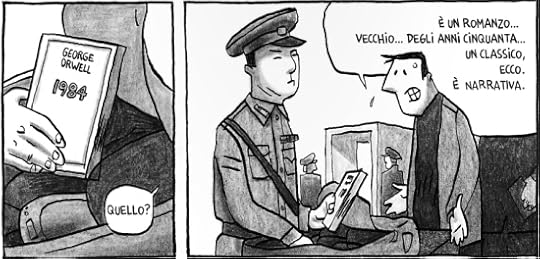
Some of the physicians are stationed at remote outposts, and even though the organization is permitted to operate, getting permission to travel to and from those outposts is difficult and can be dangerous. But here the usefulness of having an artist making the trip is apparent. We envision the enormous ancient teak house in Mudan that is rented by MSF, and the local translation of a British village complete with fenced front gardens. You will remember Orwell was stationed in Burma between the world wars.
Anyway, Delisle is not a political writer, nor a journalist, but he adds a heck of a lot to our understanding nonetheless. I'm now officially a big fan.
this book's portrait of Burma was interesting, showing a much more modern society than one would expect, as the country is in the grip of a vicious junta. although any problem the people might face pales in comparison the the indignities suffered by the author: lack of air conditioning, inability to get into an exclusive country club, power outages, having to drink Coke, pain in elbow forcing him to play Warcraft all day. the author comes across as a whiny bastard. while his wife works as a doctor in the field saving lives, he frees himself of all obligations, including most of the child care, and wanders around at his whim making shallow observations about the country. while the setting is interesting, the author gets in the way of this being an interesting, or pointful, travelogue.
Knowledge++ Funny bits in the beginning, slowly moving into daily life in Burma. Lots of insight on Burma culture (and many cultural shocks) from an obliterated country! No idea how much of it really portrays Burma in true light. But kudos to the author for being candid even about the controversial political topics. Feels like firsthand experience of an adventurous stay in Burma!! Will surely check out his other travelogues. Wish he visits India and writes this kind of a fun travelogue :)
Tamamen demir yumrukla yönetilen bir ülkede, yine mizahı ve inanılmaz gözlemleriyle Guy beyi izledik. Başbakan seçilen kadın yıllarca ev hapsinde, başka şehre taşınan ama adı devlet sırrı (wtf?) olan yeni bir başkent, yoksul hastaları tedavi etmek isteyen sınır tanımayan doktorlara; ‘dünya bizim bok içinde yüzdüğümüzü görmesin.’ diye izin vermeyen bir cunta. Doğal zenginliği olan pek çok ülke gibi, ne alaka ülkeler tarafından sömürülüyor ülke. E bir de barış, mutluluk diye yırtınan budistlerin Arakan’da ki müslümanlara yaptıkları. Ay yerin dibine batın ya. İdeal bir dünyada her ülkenin, her büyük şirketin ve her insanın boykot etmesi gereken bir ülkede, küresel anlamda dev şirketler hala var. Okurken hepsini yakışıklı çizerimizin mizahı ile okuyorsunuz ama şimdi yorum yapınca ekmeğime kan doğrandığını fark ettim resmen.
What I most love about this book is how political it WASN'T. DeLisle, considering the area he was living in, could have spent this entire book rightfully decrying a horrible and violent government, but instead choose to focus on daily life, the heat, the locals love for his cute baby, the rains, and a hundred other aspects of simple human life. Politics, of course, inevitably come into the mix, but when they do I felt so grounded by the "human" establishment that the politics had actual impact...rather than just a series of "X" and "O" movements.
And the simple art was charming. Exactly the right amount of visual information for a chronicle of this type.
This is an autobiographical account of the author’s stay in Myanmar for 1 year in 2007, as his wife was stationed there while working as an administrator for Doctors Without Borders.
I’ve also read Jerusalem and PyongYang by the same author, and they have the same great qualities and the same flaws.
Qualities - well, first of all, I love the comic format as a medium. It has the potential (almost never realized of course) to convey meaning by packing a lot of information in a single panel or an image. The author is very good at his trademark “minimalistic sketches” and I particularly enjoy the panels where he shows landscapes and architectures, rather than people. I don’t think he is very good at drawing people, actually. Also, there is great informative value in seeing the Myanmar reality through the eyes of a westerner, with a focus on the visual aspects. Very important to note that this book is a snapshot of 2006/2007, therefore many aspects of that reality have now changed in the country, especially with the establishment of the new government and the liberation of Aung San Suu Kyi (go ahead, try to remember that name tomorrow): she is their national “hero” who is currently in power (2018 as I write this).
Flaws - mainly, the author’s personality. Yes I already knew him from his other works, but damn, the guy is so hard to like. I completely understand that he is always trying to make a little joke here and a little joke there, to make the comic book more engaging maybe, but these jokes are invariably full of sarcasm directed at the locals, and very often patronizing, the type of jokes that an immature teenager might crack when confronted with the same situations. This shows that despite all of his traveling, he hasn’t really been able to develop an open mind towards people of different cultures. On the other hand, I noticed that like in other books he tries to smooth the edges of his wife’s lefty leanings. I found it revealing when he said that before leaving, he knew clearly that the corporations like Total were the BAD guys, and the ONG workers the good guys. Then only once he met some Total employees he conceded that “actually, they are not all bad”. Such a superficial worldview.
This graphic novel is really problematic for me. It can be funny and informative (as it is travel memoir in the form of graphic novel). But for me author tends to be little bit xenophobic when it comes to people who live in Burma. Ok I get it, it was written for western people, but still I don't find it necessary to laugh about other people customs and habits.
It seems I haven't seen or realised it while reading his novel "Pyongyang". I need to try other graphic novels by this author to see if it was just this one or it is in everything written by this author.
اولین چیزی که باید بهش اعتراف کنم اینه که من نمیدونستم برمه همون میانماری هست که میشناسیم؛ این سفرنامهی دولیل برام کمی متفاوت بود و علتش هم از این ناشی میشد که این دفعه به خاطر کار همسرش به کشوری رفته بودند و خودش در برمه، یه زندگی روزمرهی تکراری داشت. البته اینکه همهی مردم به خاطر لویی پسربچهش بهش توجه میکردن خیلی خندهدار بود؛ یه جورایی سیاهی لشکر سفرنامهی خودش بود.
Depois de "Pyongyang - Uma Viagem à Coreia do Norte", queria obviamente continuar a ler mais de Guy Delisle e descobri "Crónicas da Birmânia" na Biblioteca José Saramago, em Loures. Mais uma moedinha, mais uma viagem a uma país sob regime de ditadura militar - Myanmar.
Guy parte juntamente com a mulher e o filho para Burma, o próximo local dos Médicos Sem Fronteiras onde a sua mulher irá trabalhar. Guy passa a ser pai a tempo inteiro e ilustrador em part-time, e graças a isso faz uma compilação de ilustrações desta viagem de 1 ano.
É muito interessante ficar a conhecer estas realidades, especialmente o contexto histórico do país aquando da altura da viagem. Nem todos tinham eletricidade ou se tinham, havia falhas na corrente. Um país religioso e respeitoso para os monges. Um controlo cerrado do regime militar. Infelizmente ainda continuavam a manter a ganhadora do Prémio Nobel da Paz (1991) Aung San Suu Kyi, fechada entre 4 paredes. É um nível muito diferente da Coreia do Norte mas onde a liberdade de uma pessoa ainda pode ser questionada.
Foi um livro interessante no geral, gosto muito do traço de Guy e agora só falta o "Shenzhen -Uma viagem à China" e "Crónicas de Jerusalém" (que espero que seja editado em breve).
Interesting because you learn about Burma. Annoying because the whole book seems to be more about Delisle than the country and the people in it. Even his wife only has a very marginal role in the comic, even when they are on trips together. I think his work will improve when he focuses less on himself and more on the world around him.
2.5/5 Didnt like the author's style of narration. All about himself. Virtually no conversations with the Burmese. No attempt to understand their POV or how they felt about things. Secondly, have read a bit about Burma in Theroux and Pico Iyer's travelogues and felt they were better.
واقعيت اين بود كه من چيز خاصی از برمه نمیدونستم در كمال خجالت. حتی نمیدونستم برمه و ميانمار یک كشورن در واقع! و خب اين اطلاعات و چيزهايی كه به نظر یک گردشگر كانادایی فرانسوی ميومدن، جالب توجه بودن برام. غصه آور. و عاشق اون آخرش شدم كه مراقبه در معبد بوداییها رو امتحان میكنه. همچنين چاپ و ترجمه خوبی داشت بنظرم ^_^
With a lot of information and visuals to absorb, it took me three weeks to actually get this book read thoroughly and I'm happy picking it up at least.
I love Guy Delisle's Parenting book. You could get a sense that he is a very good story-telling and has keen eyes for a good observer. This graphic travelogue, apart from the content, doesn't change his perception and charms. Delisle accompanied his wife, who is an MSF managing doctor (aka Doctors Without Borders) and their two year-old son, Louis, went to Burma. His wife's work is to give treatment and supplies and to open clinics in the faraway borders between Burma and Thailand.
Considering being a skeptical reader when it comes to non-fiction and documentary genre, I'm happy, and almost relieved to see my new favorite cartoonist doesn't tell but shows how living in the foreign country in the midst of military regime was like instead of prejudices. His point of view as a stranded foreigner and a purpose to be there and observe (also babysit his son) is very selective and cut-short, opened for interpretation and various judgements, plus even the politics couldn't be more sarcastic but truly humorous.
I keep the thought to myself for a while during reading the book that is, not the best but good way, to write non-fiction or memoir is always the tricky one. To preserve your position as an observer is missing in the most of travelogues, memoirs etc. The attempt to insert the judgements and lessons learned in the work is permeating every time I try to get my hand on and they often left me a bit underwhelmed because their statement of "verified true story" while on the other side, there's nothing much more than a person's narrative. Meanwhile, this book doesn't try to justify any currents and is humble enough to give me a little nostalgic, relatable and whimsical sense of humor instead. It's functionally served its own purpose.
Good work. Better than Pyongyang: A Journey in North Korea. Guy Delisle seems more accepting towards the local culture in Burma Chronicles than what he seemed to be in Pyongyang: A Journey in North Korea. And I think it’s obvious. He stayed in Pyongyang for only 2 months and his social circle consisted only of other foreigners like him. The only substantial contact he ever had with the locals was with his guides provided by the government of North Korea. So, it was natural that a certain detachment was going to be reflected in his writing. Whereas in Burma Chronicles, he stayed for a year with his wife and kid and really made some good local friends. And that is what gives this book more depth and feel.
So how is it, overall? It’s fun, really! No, this isn't some eyewitness account of the atrocities committed by a totalitarian state. The dictatorial regime just serves as a background for this work. Because Guy Delisle is not a reporter. He is a cartoonist and has written this book as such and it should be read keeping that in mind. The graphics are breathtaking as usual. His attention to details in some of the frames is really mind boggling. I am already a major fan of his drawing abilities. And I am glad that he seems to have grown as a writer and as a person as well.
There are so many beautiful graphic novels out there. It's a bit difficult to get hands on the ones I cherish. But it's good that some of them are available O:)
Guy Delisle's travelogue comics are interesting. This is the second book I am reading in a row sketched by him. This one is about his almost one year's stay in Burma in 2008 during the dictatorship regime. Aung Saan Suu Kyi was still under house arrest. Oh I learnt, some countries like USA, UK, Australia, Canada etc. still refer the country as Burma instead of Myanmar. Therefore, the title "Burma Chronicles" instead of "Myanmar Chronicles".
The book is a sketched version of a daily diary - seen from the perspective of a foreigner, not getting too involved in things. Delisle sketches the daily hardships and the fear prevailing in the country under military junta. The hassles the NGOs face while operating in the country, requiring visa almost every week to work in any region within the country. The hard & fast censorship the print media suffers. The unrestricted availability & use of drugs and the widespread of HIV with the vested interest of military junta and so on.
Kuzey Kore kadar etkileyici ya da şöyle söyleyeyim, Kuzey Kore’yi ele aldığı çizgi romanı kadar detaylı bir inceleme ya da toplumsal bilgi yok gibiydi. Özellikle merak edilenleri es geçmiş gibi geldi bana. Belli konular üzerinde tekrar tekrar durulmuş. Az biraz aceleye gelmiş belki de bilemiyorum.
Elbette keşke dediğim yerler çok oldu. Örneğin Myanmar üzerinde petrol şirketlerinin planları, ülkenin üzerine çökmüş olan askeri diktatörlüğün oyuncuları, dinler arasında yaşanan katliamlar, halkın umusamaz durumu, inanılmaz yüksek uyuşturucu ve değerli taşlar konularında daha fazla detay bilgi verilebilirdi. Bir senelik bir oturumda yaşananları çizdiği bu çizgi romanda sanki bir aylık bir süreyi görmüş gibi oluyoruz.
Ama her halükarda çok güzel bir okuma sunuyor bizlere Guy Delisle.
Burma Günlükleri’yle, Guy Delisle’nin bu gezi-günlük tarzı kitaplarının hepsini okumuş oldum. Kendisinin gözlemciliğini ve bunu esprili bir anlatımla herkesin anlayabileceği bir forma dönüştürmesini seviyorum. Sanki ben de kendisiyle birlikte geziyormuşum gibi hissediyorum. Burma/Myanmar açıkçası öncesinde araştırmadığım bu sebeple çok da fikir sahibi olmadığım bir ülkeydi. Guy Delisle’nin eşi Sınır Tanımayan Doktorlar’da çalışıyor bu sebeple başka ülkelerde uzun süreli kalmaları gerekiyor. Myanmar’da geçirdikleri 1 yılı anlatıyor. Bol yağmuru, boğucu sıcağı ve cunta yönetiminin baskısıyla geçen dolu bir yıl. Kültürlerinden, yaşantılarından, Budistler’den ve yoğun sansürden bahsediyor. Gerçekten ilginç bir ülke ve halkın yaşadığı rezil hayatı okumak oldukça üzücü. Keyfi yönetimden dolayı sağlıklarından olan işçiler ve doğru düzgün elektriğe erişimi olmayan fakir kesim tüm bunların ortasında bir şeyler yapmak için çaba gösteren STD’ın faaliyetlerinin engellenmesi derken karanlık bir ülkenin portresini çiziyor Delisle. Bir gün başkentin yeri bile ansızın değiştirilmiş ve adını öğrenmek isteyen basına verilen cevap ‘devlet sırrı’! Aslında yeşim taşıyla, doğal gazıyla çok ferah bir ülke olabilecekken siyaset karmaşası ve paragöz insanlardan dolayı fakirliğe gömülmüş bir ülke. Beni fazlasıyla araştırmaya iten bir okuma oldu. Kitabın yazıldığı zamandan bu yana değişen tek şey ev hapsinde tutulan Ang San Su Çi’nin, Arakanlı Müslümanların haklarını savunmayan açıklamaları sonucunda gözden düşmüş olması. Çizgi roman okumuyorsanız bile Guy Delisle’nin bu gezi-günlük kitaplarına bakın derim kendisi annemi bile çizgi romana başlattı 😄
The author chronicles his time in Burma/Myanmar. His wife has been sent there by Doctors Without Borders – France. He is a stay at home dad, working on his cartoon books including this graphic presentation of his stay in Burma.
Delisle draws images of daily life. There are representations of architecture, the constant heat, the polluted water, snakes, mosquito netting etc. There are social events, searches for working internet connections, attempts to see or reach Aung San Suu Kyi, and monks who go door to door each day with their bowls.
There is a sad scene of meeting an elderly woman who, because she remembers a better country, apologizes for the state things are in.
Aid workers, represented in by pictures and acronyms, wait and wait for travel passes to the destinations where the need is greatest. These are areas of the regime’s greatest abuses and it does not want them seen. Aid workers have to determine if staying in regime favored areas only strengthens the military rule.
The material is presented in vignettes. Some are better than others. In general, those with the smallest panes and fewest words have the weakest content.
Burma Chronicles (2007) is my first Guy Delisle graphic novel, and it was a fun, swift, and untaxing read, offering an insight into what it’s like to be a foreign national in Myanmar (Burma).
Guy is a Canadian illustrator and his wife, Nadéje, works for MSF (Médecins Sans Frontières). For most of the time, Guy stays at home with their son, Louis, and works on his projects, whilst his wife is out working in the community.
Burma is a notoriously secretive country. With the military junta that has been in power for decades, and any opposition, such as activist Aung San Suu Kyi, imprisoned or worse, there is little hope for change any time soon.
Indeed, the world has gone quiet on the country ever since the Nobel Prize winner shocked the world in 2016 by stating the Junta were not committing genocide against the Rohingya. It’s well-documented that of thousands of them were raped and murdered and hundreds of thousands ended up as refugees, crossing the border into Bangladesh.
However, Burma Chronicles was published before the genocide took place, and Aung San Suu Kyi is still treated as a hero in the story. It’s difficult to know the reasoning behind her statements, but either way it leaves a bad taste and seems to have reverted any attention the international community once had for the country.
Anyway, getting back to the graphic novel. As I stated, I really enjoyed it. Some have accused it as being Eurocentric, even xenophobic. I disagree. Whilst it’s very much told from the viewpoint of a westerner and his regular complaints of power cuts, sweltering heat, and weak internet connection are critical, he is merely pointing out the realities of what every day Burmese citizens have to endure.
His method of confronting the humanitarian crisis is addressed subtly, and anyone wishing for a crying plea for change and action against the regime will be sorely disappointed. That’s not what Delisle is about.
For me, the strength of the novel lies in its ability to expose the plight the nations faces in an accessible and unsanctimonious manner.
“Hey! Did you know that the word Malaria comes from Bad (Mal) and Air (Aria)? People thought that foul swamp odors caused the disease”.