A blood-stained rope and towel, and a missing tenant, convince Mrs. Pittman that a murder has been committed in her boarding house. But without a body, the police say there is no case. Now, it's up to Mrs. Pittman to ferret out the killer. For as the landlady, she has the perfect excuse to do a little snooping--and the key to Jennie's apartment.
Mysteries of the well-known American writer Mary Roberts Rinehart include The Circular Staircase (1908) and The Door (1930).
People often called this prolific author the American version of Agatha Christie. She is considered the source of the phrase "The butler did it," though the exact phrase doesn't appear in her works, and she invented the "Had-I-But-Known" school of mystery writing.
Rinehart wrote hundreds of short stories, poems, travelogues, and special articles. Many of her books and plays were adapted for movies, such as The Bat (1926), The Bat Whispers (1930), and The Bat (1959). Critics most appreciated her murder mysteries.
I had a hard time getting through this one. The narrator was very intrusive into the story, inserting herself and her ideas into the clues, and didn’t take care to share the clues chronologically. It took me weeks to work my way through the book, and the way it doubled back on itself multiple times made it really hard to make out what was really going on. Not one of Rinehart’s best efforts, but I did enjoy the boarding-house owner who’s the narrator of the tale—just not her fashion of sharing what happened during the flood at her house!
Enjoyable, quick whodunnit (approximately 90 pages in the edition I have). The setting was one of the more unique ones: (a flooded out house in 1907 Pittsburgh), with boats coming in through the doorways to ferry people trapped inside on upper floods.
Good plot, likable heroine (a pleasure to read about fiesty, 40+ women) and an ingenious murder...or was it a murder? Rinehart crafts a short but puzzling tale for mystery lovers.
I think where this book sucked me in was the setting. Much like the last Mary Roberts Rinehart book I read, The After House, the setting is what dictates the story. Pittsburgh in the early part of the last century tended to flood every Spring. The problem was all the water, the Allegheny and the Monongahela rivers meet in Pittsburgh and form the Ohio river. Every year when the ice starts to melt the rivers start to rise and take over most of the city, especially the poorer areas.
One of those poor areas was lower Allegheny, which later became the northern part of the city of Pittsburgh. Within that slum sat a rooming house operated by a Mrs. Pitman. Pitman was not her real name, for the purposes of this book though that is all she would call herself. She came from an upper class Pittsburgh family but when she married down, her family disowned her. When she moved back to town, after the death of her husband, she never told them she was back and they never reconciled. To make ends meet Mrs. Pitman operated a boarding house that served the theater district, most of her boarders worked in that field. Two of those tenants, Jennie Brice and her husband, where a handful. They were constantly fighting and never seemed to be in a good mood. So when the floods came and took up most of the lower floors of the boarding house, the scene was set for murder.
Told over a period of a week or two by Mrs. Pitman, The Case of Jennie Brice, is a wonderfully told mystery that relies on the sense of isolation and confined quarters that a flood creates. There is a wonderful group of supporting characters, including the niece of Mrs. Pitman, though the niece never realizes their connection. Everyone involved is trying to figure out what happened to Jennie Brice the day she disappeared and whether or not the headless body is in fact the missing woman. It's a short mystery, only 187 pages long, but it packs a punch. There is no mystery of who did it, everyone knows that already. Where the mystery comes in is how are they going to prove it. How can they prove the body is in fact Jennie Brice when there is no head? How can they dispute the claims of someone they all trust, when he says he saw her after she supposedly disappeared? It's a brilliant piece of deductive writing and I loved it. The way Mrs. Pitman and friends are able to piece the information together is methodically laid out in detail. There are no missing pieces or illogical conclusions reached.
This was my third Mary Roberts Rinehart book, and I've already bought two more. I think I'm officially hooked on her style now and I can't wait to read more. She had an almost supernatural ability at creating just the right feel and atmosphere which highlights an almost perfect stage and background for the action taking place. The fact that she populates that scene with wonderful characters and never seems to fail at giving them something to do is a godsend. There are no wasted characters in her books, unlike a lot of mystery writers who simply throw in extra characters to confuse the situation. I think this is one author who should be given more recognition in this modern age than what she gets.
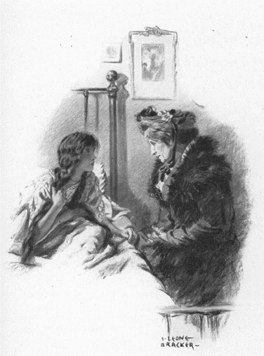
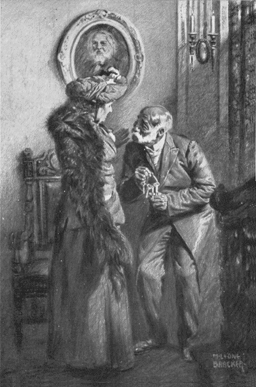
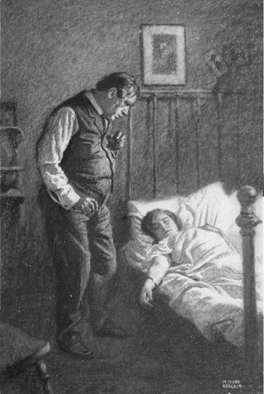
Did I mention that my copy has some wonderful illustrations that I so wish I could share with you. They are wonderful black and white prints that highlight just the right scenes. I can't find them anywhere to show you so you will just have to trust me when I say, they are the icing on the cake.
I did not read this edition, instead getting my Rinehart titles from The Collected Complete Works of Mary Roberts Rinehart:. But what was the cover designer of this hardcover edition thinking? I don't know who the person is supposed to represent as the cover bears no resemblance to any of the characters.
Rinehart mysteries are definitely period pieces. This was written in the first person, as was her The Circular Staircase. Perhaps that is her usual method of presenting the mystery. The story takes place in Pittsburgh and opens with a spring flood. Mrs. Pittman, our widowed narrator, begins taking up the carpet and moving her boarders up a flight. We are witness to such domestic activities on and off throughout.
I did mostly guess the mystery, and I didn't even care that it ceased to be a mystery. On Rinehart's GR page, she is referenced as the US Agatha Christie. Do not be misled. Her prose, characterization, and true mysteries are nowhere near as good. But fun? Every bit of it and this is a good, solid 3-stars worth of fun.
So continues my tour of Golden Age mystery writers in an attempt to see whether any of them hold a candle to Christie. To date, I've found Patricia Wentworth and Josephine Tey to be disappointments, though I will give the latter a second go. Dorothy Sayers had a very rocky first book but improved considerably in her sophomore effort, even if she was too concerned with literary showmanship to tell a tale as concisely as Christie did.
And here I am making a bit of a detour, for much of Rinehart cannot properly be called Golden Age mystery. She's too early, and Jennie Brice predates Poirot's debut by the better part of a decade.
With that in mind, Rinehart fares well. For such a slim volume, we get a surprisingly sympathetic main character and a rather unique setting in which to investigate a murder. The book rarely gets away from the business of the mystery at hand, but when it does, the extra segments work. And at the end, the whole thing makes a fair bit of sense while being sufficiently complicated so as not to insult even the modern reader.
That leaves the one piece which is most important to a good mystery tale, fairness to the reader, and it is here that the transitional state of the genre from holmes-ian adventure stories to chess matches between author and reader shows itself. I would make the case that the book is not solvable until the final 10 pages (of 190). And the revelation of information comes at an even pace. There is no moment where the detective says "a ha! all is made clear." So it is a strange (and enjoyable) amalgam of adventure and deductive mystery that does not quite belong to either period. Rinehart must have been pretty sensational then, and I will happily conclude for now that, though time would later bring us something even better in Christie, Rinehart is still quite worthy of my time.
As a rule I love MRR's books. When compared with some current writers, I find her books to be incredibly well-written, and if somewhat convoluted due to the back-and-forth of the plots, at least it keeps you on your toes!
This book was by far the easiest one to follow and ready - I think my copy had 140 and at least 10 of those pages had some delightful drawings. The main character Mrs. Pittman was well written. The plot had a nice little love story, a nice mystery that wasn't too hard to break, and some humor. If you have never read any of her books before definitely start with this one.
Great, brisk whodunnit/wasitdone/courtroom mystery made more vivid by the setting (a boarding house in Pittsburgh during flood time), the narrator (a tough landlady with a secret past), and the length (160 large print pages which fly by). I gave it 5 stars because I couldn’t put it down. The best Rinehart I’ve read so far.
Cover of this edition is wonderful; however they forgot to print the images used to illustrate certain plot points, grr.
A snappy little murder mystery (not quite as long as your average novel, I think) with a unique setting—a flooded boarding-house!—and a nicely puzzling web of clues. Not as deep in theme or character development as some of the real classics of the genre, but definitely more than mediocre in intelligence and readability.
Major characters: Bess Pitman, the landlady, our protagonist Lida Harvey, her niece Philip Ladley, her boarder; but is he a murderer? Jennie Ladley, a.k.a. Jennie Brice (stage name), an actress Ellis Howell, a newspaper reporter Mr. Holcombe, an amateur investigator Zacharia Reynolds, a boarder
Locale: Pittsburgh PA
Synopsis: The action takes place at a modest boarding house in the poor side of Pittsburgh, during the flood season. The flood has risen halfway up the first floor in Bess Pitman's boarding house, causing her to relocate her boarders - Philip Ladley and his wife Jennie (an actress with the stage name of Jennie Brice), and Zacaharia Reynolds to the second floor.
The Pitmans don't get along. Jennie has mentioned to her fellow actors that she expects him to kill her. They argue in the boarding house, and the next morning she is missing - and Philip is not too concerned, and vague as to her whereabouts. Bess Pitman immediately suspects murder has been done.
Mr. Holcombe, retired merchant with a heart for animals, is in the neighborhood feeding cats and dogs stranded by the flood. He comes in to feed the Ladley's dog, Peter; and Bess fills him in. Mr. Holcombe is an amateur investigator, and immediately brings in his newspaper reporter friend Ellis Howell.
There are clues to Jennie's whereabouts, but she cannot be located. A body washes up in the flood but cannot be identified - is it her?
Review: The landlady gets suspicious ... one of her boarder couples has a fight, the wife says he is going to kill her, and then she disappears and the husband acts nonchalant. The landlady assumes murder and sneaks into the boarder's rooms to prove it to the skeptical authorities. Could this have been the inspiration for It Had To Be Murder by Cornell Woolrich (1942) - later made into the Hitchcock movie Rear Window - in which a neighbor makes the same assumption and becomes the investigator? And both books have a dead dog and baskets on ropes as plot elements.
This is a dark little novel set in a depressing locale and time, but is a fascinating read. The characters take the flood in their stride, it happens every spring. There are none of the famous "Had I But Known" exclamations. The last page contains the shocking solution, as well as a surprising and satisfying twist to the character's relationships.
This is a short novel, but tight. There is no fluff or padding, just constant action in the style of Erle Stanley Gardner.
A short book - I read it in not much more than a couple of hours - but full of good material. The narrator is a woman from a wealthy family who was cut off by that family completely when she ran away from school to marry an Englishman named Pitman (since deceased). Shockingly, this turned out not to be a great decision, though she's mostly philosophical about the consequences - she's now middle-aged, and running a theatrical boarding-house in a dubious part of Pittsburg that floods each winter, near her childhood home. By coincidence, her niece, who has no idea of the relationship, becomes peripherally involved in the story.
Content warning, by the way: a number of people and animals drown in the annual floods. Mrs. Pitman is regretful but philosophical about this too.
Mrs. Pitman is very much the main character, even though as far as the events of the mystery plot go, she's at least as much observer as participant. She is the first to be suspicious when one of her boarders, Jennie Brice, disappears after quarreling with her husband, and she supplies important clues and observations, but the work of solving the case is done mostly by an amateur detective who happens by in a boat, from which he has been feeding animals trapped by the floodwaters. He gets interested in the case, and moves into the boarding house, the better to pursue it. He's retired, with a little money, so he can do what interests him.
Mrs. Pitman's character is well developed, with her occasional musings about the course of her life, her surreptitious encouragement of her niece and the niece's suitor, her rivalry with Molly Maguire next door, and her observations on the mystery.
The mystery takes several twists along the way, and is cleverly resolved. In other books I've read by this author (notably The Man in Lower Ten), the focus was so much not on the mystery plot that I came out of it disappointed, but this one has a better balance between "story of someone involved peripherally in a mystery" and "mystery story." It also (again, unlike The Man in Lower Ten) doesn't overplay the role of coincidence. There is some coincidence, notably the connection with Mrs. Pitman's niece, but it isn't central to the plot.
Written in 1913, the book shows us a world in which telephones are becoming common, but gas lighting is still used, and there are still a lot more horse-drawn than motorised vehicles (though we mostly see people using boats, because of the flooding). It's an atmospheric period piece with an appealing central character and a well-plotted mystery.
A very compact, quick little story. The setting is fantastic and atmospheric: in the midst of the annual flood in Pittsburgh that sweeps into people's houses, such that one needed to travel by boat from hall to hall, to the street and beyond.
The murder story was alright, with a reasonable amount of twists and turns, and an outlandish but interesting resolution. My most favorite part, though, is Mrs Pittman's story as a woman who matter-of-factly accepts that she'd made her bed and is prepared to lie in it (i.e. her family cutting all ties with her, etc), but works hard at her drudgery of a life. I enjoy the subtle humor of her thoughts, her kindness, her rivalry with the woman down the street who has salvage rights over all her furniture that are swept out by the flood... And is rewarded eventually by reconnecting with the old Butler, with her niece, and in time, Mr Holcombe.
The story takes place at a modest boarding house in the poor side of Pittsburgh, during the flood season. The flood has risen halfway up the first floor in Bess Pitman's boarding house, causing her to relocate her boarders - Philip Ladley and his wife Jennie who is an actress with the stage name of Jennie Brice, and Zacaharia Reynolds to the second floor.
The Pitmans don't get along. Jennie has mentioned to her fellow actors that she expects him to kill her. They argue in the boarding house, and the next morning she is missing - and Philip is not too concerned, and vague as to her whereabouts. Bess Pitman immediately suspects murder has been done.
Mr. Holcombe, retired merchant with a heart for animals, is in the neighborhood feeding cats and dogs stranded by the flood. He comes in to feed the Ladley's dog, Peter; and Bess fills him in. Mr. Holcombe is an amateur investigator, and immediately brings in his newspaper reporter friend Ellis Howell.
There are clues to Jennie's whereabouts, but she cannot be located. A body washes up in the flood but cannot be identified is it her?
Mary Roberts Rinehart is an author, like Josephine Tey (The Man In The Queue), whose crime mysteries seem timeless and are still being published today. Another of Rineharts's famous titles is The Circular Staircase. Since many were written over 80 years ago, you can find several on free Ebook websites. I have a vintage paperback of hers called The Man In Lower Ten that I have been meaning to read ~ bought half for the mystery that takes place on a train, and half for the great Dell cover. The Case Of Jennie Brice takes place in a flooded house, a setting unusual enough to catch my eye.
The narrator calls herself Mrs. Pitman, not her real name of course, but it will do. One of the prestigious Pitman family of Pittsburgh who fell out of favour with her relatives and now runs a boarding house on the wrong side of town. Being so close to the Allegheny River, they have to put up with winter flooding every few years and have a system to move everything to upper levels of the house while the water floods in through the open doors. It can get as high as halfway up the first floor, and so, small boats come and go as people are ferried around. When the water recedes, everything gets dried out and the paper hangers come in. Of her few boarders, Mr. Ladley and his wife Jennie Brice cause the most problems with their fighting and late rent payments. They had just moved to the second floor when Jennie disappears. Mrs. Pitman immediately thinks murder, and begins turning each clue of her investigation into proof of Mr. Ladley's guilt. Boats are sent out to discover a drowned body - headless and handless! Could if be her? Or, is Jennie still alive? Rinehart also mixes in a long lost niece of Mrs. Pitman who befriends her, unaware she is family. Another boarder is Mr. Howell, who fancies himself a detective and helps with the case, while casting an eye at the niece ~ adding the romance portion of the story. The strange clues involve a missing onyx clock, a floating fur coat, bloody towels, theatrical stunts and mistaken identities - among a few other deaths.
This was written in 1913, and takes place at that time. One of the many reprints, I read a Dell edition from 1960, and I guess being one hundred years old, it has earned 'classic' status. Not completely a winner, it lacked momentum 2/3 of the way through as she reiterated the clues as they sometimes do in serials, to catch lazy readers up to speed. However, it was diverting and had a solution twisted enough to not see coming.
Mary Roberts Rinehart is a fascinating writer. This story was originally published in 1913. The version I read was re-edited by her in 1948, as was the other story I finished a week ago.
This story is set in Allegheny, Pa., which I think may now be a part of Pittsburgh. The narrator is a struggling widow who is alienated from her wealthy family because of her marital choice. Now she runs a boarding house to pay the bills on the house she is renting. Apparenly living with Spring floods is a yearly experience for her and requires moving the boarders to a higher floor and attempting to protect carpets and other possessions. It seems that her entire neighborhoos lives with the same situation and they all commute by boat during the few days that the river is up.
Very early, she begins to suspect that one of her tenants has killed his wife and the story proceeds from there. Rinehart has a very witty, but poignant style. The story (barely novel length) is filed with interesting characters and heart-grabbing experiences. There seem to be a number of plot flaws and the logic employed by some of the prinicipal characters doesn't jump off the page at you. But I had no trouble overlooking those things because of the attractive narration.
I particularly enjoyed reading a story about average people living a life style that included no automobiles and a living space consisting of a single room in a house shared by 3 or 4 other people who are all unrelated. They probably wouldn't have understood cries of "pain" at the gas pump who spend $300 a month on cell phones, blackberries, and bluetooths, $120 on celebrity endorsed sneakers, $50 per month on mp3 downloads, $50 a meal to eat out three times a week, and $150 a month on "entertainment." (movies, beer joints, cable, internet access, or direct t.v.).
I read this in elementary school (or maybe junior high) when I went through a Rinehart-phase. Most of the plot details escape me now, but the intriguing setting has always stuck with me. It takes place during a flood, and the characters have to move their possessions to the upper floor and commute by row boat!
Something has happened, something dreadful. But what? Yet, in the face of that creeping chilling dread, this book has a warm hearty carry-on feel. The world is drowning, but let's roll up the rugs, feed the dogs, catch a murderer, and help along young love. It really is a charming mystery, even rereading it is fun.
Nice cozy mystery with a good dose of humor. The plot was a bit thin, but I'm definitely looking forward to reading more of Mary Roberts Rinehart's mysteries.
(Oh, and the name in the title is Jennie Brice, not Jenny....)
Another great old-fashioned mystery by Rinehart, completed with that small town setting, unhappy young wife, suspicious husband, overly friendly visitor, and who could by-pass the single, mature, 'I need a mystery' in my latter years protagonist...
Good story, not particularly devious or twisting, but an enjoyable read. Certainly outstanding in its time and much credit should be given to the author who was also wife and mother in a time where that was rare.
I love Rinehart's mysteries because they give a realistic look at life in America in the early 1900's. This one was published in 1913 and is one of my favorites.
Although a young woman herself, Rinehart wrote about older woman and her heroines are tough and spirited. An early feminist, she knew that her world favored males and that woman survived by being strong and determined.
The narrator Mrs Pitman is the daughter of a wealthy Pittsburg family, but was banished because she insisted on marrying a man her parents disapproved of. Her marriage was troubled and her husband far from the knight in shining armor she'd hoped for. Still, she's honest enough to recognize that her struggles have given her a wider experience of life and of people than she would have known as the sheltered wife of a prosperous man.
Now widowed, she's returned to her hometown, rented a house, and makes a living taking in boarders. Boarding houses were common until after WWII and they provided one of the few ways for a respectable woman to earn a living. Her rent is cheap because the house is next to the river and floods are a regular occurrence.
Today, riverfront property is pricey and lined with expensive homes or trendy cafes, shops, and condos. Dams and the man-made lakes they created have eliminated floods, but that wasn't true always true.
Knowing that a flood is coming, Mrs Pitman takes up carpets on the lower floor, moves her tenents and furniture to higher floors, and sets up a make-shift kitchen in the attic to prepare meals. A small rowboat tied to the lower staircase will provide transportation while they're cut off by the rising water.
Among her tenants is a married couple. Jennie Brice is an attractive young actress who works at a local theater. Philip Lading is an unemployed actor, but his wife pays the bills while he drinks and writes a play.
Mrs Pitman overhears frequent, bitter arguments and isn't surprised when Lading tells her that his wife has left him. But why did she leave in the middle of the flood? And why is there a large splotch of blood on the floor of their room? Jennie's friends are convinced that Lading killed his wife and so is Mrs Pitman.
Jennie Brice's mysterious disappearance brings three new people into Mrs Pitman's life. One is an eccentric retired gentleman who fills his time rescuing abandoned pets. He also fancies himself as an amateur detective. When he learns about Jennie Brice's disappearance, he insists on renting a vacant room from Mrs Pitman so he can keep an eye on Lading.
Mr Howell is a young newspaper reporter. He visited the Ladings the night Jennie left, but now he denies it. Then he disappears himself. This brings a beautiful girl who has a particular interest in Mr Howell. Lida Harvey is the unhappy daughter of an ambitious, controlling mother. She's in love with Howell, but knows her mother will never consent to her marrying a man without money.
Mrs Pitman likes young Howell, although she suspects he knows more about the disappearance of Jennie Brice than he's telling. She's a kind-hearted woman and (in spite of everything) still believes in love. She wants to see the young couple happy, but her concern for Lida Harvey has a deeper source than Lida suspects.
It's a story with human interest and humor. Mrs Pitman is a likable woman and a shrewd one, too. It's a fascinating look at American life in the early 1900's.
This is my first Mary Roberts Rinehart book and I have to say, it was pretty good. The Case of Jennie Brice was published in 1913 and had a very interesting setup.
So it's Pittsburg and there's an annual flood that happens. Mrs. Pitman is an elderly boarding house owner who after the flood, discovers that one of her tenants, Jeannie Brice, a well-known actress, has disappeared and that her husband doesn't seem to care too much about her whereabouts, claiming that she will turn up soon.
Not taking this lightly, Mrs. Pitman decides to do some amateur sleuthing on her own. In the process she discovers a blood-stained rope and towel, a broken knife, her onyx clock is missing, and eventually, a body turns up, only without a head. Is it Jeannie Brice?
This was such a fast-paced and interesting murder mystery in which you might suspect who did it, but you're not quite sure as to how they did it, which is actually pretty interesting.
It's kind of sad how Mary Roberts Rinehart is neglected today because in her day she was the reigning queen of murder mystery thrillers, the American Agatha Christie. She is famous for several things which I feel are so interesting, they need to be mentioned.
First, Mary Roberts Rinehart incorporated the whole "if I had but known" troupe into her writings, meaning she did a classic foreshadowing in her writing. I know that some people find this annoying, but I actually found it to be a real page-turning technique in reading the story. It was fun.
Second, Rinehart is also famous for the whole, "The butler did it!" scenario that has come to be a kind of joke in murder mysteries, but Rinehart was the first to do it.
Lastly, Rinehart was one of the three inspirations for the creation of Batman in creating his famous superhero. Rinehart wrote a book called The Bat, which was also a famous play back in the day, well, much of it, including the bat shadow signal, all came from Rinehart's creation. So I found that to be really fascinating.
So why isn't she more well known? After all, she wrote over 60 mystery thrillers... I think the two reasons that are most clear to me are that she didn't really create a sleuth who was ongoing. Her novels are more stand-alone creations, and she hasn't really been adapted to the big or small screen in over fifty years! I think it's time for a Rinehart revival.
But back to The Case of Jennie Brice... It was a swift read and had such an interesting premise to it. I've never heard about the flooding of Pittsburgh back in the early twentieth century, which added to the atmosphere of the mystery. Rinehart even added some romance and dashes of humor throughout that made the story more interesting to read. I felt like Mrs. Pitman was like Miss Marple, only Christie wouldn't create such a character till a whole decade later.
I'll definitely be reading more of Rinehart, having also picked up Miss Pinkerton, The Circular Staircase (which is her most famously known book), and The After House. Very excited to have discovered this new author that I had never picked up before. Love her style, characters, and plot so far. Looking forward to seeing what else she's got up her sleeve. My rating - 4/5
The Case of Jennie Brice was written by Mary Roberts Rinehart set in 1904 in Allegheny, Pennsylvania, which has been a part of the city of Pittsburgh since 1907. This was fun, that's all that matters. We have Jennie Brice obviously and her husband Mr. Ladley. They live at Mrs. Pitman's boarding house in Pittsburgh. Mrs. Pitman is the one telling us the story. She was born in Pittsburgh, to an old Pittsburgh family and grew up in the best part of town. I've been in Pittsburgh often, I can't picture the best part of town. But when Mrs. Pitman is still a girl in school she ran away and married Mr. Pitman and her family hasn't spoken to her since then. Now after twenty years her husband is dead and she has come back to Pittsburgh where she runs a boarding house, not in the best part of town this time. She tells us the house is always orderly and clean, even though the neighborhood had a bad name. And so she has the Ladley's for boarders. And the Ladley's argue, often and loudly. Ladley was writing a play, Jennie was an actress. And now there is a flood. From what I can tell there seems to be a flood every spring. I am going to have to start paying attention to see if Pittsburgh floods every year, I never noticed it before, but I'm closer to Philadelphia than Pittsburgh.
So Mrs. Pitman and the other boarders move their belongings, what can be moved anyway, to the second floor and watch the water rise. Then Jennie Brice disappears. Her husband says she is on a vacation, but there is a bloody towel in their room, and one of her slippers is floating around the house, and there is blood on the rope of the boat, yes, they need to use a boat to get to the part of Pittsburgh that isn't underwater. The blood wasn't there when Mrs. Pitman tied it up, now after Mr. Ladley took his wife to the other water free side, there is blood, why? There is also a broken knife floating around. If I had to put up with a flood and things floating through the house every year I'd move. So there is blood on the rope, a broken knife, a bloody towel, Mrs. Ladley disappearing. He killed her of course. But wait, she's not dead. A young man walked with her to the train station that wet morning and watched her leave on the train. The people she stayed with come forward to say she stayed with them, so where is she? And now a headless body just showed up. The poor husband is doomed, even if his wife is still alive. I read this in a few hour, you should do the same.
Mary Roberts Rinehart was called the American Agatha Christie, and for a time, was actually more famous than Christie.
Jennie Brice is a border at the home of the widowed Mrs. Pitman, whose boarding house in Allegheny City (now northern Pittsburgh), is in a flood plain. Every year the Ohio River floods the bottom floor of Mrs. Pitman's home. It is during one of these floods, in 1907, that Jennie Brice mysteriously disappears. Her husband doesn't seem very distraught that his wife is nowhere to be found. Mrs. Pitman immediately believes he's killed her. With the help of one of her boarders, she unravels the tangled plot and brings the killer to justice.
A good, old-fashioned mystery, with great plot twists and sub-plots tied to the main mystery. I wasn't sure if Mr. Ladley was the real killer or not, whatwith the other characters acting suspiciously. Rinehart kept me guessing right up until the final, suspenseful reveal. She is similar in style to Christie, her books being more cerebral. There is suspense, but not a sense of danger that Mrs. Pitman or another character may be the next victim. It's more of a-will-the-real-killer-be-identified-and-brought-to-justice? kind of suspense. It was a fun read, and a refreshing change of pace from today's grittier thrillers. Recommended for those who enjoy classic mysteries, or mysteries with a bit more substance than your average cozy, but still without violence and language.
In the first sentence, Mrs. Pitman mentions a dog dying in the flood. Had me worried all through the book that the killer hurt him, but it was clarified in the end that the dog's death was recent, and not related to the murder, and I wanted to save the next animal-sensitive reader any anxiety regarding Peter (he lives a happy doggie life with Mrs. Pitman). Hopefully that's not too much of a spoiler.
The cover alone caught my eye. The fact the Mary Roberts Rinehart was the author just added to my curiosity. I wasn't disappointed!
Elizabeth Pittman owns a boarding house. She has one regular tenant, Mr. Reynolds, and she rents out to the visiting actors that come to town to perform in the theatre. At this time she is renting to a Mr. and Mrs. Ladley. Mrs. goes by the stage name Jennie Brice. Mr. is an on-and-off actor who is currently writing a play with the idea he will star in it. The are not the perfect couple as shown by the frequent quarrels that is heard from their rooms.
The part of the town this takes place in floods yearly. This means keeping a skiff tied near, or even in the house, for getting to other parts of the town. It is flood time when this tale takes place. Mrs. Pittman is the narrator.
The discovery of the rope that held the skiff tied to the stair rail had been cut and was smeared with blood: Mr. Ladley's late night excursion out to find a pharmacy to get medicine for his wife and then the wife missing the next morning, caused Mrs. Pittman to think murder.
When she met an odd man named Mr. Holcomb and a newpaper reporter named Howell, their points of view further added to the idea that Jennie Brice had been murdered. The problem was there was no body! Mr. Ladley said she'd gone away for a few days but didn't know where. Circumstantial evidence seems to prove it, according to Mr. Holcomb. Mr. Howell disagrees due to there being no body.
When the headless body of a woman washes up from the river, the three characters begin investigating in ernest. Did Mr. Ladley kill his wife? Is the body really Jennie Brice's? If it isn't hers then who is it and where is Jennie Brice.
I listened to the audio recording of the book by LibriVox. It is not listed on Goodreads. I really liked this book. Fascinating to follow the plot through the point of view of the boardinghouse owner. Besides having to deal with lodgers and people going back and forth from her house taking her for granted, she has to deal with all of it in flood conditions.
Aside from the story, It was interesting to learn of the floods in Pittsburgh/Allegheny. It sent me on a bit of research because my grandfather was born in Pittsburgh. It was also quite interesting to realise that there was a flood district. How curious that people regularly had to take measures to let the flood through every year. Meaning that they rearranged their lives, Travelled about in boats to their destinations as if it were common, and then had all the clearing, cleaning and even wall papering to do when the flood went down. Who actually built the houses where 3 major rivers regularly flooded together?!
One of the best mysteries I have read, and so surprising that it was written over a hundred years ago. It was difficult to put myself in that era in a situation totally unfamiliar to me, but the author painted such a vivid picture that I was easily able to see how things fit together. Character development was also outstanding. What surprised me was the shrewd thinking of so many of them.
There are stories within the story that keep things very interesting. Love and romance. Marital squabbles. Difficulties of dealing with mother nature. All combine to make this a story that it was difficult to set aside. The plot kept me guessing about the conclusion, but the story was expertly brought to a surprising and satisfying end. Kudos to Miss Rinehart!