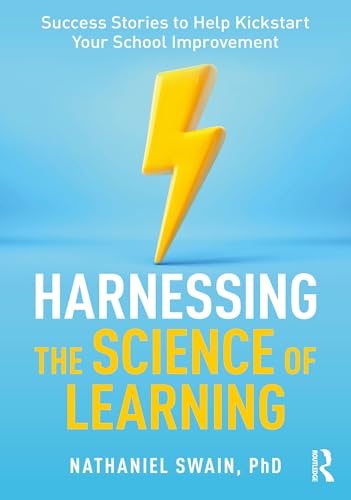
Drawing together the worlds of classroom practice, school leadership and scientific research, this is an essential how-to guide for initiating and maintaining a school improvement journey based on the science of learning.
What we now know about learning and teaching is vast; yet often, wading through the thousands of articles and books on this subject can leave even the most seasoned educator overwhelmed. This guide instead offers a distillation of key understandings—for teaching, literacy, mathematics, curriculum and implementation—to launch your school improvement work.
Harnessing the Science of Learning also features contributions from thought leaders across the fields of learning sciences and educational Pamela Snow, Tanya Serry, Zach Groshell, Reid Smith, Toni Hatten-Roberts, Simon Breakspear, Katie Roberts-Hull, David Morkunas, Steven Capp, Shane Pearson and Eamon Charles.
This book illustrates practical ways to harness this knowledge, using a series of exemplary school case studies. These insightful narratives of transformation are interwoven with summaries of powerful teaching practices, forming a roadmap to drive improvement.
In this volume, you will learn how even discrete changes in a school can have marked impacts. It is suitable for those already versed in such principles, as well as anyone curious to plunge into what the science of learning has to offer.
Every teacher in 2026 should critically read this book, especially considering how influential it has been recently during curriculum reforms in NZ.
Some good stuff conflated with some bad stuff. The bad stuff is a lot of self congratulating and mistaking correlation for causation. I'm still not convinced that it's the right programs, rather than the right people, that make the biggest impact on life long learning.
Proponents of The Science of Learning risk selling this approach as "the" way rather than "a" way, while remaining oblivious to their ideological blindspot: people are complex, development is unique, and learning is social. There are no silver bullets.
Very important for teachers and school leadership to read. Looks at key areas where schools can improve, explaining approaches that work and are backed by cognitive science research.
Fantastic explanation of essential concepts about teaching and learning with immediate real-world applications. If every school focused their professional development on the science of learning, student outcomes would soar, and this book is the ideal succinct and up-to-date guide for the work.
I am not really in the target audience for this -- it is really targeted at primary school principals or perhaps a senior teacher at a primary school who wants to push for whole-school change, a process that is going to take several years, but know basically nothing about the science of learning. But my moderate rating isn't because of that -- I often read books that I'm not the target audience for and can see how the target audience might really enjoy them.
This was more of a book for people who know absolutely nothing about the emerging science of learning. I think it is best viewed almost as a Cliff's Note to whet your appetite which then provides multiple "What's Next?" books for fuller treatments.
But almost every chapter left me with that somewhat unsatisfying feeling you often get at a degustation where each course doesn't feel quite enough but you reach the end up and go, yup, guess I ate a meal/read a book, after all. To some extent this is perhaps unavoidable given the aim: giving a broad sweep of everything from cognitive load theory to the science of mathematics all buttressed by dozens of case of studies from schools primarily (exclusively?) in Victoria who have undergone similar transformations.
Really appreciated the chapter on "four teaching misconceptions resolved by science".
I've been studying classical education & believe it fits the science explained in this book perfectly. A foundation of knowledge must first be laid (grammar stage), given through explicit instruction by an expert (mentor/teacher), before a student can move to inquiry/exploration (logic stage - rhetoric stage).
Finally finished this great guide to research informed school practice. Ultimately, the axiom that learning is a function of instruction is proven time and again by embracing practices that work for all students and that consider the fact that much of school learning is not the type we are biologically wired to do.
I adored this book, answered so many of my questions I’ve had since dabbling in the Science of Learning. I listened to the audio book and have since bought the book and re- read it. I’m a better teacher after reading! Highly recommend!
Great resource! This book provided a great summary of the research surrounding the science of learning and gave examples of schools that are implementing practices.
A tightly edited book that provides both an exploration of knowledge-rich curriculum concepts and ways to apply them within schools and proof of concept applications within real schools.