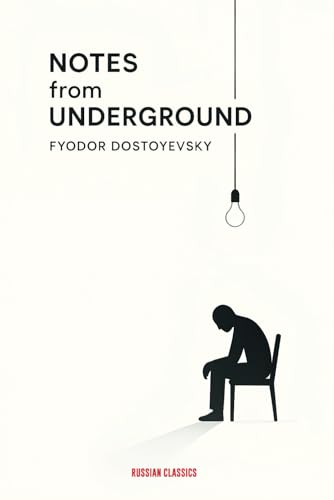
In "Notes from Underground" by Fyodor Dostoyevsky, we are not talking about revolutionary personalities, a secret struggle for some ideas Fyodor Dostoyevsky tells the story of a man who is "too conscious." The man, whose name we never learn is so aware of his own thoughts and feelings as to cause him to be indecisive and overly self-critical. Add in his belief that societal expectations are shaping his actions. Notes From Underground is one of Fyodor Dostoyevsky's most well renowned novels. It is thought to be one of the first existentialist Russian works. The novella is the disorganized memoir of an unknown narrator, who is referred to by critics as the Underground Man. His narration is disjointed and unreliable, and is colored by a general sense of disdain. The reoccurring themes in Dostoyevsky's Notes From Underground, such as hopelessness, self-consciousness, and his grotesque Gogol-esque style of prose, proved to hold much literary influence on 20th century Russian writers, exemplified in novels such as We, Envy, and Master and Margarita. Illustrated by D. Fisher.
Took a long time to wade through the first half, my eyes often losing focus before turning the page, shaking myself awake to give the section one more try. Here's a question featured in my lesson plan for Tuesday: Can we assume that we all want to feel good about ourselves and not bad about ourselves? Underground, that assumption is firmly disproven, like that worst part of myself crawled out and tried living independently. Without much success, to be fair. From section V: "For the direct, lawful, immediate fruit of consciousness is inertia [...] ingenuous people and active figures are all active simply because they are dull and narrow minded. How to explain it? Here's how: as a consequence of their narrow-mindedness, they take the most immediate and secondary causes for the primary ones, and thus become convinced more quickly and easily than others that they have found an indisputable basis for their doings [...] Oh, gentlemen, perhaps I really regard myself as an intelligent man only because throughout my entire life I've never been able to start or finish anything." Mm! Awful.
Siempre le diré que si a un depressed dostoyevski… En realidad es fuerte cómo un señor en Rusia hace 150 años se ponía a divagar, lo escribía y a día de hoy me encuentro identificada con su rayada, el problema de la gente hiperconsciente de sí misma, supongo que hemos existido siempre. La segunda parte well, que decir, he’s just a man.
"Para nós é pesado, até, ser gente, gente com corpo e sangue autênticos, próprios; temos vergonha disso, consideramos tal fato um opróbrio e procuramos ser uns homens gerais que nunca existiram. Somos natimortos, já que não nascemos de pais vivos, e isto nos agrada cada vez mais. Em breve, inventaremos algum modo de nascer de uma ideia."
El precio de ser demasiado consciente es la imposibilidad de el auto engaño, ergo de todas sus ventajas. El hombre del subsuelo ha pretendido responder a las preguntas más duras con la honestidad más dolorosa.
Be not fooled by all the blind praises towards this book; it is in actuality, barely understandable to a complete newbie in russian-anything. An individual coming into this story expecting a digestible story laced with the same emotional weight as White Night or A Gentle Creature will find that this is not simply a story with a plot and narrative, which unfortunately makes it a dull read when regarding it in that manner. However, if you power through the dense text, a painful habit in which many classic readers are well acquainted, you enter what seems to be a political or ideological discourse, and an introduction to an incredible period in the 1860s of Russia, where the culture was awash with rationalism and toxic intellectualism. And when observing at it from a perspective of curiosity, Notes from the Underground makes a fascinating piece of work highlighting a unique time in the history of Russia, and this book, an effort against its bleakness.
What makes this book interesting is not solely the content of its narrative. When I first began reading it, I immediately noticed that it must be geared towards those who already had context of something. But regardless, I finished it out of sheer stubbornness and learnt exactly a Singular thing, which I would later see again among the pages of A Discourse of Inequality by Jean Jacques Rousseau. And so I pondered about this book for a few months, waiting for the fateful day where I could meet a "real Russian person" to discuss this book (which I felt would soon happen), rather than to start my own research journey right away. My wish was granted, as it always is, and I met my Russian briefly, in the strangest of ways as I was travelling to ChongQing, China. Sitting in a rather luxurious Guang Dong restaurant, a lazy suzan in front of us, he gave me an a brief overview of that time time period which I dub as "some sort of toxic intellectualism". Just as the book alluded to, the general ideology was that of Nihilism, but also the belief that emotionality and optimism to be primitive and beneath intelligence, science and rationality. A quick google search reveals that Notes from the underground is a discourse which challenges the ideology of "rational Egoism" which plagued Russia sometime around the 1860s partly due to the rising influence of Western European philosophy.
While I wouldn't say I learned enough to enjoy this book, it definitely introduced me to a culture and a branch of philosophy that I am eager to explore more.
this read like a teenage girls diary at times, and while that was entertaining, not enough sustenance for me to actually enjoy the book. i still adore pevear and volokhonskys translations and dostoyevskys writing, this one just wasn’t for me.