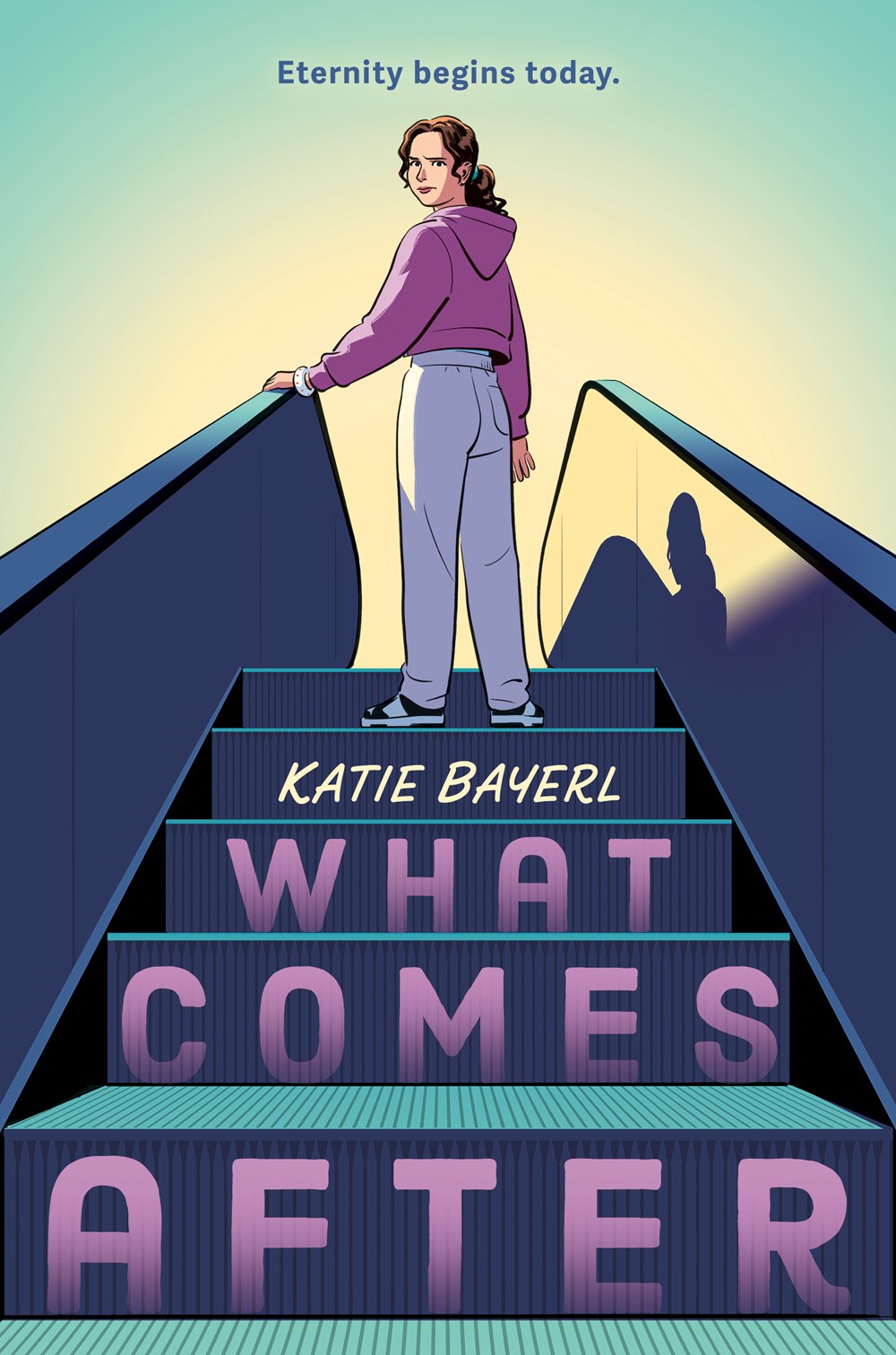
In this darkly comical, heartfelt novel, a cynical sixteen-year-old girl has only ninety days to remember how she died and finally make peace with her mother to escape spending eternity adrift in a vast nothingness. For fans of Adam Silvera and The Good Place.
No one could be more disappointed about Mari’s sudden death than Mari, herself. And if she ever thought about the afterlife, she certainly didn’t think it would be a suburban enclave called Paradise Gate or that the biggest problem to plague her in life would follow her into the great beyond: her recently deceased mother, Faye. But that is exactly who greets her when Mari opens her eyes in the In Between—where the newly dead with no religious affiliation come to work out the unfinished business of their lives so they can ascend to whatever’s next.
Mari realizes quickly Faye is her unfinished business and in order to ascend and join her loving grandparents, she’ll have to make peace with and forgive her dysfunctional mother for being no mother at all But there’s too much to forgive: never holding down a steady job, never having a stable home, Mari having to constantly change schools and in the end, Faye choosing her criminal boyfriend over Mari.
It's a lot to sort through, but Mari tries to keep her eye on the ball—attending classes at the Center like Youga and sending grief scarves sailing in Expressive Arts to move her vibe tracker from an angry unsettled red to an ascend-worthy green—all the while trying to remember how she died and deal with Faye, who, of course, is in danger of being kicked out of Paradise Gate altogether. But then Mari discovers in addition to mother drama, there’s even friend drama and boy drama to be found in the afterlife and none are good for her vibes. Even worse is the suspicion that Paradise Gate isn’t at all what it purports to be...and revolution may be afoot.
When Katie Bayerl isn't penning stories, she can be found dancing, writing about social causes, or herding a trio of (mostly well-behaved) cats. Katie holds an MFA from Vermont College of Fine Arts and is on the creative writing faculty at Grub Street. Katie lives in Boston, Massachusetts.
I received a free copy of, What Comes After, by Katie Bayerl, from the publisher and Netgalley in exchange for an honest review. Mari is 16 and she is dead, she never thought much of dying or the afterlife, before she died. Mari and her mother did not have the best relationship at all. I could not get into this book at all.
I’ve binge watched The Good Place several times, so when you tell me there is a book that has the same vibes, I’ll be reading it.
It did have similarities with TGP, but I think the book lost the plot a little along the way. We get this entire (after)world build up, but not a whole lot happened in it. This was very much a character driven book, which isn’t bad, but a little more plot would have been nice.
All the people there have some sort of device that tracks the good things they do, how they’re feeling, if they cuss, … It’s stated that it’s very important and that you’re being watched and monitored all the time. But tell me why the main character could get away with constantly being in the red with minor consequences? Why make it so known that this system is in place when you barely use it?
I found it hard to connect with any of the characters, even the main character, so I don’t have a lot to say about them other than meh?
I enjoyed my time reading it and it did remind me of one of my favourite shows, but it could have been executed better.
I think afterlife fiction only works for me if we're playing in a familiar sphere. If we're conquering philosophical problems that exist withing consistent and recognizable afterlife frameworks. This book didn't feel all that compelling because the afterlife it presents is so utterly unfamiliar. It is new. It's an invention. It's, well, a strawman to argue against. This afterlife is corrupt because the author invented it to be that way, and so there are stakes in the plot... but not stakes I was all that invested in. It felt like creating a problem just to solve it rather than tackling any of the big questions of life or death.
But not everybody wants to tackle those questions too closely. I get that. So you know what? This book might work a lot more for other readers than it did for me. Who might those readers be? Well, I'll dig into that in my full review, which goes live at Gateway Reviews on May 2, 2025. Swing by and check it out when it goes up!
Note: I was provided with an ARC by the publisher through Netgalley in exchange for an honest review. All opinions here are my own.
Thank you Net Galley and Penguin Group for this ARC What Comes Next by Katie Bayerl. Story starts with Mari who finds herself dead and in an afterlife simulator. The other definitely watched The Good Place and took a lot out of there. Basically the dead people have to earn points to get to eternal bliss….Mari and her mother Faye are both there navigating their strained relationship. There is skepticism regarding the point system and the accessions. This book for me dragged on far to king and was a tough finish. Just seemed like a Temu version of The Good Place.
Interesting concept: not everyone who dies makes it to the afterlife without baggage and for those with unfinished business (or need better karma points), there's Paradise Gate, where you have to take classes and meditate and take a test after 90days to try to ascend to the real afterlife. Paying rent twhen you're dead is such a funny struggle. But then the story gets all rage against the corporation and honestly, there's just so much suicide or mention of it. This also is the group that is considered agnostic or non-religious, etc. So then having their own pocket of limbo is...I don't know. But there's also quickly cults and influencers and reporters. lol. A lot going on.
Mari is dead. She wakes up at Paradise Gate—an afterlife with points to earn, classes to get to, and statuses to maintain before you can ascend—where she meets her mother who’s died just a few months ago. Although it presents an intriguing premise, I must admit I had a hard time following the overall plot of the story. Everything you learn from The Good Place, you’ll find it here, so I wasn’t so sure of the novelty of this book. Still, it’s a heartfelt book that deals with the complexities of morality, being your own person, earning a place in “heaven”, and mother-daughter relationships.
Thank you to Netgalley and Penguin Group for the ARC! :>
I received an ARC from the publisher in exchange for an honest review
What Comes After by Katie Bayerl is a first person-POV YA speculative exploring the afterlife in a similar vein to The Good Place. Mari has died and finds herself in the afterlife for the non-religious along with her recently deceased mother. She has to take lessons to become a better person if she’s to save her soul from joining the void, but that’s easier said than done, especially when she has to live with her mother all over again.
The second I saw that this was compared to The Good Place, I immediately picked up a copy. I think whether or not the comparison fits is really going to depend on what about The Good Place kept you watching. What Comes After has a much more serious tone compared to The Good Place’s drama-comedy genre and the focus isn’t on philosophy or the major themes of humans making each other better through love and care. Where it is similar to The Good Place is the alternative version of an afterlife, the different sections of the afterlife, the classrooms, and the complex parent-child relationships.
The complex parent-child relationships mostly come through in Mari’s relationship with her mother, Faye. I think it’s really hard not to sympathize with Mari or feel that she is in the right for being upset with her mother for not giving her a stable home life even if Faye did have some other stuff going on that does help explain it. Children deserve to have a home where they can grow into people who believe anything is possible whereas Mari’s ultimate dream was becoming a normal adult who’s biggest worry is paying the bills. Eventually they might have a healthier relationship, but it will take time.
Much like The Good Place, there is a romance arc between Mari and another teen named Jethro. It’s much more of a subplot compared to the romance arc between Eleanor and Chidi, which over time became more of a major focus in Eleanor and Chidi’s character arcs and the broader story. I was fine with this because while I love a strong romance arc, the other themes going on were taking a lot of space and needed that room to breathe.
I would recommend this to readers of novels exploring the afterlife and fans of The Good Place who loved the complex parent-child relationship between Eleanor and her mother and Tahani and her parents
I thought it was an interesting concept but would have loved to see who the new leaders are we spend so much time on ( for lack of a better word ) defeating the current powers and no time on the new one.
I also thought the ending was almost a little too easily won and think there is definitely an untapped storyline involving taco ( I already forgot his name.. ) His story was so much more interesting than his actual character and I would have loved it if he had his own point of view to go along with Mari"s, his character was really played off as a cliche but I feel with what we learn towards the end it isn't so much so.I would have loved to see his relationship with his uncle and hear more about his life and how he became a "secret agent" of sorts and also the dog! 🐶
Again with untapped storylines Larissa was also cut short with her dad and his story! I mean come on!!! would have also loved her post my of view and if she knew of taco actually being taco....
Not to say I want a sequel although I wouldn't mind if we got a novela of sorts to clear up Larissa and Taco's point of views
overall like I said a good concepts and had so much potential but really fell flat in the end.
( I SO WANT LARISSA AND TACO'S POVS IN THIS BOOK AND MAYBE FOR IT TO BE LONGER AND TO CONTINUE THE LORE OF LARISSA AND TACO BECAUSE WE GET LITTLE SNIPPETS AND THAT IS IT AND ITS NOT LIKE THOSE SNIPPETS ARE SMALL THEY ARE PRETTY MONUMENTAL TO THEIR CHARACTER!)
I digress definitely recommend
This entire review has been hidden because of spoilers.
Mari is dead. This is not a spoiler; this YA novel takes place in Paradise Gate, where thedead atheists linger until they have completed their unfinished business in order to become whole enough to ascend to a higher place. For sixteen-year-old Mari, this business is about her mother, Faye. Yet Paradise Gate is a bit nefarious and Mari becomes unwittingly involved in an underground organization that opposes the Powers That Be.
This wonderful novel is a send-up of the wellness industry. Everyone wears a vibe tracker that constantly tells what state a person is in. There's "youga," affirmations, cultivating joy, karmic colonics. The place is populated by self-anointed virgins, prophets, deadbeats, and those simply trying to ascend to the next level. Mari is an extremely likable character who is torn between doing what she has to in order to move on and wanting to call out the ridiculousness of it all.
I won't give the ending away, but I will say it's incredibly satisfying. Super fun book!
When thinking about life after death, most consider heaven, hell, or purgatory. For Mari, it's purgatory, but she lands in an unlikely place that resembles a competitive reality show. This is definitely not "The Lovely Bones." Bayerl gives voice to Mari, a sassy, cynical, almost-17-year-old now living in a state of confusion alongside her also-dead mother. They, along with other non-believers, have arrived in Last Chance Purgatory—a place where things can be made right. Or can they? She's in Paradise Gate, where her tasks seem closer to mundane dullness than anything else. And then there's Jethro—attractive, boyfriend-worthy, and a total bad boy. What's a girl to do? This rollicking romp will answer readers' need for lightness during times of grief and confusion. Intended for the YA audience, anyone looking for a laugh will love "What Comes After."
Recommended for book clubs, YA audiences, and all who enjoy a good read.
Full disclosure: I received this ARC from NetGalley and Penguin in exchange for an unbiased review. Thank you for this opportunity.
I enjoyed this book. It took me a little bit to get into the story, but I found myself very engaged in the second half. I liked the way the internal arcs developed, especially Mari’s growth. I really felt for her and her mom’s relationship. I liked what happened in the end and the way all the character’s stories wrapped up.
Pub Date: April 29th, 2025
Thank you to NetGalley and Penguin Young Readers Group for a copy of this eARC.
I received a copy of this book from NetGalley in exchange for an honest review.
Look, this is more a 2.5 than a solid 3. Also in full transparency I listened to the publisher audiobook while following along with the ARC, and there were quite a few stylistic edits between the ARC and publishing. All of which I agreed with, so good job.
Mari is a teen who does and gets thrust into an afterlife that is based on getting points so you can ascend to the real afterlife? The world (or afterlife) building tried to be interesting and I'll give the author credit for coming up with a very creative setting. But a book needs more than a setting, and the characters were... okay. The plot was at times disjointed and chaotic. And I was glad to be finished with this book when I did. I found Mari's mother, Faye, completely insufferable which I think is the point but it would have been nice to see her and Mari have a more realistic healing moment together.
4 stars for creativity, 3 stars for writing style, and 1 star for the holistic work. 2.5 overall.
What a wonderful premise for a book. Landing in the afterlife and having to earn one's way to ever after. Ideas on how to move on, what to hold onto, what to let go of. Things aren't all as they seem though and it's tougher to reach ever after than it should be.
The concept for this book was pretty interesting and as a fan of The Good Place as well as general paranormal/afterlife focused stories, I was so up for this story. There's some really compelling parts like the memory technology and the critique of lifestyle influencers and the commodification of spiritualism, but the characters are really weak, there's an uninspired romance, and a weak ending. I just feel like the potential of the premise was not fulfilled, and it also got pretty confusing at times. Mari's character arc didn't feel believable and the conclusion of her relationship with her mother was too "sunshine and rainbows" to me. It made them equals in a way they never were as parent and child.
What Comes After is about Mari arriving to an alternate limbo and trying to ascend to something better. It was a little slow, but for good reason. I really liked the idea of people getting a second chance at finding their eternal happiness and what happens when there is a prescribed way to attain it. The characters were believable. I also liked how Mari had Faye there with her to work out her issues.
I rated this book 3.5 stars and rounded up to 4.
Thank you to NetGalley and the publisher for an advanced copy in exchange for an honest review.
I got the arc for this but unfortunately it’s suuuuuuper boring? The concept of the afterlife in this is that all religious people get to go to their respective religious places but the people who aren’t religious are stuck in a limbo area that 3 random souls developed into a “Good Place” like area where they gain points to rank up to get to a better afterlife.
It’s boring. 😑 And I don’t like that it shifts to “before” sections but the one we already got was even MORE boring than the After. No thank you. 🙂↔️
I didn’t enjoy this book at all. Mari character is hard to get behind, and more importantly the afterlife portrayed in this book reflects the real world too much for it to truly be engaging. Yes, there are the watches and points that dictate if you can ascend, but too much of this book felt realistic dystopian and not like people would truly move on to the afterlife. Personally, this is not an afterlife I or anyone would probably want to face or participate in. Thank you to Penguin Group and Netgalley for allowing me to read an advance copy of this book.
Welcome to Paradise Gate, this is where Mari, who is dead, wakes up at. To ascend though she must earn points and to do so, she has to go to classes and maintain status quo. It’s also where she meets her mother, who died a couple months before her. I felt the story had a good idea but, I just couldn’t follow it or the plot. I will say the book does deal with morality and mother-daughter relationships in a very heart warming way but, it just wasn’t for me.
This book reads like it was conceived from a mind that had watched The Good Place and Divergent (not read) and, between puffs, stated, "I just like the ViBeS, man."
There is little to no substance in this book. What are we doing? Why are we here? Does it even matter? I shouldn't be asking these questions when trying to read a book ostensibly about life, death, and what we owe to each other (see what I did there).
I seriously got nothing out of this. There is nothing profound in these pages, and the fact that it is meant to be classified with the likes of other YA dystopian novels baffles me. We learn nothing about The Powers That Be; we are just arbitrarily told that they are bad for no reason, except maybe monetarily. But WHY DOES THAT MATTER IN THE AFTERLIFE? Can't you - get what you want? But no, you can't and you don't get to know why, and you don't get to understand how you can get things. You are a sheep, and you must conform.
The tone and pacing are all over the place. The story barely shows anything and reverts to info dumping instead for pretty much all the significant bits. The rules of the afterlife seem to change constantly. The time frame is confusing. There's a 90-day limit, but people have time to have entire lives and relationships that feel like they have lasted for far longer. It doesn't make any sense. And yes, the romance between the WMC and the emo boy is not good.
Some people get to stay for reasons, while others are just straight up kidnapped and put in concentration camps basically. There could be parallels to what is happening in the world now, but I doubt this book is smart enough. If the whole point of The Powers That Be was to commit fraud and steal karma points (money) from souls, why not come up with a reason to keep them there working? Why send them away? It's so stupid.
The conclusion of this is anticlimactic and awful. Just bad. The author tries to do a subversion of the narrative that fails so completely and utterly, I got second-hand embarrassment. Not only can the WMC come and go doing rebel activity without a care in the world - no one she meets is actually a rebel, but all double agents? How in the ever-loving does that work? Are there no rebels? So, who is fighting against the system? The system got bored and fought itself. What? Why is this dumb?
Then we have the blatant estranged parent propaganda that is flat out disgusting. Faye is Mari's piece of Sh*t mom. No, I will not be kind. She is a POS and one of the worst parents I have ever had the misfortune of reading about. Unfortunately, this book really wants to paint her as the victim in all this. Despite her neglect, narcissism, and manipulation of Mari throughout her entire childhood, we are meant to poo poo with her and allow Mari to wallow in "guilt" because she dared call out her mother for being a horrible parent.
As someone who is NC with a parent for many of the things that Faye did to Mari, I am floored that this author isn't secretly an estranged parent venting her frustrations that her adult children no longer speak with her. Color me shocked to find out she is basically a Gen X / Millennial who doesn't appear to have kids. So why the F is this part of your story? Did you speak to anyone, ANYONE, who has gone through this? My guess is no. Do better! Children do not hold their parents back. The child is not responsible for paying bills and ensuring they don't get kicked out of their home. Children are not responsible for their parents' decisions, choices, or lives. And if you are going to have a child, FORGIVE a parent for being a POS parent, then that parent better show some Herculean accountability for their actions. Faye does not do this, yet we are meant to be happy that she gets forgiveness. I am not. How dare this book suggest otherwise? How dare this Young Adult book broadcast to young minds that they are the problem, not their neglectful parent?
I cannot believe I finished this thing, but I knew I wanted to defend my reasoning for why this wasn't very good, so here we are.
I suspect this wasn't the book for me, but at least the last quarter made up for everything that had been making the read less interesting.
3+
I had three comparisons as I read this story. At first, for a long time, I couldn't not think of The Good Place. You suddenly die and end up in this post-life community with weird people acting very differently from what you'd expect? Plus, all the Big-Brother-like control of society, etc. The worldbuilding was very similar, even if it was obvious that the plot wouldn’t be.
As I read on, I started feeling that there was also a lot of The Sims. People have their emotions graded in colors, and you get points for achievements that you can use to buy stuff? I don’t even know how I didn’t think of that before.
Finally, and I think this is the comparison I'll take with me because it should have been the most obvious—it’s the myth of having to get into college.
We start with Mari realizing that she can have an actual life, not the struggle her mother had always put her through, if she just follows all the steps of the “recipe” to get into college and become someone. Right when she’s about to take her SATs, she dies. But the place her soul ends up in also has this limited time, in the middle of all the confusion—in this case, of having just died, and in college’s case, of being a teenager—to accumulate merits and be judged by some self-appointed people who claim it’s all for your own good. And if you don’t pass their evaluation? "Well, let’s not talk about it now." Poor Mari died and had to restart college admissions. In other words. But that’s just a theory.
Despite my three comparisons, the truth is that the book is like those with dystopian futures—only it’s not set in the future but in the… Beyond? We see an evolved society dictating rules that seem like the best thing anyone ever thought of—until you analyze them further. Unfortunately, I’m not a fan of that genre, so the reading dragged a lot. Moreover, even if it had a new coat of paint, at its core, it was still more of the same for these kinds of books—even though I could see glimpses of paths that, had it followed, I would have loved. Again, I was reading the wrong book for me, and I suspect fans of the genre will know how to appreciate it better.
Still, as I mentioned, the book does get better. I don’t know if the author felt freer nearing the end, but as we got to the climax—and especially during the denouement—small situations kept making me laugh and feel glad that I had stuck with it. "So this is why I had to go through all that information!"
Overall, this wasn’t the book for me, but I can see its appeal. The final stretch was the highlight, cooking up thoughts, making it memorable in the end.
Honest review based on an ARC provided by Netgalley. Many thanks to the publisher for this opportunity.
Thank you Netgalley and Penguin Group for the ARC in exchange for an honest review!
Katie Bayerl’s “What Comes After” transports you to Paradise Gate, a quirky, unsettling afterlife where sixteen-year-old Mari has ninety days to make sense of her untimely death and confront the turbulent relationship she had with her mother, Faye. This darkly humorous, thought-provoking novel dives deep into themes of forgiveness and the messy complexities of family bonds. This is a book that younger readers will enjoy as they may relate to Mari, especially in regards to her strained relationship with her mother.
At its core, the story is about Mari's journey of self-discovery and healing. She’s a resilient protagonist whose determination to find peace and understanding is both touching and powerful. Through Mari’s perspective, Bayerl deftly explores the depths of unresolved pain and love, especially as Mari struggles to reconcile her mother’s many shortcomings with the enduring bond that ties them together. This intense mother-daughter dynamic is captivating, capturing both the frustration and the longing that define complicated relationships.
The world-building in “What Comes After” is imaginative and layered. Paradise Gate offers a satirical take on purgatory, complete with grief scarves, vibe trackers, and mysterious classes designed to help souls “ascend.” Bayerl cleverly uses these elements to add levity to the heavy themes of forgiveness and closure. The details are vibrant and intriguing, though at times the pacing slows, particularly after the revelation of Mari’s death. While the plot occasionally meanders, the allure of Paradise Gate and the looming sense of rebellion keeps you invested in the mystery.
Fans of “The Good Place” will likely appreciate the book’s blend of dark comedy and heartfelt introspection. Although the pacing could be tighter, “What Comes After” is a unique take on the afterlife, filled with rich themes and a relatable protagonist grappling with her own unfinished business. With its memorable characters, offbeat humor, and exploration of family and forgiveness, Bayerl’s novel offers a reflective, captivating journey for readers intrigued by life’s what-ifs and afterlife’s what-might-bes.
She died a few weeks short of her seventeenth birthday, while on the way to the SAT and her future. Mari has been a force dealing with her mother's shortcomings throughout her life, and the death of her mother a few weeks before.
She had never been religious, and was surprised to find herself i a place called Paradise Gate where she was supposed to face and conclude any unfinished business. The problem was, her unfinished business was her mother, who she seems to be stuck "living" with in the Gates. She also finds out, if the business can not be settled before a specific point in time, or if she does not have enough points earned by following the rules and attending classes, she can be sent to a nothing and not move to paradise or whatever is the opposite.
Mari has always been the one to follow rules, but she finds herself questioning, leaning about her mother and others, and learning about herself.
I like Mari and the people she gets to know. While I didn't agree with some of her decisions, I think she made the decisions that worked for her, her mother, and others she has come to know. Mari is honest when she is given credit for things she shouldn't, and does look after her mother when times are difficult.
The characters are well developed. I could "see" some of her friends, and others she was warned to stay away from, like the virgins... I found myself arguing with the story when the news came on and they either loved or hated Mari, and how the reporters changed the story for ratings.
I am recommending this to some of my students that may not always understand that they must sometimes do what is in their best interest. This is a great read about what could happen after death, and is not focused on a specific religious belief. It does not take away from any particular religion, but accounts for those who do not follow a specific religion, question, or are agnostic. This is NOT a religious telling of the afterlife.
I was given the opportunity to read this book by NetGalley, in exchange for an honest review.
After sixteen-year-old Mari dies, she finds herself in a place that isn't the stereotypical version of heaven. Seems that she's in a place that requires all souls to do endless self-motivation projects to prepare to 'ascend' to whatever is next. When she dies, she finds her roommate is her dead mother, who had her own issues. Add to all this are rumors that some souls are going missing. But where? And why doesn't anyone like it when she questions what's happening?
What worked: The Good Place meets an afterlife filled with conspiracies. The humor is dark and filled with pop culture and social media references. There's even computers and self-help gurus. Youga is a hilarious attempt at yoga that focuses on you!
Mari is the girl who tries so hard to get ahead, even when her flaky mother seems oblivious to anyone besides herself. So when Mari dies and finds the very person she tried not to be around is now her roommate, that causes more than a little friction.
The social media cues are sprinkled throughout this fast-paced paranormal story that has a wicked twist on the whole 'pearly gates of heaven.' Seems the troubles and issues you had while alive follow you in the next life.
I liked how the author doesn't make Faye the villain but rather more multi-dimensional. She has a good heart but isn't perfect. But who is?
Mari's attempts to find out more about the missing souls lead to her self-reflection. When it's mentioned that she was a hero before her death, Mari questions that. The paparazzi are also part of the hereafter with their half-truths. Plus, some are part of a rebellion to unveil what's really going on and why some souls are just 'disappearing.'
Intriguing concept of a hereafter that isn't the typical angels and endless choirs singing hallelujah. This is a story of a teen who searches for the why behind her death and the truth behind mysterious disappearances.
Thank you to NetGalley and Penguin Young Readers Group | Nancy Paulsen Books for the opportunity to read What Comes Next by Katie Bayeryl in exchange for my honest review. In What Comes Next, Mari finds herself in a suburban-like purgatory called Paradise Gate. Her primary challenge is reconciling with her deeply flawed mother, Faye, who proves as much of a hindrance in death as she did in life. Katie Bayeryl introduces an intriguing concept with the layered world-building of Paradise Gate—a setting complete with expressive arts classes, vibe trackers, and grief scarves, all meant to propel souls toward ascension. However, despite this creative backdrop, the pacing falters. The novel often drifts between Mari’s flashbacks of her difficult relationship with Faye and her present-day struggles in the afterlife, with the backstory arriving in fragments that feel repetitive and ultimately less impactful as the story progresses. While potentially appealing to some, the introduction of romantic tension feels unnecessary. This subplot meanders without adding depth to Mari’s character arc or the central themes, creating moments that slow down the story rather than propel it forward. Despite its creative setting, What Comes Next struggles to maintain momentum. Ultimately, while the novel explores important topics relevant to teenagers—such as communication, self-reflection, and resilience—its execution leaves parts of the story feeling sluggish and disjointed. Those drawn to quirky depictions of the afterlife and stories centered on mother-daughter relationships may find What Comes Next worth exploring. However, readers seeking a more gripping or consistently paced read might come away from this book with mixed feelings.
I have been thinking about making this review since before I started reading the book because I saw another person's review and have been "stewing" on it for like a month now, hahha.... I saw someone have the take that (1) books about the afterlife can only "work" if they are set against a context we are already familiar with; and (2) that this book doesn't "work" because there's just so much going on that we don't understand (i.e., it's a fiction book set in a different reality).
I couldn't stop thinking about this review the entire time I read the book and ultimately, I couldn't disagree more with either point. First, a primary purpose of fiction books is to give you new worlds, concepts, and contexts to explore that you haven't or can't in real life. Consider fantasy - of course that could never exist in a context we are already familiar with. That's half the point! And specifically in the topic of the afterlife, where nobody really knows anything one way or another - what context would this exist in that does "work"? Would it just have to be the traditional Christian thought of heaven and hell? Boring that's been done a million times already. This book is original and a fun take on the topic. Also, a big takeaway from this book is a commentary on the fact that nobody knows anything and everyone believes their religion is The Right One. That part of the comment just seemed to entirely miss the point of the book, which sucks because I really enjoyed my time with it. Second, there was nothing about this book that was so far-fetched or dense that made it hard to follow. Sure we might not understand the entire system - neither does the main character, and we are learning alongside her - again, that's the point! Anyways I digress, I just couldn't stop thinking about that review LOL. (NOTE: I haven't gone back to read the review since the first time I saw it, and having "stewed" on it for a month, I easily could have misremembered details, etc. No hate intended of course!)
Separately, I was worried through the beginning of the book that the climax of our MC's story was going to be her forgiving her mom for the childhood trauma she caused her. I really was hoping that wasn't going to be the outcome because a kid that has been put through so much does NOT need to forgive their parent for that level of trauma! I loved the character development and growth in understanding more about her mom and maybe accepting things more, but ultimately, I really appreciated the fact that a big theme of forgiveness wasn't the main focus.
Anyways I give this a solid 3.5-4 star rating and highly recommend folks give it a try.
Book Name: What Comes After Author name: Katie bayerl @katiebayerl Pub date April 29 /2025 PENGUINGROUP My Rating:🌟🌟🌟🌟
Thank you to #NetGalley and #penguingroup for the ARC of this heartfelt and darkly humorous novel.
What Comes After centers around Mari, a sixteen-year-old navigating the afterlife in Paradise Gate. She has 90 days to figure out how she died and make peace with her complicated relationship with her mother, Faye. Told from Mari’s point of view, her fight to live the dream life she never had is admirable—she’s a true fighter. The story captures Mari’s self-reflection, love, betrayal, and emotional battles, and Bayerl does a fantastic job of exploring her inner world.
While I loved the characters and the concept of the afterlife in Bayerl's world, I struggled with the pacing. At times, the story felt dragged out, and I believe a shorter version would have been more impactful. The mystery of how Mari died is a driving force throughout the novel, but I was personally disappointed by the lack of detailed explanation when the reveal came.
That said, the afterlife setting is unique and intriguing. The quirky elements, like grief scarves and vibe trackers, add humor to a story that deals with heavy themes of forgiveness and self-discovery. However, I can't help but hope Bayerl's version of the afterlife stays fictional—I wouldn’t want to experience it in real life!
Fans of Adam Silvera and The Good Place will find What Comes After a thought-provoking, character-driven story, but I think it could benefit from a tighter narrative.
Katie Bayerl’s What Comes After transports readers to Paradise Gate, a quirky and unsettling afterlife where sixteen-year-old Mari has ninety days to unravel the mystery of her untimely death and confront her fraught relationship with her mother, Faye. Darkly humorous and thought-provoking, the novel delves into themes of forgiveness, grief, and the complexities of family bonds. Younger readers, especially those who have experienced strained parental relationships, may find Mari’s journey particularly relatable.
At its heart, the story is one of self-discovery and healing. Mari is a resilient and compelling protagonist, determined to make peace with her past. Through her perspective, Bayerl masterfully explores the tension between love and resentment, capturing the raw emotions of a mother-daughter relationship marked by both deep wounds and unbreakable ties.
The world of Paradise Gate is richly imagined, offering a satirical take on purgatory with its grief scarves, vibe trackers, and cryptic lessons on ascension. These clever details add levity to the novel’s heavier themes, though the pacing occasionally lags, particularly after the revelation of Mari’s death. Still, the intrigue of Paradise Gate and Mari’s rebellious spirit keep the story engaging.
Fans of The Good Place will appreciate the novel’s blend of dark comedy and heartfelt introspection. While the plot could be tighter, What Comes After is a unique and reflective take on the afterlife, weaving humor, mystery, and emotion into a captivating exploration of unfinished business, second chances, and the enduring pull of family.