Award-winning journalist Zak Podmore brings to life the magnificent terrain and complex politics of the Colorado River, its dying reservoirs—and the surprising revelation that the inevitable loss of Lake Powell could be a turning point for more a sustainable future.
“A chronicle of ecological redemption.” —KEVIN FEDARKO
After decades of drought, the American West is stretched to the breaking point.
A changing climate and design flaws in the Glen Canyon Dam have pushed the once-massive Lake Powell reservoir to the brink of collapse—putting at risk millions of people who depend on the Colorado River for water, agriculture, and electricity. Now, as Glen Canyon reemerges, its surprising ecological rebirth reminds us that nature’s capacity to heal may well outpace our own imaginations.
Environmental journalist Zak Podmore explores the complex challenges ahead and reframes the inevitable loss of Lake Powell as a turning point for a more sustainable future. Through an arresting mix of science and storytelling, Life After Dead Pool debunks the notion that the West’s water challenges are unsolvable and invites us to secure a future where the Colorado River once again runs free.
A lot of the people interviewed in this book are folks I’m familiar with in the southwest river world. This story was a great summary of the symposium I attended in Moab last fall, it was a great time re-learning and reflecting on the information presented by Zak.
I’ve read so many books about Glen Canyon—by historians, geologists, ethnographers, and this is by far the best comprehensive overview of the canyon’s natural and human histories. It’s also one of the only GC books I’ve found that turns to thinking so optimistically and creatively about the future. This book gave me hope. Highly recommend
Love the optimism this book provides about the restoration of Glen Canyon. Really cool ideas proposed about how we manage the Colorado River in the future and just some interesting stories about the history of the damming of Glen Canyon
Couldn't finish. Made it to page 70 and just couldn't slog through it. I love all things Glen Canyon Dam and Colorado River but this wasn't doing it for me. 😕
Essential reading for anyone looking to learn more about the past, present, and future of Lake Powell and the Glen Canyon Dam. Very informative and readable. The author makes a compelling case for why we need to think big given the unsustainability of the situation (as someone says in the book: Powell is where 19th century water law meets 20th century infrastructure meets 21st century climate reality).
A comprehensive and current take on the vast web of water politics in the West. Podmore pushes an agenda but makes an effort to highlight multiple perspectives and shortcomings on all who have a horse in this race. Worth a read for sure.
This was a super interesting read and made me want to go out and explore Glenn Canyon (or, what's available of it) stat. It's got some good proposals for how to get us out of the water mess we're in with Lake Powell. I wish the folks in charge would read it.
I learned a lot from reading this book and appreciated the different perspective and fact set for how to address water shortages in the American West. Podmore manages to include the usual "sky is falling" perspective while also naming positive possible outcomes and methods for reaching them. I felt that the author inserted himself into the narrative of the river and the reporting about it more than I would have liked, but I think that's just me being old and not resonating with the new ethos a "view from somewhere" in journalistic and non-fiction writing. If you live in or visit the West and eat food and/or drink water, I think this would be a good book for you to read.
Well-written and interesting. Podmore covers a lot of topics from history to politics to science and nature. This book is largely a travelogue of river journeys with plenty of background and discussion about Lake Powell and water management in the Southwest sprinkled throughout.
Thank you to Torrey House Press for sending me an ARC for review.
Lake Powell’s outline is sprawling and complex. John McPhee compared it to a diagram of the human nervous system. At full pool, the reservoir’s shoreline stretches for 1,700 miles by one conservative count—which is incidentally the same length of the Colorado River from its highest headwaters to the Gulf of California. In 2011, I told Mike, I had no interest in exploring the countless detours the lake offered. It took seven days for Will and me to paddle from Dark Canyon to the Glen Canyon Dam.
To avoid dead pool, the water budget needed to be balanced. Since increasing the natural supply of water in a warming world was not possible, the only way to stabilize the system was to reduce demand. When tasked with that problem, however, all of the tenacity and ingenuity that was marshaled to build the great dams and diversions in the twentieth century evaporated like a slickrock pothole on a summer afternoon. The belief that anything is possible immediately slid into excuses and stonewalling and obstinacy. After one of the worst runoffs on record in 2021, Utah Governor Spencer Cox, the owner of a water-intensive alfalfa farm, initiated a weekend of prayer. “We need more rain and we need it now,” he said. “We need some divine intervention.”
Interesting overview of the situation of my beloved Colorado River, but a little heavy of recitation of facts instead of storytelling. In the midway point of my life, I am still astonished how stubborn and short-sighted humans are in negotiating compromises that affect life as we know it in the West. Hope is a tough cookie, though, so read this to understand the history.
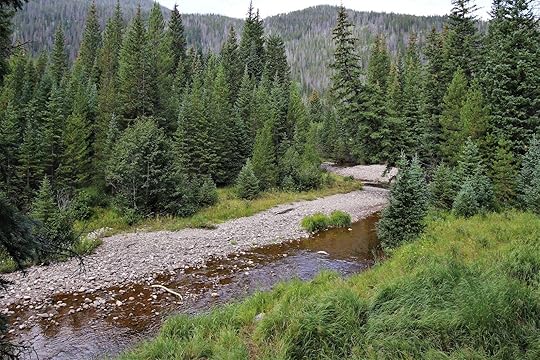
Hiking the headwaters in Rocky Mountain National Park:
This is both a memoir and a study of the Glen Canyon Dam and the effects the dam, which created Lake Powell, has had on the ecology and the economy of the four corners region of the United States. Podmore recounts the battles over construction of the dam among politicians and conservationists, which was lost when construction was initiated in 1958 and completed in 1963. It took several decades for Lake Powell to reach maximum capacity and for two decades, it appeared to be successful, reliably providing water and hydroelectric power to be passed on to partners under the contracts written by the government. Then, beginning in 1999, a severe and continuing drought began in the Southwestern United States. The water passed on by Glen Canyon dam continued, but less and less water flowed down the Colorado River and the lake level began to get lower and lower. As the level continued to go down and down, a bathtub ring appeared on the canyon walls and the upper reaches of Lake Powell receded hundreds of feet to reveal garbage from thousands of boaters, floating docks on the mud and a massive deposit of silt. Podmore has visited the lake many times and recounts his trips to canyons that are being cleansed by monsoon storms, where native vegetation has returned and other areas still covered over by silt, sludge, and trash. He talks about the river in history as a part of the cultural life of the indigenous people of the region. Many of their ancestral sacred spots have been flooded by Lake Powell and others, newly accessible by feckless tourists have been trashed. Podmore has seen ancient walls broken to make campfire rings and alcoves used as granaries by the indigenous peoples turned into outhouses. He also describes the obfuscation used by the Bureau of Reclamation which continued to pretend that the drought was temporary and Lake Powell would return to a higher level, completely ignoring climate change. Podmore recounts how very slowly the politicians and bureaucrats have come to the realization that something must be done. There are solutions to the problem of Glen Canyon Dam, which was poorly designed, but we can expect years of temporary solutions and stopgap measures before a permanent solution is found. We can expect Deadpool any year in the near future.
This books follows the author on journeys on and around Lake Powell as he looks at the reservoir and Glen Canyon Dam through fresh eyes. As the "millennium drought" speeds evaporation out of the reservoir, the scenery of Glen Canyon has been reappearing. Native plants are quickly filling in the canyons as well. The restoration of Glen Canyon has long been a long-shot wish for environmentalists, but it now appears to be more likely than not. Podmore predicts that we are in Lake Powell's last days -- time will tell, but the logic of water development now seems to be betting against Powell. In the last couple of decades, Lakes Mead and Powell have rarely been more than half full. Maintaining these two reservoirs, rather than letting Powell's water flow downstream to Lake Mead, means a substantial amount of water is "lost" to seepage and evapotranspiration. Glen Canyon's hydropower represents a small fraction of the region's energy mix, and reservoirs are not as carbon neutral as we like to imagine, because of the methane produced by decaying, inundated plant life.
A lot has happened since Marc Reisner's Cadillac Desert was published in 1986, and books like Life After Dead Pool are warranted to catch people up to speed. But perhaps more significant than the hydrological developments are the political ones. Podmore was raised, according to his own account, on Westerner river rat environmentalism. Over the course of the book, he starts to question those orthodoxies, poking holes in the mythologies of the likes of John Wesley Powell and Ed Abbey. He even flirts with reconsidering the legacy of Floyd Dominy, lightning rod commissioner of the Bureau of Reclamation. This is a welcome development, as is the presence of people in Podmore's environmental journalism. Rather than serene, empty wilderness, the author presents a landscape where humans and flora and fauna are negotiating their respective means of survival. There are no easy answers, not even for the Diné, Hopi, and Ute people who live on the Colorado Plateau, who are all too often reduced to "ecological Indian" tropes. These are weighty themes, but the first-person narrative and understated but skillful writing make for a steady, contemplative journey.
Zak Podmore joins Kevin Fedarko and David Gessner as some of my favorite chroniclers of the modern American West and the history and policy that brought us to the present day. Thank you, Mark Stevens, for your review that turned me on to this book.
In Life After Dead Pool, the author (in Fedarko style) delivers a powerful blend of investigative reporting and vivid storytelling to examine the precipitous failure of Lake Powell and its implications for the southwest United States. As 20th-century flawed infrastructure and 21st-century climate change threaten water supplies for millions, Podmore highlights the surprising ecological renewal of Glen Canyon and makes the case for a future shaped by sustainability rather than scarcity. He even proposes a renegotiation of 19th-century water law.
Podmore's timely book is unexpectedly optimistic and offers a plausible vision for the Colorado River’s recovery.
For most of my life, the effort to dam the rivers of the West seemed as it would never stop regardless of the damage done. Now that process has begun to reverse, and this book focuses on Lake Powell formed by the Glen Canyon Dam.
The story is far more than facts and figures, and Podmore's enthusiasm for his subject shines through. In a time when so many challenges seem overwhelming, he gives hope that there is a brighter future for the restoration of the Colorado River.
It reminded me of another book, Brave the Wild River by Melissa Sevigny, that focuses on two female botanists who were the first white women to raft the Colorado River in 1938. It's an excellent companion for the before and after of the Glen Canyon dam.
I have been fascinated with the western water laws for a long time. It's hard to wrap one's mind around that the horror of the dams on the rivers of this continent are a fairly recent history-all products of the New Deal, an attempt to pull Americans out of unemployment through massive public works programs. But the water laws in western states are also vestiges of colonialism and imperialism, and to be understood, we'd have to understand the geopolitical forces that shaped the decisions at the time. To this day, those decisions are impacting the ecosystems, the rivers, and the people who depend on it. The mere existence of these dams is a national tragedy, and I cannot wait for the day when they are all removed so the rivers can finally flow free. Excellent book.
I was inspired to dig deeper after reading Edward Abbey’s Desert Solitaire; particularly entranced by the trip down Glen Canyon prior to the completion of the dam that created Lake Powell and flooded the canyon. Life After Deadpool is written by an explorer and journalist of the modern day. His voice is clear and thoughtful and the book is a blend of science and reality with the ability to capture the exquisite beauty and complexity of an area in the west that requires both water and electricity from the Glen Canyon dam. I highly recommend this one.
I guided a few trips on Cataract Canyon in 1992 when Lake Powell was full and have kayaked it a few times in the 32 years since then. Each time more of the drowned canyon re-emerges. It was enlightening to read Zak’s tale of exploring the reservoir several times and weaving in history, restoration, and conversations with experts on the area. Highly recommended reading for anyone interested in the Colorado River.
Podmore is a great writer. He made the subject of Glen Canyon Dam and the never ending complexities of water rights in the West feel so approachable. He wove in data with personal anecdotes from his own time on the Colorado to keep the story flowing (river pun fully intended). Overall, would highly recommend to anyone who lives in the Western US. This is shit that directly affects you, so start caring.
Extremely well-written book that gives an historical perspective to modern complex water theory. Personally, I don't share many of the author's beliefs - broadly, that environmental concerns outweigh economic ones - but this is a very well researched and laid-out book.
I lived and worked at Bullfrog Marina for 18 months in the mid-1980's, so it was neat to read about Glen Canyon from that perspective.
This entire review has been hidden because of spoilers.
This book is so sincere and left me a little emotional. Podmore has laid out a beautiful picture of a way forward for Glen Canyon and the Colorado River. Although his conclusions are idealistic, his proposals are very feasible and doable. I’m certainly biased, because I agree with him. However, one thing is clear: if we can work together, there is hope for the future of the desert’s water and landscape.
An equally hopeful and realistic look at the possibility of restoring Glen Canyon. It spoke to my love of the desert Southwest, my love of the outdoors, and my knowledge of water in the west. The book is written on the premise that we’re at a turning point, and I hope that we can look back in twenty years to find that this premise was true.
I really enjoyed this book. Lots of info about water rights, indigenous peoples, and canyon geography. I learned a lot. It was pretty easy reading, periodically bogged down in details. Made me glad to have not been a houseboat person!
What if Glen Canyon Dam went from being a warning against hubris and ecocide to a tale of ecological renewal and restorative justice? Podmore thinks all we need to do is engineer a drain and then pull the plug.
4.5. We were lucky enough to hear Zak speak at our library about his book and Lake Powell. His book was engaging as he was. It will be interesting to see what happens with lake Powell, the Colorado River, and the dam.
Lots of good information and some intriguing future possibilities. The point of the book wasn't the author's explorations of the canyon system, but it still would have been interesting to know more, and to follow along on a map.
Great book about an important dilemma facing the American west. The vivid descriptions of familiar places to me, really gave me a deep homesickness. The American Southwest has a very special place in my heart.