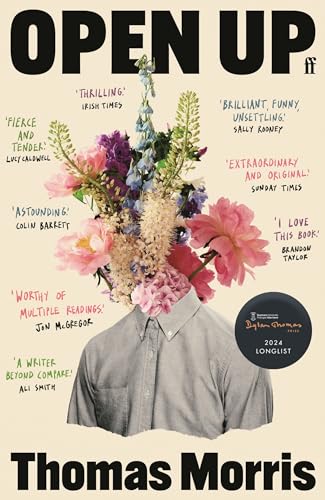
A collection of stories by award-winning, Welsh author and editor, Thomas Morris, recently singled out by Granta on their list of the best, young British writers. In one of these stories a character’s glimpsed reading Shirley Jackson, and there’s something of Jackson in Morris’s approach - although Jackson’s invoked more in spirit than in style. But like Jackson, Morris’s writing blurs the boundaries between the gothic and the domestic, intent on exposing the everyday “horrors” lurking in relationships or in seemingly-ordinary families. Morris frequently mines aspects of his own life: his passion for football; and growing up in a comparatively poor, single-parent household. His protagonists are all male - even the ones who aren’t human - often reeling from the fallout of fracturing or fractured families, in which mothers or fathers are absent or dead or too emotionally stunted to count.
In his opening story “Wales” a young boy Gareth is waiting for his estranged father to take him to a football match, caught up in magical thinking Gareth pins his hope on Wales winning the match. A victory he believes could save him and his mother from the repo man. It’s a likeable piece, if somewhat slight, but its emphasis on isolation, anxiety and vulnerability sets the stage for the stories that follow. “Little Wizard” revolves around Big Mike, a lonely, resentful office worker, who attributes his lack of success with women to the fact that he's short. He plugs the gaps in his life with fast food and snacks from the local supermarket, worries about making his mortgage payments and dreams of getting a girlfriend. At first a sympathetic character, things take a turn when Mike’s attitudes to women suggest he may be an incel in the making.
In “Passenger” Geraint’s on holiday with Niamh in Croatia but their relationship is floundering and so is he, sparking a crisis that morphs into the stuff of nightmares. “Birthday Teeth” deals with Glynn who lives with his agoraphobic mother. He’s unemployed, apparently adrift but finds meaning via an online vampire community. His desire for transformation invested in finding someone who can turn his teeth into literal fangs. Glynn’s experiences touch on issues of urban alienation, the lure of the pseudo-philosophical, quick fix as a substitute for ultimate lack of meaning or intimate connection - here represented in the many references to wellness culture.
“Passenger” is promising, if uneven, and “Birthday Teeth” is admirably inventive, filled with pleasing details from the diabetic dog to Glynn’s mum’s tea drinking. There’s a sensibility that at times reminded me of reading work from the fin de siècle, there’s a similar focus on enervated men struggling to find a footing in a hostile, decaying world. But neither story totally worked for me, particularly Morris’s blend of the real and the surreal. The different elements seemed awkwardly sutured together, and the commentary on the character’s inner lives could feel forced and overstated. Although these, along with the earlier narratives, combine to form an interesting critique of aspects of contemporary masculinity and the stifling weight of conventional gender roles.
For me “Aberkariad” is by far the stand-out here, enough to make the entire book worthwhile. Set in a fantasy, undersea world, it’s close to novella in length and presented from the point of view of a young seahorse eager to become an adult. Admirably detailed, drawing directly on the life cycles and mating rituals of actual seahorses, it’s a complex variation on a coming-of-age narrative, fresh and fluid, intense, intimate and often incredibly moving.
Thanks to Netgalley and publisher Faber for an ARC