Jump to ratings and reviews
Rate this book

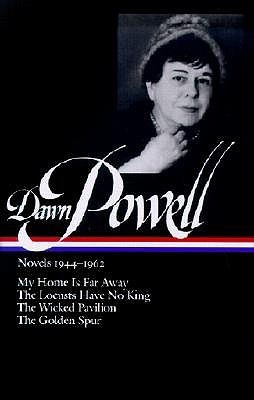
Dawn Powell: Novels 1944–1962

Rate this book
American literature has known few writers capable of the comic elan and full-bodied portraiture that abound in the novels of Dawn Powell. Yet for decades after her death, Powell's work was out of print, cherished only by a small band of admirers. Only recently has there been a rediscovery of the writer Gore Vidal calls "our best comic novelist," and whom Edmund Wilson considered to be "on a level with Anthony Powell, Evelyn Waugh, and Muriel Spark." In a two-volume set, The Library of America presents the best of Powell's quirky, often hilarious, sometimes deeply moving fiction.

Dawn Powell -- a vital part of literary Greenwich Village from the 1920s through the 1960s -- was the observant chronicler of two very different worlds: the small-town Ohio where she grew up and the sophisticated Manhattan where she lived for nearly fifty years. If her Ohio novels are more melancholy and compassionate, her Manhattan novels, exuberant and incisive, sparkle with a cast of writers, show people, businessmen, and hangers-on -- all caught with Powell's uniquely sharp yet compassionate eye. A playful satirist, an unsentimental observer of failed hopes and misguided longings, Dawn Powell is a literary rediscovery of rare importance.

My Home Is Far Away (1944), the last of Powell's Ohio novels, is a fictionalized memoir of her difficult childhood. With The Locusts Have No King (1948), the story of a scholar's unexpected brush with the temptations of celebrity and riches, Powell resumed her lifelong dissection of New York's pretensions and glamour. The first of three brilliant postwar satires, it was followed by The Wicked Pavilion (1954), a novel that lays bare its characters' illusions about love and success against the backdrop of the Cafe Julien, a relic of a bygone era in the history of Greenwich Village. The volume concludes with Powell's final novel, The Golden Spur (1962), in which she drew on her time spent among painters at the famed Cedar Tavern for an affectionate if pointed satire on Manhattan's art world.

969 pages, Hardcover

First published September 10, 2001

6 people are currently reading
2980 people want to read

About the author

Dawn Powell

43 books338 followers
Dawn Powell was an American writer of satirical novels and stories that manage to be barbed and sensitive at the same time.

Ratings & Reviews

What do you think?
Rate this book

Friends & Following

Create a free account to discover what your friends think of this book!

Community Reviews

5 stars
68 (48%)
4 stars
42 (30%)
3 stars
15 (10%)
2 stars
7 (5%)
1 star
7 (5%)
Displaying 1 - 17 of 17 reviews
Profile Image for robin friedman.
1,948 reviews414 followers
April 21, 2024
Dawn Powell In The Library Of America -- 2

This book is the second volume of the Library of America's compilation of the novels of Dawn Powell (1896 - 1965), a writer whose works have attained deserved if belated recognition. The first volume included five novels of Dawn Powell written between 1930 and 1942. This, the second, volume includes four of Powell's novels written between 1944 and 1965.

Powell's earlier novels generally are set in small-town Ohio in the early 20th Century. They have as themes what Powell saw as the conformity and frustration, sexual and otherwise, of small-town life. The main characters in these books, typically young people, long to escape to make a new life for themselves in the city. The latter novels are, for the most part, set in New York City where Powell lived most of her adult life. The novels are comic and satirical, sometimes sharply so. They reflect loss of innocence and love and, on occasion, fall into cynicism.

The first volume of the Library of America compilation included two early Ohio novels, "Dance Night' and "Come Back to Sorrento" and three novels reflecting Powell's change in style and theme and set in New York City, "Turn, Magic Wheel', "Angels on Toast", and "A Time to be Born."

The second volume opens with a novel in which Dawn Powell returned to the setting of small-town Ohio. The book, "My Home is Far Away" (1944), is a fictionalized account of Powell's early unhappy childhood. The book offers a poignant picture of the death of Powell's mother and of her father's remarriage to a cruel and jealous stepmother. There are excellent scenes of the family wandering through cramped Ohio towns and small dusty hotels and back neighborhoods. The father himself is portrayed as a traveling salesman who generally behaves carelessly and irresponsibly to his three daughters. Powell initially planned this book as the first of a trilogy. This project did not materialize.

In the next book in the collection, "The Locusts have no King"(1948), Powell returned to sharp satire and to New York City. The book is set after the conclusion of WW II and includes a memorable passage of reflection at the end on the United States atomic testing program at Bikini Atoll. The book contrasts the life of serious, scholarly writing and its difficulty with the life of superficial magazine publishing devoted to economic success and to popular culture. There is also a love story, serious to the participants, in which the main character of the book, a serious if unsuccessful scholar, becomes infatuated with a shallow, sexy blonde. This book reminded me of George Gissing's Victorian novel of the literary life, "New Grub Street" as well as of West's "Day of the Locust", which has some of the same themes and the same dark humor as does Powell's book.

Powell wrote "The Wicked Pavilion" in 1954. Unlike most of Powell's works, the book appeared on the best-seller lists if only for a very brief time. The book is set in New York City in the late 1940s and celebrates, if that is the word, a bar called "The Cafe Julien", located in Greenwich Village, and its patrons. The book is full of would-be artists without talent, unhappy lovers, and people on the lookout for the main chance. It is sharp, astringent satire, close to disillusion. The book is well and convincingly written.

Powell's final novel, and the last in this collection, "The Golden Spur" (1962) was nominated for the National Book Award. As does its predecessor, this novel centers around a drinking establishment which gives the book its title and its patrons. This book also is set in Greenwich Village in the 1950's and records the passing of an era. This novel, as are some of Powell's earlier works, is a coming-of-age story which tells the story of a young man who comes to New York City from Ohio to learn the identity of his father. In the process, the young man learns about himself as well. This book is impressive less for its story line than for the beautiful writing style Powell achieved in this, her last novel. The book is deliberately light in tone, and I think it ranks with Powell's best.

Dawn Powell produced a substantial body of excellent work describing the places and lives (primarily her own) with which she was familiar. The qualities of growing up, coming-of age, searching and frustration, and the loss of innocence are all well portrayed. The descriptions of New York City, in particular, are themselves irreplaceable. Those readers who enjoy the pleasure of discovering a previously little-known writer will enjoy the novels of Dawn Powell.

Robin Friedman
Profile Image for J..
462 reviews235 followers
July 2, 2015
There were people ... who were born café people, claustrophobes unable to endure a definite place or plan. The café was a sort of union station where they might loiter, missing trains and boats as they liked, postponing the final decision to go anyplace or do anything until there was no longer need for decision. One came here because one couldn't decide where to dine, whom to telephone, what to do. At least one had not yet committed oneself to one parlor or one group for the evening; the door of freedom was still open. One might be lonely, frustrated or heartbroken, but at least one wasn't sewed up. Someone barely known might come into the café bringing marvelous strangers from Rome, London, Hollywood, anyplace at all, and one joined forces, went places after the café closed that one had never heard of before, and never would again, talked strange talk, perhaps kissed strange lips to be forgotten next day.

It's never a certainty that the author of the Greenwich Village novels here ever knew she was documenting "an era" --an iconic supernova that rivaled the Paris of the twenties. That the Village in the late fifties and early sixties would foster much of what might euphemistically be called the counter-culture in later history, no one now disputes; much of what might be called Modernism 2.o was born in New York City and hit the beaches in the Village. That counterculture will eventually morph into Culture, we now accept. For us she need only say "some jazz player" or "an abstract expressionist"-- and we're dialed in.

Around And Around
But for Ms Powell it is the source of one grandly disconnected story, comprised of a zillion closely-connected anecdotes. She has a sensational alignment of personalities, strong cross-currents in the Arts, the hybridized rebirth of the City, storylines and detours that just won't stop metabolizing and rebirthing, an author's dream of points-of-departure writ large.

In 1897 Arthur Schnitzler wrote a now-much-imitated play in German called "Reigen", a loosely-connected set of love stories, some tender, some bittersweet, that hinged upon moving the narrative from partner to partner as love affairs began or concluded. Popular and critical reaction were negative and often harsh. In 1912, true to their worldly and libertine national calling the French staged a translation called La Ronde-- a nicely musical title, and this has become the template for this sort of story-- the revolving perspective, the round-robin viewpoints are variations on this same theme. (True to their own national character the English translated it in 1920 as "Hands Around . . ." proving once again that they really quite like a little filthy intent in their signifiers..) The format, always flexible, is perfect for the confected memoir, the novelized reminiscence of the daze of youth, romance, innocence.

The three Village Novels here by Dawn Powell are The Locusts Have No King, The Wicked Pavilion, and The Golden Spur. Each could be the subject of an in-depth review, but for now it's going to make sense to bring all three into one survey.

Breakfast And A Tiff
In Locusts, which features the most classical style of narration (whilst securely onboard the La Ronde express) and the most romantic of tints, Powell is on her home ground. Which is to say new ground every time a new scene opens. The New York of Locusts is the nerve center of creative chaos, where the unlikely first becomes plausible -- we are in the new era of blasé bohemians and off-Broadway wit-wranglers-- but then naturally enough self-destructs. Every misguided deflection is met by some deeply unlucky opposite reaction. In the new era's love story the impossible, the infuriating are the aphrodisiacs. You can almost feel the crisp newness in the air, slicing through those modern plazas uptown and the little streets of the west village downtown.

The Pavilion Of Booze
The masterpiece of the three is called The Wicked Pavilion, which broadens the cast of characters even more, moves on a few critical years in the evolution of the Village, and most importantly spins out the little narrative spheres, into their own complex sub-orbits. So that one character may arrive in a party scene, perhaps off in a corner and way offstage to the current concern-- but while the foreground drama unfolds, the side-story off in the corner is clicking over a few narrative turns, advancing the game along two tracks at once.

Here Powell gives us the full postwar Manhattan La Ronde, a rotating wheel of connections pivoting on coincidence and seemingly random elements, ala O. Henry or de Maupassant. No angle is too oblique-- that same party we've just attended may have its too-drunk post mortem, at a dive bar, right around the corner. As the night wears into morning, the creative recapitulation progresses to a point beloved of all-night party people everywhere, where high marks are given for lesser achievements, as the revision of benchmarks continues downwards:

They roared with laughter, as if their entire lives had been delightfully spiced with mischief instead of spiked with mistakes. They talked of their women, picturing themselves as pursued and bedeviled by avid females who fended off more desirable creatures. It was true that all three had left a trail of shrews, for they were the genial type that makes shrews of the gentlest of women anyway in order to have their peccadillos condoned by society. Even if the ladies had been sweet and unreproachful these gentlemen preferred to sit in taverns boasting of angry viragos ... for it made their dawdling in bars and wenching more brave and manly...

In the new postwar love story candor and alcohol are inseparable, almost a life-and-death defense in the battle of sleeping your way to the bottom in order to say you've seen the sights. But the moments of high, effervescent clarity, the ecstasy before the agony, are bright and promising :

It was the first time he'd ever been in New York, the city of his dreams, the first time he'd worn his officer's uniform, the first time he'd been drunk on champagne. New York loved him as it loved no other young man, and he embraced the city, impulsively discarding everything he had hitherto cherished ... [he] strolled happily down Fifth Avenue, finding all faces beautiful and wondrously kind, the lacy fragility of the city trees incomparably superior to his huge native forests. Under the giant diesel hum of street and harbor traffic, he caught the sweet music of danger, the voices of deathless love and magic adventure. My city, he had exulted ...

What's New Is Old Again
As might be expected, in The Golden Spur, the backwards look at the Era is tinted in glowing golden hues, even as it finds itself in frequent difficulties. Here Powell takes the gentler approach, adding lots of Artworld touches and a tour of all the old haunts. Again, though, her focus is the shared transit-points, the lofts and bedrooms, the analysts and bartenders (same job, obviously), the former wives and the future girlfriends that make the place go round. The overall story hinges on place, or time, or character-- whichever rotates the plot with more verve; Powell is taking a sentimental victory lap here, a nostalgic glide through her lovely Era's highs and lows.

Arrivederci Roma
It is tempting to compare the location, the tonality, the casual New-Yorker Magazine humor, the contradictory plot turns to the obvious 'Manhattan' or 'Annie Hall' of another era's cinema. I'd suggest that a closer comparison is to the work of Fellini, with the first spin of the wheel being the Il Bidone, La Strada series, the crucial pinnacle being La Dolce Vita and , and the final golden look back being Amarcord. The parting glance is in some ways always the most intoxicating of all. Sure, it's a different city, but the near-operatic quality of the drama is similar, the staging brilliant, and the hands behind-the-curtain are similarly masterful.
Profile Image for Jim Leckband.
786 reviews1 follower
August 5, 2017
As refreshing as a Bromo Seltzer after too many Manhattans, but without the headache. Powell is the New York writer you should read if you want to know how life was in the city back in the day. The last three novels are wonderfully sarcastic and humane. Watch for a cameo of herself as the Manhattan drinking author, Clair van Orphen in the final book - the clear-eyed orphan of the city.
Profile Image for Robert Rodi.
Author 210 books123 followers
May 19, 2014
Dawn Powell is my favorite novelist. She was ahead of her time in that she wrote without a shred of sentimentality — which was rare even for male writers of the period, but virtually unheard of for a woman. (Only Dorothy Parker could match her, and Parker wrote no novels.) She died in obscurity and has only recently been rediscovered (actually, she seems to be rediscovered every dozen years, like clockwork), and her caustic, acerbic, bleakly hilarious point of view seems more of-the-moment than that of any living writer I can think of. Her novels divide neatly into two categories: devastating social satires of bohemian, professional, and upper-class New York; and more Tennessee Williams-esque stories of life in the provincial Ohio she escaped from. This volume features three of her best New York novels (including her masterpiece, The Locusts Have No King) and one Ohio novel, My Home Is Far Away, which is also her most autobiographical. I'd have preferred a little more balance, but since the New York novels are my favorites, I suppose I shouldn't complain. Anyone interested in an entirely different, blisteringly candid portrait of American class and culture at midcentury could do far worse than to give her work a try, and this volume is an outstanding starting place.
Profile Image for Zuska.
329 reviews1 follower
September 4, 2018
Read only the first novel in the volume of collected novels of Dawn Powell, "My Home Is Far Away". A fictionalized version of her harsh childhood in rural/small town Ohio in the early twentieth century, MHIFA is an absorbing read. By turns heartbreaking and hilarious, Powell's storytelling is spellbinding. Every character in the novel is fully three-dimensional, even the bit players. Her powers of observation are phenomenal and her ability to render a scene fully in all its emotional resonance and physical detail, including olfactory descriptions so pungent I could almost catch scent of what the young protagonist Marcia was smelling, is unmatched by almost any other novelist.

Something she captures in this novel is how the very young and the very old are alike in their vulnerability to neglect and mistreatment at the hands of the adults who are running things.

This novel was such a wonderful read that it makes me want to read all Powell's other novels, as well as read about her life and her writing. I can't believe I never heard of her before. Very grateful to the author of my previous read "Secret City", Julia Watts, for including a reference to this novel in her book (two characters in "Secret City" discuss MHIFA) and thus making me want to read it.

40 reviews1 follower
February 26, 2023
Took this out of the library for the last novel in the collection, The Golden Spur. The novel was included in the NYT’s list of The 25 Most Significant New York City Novels From the Last 100 Years. As it says somewhere else, Powell writing is satirical but sympathetic, and it lives up to the promise of being a story that couldn’t have taken place anywhere other than NYC. Might hold on to it so I can read more of the collection.
Profile Image for ThereWillBeBooks.
82 reviews13 followers
August 20, 2020
Likely the funniest, definitely the most underappreciated, and maybe (if we take into account output and consistency) the best American writer of the 20th century. She’s at least in the conversation.
Profile Image for Ruth.
652 reviews
July 28, 2024
I have not read the entire anthology, but I will. The Golden Spur is delightfully clever, well written, with an incredible array of NYC characters.
Profile Image for Orit.
73 reviews7 followers
April 28, 2016
This is four novels put together in one book. 940 very thin paper with very small print! I picked this up because it's listed on the Gilmore Girls challenge.

My Home Is Far Away: 5 out of 5. AMAZING! I loved this book. It's semi autobiographical and amazing.

The Locusts Have no King: 4 out of 5. The other three novels are more her general style and it took some time to get used to after 'My Home is Far Away'. Each character is developed well, but I don't always like how the stories go along. As soon as I start to get invested in a few characters, she's switch to two totally different characters and it would be a long time before you felt their connection. While the stories do always come together- it was a bit painful to get there.

The Wicked Pavilion: 3 out fo 5. My least favorite of the four novels. I was more prepared for the style of writing this time, but in this book, characters from the first book were mentioned casually with no connection to the main plot. Are they all together in the universe? Why put them in? I also didn't feel the ending was as satisfying for the characters as it was in any of the other novels.

The Golden Spur: 4 out of 5. I really liked the way these characters were developed and the story felt like it had more flow than the others. My least favorite character was the main character, Jonathan. But I wonder if that's on purpose? Like the Wicket Pavillion, the ending didn't feel satisfying, but I was more ok with it.

There are lines in each novel that are so far ahead of their time. Especially when it came to how women are treated. Everything she wrote reminds me of A Doll's House in that it was ahead of it's time when written, and now seems outdated. A shame she wasn't really recognized during her lifetime.
Profile Image for Karen.
485 reviews8 followers
March 10, 2009
I've read three of the Novels in this collection and am currently midway thru the fourth, The Wicked Pavilion. Like The Locusts Have No King and The Golden Spur, it's set in New York in the late 1940s, and is wonderfully funny in an understated way. The humor comes from the characters thoughts and the situations they put themselves in. In addition, it's a wonderful portrait of the Greenwich Village of a bygone era.

The other novel presented here, My Home is Far Away, is equally good tho quite different subject matter and style. It's based on Powell's own childhood is smalltown Ohio and the sad circumstances that befall her when her mother dies. Not as depressing as it sounds because you know this young girl has the spirit and determination to make good.
157 reviews2 followers
June 7, 2016
I really enjoyed My Home is Far Away. The characters were well developed and the story was clear. I could picture the story in my head and felt for the girls. The Wicked Pavilion was ok. At times I had to pause because new characters would be added separately to what was currently going on so it was like putting pieces together. While at times I got lost I was able to get back on track. I didn't enjoy Locusts Have No King or The Golden Spur. Both stories were tedious to read.
Profile Image for Julia.
902 reviews
June 19, 2016
Read the first book, My Home is Far Away, semi-memoir of Dawn Powell 's miserable childhood in Ohio. Marcia is Dawn, and the middle child never gets anything of worth from the family. The saddest part was that the parents never realized how neglected their offspring were, how their selfish desires overrode any attempts anybody else made to help the children move ahead.
Profile Image for FrankH.
174 reviews13 followers
August 3, 2008
Recently Finished the Locusts Have No King...Witty writer, social satirist, weak though as a storyteller
Profile Image for Lynda.
2,497 reviews121 followers
December 7, 2016
All I can say is that I wish I had discovered Dawn Powell years ago. I feel like I have missed out on years and years of savoring her work.
Displaying 1 - 17 of 17 reviews

Can't find what you're looking for?

Get help and learn more about the design.