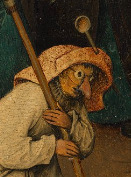
De wereld door de ogen van een ezel. Een wereld vol wreedheid en gevaar, waar het 'ieder voor zich' is en waar liefde, trouw en eerlijkheid ver te zoeken zijn. Een wereld vol verhalen over charlatans en bedriegers, rovers en rondtrekkende priesters, en met bovenaardse figuren zoals de godin Isis. Dat is het toneel in De gouden ezel, de Romeinse roman van Apuleius van Madauros uit het eind van de tweede eeuw.
De verteller en hoofdpersoon Lucius is verzot op magie en sensatie. Hij verandert al vroeg in het boek in een ezel. Wel behoudt hij zijn mensenverstand, maar ingrijpen kan hij nauwelijks meer. Hij wordt verkocht, geroofd en mishandeld, zijn opeenvolgende eigenaren zijn meestal boosaardige egoïsten. Maar als ezel krijgt Lucius ook prachtige verhalen te van geil en spannend tot verheven en stichtend. Beroemd is het verfijnde sprookje van Amor en Psyche in het hart van de roman. Als het Lucius weer lukt mens te worden treedt hij in dienst als priester van Isis. Eind goed, al goed, dus, of toch niet?
De gouden ezel is een feest van taal. In een veelzijdige en humoristische stijl vertelt Apuleius het bizarre verhaal van Lucius, waarbij je je geen moment verveelt.
People best know The Golden Ass, work of Roman philosopher and satirist Lucius Apuleius.
Apuleius (Lucius Apuleius Madaurensis “Africanus”; Berber: Afulay) wrote Latin-language prose.
This Berber of Numidia lived under the empire. From Madaurus (now M'Daourouch, Algeria), he studied Platonism in Athens and traveled to Italy, Asia Minor and Egypt. Several cults or mysteries initiated him. In the most famous incident in his life, people then accused him of using magic to gain the attentions and fortune of a wealthy widow. Apuleius declaimed and then distributed a witty tour de force in his own defense before the proconsul and a court of magistrates convened in Sabratha, near ancient Tripoli, Libya.
Few works of prose from the classical Roman era have survived and at the same time still attract a contemporary audience. One exception is this story of a rambunctious and overcurious merchant in 2nd century Roman Greece accidentally turned into an ass for most of the book.
Apuleius treats the reader to a rollercoaster of witty and often juicy folktales that the protagonist either experiences himself or overhears from other characters in the book. He finds himself going from one ordeal to another and only narrowly escapes death before finding salvation thanks to the goddess Isis.
He is no dour Tacitus, and instead gushes out a baroque cascade of anecdotes, descriptions and jokes. Many of the stories are rather explicit in nature, but he manages to cover it with a layer of wit and philosophical exhortations, turning provocative situations into amusing and thought-provoking reading. Knowing classical literature and culture helps, but is not a requisite to enjoy the book.
Even a church father like Augustine was a fan of Apuleius' work, probably owing to the redemption story of the protagonist ultimately becoming a devoted monk, which proves that it isn't some cheap form of amusement. The book is an odd mix, something quite unique that we won't see again on our day and so well worth the read for anyone today.
Fascinerend, uitdagend en vermakelijk verhaal met heel mooie en humoristische vertaling van een boek uit de klassieke tijd (2e eeuw n.C.). Leest als een roman, mede dankzij de vertaling en de keuze die de vertaler daarbij maakte - helder toegelicht in het nawoord. Het verhaal kent veel binnen-verhalen en het is opletten geblazen welke personages aan het woord zijn. Boordevol verwijzingen naar filosofie, mythologie, religie, magie en retoriek. Maar bovenal menselijk: over hoofdpersoon Lucius die gedreven door nieuwsgierigheid, opportunisme en lust meermaals in dezelfde valkuilen stapt. Zelfs wanneer hij in een ezel is veranderd… Erg van genoten!
Uiterst vermakelijk boek! Een man verandert als gevolg van zijn nieuwsgierigheid in een ezel en maakt allerlei avonturen mee. Boordevol mooie verhalen, over overspel, wraak, moord en meer van dat. Alleen het einde sprak me minder aan.