

What do you think?

Flower
'I like eating cold, clammy wraps from big pharmacies that are open late and sell just a few foods like protein bars and powders.' Flower is a book of realistic confessions, likes, dislikes, memories, and no-brainer observations, treating personal truth as unavailable – something that must be made up and convincing. Taking cues from Roland Barthes's Roland Barthes, Joe Brainard's I Remember, Marguerite Duras's Practicalities, Fernando Pessoa's The Book of Disquiet, his daughter's improvised games, poor internet writing and shitty AI, Ed Atkins, in his first work of non-fiction, equivocates between inanity and divinity, ease and pain, sentimentality and sterility. An anti-memoir, a list, a listless blur – Flower is a highly original, moving and absurd book by one of the most influential artists of his generation, formally inventive and disturbingly of our time.
96 pages, Paperback
Published October 7, 2025
Ratings & Reviews
Friends & Following
Create a free account to discover what your friends think of this book!
Community Reviews
Displaying 1 - 30 of 60 reviews
Read
January 29, 2026And the sky was watching that superb cadaver
Blossom like a flower.
Charles Baudelaire
tr. William Aggeler, The Flowers of Evil
Why was this book called 'Flower'? I’ve thought for a moment just before opening it. I’ve opened the book, read the first page and then i've forgotten the question.
I’ve read this in one day; i just could not stop reading. A cliche comes to mind: ‘a breathless monologue’. But it is definitely not breathless: there is a rhythm driving each sentence; and hardly a monologue. Written in a single paragraph, it is a propulsive movement like a stream in early spring when the snow is melting and all this newly released power just carries you forward together with debris at a ferocious speed. So I kept reading until i was thrown out at the last page: ‘It was hard but i had an amazing time.’ (This was the last sentence of the book).
Sometimes when people talk about a voice in writing, I am not sure what they mean: it is often quite an Illusive quality for me. But not in this case: i could almost hear the sound of it. It was such a contagious voice that when i’ve just started writing this i felt that i was subconsciously appropriating it. Fortunately i am not anywhere good enough.
Atkins is the artist. And it seems everything for him is object of art including himself. The subject matter is an ‘I’. The form is similar to Leve’s Autoportrait. Rather than a monologue this text is selection of statements revealing this ‘I’ in his strangeness and unprotected vulnerability. In her Frankfurt lectures Bachmann said ‘I no longer exists within history, but history exists in the I.’ This would apply here. Though the text contains a lot of ‘likes’ and ‘dislikes’, i am not sure this ‘I” is the author. Also the text does not come across as solipsistic either: more likely this ‘I’ is a kind of avatar, almost an abstraction taking over the author’s imagination to convey something universal and pertinent to our time.
The language is the first line of mediation between one’s mind and the external world. It is sad indeed when ‘inexplicability’ locks one out of ‘other’s affections', the sentiment i can perfectly relate to. I wish everyone could have their unique ‘beetle in a box’ and still be accepted and understood by each other. Unfortunately though, Wittgenstein is quite convincing about the lack of ‘private language’. Even now, while i am writing this, i am not sure how many people would understand what i mean; and what Atkins’s ‘I’ means in that passage above. I am not sure how important it is either. But in many different situations some understanding and affection between humans might be crucial. Sadly but sometimes also thrillingly, the majority of these situations ought to be mediated through a language that is inherently slippery and illusive. In extreme, consider the meaning of a word ‘freedom’ between a protester and an immigration officer; or between ex-slave and his ex-owner. Consider the meaning of word ‘peace’ between an invader and the people of the land.
This ‘I’ brings up another point: inability to separate ‘pretence from truth’ often even in an mere act of speaking itself. I know perfectly well what he means: ‘When I start speaking I am astonished by what I say sometimes but it could be the astonishment of revelation or appal I have no clear way of knowing.’
Do you know the feeling when you open your mouth with an intention to say one thing and then when you close it again you realise your utterance was totally different? It might be you've ended up involuntary pretending to idealise a bit; to be someone else ever so slightly? Your speech has been more polished. You’ve appeared more strong, less vulnerable but also less open that you intended. In other cases, you wanted to clarify something but confused the matters even more instead? Or on the contrary: you were confused and suddenly your own words have made the new idea crystal clear to yourself? This perceived lack of control over his own speech makes Atkins’s avatar alternately ‘astonished’ or ‘appalled’.
Whatever he touches upon, his prose is densely textured, almost tactile like a three-dimensional object. He writes about food with visceral energy and visual potency, such as i’ve seen only in writing of Roland Barthes. For example, according to Barthes:
However, in contrast to Barthes, Atkins descriptions contain this trans-human, industrial element treating food as a fuel in its sheer functionality, ready-made weirdness. His images should cause almost visceral disgust, but strangely they are perversely attractive:
He ‘dips’ his cigarette into the hummus, ‘dunks’ it into a gravy or watches it ‘hissing out on meeting the water in the toilet bowl.’ He eats leftovers after his family breakfast. Since childhood he is very affectionate about objects on the threshold of organic world: ‘sheeps’ skulls and jawbones greening on the mantel;.. framed skeleton leaves... This instilled a sense of beauty to me in me. Insistently gorgeous kinds of death bounded homeyness.’ Just like this.
’Real art doesn’t need to be good,’ said Cezar Aira, an Argentinian writer, in his essay On Contemporary Art it should create new values: on the contrary: if it can be called good that means it’s obeying to ready fixed parameters of quality, and so can be placed according to the category of craft.’
In his turn, Atkins’s avatar appeals to ‘sympathetic awareness’ in dealing with art rather than ‘comprehension’. Often in art something there is something intangible that can be felt, but not spelled out in words or ‘explained’. One can feel ‘death bounded with homeyness’; but to ‘comprehend’? A desire ‘to understand’ an object of art and then to explain, to categorise, to assign ‘aboutness’ is overrated, almost redundant.
I’ve mentioned how the voice hypnotised me in this text. But it is not ephemeral; on the contrary it is firmly embodied. Even if this body by itself more abstract as well, sometimes more akin to a machine consisting of the many integral parts. Mouth plays the key role as a gate-factory for food-processing:
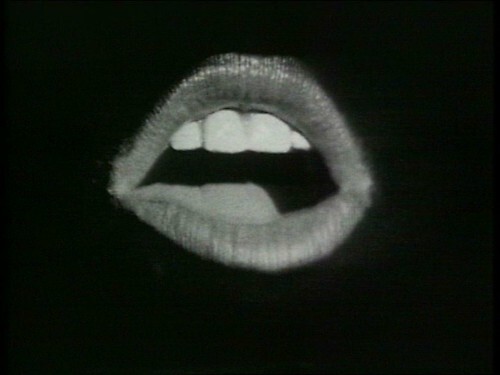
Mouth also is instrumental for ‘tasting’ words: ‘I most often can’t make statements through my mouth.’ . When i was reading this, the image of a mouth from Beckett’s Not I popped into my head and stayed there for a while:
The bowels, bladder, hands and other significant instruments feature as well. Sometimes they work, sometimes they fail to function as prescribed leading to awkwardness or even defeat.
Maybe this text is not for everyone. It is such an exposure, such a mixture of the grotesque with incredible vulnerability, verbal dexterity, almost aloofness with hopeless penetrating and very human sincerity. I have been swallowing this text until it lasted; occasionally, the stream has metamorphosed into a mouth with the voice that has chewed on me and spitted me out eventually. I was thrown out of my comfort zone, a bit shaken, but then felt thrillingly alive.
But why ‘Flower’? Maybe, it is a nod to Les Fleurs du Mal. Baudelaire was another artist capable to show ‘a cadaver blossoming like flower.’ Or maybe it’s simply because a single flower is always a precious gift.
Blossom like a flower.
Charles Baudelaire
tr. William Aggeler, The Flowers of Evil
Why was this book called 'Flower'? I’ve thought for a moment just before opening it. I’ve opened the book, read the first page and then i've forgotten the question.
I’ve read this in one day; i just could not stop reading. A cliche comes to mind: ‘a breathless monologue’. But it is definitely not breathless: there is a rhythm driving each sentence; and hardly a monologue. Written in a single paragraph, it is a propulsive movement like a stream in early spring when the snow is melting and all this newly released power just carries you forward together with debris at a ferocious speed. So I kept reading until i was thrown out at the last page: ‘It was hard but i had an amazing time.’ (This was the last sentence of the book).
Sometimes when people talk about a voice in writing, I am not sure what they mean: it is often quite an Illusive quality for me. But not in this case: i could almost hear the sound of it. It was such a contagious voice that when i’ve just started writing this i felt that i was subconsciously appropriating it. Fortunately i am not anywhere good enough.
Atkins is the artist. And it seems everything for him is object of art including himself. The subject matter is an ‘I’. The form is similar to Leve’s Autoportrait. Rather than a monologue this text is selection of statements revealing this ‘I’ in his strangeness and unprotected vulnerability. In her Frankfurt lectures Bachmann said ‘I no longer exists within history, but history exists in the I.’ This would apply here. Though the text contains a lot of ‘likes’ and ‘dislikes’, i am not sure this ‘I” is the author. Also the text does not come across as solipsistic either: more likely this ‘I’ is a kind of avatar, almost an abstraction taking over the author’s imagination to convey something universal and pertinent to our time.
I’m anxious about being baffling to others especially at a point when I’m trying to give an account of myself or my work and especially, worse, if I’m enjoying myself doing it. I need bafflement shared and put in the same place by everyone present’s hands and be a pleasure stealthy. I don’t like it when my pleasure is converted to shame by others forcibly. I do want to be inexplicable but my language locks me out of others’ affections, sadly. I have just ordered a gin and tonic but they have no tonic, sorry, so I plumped for a cup of orange juice with ice and a gin miniature and I have just now poured all the gin in we’ll see how that goes. I try to have a gin and tonic on flights. On flights I cry tears for me not visibly and turned away to look out of the splintery window listening to my music. Oh, I’m folding inwards again. Pretence and truth of me are indiscernible to me and I fret over this. Whether what I am saying is true and where. When I start speaking I am astonished by what I say sometimes but it could be the astonishment of revelation or appal I have no clear way of knowing and no one else could settle this for me ever.
The language is the first line of mediation between one’s mind and the external world. It is sad indeed when ‘inexplicability’ locks one out of ‘other’s affections', the sentiment i can perfectly relate to. I wish everyone could have their unique ‘beetle in a box’ and still be accepted and understood by each other. Unfortunately though, Wittgenstein is quite convincing about the lack of ‘private language’. Even now, while i am writing this, i am not sure how many people would understand what i mean; and what Atkins’s ‘I’ means in that passage above. I am not sure how important it is either. But in many different situations some understanding and affection between humans might be crucial. Sadly but sometimes also thrillingly, the majority of these situations ought to be mediated through a language that is inherently slippery and illusive. In extreme, consider the meaning of a word ‘freedom’ between a protester and an immigration officer; or between ex-slave and his ex-owner. Consider the meaning of word ‘peace’ between an invader and the people of the land.
This ‘I’ brings up another point: inability to separate ‘pretence from truth’ often even in an mere act of speaking itself. I know perfectly well what he means: ‘When I start speaking I am astonished by what I say sometimes but it could be the astonishment of revelation or appal I have no clear way of knowing.’
Do you know the feeling when you open your mouth with an intention to say one thing and then when you close it again you realise your utterance was totally different? It might be you've ended up involuntary pretending to idealise a bit; to be someone else ever so slightly? Your speech has been more polished. You’ve appeared more strong, less vulnerable but also less open that you intended. In other cases, you wanted to clarify something but confused the matters even more instead? Or on the contrary: you were confused and suddenly your own words have made the new idea crystal clear to yourself? This perceived lack of control over his own speech makes Atkins’s avatar alternately ‘astonished’ or ‘appalled’.
Whatever he touches upon, his prose is densely textured, almost tactile like a three-dimensional object. He writes about food with visceral energy and visual potency, such as i’ve seen only in writing of Roland Barthes. For example, according to Barthes:
sashimi exhibits not so much colours as resistances: those which vary the flesh of raw fish, causing it to pass, from one end of the tray to the other, through the stations of the soggy, the fibrous, the elastic, the compact, the rough, the slippery).
However, in contrast to Barthes, Atkins descriptions contain this trans-human, industrial element treating food as a fuel in its sheer functionality, ready-made weirdness. His images should cause almost visceral disgust, but strangely they are perversely attractive:
I like wraps fabricated on industrial estates a long way from here that come in nondescript cardboard and plastic sleeves. I won’t register what’s inside the wraps I like it doesn’t matter at all. The best wraps all taste the same: sweet creamed hospice. The wraps I like are best and look like these spent prophylactic alien larvae props. I push them through my mouth. The best wraps are always presented in half with the two halves side-by-side in the sleeve. The cut ends of it are cut on the bias and are on prominent display behind the plastic window at the top of the package. The visible cross-section is not at all instructive. The damp folded ends are hidden in the cardboard bottom like its genitals.
He ‘dips’ his cigarette into the hummus, ‘dunks’ it into a gravy or watches it ‘hissing out on meeting the water in the toilet bowl.’ He eats leftovers after his family breakfast. Since childhood he is very affectionate about objects on the threshold of organic world: ‘sheeps’ skulls and jawbones greening on the mantel;.. framed skeleton leaves... This instilled a sense of beauty to me in me. Insistently gorgeous kinds of death bounded homeyness.’ Just like this.
’Real art doesn’t need to be good,’ said Cezar Aira, an Argentinian writer, in his essay On Contemporary Art it should create new values: on the contrary: if it can be called good that means it’s obeying to ready fixed parameters of quality, and so can be placed according to the category of craft.’
In his turn, Atkins’s avatar appeals to ‘sympathetic awareness’ in dealing with art rather than ‘comprehension’. Often in art something there is something intangible that can be felt, but not spelled out in words or ‘explained’. One can feel ‘death bounded with homeyness’; but to ‘comprehend’? A desire ‘to understand’ an object of art and then to explain, to categorise, to assign ‘aboutness’ is overrated, almost redundant.
‘I don’t mind not understanding something, really..Some people try to solve art’s ambiguity with imported significance or with candid aboutness where the thing it’s about gives allaying eminence? Deference to worthier worlds brings a backwash of instrumentalization, at least to me.’
I’ve mentioned how the voice hypnotised me in this text. But it is not ephemeral; on the contrary it is firmly embodied. Even if this body by itself more abstract as well, sometimes more akin to a machine consisting of the many integral parts. Mouth plays the key role as a gate-factory for food-processing:
I like processing Doritos with my mouth. Saliva piddles moisten while molars pound to a paste. I compress the paste between my tongue and the roof of my mouth to make now Dorito-flavoured and coloured spit leach from it and get into me via ducts. The paste remainder forms a curved cast and this is a remarkable temporary food object. I cut the soft cast object into neat nothings with my teeth then and swallow it easily. I’m just getting rid of shapes down a chute.
Mouth also is instrumental for ‘tasting’ words: ‘I most often can’t make statements through my mouth.’ . When i was reading this, the image of a mouth from Beckett’s Not I popped into my head and stayed there for a while:
The bowels, bladder, hands and other significant instruments feature as well. Sometimes they work, sometimes they fail to function as prescribed leading to awkwardness or even defeat.
Maybe this text is not for everyone. It is such an exposure, such a mixture of the grotesque with incredible vulnerability, verbal dexterity, almost aloofness with hopeless penetrating and very human sincerity. I have been swallowing this text until it lasted; occasionally, the stream has metamorphosed into a mouth with the voice that has chewed on me and spitted me out eventually. I was thrown out of my comfort zone, a bit shaken, but then felt thrillingly alive.
But why ‘Flower’? Maybe, it is a nod to Les Fleurs du Mal. Baudelaire was another artist capable to show ‘a cadaver blossoming like flower.’ Or maybe it’s simply because a single flower is always a precious gift.

Read
May 23, 2025For a Rembrandt, a Van Gogh, or a Banksy, Google Images usually does the trick. But for the work of British artist Ed Atkins, what you really want is YouTube. In his weirdly hypnotic computer-generated animations—urine arrives from off-screen to fill a whiskey glass; a man hums the drumline from Ravel’s Boléro while repeatedly ripping the skin off his own face—anything can happen. It should come as no surprise, then, that Atkins’ work as a writer also slants toward the strange, the surreal, and the hip.
If the world of contemporary art is largely a gated community (and it is), then Atkins’ new book, Flower, wants to belong to the literary equivalent of that space. One is, for starters, immediately exasperated by the book’s preposterous formlessness: in all of a hundred pages, it manages to dispense with line breaks almost entirely. Of course, paragraphlessness is not the exclusive domain of the dead—Kafka, Beckett, and Bernhard all did it—but such an explicit style choice should be buttressed by something sturdier than the author’s whim.
Read the rest here: https://ocreviewofbooks.org/2025/05/2...
If the world of contemporary art is largely a gated community (and it is), then Atkins’ new book, Flower, wants to belong to the literary equivalent of that space. One is, for starters, immediately exasperated by the book’s preposterous formlessness: in all of a hundred pages, it manages to dispense with line breaks almost entirely. Of course, paragraphlessness is not the exclusive domain of the dead—Kafka, Beckett, and Bernhard all did it—but such an explicit style choice should be buttressed by something sturdier than the author’s whim.
Read the rest here: https://ocreviewofbooks.org/2025/05/2...
September 7, 2026
it’s awesome, it’s fun, it’s formally inventive. it’s also very stupid and kitschy in places and at times overly verbose. all of these things add to its charm, in my opinion. certainly not perfectly crafted and I feel like it would have been a worse book had it been

January 17, 2026
I usually don’t mind something different or experimental. I like to see where we can push literary boundaries.
But the writing has to be coherent or it loses the impact of the difference of its content or approach. Flower began well but then dissolved into more of an incoherent rant, leaping from place to place without direction or structure. Like sucking all the things your brain might have thought about over the last week and running them together in one 89 page-long paragraph. A couple of pages from the end Atkins says “I am a nascent lunatic, I worry.” I have to agree that this feels like it was written by a lunatic.
We began by talking about the kinds of wraps he likes to eat, whether they come from pharmacies, corner shops, cheap supermarkets or mid-tier garages.
Various parts of the book make perfect sense, such as the games Atkins plays with his daughter when she pretends to be a fossil, but other parts are odd, such as the detailed description of various levels of a game you can play on your phone. Other parts are just playing with language:
Whatever. It makes no sense, and not in a good way
But the writing has to be coherent or it loses the impact of the difference of its content or approach. Flower began well but then dissolved into more of an incoherent rant, leaping from place to place without direction or structure. Like sucking all the things your brain might have thought about over the last week and running them together in one 89 page-long paragraph. A couple of pages from the end Atkins says “I am a nascent lunatic, I worry.” I have to agree that this feels like it was written by a lunatic.
We began by talking about the kinds of wraps he likes to eat, whether they come from pharmacies, corner shops, cheap supermarkets or mid-tier garages.
The best wraps are cavefish and peter forever outside time. That goes for a lot of what’s happening when I’m inside of a big pharmacy. I feel outside of time and outside my life. I go in to a big pharmacy when it’s dark outside. I buy a wrap and a fizzy drink with my earbuds in listening to music. My music lends the whole thing a cinematic thing. I’m the crushed protagonist buying a corpse-like wrap and a thin can of Coke Zero on another planet the same as this one.
Various parts of the book make perfect sense, such as the games Atkins plays with his daughter when she pretends to be a fossil, but other parts are odd, such as the detailed description of various levels of a game you can play on your phone. Other parts are just playing with language:
The ambivalence I like is performative like love needs sometime to be. I do equivocation socially but in my heart I am certain. Art’s ambivalence is a bluff to protect its unpronounceable certitude, where unavailability’s coaxed into synonymity with ambivalence. It is about really adoring not knowing forever and ever. Aspects of me confuse other aspects of me and I’m at a lovely loss or just gone.
Whatever. It makes no sense, and not in a good way

May 20, 2025
Flower by Ed Atkins is an ethnographic artifact of 2025. I can imagine it being studied as a cultural document that captures the psychological, technological, and aesthetic atmosphere of our time.
Reading Flower felt like standing at the intersection of competing forces: beautifully serene yet grotesquely inadequate; intimate yet mechanical; absurd yet deeply human. It’s a book that resists easy classification, composed of a continuous stream-of-consciousness that reads like a hyper-processed internal monologue—disjointed, yet thematically precise.
Atkins deliberately avoids “untouched nature,” opting instead for symbols of ultra processed existence: vapes, Doritos, soda drinks, blue crates, ultra processed foods. They’re part of a new symbolic language. Processed nature, recurs in lines such as:
“There are no secrets there is only the puzzle of fictions inside me, a blue crate.” (p. 61)
“I am thinking about an iron moon right now” (p. 43).
The protagonist’s body is portrayed not as a bounded vessel, but a permeable, consuming organism—absorbing and being absorbed, described often through mechanical or coded metaphors. The biological becomes digital, mechanical.
“I like to put my cigarettes out in the food.” (p. 57)
“Turn me into a street.” (p. 71)
Atkins juxtaposes the mundane with the absurd, like Doritos with sacrament, or bleach with redemption. His sentences swing between hyperreal detail and fragmented abstraction. This is not a book you read—it’s a book you metabolize.
“My touch can be daintily acidic.” (p. 76)
“I am always fingering the alternative, the worst.” (p. 87)
“Here is my cigarette being wrong again, dipped in hummus and here it is dunked into my gravy on a round white plate” (p. 57)
While the disjointedness is intentional—mirroring the fractured attention of our era—it made the book challenging to finish. Its brilliance is in its resistance, its refusal to offer clarity without irony. But for that very reason, it leaves a lasting impression: as a document of the body, the machine, and the strangeness of being alive in 2025
Reading Flower felt like standing at the intersection of competing forces: beautifully serene yet grotesquely inadequate; intimate yet mechanical; absurd yet deeply human. It’s a book that resists easy classification, composed of a continuous stream-of-consciousness that reads like a hyper-processed internal monologue—disjointed, yet thematically precise.
Atkins deliberately avoids “untouched nature,” opting instead for symbols of ultra processed existence: vapes, Doritos, soda drinks, blue crates, ultra processed foods. They’re part of a new symbolic language. Processed nature, recurs in lines such as:
“There are no secrets there is only the puzzle of fictions inside me, a blue crate.” (p. 61)
“I am thinking about an iron moon right now” (p. 43).
The protagonist’s body is portrayed not as a bounded vessel, but a permeable, consuming organism—absorbing and being absorbed, described often through mechanical or coded metaphors. The biological becomes digital, mechanical.
“I like to put my cigarettes out in the food.” (p. 57)
“Turn me into a street.” (p. 71)
Atkins juxtaposes the mundane with the absurd, like Doritos with sacrament, or bleach with redemption. His sentences swing between hyperreal detail and fragmented abstraction. This is not a book you read—it’s a book you metabolize.
“My touch can be daintily acidic.” (p. 76)
“I am always fingering the alternative, the worst.” (p. 87)
“Here is my cigarette being wrong again, dipped in hummus and here it is dunked into my gravy on a round white plate” (p. 57)
While the disjointedness is intentional—mirroring the fractured attention of our era—it made the book challenging to finish. Its brilliance is in its resistance, its refusal to offer clarity without irony. But for that very reason, it leaves a lasting impression: as a document of the body, the machine, and the strangeness of being alive in 2025

August 2, 2025
An abyect account of the day to day. This short read is a wonderful insight into how the artist sees himself, his work and the world around him. Ed Adkins vividly details humans as throbbing piles of flesh and bones, and queerly blends this reality with the themes of mechanical processes, autonomy and technology. I recommend it to anyone who feels alienated and struggles in putting that feeling into words.

May 2, 2025
i don’t really have much to say other than that it’s a revelation and could be the greatest thing i’ve ever read. always through misty eyes it reinvents, or creates a language for, feeling

March 29, 2025
Flower is a book as absurd as the truth, the reality. The text is as unusual as it can get. And it is beautiful, even in its gory and disgusting details. It is like getting to know a person one sentence, one random thought at a time. It reads like an aleatory list of facts, events, thoughts, dreams and nightmares, everything that constitutes a person and their existence.
January 30, 2025
Boldly original and quietly demented.
September 11, 2025
found out about this book a few months ago & knew I would adore it & I did. the kind of writing I wish I could do... intensely personal and grounded in reality and funny and aphoristic without trafficking in cliche. going to change the way I journal immensely.
October 2, 2026
Hab’s sehr gerne gelesen, aber wenn ich jetzt drüber nachdenke verstehe ich nicht wieso der Protagonist so denkt wie er denkt und irgendwie werden die meisten Gedanken nicht weitergeführt. Wahrscheinlich ist das der Sinn aber für mich bisschen unbefriedigend
September 6, 2025
i don’t think i’m very good at listening to audiobooks without getting distracted but i rlly enjoyed this
May 10, 2026
From the minute you start this book you’re trying to keep up. It’s dances between everything and nothing. Flits from charming to vulgar - the erratic nature is utterly intoxicating.
August 3, 2025
Allow me to summarise: "Dear diary, [boring fact], [boring opinion], [boring observation], [boring opinion], [boring opinion], [me], [me], [me], [I], [I], [I], [et cetera, ad nauseam]."
July 31, 2025
Had a Moshfegh quality to it - made me feel nauseous but human.
Read
August 6, 2025I feel a kinship with Atkins for his appreciation of processed food that isn't trying to convey anything, his enjoyment of big numbers and measuring things by other things, those YouTube movie synopses I myself fall asleep to, and vaping in secret.
A very good recommendation by Scout. I don't read a lot of creative non-fiction or memoirs, but I really enjoyed this.
A very good recommendation by Scout. I don't read a lot of creative non-fiction or memoirs, but I really enjoyed this.
April 13, 2025
His stream of thoughts made me chuckle a few times, a few things are too relatable and unadmittable but he did it anyway.
very interesting expression of art
very interesting expression of art

July 21, 2025
2.5
This is a collection of banal, self-deprecating observations mixed with a fair amount of absurdity. Some of the ramblings were funny, others were just rambling. It's short. I believe that Atkins is an artist and filmmaker who also does writing. So, for all the sad sackery, he's a pretty high achiever. This is also one of those books which sounds autobiographical, but could also be fiction.
This is a collection of banal, self-deprecating observations mixed with a fair amount of absurdity. Some of the ramblings were funny, others were just rambling. It's short. I believe that Atkins is an artist and filmmaker who also does writing. So, for all the sad sackery, he's a pretty high achiever. This is also one of those books which sounds autobiographical, but could also be fiction.

June 18, 2025
Immediately when I started reading this, I thought of the sub-genre of stand up comedy, sometimes labelled alternative comedy and normally associated with people like Andy Kaufman - where the performer hijacks the very idea of comedy so much and does the opposite to telling conventional jokes, that it sort of in its own way becomes funny and people start to use labels like Avant Garde to describe it. I think of Kaufman’s performance on SNL in 1975 in particular. People start to laugh in multiple ways, there is an expectation/anticipation that is not being fulfilled, but people are sitting waiting to laugh, they have prepared themselves for it. So even when nothing funny is happening, the laughs start to come out, as though they could not be contained any longer. The audience starts to think, and be self aware about the subversion and suddenly they are in on it, and they play along with the game that is being established. I had this feeling when reading Flowers.
I thought, here is a guy writing an essay, but who very much seems to be subverting the purpose and point of what an essay is about, here is someone who seems to be writing an anti - essay of sorts. I thought to myself, why on earth am I reading about wraps, vapes and eating crisps? Is this guy playing a modern Duchamp - he is doing the urinal in the art gallery, but with my mind and time and with an essay?
Subverting form can be interesting, and there are loads of great examples of it. Blue by Derek Jarman, just so happens to be a fantastic movie, despite the screen being blue the entire time. John Cage’s 4’33 by assembling an orchestra and not playing any music and sitting in silence instead, evokes intense listening. People comment on the coughs, the rustling in the room, the small noises that seem invisible normally but now suddenly fill the room, when everyone listens to fine details. We of course have seen it consistently in novels and plays, but is the essay a place for something almost Kaufman like in its difference?
Then I also got thinking, should essays only be reserved for serious topics? Is there a place for ‘mundane’ essays? It is actually an epistemological thing that I spent some time looking over in my academic work in urban studies/hospitality. We spend so much time with fantastical samples and super interesting stuff, that we end up with a totally misguided sense of what everyday life is like. We edit out, delete the thoughts we had about the vapes, about the crisps and so on. We in a sense self-censor and try to present the ‘interesting’ parts of us. Social media is the cultivation of this, as we know.
So, the question then becomes is there a place for mundane stream of consciousness style commentary about basic things and can it be compelling enough to be in an essay format that people take seriously and read and comment on? Even the opening quote/attribution sets the stage for what is about to come in this regard,
Soft drinks can be classified into three categories: Cola flavored, fruit flavored, or citrus flavored. The colas, like Coke or Pepsi, are the favorite among real connoisseurs. Ther is nothing like a cola to pick one up or refresh one on a hot day.’
— Simon Thompson, Bluestone”
Now, here is where I think this just doesn’t work at all. What do I read essays for? I usually read them to learn something, or to hear an engaging perspective that has had a lot of thought and consideration. I value the narrator that has thought things through, and who unpacks and makes appropriate links to things. I almost feel like the narrator by doing this is being respectful to me as a reader, I feel like by spending some of their time thinking things through and sharing it with me, I gain something. What am I learning here? What does this book give me? I really have no idea what the point was, other than as some kind of middle finger of sorts and it just made me think why? Don’t we have our time wasted enough as it is?
I thought, here is a guy writing an essay, but who very much seems to be subverting the purpose and point of what an essay is about, here is someone who seems to be writing an anti - essay of sorts. I thought to myself, why on earth am I reading about wraps, vapes and eating crisps? Is this guy playing a modern Duchamp - he is doing the urinal in the art gallery, but with my mind and time and with an essay?
Subverting form can be interesting, and there are loads of great examples of it. Blue by Derek Jarman, just so happens to be a fantastic movie, despite the screen being blue the entire time. John Cage’s 4’33 by assembling an orchestra and not playing any music and sitting in silence instead, evokes intense listening. People comment on the coughs, the rustling in the room, the small noises that seem invisible normally but now suddenly fill the room, when everyone listens to fine details. We of course have seen it consistently in novels and plays, but is the essay a place for something almost Kaufman like in its difference?
Then I also got thinking, should essays only be reserved for serious topics? Is there a place for ‘mundane’ essays? It is actually an epistemological thing that I spent some time looking over in my academic work in urban studies/hospitality. We spend so much time with fantastical samples and super interesting stuff, that we end up with a totally misguided sense of what everyday life is like. We edit out, delete the thoughts we had about the vapes, about the crisps and so on. We in a sense self-censor and try to present the ‘interesting’ parts of us. Social media is the cultivation of this, as we know.
So, the question then becomes is there a place for mundane stream of consciousness style commentary about basic things and can it be compelling enough to be in an essay format that people take seriously and read and comment on? Even the opening quote/attribution sets the stage for what is about to come in this regard,
Soft drinks can be classified into three categories: Cola flavored, fruit flavored, or citrus flavored. The colas, like Coke or Pepsi, are the favorite among real connoisseurs. Ther is nothing like a cola to pick one up or refresh one on a hot day.’
— Simon Thompson, Bluestone”
Now, here is where I think this just doesn’t work at all. What do I read essays for? I usually read them to learn something, or to hear an engaging perspective that has had a lot of thought and consideration. I value the narrator that has thought things through, and who unpacks and makes appropriate links to things. I almost feel like the narrator by doing this is being respectful to me as a reader, I feel like by spending some of their time thinking things through and sharing it with me, I gain something. What am I learning here? What does this book give me? I really have no idea what the point was, other than as some kind of middle finger of sorts and it just made me think why? Don’t we have our time wasted enough as it is?

April 27, 2025
It is difficult to separate ‘Flower’ from Atkin’s art practice and discern within this separation what the fundamental themes and ideas are within this text and furthermore how these are ideas are made available to a reader.
The core of this book pivots the poetic relationship between the flesh of a body and the machinery of modernity as represented emblematically by products, foods, various combustion smoking methods and beverages. This is presented in a sort of ‘new narrative’ earnestness. This is not a text that operates with clearly defined objectives, like much contemporary art. Shame is an axis of the text, shames such as appearance, incontinence, loss of loved ones and different times. A lot here is about shame and its purpose, shame as a form of truth that is completely penetrating and not so much a feature of self flagellation.
“I like eating indexed human technology”
“I feel terribly guilty. I feel for myself via remembered stilled machines still warm to the touch. I'm shadowing myself through a history of my own impersonal sentimentality the pining for which electroplates the meaningless with a rose zirconium-like.”
"The personal lexicon of pleasures expression can be colloquially infinite, why not?"
The core of this book pivots the poetic relationship between the flesh of a body and the machinery of modernity as represented emblematically by products, foods, various combustion smoking methods and beverages. This is presented in a sort of ‘new narrative’ earnestness. This is not a text that operates with clearly defined objectives, like much contemporary art. Shame is an axis of the text, shames such as appearance, incontinence, loss of loved ones and different times. A lot here is about shame and its purpose, shame as a form of truth that is completely penetrating and not so much a feature of self flagellation.
“I like eating indexed human technology”
“I feel terribly guilty. I feel for myself via remembered stilled machines still warm to the touch. I'm shadowing myself through a history of my own impersonal sentimentality the pining for which electroplates the meaningless with a rose zirconium-like.”
"The personal lexicon of pleasures expression can be colloquially infinite, why not?"

May 28, 2025
This might be the weirdest thing I have ever read. Actually, I listened to the audiobook narrated by the author, which in this case I would say might be the best way to appreciate it.
Because of the... oddity that is this book, I felt the need to look up the author, who is actually a British contemporary artist that deals mostly in animation and video art. I find it difficult to put an actual rating on this because on the surface, this is a ranting monologue about the most mundane things in life. And yet, it was oddly.... relatable in some ways. It carries an aura of some beautiful poetic writing, in a way reminding me of the classical Russian writers describing daily life, but it is a picture of today's reality painted in a very fragmented, all over the place, almost ADHD way, which I am going to assume is part of the point.
Because of the... oddity that is this book, I felt the need to look up the author, who is actually a British contemporary artist that deals mostly in animation and video art. I find it difficult to put an actual rating on this because on the surface, this is a ranting monologue about the most mundane things in life. And yet, it was oddly.... relatable in some ways. It carries an aura of some beautiful poetic writing, in a way reminding me of the classical Russian writers describing daily life, but it is a picture of today's reality painted in a very fragmented, all over the place, almost ADHD way, which I am going to assume is part of the point.
May 15, 2026
This book breaks all the rules of what we’ve been told what writing should be, or what writing should sound like.
So many poignant thoughts throughout the weirdness, I really enjoyed. Adding to my mental “re-read” list.
“I do know what I don’t want but not what I do and that is a powerful kind of wanting.”
“I fear discovering there’s nothing wrong with me as much as I fear discovering there is.”
“With me it’s a matter of turning something happening to me into something I am choosing to have happen to me.”
So many poignant thoughts throughout the weirdness, I really enjoyed. Adding to my mental “re-read” list.
“I do know what I don’t want but not what I do and that is a powerful kind of wanting.”
“I fear discovering there’s nothing wrong with me as much as I fear discovering there is.”
“With me it’s a matter of turning something happening to me into something I am choosing to have happen to me.”
June 15, 2026
infinitamente tierno / lo podría haber seguido leyendo para siempre. el tipo de libro que te hace sentir curiosidad sobre ti mismo. me conmovió en especial su paternidad (pienso en lo de que trabaja con un audífono “in case anyone needs me” y en lo de que le gusta ser artista porque es un trabajo que su hija entiende). también me di cuenta que me gusta que la gente se refiera a sus parejas por su nombre, sin introducirlas: de pronto había esta emily cuyos rasgos se iban dibujando uno a la vez. honesto, sin miedo a resultar desagradable, justo lo que quería leer
May 13, 2025
bit of a non-event but in the best way
slight, meandering…strange.
it’s all truth-telling and neurosis and everything and nothing
in a weird stream-of-consciousness style that makes me wish I read it in one go
not least because it makes it INCREDIBLY hard to know where to stop
topics covered include:
teleportation / pharmacy meal deals / the smartphone game vampire survivor / italy / hating other people’s kids / adhd / lentil soup / wearing skirts
very much enjoyed this
slight, meandering…strange.
it’s all truth-telling and neurosis and everything and nothing
in a weird stream-of-consciousness style that makes me wish I read it in one go
not least because it makes it INCREDIBLY hard to know where to stop
topics covered include:
teleportation / pharmacy meal deals / the smartphone game vampire survivor / italy / hating other people’s kids / adhd / lentil soup / wearing skirts
very much enjoyed this
September 6, 2025
Easily one of the weirdest books I’ve ever read, and I mean that in a good way (mostly). Made me notice I think about certain topics in a certain way which felt super introspective.
I don’t think I’d really get along with Ed Atkins as a character in fiction, but knowing he’s a real person and these are his real, human thoughts made it really endearing in places, and even more concerning in others. But I guess that was perhaps the point of the book - people are mysterious and weird??
I don’t think I’d really get along with Ed Atkins as a character in fiction, but knowing he’s a real person and these are his real, human thoughts made it really endearing in places, and even more concerning in others. But I guess that was perhaps the point of the book - people are mysterious and weird??

September 7, 2025
Ed Atkins’ Flower is an anti-memoir in the form of a single-paragraph, stream-of-consciousness monologue about life’s minor joys and irritations, beginning with a description of mediocre sandwich wraps and where to find them. (Wherever you buy them, Atkins, summarizes, “The best wraps all taste the same: sweet creamed hospice.”)
It reads as a series of set-pieces, anecdotes, observations, and so forth, assembled as a single unit but with the slightest of narrative arcs as the opening begins with where Atkins is in life: in medias res. Night eventually settles in, as do fond thoughts of his wife, and big questions about god. Atkins’ technique isn’t grammatically and syntactically stream-of-conscious; instead, he represents the mind’s tendency—his mind’s tendency, at any rate—to flit from topic to topic, some periods of flitting longer than others, the topics trivial and profound, his moods running from rage to joy. Just as a good free-form jazz piece—spontaneously composed by its performers—has an experiential arc, so does Flower. Atkins’ comment on what he likes and looks for in works of art summarizes what he does in Flower: “I like it when in a film or another thing something structural or very formal that happens that’s unmistakably deliberate but also inexplicable and unrelated to the assumed consistency of the rest of it.”
For more of my reviews, please see https://www.thebookbeat.com/backroom/...
It reads as a series of set-pieces, anecdotes, observations, and so forth, assembled as a single unit but with the slightest of narrative arcs as the opening begins with where Atkins is in life: in medias res. Night eventually settles in, as do fond thoughts of his wife, and big questions about god. Atkins’ technique isn’t grammatically and syntactically stream-of-conscious; instead, he represents the mind’s tendency—his mind’s tendency, at any rate—to flit from topic to topic, some periods of flitting longer than others, the topics trivial and profound, his moods running from rage to joy. Just as a good free-form jazz piece—spontaneously composed by its performers—has an experiential arc, so does Flower. Atkins’ comment on what he likes and looks for in works of art summarizes what he does in Flower: “I like it when in a film or another thing something structural or very formal that happens that’s unmistakably deliberate but also inexplicable and unrelated to the assumed consistency of the rest of it.”
For more of my reviews, please see https://www.thebookbeat.com/backroom/...
September 18, 2025
This felt like at a sleepover when you're friend tells you literally everything about them and their thoughts and feelings, when's the lights go off and you should be asleep. I was glad to finish it because it was somewhat annoying to read, but I also felt like I'd miss Ed at the end of it, like the sleepover ended and we had become quite close friends.
April 4, 2026
I might not understand the profoundness or meaning of it. so be it. very interesting in the way it was narrated, the hrash reality and the absurd normality of how it was narrated... but I was appalled at some moments and some others simply disgusted. might have been the goal of it, might not. anyway. read it
April 18, 2025
A luxurious surge—revelling in the delicious, delightful and disgusting details of daily existence in a human body and world. I enjoyed my reading experience. Recommend visiting the Tate exhibition also.

April 23, 2025
When I'm at a contemporary art thing I will look about and I'll think I see a whole fucking edifice a whole crowd of people who are bonded over a hatred arising from a fear of art but they're all professing to love it, art.
My ancestors were all dildos.
My ancestors were all dildos.
Displaying 1 - 30 of 60 reviews