

What do you think?
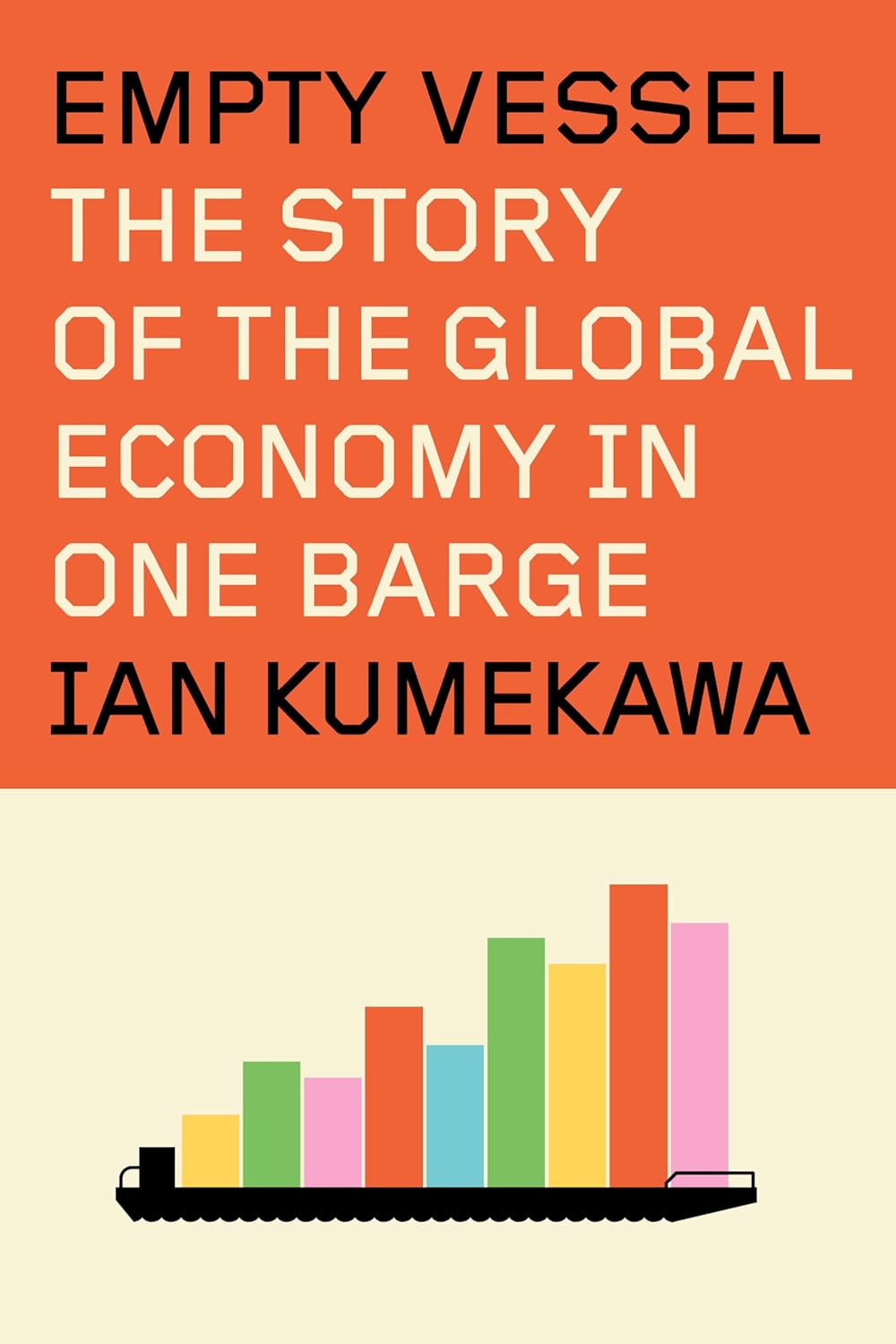
Empty Vessel: The Story of the Global Economy in One Barge
The rise of globalization and financialization as seen from a barge—one Swedish barge, to be exact, built in 1979
What do a barracks for British troops in the Falklands War, a floating jail off the Bronx, and temporary housing for VW factory workers in Germany have in common? The Balder a single barge that served all three roles. Though the name would eventually change to Finnboda 12. And then to Safe Esperia. And later on, to the Bibby Resolution. And after that . . . in short, a vessel with so many names, and so many fates, that to keep it in our sights—as the protagonist of this fascinating economic parable—Ian Kumekawa has no choice but to call it, simply, the Vessel.
Despite its sturdy steel structure, weighing 9,500 deadweight tons, the Vessel is a figure as elusive and abstract as the offshore market it comes to a world of island tax havens, exploited labor forces, free banking zones, Thatcherism, Reaganomics, and mass incarceration, where even the prisoners are held offshore. Fitted with modular shipping containers, themselves the product of standardized global trade, the ship could become whatever the market demanded. Whether caught in an international dispute involving Hong Kong, Nigeria, Indonesia, and the Virgin Islands—to be settled in an English court of law—or flying yet another foreign “flag of convenience” to mask its ownership—the barge is ever a container for forces much larger than even its hulking self.
Empty Vessel is a jaw-dropping microhistory that speaks volumes about the global economy as a whole. In following the Vessel—and its Sister Vessel, built alongside it in Stockholm—from one thankless task to the next, Kumekawa connects the dots of a neoliberal world order in the making, where regulation is for suckers and “Made in USA” feels almost quaint.
What do a barracks for British troops in the Falklands War, a floating jail off the Bronx, and temporary housing for VW factory workers in Germany have in common? The Balder a single barge that served all three roles. Though the name would eventually change to Finnboda 12. And then to Safe Esperia. And later on, to the Bibby Resolution. And after that . . . in short, a vessel with so many names, and so many fates, that to keep it in our sights—as the protagonist of this fascinating economic parable—Ian Kumekawa has no choice but to call it, simply, the Vessel.
Despite its sturdy steel structure, weighing 9,500 deadweight tons, the Vessel is a figure as elusive and abstract as the offshore market it comes to a world of island tax havens, exploited labor forces, free banking zones, Thatcherism, Reaganomics, and mass incarceration, where even the prisoners are held offshore. Fitted with modular shipping containers, themselves the product of standardized global trade, the ship could become whatever the market demanded. Whether caught in an international dispute involving Hong Kong, Nigeria, Indonesia, and the Virgin Islands—to be settled in an English court of law—or flying yet another foreign “flag of convenience” to mask its ownership—the barge is ever a container for forces much larger than even its hulking self.
Empty Vessel is a jaw-dropping microhistory that speaks volumes about the global economy as a whole. In following the Vessel—and its Sister Vessel, built alongside it in Stockholm—from one thankless task to the next, Kumekawa connects the dots of a neoliberal world order in the making, where regulation is for suckers and “Made in USA” feels almost quaint.
336 pages, Hardcover
Published May 6, 2025
Ratings & Reviews
Friends & Following
Create a free account to discover what your friends think of this book!
Community Reviews
Displaying 1 - 30 of 45 reviews

September 8, 2025
I was expecting a story about supply chains, the expansion of global trade, and the quirks of far-flung port towns. My bad. The star of the book is an engine-less barge (and its sister who plays a supporting role); that should have been my clue that this would be a relatively sedentary story.
And so it was, but sedentary did not mean boring. The barge, which was built in Sweden to house off-shore oil workers in the North Sea, floats Zelig-like through the past 50 years -- housing (and sometimes not) British soldiers in the Falklands, prisoners in New York, refugees and prisoners in the UK, and oil workers in Namibia and Nigeria. All the while it is subject to the machinations of flags of convenience, tax-haven shell companies, unpaid bills, changing labor patterns, oil-based kleptocracy, and the injustices of the lightly-regulated world of global shipping.
All in all, an excellent conceit for book that is executed with aplomb.
And so it was, but sedentary did not mean boring. The barge, which was built in Sweden to house off-shore oil workers in the North Sea, floats Zelig-like through the past 50 years -- housing (and sometimes not) British soldiers in the Falklands, prisoners in New York, refugees and prisoners in the UK, and oil workers in Namibia and Nigeria. All the while it is subject to the machinations of flags of convenience, tax-haven shell companies, unpaid bills, changing labor patterns, oil-based kleptocracy, and the injustices of the lightly-regulated world of global shipping.
All in all, an excellent conceit for book that is executed with aplomb.
February 1, 2025
I’m hardly an impartial observer (Ian is one of my closest friends) but this is the best work he’s ever done. A kaleidoscopic look at the workings of international capital, from free zones to offshore drilling to auto exports to postcolonial wars, through the lens of a single boat that doesn’t even have an engine.

June 14, 2025
I wish this was about a container ship moving goods not an accommodation barge. Very interesting concept, to follow the history of the Vessel - but a lot of filler. Does the author really need to explain “mortgages are loans”? Also unnecessarily political - apparently lowering the homicide rate in NYC through policing the city is racist? In any event an interesting book about supply and demand of an accommodation barge with associated history of the place the Vessel was moored. The early chapters about shipbuilding in Sweden and the Falkland War and final chapters in Nigeria were well researched and I enjoyed them

January 5, 2025
In The Vessel, we explore the ship that has been financed and leveraged by different countries of the world, registered in another, and serving different purposes as needed politically, socially, and economically. I’ve always been curious about how things work in open seas, and this book helped me learn a bit more.
I thought this book was very interesting and easy to understand. I also like how each chapter relates to a different region.
Thank you Knopf and Net Galley for an advanced copy of this book.
I thought this book was very interesting and easy to understand. I also like how each chapter relates to a different region.
Thank you Knopf and Net Galley for an advanced copy of this book.

December 12, 2025
struggles to be less dry than everyone I described it to assumes it is — but! an impressively researched treatise on neoliberalism and global interconnection, and an absolutely goated framing device that makes remarkable points over and over again

February 3, 2026
Fascinating!

February 14, 2026
Surprisingly great book; really enjoyed this read. Learned something from each of the chapters. This book covered capitalism, globalism, international law, imperial decline, national sovereignty, inflation, sectoral stagnation, gentrification, mass incarceration, booms, busts, racism, greed and I am sure some other topics I am forgetting.

December 22, 2024
A barge is built 45 years ago, and turned into an accommodation vessel—a “coastel”—to house oil rig workers, soldiers, prisoners, factory workers…but mostly to be carried by the currents of politics, geopolitics, economics, whims of shipping magnates and registry preferences, and culture. Kumekawa does an amazing job of paying attention to the contexts of shipbuilding—regulatory changes, government fiscal policy, crime statistics, historical foundations that set into motion movements carried out in contemporary times. The vessel (and her sister) are not tremendous feats of shipbuilding but it is indicative of the transitory needs of various national and business interests. It’s hard to think of any aspect the author may have missed. But if you needed to know how we got “here,” this book will trace the flow of our shared lifetimes—and our forebears—through the story of this “empty vessel.”
I appreciate the publisher providing an early copy.
I appreciate the publisher providing an early copy.

November 13, 2025
Dr. Kumekawa might be--likely is--a better writer, researcher, and storyteller than his boat is a metaphor (or a decoder ring for neoliberalism). And/but nevertheless, an extremely interesting journey from the surface down to the depths.

May 5, 2025
Rating: 4* of five
The Publisher Says: The rise of globalization and financialization as seen from a barge—one Swedish barge, to be exact, built in 1979
What do a barracks for British troops in the Falklands War, a floating jail off the Bronx, and temporary housing for VW factory workers in Germany have in common? The Balder, a single barge that served all three roles. Though the name would eventually change to Finnboda 12. And then to Safe Esperia. And later on, to the Bibby Resolution. And after that . . . in short, a vessel with so many names, and so many fates, that to keep it in our sights—as the protagonist of this fascinating economic parable—Ian Kumekawa has no choice but to call it, simply, the Vessel.
Despite its sturdy steel structure, weighing 9,500 deadweight tons, the Vessel is a figure as elusive and abstract as the offshore market it comes to a world of island tax havens, exploited labor forces, free banking zones, Thatcherism, Reaganomics, and mass incarceration, where even the prisoners are held offshore. Fitted with modular shipping containers, themselves the product of standardized global trade, the ship could become whatever the market demanded. Whether caught in an international dispute involving Hong Kong, Nigeria, Indonesia, and the Virgin Islands—to be settled in an English court of law—or flying yet another foreign “flag of convenience” to mask its ownership—the barge is ever a container for forces much larger than even its hulking self.
Empty Vessel is a jaw-dropping microhistory that speaks volumes about the global economy as a whole. In following the Vessel—and its Sister Vessel, built alongside it in Stockholm—from one thankless task to the next, Kumekawa connects the dots of a neoliberal world order in the making, where regulation is for suckers and “Made in USA” feels almost quaint.
I RECEIVED A DRC FROM THE PUBLISHER VIA NETGALLEY. THANK YOU.
My Review: I love microhistories. They're so sweeping. They explain so much of life, and politics, and economics. Marc Levinson's terrific THE BOX: How the Shipping Container Made the World Smaller and the World Economy Bigger, for a foundational read in this subject, is another sweeping microhistory to read and enjoy. Or maybe "value" is a better word; the prose in a microhistory is of secondary importance. Clarity is, or should be, the author of a microhistory's primary aim.
Author Kumekawa, Harvard historian by day, read that lesson, internalized it, and applies it to every piece of this complex-but-not-complicated story of the modern world using one barge's life history. The interconnectedness of the global economy, the ways and means of the greedy to avoid scrutiny...always, always it boils down to greed...and detailing the astonishing accumulation of profit from unglamourous quotidian needs-meeting.
What makes the story of a floatel/mobile military barracks/overflow prison as engrossing in this book is the carefully constructed mental diagram of interconnections of the barge's redesigns and refits and destinations. It was, however, that very complexity that knocked off my fifth star. Just too much work needed to follow them all to derive the full import of his points will cost even the most felicitous of writers a star. Shopping for the least profit-trimming places to "register" the barge...that's code for "who will take a small enough bribe for it to be cheaper than actual safety maintenance?"...as seaworthy and owned by a legitimate business has kept the author's research interesting. I expect his search history caused the FBI, NSA, and other initialism-yclept shadow dwellers a good deal of curiosity.
Why I myownself want you to read it is that it uses something very simple as a lens to focus attention on the quiet parts of capitalism that very badly need saying out loud. The money the owners of this barge collected was never huge, but was "protected" from taxation so greater in effect than simple face value. It is the fundament...double sense very much intended...of international capital's business model.
In case you're new here, I do not subscribe to the "greed is good" mindset.
Author Kumekawa's done us a solid in getting curious one day when he heard of a prison barge moored in New York City's river. (I think it's the East River, but can't be sure...could be the Bronx River, could be Long Island Sound, but I'm too lazy to look it up.) Where it's led him is the place I hoped it would go: The bank lobby where the capitalists hide their ill-got gains from the people whose labor produces them.
Good choice for a read in the present political climate.
The Publisher Says: The rise of globalization and financialization as seen from a barge—one Swedish barge, to be exact, built in 1979
What do a barracks for British troops in the Falklands War, a floating jail off the Bronx, and temporary housing for VW factory workers in Germany have in common? The Balder, a single barge that served all three roles. Though the name would eventually change to Finnboda 12. And then to Safe Esperia. And later on, to the Bibby Resolution. And after that . . . in short, a vessel with so many names, and so many fates, that to keep it in our sights—as the protagonist of this fascinating economic parable—Ian Kumekawa has no choice but to call it, simply, the Vessel.
Despite its sturdy steel structure, weighing 9,500 deadweight tons, the Vessel is a figure as elusive and abstract as the offshore market it comes to a world of island tax havens, exploited labor forces, free banking zones, Thatcherism, Reaganomics, and mass incarceration, where even the prisoners are held offshore. Fitted with modular shipping containers, themselves the product of standardized global trade, the ship could become whatever the market demanded. Whether caught in an international dispute involving Hong Kong, Nigeria, Indonesia, and the Virgin Islands—to be settled in an English court of law—or flying yet another foreign “flag of convenience” to mask its ownership—the barge is ever a container for forces much larger than even its hulking self.
Empty Vessel is a jaw-dropping microhistory that speaks volumes about the global economy as a whole. In following the Vessel—and its Sister Vessel, built alongside it in Stockholm—from one thankless task to the next, Kumekawa connects the dots of a neoliberal world order in the making, where regulation is for suckers and “Made in USA” feels almost quaint.
I RECEIVED A DRC FROM THE PUBLISHER VIA NETGALLEY. THANK YOU.
My Review: I love microhistories. They're so sweeping. They explain so much of life, and politics, and economics. Marc Levinson's terrific THE BOX: How the Shipping Container Made the World Smaller and the World Economy Bigger, for a foundational read in this subject, is another sweeping microhistory to read and enjoy. Or maybe "value" is a better word; the prose in a microhistory is of secondary importance. Clarity is, or should be, the author of a microhistory's primary aim.
Author Kumekawa, Harvard historian by day, read that lesson, internalized it, and applies it to every piece of this complex-but-not-complicated story of the modern world using one barge's life history. The interconnectedness of the global economy, the ways and means of the greedy to avoid scrutiny...always, always it boils down to greed...and detailing the astonishing accumulation of profit from unglamourous quotidian needs-meeting.
What makes the story of a floatel/mobile military barracks/overflow prison as engrossing in this book is the carefully constructed mental diagram of interconnections of the barge's redesigns and refits and destinations. It was, however, that very complexity that knocked off my fifth star. Just too much work needed to follow them all to derive the full import of his points will cost even the most felicitous of writers a star. Shopping for the least profit-trimming places to "register" the barge...that's code for "who will take a small enough bribe for it to be cheaper than actual safety maintenance?"...as seaworthy and owned by a legitimate business has kept the author's research interesting. I expect his search history caused the FBI, NSA, and other initialism-yclept shadow dwellers a good deal of curiosity.
Why I myownself want you to read it is that it uses something very simple as a lens to focus attention on the quiet parts of capitalism that very badly need saying out loud. The money the owners of this barge collected was never huge, but was "protected" from taxation so greater in effect than simple face value. It is the fundament...double sense very much intended...of international capital's business model.
In case you're new here, I do not subscribe to the "greed is good" mindset.
Author Kumekawa's done us a solid in getting curious one day when he heard of a prison barge moored in New York City's river. (I think it's the East River, but can't be sure...could be the Bronx River, could be Long Island Sound, but I'm too lazy to look it up.) Where it's led him is the place I hoped it would go: The bank lobby where the capitalists hide their ill-got gains from the people whose labor produces them.
Good choice for a read in the present political climate.
August 27, 2025
I listened to an interview about this book, and I liked it enough to bother to read it. It was a fascinating look at the story of the political economic developments of the modern economy through the POV of a barge. Said barge has changed names numerous times over the years, so it is referred to as "the Vessel".
The vessel was built in Sweden, by a state-owned shipyard at a loss as part of the Swedish govt's desperate attempt to save domestic manufacturing amidst the growing crisis of the post-war economic consensus in the 70s. Initially intended for housing offshore oil workers in the North Sea, it is acquired by a private company that then leases it to the British military to use as army barracks during the Falklands War, a jingoistic political crisis that saved Thatcherism from the brink. After its time flying a British flag, it then reflags under the banners of various different Caribbean and West African nations, mostly former British colonies, as part of a neocolonial infrastructure of maritime policies that allow skirting of taxes and labor laws.
The vessel is then brought to NY harbor in the late 80s/early 90s, where it becomes a prison barge for the NYC local jail system, housing prisoners as well as a drug addiction clinic. From here, it travels to Portland in the UK, where it again serves the same purpose throughout the 00s. It finally becomes used to house offshore oilworkers off the coast of Nigeria, before being scrapped in a facility in India.
The global economic story of the last few decades. Social democratic welfare consensus undermined by globalization leading to neoliberal reforms that necessitate new forms of militarization and privatization. Said reforms undermining the social safety net, legitimating a mass incarceration epidemic that supports private industries. Resource extraction in the Global South maintaining the modern economy of the Global North. The reliance of offshore tax shelters in small island nations to undermine domestic taxation and regulatory power.
It's a well told story, but the biggest issue of the book is the author's tendency to go off on tangents trying to thoroughly explain the specific political economic theory a lot of this is touching on. I understand why, but it definitely interrupts the storytelling and will no doubt be tough to follow along for folks newer to this stuff.
Still, an interesting book and I definitely learned a lot more about maritime capitalism!
The vessel was built in Sweden, by a state-owned shipyard at a loss as part of the Swedish govt's desperate attempt to save domestic manufacturing amidst the growing crisis of the post-war economic consensus in the 70s. Initially intended for housing offshore oil workers in the North Sea, it is acquired by a private company that then leases it to the British military to use as army barracks during the Falklands War, a jingoistic political crisis that saved Thatcherism from the brink. After its time flying a British flag, it then reflags under the banners of various different Caribbean and West African nations, mostly former British colonies, as part of a neocolonial infrastructure of maritime policies that allow skirting of taxes and labor laws.
The vessel is then brought to NY harbor in the late 80s/early 90s, where it becomes a prison barge for the NYC local jail system, housing prisoners as well as a drug addiction clinic. From here, it travels to Portland in the UK, where it again serves the same purpose throughout the 00s. It finally becomes used to house offshore oilworkers off the coast of Nigeria, before being scrapped in a facility in India.
The global economic story of the last few decades. Social democratic welfare consensus undermined by globalization leading to neoliberal reforms that necessitate new forms of militarization and privatization. Said reforms undermining the social safety net, legitimating a mass incarceration epidemic that supports private industries. Resource extraction in the Global South maintaining the modern economy of the Global North. The reliance of offshore tax shelters in small island nations to undermine domestic taxation and regulatory power.
It's a well told story, but the biggest issue of the book is the author's tendency to go off on tangents trying to thoroughly explain the specific political economic theory a lot of this is touching on. I understand why, but it definitely interrupts the storytelling and will no doubt be tough to follow along for folks newer to this stuff.
Still, an interesting book and I definitely learned a lot more about maritime capitalism!
September 5, 2026
Empty Vessel: The Story of the Global Economy in One Barge offers an inventive way to examine globalization, capitalism, and the changing structures of the modern economy. Ian Kumekawa uses the history of a single Swedish built barge as the central thread, following its many transformations across decades and showing how one seemingly ordinary vessel became connected to much larger economic and political forces.
The barge's remarkable range of uses gives the narrative its distinctive character. Over its various lives, the Vessel served as an offshore oil support ship, housing for British troops during the Falklands War, a floating jail, accommodation for Volkswagen workers, and housing for oil workers in Nigeria. Its changing identities provide a concrete way to explore otherwise abstract subjects such as offshore finance, international trade, labor, regulation, and globalization.
What makes the book particularly effective as a microhistory is the way Kumekawa connects the vessel's movements to broader transformations in the global economy. Tax havens, foreign flags, deregulation, financialization, international law, mass incarceration, and the legacy of empire all become part of the story. The result is a history that treats globalization not simply as an abstract economic process but as something operating through physical infrastructure and the lives of people who encounter it.
For readers interested in economic history, globalization, capitalism, international trade, maritime history, political economy, and the history of neoliberalism, Empty Vessel offers an unusual and accessible point of entry. Its combination of archival research, legal records, oral histories, and narrative storytelling also gives it strong potential for university courses, academic discussions, book groups, and readers seeking a more tangible understanding of how the global economy developed.
The barge's remarkable range of uses gives the narrative its distinctive character. Over its various lives, the Vessel served as an offshore oil support ship, housing for British troops during the Falklands War, a floating jail, accommodation for Volkswagen workers, and housing for oil workers in Nigeria. Its changing identities provide a concrete way to explore otherwise abstract subjects such as offshore finance, international trade, labor, regulation, and globalization.
What makes the book particularly effective as a microhistory is the way Kumekawa connects the vessel's movements to broader transformations in the global economy. Tax havens, foreign flags, deregulation, financialization, international law, mass incarceration, and the legacy of empire all become part of the story. The result is a history that treats globalization not simply as an abstract economic process but as something operating through physical infrastructure and the lives of people who encounter it.
For readers interested in economic history, globalization, capitalism, international trade, maritime history, political economy, and the history of neoliberalism, Empty Vessel offers an unusual and accessible point of entry. Its combination of archival research, legal records, oral histories, and narrative storytelling also gives it strong potential for university courses, academic discussions, book groups, and readers seeking a more tangible understanding of how the global economy developed.
February 24, 2026
Critical race theory propaganda thinly veiled as an economics book. The author makes no attempt to portray things objectively and instead it is obvious that his entire investigation into the history of this barge and the events, economies, and world that surrounds it was done with the intent to reinforce his already standing presuppositions. The book sounds like it was written by a Berkley economics student with the goal of proving that rich people are inherently racist rather than doing any deeper level analysis.
Kumekawa spares no opportunity to score points on Margaret thatcher (as if she owed him money personally), Ronald Reagan, or to point out anytime someone in history was a white man. In fact if you read it you will get no shortage of reminders about how white people are hellbent on oppressing black people. Additionally the word "offshore" is used about a billion times which transforms from reinforcing a point into repetitious annoyance.
In case the author reads my review I will say that you are very talented and this book was so close to great but missed the mark due to unnecessary political insertions and poor conclusions. 2 Stars only because I did learn a few things.
Kumekawa spares no opportunity to score points on Margaret thatcher (as if she owed him money personally), Ronald Reagan, or to point out anytime someone in history was a white man. In fact if you read it you will get no shortage of reminders about how white people are hellbent on oppressing black people. Additionally the word "offshore" is used about a billion times which transforms from reinforcing a point into repetitious annoyance.
In case the author reads my review I will say that you are very talented and this book was so close to great but missed the mark due to unnecessary political insertions and poor conclusions. 2 Stars only because I did learn a few things.
June 15, 2026
This book covers arcane history - post World War II de-industrialization in Sweden, housing arrangements for British troops after the Falklands War, re-development of the economies of West Germany and Austria after World War II, NYC's efforts to control crime, Oil drilling in Nigeria, etc.
The book covers the events that happened around a barge, right from its construction to its end of life. The barge is owned and sold through variaous transactions around the world. The barge serves different housing purposes, accommodating troops, oil workers, prisoners, factory wrokers, etc in different parts of the world.
As a reader we are given a deep history of each of the places where the barge moves.
The book is a little repetitive and seems to be try to make the story more philosophical than it really is (is the barge really a "liminal" entity, as the author so often claims?).
It is still an interesting and easy read.
The book covers the events that happened around a barge, right from its construction to its end of life. The barge is owned and sold through variaous transactions around the world. The barge serves different housing purposes, accommodating troops, oil workers, prisoners, factory wrokers, etc in different parts of the world.
As a reader we are given a deep history of each of the places where the barge moves.
The book is a little repetitive and seems to be try to make the story more philosophical than it really is (is the barge really a "liminal" entity, as the author so often claims?).
It is still an interesting and easy read.
October 11, 2025
I really enjoyed reading this book - but its not a book that will appeal to everyone. I think really appreciating the book does require (or at least benefits from) a knowledge / appreciation of the shipping industry (maybe oil & gas too). The author provides a lot of diagrams - charts - schematics which I greatly appreciated - others may not.
The reason why I did not give this book 5* - was the author put perhaps too strong a left-wing / social conscious / anti business spin on things. He did not speak rubbish and I am not so opinionated as to not appreciate his view and perspective. But I'd have liked less of his personal opinion and more objectivity in understanding the incentives of the parties involved which nudged them to behave in certain ways.
Well researched - well written - would recommend s.t. the above.
The reason why I did not give this book 5* - was the author put perhaps too strong a left-wing / social conscious / anti business spin on things. He did not speak rubbish and I am not so opinionated as to not appreciate his view and perspective. But I'd have liked less of his personal opinion and more objectivity in understanding the incentives of the parties involved which nudged them to behave in certain ways.
Well researched - well written - would recommend s.t. the above.
May 24, 2025
When hearing about this book, I thought I might be interested. Then I read some about it and changed my mind. Then I read some reviews that caused me to change my mind again, so I read it. Now that I've read it, I've changed my mind again again. Why? Several reasons:
-this book isn't even about a ship; it's about a barge, which can't move on its own power. It's a book about a big hulk being towed around by others.
-the author's disdain for capitalism, Margaret Thatcher, penology, the oil industry, is eye-rollingly naive
-for most of its life, said barge was a floating hotel; not exactly an integral cog in the global economy
-did I mention the author's priors continually got in the way?
Should have trusted by second instinct. Or my fourth.
-this book isn't even about a ship; it's about a barge, which can't move on its own power. It's a book about a big hulk being towed around by others.
-the author's disdain for capitalism, Margaret Thatcher, penology, the oil industry, is eye-rollingly naive
-for most of its life, said barge was a floating hotel; not exactly an integral cog in the global economy
-did I mention the author's priors continually got in the way?
Should have trusted by second instinct. Or my fourth.
November 4, 2025
Empty Vessel is a story of the history of an object that was involved in a set of overlapping macro economic transformations. It is a physical guide that, like all of us, have been swept up and by the swirling political and economic forces of the past 50 years. Thus even as a dumb pontoon without a voice, becomes the character that serves as a metaphor for other vessels of meaning, people. Its story reinforces that the forces that have pushed this particular vessel around the world, that have filled it with meaning and value, are at work upon all of us too.
May 4, 2026
Very interesting book centered around a barge (and its sister barge) which is more of a "if these walls could talk" story that traces how the barge is used - filled, emptied, and renovated for various ends. It also highlights how jurisdiction is quite different on the water than on land. Oh yeah, and of course the less concrete uses of the vessel as a tax haven. Some may find it a little dry, but I thought it was worth reading and quite interesting.

August 22, 2026
Fun to read material microhistory of neoliberalism and economic transformation told through a single barge’s travels. I liked how Kumekawa was able to connect little perky details about the Vessel to the big ideas in each chapter too.
It would also be a neat exercise to read this through the lens of ontological multiplicity, at the end, he even writes that the Vessel was meant to be “fluid” (!). “The Vessel multiple,” anyone?
It would also be a neat exercise to read this through the lens of ontological multiplicity, at the end, he even writes that the Vessel was meant to be “fluid” (!). “The Vessel multiple,” anyone?

June 15, 2025
I assigned this book as summer reading along with The Wealth of Nations for my AP Gov students. Excellent overview of the economic forces and social systems that shape a world rethinking globalization but still subject to disaster capitalism, imperial decline, inflation, sectoral stagnation, gentrification, mass incarceration, boom and bust cycles for extractive industries

June 23, 2025
I thought this would be more about shipping or global trade, but actually this ship was mostly just used for housing soldiers, prisoners, or workers. The "story of the global economy" subtitle is more about the financing of it, which is interesting but not nearly book-length. So it's mostly just a literal history of the ship, which is pretty impressive but not important.
July 15, 2025
Kumekawa fills a difficult task. To make 300 pages of tales about neoliberalism through a motionless boat not only readable, but engrossing is a tall order. The amount of different subjects and backgrounds that had to be studied is remarkable. Unlike most reviews, I found this on a shelf at a library rather than an advanced copy. It's worth your read.

September 28, 2025
They say cats have nine lives, but what about ships? This in-depth look at the many lives of this one barge gives insight into how the world has shifted over the last half century. It dissects the complexities of global economies and politics that have shaped the ship’s existence and changes that are made to it to reflect new needs and realities. Truly fascinating! And it makes you think about the secret and enormous history of every little item around you.
October 5, 2025
An incredibly insightful analysis of the changing world economy through the story of a barge . Well written and well researched . Amazing understanding of the global offshore and the crazy trade. It shows how the world is tipped in favor of those who can afford lawyers to win when they behave badly.
February 4, 2026
The cover grabbed my attention and I was intrigued by the premise of the story . How could the tale of a barge be so fascinating ?
The way the author ties in major economic events with the duties of the this vessel is very clever and well researched . The story of globalisation through the lense of one ship.
The way the author ties in major economic events with the duties of the this vessel is very clever and well researched . The story of globalisation through the lense of one ship.
February 25, 2026
I was excited to start this book but was ultimately quite disappointed. Whilst the different stages of the barge's life are somewhat interesting, the global economic side of things feel very shoehorned, quite forced and not particularly relevant.
The premise has potential but I thought it was poorly executed
The premise has potential but I thought it was poorly executed

June 23, 2025
Fantastic book that makes globalization an approachable issue to learn about. Weaves a story about a single barge through 50 years of world history while giving all the details to the reader that they could desire.

September 11, 2025
Surprisingly easy to read given the complexity of the topic. The book does a very good job of using an actual physical object to situate us in the decidedly non-physical world of the global economy. It's like a beach read for people with an interest in economics.
June 27, 2026
A misleading title with very little economic discussion. An unhelpful amount of personal political options and even more on contract law! It's a shame because the basic idea is excellent, if only that had been the book he chose to write.
July 21, 2026
A floating hotel goes for a cruise
Its a great book about so much more than a barge. You the vessel around the world through places and policies that demand its use. It gets around through 4 continents, A constant change of names, owners and ideas of how to use it. Fascinating.
Its a great book about so much more than a barge. You the vessel around the world through places and policies that demand its use. It gets around through 4 continents, A constant change of names, owners and ideas of how to use it. Fascinating.
Displaying 1 - 30 of 45 reviews