Jump to ratings and reviews
Rate this book

Enuma Elish (2 Volumes in One): The Seven Tablets of Creation; The Babylonian and Assyrian Legends Concerning the Creation of the World and of Mankind

Rate this book
"Enuma Elish (2 Volumes in One): The Seven Tablets of Creation; The Babylonian and Assyrian Legends Concerning the Creation of the World and of Mankind"

"The Seven Tablets of Creation": The complete Enuma Elish, detailing the Babylonian creation myth and the rise of Marduk.

"The Babylonian and Assyrian Legends": Additional creation myths from Babylonian and Assyrian traditions.

This volume provides a comprehensive look at Mesopotamian creation stories and religious beliefs.

134 pages, Kindle Edition

Published August 8, 2024

1 person is currently reading
1 person want to read

About the author

Ratings & Reviews

What do you think?
Rate this book

Friends & Following

Create a free account to discover what your friends think of this book!

Community Reviews

5 stars
1 (100%)
4 stars
0 (0%)
3 stars
0 (0%)
2 stars
0 (0%)
1 star
0 (0%)
Displaying 1 of 1 review
Profile Image for Mark Tompkins.
Author 24 books15 followers
January 9, 2026
More Than Myth: A Masterclass in Divine Politics and Polemics

To read the Enuma Elish is to gain direct entry into the religious and political mindset of ancient Babylon. It is far more than a simple creation story; it is the foundational theological charter for a civilization, a text that is at once a cosmic epic, a political justification, and the essential backdrop against which the Hebrew Bible's own creation account was consciously written. For its unparalleled historical and literary importance, it is an indispensable 5-star document.

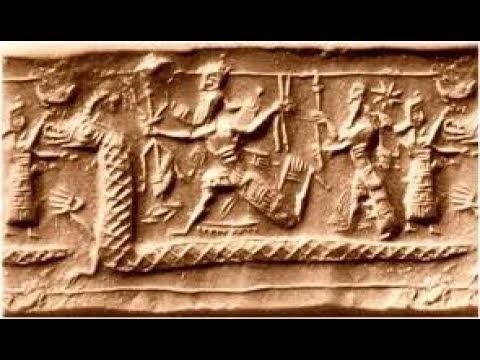
At its surface, the epic narrates a cosmic civil war. The universe begins not in peace, but in the chaotic mingling of primordial waters, personified by Tiamat (salt water) and Apsu (fresh water). Their noisy divine offspring first murder Apsu, leading the formidable Tiamat to declare war on her descendants. After all the elder gods shrink from the challenge, the young, powerful storm-god Marduk agrees to be their champion, but only after securing a pact that will grant him supreme and eternal kingship upon his victory.

The subsequent battle, and Marduk’s savage victory over Tiamat, is the central act of creation. Marduk forms the heavens and the earth from Tiamat’s dismembered corpse and establishes the cosmic order. In a final, grim act, he creates humanity from the blood of Tiamat’s defeated general, Kingu, for the explicit purpose of serving as the slaves of the gods, freeing them from labor forever.

However, the text’s true genius lies beneath the surface. This is not myth for myth’s sake; it is a powerful piece of political theology. The epic’s primary function was to explain and justify how Marduk, the patron god of the upstart city of Babylon, supplanted the ancient Sumerian god Enlil as the head of the Mesopotamian pantheon. Marduk’s victory in the divine realm is a direct reflection of Babylon’s political ascendancy in the earthly one.

For most modern readers, the text's greatest value lies in its role as the essential context for understanding the creation account in Genesis 1. When the Jewish intellectual elite were exiled to Babylon in the 6th century BCE, the Enuma Elish was the state religion of their conquerors. Read in this light, Genesis 1 transforms from a simple cosmogony into a breathtakingly bold and deliberate polemic—a systematic refutation of the Babylonian worldview.

Consider the direct contrasts:

Where the Enuma Elish depicts creation born from violent, chaotic warfare, Genesis 1 depicts creation by the calm, orderly, spoken word of a single, unopposed deity.

Where the Babylonian epic has a pantheon of flawed, plotting, human-like gods, Genesis presents a transcendent and singular God.

Where the sun, moon, and sea are powerful, often malevolent deities for Babylon, Genesis demotes them to mere objects ("lamps," "waters") created by God's command.

And most profoundly, where the Enuma Elish defines humanity's purpose as slavery, Genesis elevates humanity by creating them in the "image of God" to be stewards of creation.

The Enuma Elish can be a stark and repetitive read for those accustomed to modern narrative conventions. Its value is not in its prose but in its profound historical significance. It is an indispensable text for any serious student of the Ancient Near East, comparative mythology, or biblical studies. It is not merely a story of how the world began; it is a profound testament to how a civilization used myth to define its place in the cosmos and justify its power on earth.
This entire review has been hidden because of spoilers.
Displaying 1 of 1 review

Can't find what you're looking for?

Get help and learn more about the design.