

What do you think?

Sunburst: The Rise of Japanese Naval Air Power, 1909-1941
This acclaimed sequel to the Peattie/Evans prizewinning work, Kaigun , illuminates the rise of Japanese naval aviation from its genesis in 1909 to its thunderbolt capability on the eve of the Pacific war. In the process of explaining the navy s essential strengths and weaknesses, the book provides the most detailed account available in English of Japan s naval air campaign over China from 1937 to 1941. A final chapter analyzes the utter destruction of Japanese naval air power by 1944.
392 pages, Paperback
First published January 1, 2002
About the author
Mark R. Peattie
11 books8 followersThe son of expatriate writers, Mark Peattie grew up in Santa Barbara, California. He earned a BA in history at Pomona College and an MA in history at Stanford University. After service in Asia and Washington, DC as a member of the U.S. Information Agency, Peattie returned to the United States and earned a doctorate in history from Princeton University. He taught at Pennsylvania State University, the University of California – Los Angeles and the University of Massachusetts in Boston. For many years, Peattie was a research fellow at the Edwin O. Reischauer Institute of Japanese Studies at Harvard University. He was also a senior research staff member of the Hoover Institute on War, Revolution, and Peace, before becoming a visiting scholar at the Walter H. Shorenstein Asia-Pacific Research Center at Stanford University.
Ratings & Reviews
Friends & Following
Create a free account to discover what your friends think of this book!
Community Reviews
Displaying 1 - 14 of 14 reviews

October 8, 2021
Investigation and discussion of the use of air power in the Imperial Japanese Navy (IJN) to achieve air superiority/supremacy at sea from the early 1900’s to the IJN’s disbandment at the end of the Pacific War.
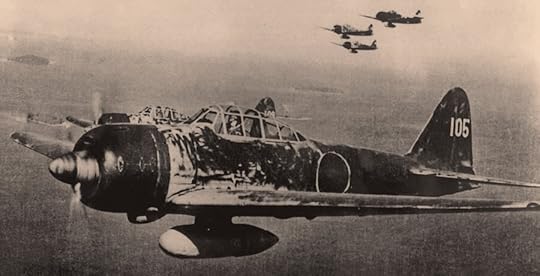
Mitsubishi A6M carrier fighter called the “Zero” by Allied pilots during the Pacific War. Note the characteristic Japanese, 3-plane "Shōtai" flying formation shown.
My dead tree version was 392-pages. It had a US 2002 copyright. This book includes nine (9) Appendices, Footnotes, and a bibliography.
Mark R. Peattie was an American military historian and Japanologist. He passed in 2014. He authored and co-authored five books on Japanese military history. The last book I read by him was Kaigun: Strategy, Tactics, and Technology in the Imperial Japanese Navy, 1887-1941 (my review).
This book is an advanced/intermediate work. Its strongly recommended having a background in: late 19th to early 20th century Japanese Imperial history, world naval history, and the history of military aviation before reading this book.
This book is very much the child of Kaigun, a book the author wrote with David C. Evans 5-years earlier. It contains a lot of IJN naval aviation material that did not make it into that more general work. While not necessary, reading Kaigun is also recommended before reading this book. Comparison between the two books in this review was unavoidable by me.
Sunburst is a good adjunct read for someone with both a strong background and a keen interest in the history of the Pacific War’s air war, specifically from the perspective of the IJN. In great detail it goes through the history of IJN naval aviation: personalities, technology, organizational behavior and aviation-related naval doctrine. Note this book contains no blow-by-blow description of any battle, other than to point-out the: doctrinal, organizational, or technological reason for victory or defeat. Having read Kaigun, I recieved no great revelations from this book. However, it gave me a deeper understanding of the Air/Sea battlespace of the mid-20th Century. Reading it, I was constantly reminded of US Army General Omar Bradley's famous quote: “Amateurs talk strategy. Professionals talk logistics.”
In general, the book was well edited. It's prose was good, if a tad flamboyant in places. It was less technically dense than some military, technology histories I’ve read. Although, the presentation was very even throughout in level-of-detail. In general, information was conveyed in a clear and unambiguous fashion.
Use of maps was good. Although, there were only six (6), they adequately described the geographical considerations toward IJN naval aviation doctrine.
I found the diagrams wanting. This opinion was due to contrast with Kaigun’s excellent diagrams. Peattie opted to put the great majority of the aircraft and aircraft-related ship diagrams in separate Appendices. This de-coupled them from the narrative. In contrast, Kaigun embedded many more diagrams in the narrative as they appeared in the discussion. I spent a lot of time poring over the diagrams. I greatly preferred the additional, immediate context of Kaigun's presentation. In addition, Kaigun’s diagrams of ships and planes were generally larger. However, both books contained the same diagrammatic, level-of-detail.
Chart and graph usage was fair. Their usage would have benefited from some information design and data visualization analysis.
Mentioned above, was that this book had nine (9) Appendices. Its total 360-pages had more than 100-pages of Appendices ranging from Naval Aircraft Engines and Glossary of Japanese Naval Aviation Terms to the excellent line diagrams of ships and planes. This lent a more “Reference Work” character to the book than something you’d read from beginning-to-end.
Peattie wrote this book to describe the IJN’s air power organization, technology, strategy and tactics. To this end, it was successful. To a large extant he was building upon the work done in Kaigun which addressed these aspects of the IJN generally. However, Kaigun went to lengths to break the link between cause and effect of politics and diplomacy on the IJN. Peattie breaks with this. He uses historical military and diplomatic events in the descriptions of the success or failure of naval aviation: doctrine, organization, or technology.
For example, the IJN was greatly affected by Japanese: politics, diplomacy and its nemesis the Imperial Japanese Army. There was a large discussion of the evolution of IJN naval aviation within the detailed context of the Second Sino-Japanese War , which was historically the Imperial Japanese Army’s war.
There was a generally chronological organization to the book. The largest parts being the: initial development of the aviation industry in Japan post WWI, the creation of both Army and Navy aviation branches of the military, the evolution of the IJN’s peculiar land-based and carrier based force for defense of the home islands, the crucible of the Second Sino-Japanese War in creating the naval air force that entered the Pacific War, and the performance and destruction of that force during the course of that war.
I found four (4) points to be most interesting. The first was the 1920’s development of a world-class, Japanese aircraft industry that eventually became an early example of the military industrial complex. The second was a detailed description, including maps, of the planned strategic defense of the home islands with a remote, cordon of island airbases (“unsinkable aircraft carriers”). The operation, and locations of these strong points was missing in Kaigun and is ill documented in the literature. Third, was the author's surprising break with American, Pacific War, military history, orthodoxy. He maintained that the spine of IJN aviation wasn’t broken at Midway. There, a greater number of aircrews survived, despite the sinking of their carriers, than was previously assumed. It was the meatgrinder of Guadalcanal and the Solomons that wasted the cadre of veteran, naval aircrews available at the start of the war. And finally, a very succinct description of the failures in naval doctrine and Japanese leadership that led to the loss of the air war by the IJN over the Pacific. I’ve included his summary here:
I note that most of these were organizational behavior issues.
This book was a story of: men, machines and organizations in contention. Its focus on a single part of the IJN over only about 40-years, during a period of rapid technological and political change was a deeper-dive than provided by Kaigun. At about 250-pages of narrative, this was a very slim work. I came away happy with the content of the book, but disappointed with its format. However, it was still a worthwhile read for someone who already has a background in 20th Century military and diplomatic history and the Pacific War, and with a deep interest in the many facets of achieving air superiority and air supremacy in modern naval history.
In addition to Kaigun: Strategy, Tactics, and Technology in the Imperial Japanese Navy, 1887-1941 , readers of this book may also be interested in: Fire In The Sky: The Air War In The South Pacific by Eric M. Bergerud who is quoted in this book extensively.
Mitsubishi A6M carrier fighter called the “Zero” by Allied pilots during the Pacific War. Note the characteristic Japanese, 3-plane "Shōtai" flying formation shown.
My dead tree version was 392-pages. It had a US 2002 copyright. This book includes nine (9) Appendices, Footnotes, and a bibliography.
Mark R. Peattie was an American military historian and Japanologist. He passed in 2014. He authored and co-authored five books on Japanese military history. The last book I read by him was Kaigun: Strategy, Tactics, and Technology in the Imperial Japanese Navy, 1887-1941 (my review).
This book is an advanced/intermediate work. Its strongly recommended having a background in: late 19th to early 20th century Japanese Imperial history, world naval history, and the history of military aviation before reading this book.
This book is very much the child of Kaigun, a book the author wrote with David C. Evans 5-years earlier. It contains a lot of IJN naval aviation material that did not make it into that more general work. While not necessary, reading Kaigun is also recommended before reading this book. Comparison between the two books in this review was unavoidable by me.
Sunburst is a good adjunct read for someone with both a strong background and a keen interest in the history of the Pacific War’s air war, specifically from the perspective of the IJN. In great detail it goes through the history of IJN naval aviation: personalities, technology, organizational behavior and aviation-related naval doctrine. Note this book contains no blow-by-blow description of any battle, other than to point-out the: doctrinal, organizational, or technological reason for victory or defeat. Having read Kaigun, I recieved no great revelations from this book. However, it gave me a deeper understanding of the Air/Sea battlespace of the mid-20th Century. Reading it, I was constantly reminded of US Army General Omar Bradley's famous quote: “Amateurs talk strategy. Professionals talk logistics.”
In general, the book was well edited. It's prose was good, if a tad flamboyant in places. It was less technically dense than some military, technology histories I’ve read. Although, the presentation was very even throughout in level-of-detail. In general, information was conveyed in a clear and unambiguous fashion.
Use of maps was good. Although, there were only six (6), they adequately described the geographical considerations toward IJN naval aviation doctrine.
I found the diagrams wanting. This opinion was due to contrast with Kaigun’s excellent diagrams. Peattie opted to put the great majority of the aircraft and aircraft-related ship diagrams in separate Appendices. This de-coupled them from the narrative. In contrast, Kaigun embedded many more diagrams in the narrative as they appeared in the discussion. I spent a lot of time poring over the diagrams. I greatly preferred the additional, immediate context of Kaigun's presentation. In addition, Kaigun’s diagrams of ships and planes were generally larger. However, both books contained the same diagrammatic, level-of-detail.
Chart and graph usage was fair. Their usage would have benefited from some information design and data visualization analysis.
Mentioned above, was that this book had nine (9) Appendices. Its total 360-pages had more than 100-pages of Appendices ranging from Naval Aircraft Engines and Glossary of Japanese Naval Aviation Terms to the excellent line diagrams of ships and planes. This lent a more “Reference Work” character to the book than something you’d read from beginning-to-end.
Peattie wrote this book to describe the IJN’s air power organization, technology, strategy and tactics. To this end, it was successful. To a large extant he was building upon the work done in Kaigun which addressed these aspects of the IJN generally. However, Kaigun went to lengths to break the link between cause and effect of politics and diplomacy on the IJN. Peattie breaks with this. He uses historical military and diplomatic events in the descriptions of the success or failure of naval aviation: doctrine, organization, or technology.
For example, the IJN was greatly affected by Japanese: politics, diplomacy and its nemesis the Imperial Japanese Army. There was a large discussion of the evolution of IJN naval aviation within the detailed context of the Second Sino-Japanese War , which was historically the Imperial Japanese Army’s war.
There was a generally chronological organization to the book. The largest parts being the: initial development of the aviation industry in Japan post WWI, the creation of both Army and Navy aviation branches of the military, the evolution of the IJN’s peculiar land-based and carrier based force for defense of the home islands, the crucible of the Second Sino-Japanese War in creating the naval air force that entered the Pacific War, and the performance and destruction of that force during the course of that war.
I found four (4) points to be most interesting. The first was the 1920’s development of a world-class, Japanese aircraft industry that eventually became an early example of the military industrial complex. The second was a detailed description, including maps, of the planned strategic defense of the home islands with a remote, cordon of island airbases (“unsinkable aircraft carriers”). The operation, and locations of these strong points was missing in Kaigun and is ill documented in the literature. Third, was the author's surprising break with American, Pacific War, military history, orthodoxy. He maintained that the spine of IJN aviation wasn’t broken at Midway. There, a greater number of aircrews survived, despite the sinking of their carriers, than was previously assumed. It was the meatgrinder of Guadalcanal and the Solomons that wasted the cadre of veteran, naval aircrews available at the start of the war. And finally, a very succinct description of the failures in naval doctrine and Japanese leadership that led to the loss of the air war by the IJN over the Pacific. I’ve included his summary here:
While the reasons are multiple, a few general categories stand out: first, the failure of the navy to anticipate the kind of air combat it would be obliged to wage; second, once in the new kind of air war, the failure to make the right decisions to deal with the realities; and third, the inability of Japanese industry and technology to support Japanese naval aviation against the emerging numerical and qualitative superiority of American air power.
I note that most of these were organizational behavior issues.
This book was a story of: men, machines and organizations in contention. Its focus on a single part of the IJN over only about 40-years, during a period of rapid technological and political change was a deeper-dive than provided by Kaigun. At about 250-pages of narrative, this was a very slim work. I came away happy with the content of the book, but disappointed with its format. However, it was still a worthwhile read for someone who already has a background in 20th Century military and diplomatic history and the Pacific War, and with a deep interest in the many facets of achieving air superiority and air supremacy in modern naval history.
In addition to Kaigun: Strategy, Tactics, and Technology in the Imperial Japanese Navy, 1887-1941 , readers of this book may also be interested in: Fire In The Sky: The Air War In The South Pacific by Eric M. Bergerud who is quoted in this book extensively.

February 18, 2013
I’m almost at a loss for reviewing this book as I’m so polarized over the way in which the author has presented his story. I guess the best is to simply note my observations.
Dislikes:
1. Of the total pages in the book, the author’s narrative or story is about half. The remainder includes appendices, general notes, etc. relating to his text. Great reference but bad format; your call.
2. The author lists his footnotes in a section following the appendices, guess that is not uncommon but it makes it damn difficult to read the text and than bounce 200 pages to find the footnote. I personally hate this especially in non-fiction history where added facts or background can clarify a lot and can add points of interest.
3. Maybe I’m simple but the author appears to love lengthily sentences. I often found I had to re-read a sentence as it has broke down with multiple inserts bound by commas. Thus read once on the fly it had to be re-read for clarity.
4. The author confined his text relative of his thesis scope, Japanese Naval Air Power 1900 thru 1945. Generally I’d say that is a positive but often the author constrained information so his presentation appeared in a summary fashion. There was much to be learned from his book but much more could have been given via “drill downs” on a sub-topics.
5. I was disappointed the author did not go into greater detail on pilot training. As a Naval Aviator, I believe the Japanese pilots of WWII to have been the best trained ever, would have liked the coverage.
Likes:
1. The reason I read history is to learn. I learned much on the development of the Japanese Naval Air Forces, the people, players, contributors, structure and events.
2. Due to the summary level of the author’s style of writing, it read fairly quickly.
3. Obviously lots or great research on the topic!
Summary:
The author presents a number of observations on why the Japanese Naval Air failed, from planning for a short war, to the lack of long range bombers, to training constraints of pilots and maintenance personnel, etc. In my eyes there is a short answer, Poor and short sighted planning by the Naval Senior Staff. If the edge of the samurai blade is sharp but there is no strength behind it, it will certainly fail. The lack of training, materials, pilots/support resources, etc all killed a talented and outstanding group of aviators.
Dislikes:
1. Of the total pages in the book, the author’s narrative or story is about half. The remainder includes appendices, general notes, etc. relating to his text. Great reference but bad format; your call.
2. The author lists his footnotes in a section following the appendices, guess that is not uncommon but it makes it damn difficult to read the text and than bounce 200 pages to find the footnote. I personally hate this especially in non-fiction history where added facts or background can clarify a lot and can add points of interest.
3. Maybe I’m simple but the author appears to love lengthily sentences. I often found I had to re-read a sentence as it has broke down with multiple inserts bound by commas. Thus read once on the fly it had to be re-read for clarity.
4. The author confined his text relative of his thesis scope, Japanese Naval Air Power 1900 thru 1945. Generally I’d say that is a positive but often the author constrained information so his presentation appeared in a summary fashion. There was much to be learned from his book but much more could have been given via “drill downs” on a sub-topics.
5. I was disappointed the author did not go into greater detail on pilot training. As a Naval Aviator, I believe the Japanese pilots of WWII to have been the best trained ever, would have liked the coverage.
Likes:
1. The reason I read history is to learn. I learned much on the development of the Japanese Naval Air Forces, the people, players, contributors, structure and events.
2. Due to the summary level of the author’s style of writing, it read fairly quickly.
3. Obviously lots or great research on the topic!
Summary:
The author presents a number of observations on why the Japanese Naval Air failed, from planning for a short war, to the lack of long range bombers, to training constraints of pilots and maintenance personnel, etc. In my eyes there is a short answer, Poor and short sighted planning by the Naval Senior Staff. If the edge of the samurai blade is sharp but there is no strength behind it, it will certainly fail. The lack of training, materials, pilots/support resources, etc all killed a talented and outstanding group of aviators.
September 27, 2012
Peattie does a good job tracing the start of Japanese aviation through WWII. The Japanese got an early start on aviation with its use for reconnaissance, but fell behind and later resorted to initially copying British aircraft and receiving their initial training from them. Once the Japanese moved toward war they began their own R&D which eventually gave them the Zero fighter.
Overall Peatties argument is that the Japanese lost because they planned for a short war which turned into a war of attrition at the Solomon islands. The Japanese lacked the personnel, aircraft, industrial capacity and logistics necessary to win a war of attrition with the US.
Peattie makes several other arguments of the Japanese shortfalls including the service rivalry between their army and navy, both of which held a portion of their air assets. He also states the Japanese were behind technologically and didn't have the radar or bomb fuzes the US did. Additionally, although the Zero was highly maneuverable, the Japanese traded off speed, ruggedness, and a high powered engine to attain it.
At the end of the book Peattie makes the comment that one of the reasons the japanese lost was a failure to develop a long range strategic bomber. Considering the lack of strategic targets in China this doesn't make much sense, but if viewed from the aspect of needing a long range bomber just due to the geographic distances of the islands in the Pacific I would agree. Peattie does not do a good job in clarifying his meaning on this statement.
Two aspects the Japanese got right was developing the a long range fighter to protect the bomber force and the concentrated use of airpower.
Overall Peatties argument is that the Japanese lost because they planned for a short war which turned into a war of attrition at the Solomon islands. The Japanese lacked the personnel, aircraft, industrial capacity and logistics necessary to win a war of attrition with the US.
Peattie makes several other arguments of the Japanese shortfalls including the service rivalry between their army and navy, both of which held a portion of their air assets. He also states the Japanese were behind technologically and didn't have the radar or bomb fuzes the US did. Additionally, although the Zero was highly maneuverable, the Japanese traded off speed, ruggedness, and a high powered engine to attain it.
At the end of the book Peattie makes the comment that one of the reasons the japanese lost was a failure to develop a long range strategic bomber. Considering the lack of strategic targets in China this doesn't make much sense, but if viewed from the aspect of needing a long range bomber just due to the geographic distances of the islands in the Pacific I would agree. Peattie does not do a good job in clarifying his meaning on this statement.
Two aspects the Japanese got right was developing the a long range fighter to protect the bomber force and the concentrated use of airpower.
September 6, 2024
Despite having been a student of military aviation all my life, I learned some interesting information, which lead to my seeing old concepts in better light.
The author was very well knowledgeable on his subject, and his presentation was (mostly) clear and straightforward. There were a few points that he rent over repeatedly, losing momentum.
The author was very well knowledgeable on his subject, and his presentation was (mostly) clear and straightforward. There were a few points that he rent over repeatedly, losing momentum.
April 1, 2020
Nice enough, but as others have pointed out quite short.
March 20, 2021
Excellent book. A concise account of the rise and fall of Japanese Naval Air Power.

January 16, 2022
Excellent book but a has a fair amount of redundancy with Kaigun. Good appendices.

September 28, 2012
Sunburst is a sort of companion to Peattie's earlier book on the Japanese Navy. It does a good job surveying the beginnings of the Japanese Air Force, from its creation in 1909 up through its first true combat test - the air war in China in 1937-1941.
For the naval aviation buff, the book provides a number of very well done illustrations of early aircraft carriers as well as early aircraft and the stats to go with them. Given the title of the book (Naval Air Power, 1909-1941), it is not surprising that very little time is spent discussing the air war of World War II. However, the significant detail leading up to it really leaves the reader wanting more. It's almost as if we are brought to the crescendo of 30 years of development and then quickly gloss over the ultimate downfall of the force. With that said, the author is no less thorough here than in the rest of the chapters, each one spending just enough time to introduce the reader to the major muscle movements of each period.
Be that as it may, Peattie does take a solid stand regarding the cause of Japanese naval aviation disintegration. Simply put, the Japanese had been planning for a quick route of the U.S. At the end of the day, their strategy depended on a swift victory and when the U.S. turned the Pacific into a war of attrition, they simply could not keep up. While all aspects of the force were affected, the author argues it was the attrition of the pilots (small number of exquisitely trained vs U.S. large number of adequately trained) and ground crew that ultimately led to their demise. Though clearly superior to U.S. pilots as the war opened, the Americans eventually caught up, adjusted tactics, and benefited from simple math. Interestingly, the author argues that while the Battles of Coral Sea and Midway were certainly critical, it was actually the attrition experienced in the Solomons that ultimately did them in. The loss of final two carrier airgroups along with a "paucity" of airfields on Rabaul from which to operate land-based aircraft signaled the end.
For the naval aviation buff, the book provides a number of very well done illustrations of early aircraft carriers as well as early aircraft and the stats to go with them. Given the title of the book (Naval Air Power, 1909-1941), it is not surprising that very little time is spent discussing the air war of World War II. However, the significant detail leading up to it really leaves the reader wanting more. It's almost as if we are brought to the crescendo of 30 years of development and then quickly gloss over the ultimate downfall of the force. With that said, the author is no less thorough here than in the rest of the chapters, each one spending just enough time to introduce the reader to the major muscle movements of each period.
Be that as it may, Peattie does take a solid stand regarding the cause of Japanese naval aviation disintegration. Simply put, the Japanese had been planning for a quick route of the U.S. At the end of the day, their strategy depended on a swift victory and when the U.S. turned the Pacific into a war of attrition, they simply could not keep up. While all aspects of the force were affected, the author argues it was the attrition of the pilots (small number of exquisitely trained vs U.S. large number of adequately trained) and ground crew that ultimately led to their demise. Though clearly superior to U.S. pilots as the war opened, the Americans eventually caught up, adjusted tactics, and benefited from simple math. Interestingly, the author argues that while the Battles of Coral Sea and Midway were certainly critical, it was actually the attrition experienced in the Solomons that ultimately did them in. The loss of final two carrier airgroups along with a "paucity" of airfields on Rabaul from which to operate land-based aircraft signaled the end.

May 24, 2011
In the late 1920s and early 1930s, Japanese naval leaders debated the allocation of their resources between airpower and surface ships. In the end, the latter won out. It is an interesting historical “what-if” to consider the results had they gone with the choice to build carriers, aircraft and to develop pilots and aircrews rather than build the super battleships Musashi and Yamato. While it is likely that the industrial might of the US would still have led to an ultimate allied victory, it would not be unreasonable to assume that the early successes of the Japanese Imperial Fleet would have been even more devastating to the allies and much more difficult to overcome. One extra carrier division at the Coral Sea, for example, would likely have led to the isolation and probable occupation of Australia.
Sunburst is an excellent analysis of the development Japanese naval airpower up to the beginning of the Pacific War. Peattie covers the personalities, technologies and weapon systems, doctrines and errors of this development in a readable and comprehensive manner. The appendices detail important figures involved, key aircraft used and carriers built. This book is an invaluable resource for any reader with a serious interest in the Second World War in the Pacific.
Sunburst is an excellent analysis of the development Japanese naval airpower up to the beginning of the Pacific War. Peattie covers the personalities, technologies and weapon systems, doctrines and errors of this development in a readable and comprehensive manner. The appendices detail important figures involved, key aircraft used and carriers built. This book is an invaluable resource for any reader with a serious interest in the Second World War in the Pacific.
January 20, 2016
While a bit lacking in narrative, the book more than makes up for this with new terms and explaining what they mean. The organizational structure, ship and aircraft detail and force compositions are quite extensive; much of which I was not aware of.
The book does not go into extensive details about the campaigns and battles of the war. The focus is on the structure, tactics, doctrine and philosophy of the naval officers and pilots that were used in both the China War and the Pacific War. One statistical quality this book has that I've never seen in other books is that it gives estimated hanger dimensions of the Japanese aicraft carriers in square feet. Every other book will give a specific plane capacity but overlooks the fact that as planes get larger, carriers carry fewer planes. So a carrier that carried say 90 planes in 1941 but has replaced the original planes with newer, more modern aircraft will not be carrying 90 planes in 1945.
The book does not go into extensive details about the campaigns and battles of the war. The focus is on the structure, tactics, doctrine and philosophy of the naval officers and pilots that were used in both the China War and the Pacific War. One statistical quality this book has that I've never seen in other books is that it gives estimated hanger dimensions of the Japanese aicraft carriers in square feet. Every other book will give a specific plane capacity but overlooks the fact that as planes get larger, carriers carry fewer planes. So a carrier that carried say 90 planes in 1941 but has replaced the original planes with newer, more modern aircraft will not be carrying 90 planes in 1945.

May 10, 2011
This work started as three chapters on the history of Japanese naval aviation, which were excised from Kaigun, the history of the Imperial Japanese Navy, to limit the volume of that already voluminous work. Sunburst is a worthy complement to it, which has the merit of using source materials in Japanese to provide information not previously available in the West. The work has some minor flaws that are probably due to Peattie being a naval historian more than an aviation historian. But these a more than compensated for by the wealth of new information. Admittedly, long chapters on Japanese service politics will not be to everyone's taste, but to those who persevere will be rewarded with a better insight in the creation, the successes, and the dramatic, total destruction of the Japanese Imperial Navy.

Read
March 25, 2016This was split off from Kaigun: Strategy, Tactics, and Technology in the Imperial Japanese Navy, 1887-1941 when Evans and Peattie realized they couldn't give it its proper treatment without making the previous book unreadably long; Peattie finished the work after Evans passed away. Like Kaigun, Sunburst is focused on the prewar Navy but is equally foundational.

August 20, 2018
The sequel to Kaigun lives up to the high standards of the original, balancing between the importance of technology, industry, personality, and doctrine. It also much more readable than most. It has one advantage over Kaigun: the chapter about the navy during the war shows the implications of pre-1941 developments.
March 11, 2016
An excellent overview of the Imperial Japanese Navy Air Service. My only complaints involve relatively minor factual errors and misunderstandings about technology.
Displaying 1 - 14 of 14 reviews