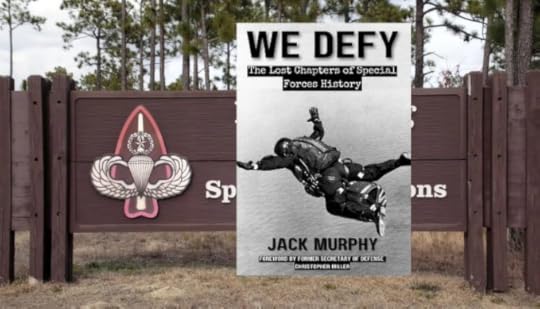
On a clear night in 1983, a U.S. Special Forces team is issued a backpack nuclear weapon at an airfield where two men in black appear and declare that they now have operational control over the team for a real life mission. Issued live ammo, the team rigs the nuke for a parachute insertion and takes off to hit a strategic target in Cuba.
This is one of the many vignettes in We Defy which covers the “lost” and previously unpublished chapters of Special Forces history. Meet the holocaust survivor who led a Special Forces unit that included former Nazis conducting undercover assignments in Berlin, or the first woman assigned to a Special Forces team way back in 1977. Read about little known rescue missions and the history of specific capabilities developed by Special Forces from hostage rescue to nuclear sabotage.
Chapters of this lost history included in We Defy are Special Forces Detachment A, the undercover Green Beret sabotage teams in Berlin during the Cold War, Detachment K which is a Special Forces resident team stationed in South Korea playing a low key but vital role in checking North Korean aggression. Blue America's first counter-terrorism team that existed before Delta Force. The Special Forces Commanders In-extremis Force (CIF), their creation, secret missions (before and during the Global War on Terror), and where they are today. Finally, Green the Special Forces nuclear sabotage teams poised to turn off entire parts of the world if the Cold War went hot.
Based on dozens of primary source interviews with the men and women who lived it, We Defy blows the doors off previously highly classified Special Forces units and missions.
Jack Murphy--a renowned journalist and SOF veteran--has compiled a must-read history of the US Army Special Forces in WE DEFY.
To be clear: this is not a complete, back to front history. This is a history of the sections that are often omitted entirely or glossed over, such as Detachment Berlin or the Green Light teams. The Cold War was a busy time for Special Forces, particularly in the days before Special Mission Units. Murphy has managed to capture an enormous chunk of that history in this concise yet comprehensive work.
The entire book was a fascinating read. I particularly found the chapters on Detachment Korea and the CIF companies to be the most interesting, the former because I had not read much about them previously and the latter because Murphy gets right down to what CIF/CRF/CTAC was and wasn't.
SOF history geeks and action writers (such as myself) rejoice. WE DEFY is here and it belongs in your personal library.
Great stories, mostly. The stream of consciousness writing is hard to read at times. But holy cow the editing is non existent. A before a consonant and AN before a vowel, dude. It not hard. And who the hell is “Omar Gadaffi”??? It’s Muammar. MANY misspellings, partial words, and incomplete sentences. You write for a living now, Jack. This is an interesting and important work, at least put some effort into making it readable.
Because 'Wendengli' would have sounded odd as a title for a movie starring Clint Eastwood, the Battle of Wendengli's alternate name of the nearly month-long confrontation that lasted from September 13 to October 15, 1951 in the hills of North Korea just shy of the 38th Parallel, the Battle of Heartbreak Ridge was used instead. Famously playing a gruff and uncouth Marine, Clint only struck gold much later in the days of meme-tastic social media, eternalizing USMC Gunnery Sergeant Highway and his attempt to shape a band of misfit 0311s into a well-oiled crew of killers. Stand-out among the discipline and precision is Highway's three word mantra, drilling down on making do, revise, and to prevail. Excellence is branch agnostic, allowing the Army's Special Forces to roll that three word phrase into their agenda, in the least by one of their own, the author of WE DEFY, outlining that among the actions, history, and future of the vaunted Green Berets, their way into the future is to keep doing their thing, which is to improvise, adapt, and overcome.
Specifically insisting that WE DEFY is not a historical account of Green Beret genesis and stating on the cover that these are the lost chapters of Special Forces history, it must dwell on the special breed of personnel that make up Special Forces. These extraordinary men and women, however, aren't better than conventional soldiers, the chapters reveal, they are just different. As mentioned by the fictional Colonel Trautman in FIRST BLOOD, that particular Green Beret was special at one time, falling in line with the historical narrative that goes semi-deep into life in Berlin and Special Forces stationed there after the construction of the Berlin Wall until decommission somewhere in the 1990s. Said Detachment A in Berlin keenly sounds like what CIA Ground Branch does in modern times. Comprising over a decade of research and nearly a hundred separate interviews as well as perusing declassified military documents, WE DEFY is a contemporary history with most of the participants still living. As such, there's fascinating intel of the Korean War and its split at the 38th parallel for those who are a little weak on U.S. involvement in the Korean War. Right along those lines, the meat's with the retelling of Special Forces presence before, during, and after political turmoil in South Korea and resulting fracas with the Northern baddies.
Sporting more colors than lightsabers in an Imperial Death Match, WE DEFY is a succinct tribute to Special Forces' contribution to today's counter-terror work and dwells on the stop-gap missions of suitcase nuke jumpers and DELTA FORCE competitor that kept Green Berets in the fight in the 70s & 80s after the then recent unpleasant experience with counterinsurgency in Southeast Asia and instead winning on a large-scale war in Europe and suppressing commie proxy tangos stirring up trouble. Though thoroughly explained, the whole WE DEFY & its French origin 'Nous Defions' seems counter-intuitive to American heritage and the distribution of liberty and justice for all, especially since the GB's already owned a deft and powerful motto in 'De Oppresso Liber'. Most possibly born from the fertile soil of a commissioned article, as the author refers to a chapter as an article inside the manuscript, WE DEFY does a swell job of bringing obscure facts about Special Forces to the uninitiated and does so with entertaining flourish. Somewhat confusing is the retelling of Operation Eagle Claw, though including some of the Berlin Green Berets, as it's not quite obvious or necessary, given that there are books aplenty that go really granular in chronicling the Op and blaming President Carter. As such, there is also plenty of mention of Son Tay, SS Mayaguez, Operation Feuerzauber, Raid on Entebbe, Blue Light, Delta Force, Mike Force, and MacV-SOG, none of which will dazzle those versed in the literature that's preceded WE DEFY.
Besides featuring a grandiose shameless plug for the author's side hustle, The Team House podcast, WE DEFY is ambitious to the point of being fanciful. In particular, Chapter 4 shines when showcasing some of the politics involved in Special Forces and the repeated political maneuvering and rebranding of counter-terror companies, pointing out that all was not just rainbows and cotton candy in the different direct action teams. As a former Green Beret himself, Jack Murphy is obviously well versed in the subject, making WE DEFY an interesting read with lingo like beacon bombing, tab protectors and the Delta mafia. Asserting that change happens slowly in the very hierarchical Army, scrounging is a tried and true Special Forces tradition, technology changes-missions don't, that there are secret places to infil planes that pilots don't even know about and that Green Berets helped the Bolivians kill Che Guevara in 1967, WE DEFY nonetheless completely avoids any mention of Robin Moore's 1965 book THE GREEN BERETS or the renown Barry Sadler ditty. Captivating and complementary, WE DEFY finishes strong with the author's point in case why Green Berets exist, what they do, where they're going and why they should exist, making it a must-read Special Forces compendium that means just what it says.
This was a very interesting read with lots of information on US Special Forces (aka Green Berets) in period from Vietnam war to modern times (with some detours like Korean peninsula situation and immediate post WW2 special forces stationed in Berlin).
All in all, lots of information, first person accounts (and some pretty good references I was not aware of and that I immediately started to look for :)). What I like about the book is that it's chapters are independent and can be read in any order (although Blue Light/Delta Force chapters do require to be read in sequence, as author also suggests in the introduction).
While we can see how SF developed from stay behind armies in Central Europe (you know how other authors mention that Gladio was never a thing (hah!), no military caches through the Eastern parts or Western for that matter - well this books gives some details that show it is not all "conspiracy theory"), developing the counter terrorist/hostage rescue capability in the turbulent 1970's (I especially liked how SAS tactics were something Delta Force integrated from the beginning while Blue Light had to learn on its own), direct action SF companies (I am still not quite sure why SOCOM would be against these, it is not like MACV SOG and wartime operations were always centered on training allies - it seems like they do want to differentiate between ordinary SF troops and elite CT shooters (using argument how CIF troops became too big for their shoes), while integrating all the tactics in the single place (and keeping some secret trades of the business with CT teams) would increase overall capabilities multiple times) and finally atomic munition companies (and please, dont tell me that these are gone, miniaturization is now so dominant that 70 pound warheads in the 1980's are small enough today for envisaged deployments, at least for what they are planning to use them for - and, no, assassination/beheading strikes were never (and will never be) via-technicals-alone).
Together with the lots of information on SF/Delta Force and Green Light we are also given information how post WW2 lots of Naz.... hmmm, I guess reformed swastika wearing freedom fighters [:D hahahahahaha, I like how Freikorps[likes] get used after every war no matter what Germany and their allies do during the war because .... the Mission ......] served in US Army especially in the Central Europe (because, hey it is not like there will be any grudge with any of the nations where they will operate - right?). This is something that French Foreign Legion tried to bury up [and made it something of a public secret] but apparently US Army is no longer shy of saying (because, hey these guys were goodies, they were Wehrmacht, right? Oh shoot, no we also have SS mentioned, but hey they are not the baddies, these are Waffen SS, OMG) because of ..... The Mission. I am sure that veterans of Battle of the Bulge and Ardennes offensive would be full of understanding and proud to see these "worthy" adversaries serving in their ranks not couple of years after the war. And of course they are so cocky and secure that they tell Stasi (in the middle of the Eastern Berlin) into their face something like "F**k you, my c***k is twice as big as yours, and you can do nothing to me nah-nah-nah-nah-nah!" with Stasi of course goes "Oh sh*t, these are the superiors in any way, what can I do, what can I do, oh, Herr Kommisar help me!". I mean for real! And of course Eastern Germany looked like 1944 until .... well, I guess 1990's when they got enlightened. This ruined it for me a bit, because it is so unnecessary and bull-sh****ng.
Second weird part is weird role of SF in Korea specially during multiple military coups (in South Korea mind you). Apparently ROK SF trusted only US SF and used them as liaisons with US Army and government. Which begs the question - if they asked US SF to see the pulse of US government, are we truly to believe they did not check that before the coups? Heretical thinking ain't it. One might come to conclusion that coups were OK'd at some point (not that it is possible because these were democratically elected governments (or previous coup leaders) - meddling never happens, right?).
With these two disturbing elements (that would be treated as "conspiracy theories" not so long ago) rest of the book shows how US SF developed over time and at times developed duplicate operational abilities, only to finally merge them into something more and grow even further.
It is no doubt that US SF are very potent weapon and they will continue to be deadly while they constantly learn new techniques, develop new features and experiences to serve on battlefield of the tomorrow.
For everyone interested in special forces/operations and especially US SF highly recommended.
WE DEFY: THE LOST CHAPTERS OF SPECIAL FORCES HISTORY is a stand-out and worthy of your time. While a ‘history’, it is tightly written and will appeal to a broader audience, to include aficionados of the military thriller genre. But unlike a fictional thriller, it’s real.
WE DEFY is not a heavy lift and I read most of it over a single weekend. Unlike many other military histories, it doesn’t focus on a specific mission, battle or campaign, nor does it reexamine the history of the U.S. Army Special Forces as has been covered extensively elsewhere. WE DEFY is special in that regard. It fills in the gaps of those rumored missions that folks in the community whisper of with awe and reverence. Stories that until now have largely been passed on as tribal lore.
Now you get to know the rest of the story.
Jack Murphy brings to life several critical missions from the Cold War that are of keen interest to the military historian. Blue Light, a counterterrorism mission that predates 1st Special Forces Operational Detachment–Delta (1st SFOD-D), as well as the Commander’s In-extremis Force, a mission that lasted through the 1990s. The first chapter, focused on Special Forces Detachment A, adds worthy texture to James Stejskal’s SPECIAL FORCES BERLIN and the second chapter on Special Forces Detachment Korea, an element that exists to this day, is a capability that is too frequently missed.
Personally, I found the last chapter focused on Green Light to be particularly eye-opening as it covers a mission few know anything about—the Special Forces capability of inserting Special Atomic Demolition Munitions (SADM) covertly behind enemy lines via military freefall insertion. As a younger man, I recall long runs and rucks along Chicken Road on what was once called Fort Bragg and one of my mates pointing out “that building” where the Green Light teams trained. While I still can’t fathom jumping something that big and heavy from a perfectly good aircraft, it’s humbling to know we once walked in the shadow of giants.
Let's be clear...if you love all things military, you will like the detail and revelations behind this book which are at times astounding! I learnt so much!! On the other hand, I did struggle with some of the later chapters and got a bit lost in the detail. So, I struggled with the star rating which only represents my own view.
By the author's own admission, the chapters in the book could be read in almost any order. They stand almost independently and this is deliberate as he is filling in the gaps of the history behind the special forces with stories (real of course) set in different places and seminal points in time. I enjoyed the first chapters the best, and don't put any spoilers in here as there are a few amazing things you will learn about the military that might surprise you. I read this book out of curiosity. If you are a fan of military history I think you would probably give it a 5*.
Kudos to Jack Murphy! Murphy undertook a NON-fiction of a series of previously sensitive Special Forces projects - and I find little daylight between his accounting and my personal recollections. He undertook this endeavor with the full understanding that there would be a few who remembered those events differently, have their own personal vignettes and perspectives, or who would challenge even the basic details and sources. But Murphy does something in the book I've never seen before - he provides and invites readers to his personal email address to gain a fuller story and perhaps address those vignetters and perspectives in a second edition. I'm looking forward to it! Well done! Randal R. Jones
Jack Murphy does a good job of weaving very important and very different aspects of the Special Forces evolution into a coherent narrative.
While the writing itself probably leaves something to be desired, the message is clear: Special Forces are indeed special and their contributions to national security will never be diluted or diminished - they must remain on the tip of the spear and be cared for accordingly.
Great read for anyone interested in SOF history. Murphy also includes a good list of other books to check out for more information on any one of the chapters.
The information in the book is interesting, but there isn’t as much detail as I expected. The author could have improved the book by spending several more years doing research, talking and interviewing other sources, etc. Overall, it seems like a very small number of primary sources were used. More would have improved the book and added a lot of detail. Further, there was inaccurate information in certain parts of the book where I have firsthand experience. This caused me to question the accuracy of other parts of the book as well.
My father was a 12E20 Senior Tactical Nuclear Combat Engineer with the 567th ADM Engineering Co. He led one of these Green Light teams from 1972 till 1976. Everything written in the chapter about them matches exactly what he told me. My only complaint is that the whole book is not about them and I would have included something about the One Time Pad encryption since it was such an important part of their job. I’ve bought multiple copies so all his descendants will know what they did.