

What do you think?

لوغالباندا: قصة الصبي الذي ساهم في إنهاء الحرب
Found in Iraq and older than the Bible, the Koran, or the Torah, this stirring epic - the world's oldest written story - now becomes available to a general readership for the very first time.
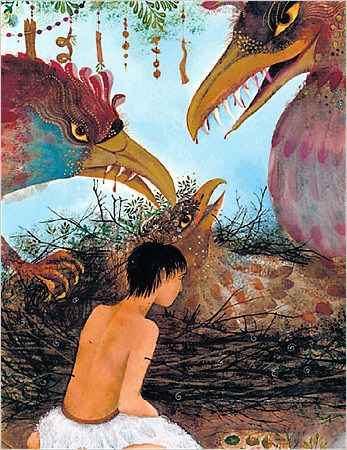
Lugalbanda woke with a jolt. He opened his eyes and what did he see but the terrible Anzu bird beating its wings in its nest high above. . . . Did he quake? Did he quail? No. Lugalbanda the Brave sat and stared, and into his head came a brilliant idea.
Before the Bible and the Koran, before even the Greek and Roman myths, there came a story from the land we now call Iraq. Speaking across five thousand years, in a voice so fresh and timeless it could have been written yesterday, this tale tells of an extraordinary journey, of a magical bird, of a battle that wouldn't end, and of wisdom gained. It is the story of Lugalbanda, a boy in a time of war.
Etched on clay tablets in cuneiform, lost underground for thousands of years, and rediscovered just 150 years ago, this account of the epic adventures of a loyal, resourceful boy is renarrated in lyrical prose by Kathy Henderson and set against Jane Ray's glorious images glinting with gold.
Lugalbanda woke with a jolt. He opened his eyes and what did he see but the terrible Anzu bird beating its wings in its nest high above. . . . Did he quake? Did he quail? No. Lugalbanda the Brave sat and stared, and into his head came a brilliant idea.
Before the Bible and the Koran, before even the Greek and Roman myths, there came a story from the land we now call Iraq. Speaking across five thousand years, in a voice so fresh and timeless it could have been written yesterday, this tale tells of an extraordinary journey, of a magical bird, of a battle that wouldn't end, and of wisdom gained. It is the story of Lugalbanda, a boy in a time of war.
Etched on clay tablets in cuneiform, lost underground for thousands of years, and rediscovered just 150 years ago, this account of the epic adventures of a loyal, resourceful boy is renarrated in lyrical prose by Kathy Henderson and set against Jane Ray's glorious images glinting with gold.
84 pages, Paperback
First published April 11, 2006
About the author
Kathy Henderson
60 books3 followersKathy Henderson is an artist, printmaker and illustrator, as well as an author. She has written many books for children of all ages including In the Middle of the Night, The Year in the City, Fearless Fitzroy and The Little Boat, which won the Kurt Maschler Award and was shortlisted for the Smarties Prize. She has also illustrated a number of books herself including And the Good Brown Earth and The Storm which was shortlisted for the Kate Greenaway Medal and her collection of poems The Dragon with a Big Nose which was shortlisted for the CLPE Children’s Poetry Award 2014.
Ratings & Reviews
Friends & Following
Create a free account to discover what your friends think of this book!
Community Reviews
Displaying 1 - 30 of 39 reviews

May 4, 2011
The oldest written Sumerian story tells of the youth of Lugalbanda, father of the famous Gilgamesh. Lugalbanda was the youngest son of Enmerkar, who drained the marshes to build the city of Uruk (according to myth, at the direction of the goddess Inanna). Wanting to make Inanna's city the most beautiful, Enmerkar decides to conquer the beautiful neighboring city of Aratta and pillage all its lovely art. His sons all go with him, but during the difficult journey through the mountains, young Lugalbanda becomes seriously ill and is left in a cave to recuperate. He recovers by praying to the various Sumerian deities and is able to continue his journey through the mountains to find his family. Lost, he instead finds the monstrous Anzu birds and obtains their help in reaching Aratta, where the war isn't going so well but his brothers are happy to see him. He is sent back to Uruk to consult the goddess and uses her advice to end the war.

Aside from the lovely Ray illustrations and inherent coolness of translating a really ancient, previously obscure story, here are some specific elements I liked:
--The family. Everyone seems to get along, and instead of being jealous the brothers all love one another. They are depicted as weeping when Lugalbanda becomes ill.
--The gods. People just go talk to them when they have problems, respectfully but not grovellingly. And the gods talk back in straightforward ways, no vague signs or confusing prophecies. Their wishes seem pretty reasonable.
--The "monsters". They have shark teeth and eat bulls whole! In most stories that would be treated as adequate justification for slaying them and stealing their treasure, but that doesn't happen here. Lugalbanda instead bakes them sweet cakes and decorates their chick (rather hilariously, really) with his make-up and hair wreaths. So it is pretty! The parent Anzu birds are so pleased that they offer him a gift.
--The war. Even though Enmerkar is her chosen dude, Inanna won't help him destroy Aratta. She tells him to just bring some artisans back instead. Both cities get dolled up and everyone is happy.
The title was a little misleading -- it makes Lugalbanda sound like an innocent bystander when in fact he insists on going to war because his brothers are going. But perhaps that was the original title. This question may even be answered in the extensive notes on source and translations, which I only read part of.
Aside from the lovely Ray illustrations and inherent coolness of translating a really ancient, previously obscure story, here are some specific elements I liked:
--The family. Everyone seems to get along, and instead of being jealous the brothers all love one another. They are depicted as weeping when Lugalbanda becomes ill.
--The gods. People just go talk to them when they have problems, respectfully but not grovellingly. And the gods talk back in straightforward ways, no vague signs or confusing prophecies. Their wishes seem pretty reasonable.
--The "monsters". They have shark teeth and eat bulls whole! In most stories that would be treated as adequate justification for slaying them and stealing their treasure, but that doesn't happen here. Lugalbanda instead bakes them sweet cakes and decorates their chick (rather hilariously, really) with his make-up and hair wreaths. So it is pretty! The parent Anzu birds are so pleased that they offer him a gift.
--The war. Even though Enmerkar is her chosen dude, Inanna won't help him destroy Aratta. She tells him to just bring some artisans back instead. Both cities get dolled up and everyone is happy.
The title was a little misleading -- it makes Lugalbanda sound like an innocent bystander when in fact he insists on going to war because his brothers are going. But perhaps that was the original title. This question may even be answered in the extensive notes on source and translations, which I only read part of.

March 11, 2025
يعتقد الباحثون بأن هذه القصة أقدم من ملحمة جلجامش، وممكن أن لوغالباندا هو والد جلجامش، قصة سومرية حدثت في أوروك، لوغالباندا وهو الأمير الصغير لديه سبعة أخوة مع ملكهم يتجهزون للحرب على مدينة من أجل ثرواتها لكن تحدث هذه الملحمة حيث الأمير الصغير ينقذ الجميع ويصبح هو البطل المحبوب عند آلهتهم والناس، قصة تنفع للكبار والأطفال أيضاً ورسوماتها واضحة مع أحداثها.

October 5, 2019
Incorporating two ancient Sumerian poems - written down on clay tablets approximately 5,000 years ago, and rediscovered in the nineteenth century, they were only recently (in the 1970s) translated - Kathy Henderson tells the tale of Lugalbanda, a prince of the Mesopotamian city of Uruk, and (eventually) the father of the epic hero Gilgamesh. The oldest written story on earth (as far as our scholarship extends thus far), it incorporates characters and creatures from Sumerian mythology, and concerns a war being waged by Lugalbanda's father, King Enmerkar, who is determined to conquer the beautiful city of Aratta, and use its treasures to glorify Uruk, and its patron goddess, Inanna.
Lugalbanda, who insists on accompanying his father's army on their trek to Aratta, becomes ill in the mountains, and is left behind in a cave by his loving brothers. Beseeching the gods and goddesses of the Sumerian pantheon for aid, he is cured, and, in his own inimitable style, then wins the favor of the powerful Anzu birds, who help him on his journey to retake his father's army, and who give him those blessings - such as the ability to run without becoming tired - that allow him to aid King Enmerkar, and prevent the utter destruction of Arrata.
A fascinating story in its own right, Lugalbanda's tale also has the distinction of being both ancient and new, and the dizzying sense of discovery such stories always give me (I felt this most recently with The Dark Star of Itza: The Story of a Pagan Princess , which introduced me to an epic tale from the ancient Mayan civilization) made the reading experience a powerful one! My friend Miriam, who recommended this to me (many, many thanks, Miriam!), highlighted many of the appealing aspects of the story itself in her own excellent review, with which I am in complete agreement, but the artwork also deserves a mention, as I found it immensely engaging as well. Jane Ray has done quite a bit of work with fairy-tales and mythology, and her style, with its copious uses of golden accents, seems very well suited to the story here. I liked her depictions of the men of Uruk, and of Innana, but my favorite painting was the one in which Lugalbanda, lying on his side, looks out on the world from his cave.
This is just a wonderful, wonderful book, and although a picture-book, one I would recommend to anyone, young or old, who is interested in ancient Sumer, or ancient epics in general. The author's afterword is quite interesting, but now I'm hungry for more! Have the translations she mentioned been collected in an anthology of some kind? Clearly I need to do more research. Also, clearly I need to reread Gilgamesh !
Lugalbanda, who insists on accompanying his father's army on their trek to Aratta, becomes ill in the mountains, and is left behind in a cave by his loving brothers. Beseeching the gods and goddesses of the Sumerian pantheon for aid, he is cured, and, in his own inimitable style, then wins the favor of the powerful Anzu birds, who help him on his journey to retake his father's army, and who give him those blessings - such as the ability to run without becoming tired - that allow him to aid King Enmerkar, and prevent the utter destruction of Arrata.
A fascinating story in its own right, Lugalbanda's tale also has the distinction of being both ancient and new, and the dizzying sense of discovery such stories always give me (I felt this most recently with The Dark Star of Itza: The Story of a Pagan Princess , which introduced me to an epic tale from the ancient Mayan civilization) made the reading experience a powerful one! My friend Miriam, who recommended this to me (many, many thanks, Miriam!), highlighted many of the appealing aspects of the story itself in her own excellent review, with which I am in complete agreement, but the artwork also deserves a mention, as I found it immensely engaging as well. Jane Ray has done quite a bit of work with fairy-tales and mythology, and her style, with its copious uses of golden accents, seems very well suited to the story here. I liked her depictions of the men of Uruk, and of Innana, but my favorite painting was the one in which Lugalbanda, lying on his side, looks out on the world from his cave.
This is just a wonderful, wonderful book, and although a picture-book, one I would recommend to anyone, young or old, who is interested in ancient Sumer, or ancient epics in general. The author's afterword is quite interesting, but now I'm hungry for more! Have the translations she mentioned been collected in an anthology of some kind? Clearly I need to do more research. Also, clearly I need to reread Gilgamesh !

December 19, 2015
An ancient story and still a good one, quite well told and BEAUTIFULLY illustrated. I picked it up off the floor at work and immediately was enchanted by the cover. Inside, the pictures were even better. And the words did not disappoint. The language is sometimes quite beautiful. "And near this tree on the rocks on the ground was the nest of the terrible Anzu bird." That sentence is even better in situ at the end of its glorious paragraph.

October 21, 2024
This was a recently found legend that is older than written history. It was found on an ancient cuneiform from over 4,000 years ago. Very rich story, full of interesting details. Based on what is now Iraq.

October 14, 2024
قصة سومرية ساعد على اظهارعا برفسور انجليزي و راوية انجليزية. أهدوها إلى أطفال دجلة و الفرات ❤️❤️❤️
الرسومات آخاااذة.
الرسومات آخاااذة.

March 3, 2012
A bull eating bird with shark teeth, superpowers visited on a deserving, clever child, and the opportunity for our hero, Lugalbanda, to rescue two civilizations from the worst excesses of war, are all packed into the oldest story known to man. Lugalbanda, is a five thousand year old Sumerian tale. Translated in the seventies it sees print for the first time in this richly illustrated children’s book, perfect for second through fourth graders. Despite its antiquity there are welcome and familiar folk tale elements: beginning with the comforting: “A very long time ago, in a land now called Iraq, there lived a little prince whose name was Lugalbanda.” Henderson manages a subtle balance, inserting colorful, colloquial language from 2400 BCE into an epic oral tale adapted to print. When taken sick Lugalbanda’s head ‘twitched like a strangled snake’ and he falls ‘like a snared gazelle.’ The unfamiliar turns of phrase and unusual details manage to feel simultaneously fresh and ancient, reminding readers of the distance this story has covered. Children will find the mix of oddness and authenticity evocative and magical. While the story is text-dense, the large font, patterned language, pacing and myriad full page and spot illustrations keep the story moving.
Illustrations
Jane Ray’s exquisite watercolor, ink and collage paintings have the gemlike quality of illuminated manuscripts. She researched Sumerians at the British Museum and her rich images bring to life authentic details. The stiff imposing figures we know from the period’s low reliefs are softened and given some individuality, yet remain clearly inspired by originals. The patterned lines of men’s skirts rendered in stone become, in Ray’s illustrations, soft goat fur; the phalanx of soldiers retain regimented shields and helmets, but acquire individualized and slightly disheveled beards. The illustrations vary from an earth-tone two-page spread showing Lugalbanda nurturing a fire, surrounded by curious animals, to an inset of an exquisite sunrise that reveals, in negative space, the sleeping shape of Lugalbanda. Jane Ray has received the Smarties Book Prize and been nominated six times for the Kate Greenaway Medal.
Source Note
The extensive preface and model source notes provide context and detail the adaptations Henderson made transforming a powerful adult epic into a children’s story. The two-page preface is written to be read to children. It gives a brief evocative history of Sumerian culture and describes the development of cuneiform. An illustration of a cuneiform tablet gives children a glimpse of how the story originally appeared. The four pages of source notes at the end of the book seem intended for adults. Henderson locates the cities concerned and includes an illustrated map. The decline of the Sumerian civilization, its rediscovery and the decipherment of cuneiform are concisely relayed. Hederson describes her initial encounter with the story just before the 2003 invasion of Iraq and explains her motivations in bringing the story to life for children. She details the specific adaptations she made to turn two adult epics into a single children’s folktale.
Illustrations
Jane Ray’s exquisite watercolor, ink and collage paintings have the gemlike quality of illuminated manuscripts. She researched Sumerians at the British Museum and her rich images bring to life authentic details. The stiff imposing figures we know from the period’s low reliefs are softened and given some individuality, yet remain clearly inspired by originals. The patterned lines of men’s skirts rendered in stone become, in Ray’s illustrations, soft goat fur; the phalanx of soldiers retain regimented shields and helmets, but acquire individualized and slightly disheveled beards. The illustrations vary from an earth-tone two-page spread showing Lugalbanda nurturing a fire, surrounded by curious animals, to an inset of an exquisite sunrise that reveals, in negative space, the sleeping shape of Lugalbanda. Jane Ray has received the Smarties Book Prize and been nominated six times for the Kate Greenaway Medal.
Source Note
The extensive preface and model source notes provide context and detail the adaptations Henderson made transforming a powerful adult epic into a children’s story. The two-page preface is written to be read to children. It gives a brief evocative history of Sumerian culture and describes the development of cuneiform. An illustration of a cuneiform tablet gives children a glimpse of how the story originally appeared. The four pages of source notes at the end of the book seem intended for adults. Henderson locates the cities concerned and includes an illustrated map. The decline of the Sumerian civilization, its rediscovery and the decipherment of cuneiform are concisely relayed. Hederson describes her initial encounter with the story just before the 2003 invasion of Iraq and explains her motivations in bringing the story to life for children. She details the specific adaptations she made to turn two adult epics into a single children’s folktale.
December 2, 2012
This book is amazing. Framed by history and explanations of the scholarly background of this old(est) tale, Kathy Henderson tells the story of the 'little prince' in words that reflect the oral tradition of the tale. This book is a masterpiece. Illustrator Jane Ray carefully researched the historical period for her illustrations in this book. Every watercolor-ink-and-collage painting is a piece of art and further invites the reader into this outstanding story.
I like how the text of each page ends with a full-stop. This give a natural break to enjoy and explore the illustration without losing any of the flow of the text.
Winner of the Aesop Prize.
I like how the text of each page ends with a full-stop. This give a natural break to enjoy and explore the illustration without losing any of the flow of the text.
Winner of the Aesop Prize.

October 17, 2024
سبب إقتنائي لهذه القصة هو حجم الإثارة الذي إنتابني كونها أقدم قصة مكتوبة في التاريخ حيث تم إكتشاف الألواح المسمارية التي نقشت عليها هذه الأسطورة السومرية في القرن التاسع عشر ولكن لم يتم كشف رموزها الا في القرن العشرين
القصة عادية جدا وتم إعادة صياغتها هنا وتحويرها
لتناسب جميع الأعمار
مزودة برسومات جميلة
القصة عادية جدا وتم إعادة صياغتها هنا وتحويرها
لتناسب جميع الأعمار
مزودة برسومات جميلة

May 5, 2011
I loved the way Kathy Henderson retold this tale. I'm sure the original cuneiform text is incomplete, and she must have had to add in explanations for ideas and objects unfamiliar to today's readers. The text reads smoothly in prose, with portions of it written in its original poetic form. There are some loose ends in the story, but, as the author explains at in a note at the end, this is because portions of the story have been lost or are yet to be discovered. I especially liked Jane Ray's illustrations, which were colorful and truly evoked the feeling of ancient Iraq. I particularly like the 2-page spread that begins chapter 3; all you see is the darkness of the cave and a small opening through which you see, silhouetted against the blue sky and mountains, Lugalbanda lying ill. Beautiful! To think that this story is 4500 years old in written form, and much older than that in oral tradition! Wonderful story--recommended!

March 13, 2009
My seven year old son loved this story about Lugalbanda and his mystical travels in the mountains. The prince, who accompanies his seven older brothers to war, becomes sick in the mountains. He is left to recover with enough provisions to supply his needs for several weeks and his brothers promise to return for him after the battle. Lugalbanda recovers some and after seeking the blessing of his gods and the powerful mystical bird of the moutains who blesses him with speed and strength, Lugalbanda rejoins his brothers at the siege. With his new-found speed he becomes instrumental in communicating a message to their patron goddess which saves the army and delivers the city.
The Summarian story is thought to detail the mythic adventures of an actual king, as Lugalbanda is believed to be the father of the famed Gilgamesh. We'll read that epic next.
The Summarian story is thought to detail the mythic adventures of an actual king, as Lugalbanda is believed to be the father of the famed Gilgamesh. We'll read that epic next.

July 24, 2019
Exceptional - great combination of text and art, plus not one but two detailed notes by the author that cover the history of the story and provide information on the setting and time. Would that there were a series done in this way.

December 7, 2013
The oldest written story in the world !
A simple beautiful one , it was really interesting and I loved the drawings so much
A simple beautiful one , it was really interesting and I loved the drawings so much

February 16, 2020
This story of a young prince who follows his brothers to war is one of the oldest stories known. Discovered on clay tablets written some four and a half thousand years ago, it wasn't translated until the 1970s. This adventurous story has the prince talking to goddesses and making deals with giant birds. The story itself is engaging and interesting but the author's notes are what make this book stand out.
We had no idea the Sumerians even existed until relatively recently yet they had a complex civilization. The city-state Uruk had more than 100,000 inhabitants, covered almost 1,000 acres, and was surrounded by a 5 and a half mile wall! The Sumerians had law, literature, math, and science. They had wheeled vehicles and boats with sails. They were the first to harness animals to the plow. Most importantly, they left a written record on clay tablets that survived all these years.
This book is a fascinating read, both for the story and the history.
We had no idea the Sumerians even existed until relatively recently yet they had a complex civilization. The city-state Uruk had more than 100,000 inhabitants, covered almost 1,000 acres, and was surrounded by a 5 and a half mile wall! The Sumerians had law, literature, math, and science. They had wheeled vehicles and boats with sails. They were the first to harness animals to the plow. Most importantly, they left a written record on clay tablets that survived all these years.
This book is a fascinating read, both for the story and the history.

October 21, 2016
I had actually read this book about 10 years ago, and I was delighted to rediscover it in my bookcase at home. This amazing tale -- some 4500 years old! -- is just as good as any modern fantasy novel, and all the more intriguing, because it gives us rare insights into the people who told it and their worldview (which was quite sophisticated, I might add). The characters and plotline are taken from authentic Sumerian source material, adapted for a general audience, accompanied by wonderful illustrations, too. The lessons of the story -- about family, loyalty, and peacemaking after warfare -- are just as timely today as they were in the ancient Near East, where this tale originated. This book is a more-than-worthy prequel to the Epic of Gilgamesh but can also be read and enjoyed on its own.

August 15, 2021
Set a generation before The Epic of Gilgamesh, an engaging retelling of a very Campbellian Hero's Journey.
Illustrations are quite good, too. Don't skip the Author's Note at the end (for yourself if not the kiddo) -- it provides provenence on this story, and why my generation & earlier didn't grow up hearing it.
Would pair well with Gilgamesh the King when learning about the early era of ancient Mesopotamia.
Illustrations are quite good, too. Don't skip the Author's Note at the end (for yourself if not the kiddo) -- it provides provenence on this story, and why my generation & earlier didn't grow up hearing it.
Would pair well with Gilgamesh the King when learning about the early era of ancient Mesopotamia.

February 2, 2025
يُقال بانه الامير الصغير هو والد الملك قلقامش وهذا خلق نوع من الترابط مابين القصتين برأيي وفضول اكبر بالنسبه لي ..
احجية انانا والسمكة تمنيت الاجابه عليها ما الذي حدث وكيف تم العثور عليها .. بالنسبه لطائر الانزو فهو اشبه بالعنقاء .. اشعر بالفضول ناحيته و ساقرا وابحث عنه بشغف اكبر .. قصة جميله
احجية انانا والسمكة تمنيت الاجابه عليها ما الذي حدث وكيف تم العثور عليها .. بالنسبه لطائر الانزو فهو اشبه بالعنقاء .. اشعر بالفضول ناحيته و ساقرا وابحث عنه بشغف اكبر .. قصة جميله

August 18, 2017
Beautiful story telling and illustrations -- a great introduction to a mythology we knew nothing about.

March 24, 2022
Fascinating - a kid-friendly translation of a pre-Gilgamesh era Sumerian poem. Feels like a classic fairy tale. Wondering if Abram grew up hearing this story. Beautiful illustrations too.
March 23, 2023
This is an ancient tale retold for children and set in a children's book format. The illustrations are beautiful and complement the story perfectly.

October 17, 2025
يعتقد أن لوغالباندا هو والد جلجامش وذلك لأن قصته تسبق ملحمة جلجامش بآلاف السنين مما يجعلها أقدم قصة مكتوبة في تاريخ البشرية.
قصة لطيفة ومدخل شديد البساطة للمهتمين بالأساطير القديمة وحضارة سومر.
قصة لطيفة ومدخل شديد البساطة للمهتمين بالأساطير القديمة وحضارة سومر.

January 21, 2026
قصيرة وممتعة
February 23, 2025
Ancient Sumerian myth rewritten for children. Any fan of Lord of Spirits podcast will appreciate this, as will anyone interested in ancient history or archeology. Introduction and epilogue give great information about the funding if the clay tablets from which this sorry was translated.

October 28, 2019
I read this book aloud to my first grader during our unit about Ancient Mesopotamia and she fell in love with it. I enjoyed the story and artwork as well as the introduction and back matter explaining how this tale was discovered, translated, and brought to English-speaking audiences.
January 12, 2016
Said to be one of the oldest tales in the world (Lugalbanda could be the father of Gilgamesh, thus making the story even older than that famous saga), Lugalbanda: The Boy Who Got Caught up in a War tells the story of a young boy given special gifts, gifts that help his people in a time of crisis.
The book states with straightforward prose about King Enmerkar’s decision to raid, conquer and ruin a distant city merely out of a desire for its precious stones and metals. There is no moralizing about the greedy king’s wish for conquest and loot but the disasters it wreaks can’t be ignored.
He immediately takes young men in the prime of life from their families and forces them to trek through dangerous wastelands whispered to be homes to monsters to attack an innocent city of foreigners who have never harmed them. When Lugalbanda falls deathly ill, his brothers tend to him for a while but then abandon him in a desolate land to march off with the king’s army.
Thus, without any moralizing whatsoever, we realize warfare for the dehumanizing and crippling beast that it is, one that destroys family ties and wreaks needless bloodshed and destruction. It was with relief that one reads about the goddess Inanna’s wisdom, temperance and mercy. She suggests an alternate course to the king’s careless, willful avarice, one that brings the story to a happier conclusion.
But the center of the story is Lugalbanda. Abandoned by his brothers, he learns self reliance and makes an unusual ally. He makes a careful wish, gains powerful rewards and uses them wisely to aid his nation. The story is accompanied by lovely flat illustrations, done in a style reminiscent of ancient Persian paintings, filled with outré designs. The images of the Anzu bird are particularly comely, stylish and fanciful like an embroidered quilt.
This is a thrilling addition to a bibliophile’s collection, an unusual and nearly forgotten story about one of the oldest and most mysterious civilization’s that ever existed. Children and adults will find this a gripping tale.
The book states with straightforward prose about King Enmerkar’s decision to raid, conquer and ruin a distant city merely out of a desire for its precious stones and metals. There is no moralizing about the greedy king’s wish for conquest and loot but the disasters it wreaks can’t be ignored.
He immediately takes young men in the prime of life from their families and forces them to trek through dangerous wastelands whispered to be homes to monsters to attack an innocent city of foreigners who have never harmed them. When Lugalbanda falls deathly ill, his brothers tend to him for a while but then abandon him in a desolate land to march off with the king’s army.
Thus, without any moralizing whatsoever, we realize warfare for the dehumanizing and crippling beast that it is, one that destroys family ties and wreaks needless bloodshed and destruction. It was with relief that one reads about the goddess Inanna’s wisdom, temperance and mercy. She suggests an alternate course to the king’s careless, willful avarice, one that brings the story to a happier conclusion.
But the center of the story is Lugalbanda. Abandoned by his brothers, he learns self reliance and makes an unusual ally. He makes a careful wish, gains powerful rewards and uses them wisely to aid his nation. The story is accompanied by lovely flat illustrations, done in a style reminiscent of ancient Persian paintings, filled with outré designs. The images of the Anzu bird are particularly comely, stylish and fanciful like an embroidered quilt.
This is a thrilling addition to a bibliophile’s collection, an unusual and nearly forgotten story about one of the oldest and most mysterious civilization’s that ever existed. Children and adults will find this a gripping tale.
Read
February 21, 2010An ancient Sumerian tale recorded in cuneiform over five thousand years ago. The tale describes a boy who comes of age during a war using his wits and courage and who eventually becomes king.
The fact that this tale is older than the Torah, Koran, and the Bible is especially intriguing. It was written in cuneiform on clay tablets some five thousand years ago. The fact that it also comes from Ancient Sumer, which we now call Iraq, makes it particularly relevant given the attention that Iraq has received in recent years.
The title tells of a boy "who got caught up in a war" suggesting that it was not his intention to be a part of the conflict, yet it is he who ends the conflict in a peaceful manner. If only it were as simple as the ancient stories suggest. How wonderfully at peace the world would be now.
The fact that this tale is older than the Torah, Koran, and the Bible is especially intriguing. It was written in cuneiform on clay tablets some five thousand years ago. The fact that it also comes from Ancient Sumer, which we now call Iraq, makes it particularly relevant given the attention that Iraq has received in recent years.
The title tells of a boy "who got caught up in a war" suggesting that it was not his intention to be a part of the conflict, yet it is he who ends the conflict in a peaceful manner. If only it were as simple as the ancient stories suggest. How wonderfully at peace the world would be now.

January 11, 2013
While clearly aimed at a younger audience, I enjoyed its simple story and beautiful illustrations. The story presented here is really from two ancient poems originally recorded in cuneiform on clay tablet. I don't know of any other general audience versions available out there.
Drawing upon available academic sources, the author attempts to convey the meaning in the language rather than a literal word-for-word translation. Reading such an ancient story gave a greater depth to the experience. I loved the feeling of connection it gave me to the time and place of Sumer almost five-thousand years ago.

March 10, 2015
It was interesting and illustrated very well, the translations used are at The Electronic Text Corpus of Sumerian Literature, which is credited in the book, but this is basically a recasting of the translations. The notes in this also stress its age, though the text comes from various tablets of differing ages and eras, so it is not internally consistent. All in all, the reselling is fairly smooth, and anything that would increase someone's interest in this kind of material is a good thing. The art is pretty amazing.

July 26, 2007
This warmly worded and intricately illustrated epic enchants our daughters with its exotic beauty and its underlying themes of kindness and generosity, in spite of its war and gore and shark-toothed, eagle-taloned Anzu birds.
Listen to our chat about this book on our JustOneMoreBook.com Children's Book Podcast:
http://www.justonemorebook.com/2007/0...
Listen to our chat about this book on our JustOneMoreBook.com Children's Book Podcast:
http://www.justonemorebook.com/2007/0...
April 5, 2010
It was very good in the beginning. But at the end you always know that you want it to carry on the stories. I thought the baby bird was cute. And I thought the mother and father looked really scary even when he said what he did was very good, they still looked a bit like they didn't like it. And his brothers were very nice to him, so that's a good thing. I like the pictures and the way they spoke.
Displaying 1 - 30 of 39 reviews