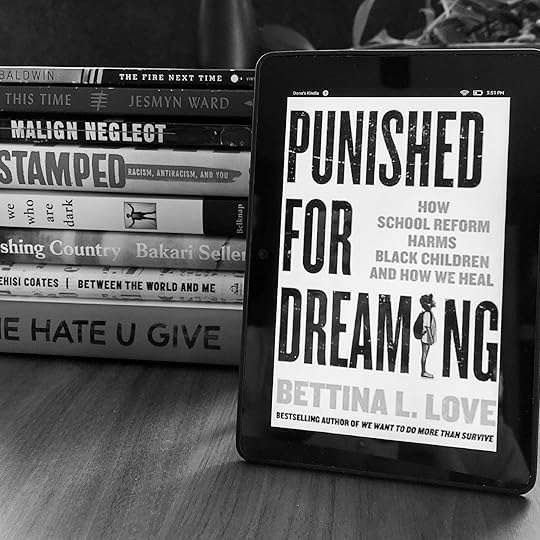
Long-listed, Barnes and Noble Best New Books of the Year 2023
This program features an introduction read by the author.
“I am an eighties baby who grew to hate school. I never fully understood why. Until now. Until Bettina Love unapologetically and painstakingly chronicled the last forty years of education ‘reform’ in this landmark book. I hated school because it warred on me. I hated school because I loved to dream.”—Ibram X. Kendi, New York Times bestselling author of How to be an Antiracist
In the tradition of Michelle Alexander, an unflinching reckoning with the impact of 40 years of racist public school policy on generations of Black lives
In Punished for Dreaming Dr. Bettina Love argues forcefully that Reagan’s presidency ushered in a War on Black Children, pathologizing and penalizing them in concert with the War on Drugs. New policies punished schools with policing, closure, and loss of funding in the name of reform, as white savior, egalitarian efforts increasingly allowed private interests to infiltrate the system. These changes implicated children of color, and Black children in particular, as low performing, making it all too easy to turn a blind eye to their disproportionate conviction and incarceration. Today, there is little national conversation about a structural overhaul of American schools; cosmetic changes, rooted in anti-Blackness, are now passed off as justice.
It is time to put a price tag on the miseducation of Black children. In this prequel to The New Jim Crow, Dr. Love serves up a blistering account of four decades of educational reform through the lens of the people who lived it. Punished for Dreaming lays bare the devastating effect on 25 Black Americans caught in the intersection of economic gain and racist ideology. Then, with input from leading U.S. economists, Dr. Love offers a road map for repair, arguing for reparations with transformation for all children at its core.
A Macmillan Audio production from St. Martin’s Press.
I did not like this book. This book is ridiculously depressing. But this book is absolutely 100% necessary, and it is full of the truth our society needs to hear. Bettina L. Love is absolutely unapologetic in her hatred of white supremacy and all the harms it causes, and in her love for Black love, joy, and success.
This book goes into how school reforms (No child left behind, school choice, etc.) are stemmed in racism and white supremacy, and how many of the ways we try to help Black children just results in more harm. She gives actual solutions to these issues, and Love is clearly extremely knowledgeable in this field. I would recommend anyone who is at all connected to education read this book. There may be things in it that are hard to hear, but they are necessary.
Thank you to Macmillan Audio and Netgalley for this audio ARC in exchange for an honest review!
Thank you, thank you, thank you to NetGalley and the publisher for the opportunity to read this book in exchange for an honest review.
This is a book that is important. It speaks to the systemic structures put into play, the structures that uphold the very fabric of the issues we are facing in our country. It starts with education. It starts with the school system. But it doesn't end there. Bettina L. Love writes confidently, clearly, and provides plenty of evidence to back up the points explored in this text. This book is essential for educators - whether they work within the public school system, a private sector, university, etc.
As for the educator questions: I cannot say that I will recommend this book to my students, as they are too young to read (or grasp many of these concepts), but I will absolutely recommend to my colleagues and the families with whom I work.
Thank you to the author Bettina L. Love, publishers St. Martin's Press, and as always NetGalley, for an advance digital copy of ᴘᴜɴɪsʜᴇᴅ ғᴏʀ ᴅʀᴇᴀᴍɪɴɢ . All views are mine.
Black life in America is itself a trigger, from the moment you open your eyes in the morning until you close them at night—and even then, your nightmares are White rage and violence. Loc. 3808
This is a book about education and about how racism in the US prohibits black students from accessing the vast educational resources that belong to every child in this country as a national right, how the lack of access to proper education affects these students' entire lives, and the reparations the author proposes to begin correcting the educational deficit black students have historically been forced to accept.
Beautifully organized and composed, ᴘᴜɴɪsʜᴇᴅ ғᴏʀ ᴅʀᴇᴀᴍɪɴɢ is not just a brave source of excellent content, it's also a pleasure to read. Whether you're reading this because you're a book lover looking for a great nonfiction book, or you're a sociology student reading for assignment, you'll appreciate Love's accessible and readable style, her deep passion, and amazing treatment of her topic!
Sometimes, you come across a book that is deeply moving, inspiring, and full of amazing value. For me, ᴘᴜɴɪsʜᴇᴅ ғᴏʀ ᴅʀᴇᴀᴍɪɴɢ is one of these books. Love teaches so much, and clearly, about instructional racism.
Three (or more) things I loved:
...
2. The American myth of education: My family, like many others, bought into the American myth that education would be the great equalizer— that obtaining a “good” education would keep their children safe and afford them their piece of the American dream. loc. 957
4. I appreciate the acknowledgement of disability as a compounding factor.
...
Rating: 🧑🏽🎓👩🏾🎓🧑🏿🎓👨🏾🎓👩🏽🎓 education opportunities Recommend? Yes! Finished: Aug 18 23 Format: Digital arc, NetGalley, SMPI Read this book if you like: 📓 nonfiction 📚 education ⚖️ social justice 👩🏾🦱 Own Voices books
Thank you to Goodreads and the publisher for providing me an advance reader copy of this amazing book. I took my time reading it so that I could absorb all the information. At various points I was both enraged by how things are and hopeful that we can make changes. There was plenty of history here that I had only a vague knowledge of.
Reading the comments, I already don't want to read this book. Will free money really fix education? I don't think so. Parents need to be responsible for their kids behavior and demeanor at school, and teachers need to be responsible for teaching. Once we start focusing on reading, writing and math, I think it will fix a lot of problems. With all their extreme DEI policies, schools still fail to teach kids to read and do math, effectively. Our school's DEI is outrageous and we barely have any black persons. And in my opinion, black and immigrant kids are hurt the most from DEI, regardless of race. I had to teach my preschooler reading, because our school prefers the easy escape method "Look at the picture and guess", it cost me only $20. How can you guess reading? There is a better way, and it's not difficult, but they all think it is and would prefer not to be bothered.
Bettina Love pulls no punches about America's educational system as a carcereal institution where private companies are making fortunes off of punishing black bodies. Tracing the failure of especially urban education fr9m Reagan's "reforms" through No Child Left Behind, Dr. Love vivisects public education to lay bare a decline that many have been decrying for decades.
As one of those white teachers in black schools who also teaches at the college level and who has taught in majority white spaced none of this was news to me. She gets a lot right. We need more black teachers. We need equal opportunity, equal resources, and equally difficult content. I'm even firmly behind reparations. If you arent, you especially need to read the last chapter. Show it to your racist family. Love also does amazing and important work drawing explicit connections between the War on Drugs and education reform.
But there is a core issue here that still has not been addressed. Money per student is spent very differently in minority majority institutions than white schools. Dr. Love goes into the what of that, and calls for change. She puts the why completely on white supremacy, racism, and anti-blackness.
But is that all? What is really going on on the ground here? Why can't some schools retain substitutes, paraeducators, nurses, counselors, all those support staff to spend money on instead of resource officers? Why does the school I work in have half of their students not receiving instruction in core subjects because of lack of personnel? Why did multiple teachers and every single paraeducator leave within the first month? Why are the vast majority of school staff (black and white) on the job market every single year for a job in one of those white spaces? Why would children rather be in ISS than regular classes?
Money isnt the only issue here. What kind of education do we want for everyone? What is its purpose? How do we get there? How do we get people to be curious? The industrial jobs from before the period of Love's study aren't coming back. Education has tanked across the board, although to varying degrees. The anti-CRT movement that Love discusses is worse than many realize and fights against basic things people our age and older take for granted as true and should be taught in school. What about the implosion of higher education? Minting too many PhDs? What needs to change in education to help people stay in the field. And just so much more.
Overall, this really resonated with me, but I wanted more connections and more acknowledgement of the multilayered complexity. Dr. Love and I are of an age (I entered high school in the 1993-1994 school year) making many of the personal experiences quite resonant. I'm here to keep listening and do the best that I can.
This is essential reading for anyone who wants to understand why schooling in the US is failing so many students. It gave a historical context for US education reform from desegregation all the way through COVID and then modern day, outlining how and why education became a big thing among politicians and entrepreneurs recently. It always felt rooted in the people being affected. It's told with a series of stories, building empathy and humanizing the subject in ways the policymakers it critiques don't do. This made me aware of my privilege in ways I didn't expect, and I feel more aware of how and why we need to make change going forward...this gives directly actionable insights on educational antiracism that I plan to use going forward
If you are not familiar with Bettina L. Love, please stop what you are doing and watch her speak - You Tube is a great resource for this!
Dr. Love is a gift to all us, and I was very excited to preview this book. Via Punished for Dreaming, Dr. Bettina L. Love provides us a well researched thesis that during the Reagan era, black students were punished and made synonymous with the idea of a problem. Similar tot the War on Drugs. Love has qualitative research as well via interviews with families, students and administrators on how policies impacted their lives. Her research and writings provide a strong argument that the policies not only impacted black families for decades but served to keep the wealthy rich and in power. I also love that Love promotes moving even past DEI and utilizing the ideas of " Community and School Reparations Collectives (CSRCs)."
Best of all, not only does Love identify past problems and events and put current issues into context, Love provides solutions for moving forward. If you are in education, or just care about the world we live in, Punished For Dreaming is for you! #Bettinallove #Punishedfordreaming #stmartinspress
I said it before and I will say it again: Bettina Love for Secretary of Education. She is not afraid to say the quiet parts out loud and call out the harm that is caused by the education system. She has a unique perspective as she was a student during the beginning of many education reforms and is able to weave her personal experiences and her peers experiences into the overarching narrative of educational harm.
Love does an incredible job of building the historical context that laid the groundwork for the harmful and oftentimes violent version of education reform that has been happening for decades and then providing concrete examples of how these reforms show up in their ugliest forms in majority black schools. Her points about white rage, charter schools, educational entrepreneurs, education philanthropists, and the carceral treatment of black bodies were exceptionally compelling. There were many times she was able to eloquently put into words the thoughts and feelings I've had about the way that the education system was built to treat my students and the ways in which I felt complicit, which was simultaneously shame and regret filled, infuriating, and cathartic.
The majority of the content of this book is heavy and rage inducing as it does not allow you to look away from the real impacts caused by an educational system built on white supremacy, but Love doesn't leave you there. She provides real, tangible recommendations and ways that we as a country can both atone for the harm done and move forward into a system that better serves all of its students. Her willingness to maintain hope and shine a light on the way forward despite all that she has experienced and seen and proven through research left me feeling more hopeful about what the education system could be, as she says, if we just change our priorities.
Fantastic book. Tough to read at times. Bettina Love dives into topics about education reform including charter schools, Teach For America, and “experiments” like Common Core and No Child Left Behind. As someone that has worked in the education nonprofit sector for the last five years, it was sobering to read about the “super predators” aka the wealthy philanthropists that give hundreds of millions of dollars to initiatives that fail Black children. Dr. Love does a great job weaving in history, stories, and compelling statistics. This should definitely be required reading for anyone!
Without question the school reform movement has had devastating impacts on children, especially children of color. This book offers a clear distillation of that harmful movement and its real costs to lives, including the unintended consequence of the 1954 Brown vs. Topeka Supreme Court decision. Both democrats and republicans earn blame for their horrible education policies.
Now that I've been hanging around public schools for a few months, can confirm. Please do read this book. Then kill charter schools. All teachers need training and this country needs one curriculum and equal funding.
The book presents itself as research, and while there are copious facts, figures, and footnotes, it ultimately fails to support its premise effectively. Much of the book is personal anecdotes, and while many readers may find this interesting, I do not. More examples of the obvious negative effects of capitalism and neo-liberal governance are spurious at this point. It is 2023, if you don't know now, you either already know of don't care. The anecdotes also don't provide any path forward. The writing swerves from conversational to psuedo-academic frequently, which I found distracting. It felt like Love was looking for support for a conclusion she had already reached - that racism is the cause of the problem - and so she mentions all the usual suspects and events and names and jargon, none of which holds any weight outside social media circles. That aside, my biggest problem with the book is that I fundamentally disagree with her conclusion that racism is the culprit. The problem is capitalism, and racism/White Supremacy has simply been co-opted by that system to further its goals. Many books have already shown this, and so I am not going to rehash them here. Setting this aside, I had plenty of other disagreements with how Love picks low-hanging fruits to support her premise, thus oversimplifying rather complicated structural, systemic problems. Ultimately, I just didn't enjoy this book and I think it is a mistake to go with Love's conclusions or her analysis, most of which lacks depth and shows a lack of intellectual understanding of how we got to the place we are now.
Punished for Dreaming is a much needed book about how our education system continues to fail Black children in a multitude of ways. I found this book absolutely fascinating and I highly recommend it to anyone interested in learning about the education system.
⁉️: Thinking back about your school education, what would you keep or what would you change?
Change - it’s something that we fear but change is what is needed when young minds can be - as the title suggests - “punished for dreaming”. I have been thinking of this book ever since it showed up on my doorstep a few months ago. The author, Bettina Love, begins this story by relating about her own experiences with the education system that often would isolate her and not give her opportunities that she should have received. In her book, Love is not afraid to address racism and prejudice for what it is citing historical decisions that have affected access to the education system by installing policies that keep certain kids from benefiting the education system.
Love’s unflinching, bold, and influential book compels us to revisit education policies that had been reinstated in the 1980s. As Love explores educational policies in various administrations and their impact on the lives of Black children. For me, Kia’s case was striking and memorable. Based in Chicago, her first encounter with the carceal state was because as an eight-year-old, she had been “caught” by a police officer for standing near and admiring them. Perhaps that was the moment that was heart breaking for me that “Kia understood immediately that in his eyes, she was not a child but a criminal and that, as a ward of state, she was at the mercy of the angry and scary white officer but also a system that thought nothing of moving her like a chess pawn every year.” This quote to me was hard hitting and spoke to me about just how important education is for all, and should be accessible to everyone, and especially those who exist on the margins.
This book releases tomorrow, September 12. Thank you @stmartinspress and @BLoveSoulPower for the gifted copy.
In Punished for Dreaming: How School Reform Harms Black Children and How We Heal, Bettina L. Love delivers a bold critique of the U.S. education system, shedding light on the deep, persistent inequalities that continue to shape it. Through a powerful combination of personal stories and extensive research, she calls for transformative change, urging readers to confront uncomfortable truths about race, capitalism, and power in education. Love exposes how education reform has often been manipulated for political and financial gain, with each U.S. president leaving their mark—often at the expense of the communities that need help the most. The result is a system that prioritizes power, control, and profit over the futures of children, particularly Black children.
What makes this book especially impactful is its emotional depth. Love amplifies the voices of those most affected by educational inequality, making the fight for fairness feel urgent and personal. She critiques policies like charter schools and school choice, which have only deepened the divide between the privileged and the underserved. Love also challenges the myth of meritocracy, exposing how racism and white supremacy continue to determine who succeeds in the system. This book is a powerful call to action, urging readers to rethink their beliefs and work toward meaningful, lasting change. If you're ready to challenge your perspective and make a difference, this book is for you.
A huge thanks to NetGalley, the author, and the publisher for the opportunity to review this book in exchange for an honest review.
The point of this book is lost on me. I imagine most who choose to pick it up are already somewhat liberal or sympathetic to the reparations case in the US. However, the first 95% of the book holds readers in suspenseful captivity as the author makes hugely irresponsible over generalizations, assumptions and accusations. The data are cherry picked and then universalized. Outcomes are equated to intentions and there is a disappointing absence of nuance. Even as a supporter of the ends (a comprehensive reparations package proposal, described only in the final pages), I am sad to say it did not justify the means (hundreds of rambling pages of vague, anecdotal, or otherwise bias content). At best, this book seeks to add evidence to the case for reparations. However, even among that ideal audience (people like myself), this book presents undeniably misguided evidence to make points that are only distantly relevant to the concluding proposal. At worst, this book seeks to change the minds of individuals who are against or skeptical of reparations. Here, it assigns politically escalating language that would alienate the target reader on just the first page. If you want to commiserate about the already well-known reasons to hate US institutions, by all means you should read this book. But for anyone who wants a meaningful argument for reparations, or insightful additions to your critical thinking, this book is not it.
I received a free copy from St. Martin’s Press through NetGalley in exchange for an honest review.
To summarize this book, it’s best to just refer to Bettina L. Love’s thesis, specifically that Reagan began a war on black children that worked concurrently with the war on drugs to pathologize and penalize Black children using school safety policies. Love looks specifically at how A Nation at Risk manufactured an educational crisis and destroyed several generations of Black families.
Love succeeds in this goal. She traces the historical roots of this trend to Brown v. Board of Education and the white rage that came from educational integration. Seeking to find ways to separate students, an educational crisis was created, often seeing Black and Brown children as “at risk,” forcing them into classes that often had underprepared teachers and fewer resources. In addition, school choice is born from this movement, shifting money that would have gone to public education to a privileged few. Finally, entrepreneurs chopped up what was left of education and sold it back to others, helping to fuel the high-stakes testing climate that often links teacher raises to student performances on exams.
After tracing these threads, Love offers evidence of the outcome of these measures, sharing data about the suspension and truancy rates for Black and Brown children, signifying the school to prison pipeline. This includes the carcerality of standardized tests, which Love argues are designed to measure inferiority and justify captivity. Even efforts to tackle these challenges, specifically diversity, equity, and inclusion measures, are often traps, and Love breaks down the way these offices and employees are often helping students cope with trauma from racism while schools refuse to change punishing structures.
There’s a wide range of blame here, and Love doesn’t let anyone off the hook, whether they are Republican or Democrat. Policies under a wide variety of presidents, including No Child Left Behind and Common Core State Standards, are held up as examples of more of the same. So what can we do? Love proposes educational reparations, specifically $56 billion for the educational experimentation that has been conducted and caused Black and Brown people to lose a multitude of opportunities over the past 40 years. In her final chapter, Love breaks down this number, showing her work and how she arrived at this amount.
If any of the topics I summarized above are of interest, this is the book for you. Love does an excellent job laying out her argument and offering source after source that shows how devastating the educational changes over the last 40 years have been for Black and Brown children.
“White rage is what has built America’s institutions, working to cunningly craft laws, policies, covenants, and approaches that undercut democracy, halt Black advancements, and cage Black bodies while leaving White supremacy intact and even stronger.”
Thank you to St. Martin’s Press for an ARC in exchange for an honest review. This is a crucial book, especially for educators.
I always cite How the Word is Passed by Clint Smith as required reading. I truly think that this book needs to be added to the required reading tier. I can’t even say that I was shocked reading a lot of the information provided here, because we see how differently Black and Brown people are treated every day.
What readily stuck out for me was the way Dr. Love interviewed other Black people about their school experiences and how similar they were. Dr. Love herself was told that she was only in college to play basketball, not to further her education. Black children are routinely branded as rambunctious when they’re behaving no differently than their White counterparts.
Chronicling the past forty years of education reform, she explains that nothing has changed for the better and disproportionately affects Black and Brown children. School choice has only resulted in students facing severe racism and that affects their ability to learn. And it’s not just students; it’s White teachers that perpetuate these stereotypes. Many people interviewed here vividly remember their first Black teacher because they only had one or two.
This book is critical for educators or anyone in the educational space. It’s detailed and informative, and while it can be difficult at times it doesn’t make it any less necessary.
Dr. Love sets out to explain how four decades of school reform have harmed black children more than it has helped, with charter schools as a central piece of the degradation of public schools. It felt important to me to read this, as a supporter and employee of charter schools. Some of her arguments were very compelling, particularly the shady billionaires who are key to funding many of the charter schools in the country (the Walton family, etc). LMAO that there is a whole chapter about KIPP and how its founders basically stole their ideas from an experienced black educator and then never really compensated her… sounds about right.
Some of the later chapters lost the plot a little bit for me, as she focused more on legacies of racism generally and moved away from schools. At the end, she argues for reparations to black students who were educated in the era of school reform, including specific calculations of how much money is owed, which I found interesting.
Ultimately, I was frustrated that Dr. Love’s main argument was “school reform is racist and bad, and instead we need to radically transform public schools.” Isn’t that… what charter schools are trying to do??? What is your concrete suggestion for school transformation, ma’am? “Our schools need to be centered more on love” does not really do it for me.
Saw Bettina Love in person with Kamau Bell and her energy and passion resonate while reading her book. I could hear her. The best part here is when Bettina goes deep into storytelling. Stories about her mom, her childhood friends, Harriet Bell. She is an excellent storyteller and brings humanity to her work on policy. The case against the US government with one anti-Black policy after another is strong and it made me think that the period she covers is the last 40 years- the years I have been both a student and an educator- and a terrible period in education. To re and reread. A good reminder to focus on what you can do as a teacher and what you need to do to fight outside of the classroom.
This is one of those books that, for white readers especially, it will make you kind of uncomfortable to read. Which I think is a good thing. It's always hard to be reminded that we live in a system that is designed to work for us - at the expense of people of color, and especially Black people. In terms of the execution of this book, I will say that the first 75% was gripping, and told lots of stories to help communicate facts. The last 25% is where it starts to get a little academic (which is fine, this is a book written by a successful professor), but it did lose my interest a little. The data on reparations and specifically how they can be paid was really interesting, but it was also a lot of numbers and hard for me to stay as drawn in.
A really harrowing read for educators (and maybe not the best book to read while your students are taking standardized tests lol). Love outlines three main arenas of school reform that have taken away educational opportunities from Black children: school choice, carcerality, & standardized testing. All of these reforms result in the privatization of public education which is designed to harm Black communities for profit. This book ended on a good note which I very much appreciated:
“In order to build the movement capable of transforming our world, we have to do our best to live with one foot in the world we have not created.” (256).
A very important book for all adults involved in politics at any level as well as educators. Love has done the work to show how the last 40 years of education reform has made schools worse, not better for Black students. Every president, including Obama, has contributed to the problem. The book looks harshly at the harm that both charter schools and philanthropic foundations have done. There is a ton to unpack in this book and individual chapters as well as the whole book is worthy of discussion in several different types of graduate courses. ARC courtesy of the publisher and NetGalley.
This book was hard for me to get through, but I’m so glad I pushed through this read. This book would serve everyone in education justice to read it, to better understand how reform has affected the lives of Black and Brown students. I especially liked the interviews throughout the book and it caused me to continuously reflect on my tenure as a student in public schools, in underprivileged communities where we were seen as disposable. The ending calculates reparations (that I hope to one day see for us all). This book is necessary!