

What do you think?

Viper Rum
In her third collection of poetry, Mary Karr delves into autobiographical subject matter; various beloveds are birthed and buried in these touching lyrics.
I cast back to those last years
I drank, alone nights at the kitchen sink,
bathrobed, my head hatching snakes,
while my baby slept in his upstairs cage
and my marriage choked to death
Precise and surprising, Karr's poems "take on the bedevilments of fate and grief with a diabolical edge of their own" (Poetry) .
Also included is Karr's controversial and prizewinning essay "Against Decoration," in which she takes aim against the verbal ornaments that too often pass for poetry these days--the "new formalism" that elevates form to an end itself.
I cast back to those last years
I drank, alone nights at the kitchen sink,
bathrobed, my head hatching snakes,
while my baby slept in his upstairs cage
and my marriage choked to death
Precise and surprising, Karr's poems "take on the bedevilments of fate and grief with a diabolical edge of their own" (Poetry) .
Also included is Karr's controversial and prizewinning essay "Against Decoration," in which she takes aim against the verbal ornaments that too often pass for poetry these days--the "new formalism" that elevates form to an end itself.
- GenresPoetryEssaysNonfiction
78 pages, Paperback
First published April 1, 1998
About the author
Mary Karr
25 books2,160 followersMary Karr is an American poet, essayist and memoirist. She rose to fame in 1995 with the publication of her bestselling memoir The Liars' Club. She is the Peck Professor of English Literature at Syracuse University.
Karr was born January 16, 1955, in Groves, a small town in East Texas located in the Port Arthur region, known for its oil refineries and chemical plants, to J. P. and Charlie Marie (Moore) Karr. In her memoirs, Karr calls the town "Leechfield." Karr's father worked in an oil refinery while her mother was an amateur artist and business owner.
The Liars' Club, published in 1995, was a New York Times bestseller for over a year, and was named one of the year's best books. It delves vividly and often humorously into her deeply troubled childhood, most of which was spent in a gritty, industrial section of Southeast Texas in the 1960s. She was encouraged to write her personal history by her friend, author Tobias Wolff, but has said she only took up the project when her marriage fell apart.
She followed the book with another memoir, Cherry (2000), about her late adolescence and early womanhood. A third memoir, Lit, which she says details "my journey from blackbelt sinner and lifelong agnostic to unlikely Catholic," came out in November 2009.
Karr thinks of herself first and foremost as a poet. She was a Guggenheim Fellow in poetry in 2005 and has won Pushcart prizes for both her poetry and her essays. Karr has published four volumes of poetry: Abacus (Wesleyan University Press, CT, 1987, in its New Poets series), The Devil's Tour (New Directions NY, 1993, an original TPB), Viper Rum (New Directions NY, 1998, an original TPB), and her new volume Sinners Welcome (HarperCollins, NY 2006). Her poems have appeared in major literary magazines such as Poetry, The New Yorker, and The Atlantic Monthly.
She is a controversial figure in the American poetry "establishment," thanks to her Pushcart-award winning essay, "Against Decoration," which was originally published in the quarterly review Parnassus (1991) and later reprinted in Viper Rum. In this essay Karr took a stand in favor of content over poetic style. She argued emotions need to be directly expressed, and clarity should be a watch-word: characters are too obscure, the presented physical world is often "foggy" (that is imprecise), references are "showy" (both non-germane and overused), metaphors over-shadow expected meaning, and techniques of language (polysyllables, archaic words, intricate syntax, "yards of adjectives") only "slow a reader"'s understanding. Karr directly criticized well-known, well-connected, and award-winning poets such as James Merrill, Amy Clampitt, Vijay Seshadri, and Rosanna Warren (daughter of Pulitzer Prize winner Robert Penn Warren). Karr favors controlled elegance to create transcendent poetic meaning out of not-quite-ordinary moments, presenting James Merrill's Charles on Fire as a successful example.
While some ornamentations Karr rails against are due to shifting taste, she believes much is due to the revolt against formalism which substituted sheer ornamentation for the discipline of meter. Karr notes Randall Jarrell said much the same thing, albeit more decorously, nearly fifty years ago. Her essay is meant to provide the technical detail to Jarrell's argument. As a result of this essay Karr earned a reputation for being both courageous and combative, a matured version of the BB-gun toting little hellion limned in The Liars' Club.
Another essay, "Facing Altars: Poetry and Prayer", was originally published in Poetry (2005). Karr tells of moving from agnostic alcoholic to baptized Catholic of the decidedly "cafeteria" kind, yet one who prays twice daily with loud fervor from her "foxhole". In this essay Karr argues that poetry and prayer arise from the same sources within us.
Karr was born January 16, 1955, in Groves, a small town in East Texas located in the Port Arthur region, known for its oil refineries and chemical plants, to J. P. and Charlie Marie (Moore) Karr. In her memoirs, Karr calls the town "Leechfield." Karr's father worked in an oil refinery while her mother was an amateur artist and business owner.
The Liars' Club, published in 1995, was a New York Times bestseller for over a year, and was named one of the year's best books. It delves vividly and often humorously into her deeply troubled childhood, most of which was spent in a gritty, industrial section of Southeast Texas in the 1960s. She was encouraged to write her personal history by her friend, author Tobias Wolff, but has said she only took up the project when her marriage fell apart.
She followed the book with another memoir, Cherry (2000), about her late adolescence and early womanhood. A third memoir, Lit, which she says details "my journey from blackbelt sinner and lifelong agnostic to unlikely Catholic," came out in November 2009.
Karr thinks of herself first and foremost as a poet. She was a Guggenheim Fellow in poetry in 2005 and has won Pushcart prizes for both her poetry and her essays. Karr has published four volumes of poetry: Abacus (Wesleyan University Press, CT, 1987, in its New Poets series), The Devil's Tour (New Directions NY, 1993, an original TPB), Viper Rum (New Directions NY, 1998, an original TPB), and her new volume Sinners Welcome (HarperCollins, NY 2006). Her poems have appeared in major literary magazines such as Poetry, The New Yorker, and The Atlantic Monthly.
She is a controversial figure in the American poetry "establishment," thanks to her Pushcart-award winning essay, "Against Decoration," which was originally published in the quarterly review Parnassus (1991) and later reprinted in Viper Rum. In this essay Karr took a stand in favor of content over poetic style. She argued emotions need to be directly expressed, and clarity should be a watch-word: characters are too obscure, the presented physical world is often "foggy" (that is imprecise), references are "showy" (both non-germane and overused), metaphors over-shadow expected meaning, and techniques of language (polysyllables, archaic words, intricate syntax, "yards of adjectives") only "slow a reader"'s understanding. Karr directly criticized well-known, well-connected, and award-winning poets such as James Merrill, Amy Clampitt, Vijay Seshadri, and Rosanna Warren (daughter of Pulitzer Prize winner Robert Penn Warren). Karr favors controlled elegance to create transcendent poetic meaning out of not-quite-ordinary moments, presenting James Merrill's Charles on Fire as a successful example.
While some ornamentations Karr rails against are due to shifting taste, she believes much is due to the revolt against formalism which substituted sheer ornamentation for the discipline of meter. Karr notes Randall Jarrell said much the same thing, albeit more decorously, nearly fifty years ago. Her essay is meant to provide the technical detail to Jarrell's argument. As a result of this essay Karr earned a reputation for being both courageous and combative, a matured version of the BB-gun toting little hellion limned in The Liars' Club.
Another essay, "Facing Altars: Poetry and Prayer", was originally published in Poetry (2005). Karr tells of moving from agnostic alcoholic to baptized Catholic of the decidedly "cafeteria" kind, yet one who prays twice daily with loud fervor from her "foxhole". In this essay Karr argues that poetry and prayer arise from the same sources within us.
Ratings & Reviews
Friends & Following
Create a free account to discover what your friends think of this book!
Community Reviews
Displaying 1 - 30 of 39 reviews

April 26, 2014
there will be many re readings of this slim volume of poetry. it is tight and cohesive and spare in its language, while addressing more than what I expected. karr has the same mastery of allusion as heaney, but used her language to more devastating effect. these are poems for mothers, for ex addicts, for the lost, for the broken, for the found. so incredibly good.

October 10, 2008
Best line from this book: "Your head's a bad neighborhood:/ Don't go there alone, even if you have to stop/ strangers to ask the way, and even if/spiders fall from your open mouth."

April 5, 2010
Fierce, brilliant work here. Like exploring an open wound. Not for the timid. Not for those unwilling nor unable to explore darkness or go outside the bounds of textbook time-lines.

July 8, 2013
I've several of her books and I really enjoy Mary Karr's writing. This particular book has a nice selection of poems, but it also contains a well constructed essay at the end called "Against Decoration." This essay was the highlight of the book for me because Karr explains why she doesn't like this style of writing and builds a strong case. The book is worth reading just for the essay and is something that I think many new writers should read as they develop their own styles and voices.

November 4, 2021
This is my second Karr volume this year, after also reading her earlier collection The Devil's Tour (1993). Between publishing these two volumes, Karr published her seminal memoir, The Liar's Club and burst into literary stardom.
Karr feels settled in to these poems in a way she didn't in The Devil's Tour, which is dense and at times disjointed. In Viper Rum Karr nearly rollicks, nimbly integrating heavy topics like suicide and aging with her sharp observational wit and, of course, religiosity pulses throughout.
For the theologically uninitiated, the religious imagery in Viper Rum is notably more accessible than that in The Devil's Tour. The God Karr writes of in Viper Rum is a far different God than that in The Devil's Tour; if Devil's Tour is the writhing, fire-and-brimstone Old Testament, Viper is the mellowed-out New Testament.
In the funny and insightful poem "Mall Crawl," for example, Karr relays the odd experience of taking her infant son to a mall, which becomes a space for worship of consumerism. The mall as cathedral and her baby's stroller as a sort of sacred ark, she writes,
I went to worship at the cathedral
of emptiness. The air was cool as mint.
Before me in the infant boat
my son fought with his covers
Karr is downright playful throughout this collection. She imagines a marriage for Jesus Christ in "The Wife of Jesus Speaks" ("Ours was the first inch of time. / The word passion hadn't yet been coined.") and one of the longest poems – "Lifecycle Stairmaster" – is dedicated to an evocative basement workout:
If Sisyphus shoved his rock for eternity up
the mountain said rock always toppled down,
so I must daily hike my middle-aged ass
north off the back of my leg
I loved the inclusion of Karr's critical essay "Against Decoration" as an afterward. I think it 1) shows respect to readers to include this academic writing, almost challenging us to conquer it and 2) retroactively sheds light on Karr's style for those not acquainted with academic discourse on poetry.
In the essay, Karr laments neo-formalism, a then-newish poetry movement with which Karr identifies "two sins" (p 51): absence of emotion and lack of clarity. Essentially, neoformalists almost harken back to a Victorian-style lyric that leans on an ornamental structure and shucks an accessible, realist element. She calls their work "high-brow doily making" that she only finds interesting "in the way an exorcist might find certain demons interesting," (p 71).
I couldn't help but think that David Foster Wallace was wrestling with something similar in fiction during the same time period. As Wallace matured in the '90s, he markedly moved away from postmodernism and into something new. He shed the ironic, somewhat-sneering smartass attitude of postmodernist fiction in favor of a vulnerable attempt at raw feeling. One can imagine Karr and Wallace very possibly discussed the criticisms of their respective disciplines during their time together.
Karr feels settled in to these poems in a way she didn't in The Devil's Tour, which is dense and at times disjointed. In Viper Rum Karr nearly rollicks, nimbly integrating heavy topics like suicide and aging with her sharp observational wit and, of course, religiosity pulses throughout.
For the theologically uninitiated, the religious imagery in Viper Rum is notably more accessible than that in The Devil's Tour. The God Karr writes of in Viper Rum is a far different God than that in The Devil's Tour; if Devil's Tour is the writhing, fire-and-brimstone Old Testament, Viper is the mellowed-out New Testament.
In the funny and insightful poem "Mall Crawl," for example, Karr relays the odd experience of taking her infant son to a mall, which becomes a space for worship of consumerism. The mall as cathedral and her baby's stroller as a sort of sacred ark, she writes,
I went to worship at the cathedral
of emptiness. The air was cool as mint.
Before me in the infant boat
my son fought with his covers
Karr is downright playful throughout this collection. She imagines a marriage for Jesus Christ in "The Wife of Jesus Speaks" ("Ours was the first inch of time. / The word passion hadn't yet been coined.") and one of the longest poems – "Lifecycle Stairmaster" – is dedicated to an evocative basement workout:
If Sisyphus shoved his rock for eternity up
the mountain said rock always toppled down,
so I must daily hike my middle-aged ass
north off the back of my leg
I loved the inclusion of Karr's critical essay "Against Decoration" as an afterward. I think it 1) shows respect to readers to include this academic writing, almost challenging us to conquer it and 2) retroactively sheds light on Karr's style for those not acquainted with academic discourse on poetry.
In the essay, Karr laments neo-formalism, a then-newish poetry movement with which Karr identifies "two sins" (p 51): absence of emotion and lack of clarity. Essentially, neoformalists almost harken back to a Victorian-style lyric that leans on an ornamental structure and shucks an accessible, realist element. She calls their work "high-brow doily making" that she only finds interesting "in the way an exorcist might find certain demons interesting," (p 71).
I couldn't help but think that David Foster Wallace was wrestling with something similar in fiction during the same time period. As Wallace matured in the '90s, he markedly moved away from postmodernism and into something new. He shed the ironic, somewhat-sneering smartass attitude of postmodernist fiction in favor of a vulnerable attempt at raw feeling. One can imagine Karr and Wallace very possibly discussed the criticisms of their respective disciplines during their time together.

June 4, 2021
i didn't expect there to be an afterward but i unexpectedly loved it (so much to the point that i'm just going to talk about her afterward here instead of the poems themselves... which i really enjoyed too).
on one hand, i don't think her afterward (which shits on poetry's recent stylistic history, i.e. Old White People becoming more pretentious and intentionally making their work very obscure/impossible to read) would exist if poetry wasn't only seen in the context of old white men, which sadly it always is in both academia and any non-explicitly-POC literary sphere.
on the other hand, i am now dying to know mary karr's take on the rise of instagram poetry which is, in many ways, the exact opposite of what she's ranting about—literature without decoration (i.e. attention to meter and form) & therefore extremely accessible & now consumed by anybody who can read—yet ultimately beckons the same consequences (if you believe that authors like rupi kaur write poetry that falls very flat and ultimately carries no depth).
i absolutely love how karr articulates exactly how i feel about poetry, and i especially value this from a professor when lit theory often feels inaccessible/indigestible — "I always thought that poetry's primary purpose was to stir emotion, and that one's delight in dense idiom or syntax or allusion served a secondary one." (yet here i was, sometimes feeling stupid or silly for liking a poem but not knowing how to justify it except that it makes me feel like i'm going to puke or like i just got the wind knocked out of me!)
the end of the afterward is my favorite. mary karr remembers how she sat through a poetry reading at harvard with fellow literature colleagues, poets, and critics who she all respected, and all of whom "were jubilant about the performance." she writes, "I asked each in turn what he or she liked in the reading, which parts were moving, because I assumed that I had missed something. [...] No one seemed to remember much. Maybe my question seemed too bone-headed to warrant an answer, but no one seized upon an instant or quoted a line to support the consensus that the reading was a smash. Yet here stood, in my opinion, a fairly elite audience. [...] Yet ten minutes after an allegedly brilliant reading, the poems had merely washed past the audience, leaving no traces except for some vague murmurings." she is unafraid to call out the bullshit and pretentiousness of the poetry she has to interact with in elite spaces (let alone as an academic), but i hope she understands why.
on one hand, i don't think her afterward (which shits on poetry's recent stylistic history, i.e. Old White People becoming more pretentious and intentionally making their work very obscure/impossible to read) would exist if poetry wasn't only seen in the context of old white men, which sadly it always is in both academia and any non-explicitly-POC literary sphere.
on the other hand, i am now dying to know mary karr's take on the rise of instagram poetry which is, in many ways, the exact opposite of what she's ranting about—literature without decoration (i.e. attention to meter and form) & therefore extremely accessible & now consumed by anybody who can read—yet ultimately beckons the same consequences (if you believe that authors like rupi kaur write poetry that falls very flat and ultimately carries no depth).
i absolutely love how karr articulates exactly how i feel about poetry, and i especially value this from a professor when lit theory often feels inaccessible/indigestible — "I always thought that poetry's primary purpose was to stir emotion, and that one's delight in dense idiom or syntax or allusion served a secondary one." (yet here i was, sometimes feeling stupid or silly for liking a poem but not knowing how to justify it except that it makes me feel like i'm going to puke or like i just got the wind knocked out of me!)
the end of the afterward is my favorite. mary karr remembers how she sat through a poetry reading at harvard with fellow literature colleagues, poets, and critics who she all respected, and all of whom "were jubilant about the performance." she writes, "I asked each in turn what he or she liked in the reading, which parts were moving, because I assumed that I had missed something. [...] No one seemed to remember much. Maybe my question seemed too bone-headed to warrant an answer, but no one seized upon an instant or quoted a line to support the consensus that the reading was a smash. Yet here stood, in my opinion, a fairly elite audience. [...] Yet ten minutes after an allegedly brilliant reading, the poems had merely washed past the audience, leaving no traces except for some vague murmurings." she is unafraid to call out the bullshit and pretentiousness of the poetry she has to interact with in elite spaces (let alone as an academic), but i hope she understands why.

February 9, 2013
Just look at the cover of this poetry collection, and know after reading this review. It's something you can sink your teeth into.
I will be looking into more of Mary Karr. My favorites below.
-Viper Rum
-Incant Against Suicide
-The Last of the Brooding Miserables
-Terminus
-Domestic Ruins
-Lifecycle Stairmaster
-Choosen Blindness
I will be looking into more of Mary Karr. My favorites below.
-Viper Rum
-Incant Against Suicide
-The Last of the Brooding Miserables
-Terminus
-Domestic Ruins
-Lifecycle Stairmaster
-Choosen Blindness

August 16, 2011
These poems read like chocolate in your mouth.
Read
January 8, 2025frankly, i wasn't overly impressed by the poetry. i had a few that stood out to me (the titular poem, "adieu", "domestic ruins", "county fair", and "belongings"), but i didn't feel connected to the work. karr's essay "against ornamentation", however, had a lot of interesting points. here are some of the notes i took:
-karr's biggest qualms are with an absence of emotion and a lack of clarity
-when a poet enters a poem with ornamentation as the final goal, the poem is kept from serving its true purpose; karr argues that a poem's true purpose is always to emotionally move the reader (i agree)
-karr's test for emotional clarity is, "can you fill in a blank about a poem's subject with an emotional word?"
-many poets can't move away from their dependency on a critic; even while writing a poem, they feel that a critic can take on the "communicative burden", mediating between poet and reader
-donald hall and the mcpoems that circulate through mfa programs (iykyk)
-rudolph arnheim's warning against "an art that generates chaotic forms under the guise of reflecting a chaotic world" (70)
-randall jerrell's quote that "poet and public stared at each other with righteous indignation, till the poets said, 'since y9ou won't read me, i'll make sure you can't'" (71) which i totally endorse and have been yapping about a lot; the cycle/toxic relationship between poet/public
-karr's biggest qualms are with an absence of emotion and a lack of clarity
-when a poet enters a poem with ornamentation as the final goal, the poem is kept from serving its true purpose; karr argues that a poem's true purpose is always to emotionally move the reader (i agree)
-karr's test for emotional clarity is, "can you fill in a blank about a poem's subject with an emotional word?"
-many poets can't move away from their dependency on a critic; even while writing a poem, they feel that a critic can take on the "communicative burden", mediating between poet and reader
-donald hall and the mcpoems that circulate through mfa programs (iykyk)
-rudolph arnheim's warning against "an art that generates chaotic forms under the guise of reflecting a chaotic world" (70)
-randall jerrell's quote that "poet and public stared at each other with righteous indignation, till the poets said, 'since y9ou won't read me, i'll make sure you can't'" (71) which i totally endorse and have been yapping about a lot; the cycle/toxic relationship between poet/public

November 7, 2022
These plainspoken, clear and moving poems deal mostly with death and coming to terms with it. Some dig into her coping with the loss of loved ones, while others deal with her own impending mortality.
The book concludes with a controversial article about poetry and criticism, "Against Decoration". It says exactly what I feel about so much modern poetry. It was nice to read a collection that was easy to understand, so that it could actually be moving.
The book concludes with a controversial article about poetry and criticism, "Against Decoration". It says exactly what I feel about so much modern poetry. It was nice to read a collection that was easy to understand, so that it could actually be moving.

June 19, 2020
Viper Rum is a stunning, vivid collection. Karr illuminates moments bringing them into clear view before often turning to raw, provocative observations.

July 5, 2020
I really enjoyed her poetry style. Edgy. Funny. Melancholy. Sort of a mash-up of Mary Oliver and Charles Bukowski. And her essay critique of ornament in modern (circa 1990’s) poetry was excellent!

October 7, 2016
What I 'really liked' was the essay, "Against Decoration" in which Karr strikes out with viperous venom on poetry's neo-formalists: the Amy Clampitts, Brad Leithausers and not least the James Merrills and Helen Vendlers who dominated American letters in the 80s-90s (even earlier I think, but I know them from that time). The neo-formalists wowed the reader with form and meter, metaphor and imagery, at the cost (claims Karr) of meaning and emotion. All of us who came of age as poets during this period are well aware of what she is talking about. To be clear or to be purposefully obscure, that was the question. The point was to elevate poetry out of plebeian free verse and put it back on its pedestal as an art which required skill not just to write but to read.
The great non-neo-formalists of the time, the Philip Levines, Sharon Olds, Maxine Kumins, Donald Justices, James Wrights, Donald Halls (to grab some names off the top of my head who I think must fall into this category) are witness to the truth that skill is required to craft free verse poetry. Any poem that succeeds in giving the reader an emotional experience requires great skill. It shouldn't really be necessary to have to state that point, but Karr goes out on a limb, as a good viper will, and is not afraid to take aim.
Anyone worth their weight in ink knows that form and emotion (Seamus Heany, um Shakespeare?) do not cancel each other out. The neo-formalists threw the bathtub, not just the water, out with the baby by obscuring meaning and emotion with their craft. Karr, who I believe won a Pushcart for this essay, initiated an important debate.
It could appear that the very small number of poems in this book (more a chapbook length) are being padded with the essay. More likely Karr just wanted to make sure this got into print beyond the magazine where it first appeared.
The great non-neo-formalists of the time, the Philip Levines, Sharon Olds, Maxine Kumins, Donald Justices, James Wrights, Donald Halls (to grab some names off the top of my head who I think must fall into this category) are witness to the truth that skill is required to craft free verse poetry. Any poem that succeeds in giving the reader an emotional experience requires great skill. It shouldn't really be necessary to have to state that point, but Karr goes out on a limb, as a good viper will, and is not afraid to take aim.
Anyone worth their weight in ink knows that form and emotion (Seamus Heany, um Shakespeare?) do not cancel each other out. The neo-formalists threw the bathtub, not just the water, out with the baby by obscuring meaning and emotion with their craft. Karr, who I believe won a Pushcart for this essay, initiated an important debate.
It could appear that the very small number of poems in this book (more a chapbook length) are being padded with the essay. More likely Karr just wanted to make sure this got into print beyond the magazine where it first appeared.

May 8, 2011
I came to Mary Karr's writing via her 2 memoirs. At the time, I wasn't aware that her writing origin was poetry. Her prose flows with vivid scenes, rich imagery, and a sense of irony. Eager to enjoy Karr's skill in a different genre, I couldn't wait to get my hands on her poetry.
Viper Rum has a strong streak of autobiography. Many of the poems refer to her years of alcoholism. The title poem discusses walking away from offered shots after remembering drinking alone at night while her baby slept. Her use of snake metaphors is powerful and intriguing. There are also several poems about the deaths of her parents.
My first impression was that there were a few excellent poems, but on repeat reads I found that I really enjoy her poetry. I'm glad I took the time to re-read because I now feel this is a tight, coherent book.
Viper Rum has a strong streak of autobiography. Many of the poems refer to her years of alcoholism. The title poem discusses walking away from offered shots after remembering drinking alone at night while her baby slept. Her use of snake metaphors is powerful and intriguing. There are also several poems about the deaths of her parents.
My first impression was that there were a few excellent poems, but on repeat reads I found that I really enjoy her poetry. I'm glad I took the time to re-read because I now feel this is a tight, coherent book.

February 9, 2013
Karr's a great poet. She seems to care quite a bit about both form and content in a poem and its ability to evoke emotion and great pleasure in the process, which leaves a lasting impression or memorable phrase. She also has a short essay after her poems which goes a great deal into eviscerating neo-formalism, as she feels it is a bastardization of good poetry akin to mere bare husks with blood let out. If you like her memoirs, you should definitely read these. If you don't, then carry on with your life how you see fit.

September 17, 2018
Read most of this on a trip to LA to see Michael McDonald playing at the Hollywood Bowl, backed by the Hollywood Bowl orchestra playing a couple of my orchestrations, but it took another trip out here (for a session at Capital Records) for me to make time to read the essay that concluded the book, “Against Decoration.” I liked the poems, but I think I’ll be returning to the essay more often, as it provides good creative food for thought.


February 20, 2018
I will need more time and several rereads to fully process Karr's work. "Viper Rum" is quite brilliant in the way it pairs Karr's poetry with her thought provoking and controversial essay "Against Decoration", as it sets up the scenario for the question of "does one practice what one preaches?" My short answer to this: yes. Karr's poems are simple in the sense that they are direct and emotional, just as she advocates. There are none of the obtuse references she shoots down in her essays, and poems like the titular "Viper Rum" and "The Wife of Jesus Speaks" are thoughtful and emotional.
I cannot say this about the whole collection, however. Of the 45 pages dedicated exclusively to her poetry, Karr had my full emotional investment for about half of them, and even then in jumps and starts. It became an interesting case of considering what one does when the emotion is lacking, or is at least not being invoked in the reader, in a poem that sets out to cut down on the fat of language to reveal the juicy emotional core. I wouldn't say Karr is a mind-blowing poet, therefore, if her work is taken as it is off the page, without being contextualized and compared to her essay that follows. I get much more out of Louise Gluck, who I think follows Karr's rules when it comes to poetry. So if I had to consider her simply as a poet, I'm very much on the fence of what my opinion is of Karr's poetry.
"Against Decoration" is a beast all of its own, and should be approached in the same way. Here, the divide between my own opinion and Karr's became even fuzzier, for while there are certain elements of her argument I followed and agreed with, others made me want to sit down and have a long debate/discussion about them. It's an essay that has too many thoughts and underlying implications to be discussed here, so instead I would recommend it to any poet or lover of poetry the same way that Rilke's "Letters to a Young Poet" are often recommended. It would be interesting to consider the implications of Karr's argument now, when there is Tumblr/Instagram poetry, which is very much bare-bone in regards to decoration and is injected with pure feeling, at least from the poet's perspective.
It was an eye-opening essay for me personally as a poet as well, as form has never been my strong point, nor have a read Keats or other fundamental poets that are considered to be cornerstones of the genre. I wonder what Karr would say if she looked at my poetry, or considered that my writing process is more instinctive than anything else. She would probably similarly bash me for loving the fragment from Rosanna Warren, which she bashes for sounding like something an art history student would say in a seminar class. The more I read Karr, the more I realized that sometimes I like decoration when it isn't convoluted. I love ekphrastic and descriptive poems that can create a setting or atmosphere for me that comes close to life through description, the final missing piece being completed by human presence.
The most telling part, however, was a statement made by Karr that I couldn't gloss over no matter how hard I tried, one that was situated almost at the end of the essay and is quite easy to miss if one isn't looking for loopholes or reading attentively. The statement consists of the following two sentences:
Who isn't ambivalent about intimacy? And how many of us writing poetry in this country aren't privileged?
Much can be said about these two questions, but my first reaction was annoyance. They are perhaps the most telling because they present Karr as being a somewhat self-contradictory personality in that regard, as well as point to how dated and, frankly, continually insular the genre of poetry remains, despite her loud attempt to pry the doors open through her aforementioned bashing of decorative poetry. Whether she intended to or not, Karr's little slippage in those two lines struck me as a disregard for modern voices that are fighting to dispel this very ambivalence, or are challenging privileged in numerous ways, beginning with their personal histories/background and continuing with their very approach. It was the moment when the essay lost me, when I returned back to self-reflection and realized that, however ignorant formalists may consider me for writing free verse that is driven by instinct, I get satisfaction out of it as a medium for self-reflection and exploration.
I'll be coming back to Mary Karr for years to come, but it will probably be more because of her essay than it is because of her poems. I'm sure she is an individual that has a choir to preach to who will listen and take something away from it. I think I'll remain perfectly content with sitting in the back pew and slipping out when a better way to pass the time arises.
I cannot say this about the whole collection, however. Of the 45 pages dedicated exclusively to her poetry, Karr had my full emotional investment for about half of them, and even then in jumps and starts. It became an interesting case of considering what one does when the emotion is lacking, or is at least not being invoked in the reader, in a poem that sets out to cut down on the fat of language to reveal the juicy emotional core. I wouldn't say Karr is a mind-blowing poet, therefore, if her work is taken as it is off the page, without being contextualized and compared to her essay that follows. I get much more out of Louise Gluck, who I think follows Karr's rules when it comes to poetry. So if I had to consider her simply as a poet, I'm very much on the fence of what my opinion is of Karr's poetry.
"Against Decoration" is a beast all of its own, and should be approached in the same way. Here, the divide between my own opinion and Karr's became even fuzzier, for while there are certain elements of her argument I followed and agreed with, others made me want to sit down and have a long debate/discussion about them. It's an essay that has too many thoughts and underlying implications to be discussed here, so instead I would recommend it to any poet or lover of poetry the same way that Rilke's "Letters to a Young Poet" are often recommended. It would be interesting to consider the implications of Karr's argument now, when there is Tumblr/Instagram poetry, which is very much bare-bone in regards to decoration and is injected with pure feeling, at least from the poet's perspective.
It was an eye-opening essay for me personally as a poet as well, as form has never been my strong point, nor have a read Keats or other fundamental poets that are considered to be cornerstones of the genre. I wonder what Karr would say if she looked at my poetry, or considered that my writing process is more instinctive than anything else. She would probably similarly bash me for loving the fragment from Rosanna Warren, which she bashes for sounding like something an art history student would say in a seminar class. The more I read Karr, the more I realized that sometimes I like decoration when it isn't convoluted. I love ekphrastic and descriptive poems that can create a setting or atmosphere for me that comes close to life through description, the final missing piece being completed by human presence.
The most telling part, however, was a statement made by Karr that I couldn't gloss over no matter how hard I tried, one that was situated almost at the end of the essay and is quite easy to miss if one isn't looking for loopholes or reading attentively. The statement consists of the following two sentences:
Who isn't ambivalent about intimacy? And how many of us writing poetry in this country aren't privileged?
Much can be said about these two questions, but my first reaction was annoyance. They are perhaps the most telling because they present Karr as being a somewhat self-contradictory personality in that regard, as well as point to how dated and, frankly, continually insular the genre of poetry remains, despite her loud attempt to pry the doors open through her aforementioned bashing of decorative poetry. Whether she intended to or not, Karr's little slippage in those two lines struck me as a disregard for modern voices that are fighting to dispel this very ambivalence, or are challenging privileged in numerous ways, beginning with their personal histories/background and continuing with their very approach. It was the moment when the essay lost me, when I returned back to self-reflection and realized that, however ignorant formalists may consider me for writing free verse that is driven by instinct, I get satisfaction out of it as a medium for self-reflection and exploration.
I'll be coming back to Mary Karr for years to come, but it will probably be more because of her essay than it is because of her poems. I'm sure she is an individual that has a choir to preach to who will listen and take something away from it. I think I'll remain perfectly content with sitting in the back pew and slipping out when a better way to pass the time arises.

September 26, 2024
The language Mary Karr uses in her poetry is stripped down and even vulgar sometimes, with her clearly striving to get to the emotional heart of things. As always, the work is autobiographical, and I found myself searching for reflections of events described in her great memoirs
The Liars’ Club
,
Cherry
, and
Lit
. These abound in Viper Rum. Karr delves into the horrors of watching her parents waste away, her struggles with addiction, and the begrudging joy she found in her spiritual conversion. The book concludes with Karr’s essay “Against Decoration,” where she provides an interesting argument about what makes for good poetry.
QUOTES:
*
*
*
*
*
*
***************************************************************************
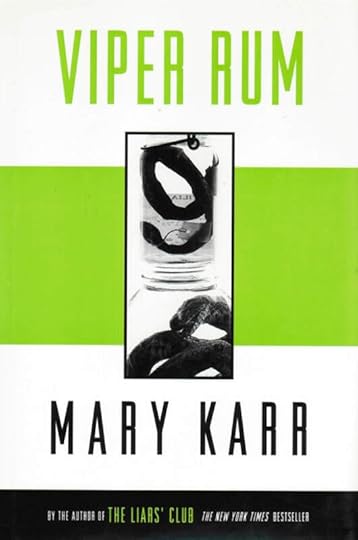
[Image: Book Cover]
Citation:
Karr, M. (2001). Viper rum. Penguin.
Title: Viper Rum
Author(s): Mary Karr
Year: 2001
Genre: Poetry
Page count: 78 pages
Date(s) read: 9/22/24 - 9/25/24
Book # 182 in 2024
***************************************************************************
QUOTES:
“Mother’s on the sofa with her channel-changer raised/
Aimed like a wrist-rocket at the last reality/
She can alter. Her bearing’s still imperial/
But each day she fades a little.”
(p. 8)
*
“I don’t miss drinking, don’t miss/
Driving into shit with more molecular density/
Than myself, nor the Mission Impossible/
Reruns I sat before, nor the dead/
Space inside only alcohol could fill and then/
Not even. But I miss
The aftermath, the pure simplicity:/
Mouth parched, head hissing static./
How little I asked of myself then - to suck/
The next breath, stuff the next heave, live/
Till cocktail hour when I could mix/
The next sickness.”
(p. 22)
*
“The elevator we wedged into became a jar/
Of steel and glass where we sucked/
For air like insects through forkholes/
The giant was kind enough to poke.”
(p. 32)
*
“I half-longed/
For the titanium blade I’d just seen/
Curved like a falcon’s claw./
Some truth wanted cutting,/
In my neighbor’s impermanent flesh.”
(p. 37)
*
“No word/
Of praise passed my lips though a million breaths/
Moved through me. That’s what human bodies do, keep/
Breathing, no matter the venom their brains manufacture.”
(p. 43).
*
“In my view, emotion in a reader derives from reception of a clear rendering of primal human experiences: fear of death, desire, loss of love, celebration of being. To spark emotion, a poet must strive to attain what Aristotle called simple clarity. The world that the reader apprehends through his or her senses must be clearly presented.” (p. 56).
*
***************************************************************************
[Image: Book Cover]
Citation:
Karr, M. (2001). Viper rum. Penguin.
Title: Viper Rum
Author(s): Mary Karr
Year: 2001
Genre: Poetry
Page count: 78 pages
Date(s) read: 9/22/24 - 9/25/24
Book # 182 in 2024
***************************************************************************

December 19, 2018
*3.5*
technically speaking, i read all of the poetry in this collection. i just didn't know before picking this book up that i had an essay at the end as a companion piece. yet, considering my knowledge of contemporary american poetry is woefully lacking, i skipped that.
in terms of the poetry, i thought the beginning felt much stronger than the ending. some of my favourite pieces-- "incant against suicide," "the wife of jesus speaks," "requiem for the new year," and "terminus" --felt touching and original without resorting to greater linguistic resources. especially coming from a female, former catholic perspective. however, some of the poems at the end were too separated from my life experience for me to feel as much--particularly those about motherhood. which, of course, has nothing to do (and says nothing about) the poems or poet themselves.
despite having deflated a bit towards the final poems, i would still recommend this collection--perhaps, to those who enjoy sylvia plath's works. i will pick up more of karr's collections in the future, though. her voice was too intriguing for me to let it pass just because i'm not a mother like her.
technically speaking, i read all of the poetry in this collection. i just didn't know before picking this book up that i had an essay at the end as a companion piece. yet, considering my knowledge of contemporary american poetry is woefully lacking, i skipped that.
in terms of the poetry, i thought the beginning felt much stronger than the ending. some of my favourite pieces-- "incant against suicide," "the wife of jesus speaks," "requiem for the new year," and "terminus" --felt touching and original without resorting to greater linguistic resources. especially coming from a female, former catholic perspective. however, some of the poems at the end were too separated from my life experience for me to feel as much--particularly those about motherhood. which, of course, has nothing to do (and says nothing about) the poems or poet themselves.
despite having deflated a bit towards the final poems, i would still recommend this collection--perhaps, to those who enjoy sylvia plath's works. i will pick up more of karr's collections in the future, though. her voice was too intriguing for me to let it pass just because i'm not a mother like her.

May 30, 2022
The autobiographical nature of Karr's poetry make this a relational work. She also has a way of examining stories from the gospel with a candid, fresh and unorthodox way. The poetry in this work is as strong as her collections like "Sinners Welcome." The second half of the book is her elevated reflection on modern poetry. She distances herself from academics and critics who write about poetry. Still, this part of the book reads like a paper you would expect to hear read at a conference. Much of it was over the head of a causal poetry admirer like me.

August 8, 2021
2.5, I think. I enjoyed reading her critical essay at the end. “I wonder if Jarrell would find the highbrow doily-making that passes for art today interesting. I scarcely do, except in the way that an exorcist might find certain demons interesting.”
Publisher's Note: Special thanks are due to David Kirizian of the Department of Herpetology at the American Museum of Natural History for his kindness in helping to arrange the photograph of vipers.
Publisher's Note: Special thanks are due to David Kirizian of the Department of Herpetology at the American Museum of Natural History for his kindness in helping to arrange the photograph of vipers.
February 24, 2023
Some of Karr’s poems, particularly on alcoholism, really make me sit up straight. She's been through it, and she's not afraid to throw a punch. Many are pretty serious, but then there is “The Revenge of the Ex-Mistress,” which is pure delight.
This volume includes her essay “Against Decoration,” which is a critique of contemporary poetry that manifests only intellectualism and obscurity, the type flying the banner “neo-formalism.” She makes a case for clarity and emotional involvement.
This volume includes her essay “Against Decoration,” which is a critique of contemporary poetry that manifests only intellectualism and obscurity, the type flying the banner “neo-formalism.” She makes a case for clarity and emotional involvement.

August 6, 2026
Collection was solid, just not really for me. Thoroughly enjoyed the essay "Against Decoration", however. Karr's thorough explanation of her distaste for and issues with the rising ornamentalism in poetry (in the 1990's -- I think we've circled back around to less ornament in today's poetry) is very intelligent and interesting. She clearly articulates her reasoning which is not something I am used to in criticism; she does not hide her arguments beneath, well, ornament.

May 28, 2019
poems about life, death, church, jesus fucking someone. i'm not real sure what her deal is as far as religion because there was some, uh, kind of seemingly conflicting shit happening, but she's got some beautiful prose. 3/5.

August 23, 2023
Karr's perspective on the neo-formalist movement is thought-provoking and refreshing in the face of modern poetry's current climb towards forced structure.
On another note, her gorgeous memoirs are just as touching to the mind, and heart, as I expected from any of her work.
Incredible read!
On another note, her gorgeous memoirs are just as touching to the mind, and heart, as I expected from any of her work.
Incredible read!

February 20, 2026
I always thought that poetry’s primary purpose was to stir emotion, and that one’s delight in dense idiom or syntax or allusion served a secondary one.
- Against Decoration
This is how poetic criticism should be cheered on.
- Against Decoration
This is how poetic criticism should be cheered on.

July 8, 2019
I want to write poetry like Mary Karr.

October 25, 2020
I do not know whether I enjoyed the poems or the essay more. Karr's essay "Against Decoration" is about what I wanted Lerner's "Hatred of Poetry" to be about.
September 16, 2021
An exceptional collection Well worth rereading
Displaying 1 - 30 of 39 reviews