

What do you think?
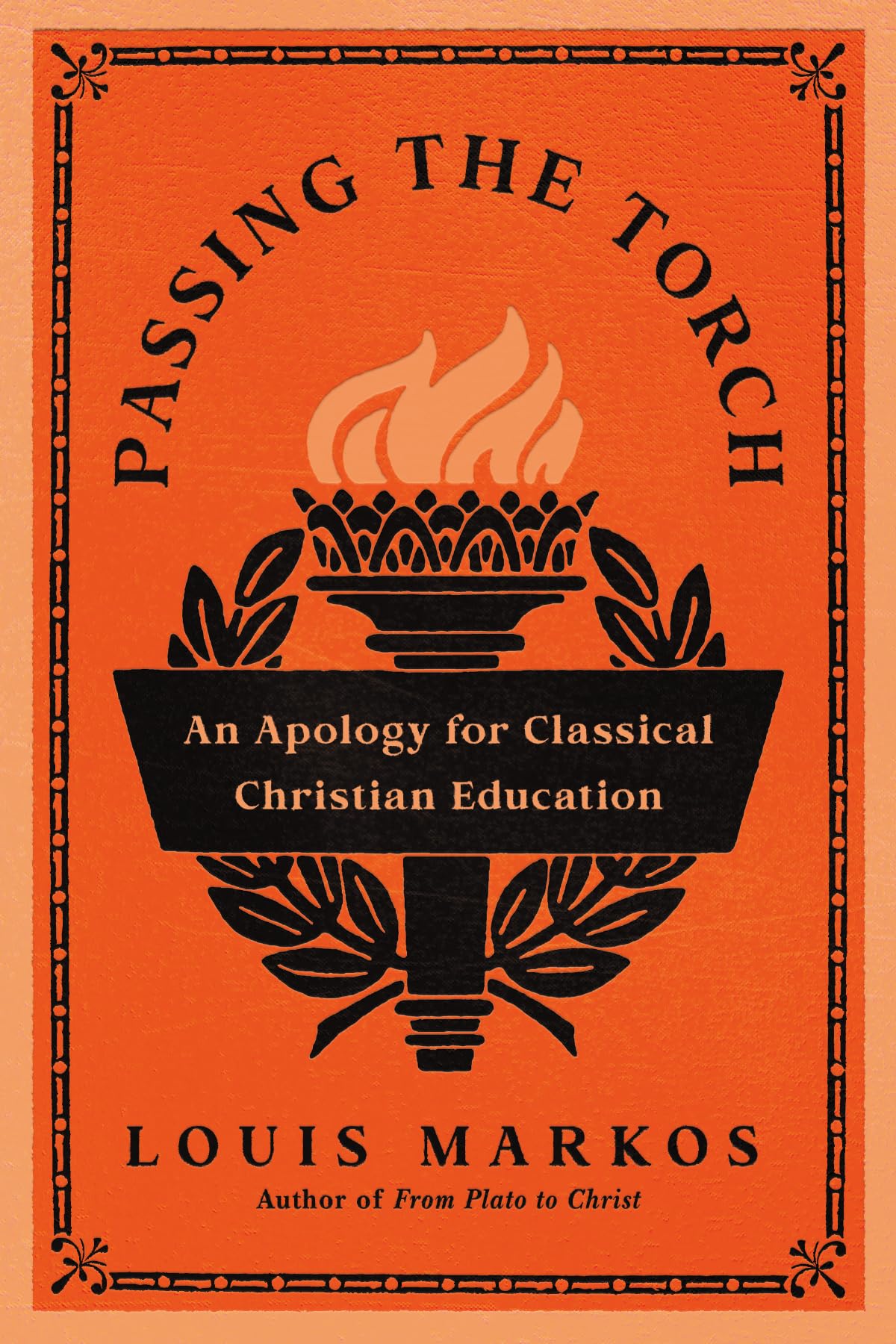
Passing the Torch: An Apology for Classical Christian Education
What is the purpose and meaning of classical education?
Imagine a world where education isn't just about information transfer but about shaping the soul, where students are nurtured to become virtuous, morally self-regulating citizens. Passing the Torch makes an energetic case for the critical role of classical Christian education in today's world. From the pre-Christian musings of Plato to the modern reflections of C. S. Lewis, Passing the Torch intertwines the wisdom of diverse epochs to argue for an educational renaissance grounded in classical Christian values.
Passing the Torch takes educators and parents on a literary and philosophical pilgrimage that
Bibliographic Each essay serves as a gateway to key texts and influential thinkers, making it an invaluable guide for educators and homeschooling parents alike.Close Delve into thoughtful examinations of pivotal figures such as Augustine, Rousseau, and Dorothy Sayers offering an intimate understanding of the moral and educational imperatives they championed.Passionate Passing the Torch ignites a fervor for the value and necessity of classical Christian education that is both infectious and inspiring.In an era where educational paradigms often prioritize technological proficiency over moral formation, Passing the Torch is a call to return to the roots of classical Christian education.
Imagine a world where education isn't just about information transfer but about shaping the soul, where students are nurtured to become virtuous, morally self-regulating citizens. Passing the Torch makes an energetic case for the critical role of classical Christian education in today's world. From the pre-Christian musings of Plato to the modern reflections of C. S. Lewis, Passing the Torch intertwines the wisdom of diverse epochs to argue for an educational renaissance grounded in classical Christian values.
Passing the Torch takes educators and parents on a literary and philosophical pilgrimage that
Bibliographic Each essay serves as a gateway to key texts and influential thinkers, making it an invaluable guide for educators and homeschooling parents alike.Close Delve into thoughtful examinations of pivotal figures such as Augustine, Rousseau, and Dorothy Sayers offering an intimate understanding of the moral and educational imperatives they championed.Passionate Passing the Torch ignites a fervor for the value and necessity of classical Christian education that is both infectious and inspiring.In an era where educational paradigms often prioritize technological proficiency over moral formation, Passing the Torch is a call to return to the roots of classical Christian education.
240 pages, Paperback
Published April 29, 2025
Ratings & Reviews
Friends & Following
Create a free account to discover what your friends think of this book!
Community Reviews
Displaying 1 - 17 of 17 reviews

May 26, 2026
This book examines modern philosophies of education and compares them to classical education and especially to Christian education. We begin with the question of the nature of mankind. The entire preface establishes that we are incarnational beings with both body and soul, we have a dualistic nature of both good and evil possibilities inside us, we are moral agents responsible for our own choices, and we are habitual beings who are capable of learning and changing. Therefore, one of the main objects of education is to train people to have the habit of virtuous living and right thinking, so that we react properly to good or evil. We are also subcreators, so we create stories and narratives to explore truth and define our place in the world. We are builders, so we have a desire to create order in a chaotic world. We are political, meaning that we function inside a community, and the purpose of education is to train citizens who are self-regulating within their society.
In order to define a proper philosophy of education, we must first understand who we are educating. I really love that this book starts from that point and gives a very clear picture of mankind, so that educators can then figure out exactly what our job is and what we ought to be teaching.
Then we tackle the differences between a liberal arts education (that focuses on language, logic, rhetoric, math, music, gymnastics, and philosophy) and a vocational education that equips someone with skills to do manual work. Both are important, but a liberal arts education educates the entire person, body, mind, and soul, whereas a vocational education leaves the mind and soul wandering in ignorance. A vocation can teach you to be productive in your community, but a liberal arts education teaches you what it means to be a person, making moral choices as you interact with your community.
The main purpose of a liberal arts education is to teach students the habit of virtue, and to do that you need a divine standard by which to measure morality. The author says that virtue cannot exist in a "morally relative vacuum".(pg.39) There has to be absolute fixed truth and goodness and beauty, or education falls apart because there is "nothing against which to measure the goal and the quality of the instruction."
I love that this book has a focus on studying history and gleaning wisdom from the books of the past. You have know where you are coming from to be able to see where you are going. With all of history behind us, we can see what to avoid and what to mimic, "forming human character in harmony with an ideal sense of balance and proportion." (pg.43) I think so many people today are missing a sense of proportion because they have not properly studied their history. A student who studies history has "a sense of themselves as participants in the flow of history and the choices of their ancestors." (pg. 77)
One chapter is devoted to canonical education. The author says that a true educator must expose the students to "timeless and time-tested works that have proven themselves to be worthy of long and careful study and contemplation." These are the "Great Books" of Western culture that teach people their heritage and how to function in their own culture. Dante, Shakespeare, Plato, John Milton, Austen, Dickens, Chaucer, Machiavelli, on and on, all the great writers. The author says "...the best way to instill virtue in young people was to embody those virtues in stories." (pg. 119)
If you want to "wrestle" with deep philosophical questions about purpose and belonging and morality, then you have to explore the works of the great authors and thinkers of the past. The author describes it as "joining in the Great Conversation" of philosophers who have been asking the big questions since time began. The author says "they are those who have stared deeply into the abyss of self and returned to teach us what they saw and heard. By reading and reflecting on their works, we are challenged to put in order our own wandering thoughts and feelings..."(pg.61)
I also really liked the chapter on books vs. textbooks, where the author argues that it's not enough for students to read a summary or an excerpt in a textbook and call that education. Students should be reading entire books and experiencing these great thinkers for themselves. That is the only way to reach their souls with these timeless stories and poems that touch the heart and change people from the inside out. Of course there are textbooks that are appropriate for certain subjects or particular lessons, but students should be receiving a more hands-on education where they experience things first-hand.
Too many textbooks filter history through a modern lens that looks on the past with a sense of superiority, as if the present is so much more enlightened and the past was full of fools. Students are taught to criticize the authors and thinkers of the past, instead of being taught to humbly learn from them. The author says "To stand naked and face to face with the Great Books is to have our thoughts tested and our actions altered. Those same works, when they are filtered through a textbook that defangs, deconstructs, and domesticates them, only reinforces our feelings of smugness, self-satisfaction, and self-righteousness."(pg. 71)
I really liked what the author had to say about classroom management being a social science where "students end up being more herded than taught, controlled than nurtured." Order in the classroom is necessary for learning, but social experiments in schools end up being more about regulation and statistics rather than about teaching anything to the actual child in front of you. What they call education teaches a child how to take tests. A true education will teach the child to love learning. "Students who fail to develop the power to continue acquiring their own knowledge will never be fully educated." (pg. 109)
Students are taught relativistic "values" rather than concrete "virtues", and the consequence is that they feel no shame when they do something wrong because they have not been taught the correct responses to good or evil in others or themselves. They are left adrift in a moral wasteland... but they scored well on a standardized test, so off they go into the world to live their lives with no education on how to actually live. But the social experiment has the measurable results that they tested for, so we call that an education.
They are "enslaved to whatever fashion or trend is currently in vogue" (pg. 104) because they have no fixed standard by which to measure their life. The author says that civilization is a garden, and educators are the gardeners. We have to teach people to recognize and desire truth, goodness, and beauty if that garden is to flourish and grow.
My favorite part of the book was when the author talked about the "lightbulb flash" moment when a student suddenly understands a new concept and connects with what is being taught. I LOVE that moment! I've been teaching for 25 years, and it's the best thing to see a student when their face lights up with understanding and there is this fire in their eyes as they get to apply what they have learned and really understand the meaning behind all that knowledge and information that I've been pumping into their little brain for months. The best part is that their "spirit of inquiry" as the author calls it (pg. 109) has been ignited, and they are eager to learn more and reform that information into their own way of expressing it.
The last sections of this book explore some different models of education and educational philosophies throughout history, including Plato, Augustine, Jean-Jacques Rousseau, John Dewey, C.S. Lewis, Dorothy Sayers, Charlotte Mason, Mortimer Adler, and others. We compare classical education and Christian education with relativistic modern education, and we go through the history of education in America and how things have changed in the last one hundred years.
I really loved the chapters on C.S. Lewis and Dorothy Sayers! C.S. Lewis wrote an essay, "The Abolition of Man", which examines the education system and how relativism and subjectivism have broken down all wisdom and virtue, and left "men without chests" who have no compass within to guide them through life. If everything is relative, then nothing can be known. Nothing can be taught. You have nothing to hold onto, so you just drift through life. Such people are in rebellion against reality. A true education will teach you that there are absolutes - absolute truth and goodness and beauty - and it "reconciles us to reality." (pg. 173)
Dorothy Sayers wrote "The Lost Tools of Learning", calling for an education that will "free the mind, arming it against faulty logic, emotional appeals, and manipulative propaganda." (pg. 179) She defines three different learning stages as children grow up, and shows how they are perfectly aligned with classical education to learn grammar, logic, and rhetoric as young children, then preteens, and finally as teens growing into adults. I really enjoyed reading that section because it's so easy to recognize these different learning stages in my own students!
Overall, this book is so brilliant, and I found a lot of great wisdom that I can apply to my own teaching!
Disclaimer: I received a copy of this book from the publisher in exchange for a free and honest review.
In order to define a proper philosophy of education, we must first understand who we are educating. I really love that this book starts from that point and gives a very clear picture of mankind, so that educators can then figure out exactly what our job is and what we ought to be teaching.
Then we tackle the differences between a liberal arts education (that focuses on language, logic, rhetoric, math, music, gymnastics, and philosophy) and a vocational education that equips someone with skills to do manual work. Both are important, but a liberal arts education educates the entire person, body, mind, and soul, whereas a vocational education leaves the mind and soul wandering in ignorance. A vocation can teach you to be productive in your community, but a liberal arts education teaches you what it means to be a person, making moral choices as you interact with your community.
The main purpose of a liberal arts education is to teach students the habit of virtue, and to do that you need a divine standard by which to measure morality. The author says that virtue cannot exist in a "morally relative vacuum".(pg.39) There has to be absolute fixed truth and goodness and beauty, or education falls apart because there is "nothing against which to measure the goal and the quality of the instruction."
I love that this book has a focus on studying history and gleaning wisdom from the books of the past. You have know where you are coming from to be able to see where you are going. With all of history behind us, we can see what to avoid and what to mimic, "forming human character in harmony with an ideal sense of balance and proportion." (pg.43) I think so many people today are missing a sense of proportion because they have not properly studied their history. A student who studies history has "a sense of themselves as participants in the flow of history and the choices of their ancestors." (pg. 77)
One chapter is devoted to canonical education. The author says that a true educator must expose the students to "timeless and time-tested works that have proven themselves to be worthy of long and careful study and contemplation." These are the "Great Books" of Western culture that teach people their heritage and how to function in their own culture. Dante, Shakespeare, Plato, John Milton, Austen, Dickens, Chaucer, Machiavelli, on and on, all the great writers. The author says "...the best way to instill virtue in young people was to embody those virtues in stories." (pg. 119)
If you want to "wrestle" with deep philosophical questions about purpose and belonging and morality, then you have to explore the works of the great authors and thinkers of the past. The author describes it as "joining in the Great Conversation" of philosophers who have been asking the big questions since time began. The author says "they are those who have stared deeply into the abyss of self and returned to teach us what they saw and heard. By reading and reflecting on their works, we are challenged to put in order our own wandering thoughts and feelings..."(pg.61)
I also really liked the chapter on books vs. textbooks, where the author argues that it's not enough for students to read a summary or an excerpt in a textbook and call that education. Students should be reading entire books and experiencing these great thinkers for themselves. That is the only way to reach their souls with these timeless stories and poems that touch the heart and change people from the inside out. Of course there are textbooks that are appropriate for certain subjects or particular lessons, but students should be receiving a more hands-on education where they experience things first-hand.
Too many textbooks filter history through a modern lens that looks on the past with a sense of superiority, as if the present is so much more enlightened and the past was full of fools. Students are taught to criticize the authors and thinkers of the past, instead of being taught to humbly learn from them. The author says "To stand naked and face to face with the Great Books is to have our thoughts tested and our actions altered. Those same works, when they are filtered through a textbook that defangs, deconstructs, and domesticates them, only reinforces our feelings of smugness, self-satisfaction, and self-righteousness."(pg. 71)
I really liked what the author had to say about classroom management being a social science where "students end up being more herded than taught, controlled than nurtured." Order in the classroom is necessary for learning, but social experiments in schools end up being more about regulation and statistics rather than about teaching anything to the actual child in front of you. What they call education teaches a child how to take tests. A true education will teach the child to love learning. "Students who fail to develop the power to continue acquiring their own knowledge will never be fully educated." (pg. 109)
Students are taught relativistic "values" rather than concrete "virtues", and the consequence is that they feel no shame when they do something wrong because they have not been taught the correct responses to good or evil in others or themselves. They are left adrift in a moral wasteland... but they scored well on a standardized test, so off they go into the world to live their lives with no education on how to actually live. But the social experiment has the measurable results that they tested for, so we call that an education.
They are "enslaved to whatever fashion or trend is currently in vogue" (pg. 104) because they have no fixed standard by which to measure their life. The author says that civilization is a garden, and educators are the gardeners. We have to teach people to recognize and desire truth, goodness, and beauty if that garden is to flourish and grow.
My favorite part of the book was when the author talked about the "lightbulb flash" moment when a student suddenly understands a new concept and connects with what is being taught. I LOVE that moment! I've been teaching for 25 years, and it's the best thing to see a student when their face lights up with understanding and there is this fire in their eyes as they get to apply what they have learned and really understand the meaning behind all that knowledge and information that I've been pumping into their little brain for months. The best part is that their "spirit of inquiry" as the author calls it (pg. 109) has been ignited, and they are eager to learn more and reform that information into their own way of expressing it.
The last sections of this book explore some different models of education and educational philosophies throughout history, including Plato, Augustine, Jean-Jacques Rousseau, John Dewey, C.S. Lewis, Dorothy Sayers, Charlotte Mason, Mortimer Adler, and others. We compare classical education and Christian education with relativistic modern education, and we go through the history of education in America and how things have changed in the last one hundred years.
I really loved the chapters on C.S. Lewis and Dorothy Sayers! C.S. Lewis wrote an essay, "The Abolition of Man", which examines the education system and how relativism and subjectivism have broken down all wisdom and virtue, and left "men without chests" who have no compass within to guide them through life. If everything is relative, then nothing can be known. Nothing can be taught. You have nothing to hold onto, so you just drift through life. Such people are in rebellion against reality. A true education will teach you that there are absolutes - absolute truth and goodness and beauty - and it "reconciles us to reality." (pg. 173)
Dorothy Sayers wrote "The Lost Tools of Learning", calling for an education that will "free the mind, arming it against faulty logic, emotional appeals, and manipulative propaganda." (pg. 179) She defines three different learning stages as children grow up, and shows how they are perfectly aligned with classical education to learn grammar, logic, and rhetoric as young children, then preteens, and finally as teens growing into adults. I really enjoyed reading that section because it's so easy to recognize these different learning stages in my own students!
Overall, this book is so brilliant, and I found a lot of great wisdom that I can apply to my own teaching!
Disclaimer: I received a copy of this book from the publisher in exchange for a free and honest review.

September 11, 2026
Dr. Markos explains the traditional understanding of human nature and the purpose of education. He builds his case on universal principles that both Christian and secular readers can accept, though I think he ends up fudging biblical doctrine in a few places. Most helpful to me were his summaries and assessments of the key works of educational philosophy, from Plato to Postman; just what I’ve needed! At times his arguments seemed too simplistic and repetitive, but that may be helpful in your first time through these philosophies.

November 21, 2025
4.5 stars. Wonderful apology, it's what our society needs, would possibly benefit from slightly more implementation instructions, but it gives good background and logic.

September 3, 2026
As a classical Christian educator myself I found it informative and inspiring. The opening essay on who we are as humans was in itself worth the cost of the book. Every parent and educator should read it!

December 30, 2025
Summary: An argument for Classical Christian Education based on its aim to produce virtuous, morally self-regulating citizens.
Louis Markos has written several books arguing the value of the Greek classical tradition for Christians while engaging that tradition critically. Therefore, it makes sense that Markos would defend the idea of classical Christian education, which he ably does in this book. Foundational to his argument, as he argues in the Introduction, is understanding what it means to be human. He understands humans as created with basic dignity but also as fallen, needing rules, limits, and discipline. Specifically, humans are rational, emotional, and volitional creatures. Our choices shape our feelings. A human fully alive is one whose virtues, affections, and desires have been formed and ordered.
Markos then argues that the nature of education must arise for our understanding of human nature. Specifically, what books and activities foster virtue? Firstly, he argues for a liberal rather than vocational education, liberal in the sense of liberating the mind to reason well and make virtue-shaped moral choices. Secondly, this is best accomplished through the canon of great books going back to the Greek tradition. He argues both that these book address universal human concerns and also that these works formed the shared values of the Western world. Thirdly, he argues for reading books rather than distillations of these books in textbooks or course packs.
Fourthly, he makes a case for reading history rather than a curriculum of social studies to understand the past that has shaped us. Fifthly, he likewise emphasizes humanities over social sciences, due to the latter’s methodological naturalism that mutes the imago dei in human beings. Sixthly, amidst moral relativism, classical education emphasizes the transcendentals of Goodness, Truth, and Beauty as objective realities. Finally, classical education emphasizes virtues of character rather than mutable values.
Then, in the second part of the book, Markos dialogues with influential educators through history. He includes chapters on Plato, Augustine, Rousseau, Dewey, C.S. Lewis, Dorothy Sayers and Charlotte Mason, and Mortimer Adler, E. D. Hirsch, and Neil Postman. He offers both positive and critical assessments of each. He especially highlights Lewis’s Abolition of Man as well as Dorothy L. Sayers, The Lost Tools of Learning. The latter was popularized by Douglas Wilson, a pioneer in the Christian Classical Education movement. He does believe Rousseau’s utopianism and Dewey’s progressiveness weakened much of contemporary education, as well-intended as were their efforts.
In concluding, he summarizes his argument as one critical for the American experiment at its 250th year. He writes, “If we are to continue, however, we must revive an understanding of the Greco-Roman, Judeo-Christian traditions that gave birth to that experiment and that continue to draw hopeful travelers here from all over the world. If we do not pass the torch to the next generation, then the glorious flame of liberty, which immigrants to Ellis Island saw as they docked in New York Harbor, will slowly, I fear, go out.”
On one hand, Markos makes an important argument that education needs to reflect an understanding of human nature. Certainly, the tradition he upholds deeply explores the human condition, the formation of virtues, and the ordering of society. Markos advocacy of books and history seems a much needed corrective to bland and ideologically driven social sciences. In addition, his recognition particularly of the Black contribution to this tradition, touched on in the text and bibliography and highlighted in a concluding review, is important.
I think Markos makes a valid point of immigrants (if we allow them in!) learning the intellectual tradition that has shaped our country. But, just as other cultures have illumined my reading of scripture, including American Indigenous Peoples (not discussed) as well as Latino, Asian, and African cultures, Might these enrich rather than dilute our Western cultural tradition? This possibility does not seem to be considered. I’d also love to see more evidence of classical education as a multi-ethnic movement.
Two figures mentioned in Markos’ text, Douglas Wilson and Pete Hegseth, might contribute to a perception associating Markos with a conservative culture war. He cites a book of Hegseth’s, noting its “polemical” character. but making an argument worth considering concerning American education. Likewise, he mentions Douglas Wilson at various points, duly crediting him with his contribution to classical education. However, he is silent regarding other critiques of Wilson.
I think the perception is not fair to Markos’ larger purpose. Classical education is a larger movement, both in its Christian and secular expressions, than Wilson or Hegseth. Markos offers a critique of American education, its assumptions and methodologies that needs to be weighed. He puts forth an alternative that is gaining traction. Finally, I find myself sympathetic to this proposal. I have spent my adult life backfilling the deficits in my own education by reading many of the Great Books mentioned here, as well as great works of other cultures.
_______________________
Disclosure of Material Connection: I received a complimentary copy of this book from the publisher for review.
Louis Markos has written several books arguing the value of the Greek classical tradition for Christians while engaging that tradition critically. Therefore, it makes sense that Markos would defend the idea of classical Christian education, which he ably does in this book. Foundational to his argument, as he argues in the Introduction, is understanding what it means to be human. He understands humans as created with basic dignity but also as fallen, needing rules, limits, and discipline. Specifically, humans are rational, emotional, and volitional creatures. Our choices shape our feelings. A human fully alive is one whose virtues, affections, and desires have been formed and ordered.
Markos then argues that the nature of education must arise for our understanding of human nature. Specifically, what books and activities foster virtue? Firstly, he argues for a liberal rather than vocational education, liberal in the sense of liberating the mind to reason well and make virtue-shaped moral choices. Secondly, this is best accomplished through the canon of great books going back to the Greek tradition. He argues both that these book address universal human concerns and also that these works formed the shared values of the Western world. Thirdly, he argues for reading books rather than distillations of these books in textbooks or course packs.
Fourthly, he makes a case for reading history rather than a curriculum of social studies to understand the past that has shaped us. Fifthly, he likewise emphasizes humanities over social sciences, due to the latter’s methodological naturalism that mutes the imago dei in human beings. Sixthly, amidst moral relativism, classical education emphasizes the transcendentals of Goodness, Truth, and Beauty as objective realities. Finally, classical education emphasizes virtues of character rather than mutable values.
Then, in the second part of the book, Markos dialogues with influential educators through history. He includes chapters on Plato, Augustine, Rousseau, Dewey, C.S. Lewis, Dorothy Sayers and Charlotte Mason, and Mortimer Adler, E. D. Hirsch, and Neil Postman. He offers both positive and critical assessments of each. He especially highlights Lewis’s Abolition of Man as well as Dorothy L. Sayers, The Lost Tools of Learning. The latter was popularized by Douglas Wilson, a pioneer in the Christian Classical Education movement. He does believe Rousseau’s utopianism and Dewey’s progressiveness weakened much of contemporary education, as well-intended as were their efforts.
In concluding, he summarizes his argument as one critical for the American experiment at its 250th year. He writes, “If we are to continue, however, we must revive an understanding of the Greco-Roman, Judeo-Christian traditions that gave birth to that experiment and that continue to draw hopeful travelers here from all over the world. If we do not pass the torch to the next generation, then the glorious flame of liberty, which immigrants to Ellis Island saw as they docked in New York Harbor, will slowly, I fear, go out.”
On one hand, Markos makes an important argument that education needs to reflect an understanding of human nature. Certainly, the tradition he upholds deeply explores the human condition, the formation of virtues, and the ordering of society. Markos advocacy of books and history seems a much needed corrective to bland and ideologically driven social sciences. In addition, his recognition particularly of the Black contribution to this tradition, touched on in the text and bibliography and highlighted in a concluding review, is important.
I think Markos makes a valid point of immigrants (if we allow them in!) learning the intellectual tradition that has shaped our country. But, just as other cultures have illumined my reading of scripture, including American Indigenous Peoples (not discussed) as well as Latino, Asian, and African cultures, Might these enrich rather than dilute our Western cultural tradition? This possibility does not seem to be considered. I’d also love to see more evidence of classical education as a multi-ethnic movement.
Two figures mentioned in Markos’ text, Douglas Wilson and Pete Hegseth, might contribute to a perception associating Markos with a conservative culture war. He cites a book of Hegseth’s, noting its “polemical” character. but making an argument worth considering concerning American education. Likewise, he mentions Douglas Wilson at various points, duly crediting him with his contribution to classical education. However, he is silent regarding other critiques of Wilson.
I think the perception is not fair to Markos’ larger purpose. Classical education is a larger movement, both in its Christian and secular expressions, than Wilson or Hegseth. Markos offers a critique of American education, its assumptions and methodologies that needs to be weighed. He puts forth an alternative that is gaining traction. Finally, I find myself sympathetic to this proposal. I have spent my adult life backfilling the deficits in my own education by reading many of the Great Books mentioned here, as well as great works of other cultures.
_______________________
Disclosure of Material Connection: I received a complimentary copy of this book from the publisher for review.

May 14, 2025
Starting in 1934, Werner Jaeger began his work on the three-volume series on the establishment of Greek culture and through the education developing the citizenship and character of the Greek person - his or her Paideia. Martin Cothran, of Memoria Press, described it as one of the best works of classical education you could find (paraphrased). I've just started reading it and I came upon Markos' book that presents a more direct linking of Paideia and classical education. On the subject of what is classical education, its importance, and the tracing of the history of not just classical education but also modern-western, secular education history and debate; Markos does a phenomenal just in 240 pages.
In the first part of the book, Markos defines the terms and gives the basis for the classical education model. Again, borrowing from Jaeger's Paideia he contrasts the classical with the modern, secular style. While making the distinctions clear, Markos focuses on the benefits of items like liberal arts vs vocational, a Western canon vs ideological texts, books vs textbooks, history vs. social studies, and humanities vs. social sciences. What doesn't get lost is the focus on the classical model and this shows the quality of writer Markos is. Whereas one could mention all sorts of major shortfalls of the modern western system and decry the communistic progressive takeover and agenda pushing, Markos focuses more on what the classical model offers and uses the contrasting model in contention as a short touchpoint. Markos isn't writing for the Twitter crowd but using the rhetoric to communicate the beauty of the classical method while also showing the benefits in all areas of life. If all you gave someone was this first half of the book to have a really good explanation and starting point for classical education this book would be worth it.
Then you get the second half of the book, which traces the history of Western education from Plato to Augustine and then makes a sharp leftist hand turn as Rousseau and Dewey. I do have to say that I was slightly in awe of Markos not only not calling both these men villains of the highest order of the second millennia but actually had areas of praise to deliver out where appropriate. Finally the discussion of people like C.S. Lewis, Dorthy Sayers, Charolotte Mason, Mortimer Adler, and Doug Wilson (among others) in pushing forward the modern-day resurgence of Western classical education. Again, I was impressed at the balanced attitude towards Sayers and Mason and I think both sides of that internal conversation will walk away happy (or at least equally both unhappy).
I really appreciated this book and Markos' work. I almost feel bad now having to reader Jaeger's book on the subject but this probably will provide a great foundation for getting more into the weeds of Paideia. A small critique I would have is that the two parts of the book do seem very much like two parts. I would have enjoyed a few more tie-ins directly pointing back to direct parts of the previous section of the book. This is not to say they are discarded or you're lost in the ideas of where they happen, but I do think the knitting together could have happened just a bit closer. This will be a resource for those wanting to know more about classical education, firming up the foundational thoughts of classical education, or a tool to give to a homeschool parent looking at what direction to take. Final Grade - A
In the first part of the book, Markos defines the terms and gives the basis for the classical education model. Again, borrowing from Jaeger's Paideia he contrasts the classical with the modern, secular style. While making the distinctions clear, Markos focuses on the benefits of items like liberal arts vs vocational, a Western canon vs ideological texts, books vs textbooks, history vs. social studies, and humanities vs. social sciences. What doesn't get lost is the focus on the classical model and this shows the quality of writer Markos is. Whereas one could mention all sorts of major shortfalls of the modern western system and decry the communistic progressive takeover and agenda pushing, Markos focuses more on what the classical model offers and uses the contrasting model in contention as a short touchpoint. Markos isn't writing for the Twitter crowd but using the rhetoric to communicate the beauty of the classical method while also showing the benefits in all areas of life. If all you gave someone was this first half of the book to have a really good explanation and starting point for classical education this book would be worth it.
Then you get the second half of the book, which traces the history of Western education from Plato to Augustine and then makes a sharp leftist hand turn as Rousseau and Dewey. I do have to say that I was slightly in awe of Markos not only not calling both these men villains of the highest order of the second millennia but actually had areas of praise to deliver out where appropriate. Finally the discussion of people like C.S. Lewis, Dorthy Sayers, Charolotte Mason, Mortimer Adler, and Doug Wilson (among others) in pushing forward the modern-day resurgence of Western classical education. Again, I was impressed at the balanced attitude towards Sayers and Mason and I think both sides of that internal conversation will walk away happy (or at least equally both unhappy).
I really appreciated this book and Markos' work. I almost feel bad now having to reader Jaeger's book on the subject but this probably will provide a great foundation for getting more into the weeds of Paideia. A small critique I would have is that the two parts of the book do seem very much like two parts. I would have enjoyed a few more tie-ins directly pointing back to direct parts of the previous section of the book. This is not to say they are discarded or you're lost in the ideas of where they happen, but I do think the knitting together could have happened just a bit closer. This will be a resource for those wanting to know more about classical education, firming up the foundational thoughts of classical education, or a tool to give to a homeschool parent looking at what direction to take. Final Grade - A

June 22, 2025
A brief but meaty overview of the history and philosophy of classical (and more specifically classical Christian) education. Markos also delves into the alternate models of education that have been popular in modern times.
A great introduction to the topic while also making the case for its adoption. Polemically pungent and rhetorically unvarnished in places, nevertheless over all Markos provides a good argument for why classical education should be pursued today (whether Christian or not). A good book. Recommend.
A great introduction to the topic while also making the case for its adoption. Polemically pungent and rhetorically unvarnished in places, nevertheless over all Markos provides a good argument for why classical education should be pursued today (whether Christian or not). A good book. Recommend.

October 31, 2025
I find it difficult to decide on a 1-5 star rating for books, so I am trying out a system for assigning stars. One category for each of the 5 starts. If the book fulfills the category it gets the star:
1. Is it good (morally)?
2. Is it true (in terms of absolute truth)?
3. Is it beautiful (well written in terms of craft)?
4. Would I recommend it to someone else?
5. Did I personally enjoy it?
For this title:
1. Yes
2. Yes
3. Yes
4. Yes
5. Yes
1. Is it good (morally)?
2. Is it true (in terms of absolute truth)?
3. Is it beautiful (well written in terms of craft)?
4. Would I recommend it to someone else?
5. Did I personally enjoy it?
For this title:
1. Yes
2. Yes
3. Yes
4. Yes
5. Yes
December 20, 2025
Markos's stance in defense of classical education is bold yet irenic. His approach to the different factions of the classical education movement is synthetic rather than analytic: he prefers to weave the different strands together, in order to present a seamless banner to the outside world. There are virtues to this approach; but personally I would like to read a treatment that tries to work through the contradictions.

Read
March 31, 2026strong argument/apology in support of what the actual purpose of education ought to be, the utility in reading traditional works, the long-standing superiority of virtues over values, and helped me understand some of what was clearly skipped in my own education. also recommends a favorite: C. S. Lewis' The Abolition of Man. #recommended

June 26, 2025
Helpful, big picture view. I wish he would have spent some time discussing the importance of studying classical languages.

July 27, 2025
The Introduction ("The Nature of Man") and Part 1 ("The Nature of Education") are stronger and less polemical than Part 3 ("The Nature of the Debate").

Read
December 19, 2025Audio

July 25, 2026
A must read for Christian educators, and a cogent argument for Classical education.
May 27, 2025
A bit dry but covers the need and meaningful impact.

July 3, 2025
Really good book, strongly recommend to anyone in christian education or who is a christian in education.

January 30, 2026
Excellent book. 10/10
Displaying 1 - 17 of 17 reviews