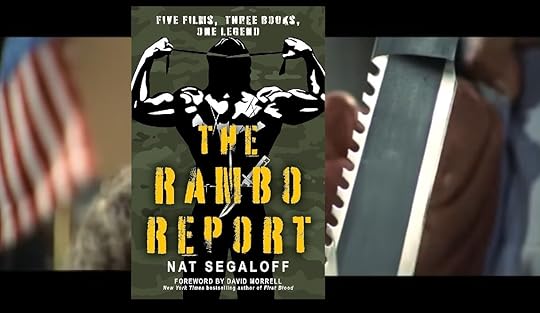
The ultimate guide to the Rambo phenomenon—from bestselling novel to Hollywood blockbuster to all-American hero, legend, and icon—written with the full cooperation of Rambo’s creator, bestselling author David Morrell . . .
From the beginning, Rambo was more than a character in a 1972 novel by David Morrell. He was the culmination of the author’s personal encounters with veterans returning from the Vietnam War. The 1982 movie adaptation of First Blood reflected the novel’s powerful insights into a troubled veteran’s postwar experience. Then in 1985, the film’s explosive sequel First Blood Part II transformed the character into something shockingly different. With a focus on blood-and-guts action—and the beefed-up muscles of Sylvester Stallone—Rambo became an invincible one-man army. A new kind of hero for a new day in America. A full-blown pop-culture icon as controversial as he was crowd-pleasing—blasting his way through the most influential action film franchise in Hollywood history . . .
The Rambo legend was born.
Five feature films. Three novels. Seven video games. Countless comic books, action figures, and even an animated TV show for kids. The Rambo machine has been as unstoppable as Rambo himself. Now for the first time, Hollywood insider Nat Segaloff digs deep into the man, the myth, and the massive impact of the phenomenon known as “The Rambo Effect.” Packed with behind-the-scenes anecdotes, sharp cultural insights, and ongoing debates about violence in the media, this is an explosive no-holds-barred report from the front lines of Hollywood mythmaking. A must-read for Rambo fans, movies buffs, and anyone interested in American culture . . .
Nat Segaloff is a writer-producer-journalist. He covered the film industry for The Boston Herald, but has also variously been a studio publicist (Fox, UA, Columbia), college teacher (Boston University, Boston College), and broadcaster (Group W, CBS, Storer). He is the author of twenty books including Hurricane Billy: The Stormy Life and Films of William Friedkin, Arthur Penn: American Director and Final Cuts: The Last Films of 50 Great Directors in addition to career monographs on Stirling Silliphant, Walon Green, Paul Mazursky and John Milius. His writing has appeared in such varied periodicals as Film Comment, Written By, International Documentary, Animation Magazine, The Christian Science Monitor, Time Out (US), MacWorld and American Movie Classics Magazine. He was also senior reviewer for AudiobookCafe.com and contributing writer to Moving Pictures magazine.
In 1996 he formed the multi-media production company Alien Voices with actors Leonard Nimoy and actor John de Lancie and produced five best-selling, fully dramatized audio plays for Simon & Schuster: The Time Machine, Journey to the Center of the Earth, The Lost World, The Invisible Man and The First Men in the Moon, all of which feature Star Trek casts.
I received a free copy of, The Rambo Report, by Nat Segaloff, from the publisher and Netgalley in exchange for an honest review. Rambo was first a character in a book in the early 1970s, by David Morell.. Mr. Morell talked to Vietnam vets about their experiences, and the book, Rambo was born. Then the movies came and more books. Rambo is a cult classic for a reason. This is an interesting story.
In much the same way that he has done for THE EXORCIST and SCARFACE, author Nat Segaloff takes a deep (Sometimes TOO deep) dive into the Rambo film franchise, hitting on the source material, the films, the novelizations of the sequels, spinoffs, inspirations, the studios, the suits, the stars, the budgets, the lawsuits, the history of the war and protests that inspired it all, and a lot more.
Often, the "a lot more" became TOO MUCH more for me, and my eyes glazed over when he got into the minutiae of budgets, payroll, location scouting, etc. Doubtless this will be interesting to some readers, just not this one.
There is a lot to enjoy here, and Segaloff is nothing if not thorough. The foreword, by Rambo creator David Morrell, is also illuminating, and it's an easy book to recommend to fans of the character and franchise.
I started this book in hopes of being entertained but it is much deeper and poignant than I expected. Segaloff does an effective job of capturing the spirit of the popular movies but spends most of the time fleshing out the depth of purpose behind the original work of David Morell and his involvement with the character. Along the way we learn plenty about the famous actors, the challenges of getting the movies made, and the literary history of the character. Some portions of the narrative are a little repetitive and some of the extra pieces could have been better organized but it is a well-done evaluation of the legacy of Rambo.
While the Korean War was winding down in 1953, a future bestseller eight years in the making took root, wooing readers with anti-war sentiment and a comical look at military management and those they lead. Also coining the phrase 'catch-22', CATCH-22 was Joseph Heller's debut satirical war novel that examines the absolute insanity of war and the ridiculous state of military bureaucracy. Nary more than a decade later and America deep in the throes of the Vietnam War, FIRST BLOOD took a similar look at the military establishment, its products and what happens when those assets are released among the normies without unlearning their lethal skills. Examining the legend that followed over the next fifty years via three books and five movies, THE RAMBO REPORT lands in the curiously unaddressed CATCH-22 of chicken and egg, where FIRST BLOOD gave birth to the Rambo character, but could it have become the pop-culture frenzy without the cinematic portrayal and box-office success of the Sylvester Stallone films. Conveniently packaging almost everything Rambo related into its lean 304 page frame, THE RAMBO REPORT is a treasure trove for cinephiles and Rambo-fans, jubilating the Rambo novels, the films, and the journeys of those who crafted them, all in one convenient tome.
Ranging from an anecdote of surname etymology and the apple genus 'Maluz pumila', the Rambo apple, to a quick retrospective of the Vietnam War and the events leading up to it in Southeast Asia, THE RAMBO REPORT really takes the reader to the birth of a legend and the difficult journey through time. It's dastardly interesting how FIRST BLOOD's silver screen adaptation was financed, made, released and reviewed. There is, however, not too much new information here for long term fans of Stallone, Morrell, and Rambo who've stuck with it for the duration and have read to the end of the Internet and remember microfiche. Newcomers to the topic will indubitably have their work cut out to absorb the mountain of details about Rambo's herculean trek that's thus far has lasted fifty plus years, for THE RAMBO REPORT valiantly tries to reconcile its ambitions with its limitations.
Remember when Bruce Willis' character John McClane tossed a duffel bag of hand grenades into a helicopter from the roof of Nakatomi tower while yelling "Hi-Yo Silver!"? No? That's because that didn't happen, not even in the deleted scenes section of the Japanese edition Laserdisc. With the same inventive bravado of THAT middle-school kid who's never seen a Rated R movie but brags about them all the time, THE RAMBO REPORT boasts a staggering 35 factual errors, mainly in the synopsis sections of the novel FIRST BLOOD, the novelization for RAMBO: FIRST BLOOD PART II and RAMBO III and the synopses of the film versions of FIRST BLOOD, RAMBO: FIRST BLOOD PART II, RAMBO III and RAMBO (2008), despite running the manuscript through various individuals, including the author of the novel that gave birth to the Rambo character. These errors would probably be "okay" for a fan/blog site posting with the aim of click baiting. Anyone employed who'd hand in a report on anything of the caliber of THE RAMBO REPORT would end up looking for a new job parking cars.
THE RAMBO REPORT wants to treat the Rambo legacy in terms of war, loss, friendship, inspiration, understanding and misunderstanding, betrayal, bravery, and of course, survival, though it never really digs down deep. Scratching the surface and reminding the readers of "Iceberg right ahead" throughout the book, THE RAMBO REPORT avoids treating the Rambo phenomenon via a direct cause and effect relationship, alluding to a host of cultural, political and social factors that all contribute to its existence; sort of like homelessness among veterans without solid reasoning and evidentiary support. While at times reading like a doctoral thesis, THE RAMBO REPORT is a beautiful 2025 lens on the Rambo topic and formative narrative process that has never been documented before social media and click farming content creators jumped on the 80s bandwagon of Rambo fandom. Along the amusing commentary from producer Mario Kassar interviews and hilarious phrases the likes of 'Rambo limbo' and 'nyet profits', THE RAMBO REPORT features several highly informative and interesting sidebar-sections that make the book shine. Among these are the journalist focused 'Assignment Stallone', 'The Song of Rambo', and the Carolco story and how parts two and three were made and went through development hell. Rambo and America have traveled a long and winding road together between 1972 and 2019. Read THE RAMBO REPORT to experience the joy, the pain, patriotism, disapproval, the mania and euphoria. Go back to the '70s, relive the 1980s and follow along from the first novel to the last movie--Rambo is more than a phenomenon; he's become an institution.
Thank you Nat Segaloff, NetGalley, and Kensington Publishing/Citadel for the ARC.
My thanks to NetGalley and Kensington Publishing- Citadel for an advance copy this history and look at a book and film series, that influenced much in the culture, from a new understanding of the treatment of veterans, how a new genre of film was created, and how movies became the message of many political groups.
First Blood the movie was released in 1982, and made me a fan of two things. One was the writing of David Morrell, an author who mixes both action and character development in both his novels and even his nonfiction. The second was the actor Brian Dennehy who never made a movie I didn't enjoy, including personal favorites like F/X and Silverado. I also enjoyed the movie, though I was still not sold on Sylvester Stallone, the Rocky movies never being that important to me. Demolition Man on the other hand, a classic movie. In First Blood, even to me just beginning to understand cinema I could see the mix of 70's everything is wrong, mixed with the start of what thrillers were becoming, bigger booms, bigger guns, bigger than life actors. Also, Rambo survived which would not have happened in a 70's movie. However things were changing, in the world, and in Hollywood, and much can be traced to this movie, for good or bad. The Rambo Report: Five Films, Three Books, One Legend by film historian and insider Nat Segaloff is a look at the entirety of the Rambo canon, from book to movies, to children's cartoon to Republican dream board of American policy.
David Morrell was a young man who came to America from Canada with an interest in Hemingway, writing and teaching others how to write. This was the early Seventies and many of his students were veterans of the Vietnam war, the same age as Morrell. Many took exception to Morrell, why was he not fighting in the war? Morrell explained he was Canadian, married, and with child, any of which made him draft exempt. As Morrell picked up on their anger an idea for a story slowly took hold. After many starts and stops and advice, Rambo was born, in the novel First Blood, in 1972. The book was a well-reviewed hit, and Hollywood came calling, but the times were hard to make a movie dealing with Vietnam, and time passed. In the early 80's two want-a-be film producers gathered the money, and went for it, hiring a director, and an actor eager to stretch his skill, Sylvester Stallone. The movie did well enough for a sequel, which hit the culture like a napalm bomb on a waterfall. Soon more sequels followed to diminishing returns, more controversy, and lots more digital ultraviolence.
Nat Segaloff is a longtime industry insider with a very good grasp of what makes Hollywood run, and what inspires people to work in this medium. Segaloff does a very good job profiling the author David Morrell and setting the scene of why Rambo works, and why it is important to understand his backstory. Segaloff looks at the long developmental process, tracking different scripts, different stories, and adds a lot of behinds the scenes info. Plus, a lot of behind the scenes drama, proving sometimes the best parts of a movie don't end up on screen. Segaloff looks at the cartoon, the idea of a son of Rambo, and even the comic books. Most importantly, Segaloff adds a chapter on how veterans and their problems have been treated in movies, and offers an appendix on places for veterans to get help. Something he didn't have to do, but might help people, and for that he should be thanked.
I loved this book, as I have loved the other books by Segaloff that I have read. Segaloff has, as I said an understanding of the making of, the creative sense, and how movies really get made. Also one can tell Segaloff loves movies, what they can do, and what they can make us feel. Another great book by Segaloff and I can't wait for more.
I'm a big enough Rambo fan (First Blood, specifically) that earlier this year--2025--I made the pilgrimage to Hope, British Columbia to take the film site walking tour! As such, this book was practically made for me. Even though a fair amount was "review" for me in particular, I still enjoyed pulling together all the elements of the Rambo legacy in one binding.
That's exactly what author Nat Segaloff does in "The Rambo Report"--collate information about the David Morrell novels, the Sylvester Stallone films, and all the other properties/themes pursuant to the franchise. While this takes the obvious form of film/novel synopses and behind-the-scenes stories & interviews, Segaloff also tackles Rambo from a few different socio-political lenses. As the character evolved on the page and on the screen, so did fan reaction to it.
Such "next level" analysis was probably my favorite portion of "The Rambo Report". Well, that and interviews/commentary from the likes of Stallone & Richard Crenna (to name just a few) on how the character's Vietnam War roots make him extremely complicated (but equally as important) to get a grasp on.
From Morrell's pen to Stallone's army jacket to the most recent 2019 film, Segaloff covers it all here. An absolute treasure-trove of information and analysis about one of the most interesting characters in the history of popular culture. Many interested readers may likely rank it 5/5 stars if synopses are needed or appreciated. In that way, "The Rambo Project" is inclusive to all readers--from the "die hards" like myself to the more casual fans of the character or concept.
There was a time when the character of John Rambo was a touchstone of a certain type of cultural debate that was prevalent in the mid-1980s. Then came the overkill of a series of increasingly ludicrous movies that seemed aimed primarily at keeping star Sylvester Stallone relevant at the box office. Still, the phenomenon surrounding this particular character at a particular time deserves to be remembered. The best part of this book is its devotion to the complexity of the text that started the whole story, First Blood by David Morrell. What isn't so great is the author's tedious, repetitive efforts to detail plots and production minutiae, a problem that plagued previous books on The Exorcist and Scarface. More attention also needed to be paid to some of the things that irritated people about Rambo: First Blood Part II, particularly the exploitive use of the POW-MIA issue. At heart, these are just movies where shit and people get blowed up real good.
Nat Segaloff is a master at writing about movies and movie stars. I loved his take on the Exorcist and this book about Rambo and the franchise was equally good. Growing up with the movies it was so interesting to read about the stories behind Rambo. If you like me love the movies and David Morells books then I’m sure you’ll enjoy this book. Highly recommended.
Thanks to the author, the publisher and NetGalley for the copy.
Based on the reviews of the author’s previous work, and being a big fan of the Rambo character, I was excited to dive into this and take a deeper look. I unfortunately found a lot of errors, whether it be the novel and the movie versions are confused, or even just basic plot summaries. After a number of these gaffes, I found myself questioning the veracity of the other info in the book. Disappointing.
DNF. I don't feel I'm getting what's been promised here. There is a lot of retelling of the movies' plots, and many well-known anecdotes from the filming of the movies, not all of them very interesting. I wanted to learn more about the writing of the original book, the building of the character, the topic of war trauma and how the world learned about it and came to look at it differently. There was relatively little of that in the book so far (I'm about 60% through).
An enjoyable overview of the Rambo franchise - the source novel, film series and novelizations (and brief touches on animated series and other my merchandising). There is a fair page count providing synopsis of the stories - which, depending how hardcore of a fan, you may find redundant. The author also addresses the impact and themes of the various interations (I particularly found the info about the director cuts of the later movies interesting).
absolute must read for every fan of Rambo. If you have grown up in the 80s or have seen the recent movies, this is a book for you. Very detailed accounts on how and why the movie, the book and the series was made. Very interesting and intriguing. Love it!
Nat Segaloff delivers the definitive history of the literary and film character John Rambo. The book is thoroughly researched and it was written in close conjunction with the character's creator (author of First Blood) David Morrell. An absolute must-read for any fan of the Rambo films or books.
I knew I’d love it. I love David Morrell’s book. I love all the movies, especially First Blood. I love the whole franchise. This book shows what a huge influence on our culture Rambo has had. I’ve always thought so but it was nice to read that someone really smart did too. And if Tarantino would really make First Blood the way Morrell wrote it, that might be my favorite movie of all time.
Won this book in a giveaway and I wasn’t expecting to enjoy it as much as I did, this is not my typical read but I found the whole novel entertaining and detailed. This author does an amazing job at showcasing the history and background of the character Rambo and the franchise as a whole. If you like films, I highly recommend this book