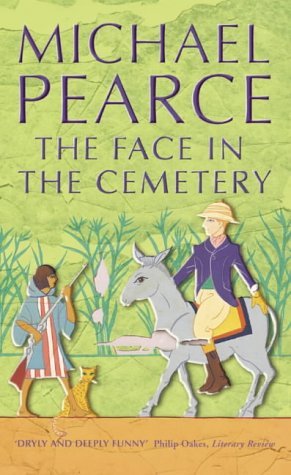
Egypt, 1914. The outbreak of war in Europe casts ripples even in Cairo. Gareth Owen, Mamur Zapt and Head of the Khedive's Secret Police, is given the task of rounding up enemy aliens. But determining who counts as a German proves contentious. And then there's the face in the cemetery. Who disturbed the mummified remains of cats by placing a human corpse among them? Is the villagers' talk of a mysterious Cat Woman mere superstitious nonsense, or something rather sinister? Owen has more pressing concerns in the shape of missing rifles and dubious gun-toting ghaffirs or watchmen. But the face in the cemetery refuses to go away, and Owen comes to realize that it poses questions that are not just professional but uncomfortably personal.
Michael Pearce grew up in the (then) Anglo-Egyptian Sudan. He returned there later to teach, and retains a human rights interest in the area. He retired from his academic post to write full time.
Egypt just before the Great War was a turbulent place where people of many nationalities tried to get along - or not. Owen, a Welshman and Zeinab his Egyptian wife (?) find others in the same situation. And then there are the missing 200 rifles to recover
How did she die? ‘What nonsense is this? She took enough poison to kill herself, bandaged herself from toe to head like a mummy, walked half a mile and then put herself into a grave: is that what you are saying? Suicide? You foolish man!’
Ignorant provincials and the mysterious Cat Woman hinder the police work ‘The provinces,’ said Mahmoud darkly, ‘are very backward.’ Owen could tell that the Cat Woman rankled. It was an affront to everything that Mahmoud believed in: rationality, progress, the essential equality of Egyptians with people in more developed nations. It was yet another example of Egypt falling short. ‘What hope is there for Egypt,’ said Mahmoud passionately, ‘when people believe such things? Even an intelligent man like the omda? It is ignorance, ignorance that is holding them back.’ ‘But that can be remedied,’ said Owen. ‘Yes, I know. Education. Well, yes, I agree we need more of that, and better. But even then! What hurt me most,’ he said, ‘was that mamur. Because, you see, he has had education. Training, certainly. But what use has he made of it? It is not so much his stupid prejudices as his inability to proceed professionally—despite his training! Where are the questions? How could it be suicide? Was someone helping her? Where did the arsenic come from? Did someone have a motive for murdering her? How might the poison have been administered? None of these questions did he ask! His mind was quite closed. It comes as a shock,’ Mahmoud confided, ‘to find such incompetence. But then,’ he went on gloomily, ‘it is not just confined to the provinces. As you yourself know.’
Guns 'n' Girls Owen saw a small girl standing in a vegetable patch at the edge of the sugar cane sucking her thumb. She was carrying a gun. Gun? ‘Stop!’ he said to the driver. The truck came to a halt. ‘What’s she doing?’ he said, pointing to the girl. ‘Scaring away the crows,’ said the driver indifferently. ‘Yes, but—that gun!’ ‘That’s to scare them with.’ ‘Yes, but that’s one of the new guns—the ones issued to the ghaffirs.’ ‘She is a ghaffir,’ said the driver. Owen got out of the truck and went over to the girl. ‘Hello!’ he said. ‘Hello!’ she said, removing her thumb from her mouth. ‘That’s a fine gun,’ said Owen. ‘It’s heavy,’ said the girl. ‘What are you going to do with it?’ ‘I know how to shoot it,’ said the girl. ‘Yes, but who, or what, are you going to shoot?’ ‘I haven’t shot anyone yet,’ confessed the girl. ‘They’ve made you the ghaffir?’ ‘That’s right,’ said the girl, putting her thumb back into her mouth.
. . . . . . Owen saw a small girl looking at him. Her face seemed familiar. ‘Hello,’ he said, ‘you’re not the ghaffir here, then?’ The girl removed her thumb from her mouth and grinned, pleased to be recognized. ‘No,’ she said, ‘they sent me home.’ ‘This is your village?’ ‘That’s right.’ She pointed to one of the houses. ‘That is where my uncle lives. He doesn’t beat me now.’ ‘Not now that you’ve been a ghaffir?’ ‘Not now that I’ve got a gun,’ she said.
Money - the root of all Evil Then Zeinab said: ‘What made it go wrong?’ ‘Well, the family—’ ‘No, no,’ said Zeinab, shaking her head impatiently. ‘Before that. In Uganda, or even before. What made it necessary for them to have to come back and live like that?’ ‘Money,’ said Owen. ‘It’s usually money.’ ‘Yes,’ said Zeinab thoughtfully, ‘that’s where marriages often go wrong. Especially if it’s between two people from very different backgrounds.’ ‘It’s where one of them has to move to something different from what they’re used to. It comes as a surprise, I suppose.’ ‘Yes.’ ‘It won’t be like that with us,’ said Owen confidently. ‘No,’ said Zeinab. ‘I’ve known from the start that you’re never going to have any money.’
The Great War was going to tear many couples apart including Owen and Zeinab. Unless he finds the missing 200 guns . . .
I have long enjoyed this series, reading it over a span of many years. I enjoy the history, which depicts Britain in Egypt in the early decades of the 19th century. The history, and the mystery, and the politics of the period are told with a light, humorous touch. I have always found them to be a an easy, fun, breezy read, always happy to find a new one. I especially love th e romance between Owens and Zeinab...it is especially poignant in this book, when they realize the difficulties of cross cultural relationships between english and Egyptian...
one of the best thing about this book is the buerocratic bumblings of governments...truly some great comedic moments!
Initially I was only ho-hum about this story, and would have only given it three stars, but as the story progressed I got more into the characters and the mysteries that the main protagonist, Owen, is investigating. Towards the end I was rather enjoying the novel and will likely look into others of the same series.
A good solid mystery. A bit tough to follow at times with all the odd titles - mamur, mudir, mamur zapt, etc; also, not usually a big fan of “he said” & “she said” dialog strings, but when multiple people in a scene are speaking in rapid fire turns, it’s tough to figure who’s saying what to whom. Nit picking, the book held my interest, and got better by the page. Gareth Owen is the Mamur Zapt (head of the secret police?) and with the outbreak of World War One in Europe, even backwater colonies like Egypt feel the effects: interning of certain foreign nationals (read, Germans), apparent gun-running and nationalist strife (read, Egyptians) and even an odd murder at a sugar plantation. Throw in a mysterious “cat lady” seen repeatedly in the sugar canes, and there’s a lot to sort out. The Mamur Zapt does, and Michael Pearce does, and we readers are happy to go along for the ride.
The Great War has begun. The Mamur Zapt is overseeing internment of German nationals, when a women's body is found among mummified cats at an archaeological site. Her murder seems to be purely a police matter though the Parquet seems uninterested until Mahmoud steps in. Meanwhile the Mamur Zapt has realized that some 1,050 military rifles have been shipped to the provincial town for distribution to local watchmen, under a plan of the Ministry of the Interior that would create a 50,000 strong unit of locals, some of whom see the Ottoman Empire as closer to them than any British interlopers. That attitude is, as well, causing stress in his relationship with Zeinab.
Gareth Owen is a member of the secret police in Egypt, 1914. There has been the murder of a young German woman, left wrapped in white cloths in the site of many cat mummies. Or was this suicide? How can that be? Owen searches for the murderer at the same time he investigates the problem of 200 missing Army rifles. Is there a secret army afoot? Is the woman's death connected? I found the book very interesting because of the setting. The mystery was good and there was some humor that kept the pace of an easy read. It wasn't exactly my cup of tea but I can see why the series has been so popular. I would consider reading another.
I enjoyed this book, but I had a little trouble getting into the groove, so to speak, when I first started reading it. Michael Pearce’s writing style and plot progression is different from most mystery novels, somehow.