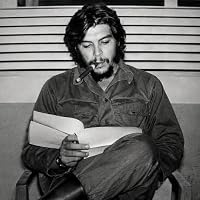
In this seminal exploration of Che Guevara's contributions to Marxist thinking, Michael Lswy traces Che's ideas about Marxism both as they related to Latin America and to more general philosophical, political, and economic issues. Now revised and updated, this edition includes a chapter on Guevara's search for a new paradigm of socialism and a substantive essay by Peter McLaren on Che's continued relevance today. This book eloquently captures his views on humanity, his contributions to the theory of revolutionary warfare, and his ideas about society's transition to socialism, offering a cohesive, nuanced introduction to the range of Guevara's thought.
French-Brazilian Marxist sociologist and philosopher. He is presently the emerited research director in social sciences at the CNRS (French National Center of Scientific Research) and lectures at the Ecole des Hautes Etudes en Sciences Sociales (EHESS; Paris, France). Author of books on Karl Marx, Che Guevara, Liberation Theology, György Lukács, Walter Benjamin and Franz Kafka, he received the Silver Medal of the CNRS in 1994.
همانگونه که از نام کتاب مشخص است، نویسنده در سه بخش به بررسی آرا، افکار و پراکسیس چهگوارا در سه زمینهی فلسفهی فکری، اقتصاد سیاسی و رزم انقلابی یا نبرد چریکی میپردازد. در این کتاب خبری از چهگوارای رمانتیک انقلابی نیست و خواننده با یک چهگوارای واقعبین و عملگرا روبرو خواهد شد. کتاب روان است و ترجمهی خوبی هم دارد و خواندنش دشواریای ندارد. تنها نقص کتاب، تروتسکیست بودن نویسنده است که باعث جهتدار شدن متن گشته و نویسنده عقاید چهگوارا را از فیلتر ایدئولوژیک تروتسکیستی خود عبور میدهد.
سوای اینکه نویسنده دل در گرو تروتسکیسم داشت (که اون بخشهاش ناامیدم میکرد)، کتاب پرارجاع به درد بخوری بود. این رو هم بگم که ترجمهی فارسی نشر مضمون خیلی خوب بود. برعکس ترجمههای کتابهای همدسته که اکثراً ویرایشنشدهن و خوندنشون مایهی عذابه، این ترجمه، فارسی تروتمیزی داشت.
Michael Löwy shows why Che Guevara, the “avenging prophet of future revolutions,” deserves to be studied and remembered as a champion of an internationalist socialism from below. Guevara ranks among others like Rosa Luxemburg, Antonio Gramsci, and José Carlos Mariátegui as a brilliant thinker and powerful force for global efforts to build a new world, not only technically, but morally.
This book is a good summary of some (not all) themes in Che Guevara’s political thought. It helpfully refutes the idea that Guevara’s politics can be reduced to (or, for that matter, generally characterized as) a utopian voluntarism. Unlike many of his Soviet or European contemporaries, Guevara was simply aware of the subjective element of a dialectical social process with a potential revolutionary outcome.
Guevara’s thought and the history he shaped seems all the more relevant in an era where “degrowth communism” is being debated and discussed.
The appendix written in 2007 is helpful in taking on the question of democracy within Guevara's thought. A useful addition to this book is Löwy's and Janette Habel's 2024 article in defense of Guevara: https://newpol.org/issue_post/against...
More like 4-4.5 stars. This is a really great introduction to Guevarian thought in all the aspects the title lists: philosophy, economics, and revolutionary warfare, with the latter two being much more fruitful (and thus rightfully longer) of expositions. Lowy also sets out for the book to progress through these three fields linearly. The philosophy section feels forced in trying to make Che's conceptions of the "New Man" and his Marxist Humanism into his own philosophy rather than just letting them be exactly those things. Thus, for the first thirty pages, I don't get much out of the content except for applying Marxism-Leninism to the material conditions of Cuba and hints of Che's humanist sentiments along the way. Moving into the economics section is where this book really picks up. Lowy does a great job outlining the notably underrated economic ideas and policies Che established and fought for in Cuba, mainly the "budgetary system of finance" that negates the view of enterprises as "juridical" production units. He does this by creating the "consolidated enterprise" (having similar technological bases and common destinations) seen as an agglomeration of factories that do NOT have their own funds, having separate deposit and withdrawal accounts. Many elements reflect the very worker-based management styles of the early Chinese Maoist communes combined with this budgetary system reminiscent of my own experience with how universities fund student organizations (which isn't surprising since Che wanted society to be like a huge university as he was a huge champion for education). Lastly, the section on revolutionary warfare is phenomenal and honestly where Che's humanism works best for Lowy's arguments. He rightfully extrapolates guerilla warfare as not merely a mechanical/physical tactic of battle but a revolutionary METHOD of people's war (the masses being a NECESSARY condition for at least his conception of guerilla warfare) that transcends the military scope into the economic, social, and political. This best suits Che's humanism as it is reaped from the early, emancipatory Marx's "Economic and Philosophic Manuscripts of 1844," which puts revolutionary practice at the helm of consciousness. Lowy creates a great argument for us to remember that this humanism and revolutionary agency is not of idealistic authority, but precisely to remind us of the dialectical relationship between action and determined conditions. We must not only understand that there are necessary conditions of the economic and state progression/situation for revolution but also know that we can expedite those conditions through revolutionary action; we must not only understand the conditions that require people's war but also know that guerilla warfare is a catalyst for political consciousness. "Che's position is thus precisely that of the Marxist dialectic, which transcends both mechanical materialism ('conditions determine the historical process') and abstract idealism (which asserts the omnipotence of the will): the praxis of the revolutionary vanguard is both the product of given conditions and the creator of new conditions" (93). My criticisms would mainly reside in the philosophy section and his strange alliance towards Trotsky (with not much evidence of the breadth of knowledge or reason of Trotsky's ideas) in some of Lowy's historical expositions and connections he makes of other revolutionaries with Che.
wow wow wow !! no iba con muchas expectativas cuando empecé a leer el libro por mis roces personales con el marxismo-leninismo que sé que pregonaba el che pero estuve súper pleasantly surprised con todos los encuentros teóricos que descubrí con algunos pensadores anarquistas, sobre todo bakunin. lo que más rescato del libro es el pensamiento del che alrededor de la supuesta "burguesía nacional revolucionaria" que se aliaría con la clase obrera frente y en contra de los grandes monopolios imperialistas que explotan las naciones subdesarrolladas de latinoamérica. el che básicamente decía que esas eran mamadas y que la burguesía local jamás iba a aliarse con la vanguardia revolucionaria simplemente por el hecho de que sus intereses económicos, políticos, ideológicos y militares estaban estrechamente vinculados con los de los grandes trusts norteamericanos (QUE SE COMPROBÓ CON EL GOLPE DE ESTADO DE GUATEMALA EN 1954 PERPETRADO POR LA UNITED FRUIT, LA CIA Y LA BURGUESÍA NACIONAL EN CONTRA DE ARBENZ). también rescato muchísimo su internacionalismo proletario antiimperialista que casi podría pensarse como un bolivarismo con conciencia de clase, su rechazo del ejército como fuerza revolucionaria al denunciarlo como un instrumento más de dominación de las clases reaccionarias y de los monopolios imperialistas y los encuentros en su pensamiento con franz fanon, sobre todo en cuanto al papel revolucionario del campesinado, la importancia de la violencia de los oprimidos, la unidad antiimperialista del tercer mundo y la búsqueda de un nuevo modelo de socialismo.
o sea sí es un poco enfadoso que constantemente se refieran a lo anarquista como lo utópico, lo idealista, lo romántico, lo estúpido básicamente jajaja, a lo largo de todo el libro pero equis lo dejo pasar porque contiene muchísima información súper valiosa y aparte está escrito con mucha lucidez. no sé si se lo recomendaría a personas que apenas comienzan a adentrarse en la teoría política o la sociología de la revolución porque sí hay bastantes tecnicismos, pero es un libro EXCELENTE si ya tienes tantito bagaje de conocimiento sobre estos temas. lo amé mucho, te kiero che, quijote del comunismo jaja ❤️
É um excelente resumo das posições políticas de Che. Obviamente não tem um ponto crítico à ele (não existe uma razão real para tal). Löwy, como sabemos, tem uma posição determinada dentro do Marxismo, sendo paralela às de Che, consegue desenvolve-las muito bem. Caso procure uma explicação boa dessa figura vital para o comunismo latino-americano e "terceiro-mundista", não existe uma síntese melhor.