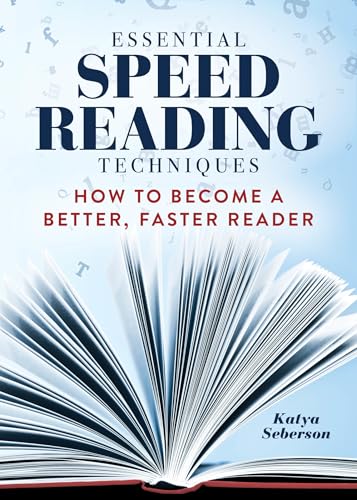
"Before this book, I thought I was a quick reader―but I was wrong! . . . my comprehension at high reading speeds substantially improved." —Jon Krohn, PhD, neuroscientist and author of Deep Learning Illustrated Faster reading is possible without sacrificing understanding—and this handbook will get you up to speed. Learn the most effective speed reading techniques for your personal strengths and challenges, and make visible progress through a series of engaging exercises. Choose from a variety of strategies and practices proven to advance speed and improve reading comprehension. The integrated exercises help develop your skills, allowing you to read quickly—and still enjoy every word. Whether you're reading an entertaining novel or a challenging textbook, this speed-reading guide will help you sail right through. In Essential Speed Reading Techniques, you'll
Achievable goals—Improve your speed by setting realistic goals based on your own individual baseline.Track your improvement—Assess your progress with self-tests for knowledge retention, smooth eye movement, and more.Tips and tricks—Discover speed reading strategies to minimize rereading, focus your attention, and reduce eyestrain from screens. With the personalized strategies in Essential Speed Reading Techniques, boosting your speed and reading comprehension will be a breeze.
Essential Speed Reading Techniques: How to Become a Better, Faster Reader by Katya Serberson is a pretty phenomenal book. It does exactly what it says it does, that is, presents various methods one can use to improve their reading speed while still retaining their comprehension. Not only that, but this book also includes practice activities and tests one can use to ascertain what their reading speed level is currently and then measure their progress periodically as they work through the activities.
This is not the sort of book one reads in one sitting or really just powers through. Instead, it's the kind of manual one continues to use over a long span of time. And as you get through each section of the book, you're able to mark all the progress you've made. The practice and testing activities allow readers the opportunity to watch as their reading speed increases.
I found Essential Reading Techniques to be an incredibly useful and insightful book. I learned quite a lot from reading it. While I will say that I was already an incredibly fast reader, I did find that the ideas presented in this book were quite useful in fine-tuning my reading speed whilst still maintaining an in-depth understanding of what I was reading. Honestly, this book did contribute somewhat to my having managed to read 352 books in 2019.
If you're looking to improve your reading abilities, I'd definitely suggest giving the techniques in this book a try.
I was provided a free copy of this book via NetGalley in exchange for an honest review.
Pretty solid overall. I appreciate the inclusion of practice tests, the prioritization of speed AND comprehension, realistic expectations, and the affirmation of the author's ethos by the inclusion of anatomical explanations behind speed-reading. I find myself seeing the author in a very positive light. In terms of tangible results, I increased my reading speed from 363 WPM to 650 WPM (both with perfect comprehension) - though, admittedly, this was over the course of less than a week and certainly not according to the recommended timeline within the book.
The only reason why I don't rate the book five stars is because I have fairly high standards for what deserves a perfect score, and this book was missing some unexplainable factor that is difficult to get down in non-fiction. If you're interested in the topic, then I would recommend you to try it out. I'm sure if you spent more time thoroughly enacting her recommendations, you could experience a far better improvement than the already notable increase that I ascertained from the contents.
This was the latest title in my ongoing efforts to find something interesting to read at Kindle Unlimited, after impulsively pre-purchasing a six-month subscription last week when it was on sale, then immediately learning that not a single book I actually want to go out of my way to read is carried through their service. (Seriously, of the 98 books currently in my TBR list, a grand total of zero of them are available through Kindle Unlimited.) That has me trawling through Amazon's "million-book" KU backlist each day, skimming and browsing in the hopes of stumbling across subjects that I happen to have an interest in; and when I came across this book, it reminded me that speed reading was a subject I found really fascinating when I was a kid in the late '70s and early '80s, although I quickly lost interest as an adult in the '90s once it was conclusively proven that most traditional speed reading techniques are just snake-oil bullshit (with the most notable example also being the most famous, the so-called "Evelyn Wood Method" which was still highly regarded when I was a kid, but has since been pretty thoroughly debunked as worthless).
Thankfully, SAT coach Katya Seberson admits as such in her own book, acknowledging that these old programs' claims of being able to teach people to read at literally thousands of words per minute were pretty much out-and-out lies, and that in reality most humans will never be able to get past 800 or 900 WPM in an absolute best-case scenario, and with most people never getting beyond 400 to 500 WPM even after taking a speed-reading course. (To give you a comparison, most text read out loud is done at around 150 to 200 WPM.) But sheesh, it turns out that it takes a lot of freaking work just to increase your rate by 50 or 100 WPM from your natural state, months and months of daily practice for hours and hours at a time, and that the people who mostly benefit from "speed" reading are those with learning disorders such as dyslexia who are just trying to catch up to a standard normal reading pace to begin with. For someone like me who already reads a hundred books a year, it begs the question of just how much work I want to put into reading fractionally faster than I already do, and whether I should even care about reading faster when I'm already getting through an average of two books every week even without the training.
I'm sure much to Seberson's chagrin, her otherwise smart and sober book convinced me that the answer in my own life is "no," although perhaps this will be a different answer for you? If so, I suppose this book isn't the worst place to start; although if Seberson's generic advice about learning (she seems to have cribbed about half of it wholesale from Mortimer Adler's How to Read a Book) is the best the speed-reading industry has to offer us (which I'm assuming it is, since this was the top book recommended at Amazon when I searched on "speed reading"), perhaps the critics are right when they say that speed-reading is ultimately a sham and that we shouldn't be paying attention to what any of these Harold Hills have to say about the subject. Buyer beware.
Libro completamente práctico en técnicas de lectura. Cubre los puntos básicos para iniciar el entrenamiento de velocidad y comprensión lectora, tales como la guía visual, la lectura por ideas, la gramática para leer consistentemente, y tips para formar el hábito de la lectura.
Although the book has good tips on how to read faster, ultimately, I think it is reading regularly that ultimately helps one to speed up reading. The last chapter even suggests that we read twenty five pages a day. I cannot help but to think that those who read regularly will acquire the techniques described in the book naturally.
Very practical steps to improve your reading quality and remove some weaknesses that naturally develop in readers. The exercises are useful and work even with your own reading material.
My favorite tips on improving reading speed include: - Fixating on prepositional and opening phrases - Steadily moving your eyes forward to reduce regression - Read the index to familiarize yourself with the jargon of a text - Identify the primary grammar components to stay aware of what you're reading (e.g. Subject, Verb, Object/Complement, Clauses) - Track pronouns while reading to avoid confusion
The author provided good descriptions of how the brain works to read and understand. It did feel stretched out. The ultimate take aways: Read more, Focus on reading fast when you do, and use fixations/ peripheral vision as you glide across the page. Not too much more to it than what’s on a quick google except for the tests that actually quantified my reading ability. This was a nice touch.
This is an amazing book. It uses a totally different method than the more commonly accepted form of speed reading training which is widely accepted, but fundamentally flawed. This is a more realistic way to learn to speed read.
Katya has done her research and presents practical ways to learn to read faster and comprehend what you're reading, which is important.
A well written book on improving your reading speed
This is well written. It starts out explaining what speed reading is and debunks many of the stories of speeds that are not possible if you are reading. It lays out a fifteen minute exercise to help you determine your current reading speed. The exercise is easy to complete and gives you a good understanding of your starting point. It then walks you through how to improve and set reasonable expectations. Well worth reading.
Good tips and information, and my reading speed did improve. Time will tell how much. That’s said, I can’t put my finger on it, but something felt lacking. Still definitely worth the read.
I loved this book. I have a great interest in reading but I find myself frustrated when I think of how much time I'm spending reading, I tend to spend up to 5 hours a day reading and I have sooo many books I want to read. Thank you so much for the tips.
Loved this book, actual tips you could use to help you read faster right now. Started at 250 WPM and finished this book reaching 550 WPM. Just wow! Thanks for sharing this with people who want to read faster right away.
I’ve read a lot of speed reading book over the years. Katya’s book had a number of very helpful insights. It’s a small book packed full of valuable information. Highly recommended!
229 to 338 from when I started the book to when I finished. Same comprehension, 70%. Needs work. This is more of a reference book you must continually work with than a one and done read.
Have you ever wanted to read faster? Have you looked into one of those speed-reading books or classes and felt like you were just told to skim the material to go faster and left disappointed? I know I have, so when I first picked up Essential Speed Reading Techniques, I was skeptical.
Katya Seberson understands that. When she developed her speed reading techniques, she read those books too, and she saw how unhelpful their advice was. She created her own techniques for becoming a faster reader by studying how people read, how a reader’s eyes move across the page, how the brain processes the words, the information, and the meaning.
Without making wild promises or asking readers to jump through hoops, Seberson offers simple, workable ways to increase reading speed and comprehension by small steps, by making progress in 5-10% increments. With simple but steady progress, by following the simple techniques of looking for word clusters and decreasing your subvocalizations, by creating your ideal reading environment and working on your focus, by looking at the context of the material and reducing the margins, you can find ways to get a little faster and then a little faster and then a little faster. And the key that she keeps coming back to is this: practice.
With down-to-earth ideas and a deep understanding of reading, Essential Speed Reading Techniques meets you where you are in your reading and helps you figure out the steps you need to take to be a better reader. If you want to read faster, if you want to comprehend more of what you read, or even if you just want to learn how to focus more on what you’re reading so you can get more enjoyment out of it, Seberson has the steps figured out to take to help you on your journey.
Perfect for students, this small book can help poor readers become more confident, it can help distracted readers find focus, and it can help any reader go faster. Highly recommended!
Essential Speed Reading Techniques was provided by Callisto Publishers, with many thanks.
I have read a “first pass” as I have only gone through a couple of the exercises presented to improve my reading speed. I read this book out of curiosity, but to potentially my reading speed and comprehension becoming interested in the concept of speed reading after watching Max Joseph’s excellent video on the joy of bookshops and reading.
I will return to it, and practice the techniques. I’m interesting improving my compression c.f. my speed.
My current reading speed is around 280 words per minute. Can I improve? Or read for simple enjoyment?
It gives you all the essential basics of speed reading. It's short enough to instill in you the basic ideas, but then you need to keep practising the various techniques in your usual reading routine to appreciate and benefit from speed reading.
They key idea for me were clustering, reduce vocalisation and reduced margin technique.
Moreover, it gives some useful tips on how to get the max out of a book and make it to stick in your mind, based on the pattern analyse read and review.
The book is quite short, just 2 or 3 days of read, hence I would recommend it.
This entire review has been hidden because of spoilers.
Doubled my WPM from 400 within a few days with no loss in comprehension. Some interesting theory behind sentence structure and writing on top of the exercises.