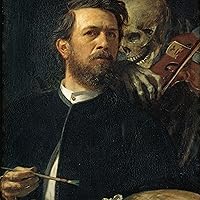
Situated on the cusp of West and East, between the foothills of the Alps and the mighty 'Blue Danube', Vienna has long presented authors with a wealth of material for stories that entertain and intrigue. The city's famous quality of life and rich variety of cultural offerings is apparent here at every turn, but so too is its darker side, whether it be the Viennese obsession with death and decay or the dramatic, tragic events of its twentieth-century history. In stories from the early to mid-nineteenth century in particular, the city stands for wine, women and song, for a laid-back - - perhaps somewhat lax?- - outlook on life that is invariably linked to its location as German culture's southernmost centre. In more recent tales, the theme of the good life and of Vienna's beauty continues, but there are very few authors who do not dwell on elements of darkness or melancholy. Indeed, from the mid-twentieth century onward, death itself seems to have become literature's preferred guide to the city.
The collection concentrates on stories set at the city's margins. The tales are arranged geographically rather than chronologically, around and through the city from west to east and back again. We begin and end with Arthur Schnitzler and Joseph Roth, two authors already indelibly associated with Vienna, but represented here by little-known gems, translated for the first time. Other authors include stars of Vienna's nineteenth century feuilleton journalism - Heinrich Laube, Ferdinand Kürnberger, Adalbert Stifter - but also the most recent generation of Viennese writers, Doron Rabinovici, Eva Menasse, Dimitré Dinev, with tales as yet unknown in English.
Helen Constantine read French and Latin at Oxford. She was Head of Languages at Bartholomew School, Eynsham, until 2000, when she gave up teaching and became a full-time translator. She has published volumes of translated stories, Paris Tales, and French Tales and edits a series of City Tales for Oxford University Press. Paris Metro Tales will be published in March 2011. She has translated Mademoiselle de Maupinby Théophile Gautier and Dangerous Liaisons by Choderlos de Laclos for Penguin and is currently translating Balzac’s La Peau de Chagrin for OUP. She is married to the poet, David Constantine and with him edits Modern Poetry in Translation.
I can't be completely objective about a book featuring Viennese locations and stories, but I'll try. The editor and translator have opted for a number of interesting choices, lesser-known writers (at least outside their home country) such as Anton Kuh, Christine Nostlinger, Veza Canetti) with the more obvious choices such as Arthur Schnitzler, Joseph Roth and Ingeborg Bachmann. Yet even in the case of the better-known writers, they have chosen works which have not been translated before or are less circulated. They also combine 19th century writers from other parts of the Empire such as Heinrich Laube or Adalbert Stifter with modern immigrants such as Dimitre Dinev and Doron Rabinovici. So a really interesting and varied collection, with some deliberate ommissions and an attempt to give a geographical rather than a chronological feel to this beautiful city.
This is a very literary collection which I guess is aimed at students of litarture as much as the everyday traveller. The stories are chosen from many sources and vary greatly in length, period and style. The stories as a whole give an idea of what living in Vienna is/was like, rather than what we would see if we were to visit. It hasn't changed my perception of Vienna (I have never been) as being a very mysterious place that everyone knows, but we hear of very rarely.
I was pleased to have won 'Vienna Tales' in the Goodreads Giveaway, but I did find this book hard going. Nonetheless, it was well written and for anyone who is interested in literary collections, then I would recommend this book.
Vienna Tales was a miss for me. I got this book at my local bookstore, and had the wrong impression when I picked it up. I was expecting a collection of travel fiction, but this is actually a short story collection. The stories differ greatly in length, and there were some authors I’d never heard of in the mix. I did very much enjoy the story about the young refugee, and the one about Ottakring. If you do speak German, I’d recommend reading the originals, though, as the translated versions in this book were a bit lacklustre, and quite hard to follow.
A collection of short stories with a common theme - Vienna. In some ways the most perfect of cities, especially in Summer. It is still possible to hear Hungarian musicians play your requests in the Kursalon restaurant in the Stadpark, take a ride in a Fakir around the Ring, or take the tram out to the Prater, admire the Secession Haus, and generally have a good time. This small volume captures some of the joys of Vienna. Well worth a read.
I’ve long wanted to visit Vienna – a European city break is just my type of holiday. I’m sure I’ll get there one day, but in meantime, what better way to experience the city than through its literature.
Vienna Tales is a collection of stories featuring Vienna. This diverse anthology includes pieces by older, established writers such as Arthur Schnitzler (1862-1931), Joseph Roth (1894-1939) and Adalbert Stifter (1805-68), along with works by more contemporary authors, many of whom were new to me. As with other collections I’ve reviewed, I’m not going to try to cover each story in turn. My aim instead is to give a flavour of the themes and a little of what I thought of the anthology as a whole.
The stories in Vienna Tales are arranged geographically rather than chronologically, so we roam around the capital from west to east and back again. Several of the pieces are set in the margins of Vienna, reflecting the centre from a distance, but each one seems to capture a different facet of the city.
The collection opens with The Four-poster Bed, a poignant story about the demise of a love affair. In this early work by Arthur Schnitzler, a melancholy summer evening reflects the dying embers of one man’s love for a ‘sweet, darling girl’:
The last embers of sunset died down. Cool shadows crept up the houses, slowly, until they disappeared on the roofs. All that remained, way out on the last buildings, was a reddish, aching glow. (pg 24)
Many of the stories are packed with imagery, pictures of life in Vienna in the 19th and 20th centuries. In one of my favourite pieces from the collection, The Prater by Adalbert Stifter, we follow the narrator on an afternoon walk through this extensive park, an area that combines parkland, meadows, a fairground, beer stalls, coffee houses and more remote woodlands. It’s a feast day in May, and the Prater is bustling with activity:
Carriages drive through the midst of this crowd like ships in pack-ice, mostly slowly, often held up and forced to stand still for many minutes at a time, but then, when gaps present themselves, flying past each other like gleaming phantoms through the stolid, meandering mass. Figures on horseback can be seen rearing up out of the sea of pedestrians here and there, hopping over and through the line of carriages; (pgs. 164-165)
Joseph Roth’s short sketches, Day Out and Merry-go-round, also fall into this category.
Another of my favourites is The Feuilletonists by Ferdinand Kürnberger (1821-79), a delightfully amusing piece in which the narrator describes the characteristics of each type of feuilletonist (writers of feuilletons) to be found in the city. (Originating in France and Germany, popular in the mid-19th century, a feuilleton was the part of a newspaper or journal devoted to fiction, cultural criticism, light literature and gossip.) In Kürnberger’s sketch, we are introduced to the house feuilletonist, a writer who draws on his domestic surroundings for inspiration. Then we have the street feuilletonist, aka ‘the flaneur’ in high German, or ‘loafer’ in low German:
Exemplars of this species can often be found in front of the window displays of the larger fancy goods and fashion emporia. They also loiter in doorways to let the architecture of the magnificent new buildings opposite “work” on them; unfortunately, prestigious edifices freshly built in Vienna cannot be enjoyed from any other point of view. (pg 108)
By contrast, the tavern feuilletonist is to be found in the coffee houses of Vienna. ‘You will never find it there with a newspaper, but always with cards or a billiards cue in its hand. Loathing for periodical publications of all kinds is a distinguishing characteristic of this kind of journalist.’ There are one or two others as well, but I’ll let you discover them for yourselves should you decide to read this book. (Incidentally, a Viennese coffeehouse, Konditorei Demel, also features in Anton Kuh’s Lenin and Demel, a short piece on deposed aristocrats trying to getting to grips with the new culture following WW1.)
We (non-Austrians) tend to know many German writers, but when it comes to Austrian writers, not so much. It was a real nice introduction to Austrian literature (which provides a deeper understanding of city of Vienna), so I can read more great books by Austrian writers in future.
The best part of this book a short story Spas Sleeps by Dimitré Dinev. Dinev initially moved to Austria as a illegal migrant from Bulgaria, and worked his (hard) way up to current status of respected Austrian author writing in German language. Spas Sleeps is a deeply moving story about survival and friendship between childhood friends from Bulgaria who meet again as illegal migrants in Vienna. I recommend everyone who has even a remote interest in current refugee/migrant crisis, either pro or con, to read this. With only just 30+ pages, Dinev take us on a journey to experience what those migrants experience, and feel what they feel. Unfortunately, there seem to be no books by Dinev translated into English (which I hope would change not far in future), but at least, you can read a really good short story by Dinev here in this book.
I bought the book during my recent trip to Vienna. I would read it again next time I am back. And I hope to visit those places written beautifully in the book but hadn't had chance to visit this time.
This volume of short stories inspired by Vienna is part of a series of OUP publications themed around European capital cities. "Vienna Tales" comprises pieces ranging from the 19th century to the present day, each of which gives us a glimpse of the Austrian city. The selection - by Deborah Holmes, who also provides the idiomatic translations - tends to favour stories of a rather experimental bent. Just to the give an example, there are a number of works by Joseph Roth in which "travel writing" is combined with a dash of magical realism. This makes the collection interesting but, at times, something of a challenging (and slower) read.
My favourite stories are the more contemporary ones: "Spas Sleeps" by Dimitre' Dinev, a portrayal of the plight of illegal immigrants, emotionally devastating in its artful simplicity; "Envy" by Eva Manasse, in which a funeral "wake" becomes a subject of a wry tragicomedy; "Six-nine-six-six-nine-nine" by Doron Rabinovici a ghost story of sorts with an erotic undercurrent.
The volume includes notes on each author, bibliographical details and suggestions for further reading.