Jump to ratings and reviews
Rate this book

Who Goes There?

Rate this book
"Who Goes There?" is the novella that formed the basis of John Carpenter's film The Thing. Campbell's classic story tells of an Antarctic research base that discovers and thaws the ancient, frozen body of a crash-landed alien—with terrifying results!

90 pages, Hardcover

First published August 1, 1938

714 people are currently reading
13984 people want to read

About the author

John W. Campbell Jr.

778 books283 followers
John Wood Campbell, Jr. was an influential figure in American science fiction. As editor of Astounding Science Fiction (later called Analog Science Fiction and Fact), from late 1937 until his death, he is generally credited with shaping the so-called Golden Age of Science Fiction.

Isaac Asimov called Campbell "the most powerful force in science fiction ever, and for the first ten years of his editorship he dominated the field completely."

As a writer, Campbell published super-science space opera under his own name and moody, less pulpish stories as Don A. Stuart. He stopped writing fiction after he became editor of Astounding.

Known Pseudonyms/Alternate Names:

Don A. Stuart
Karl van Campen
John Campbell
J. W. C., Jr.
John W. Campbell
John Wood Campbell

Ratings & Reviews

What do you think?
Rate this book

Friends & Following

Create a free account to discover what your friends think of this book!

Community Reviews

5 stars
3,109 (25%)
4 stars
4,482 (37%)
3 stars
3,425 (28%)
2 stars
881 (7%)
1 star
214 (1%)
Displaying 1 - 30 of 1,363 reviews
Profile Image for Stephen M.
145 reviews645 followers
April 6, 2012
"The huge blowtorch McReady had brought coughed solemnly. Abruptly it rumbled disapproval throatily. Then it laughed gurglingly. . ."

Yikes.
Profile Image for Jon Nakapalau.
6,495 reviews1,022 followers
October 17, 2024
Almost every 'we are trapped and a monster is killing us one by one and now we are turning on each other' story or movie I have ever seen is indebted to this novella in some way or other. Really glad that I finally finished this highly underrated classic; creepy and very atmospheric - highly recommended!
Profile Image for Charles  van Buren.
1,910 reviews303 followers
September 3, 2023
This review is from the 99¢ Kindle edition described herein:
ASIN: B08WKXPF6L
Publication date: February 13, 2021
Language: English
File size: 574 KB
Text-to-Speech: Enabled
Screen Reader: Supported
Enhanced typesetting: Enabled
X-Ray: Not Enabled
Word Wise: Enabled
Print length: 68 pages
Lending: Not Enabled

This is the classic sci-fi story which inspired Howard Hawk's 1951 movie, The Thing From Another World, John Carpenter's 1982 movie The Thing and helped inspire the 2011 prequel also called The Thing.

None of those movies actually tell John Campbell's story in full. Amazon reviewer James Girasa wrote,
"If you took the first part/act of 'The Thing from Another World (1951)' and the middle part/act of the 'The Thing (1982) and combined them, the story would be very similar to this novella by John Campbell. "

Who Goes There was written by Campbell under the name  Don A. Stuart. It was published in the August 1938 edition of Astounding Science Fiction. It has seldom if ever been out print and it has never been that hard to find a copy.

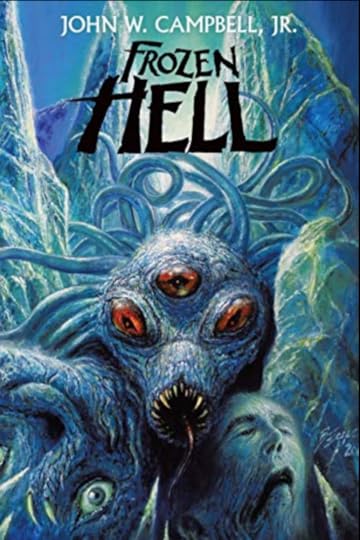
There were two versions of the novella published in three or four different magazines. In 2018, a novel version was found among Campbell's papers. That version was subsequently published as Frozen Hell.

This particular 99¢ Kindle edition has the cover and the text. No introduction. No explanations. No indication as to which version of the story this is. As of 9/1/23, I can not find this edition on Amazon.
Profile Image for Chris Lee (away).
209 reviews189 followers
January 25, 2024
John W. Campbell’s “Who Goes There?” is an ingenious piece of sci-fi horror written in the late 1930s. There is an updated version entitled Frozen Hell, which expands on the original and has a few added illustrations, but from what I read, the original has less setup and really tosses you into the nightmarish fray early on. Game on!

Hmmm. What is the best way to describe the book? An Antarctic research team stumbles upon a spaceship along the frosty tundra, and to the crew’s surprise, they find an ancient, frozen creature. So, what does any enterprising research team do? Yep! That’s right. They exhume what they can and bring the body back to the lab. Most of the team is gung-ho on defrosting the creature so that it may learn its secrets. The cook, funny enough, wants nothing to do with it and makes his voice heard. Also, speaking of cooks, I might have been devouring a naan with pesto at this point. Not recommended when it gets to the grislier bits. 😅

|| "What was it planning to do?" Barclay looked at the humped tarpaulin. Blair grinned unpleasantly. The wavering halo of thin hair round his bald pate wavered in a stir of air. Take over the world, I imagine." ||

Once the creature defrosts, it starts to run amok, clasping on to the crew and taking its pound of flesh. (quite literally), but what makes this story so unique is the fact that the creature embodies its host and imitates it. The scientists start to worry that if the creature can imitate a human, it can use their research plane and travel to other parts of the world, where it can eventually propagate. 😨

|| "The idea of the creature imitating one of us is fascinating, but unreal, because it is too completely unhuman to deceive us. It doesn't have a human mind." ||

If this sounds familiar, it’s because this novella is what inspired the horror film The Thing. There have been several remakes over the years, but in my humble opinion, John Carpenter's version is the masterpiece.

I pretty much could not put this book down. I was pleasantly surprised at how much hard sci-fi went into the makeup of the novel. For a conceit that could easily divulge into a campier nature, this book shines with exciting insights about society, science, and human nature. Even though the creature is taking control and manifesting the crew, I was somewhat reminded of my guy, Shakespeare, and his famous quote, “The fault, dear Brutus, is not in our stars, But in ourselves.” For this crew and possibly the world at large, Pandora's box had been unlocked.

If you enjoy your secluded horror with a bit of intrigue, some fun sprinkled in, and a horrifying end, give this novella a read.

🎵| Soundtrack |🎵
❖ Låpsley – Hurt Me
❖ Jordan F – Abandoned Streets
❖ Coheed and Cambria – The Suffering
❖ The Temptations – You’ve Really Got a Hold on Me
❖ Placebo – Running Up That Hill (cover)

** I read a teeny tiny bit of this with Helga, but I am a terrible buddy reader and just went ahead and finished it off. **

⭐ | Rating | ⭐
❖ 4 out of 5 ❖
Profile Image for Bionic Jean.
1,384 reviews1,568 followers
December 8, 2024
Who Goes There?, by John W. Campbell Jr., is the novella on which "The Thing", the 1982 film directed by John Carpenter, is based. It was first published in the August 1938 edition of the "Astounding Science Fiction" magazine, under the pen name Don A. Stuart.

The story is set in Antarctica, where an isolated group of scientific researchers find the body of an alien creature in the ice. They realise that its spaceship must have crashed there 20 million years before. With misgivings, they proceed to thaw the creature, which then disappears. The premise of the story is a good one, and there are lots of possibilities for tension and paranoia, all of which Campbell tries to create. However it is now sadly dated and feels extremely overwritten. Passages which should be chilling and horrific come across to a modern reader as unbelievable. In its worst excesses it is so over-the-top as to be funny,

"They haven't seen those three red eyes and that blue hair like crawling worms. Crawling - damn, it's crawling there in the ice right now!"

"The broken haft of the bronze ice-axe was still buried in the queer skull. Three mad hate-filled eyes blazed up with a living fire, bright as fresh-spilled blood, from a face ringed with a writhing, loathsome nest of worms, blue, mobile worms that crawled where hair should grow -"

"The last I saw the split skull was oozing green goo, like a squashed caterpillar...wandering around with a split skull and brain oozing out...has anybody seen it coming over here?...About four feet tall - three red eyes - brains oozing out?"
(presumably this last was in case anyone had spotted a different scary alien and mistook it for the first one...)

The fact that the story has been filmed several times shows that there is a good basic storyline; material for a horror film. The idea that the alien could mutate or "morph" into any other creature, is fodder for many imitations since. "Each of us with an eye on the other, to make sure he doesn't do something - peculiar." Who is the imposter? Who can you trust? And who is the alien? It fed on the paranoia of the time between the two World Wars. Here is a slightly less "pulpy" quote,

"The cells are made of protoplasm, their character determined by the nucleus. Only in this creature, the cell nuclei can control those cells at will...shape its own cells to imitate them exactly...This is a member of a supremely intelligent race, a race that has learned the deepest secrets of biology, and turned them to its use."

In the end though, this story does not live up to its expectations. Perhaps as modern readers we are now too cynical to enjoy pure pulp. Just over forty years ago, in 1973, it was voted one of the finest science fiction novellas ever written, by the Science Fiction Writers of America. But that time was slightly closer to when it was written than to the present, and the world has seen a lot of changes since.

John W. Campbell Jr., himself was a revered and influential figure in American science fiction. He was the editor of "Astounding Science Fiction" as well as a contributor, from just before this story until his death. He is generally credited with shaping what is called the "Golden Age" of Science Fiction. Isaac Asimov said that Campbell dominated the field completely for the first ten years of his editorship, calling him "the most powerful force in science fiction ever." Perhaps he should be remembered for his editorship, and this story remain firmly in its classic pulp magazine past.
Profile Image for Tadiana ✩Night Owl☽.
1,880 reviews23.3k followers
May 23, 2017
I first read "Who Goes There?," by the well-known Golden Age SF editor John W. Campbell, as a young adult and I have a lot of residual affection for it, and that's clearly coloring my 4 star rating for it. It's gloriously, unabashedly pulp SF and it's from 1938, so just know that going in. Once you get over the occasionally deep purple prose and the fact that there are only male scientists at this camp, there's a great story here.

This is a old-fashioned SF monsters-from-space horror story about a malevolent, incredibly dangerous space alien that terrorizes an isolated scientist's camp in Antarctica. An expedition of scientists finds a spaceship encased in ice that's probably been there for millennia. One deep-frozen alien is outside of the ship; it looks like there are a few more inside. In attempting to bust the door of the spaceship open and get inside, the scientists set off an explosion that burns up the magnesium-hulled ship. Oops!

But there's still the one alien, and after some heated debate ("But it looks so EEEVIL!!!" "How do you know? It's ALIEN! That may be a peaceful, friendly expression on its face.") Blair, the pathologist, successfully lobbies to thaw it for examination. No one figures that it would have any real life to it after its long freeze. But of course, it does. And now something's on the loose and no one is quite sure what it is or how to deal with it.

The claustrophobic feel of the isolated camp, the cold and ice everywhere, and not knowing which of your friends and colleagues have been taken over by the alien (writhing tentacles alert!), thinking you're going to be next... Whew! I can see why it's been made into a film three times. The image of a few shrieking drops of blood, is permanently imprinted on my brain. It's short on characterization but the plot makes up for it, IMO.

Free online here at Baen.com. Read when you're in the mood for some good old-fashioned SF horror!

Side note: I reread this classic SF novella to get a better basis for understanding and appreciating the 2016 Nebula award-nominated short story "Things With Beards." As it turns out, the short story is based much more on the 1982 John Carpenter movie "The Thing" (with Kurt Russell), which is only loosely based on this novella, but a quick read of Wikipedia's summary of that movie gave me the missing info I needed (mostly about the way the movie ends).
Profile Image for Eloy Cryptkeeper.
296 reviews226 followers
April 15, 2021
"Nada de lo engendrado en la Tierra tiene la indecible sublimación de la devastadora ira que ese ser exhibió en su semblante al contemplar a su alrededor la helada desolación terrestre, hace veinte millones de años...
He tenido constantes pesadillas desde que contemplé esos tres ojos encamados. Pesadillas… Soñé que ese ser se deshelaba y resucitaba… que no había estado muerto y ni siquiera totalmente inconsciente durante esos veinte millones de años, sino sólo detenido, esperando…, esperando."

"Puede ser que las cosas de otros mundos no tengan que ser malas por el solo hecho de ser distintas. ¡Pero eso sí lo era! Un hijo de la naturaleza…, Bueno, pues era una naturaleza de todos los diablos.
Ese ser es inhumano; tiene unas facultades de imitación que exceden toda concepción posible del hombre. . Desde luego ningún actor podría imitarlo en forma perfecta como para engañar a los que han estado conviviendo con el en la total intimidad de un campamento antártico."

Esta historia si bien es bastante aclamada probablemente sea mas conocida y haya pasado a la posteridad por sus versiones cinematográficas: The Thing from Another World/ El enigma de otro(1951), Y principalmente por the thing/ La cosa (El enigma de otro mundo) de John Carpenter(1982)

A grandes razgos: Un grupo de investigadores de una base científica de la Antártida descubren en los densos hielos una nave espacial y un extraterrestre congelado,perfectamente conservado. Luego de un intenso debate deciden descongelarlo para estudiarlo. Resultando en que no estaba muerto, apenas congelado. La situación se les va completamente de las manos debido a que este ser tiene la capacidad de replicar biológicamente a cualquier ser viviente luego de devorarlo, ademas de absorber sus recuerdos y su personalidad para emularlos a la perfección.

Yo diría que es una historia muy cercana con la ciencia ficción de la época pero también tiene mucho de"Fantaciencia" si bien tiene algunos tintes de horror y misterio, el eje principal pasa por la psicología de los personajes, de como resolver la situación apremiante y como interactúan al desconfiar mutuamente y no saber quien podría ser una replica.
Creo que el mayor aporte de la obra es el el aspecto de la creación intelectual, porque en cuanto a la narrativa es un poco confusa y se queda muy corta en las descripciones dando la sensación de que siempre esta corriendo detrás de los hechos, y desaprovechando a la criatura en si y la amenaza que provoca. Tal vez se evidencia un poco la preponderancia del autor como mente creativida y su impacto a nivel editorial, por sobre su habilidad como escritor.
Definitivamente Carpenter se la "Adueño" a la historia y supo aprovechar mucho mas a esta criatura tan compleja y amenazante y lo inhóspito que de por si evidencia encontrarse en el continente helado, llevándola para el lado del terror y ciencia ficción en estado puro. Ademas de que la película marco un Hito, y es una de las que marco un antes y un después en lo visual, con sus efectos especiales/prácticos adelantados para la época.
De todas maneras vale la pena esta lectura y siempre es auspicioso recurrir a las fuentes, al origen.
Profile Image for inciminci.
635 reviews270 followers
January 15, 2024
Just read this after recently re-watching The Thing; in the beginning there are a lot of discussions and talks about whether or not thawing the frozen alien life form and the possibly fatal and concerning outcomes on medical, biological, social levels.
The paranoia-element is really something and the ending is just stellar, really liked this and liked seeing Carpenter stayed true to the book on many levels.
Profile Image for Leo.
4,986 reviews629 followers
September 20, 2022
Don't think I've seen the movie this novel inspired. But it was a good story, maybe need to watch the movie too.
Profile Image for Brian.
Author 18 books3 followers
July 12, 2013
I can't understate how terribly this thing was written. While the premise was interesting enough to create a classic in the hands of someone with a talent for the craft (I'm looking at you, John Carpenter), this original story fails on all levels. The characters are flat and interchangeable, changing their minds in mid sentence and wandering through tangential info dumps and speculations that come out of nowhere. Even stage direction is so lacking that you can't tell what's happening. People appear and disappear from scenes, dropping in and out at the whims of the author between snippets of indecipherable action. The story could be an excellent teaching tool in any class on fiction writing as its necropsy could likely identify all the horrible mistakes any budding writer could make. I'm flabbergasted.
Profile Image for Gianfranco Mancini.
2,338 reviews1,070 followers
May 14, 2021


Il classico fanta-horror del '38 che ha ispirato l'omonimo capolavoro cinematografico di John Carpenter, a sua volta remake de "La cosa da un altro mondo" del '51, ed il prequel (pessimo) del 2011, può non essere invecchiato benissimo, ma rimane un gran bel racconto "lovecraftiano": il gruppo di scienziati in Antartide le cui menti razionali si trovano ad affrontare l'alieno e l'ignoto mi ha ricordato parecchio "Alle montagne della follia" del Solitario di Providence... E la creatura infesta non soltanto la carne delle sue vittime ma anche i loro sogni. Brrr! Nel '38 John W. Campbell deve aver terrorizzato per bene i suoi lettori, ma se cercate il body-horror carpenteriano in questo breve racconto non ne troverete traccia o quasi.


La paranoia e l'isolamento sono un tutt'altro discorso... Ed é stato bello scoprire come il film di Carpenter sia un perfetto adattamento delle atmosfere e situazioni dell'originale letterario (con giusto l'aggiunta di abbondanti dosi di splatter & gore).


Uno dei rari casi in cui il film é parecchio superiore al libro che lo ha ispirato, ma é solo una questione di età: John Carpenter's "The Thing" (1982) é invecchiato molto meglio, ma senza questo classico non sarebbe mai esistito.


Se avete visto il film un centinaio di volte come me, leggetelo.


Merita davvero.
January 26, 2024
In this book which was written in 1938 and was adapted by John Carpenter to the movie ‘The Thing’ in 1982, a group of scientists in Antarctica discover an alien buried in ice millions of years ago.
It has three red eyes and blue hair like crawling worms. It is apparently dead. How could it have survived all these years buried in the ice?

The wisest thing to do is to just put it back where it belongs and run, but we have an enthusiastic biologist among the scientists who wants to defrost the alien and do tests on it. He is like a naughty toddler eager to dissect a new toy.
But soon they find out that the alien isn’t dead at all and it can imitate and assume the personality of the humans he devours.

Who is a monster and who has remained human and how can the scientists prevent ‘the thing’ unleashed from hell from destroying all and taking over the planet?

Chris, thank you for suggesting this book and reading it with me.
Profile Image for Andrea.
436 reviews169 followers
September 1, 2015
A: We found an unknown monster frozen in ice for 20 million years.
B: Let's defrost it!
A: Wouldn't the thing come to life or some unknown pathogen wipe out us all?
B: Nah, worked for the snakes.
C: Not on my kitchen table!
A: Okay.

*monster comes to life and rampages*

B: Hit it with human-immune rabbit blood!
A: AAARGH! *dies*
C: How do you know that the blood is a good indicator if one of us is a monster?
B: I'm a scientist, it will work.
C: Isn't assuming things about alien life what got us into this mess in the first place?

*everyone dies*
Profile Image for Mon.
353 reviews204 followers
September 23, 2021
No me gusta el fanatismo, pero a veces me es imposible escapar de él. Las películas The Thing (todas), son mis películas favoritas desde que tengo uso de razón y da la vergonzosa casualidad de que no sabía que tenían libro hasta el año pasado xD

Who goes there nos cuenta la historia de un grupo de hombres que se ven envueltos en una situación muy particular cuando encuentran el cadáver de un alienígena.

Para empezar, que le haya dado dos estrellas es por gustos propios. Detesto cuando los autores abusan de los adjetivos, me provoca aburrimiento y problemas para concentrarme en lo que están tratando de contarme. Tampoco es que los personajes hayan hecho mucho por arreglar las cosas, de todos los que hicieron acto de aparición solo dos me gustaron, incluído el alienígena. El resto me parecieron un montón de muñecos de cartón siendo controlados por un niño aún cuando sus diálogos eran más bien pretenciosos.

Supongo que lo mío no son los libros pasados donde, desde el lenguaje hasta los personajes, son anticuados, pues viendo las reseñas de mis amistades hay más cosas buenas en este libro de las que yo he podido rescatar. Quizá se sume a esas lecturas a las que pienso darles otra oportunidad en el futuro, cuando esté de mejor humor, o quizá se quede enterrada en el baúl de las que olvidé.
Profile Image for Ken.
2,564 reviews1,377 followers
April 9, 2019
The sole reason for wanting to read this book was for the titular novella Who Goes There? - most commonly known for the movie adaptation ‘The Thing’.
I was pleasantly surprised that this edition also included 6 other short stories.

Who Goes There? is the main focus as it’s the first in the collection, amassing 75 pages it’s close to a third of the whole books page count.

It’s certainly the strongest and most memorable story. Even though it’s quite telling by the prose that this was written in the 1930’s, I kept thinking it was so advanced for the time.
Science Fiction has borrowed a lot from this story, not only the scientists deciding to release the creature from the ice would be a good idea (spoilers - it wasn’t!!) but the way the way the alien could transform was incredibly creative.

The other 6 stories were so much shorter and in truth rather uninteresting, I felt the best way to look at them as additional bonus material.

I’m so glad that the main story lived up to my expectations (Carpenter’s 1982 is very faithful) and reflects why I rated this collection so highly.
Profile Image for Michelle .
390 reviews181 followers
April 13, 2021
Who Goes There? is John W. Campbell's classic sci-fi novella that spawned Howard Hawks' The Thing From Another World and John Carpenter's The Thing.

Every horror fan knows the general story. A group of scientists in Antarctica find an alien frozen in the ice. They decide to thaw it out to study it, but the thing ends up not being dead as expected. Terror then ensues as the group is faced with an enemy they struggle to comprehend amidst growing paranoia in their small, isolated community.

I thoroughly enjoyed this book. The characters were intelligent. Obviously, they made a few ridiculously terrible decisions, but they were not made out of stupidity. There were heated debates with well thought-out ideas and a clear voice of dissention. So many horror plots are based on characters reacting, and those reactions are usually poorly considered at best. This group, however, was proactive and constantly attempting to get ahead of the enemy.

Originally written in the 1930s, the writing is purposeful and dialogue heavy. We even receive an oddly in-depth lesson on early forensics.

5 Stars! It is a classic for a clear reason.
Profile Image for Matt (Fully supports developing sentient AGI).
153 reviews60 followers
April 8, 2024
The premise is deliciously creepy - A telepathic alien creature capable of absorbing, replicating and imitating any living creature it contacts. The setting is perfect - Antarctica in the 1930's. Desolate and dark, cold and dangerous. The combination ripe for increasing paranoia and distrust, anxiety and fear. Who is infected and who is not? There is no outside help, no communication, no escape.

I prefer the ambiguous ending of John Carpenter's classic movie The Thing. It was the perfect movie to scare the crap out of young Matt and his friends, sitting in a Stranger Things suburban basement at midnight, watching HBO on an ancient CRT television. I'm getting a little misty-eyed.
Profile Image for Ana Cristina Lee.
767 reviews404 followers
July 31, 2021
Un grupo de investigadores en la Antártida descubren una nave espacial enterrada en el hielo y liberan a un ser que es capaz de adoptar la forma de los perros o la de los mismos científicos.

¿Os suena? Pues sí, este relato de 1938 ha tenido varias adaptaciones al cine: en 1951 (Howard Hawks), 1982 (John Carpenter) y 2011 (Matthijs van Heijningen), siendo la más conocida ‘The thing’ de Carpenter. Ay, ese principio con el perrete corriendo por la nieve…

John W. Campbell, más que como autor, fue conocido por su labor de editor de la revista ‘Astounding Science-Fiction’ y descubridor de muchos de los talentos que configuraron la edad de oro de la CF.

Me confieso fan total de la historia, he visto las tres versiones y finalmente me decidí a leer el relato original. Por tanto, me es difícil considerar la historia en sí, ya que las imágenes de las películas me han ido llenando y enriqueciendo la narración. Hay que reconocer que algunos fragmentos son un poco monótonos y a veces confusos. Como ya he dicho, Campbell no era una gran autor, pero sí que tenía una intuición especial para detectar una buena historia. Y ésta lo es, todo el potencial está ahí y ha llegado a su pleno desarrollo en el cine.

Un clásico que vale la pena conocer. Le pongo 4 estrellas por su significado en la historia de la CF.
Profile Image for Kirsten .
1,749 reviews292 followers
January 30, 2020
The premise behind Howard Hawks' 1951 film "The Thing From Another World" -- one of my all time favorite films (not the colorized travesty).

However, if I had read this novella first, I probably would've hated it. The film does not follow the story very closely but it does keep the skeleton of the story. This is one of these classic premises. A group of people isolated and trapped with a killer. Yet, they don't know who the killer is! They can't trust each other, yet they have to trust each other to survive.

I listened to this in one afternoon and loved it. For a book written in 1938, it really holds up. Even the science is not (too) dated and the plot is riveting and it is nicely paced.
Profile Image for Carl Bluesy.
Author 8 books114 followers
January 4, 2025
This was good short fun! It is easy to see how the movie “the Thing” was bast off of it. There are Lots of similarities. But things are different or how it’s more time discussing the science ends of things. The part where they talk about how the terms that might be attached to the alien would not be able to affect other species like themselves. It was a very different angle than say the word of the world, but it was cool and she went to see talked about. And it still had all the good monster story fun.
Profile Image for Alan (the Lone Librarian rides again) Teder.
2,710 reviews251 followers
May 22, 2024
A Defrosted Thing
Review of the Avarang Books kindle edition (May 30, 2023) of the original novella published in Astounding Science Fiction magazine (1938).

Scientists in Antarctica defrost an alien found in a crashed spaceship from "20 million years ago" and discover that the creature is still alive and can transform itself and assume the shape of any other living thing. They seek to identify which of them is the creature in disguise, as they are picked off one by one.

I'll have to admit that I found parts of this quite confusing. I never really understood the blood test business and some of the other scenes make rather inexplicable jump cuts. Perhaps it was the fault of the cheap $1.35 Kindle public domain edition that I grabbed, rather than wait to source a more authoritative print version. It was still an interesting early "Alien" precursor.


The cover for the original extended version of "Who Goes There?" discovered and finally published as "Frozen Hell" (2019). It gives an artist's impression of the three-red-eyed monster of the novella. Image sourced from Goodreads.

Trivia and Links
Who Goes There? has been adapted for film three times as:
1. The Thing From Another World (1951) dir. Christian Nyby. You can see the trailer for it here.
2. The Thing (1982) dir. John Carpenter. You can see the trailer for it here.
3. The Thing (2011) dir. Matthijs van Heijningen Jr.. You can see the trailer for it here.
Profile Image for Adrienne L.
368 reviews126 followers
February 5, 2024
Who Goes There?, the basis for, most famously, John Carpenter's film The Thing, is a gripping, intelligent and timeless tale of a group on scientists at an Antarctic research station who uncover something hideous in the ice.

I really enjoyed this story, particularly the first half as Campbell paints a vivid picture of the conditions and landscape at this remote location, and the men argue the pros and cons of un-thawing their discovery. My enjoyment decreased a little in the second half as the scientists deal with the consequences of their decision as well as their own paranoia, but it was a suspenseful and interesting read nonetheless.

Although the narrator did a great job, I do think this story would have made better reading than listening, as I was confused on occasion about which character was speaking. All in all, though, this was a worthwhile read, especially for fans of the film or fans of polar horror.
Profile Image for Jamie.
1,436 reviews221 followers
June 18, 2019
A seminal sci-fi classic, this is a chilling first contact story set amidst the desolation of Antarctica and a seriously taut, harrowing thriller. First published in 1938, the story holds up amazingly well and it's influence can be seen broadly on modern sci-fi, not least of all on the Alien/Aliens film series. Whether you've seen John Carpenter's classic film adaptation, The Thing, or any of the several others, this is worth a read. It's short and packs a punch!
Profile Image for David.
Author 20 books403 followers
December 6, 2014
One of the things that surprised me about this 1938 Hugo-winner was its conformity to modern science. I am not enough of a historian to always remember at what point people knew what facts, so I was a little surprised at the references to atomic power, and fairly advanced discussions of biochemistry. Physicists or biologists would probably find some fault with the technical details in this novella, but it reads as quite a plausible, relatively "hard" SF story given that the premise is a shapeshifting alien being thawed after spending 20 million years frozen in Antarctica.

This novella is better known, of course, by the movie based on it, John Carpenter's The Thing, which was a remake of 1951's The Thing from Another World.

The Thing

Characterization is sparse, as is typical of 1930s sci-fi. The team of scientists and research camp staff are not much more than names and roles — which isn't much of a fault in a story where most of the characters are expendable. What's notable is how much Campbell does convey in his sparse descriptions.


Vance Norris moved angrily. He was comparatively short in this gathering of big men, some five feet eight, and his stocky, powerful build tended to make him seem shorter. His black hair was crisp and hard, like short, steel wires, and his eyes were the gray of fractured steel. If McReady was a man of bronze, Norris was all steel. His movements, his thoughts, his whole bearing had the quick, hard impulse of a steel spring. His nerves were steel—hard, quick acting—swift corroding.


After finding an alien spaceship that was generating a magnetic field strong enough to distort their compasses from miles away, they bring back a frozen thing in a block of ice. Obviously, such a remarkable scientific discovery cannot just be left alone - they make plans to bring it back to New York. Which means thawing it out.


"How the hell can these birds tell what they are voting on? They haven't seen those three red eyes and that blue hair like crawling worms. Crawling—damn, it's crawling there in the ice right now!

"Nothing Earth ever spawned had the unutterable sublimation of devastating wrath that thing let loose in its face when it looked around its frozen desolation twenty million years ago. Mad? It was mad clear through—searing, blistering mad!

"Hell, I've had bad dreams ever since I looked at those three red eyes. Nightmares. Dreaming the thing thawed out and came to life—that it wasn't dead, or even wholly unconscious all those twenty million years, but just slowed, waiting—waiting. You'll dream, too, while that damned thing that Earth wouldn't own is dripping, dripping in the Cosmos House tonight.


Obviously, this is not going to end well. Despite the biologist's confident assurances that the thing couldn't possibly still be alive after being frozen for 20 million years, they are soon playing a game of "Monster, monster, who's the monster?"

This story reminded me quite a bit of H.P. Lovecraft's At the Mountains of Madness — not just because of the Antarctic setting, but also the stark terror of ordinary, rationalist-minded men facing alien, cosmic horror. Campbell did a lot more with psychological suspense, though, as the survivors eye one another knowing that one or more of them is actually an alien.

A classic for good reason, and the remote, Antarctic setting, not changed all that much in the decades since, means it hasn't aged too badly.
Profile Image for The Girl with the Sagittarius Tattoo.
2,943 reviews391 followers
May 20, 2025
Very, very good - surprisingly so for me, since I don't typically care for older sci-fi (published in 1938).

This is the original story The Thing was based on. I have always loved that 1982 movie, starring Kurt Russell. The special effects seem cheesy now, but when it first came out it scared the bejeezus out of little me. The only thing the movie did better was the ending, which was terrifying in an I-can't-imagine-what-I'd-do-if-it-was-me situation:

The very best mysteries/thrillers center around "the locked room" - an impossible situation wherein a person is clearly murdered with no obvious way for a killer to get in or out. Who Goes There? extrapolates and then twists this device by trapping 30 or so scientists and staff on a remote Antarctic station with no one coming or leaving for months yet. When the scientists discover a ship buried in 20 million-year-old ice and an inhuman corpse, the team biologist concludes that it's extraterrestrial. Although the team takes steps to isolate the remains, the damage has already been done. Removing it from the ice allowed thawing to begin, and its cells start to reanimate. To the team's horror, they discover that the alien's most incredible ability wasn't surviving eons in ice - it's the ability to kill and then mimic any life form it comes in contact with, even speech and behavioral patterns.

This shortish story of only 250 pages really packs a lot into a little. Some of the men emerge as cool-headed leaders; others succumb to fear and insanity - or are they just pretending?? This terrific gem leaves you constantly guessing as to who or what is as it seems. The science isn't ridiculous (until the very, very end), which is a huge checkmark in the pros column. A perfectly creepy read.
Profile Image for Rachelle.
384 reviews94 followers
October 24, 2021
"It came down from space, driven and lifted by forces men haven't discovered yet, and somehow perhaps something went wrong.."

Classic claustrophobic horror at its finest! Loved this intense, paranoid, frozen little novella.
Profile Image for Kate.
517 reviews17 followers
February 6, 2017
3.5*
An Antarctic research crew finds unfriendly alien, kills it only to find it can't really be killed.

I love the movie The Thing, a fantastic sci fi horror that oozed paranoia and gore. This just didn't live up to the movie. It was still an interesting read but I didn't get any closure at the end, the flow of the book felt stilted and dialogue forced. There was also too many characters to concentrate on in such a short read and it got a bit confusing trying to keep everyone straight.

Enjoyable enough especially nearer the end but overall disappointing.
278 reviews64 followers
May 22, 2012
Okay, maybe to some, this is an obscure short story from an obscure writer better known for thriller science fiction than long involved novels. Or maybe, he's a household name in household's other than my own. Either way, I really liked this story. It's short. It's scary. It has a creative villain that is, perhaps, ahead of his time. At the heart of it it evokes man's fear of the unknown and pits his instinct for survival against his desire to understand the universe around him. Above all, it's a fun read. Five stars with a short review. Not a first, but, please, don't come to expect it. I'll be properly wordy and verbose for the next review. I promise.

Oh, and by the way

I hope you enjoy the read as much as I did. No warnings needed. This is suitable for anyone able to read and comprehend the words, there is some violence and people get hurt in creative ways, but, generally, there is nothing here so shocking we need to protect anyone from it.

It gets five stars from me, rather than four, because I loved that first movie so much, how ever much it may or may not have strayed from the original story. Another good use of $0.99 for those who own Kindle.
Profile Image for Bill.
1,884 reviews131 followers
February 8, 2018
Loved this. A very well done sci-fi/horror novella that definitely stands the test of time. Love the Carpenter movie too. The 2011 movie version sucked.
Displaying 1 - 30 of 1,363 reviews

Can't find what you're looking for?

Get help and learn more about the design.