Lambasted as the contrast program to Jane Austen’s mockery of excessive sensibility, The Mysteries of Udolpho both deserves her hilarious sendup and exceeds its own reputation for the promotion of superstitious nonsense.
The frequent references to this novel in Northanger Abbey convinced me it was finally time not only to have read about it, but to read it myself. I’m no stranger to Gothic literature and even took a course on it in college, but somehow managed not to read this classic of the genre. Perhaps its length kept it off the syllabus. When I read Northanger Abbey as a teenager, I didn’t need to rush immediately to Radcliffe to see what exactly was being parodied. Perhaps it’s the influence of Fionnuala – she who weaves beautiful tapestries from stray threads she picks up along her reading journey – but I couldn’t imagine not pausing my Austen-fest for a Radcliffean diversion. And now I am ready to return to Northanger Abbey with renewed appreciation, and to turn to Sense and Sensibility prepared to see the difference between Elinor and Marianne in a new light.
I have to confess I was a bit surprised by The Mysteries of Udolpho. It was neither as expertly written nor as silly as I expected. It’s not much fun to expand on the former, since everyone loves to make fun of the novel – even the expert chosen to write the introduction to the Oxford’s World’s Classics edition, which I read (Terry Castle). Castle goes through all the infelicities and inconsistencies, the occasions in which Radcliffe reveals that she doesn’t know when coffee was introduced to Europe or opera to France. Fine.
So I will limit myself to some observations on the latter claim – that there is less silliness here than I expected. First a caveat: I expected a lot of silliness. I expected this novel to be full of fainting fits and mysterious disappearances, dark and foreboding landscapes, and threatening apparitions, but I also expected it to invite its readers to gullibly enjoy those spooky scenarios, to celebrate and share the sensibilities of its protagonists. I was surprised to discover that Radcliffe does as much mocking and disclaiming of superstition, gossip, and exaggerated sensibility as anyone could desire.
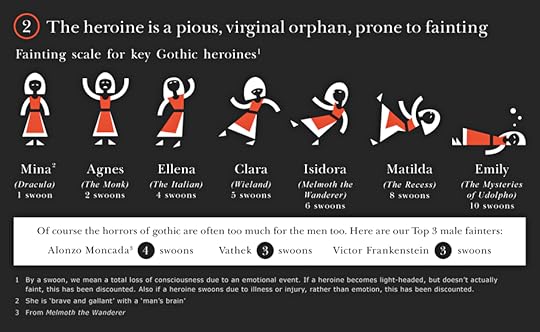
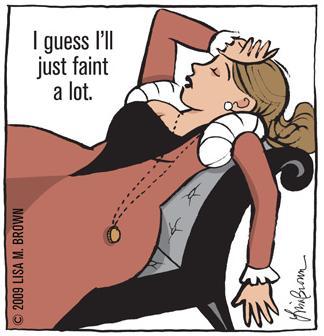
Our heroine, Emily, faints when her carriage is interrupted by robbers (38), when her father tells her he is dying (76 - more on this below), when she sees his coffin (87), twice when she sees something scary behind a curtain (249 and 348), when ruffians enter her chamber (316), when she hears her beloved had misbehaved badly in Paris (507), when she sees her beloved unexpectedly (624) – and on other occasions I didn’t note – and this list doesn’t even consider still other occasions where she nearly faints but doesn’t entirely lose consciousness.
And yet, Emily isn’t as helpless as her apparently low blood pressure might suggest.
(As an aside, I was surprised by how funny Radcliffe could be, for example when Emily’s selfish and foolish aunt learns that her husband – whom everyone but she had long realized was a villain – was a terrible person:
“‘The most flattering prospects often change – the best judgments may be deceived – who could have foreseen, when I married the Signor, that I should ever repent my generosity?’
Emily thought she might have foreseen it, but this was not a thought of triumph.” (280))
Radcliffe interjects light comedy into the last hours of Emily’s father, St. Aubert, when she has Emily respond to his request, “‘give me this promise, a promise made to your dying father!’” by fainting herself – so that her mortally ill father has to call the servants to assist her. “When she recovered, St. Aubert was so exhausted by the scene he had witnessed, that it was many minutes before had had the strength to speak; he was, however, somewhat revived by a cordial, which Emily gave him; and, being again alone with her, he exerted himself to tranquillize her spirits, and to offer her all the comfort of which her situation admitted” (76). Before I could proceed to read the next 600 pages, I had to convince myself that Radcliffe saw the humor in this scene of mutual consolation between a perfectly healthy young woman and her father on his literal deathbed.
But Radcliffe knows that excessive sensibility does her heroine no favors. In a speech that would do Polonius proud, St. Aubert warns her: “beware of priding yourself on the gracefulness of sensibility; … Always remember how much more valuable is the strength of fortitude, than the grace of sensibility.” He then continues, conveying a message that I feel certain Austen would endorse: “Do not, however, confound fortitude with apathy; apathy cannot know the virtue. Remember, too, that one act of beneficence, one act of real usefulness, is worth all the abstract sentiment in the world. Sentiment is a disgrace, instead of an ornament, unless it lead us to good actions.” (80)
Emily’s values seem unobjectionable, her intelligence laudable (she opposes her uncle’s “turbulence and indignation only by the mild dignity of a superior mind” 214). She struggles against her own tendency towards sensibility and is highly critical of her maid’s tendency toward superstition (“Yes, Annette, you love the wonderful; but do you know, that, unless you guard against this inclination, it will lead you into all the misery of superstition?” (278). And on multiple occasions, she demonstrates both fortitude and good sense. She takes her father’s words to heart, and many many many chapters later recalls them almost verbatim: “I do indeed perceive how much more valuable is the strength of fortitude than the grace of sensibility… I will not indulge in unavailing lamentation, but will try to endure, with firmness, the oppression I cannot elude.” (214) Even one of her wise counselors and benefactors, a man of uncommon good sense, has cause to lament his own foolishness: “When the Count was informed of the error he had committed, he was extremely shocked at the consequence of his credulity” (654) – so Emily is not singled out for censure, nor are women alone in their vulnerability to error. What is it, then, that makes The Mysteries of Udolpho so tempting to satirize? Some of it must be the landscapes and their ability to affect mood, for better or worse. “The grandeur and sublimity of the scenes, amidst which they [Emily & Valancourt] had first met, had fascinated her fancy, and had imperceptibly contributed to render Valancourt more interesting by seeming to communicate to him somewhat of their character.” (89)
But no, there’s nothing inherently absurd about appreciating “how infinitely inferior all the splendour of art is to the sublimity of nature” (189).
Ultimately, I had to conclude that the absurdity of the story came not from an attachment to the supernatural (which it explores only to dismiss) or the silliness of its heroine (who may faint a lot, but is actually quite brave when it really counts), but from its sheer drama. There’s a line about a quarter of the way through that caught my attention: “Several weeks passed in the course of customary visits, during which nothing remarkable occurred.” (189). This, then, is one way of articulating the gulf separating the world of Radcliffe from that of Austen. The former is a world of cliffs and ruins and forests, of haunting midnight melodies, secret passages, kidnappings, swordfights, abductions, poison, banditti, pirates, and highway robbery. The latter is a world of “customary visits during which” perhaps “nothing remarkable occurred,” in the eyes of some, but in the eyes of others – two centuries of dedicated and enthralled readers – everything necessary for a good, compelling drama does occur. Or, to borrow a line from Radcliffe: “happiness arises in a state of peace, not of tumult” (80).
I’ll close with comments on two of the more remarkable passages to me.
The first came when a highly disagreeable character (a mean-spirited and selfish aunt) criticizes our heroine thus: “‘I am sorry to perceive, niece,’ said she, in allusion to somewhat that Emily had said, concerning physiognomy, ‘that you have a great many of your father’s prejudices, and among them those sudden predilections for people from their looks. … What has a man’s face to do with his character? Can a man of good character help having a disagreeable face?’” [in the original the passages before and after the ellipsis here occur in reverse order] (112). To punctuate the claim, we are told that the aunt in question “delivered” these words “with the decisive air of a person who congratulates herself on having made a grand discovery, and believes the question to be unanswerably settled.” Could poor Aunt Cheron turn out to have been on the right side of history, despite her own spiteful nature?
The second came when a loyal and wise housekeeper opined on the foibles of gentlefolk: “‘Dear! dear! to see how gentlefolks can afford to throw away their happiness! Now, if you were poor people, there would be none of this. To talk of unworthiness, and not caring about one another, when I know there are not such a kind-hearted lady and gentleman in the whole province, nor any that love one another half so well’” (626) (Not atypically for Radcliffe, whose writing could have benefitted from more forceful editing, she repeats this observation ten pages later: “Dear dear! to see how some people fling away their happiness, and then cry and lament about it, just as if it was not their own doing, and as if there was more pleasure in wailing and weeping, than in being at peace. Learning, to be sure, is a fine thing, but, if it teaches folks no better than that, why I had rather be without it: if it would teach them to be happier, I would say something to it, then it would be learning and wisdom too.’” (637)