

What do you think?

The Woman Chaser
Hard boiled crime from the author of 'Miami Blues'.
192 pages, Paperback
First published April 1, 1960
About the author
Charles Willeford
80 books437 followersCharles Willeford was a remarkably fine, talented and prolific writer who wrote everything from poetry to crime fiction to literary criticism throughout the course of his impressively long and diverse career. His crime novels are distinguished by a mean'n'lean sense of narrative economy and an admirable dearth of sentimentality. He was born as Charles Ray Willeford III on January 2, 1919 in Little Rock, Arkansas. Willeford's parents both died of tuberculosis when he was a little boy and he subsequently lived either with his grandmother or at boarding schools. Charles became a hobo in his early teens. He enlisted in the Army Air Corps at age sixteen and was stationed in the Philippines. Willeford served as a tank commander with the 10th Armored Division in Europe during World War II. He won several medals for his military service: the Silver Star, the Bronze Star, two Purple Hearts, and the Luxembourg Croix de Guerre. Charles retired from the army as a Master Sergeant. Willeford's first novel "High Priest of California" was published in 1953. This solid debut was followed by such equally excellent novels as "Pick-Up" (this book won a Beacon Fiction Award), "Wild Wives," "The Woman Chaser," "Cockfighter" (this particular book won the Mark Twain Award), and "The Burnt Orange Heresy." Charles achieved his greatest commercial and critical success with four outstanding novels about hapless Florida homicide detective Hoke Moseley: "Miami Blues," "New Hope for the Dead," "Sideswipe," and "The Way We Die Now." Outside of his novels, he also wrote the short story anthology "The Machine in Ward Eleven," the poetry collections "The Outcast Poets" and "Proletarian Laughter," and the nonfiction book "Something About A Soldier." Willeford attended both Palm Beach Junior College and the University of Miami. He taught a course in humanities at the University of Miami and was an associate professor who taught classes in both philosophy and English at Miami Dade Junior College. Charles was married three times and was an associate editor for "Alfred Hitchcock Mystery Magazine." Three of Willeford's novels have been adapted into movies: Monte Hellman delivered a bleakly fascinating character study with "Cockfighter" (Charles wrote the script and has a sizable supporting role as the referee of a cockfighting tournament which climaxes the picture), George Armitage hit one out of the ballpark with the wonderfully quirky "Miami Blues," and Robinson Devor scored a bull's eye with the offbeat "The Woman Chaser." Charles popped up in a small part as a bartender in the fun redneck car chase romp "Thunder and Lightning." Charles Willeford died of a heart attack at age 69 on March 27, 1988.
Ratings & Reviews
Friends & Following
Create a free account to discover what your friends think of this book!
Community Reviews
Displaying 1 - 30 of 94 reviews

September 14, 2019
”This period of my life should have been a happy one, and suppose it was, in a weird, unrealistic way. Wasn’t I making money hand over fist, as the saying goes? And isn’t the making of money the reason for existence? Isn’t it?”
Richard Hudson believes he is the best used car salesman in California. He may be right. He has made Honest Hal so much money on the San Francisco car lot that Hal has dispatched Hudson back to his hometown to open an Honest Hal car lot in Los Angeles. Soon Hudson is making money hand over fist.
Hudson’s expenses are minimal. He moves in with his mother, who was once a professional dancer, and who still dances every day in front of the mirror instead of for audiences. She loves him in an ”absent minded way.” She is married to Leo Steinberg, a producer who is on the skids and has a blossoming teenage daughter, Becky. Leo is only a few years older than Hudson, but Hudson loves to call him Pops anyway. They are an odd gathering of people who have all washed up on the same shore together. Becky is trying desperately to get rid of her virginity and she has decided that Hudson is the man for the job. Leo is desperately trying to get back into Hollywood. Hudson’s mom is one grand jeté away from flying off into the atmosphere.
Hudson is irritated. He should be happy, but the more money he makes, the more dissatisfied he becomes. He wants something more, but what?
”Our lives are so short and there is so little time for creativeness, and yet we waste our precious time, letting it dribble through our fingers like dry sand. But that was it. Creativeness. To create something. Anything.”
Hudson decides he needs to make a movie. Not only will he make a movie, but he is going to write and direct it. If I were Hudson’s friend, I would have been shaking my head and explaining to him...that isn’t the way things work in Hollywood. I would have laughed at his naivety and then watched in amazement as the SOB pulls it off. ”Self-doubt is the worst thing that can happen to a man. It tightens the stomach muscles, freezes the intellect. But worst of all it causes men to stay in dead-end jobs all of their lives because they are afraid to try anything else, afraid of failure, afraid to lose their stupid security. Afraid, period.”
Well, Richard is not afraid to fail. He is more afraid to never try.
Selling is selling, and once you’ve learned to sell used cars, you can pretty much sell anything. He has Leo and he has Leo’s connections. They decide THE MAN at Mammoth Productions is the guy to approach about using his film lot for a piece of the action. All Hudson needs is THE MAN’s objections so he can overcome them one by one.
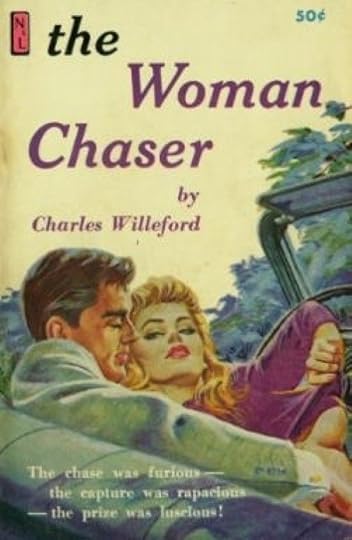
This is not only the funniest Charles Willeford novel I’ve read but also the most psychotic. On the cover of the book is the very fitting tagline…The psycho-pulp classic.The characters are all odd, fascinating creatures. They are the satellites circling around Hudson’s descent into madness. Hudson isn’t a man to take even his madness lying down. He does even that in spectacular fashion. The title is a bit nonsensical because he spends a lot more time chasing cars or dreams than he does women, but of course, a title like The Woman Chaser, emblazoned across a pulp paperback cover, will have a lot of guys digging the four bits out of their pockets.
Don’t get me wrong, Richard Hudson gets laid, but it is not the burning desire in his life. He must create something or destroy everything.
In 1999, the director Robinson Devor made a movie based on the book, starring the hilarious Patrick Warburton. The movie script actually follows the book very closely and lifts many pieces of dialogue straight from Willeford. It is interesting for me to notice what they change and what they keep. I suggest reading the book before watching the movie because it certainly increased my enjoyment of both.
If you need a hardboil fix, this one will have you sweltering in the LA heat and picking some grit out of your teeth. It is fantastic.
If you wish to see more of my most recent book and movie reviews, visit http://www.jeffreykeeten.com
I also have a Facebook blogger page at:https://www.facebook.com/JeffreyKeeten

Richard Hudson believes he is the best used car salesman in California. He may be right. He has made Honest Hal so much money on the San Francisco car lot that Hal has dispatched Hudson back to his hometown to open an Honest Hal car lot in Los Angeles. Soon Hudson is making money hand over fist.
Hudson’s expenses are minimal. He moves in with his mother, who was once a professional dancer, and who still dances every day in front of the mirror instead of for audiences. She loves him in an ”absent minded way.” She is married to Leo Steinberg, a producer who is on the skids and has a blossoming teenage daughter, Becky. Leo is only a few years older than Hudson, but Hudson loves to call him Pops anyway. They are an odd gathering of people who have all washed up on the same shore together. Becky is trying desperately to get rid of her virginity and she has decided that Hudson is the man for the job. Leo is desperately trying to get back into Hollywood. Hudson’s mom is one grand jeté away from flying off into the atmosphere.
Hudson is irritated. He should be happy, but the more money he makes, the more dissatisfied he becomes. He wants something more, but what?
”Our lives are so short and there is so little time for creativeness, and yet we waste our precious time, letting it dribble through our fingers like dry sand. But that was it. Creativeness. To create something. Anything.”
Hudson decides he needs to make a movie. Not only will he make a movie, but he is going to write and direct it. If I were Hudson’s friend, I would have been shaking my head and explaining to him...that isn’t the way things work in Hollywood. I would have laughed at his naivety and then watched in amazement as the SOB pulls it off. ”Self-doubt is the worst thing that can happen to a man. It tightens the stomach muscles, freezes the intellect. But worst of all it causes men to stay in dead-end jobs all of their lives because they are afraid to try anything else, afraid of failure, afraid to lose their stupid security. Afraid, period.”
Well, Richard is not afraid to fail. He is more afraid to never try.
Selling is selling, and once you’ve learned to sell used cars, you can pretty much sell anything. He has Leo and he has Leo’s connections. They decide THE MAN at Mammoth Productions is the guy to approach about using his film lot for a piece of the action. All Hudson needs is THE MAN’s objections so he can overcome them one by one.
This is not only the funniest Charles Willeford novel I’ve read but also the most psychotic. On the cover of the book is the very fitting tagline…The psycho-pulp classic.The characters are all odd, fascinating creatures. They are the satellites circling around Hudson’s descent into madness. Hudson isn’t a man to take even his madness lying down. He does even that in spectacular fashion. The title is a bit nonsensical because he spends a lot more time chasing cars or dreams than he does women, but of course, a title like The Woman Chaser, emblazoned across a pulp paperback cover, will have a lot of guys digging the four bits out of their pockets.

Don’t get me wrong, Richard Hudson gets laid, but it is not the burning desire in his life. He must create something or destroy everything.
In 1999, the director Robinson Devor made a movie based on the book, starring the hilarious Patrick Warburton. The movie script actually follows the book very closely and lifts many pieces of dialogue straight from Willeford. It is interesting for me to notice what they change and what they keep. I suggest reading the book before watching the movie because it certainly increased my enjoyment of both.
If you need a hardboil fix, this one will have you sweltering in the LA heat and picking some grit out of your teeth. It is fantastic.
If you wish to see more of my most recent book and movie reviews, visit http://www.jeffreykeeten.com
I also have a Facebook blogger page at:https://www.facebook.com/JeffreyKeeten

February 6, 2013
The Woman-Chaser has one of the most interesting plots ever for a crime thriller. Richard Hudson, a crooked, arrogant and vicious car salesman who is really good at his job panics at a meeting of aspiring young reps. He realizes that he is wasting his life in the 9 to 5 grind. It dawns on him that we are on this planet to be creative. So he writes a script with help from his step-father and decides to direct a film based on the script. But when his edited film fails to meet the six reel 90 minute length standard, the studio tries to interfere in the film's future. The crazed car salesman/movie director embarks on a rampage of destruction.
I think there is more to this book than a man trying to escape his mundane life. It is also about 20th century man's impulsive behavior without thinking about the consequences. It is about how a lot of our actions are driven by barely concealed madness. I found myself laughing and cheering on some of the actions of the main character. I could totally identify with him. Like Willeford himself said - "I had a hunch that madness was a predominant theme and a normal condition for Americans living in the second half of this century."
The book is quite similar to High Priest of California. The character Russell Haxby (also a car salesman) in that novel was quite similar to Richard Hudson. Both of them are street smart all American males who would go to any lengths including violence to get what they want. This is another captivating little novel from the cruelly underrated Charles Willeford.
I think there is more to this book than a man trying to escape his mundane life. It is also about 20th century man's impulsive behavior without thinking about the consequences. It is about how a lot of our actions are driven by barely concealed madness. I found myself laughing and cheering on some of the actions of the main character. I could totally identify with him. Like Willeford himself said - "I had a hunch that madness was a predominant theme and a normal condition for Americans living in the second half of this century."
The book is quite similar to High Priest of California. The character Russell Haxby (also a car salesman) in that novel was quite similar to Richard Hudson. Both of them are street smart all American males who would go to any lengths including violence to get what they want. This is another captivating little novel from the cruelly underrated Charles Willeford.

April 30, 2021
Willeford has a knack for getting inside creep's heads. And, that's exactly what he does with Richard Hudson in The Woman Chaser. Hudson is the star salesman of Honest Hal's San Francisco dealership and has mastered the art of swindling the feebs, the suckers, the ordinary 9 to 5 cookie cutter men and women. Now, he's heading to Los Angeles to open a second dealership. He walks onto an ailing used car lot and makes the owner an offer on the spot for the whole kit and kaboodle.
But, once you leave a guy like Hudson alone to run things his own way, his slick creepiness comes out of hiding. See, Hudson comes from Los Angeles and grew up in a creepy old house with his prima Donna ballerina mother who he oodles over, thinks she's the best mother in the world, likes to dance with her in costume in the basement studio, and likes to stare at her bare breasts. Hudson's creepiness further comes on display in his dealings with his sixteen year old stepsister who has a teenage crush on her thirty year old stepbrother. He takes it upon himself to teach her the facts of life and then casts her aside. But that's Hudson who plays the same game with his secretary, firing her the next day.
Hudson though thinks the car business is too easy and decides that he wants to be an artist and make a Hollywood movie with his stepfather, a washed up producer with nothing going on now. Obsessed with making the greatest movie ever, he loots the car business and focuses all his energy on his masterpiece.
But we all have to answer to someone and for Hudson that means answering to "the Man," who runs Mammoth Pictures. And "the Man" wants to change Hudson's masterpiece, not letting him issue a 63 minute film in a world of 90 minute movies. That's when Hudson throws his tantrum.
It's an odd portrait of a creepy narcissistic guy through his eyes where everything he does is somehow justified. Not exactly a crime novel in the traditional sense, but a pulp paperback study of a guy slowly losing it and his world collapsing around him.
But, once you leave a guy like Hudson alone to run things his own way, his slick creepiness comes out of hiding. See, Hudson comes from Los Angeles and grew up in a creepy old house with his prima Donna ballerina mother who he oodles over, thinks she's the best mother in the world, likes to dance with her in costume in the basement studio, and likes to stare at her bare breasts. Hudson's creepiness further comes on display in his dealings with his sixteen year old stepsister who has a teenage crush on her thirty year old stepbrother. He takes it upon himself to teach her the facts of life and then casts her aside. But that's Hudson who plays the same game with his secretary, firing her the next day.
Hudson though thinks the car business is too easy and decides that he wants to be an artist and make a Hollywood movie with his stepfather, a washed up producer with nothing going on now. Obsessed with making the greatest movie ever, he loots the car business and focuses all his energy on his masterpiece.
But we all have to answer to someone and for Hudson that means answering to "the Man," who runs Mammoth Pictures. And "the Man" wants to change Hudson's masterpiece, not letting him issue a 63 minute film in a world of 90 minute movies. That's when Hudson throws his tantrum.
It's an odd portrait of a creepy narcissistic guy through his eyes where everything he does is somehow justified. Not exactly a crime novel in the traditional sense, but a pulp paperback study of a guy slowly losing it and his world collapsing around him.

January 3, 2013
01/2021
From 1960
This book would be edgy and outrageous in the 21st century. It seems at the end that Richard Hudson has gone insane and is retelling what happened to him as a movie. So that's what's been going on... Extremely "meta" they would say now. Especially since what happened to him involves making a movie. Layers of reality? He is naturally a very untrustworthy narrator. And an utter horror.
Before or originally this novel was titled The Director. Why is it called The Woman Chaser? Is this another example of his false vision of himself?
01/2013
The Pope of Psychopulp. Okay, I read that on the first page. The 3rd book I've read by Willeford, and I liked it the best. Awesome. Weird.
From 1960
This book would be edgy and outrageous in the 21st century. It seems at the end that Richard Hudson has gone insane and is retelling what happened to him as a movie. So that's what's been going on... Extremely "meta" they would say now. Especially since what happened to him involves making a movie. Layers of reality? He is naturally a very untrustworthy narrator. And an utter horror.
Before or originally this novel was titled The Director. Why is it called The Woman Chaser? Is this another example of his false vision of himself?
01/2013
The Pope of Psychopulp. Okay, I read that on the first page. The 3rd book I've read by Willeford, and I liked it the best. Awesome. Weird.

January 31, 2024
Another compelling portrait of a sociopathic bastard from Willeford. Damn, he's good at these! The Woman Chaser follows an utterly self-absorbed, amoral used car salesman. He's bored by his success cheating rubes so pursues his dream of becoming a movie writer/director, bent on creating a film depicting the corruption of the American way of life resulting from the soul crushing rat race that has hollowed out American workers and families. However, his own childish stubbornness to compromise his vision in any way invites bitter failure. What starts out as an upbeat, yet thoroughly creepy story with a cast of oddball characters descends into bitterness, pure cynicism and madness while remaining more than just a bit absurd and amusing.

January 16, 2023
A used car salesman pursues his dream of making a movie. But when he finally makes his movie, and doesn’t get the deal he expected, he decides to enact a brutal revenge…
I genuinely don’t know what to make of Charles Willeford’s The Woman Chaser - it’s unlike any other novel I’ve read before, but only because it’s so nonsensical and bizarre!
I guess our main character Richard Hudson is a bigshot used car salesman only as a plot device to get his hands on ready cash to help finance his bonkers movie, but did we need to spend so long on his career as a used car salesman - couldn’t we just skip over the finer details? Or better yet, considering he also uses his stepfather’s expensive painting to fund the movie, jettison it completely, as it’s an utterly superfluous addition to the novel, and just say the painting’s sale paid for the whole budget?
It’s strange details like this that make up the novel and I can only think that this, along with other decisions, was done to beef up a page count and/or play to the pulp audience (the novel was first published in 1960). Like, why is Richard’s defining characteristic that he’s a “woman chaser” - what’s that got to do with anything? He’s a sleazy guy but you get that from pretty much every other action the man takes - you don’t need to also know that he slept with his teenage step-sister or has this unsettling incestuous relationship with his mother.
Richard’s more than a sleazy guy though; he’s a complete scumbag. This is a man who literally punches a woman in the gut after she tells him she’s pregnant with his baby to induce a miscarriage. But then this was also the 1950s so maybe by those standards he was just an average guy? (I’m joking, I’m joking!)
My point is: what’s the point? Are we meant to empathise with Richard on some level - are we meant to like this guy somehow? Because that’s a massive failure on Willeford’s part if so - only a sociopath could think Richard a stand up dude. Maybe the one thing we’re meant to understand about him is his desire to make art and transcend his otherwise mundane existence for a stab at immortality.
And it’s another really weird choice - not making a movie, but the subject of the movie itself: about a trucker who accidentally runs over a kid, then drives off, only to have cops chase him and die in a roadblock. Wha - huh? Why THAT story? I can’t tell if the novel is meant to be a comedy or not. He literally casts his leading lady by stalking a woman - a completely random woman - at a supermarket, following her home, and telling her she got cast in his movie (and of course he sleeps with her because he’s a “woman chaser”). She goes along with it all of course because… that sort of thing happened all the time in the ‘50s?!
What interested me in the novel initially was the promise of the protagonist going off on one after his dreams are dashed. I was expecting some insane John Wick-style rampage but less martial arts-y. And what I got was a remarkably quick scene right at the end, almost like an afterthought, before the inevitable ending. Very disappointing. There are vastly more pages devoted to the irrelevant selling of used cars than a much more interesting plot point.
So, I really don’t know what to make of it. If it’s a satire, I don’t know of what. If it’s a comedy, it needed to be more funny than dark. I guess it’s a decent example of the pulpy novels being published around that time, though only of its trashy nature than anything else. The main character is a reprehensible cretin and a pointless womaniser doing a pointless job then making a pointless movie starring random people and telling a pointless story who then throws his life away doing something pointless.
The Woman Chaser is easy to read - Willeford was a fine writer and the prose is still accessible and clear. And the novel is unpredictable at the very least, and original. But its biggest impression is also that of one big baffling shrug of a story - I wouldn’t recommend it even to Willeford fans. At best, it reads like a long forgotten in-joke or piss-take between him and someone else who’s also long dead. If you haven’t read them yet, his Hoke Moseley novels are much better, and also more coherent, than this forgettable earlier effort.
I genuinely don’t know what to make of Charles Willeford’s The Woman Chaser - it’s unlike any other novel I’ve read before, but only because it’s so nonsensical and bizarre!
I guess our main character Richard Hudson is a bigshot used car salesman only as a plot device to get his hands on ready cash to help finance his bonkers movie, but did we need to spend so long on his career as a used car salesman - couldn’t we just skip over the finer details? Or better yet, considering he also uses his stepfather’s expensive painting to fund the movie, jettison it completely, as it’s an utterly superfluous addition to the novel, and just say the painting’s sale paid for the whole budget?
It’s strange details like this that make up the novel and I can only think that this, along with other decisions, was done to beef up a page count and/or play to the pulp audience (the novel was first published in 1960). Like, why is Richard’s defining characteristic that he’s a “woman chaser” - what’s that got to do with anything? He’s a sleazy guy but you get that from pretty much every other action the man takes - you don’t need to also know that he slept with his teenage step-sister or has this unsettling incestuous relationship with his mother.
Richard’s more than a sleazy guy though; he’s a complete scumbag. This is a man who literally punches a woman in the gut after she tells him she’s pregnant with his baby to induce a miscarriage. But then this was also the 1950s so maybe by those standards he was just an average guy? (I’m joking, I’m joking!)
My point is: what’s the point? Are we meant to empathise with Richard on some level - are we meant to like this guy somehow? Because that’s a massive failure on Willeford’s part if so - only a sociopath could think Richard a stand up dude. Maybe the one thing we’re meant to understand about him is his desire to make art and transcend his otherwise mundane existence for a stab at immortality.
And it’s another really weird choice - not making a movie, but the subject of the movie itself: about a trucker who accidentally runs over a kid, then drives off, only to have cops chase him and die in a roadblock. Wha - huh? Why THAT story? I can’t tell if the novel is meant to be a comedy or not. He literally casts his leading lady by stalking a woman - a completely random woman - at a supermarket, following her home, and telling her she got cast in his movie (and of course he sleeps with her because he’s a “woman chaser”). She goes along with it all of course because… that sort of thing happened all the time in the ‘50s?!
What interested me in the novel initially was the promise of the protagonist going off on one after his dreams are dashed. I was expecting some insane John Wick-style rampage but less martial arts-y. And what I got was a remarkably quick scene right at the end, almost like an afterthought, before the inevitable ending. Very disappointing. There are vastly more pages devoted to the irrelevant selling of used cars than a much more interesting plot point.
So, I really don’t know what to make of it. If it’s a satire, I don’t know of what. If it’s a comedy, it needed to be more funny than dark. I guess it’s a decent example of the pulpy novels being published around that time, though only of its trashy nature than anything else. The main character is a reprehensible cretin and a pointless womaniser doing a pointless job then making a pointless movie starring random people and telling a pointless story who then throws his life away doing something pointless.
The Woman Chaser is easy to read - Willeford was a fine writer and the prose is still accessible and clear. And the novel is unpredictable at the very least, and original. But its biggest impression is also that of one big baffling shrug of a story - I wouldn’t recommend it even to Willeford fans. At best, it reads like a long forgotten in-joke or piss-take between him and someone else who’s also long dead. If you haven’t read them yet, his Hoke Moseley novels are much better, and also more coherent, than this forgettable earlier effort.
This entire review has been hidden because of spoilers.

December 10, 2017
So what is this book about?:
a. Richard Hudson, the used car dealer who tries to write a very bitter, cynical and dark humoured movie about hard working people and the flaws of the American Dream.
b. Script writer Richard Hudson who wrote a very bitter, cynical and dark humoured movie script about a used car dealer trying to make a movie about hard working people and the flaws of the American Dream.
c. Author Richard Hudson who tries to write an autobiographical book about writing a very bitter, cynical and dark humoured movie script about a used car dealer trying to make a movie about hard working people and the flaws of the American Dream.
d. All of the above.
e. Neither, it's a structurally different storyline all together.
f. Shut up, little man! You're overthinking it!
Well, this was weird...changing tones and perspectives all the time. One time being told as "first person", switching to "third person" midway and sometimes landing somewhere in the middle with the voice of Charles Willeford himself shining through. It's marketed as "crime pulp" and while being very "noir-ish", harsh, violent, bleak, bitter and way way funny in the way of the doomed loser characteristics of Jim Thompson it defies clear genres all together. You would have to call it "soapy satire psychothriller loser-noir comedy". There, I did it: bullshit.
It's confusing, but amazing. I already said too much. Read it if you like rotten-, doomed characters, bleak atmosphere and pitchblack humour.
Putting this in my "favorite books" shelf. Will eventually need to buy a physical copy and read it again and again. Already looking forward to that. I'm watching the movie next week. Should be good, i love Patrick Warburton's acting and delivery.
a. Richard Hudson, the used car dealer who tries to write a very bitter, cynical and dark humoured movie about hard working people and the flaws of the American Dream.
b. Script writer Richard Hudson who wrote a very bitter, cynical and dark humoured movie script about a used car dealer trying to make a movie about hard working people and the flaws of the American Dream.
c. Author Richard Hudson who tries to write an autobiographical book about writing a very bitter, cynical and dark humoured movie script about a used car dealer trying to make a movie about hard working people and the flaws of the American Dream.
d. All of the above.
e. Neither, it's a structurally different storyline all together.
f. Shut up, little man! You're overthinking it!
Well, this was weird...changing tones and perspectives all the time. One time being told as "first person", switching to "third person" midway and sometimes landing somewhere in the middle with the voice of Charles Willeford himself shining through. It's marketed as "crime pulp" and while being very "noir-ish", harsh, violent, bleak, bitter and way way funny in the way of the doomed loser characteristics of Jim Thompson it defies clear genres all together. You would have to call it "soapy satire psychothriller loser-noir comedy". There, I did it: bullshit.
It's confusing, but amazing. I already said too much. Read it if you like rotten-, doomed characters, bleak atmosphere and pitchblack humour.
Putting this in my "favorite books" shelf. Will eventually need to buy a physical copy and read it again and again. Already looking forward to that. I'm watching the movie next week. Should be good, i love Patrick Warburton's acting and delivery.

July 26, 2024
3.5
My second try with Willeford's work, having recently started into it by way of 'Pick-Up' (published 5 years prior; so this is still early stuff).
First, the whole misnomer of 'The Woman Chaser'. Apparently Willeford wanted to call his novel 'The Director' (... crickets ...)... but if you're an enterprising editor looking to sell a novel, you won't let it out on the city streets with the offer-defying title 'The Director'. Of course not; you'll jazz it up, so that other, noir-seeking editors will sit up and take notice.
~ you'll make it sound sleazy; like it's dripping with sex. Call it 'The Woman Chaser', even if not a single woman is chased. ~ and there's only maybe one paragraph of actual sex.
Willeford's shaggy dog tale is much more entertaining in its first half (certainly more entertaining than 'Pick-Up' at any given point). This is largely due to protagonist Richard Hudson; kind of admirable as a snappy-yapping go-getter who gets things done (in this case, rising up in the world of used cars) but, though not dumb, he is still something of a doofus.
Richard is the kind of late 1950s, sexist chump (just a t-a-d more sensitive; he reads poetry) who has no real sense of women (outside of weirdly wanting to save them from guys even more of a dope than himself) and really only loves his mother (a still very in-shape ex-dancer). For the life of him, Richard is perpetually unable to fathom why a woman who embraces her femininity would also want to be intelligent.
~ but he spends as little time as possible pondering that. Richard has dreams of being a movie writer / director. He feels life can be something of a repetitive slog if a person isn't tapping into his creativity. He actually breaks down crying in a parking lot, thinking about how men become "prisoners... they were also their own jailers!":
Richard does get his movie made - and the way Willeford breathlessly describes that process (esp. the hunt for his 'unknown' leading man) makes for fun reading for movie fans. The author also serves up some sympathetic supporting characters (as well as one surprisingly savvy one) along the way.
Weirdly, though, the novel begins to lose steam once Richard achieves his goal in a manner that is ultimately frustrating for him. The narrative simply, sadly, then has nowhere to go. Still, it's sort of fun while the fun lasts (and it gets an extra half-point for the kooky way Willeford sets up his tone).
My second try with Willeford's work, having recently started into it by way of 'Pick-Up' (published 5 years prior; so this is still early stuff).
First, the whole misnomer of 'The Woman Chaser'. Apparently Willeford wanted to call his novel 'The Director' (... crickets ...)... but if you're an enterprising editor looking to sell a novel, you won't let it out on the city streets with the offer-defying title 'The Director'. Of course not; you'll jazz it up, so that other, noir-seeking editors will sit up and take notice.
~ you'll make it sound sleazy; like it's dripping with sex. Call it 'The Woman Chaser', even if not a single woman is chased. ~ and there's only maybe one paragraph of actual sex.
Willeford's shaggy dog tale is much more entertaining in its first half (certainly more entertaining than 'Pick-Up' at any given point). This is largely due to protagonist Richard Hudson; kind of admirable as a snappy-yapping go-getter who gets things done (in this case, rising up in the world of used cars) but, though not dumb, he is still something of a doofus.
Richard is the kind of late 1950s, sexist chump (just a t-a-d more sensitive; he reads poetry) who has no real sense of women (outside of weirdly wanting to save them from guys even more of a dope than himself) and really only loves his mother (a still very in-shape ex-dancer). For the life of him, Richard is perpetually unable to fathom why a woman who embraces her femininity would also want to be intelligent.
~ but he spends as little time as possible pondering that. Richard has dreams of being a movie writer / director. He feels life can be something of a repetitive slog if a person isn't tapping into his creativity. He actually breaks down crying in a parking lot, thinking about how men become "prisoners... they were also their own jailers!":
Our lives are so short and there is so little time for creativeness, and yet we waste our precious time, letting it dribble through our fingers like dry sand. But that was it. Creativeness. To create something. Anything. I pulled myself together, wiped my streaming eyes with my handkerchief. One thing. That was all. One little thing.'TWC' becomes a paean to that creative urge; to those who risk everything in the service of something artistic.
Richard does get his movie made - and the way Willeford breathlessly describes that process (esp. the hunt for his 'unknown' leading man) makes for fun reading for movie fans. The author also serves up some sympathetic supporting characters (as well as one surprisingly savvy one) along the way.
Weirdly, though, the novel begins to lose steam once Richard achieves his goal in a manner that is ultimately frustrating for him. The narrative simply, sadly, then has nowhere to go. Still, it's sort of fun while the fun lasts (and it gets an extra half-point for the kooky way Willeford sets up his tone).

March 23, 2018
THE WOMAN CHASER by Charles Willeford.
Willeford is impossible to pin down. He wrote all sorts of novels, always pulpy and economic, always good. The Woman Chaser follows Richard, a wildly successful used car salesman who, bored by his brilliance, embarks on a vanity film project in 50s LA.
Richard's movie dreams dissolve around him and he decides to take revenge on those who have wronged him.
Slightly creepy, always uncomfortable, it serves as an insight into the psyche of American males of the era, particularly in LA, where the American Dream was still a romantic possibility.
Not my favourite Willeford (see Cockfighter and Pick-Up) but very good reading as always.
Willeford is impossible to pin down. He wrote all sorts of novels, always pulpy and economic, always good. The Woman Chaser follows Richard, a wildly successful used car salesman who, bored by his brilliance, embarks on a vanity film project in 50s LA.
Richard's movie dreams dissolve around him and he decides to take revenge on those who have wronged him.
Slightly creepy, always uncomfortable, it serves as an insight into the psyche of American males of the era, particularly in LA, where the American Dream was still a romantic possibility.
Not my favourite Willeford (see Cockfighter and Pick-Up) but very good reading as always.

September 10, 2022
Charles Willeford wrote unique characters and truly grasped the human psyche and humanity.

February 3, 2023
Finished it up today. Having just torn through two other Willefords before this one, The Woman Chaser had more explicit philosophical reflection than those others. Not saying that either "Wild Wives" or "High Priest" are not deep books. Both are full of Willeford's wit and wisdom; but the riches of his thought are better hidden in those shorter yarns.
Here in The Woman Chaser, the narrator Hudson will stop himself from time to time and ask deep questions about his motives and emotions. He'll ask the reader those questions retrospectively, years on from the main timeline he's narrating; but thankfully he never dwells long on the deep thoughts and feelings. As soon as he asks one, he answers it by diving right back into the narrative and recalling some insane act of his.
Such as an improvised infanticide.
I wish I could explain to you how funny this book is, but it would defeat the point in some ways. Check out this scene, where the main character is on a road trip searching for a man in Santa Barbara.
The line about $1 million got me laughing hard, but then the bartenders reply was also funny, and the impatient question really capped it off.
I found a passage in this book that's a kind of nutshell of everything I've seen so far from Willeford:
This is also my exact feeling about talking with other people about my life, although it also applies to writing.
“When a man knows the troth it is no longer necessary to search for it. As I see things now, in retrospection, the only thing the matter with me was my compassion for others. I felt sorry for the Feebs, and that was fatal. Down inside myself, in some hidden pocket of a fold in my heart, compassion lay for the poor ignorant slob. It was too bad.”
Here in The Woman Chaser, the narrator Hudson will stop himself from time to time and ask deep questions about his motives and emotions. He'll ask the reader those questions retrospectively, years on from the main timeline he's narrating; but thankfully he never dwells long on the deep thoughts and feelings. As soon as he asks one, he answers it by diving right back into the narrative and recalling some insane act of his.
Such as an improvised infanticide.
I wish I could explain to you how funny this book is, but it would defeat the point in some ways. Check out this scene, where the main character is on a road trip searching for a man in Santa Barbara.
“Where can I find him?” I asked the bartender.
“Today’s Tuesday, isn’t it? He goes to art classes on Wednesday mornings, so I suppose he’s at the grove today. But he might be hard to find though. Mrs. Larson bought him a horse and he rides it all over hell and gone.”
“We’ll look for him. Where’s the grove?”
“What do you fellows want Chet for, anyway?”
“His aunt in Glendale died,” I said, “and left him a million dollars.”
“He can sure use it,” the bartender said.
“Where’s the grove,” I asked impatiently, as Milo laughed.
The line about $1 million got me laughing hard, but then the bartenders reply was also funny, and the impatient question really capped it off.
I found a passage in this book that's a kind of nutshell of everything I've seen so far from Willeford:
Some of my story is too personal to write in the first person, and some of it is too personal to write in the third person. Most of it is too personal to write at all.
This is also my exact feeling about talking with other people about my life, although it also applies to writing.
“When a man knows the troth it is no longer necessary to search for it. As I see things now, in retrospection, the only thing the matter with me was my compassion for others. I felt sorry for the Feebs, and that was fatal. Down inside myself, in some hidden pocket of a fold in my heart, compassion lay for the poor ignorant slob. It was too bad.”

October 12, 2019
This time round on audiobook..
and this time I see it differently, more of an insight into the psyche of the American male of the 1950sparticularly in LA, where the American Dream was still a romantic possibility.
Richard Hudson is a pure sociopath and Willeford writes him compellingly. He, with his violence against women, is representative of the misogynistic attitude of American society at the time. Many won’t like it.. but I think that’s the point, neither did he.
My earlier review..
Though written in the same vein as his hard-boiled Hoke Moseley novels, this is very different, and not a traditional crime novel at all. It was also first published in 1960, whereas the first Hoke Moseley (the excellent Miami Blues was 24 years later. Creepy and often shocking, Willeford’s writing is always uncomfortable. I’m sure he didn’t write this to either be one of his better books, or to be taken on face value, though no doubt, as a piece of pulp fiction some people did.
This is the story of one man’s downfall in 1950s Los Angeles with Richard Hudson, a used-car salesman as protagonist, who is a pretty unpleasant character, especially when it comes to his interactions with women, as the title suggests. With the exception of an extremely strange relationship with his mother, Hudson is self-centred and an egotist; bored with car sales, he decides to make a movie. Willeford's skilful prose leads the reader to being fascinated by an amoral mysogynist, seeing exactly how the mind of a sociopath works, and who next he will offend and how.
It is structured like a screenplay, but the story the reader follows isn’t the film Hudson is creating, but the mess he is making of his own life.
and this time I see it differently, more of an insight into the psyche of the American male of the 1950sparticularly in LA, where the American Dream was still a romantic possibility.
Richard Hudson is a pure sociopath and Willeford writes him compellingly. He, with his violence against women, is representative of the misogynistic attitude of American society at the time. Many won’t like it.. but I think that’s the point, neither did he.
My earlier review..
Though written in the same vein as his hard-boiled Hoke Moseley novels, this is very different, and not a traditional crime novel at all. It was also first published in 1960, whereas the first Hoke Moseley (the excellent Miami Blues was 24 years later. Creepy and often shocking, Willeford’s writing is always uncomfortable. I’m sure he didn’t write this to either be one of his better books, or to be taken on face value, though no doubt, as a piece of pulp fiction some people did.
This is the story of one man’s downfall in 1950s Los Angeles with Richard Hudson, a used-car salesman as protagonist, who is a pretty unpleasant character, especially when it comes to his interactions with women, as the title suggests. With the exception of an extremely strange relationship with his mother, Hudson is self-centred and an egotist; bored with car sales, he decides to make a movie. Willeford's skilful prose leads the reader to being fascinated by an amoral mysogynist, seeing exactly how the mind of a sociopath works, and who next he will offend and how.
It is structured like a screenplay, but the story the reader follows isn’t the film Hudson is creating, but the mess he is making of his own life.

November 15, 2019
Richard Hudson has a Midas touch when it comes to making money. He knows what makes people tick and knows exactly how to use their desires to enrich himself. His latest venture, running a used car lot in Los Angeles, soon bores him. His keen observation of human nature drives him into pursuing a scheme to direct a movie. His movie won't be just something to sit and eat popcorn to, however. It's going to be a M-O-V-I-E! A spotlight on the human condition as he sees it. And pursuing his goal will involve a sexy dimwitted teenage stepsister, an icy secretary, a retired Army man, a failed producer, and a bizarre obsession with having car salesmen dress like Santa Clause. This is exactly the kind of novel I love.

October 29, 2019
COUNTDOWN: Mid-20th Century North American Crime
BOOK 35 (of 250)
I can't think of a more misleading title, and then on the inside cover the Village Voice writes that this author "is the pope of psychopulp". I'm pretty sure Willeford completely owns the genre of "psychopulp", and there is only one book in this genre: this one.
HOOK - 4 stars: "START HERE. Using the thumb and forefinger of the right hand, get a little slack and pull the film through this little thingamajig. Clamp here. Leave a small loop so it won't flutter...If the sound is loud enough the incidental slithering of the film won't bother you a bit..." Now we know what this book MIGHT be about: film-making. Then the author quickly switches to the counting of cars at an intersection. Odd and interesting.
PACE - 5: One-sit read.
PLOT - 3: A used-car salesman decides to make a movie. And he does. The author takes us through the process: sets, casting, budgets, etc., and our salesman has affairs here and there. The 'chapter titles' are from typical screenplays, like "Cut to" and "Dissolve". It's an interesting construct, but often I couldn't figure out what the title had to do with the section. And this salesman buys his own lot and forces his staff to dress as Santa Claus...to sell more cars...in the summer. He thinks he is a bad-ass Hollywood big-time producer...oh, this sorta feels like the first treatment for the mid-60s film, "The Producers" in which very stupid people think they can outwit Broadway (the film later made into the stage musical with Lane and Broderick then into the film musical).
PEOPLE - 3: For a 'psychopulp' novel, we don't learn much about the people. Then again, what did we expect?
PLACE - 5: Movie-making in L.A. The story HAS to take place in L.A: this is a perfect case of atmosphere matching plot. The title? What director/producer would even bother with a script entitled "Used Car Salesman Makes a B-Movie"? Better to call this "The Woman Chaser"!
Oh, and I loved this PERFECT description of Southern California (I've lived there) housing in 1960:
"This suburb of Van Nuys was the 3-bedroom-den-section, a step above the 2-bedroom-den section, and way above the 2-bedroom-no-den section"
Now, move forward to 1994 Southern California housing, you could choose:
A) The 2-story pink stucco, red-tiled roof, 4 bed, 2.5 bath with upstairs master bedroom OR
B) The 2-story pink stucco, red-tiled roof, 4 bed, 2.5 bath with downstairs master bedroom.
I bought plan A, but on a stupendously large plot: why, it was almost 1/10th of an acre!
SUMMARY: 4.0. Good plot with great atmospheric touches and a true page-turner: yes, the best "psychopulp" novel EVER! You disagree? Okay, name your favorite "psychopulp" book.
BOOK 35 (of 250)
I can't think of a more misleading title, and then on the inside cover the Village Voice writes that this author "is the pope of psychopulp". I'm pretty sure Willeford completely owns the genre of "psychopulp", and there is only one book in this genre: this one.
HOOK - 4 stars: "START HERE. Using the thumb and forefinger of the right hand, get a little slack and pull the film through this little thingamajig. Clamp here. Leave a small loop so it won't flutter...If the sound is loud enough the incidental slithering of the film won't bother you a bit..." Now we know what this book MIGHT be about: film-making. Then the author quickly switches to the counting of cars at an intersection. Odd and interesting.
PACE - 5: One-sit read.
PLOT - 3: A used-car salesman decides to make a movie. And he does. The author takes us through the process: sets, casting, budgets, etc., and our salesman has affairs here and there. The 'chapter titles' are from typical screenplays, like "Cut to" and "Dissolve". It's an interesting construct, but often I couldn't figure out what the title had to do with the section. And this salesman buys his own lot and forces his staff to dress as Santa Claus...to sell more cars...in the summer. He thinks he is a bad-ass Hollywood big-time producer...oh, this sorta feels like the first treatment for the mid-60s film, "The Producers" in which very stupid people think they can outwit Broadway (the film later made into the stage musical with Lane and Broderick then into the film musical).
PEOPLE - 3: For a 'psychopulp' novel, we don't learn much about the people. Then again, what did we expect?
PLACE - 5: Movie-making in L.A. The story HAS to take place in L.A: this is a perfect case of atmosphere matching plot. The title? What director/producer would even bother with a script entitled "Used Car Salesman Makes a B-Movie"? Better to call this "The Woman Chaser"!
Oh, and I loved this PERFECT description of Southern California (I've lived there) housing in 1960:
"This suburb of Van Nuys was the 3-bedroom-den-section, a step above the 2-bedroom-den section, and way above the 2-bedroom-no-den section"
Now, move forward to 1994 Southern California housing, you could choose:
A) The 2-story pink stucco, red-tiled roof, 4 bed, 2.5 bath with upstairs master bedroom OR
B) The 2-story pink stucco, red-tiled roof, 4 bed, 2.5 bath with downstairs master bedroom.
I bought plan A, but on a stupendously large plot: why, it was almost 1/10th of an acre!
SUMMARY: 4.0. Good plot with great atmospheric touches and a true page-turner: yes, the best "psychopulp" novel EVER! You disagree? Okay, name your favorite "psychopulp" book.

August 8, 2020
Richard Hudson is The Man Who Got Away. Because everything was too easy for him and he was tired of it.
This (deceptively-titled) story, is much like Willeford's 1953 debut High Priest of California but with a more enterprising plot and flashier writing.
For you GRers, here is a reading list for sociopaths (courtesy of Richard Hudson):
Ulysses
The Trial
Practical Clinical Psychiatry
Crime and Punishment
Self-Analysis
Seven Pillars of Wisdom: A Triumph
This (deceptively-titled) story, is much like Willeford's 1953 debut High Priest of California but with a more enterprising plot and flashier writing.
For you GRers, here is a reading list for sociopaths (courtesy of Richard Hudson):
Ulysses
The Trial
Practical Clinical Psychiatry
Crime and Punishment
Self-Analysis
Seven Pillars of Wisdom: A Triumph

December 4, 2008
Very funny noir about a psycho used car dealer who gets the itch to make a movie and walks all over everybody in sight to get it done. If the film version ever shows on the Sundance Channel or IFC drop everything and watch it. This is one of the few movies that totally gets the book right. Charles Willeford rules!

September 3, 2012
Hummm. Another book by Charles Willeford and again, how would this be classified, what genre?
As a writer, Willeford is very difficult to categorize and rightly so. I’ve read almost all of his books and they range from absurd to zany from intense to humorous.
The Woman Chaser falls somewhere between a to z starting with the opening paragraph which begins like a movie script. For good reason, too. After a few chapters that's what it's about; a movie script and Richard Hudson's life in humdrum Amercia, living (or not) the Amercian dream.
Hudson is an off-the-chart great used car salesman who gets bored with all the money he’s made selling used cars. With the big ‘thumbs up’ from his boss in San Francisco, Richard buys a used car lot in Los Angeles, gussies it up, staffs it, reconnects with his family (he grew up in LA) and soon thereafter leaves for a hotel room to write his first movie script. He has a strong desire, an urgent need to be creative apparently having lost his himself in making money in the used car business. Richard is like 'is this all there is?' or ‘What’s it all About, Alfie?”
His family consists of his ‘forever a ballerina’ mother, step-father who is about his age and a down and out movie producer, and his step-sister, a nubile teenager. Beginning with absurd or ending with zany, either term will do, my favorite part in the book is when he finds his mother in the well-appointed basement ballet dancing to The Miraculous Mandarin. He strips off his shirt and begins dancing with her becoming the “the Miraculous Mandarin himself, the damndest Chinaman anybody ever saw! I chased, I pursued, I made impossible leaps and came down as lightly as a wind-wafted cigarette paper.” What a sight, in my mind, to behold when Richard “pranced, cavorted, darted, turned, glided, bent, stretched, and did a mad fouetee on one leg” until he almost lost reason, he says. That was the turning point, when he decided that writing and directing the movie was his destiny. The only reason for his existence at this point in his life.
I found myself from time to time thinking about the movie American Beauty, a mid-life crisis in the making. Here's Richard, in mid-life crisis mode, and I'm reading it line by line. And the title, well, women are throwaways for him, but then so is everything else when he decides his life is not complete until his movie is written, directed (by himself, of course) and in the theaters as the biggest success since Gone With the Wind. When his masterpiece is completed, well, that’s the story, so I’ll leave it up to you to take the time to read this little jewel of a book, a scant 192 pages.
In my view, Willeford is underestimated, if estimated at all on anyone’s radar. He’s relatively unknown except for those interested in noir (he wrote from the 1950's-1980's) although he can’t, in my mind, be classified in that category either. But he was a great underrated talent who should be studied in creative writing classes and read by even more readers than some of the noted authors of today. He's a vivid and a simply great writer in my opinion.
In my list of favorite authors, Willeford is right up there with my favorites. My only regret is that he went long periods of time (12 years) without writing or publishing anything so he has a very small library of books; unfortunately, I’m near the end of reading them. Too bad for me but good for you if you haven’t read him. He’s a must in on my list and you are missing out if you haven't read him yet.
As a writer, Willeford is very difficult to categorize and rightly so. I’ve read almost all of his books and they range from absurd to zany from intense to humorous.
The Woman Chaser falls somewhere between a to z starting with the opening paragraph which begins like a movie script. For good reason, too. After a few chapters that's what it's about; a movie script and Richard Hudson's life in humdrum Amercia, living (or not) the Amercian dream.
Hudson is an off-the-chart great used car salesman who gets bored with all the money he’s made selling used cars. With the big ‘thumbs up’ from his boss in San Francisco, Richard buys a used car lot in Los Angeles, gussies it up, staffs it, reconnects with his family (he grew up in LA) and soon thereafter leaves for a hotel room to write his first movie script. He has a strong desire, an urgent need to be creative apparently having lost his himself in making money in the used car business. Richard is like 'is this all there is?' or ‘What’s it all About, Alfie?”
His family consists of his ‘forever a ballerina’ mother, step-father who is about his age and a down and out movie producer, and his step-sister, a nubile teenager. Beginning with absurd or ending with zany, either term will do, my favorite part in the book is when he finds his mother in the well-appointed basement ballet dancing to The Miraculous Mandarin. He strips off his shirt and begins dancing with her becoming the “the Miraculous Mandarin himself, the damndest Chinaman anybody ever saw! I chased, I pursued, I made impossible leaps and came down as lightly as a wind-wafted cigarette paper.” What a sight, in my mind, to behold when Richard “pranced, cavorted, darted, turned, glided, bent, stretched, and did a mad fouetee on one leg” until he almost lost reason, he says. That was the turning point, when he decided that writing and directing the movie was his destiny. The only reason for his existence at this point in his life.
I found myself from time to time thinking about the movie American Beauty, a mid-life crisis in the making. Here's Richard, in mid-life crisis mode, and I'm reading it line by line. And the title, well, women are throwaways for him, but then so is everything else when he decides his life is not complete until his movie is written, directed (by himself, of course) and in the theaters as the biggest success since Gone With the Wind. When his masterpiece is completed, well, that’s the story, so I’ll leave it up to you to take the time to read this little jewel of a book, a scant 192 pages.
In my view, Willeford is underestimated, if estimated at all on anyone’s radar. He’s relatively unknown except for those interested in noir (he wrote from the 1950's-1980's) although he can’t, in my mind, be classified in that category either. But he was a great underrated talent who should be studied in creative writing classes and read by even more readers than some of the noted authors of today. He's a vivid and a simply great writer in my opinion.
In my list of favorite authors, Willeford is right up there with my favorites. My only regret is that he went long periods of time (12 years) without writing or publishing anything so he has a very small library of books; unfortunately, I’m near the end of reading them. Too bad for me but good for you if you haven’t read him. He’s a must in on my list and you are missing out if you haven't read him yet.

October 7, 2021
I was expecting a mystery with a tough good looking private eye. It wasn't anything like that. Taking place in early sixties it a book about life and the frustrations we have when our life is too comfortable. I could not stop reading or thinking about this book. It is not the best book I read but it wasn't the worst. It was interesting

November 20, 2012
Charles Willeford is one of those rare authors who makes me laugh out loud in book after book. Donald Westlake is another. It's their deadpan delivery or something. Anyway, Richard Hudson is a fun-loving used car salesman (one of Willeford's favorite characters to use) who gets bored and decides to make a movie. He runs into all types of crazy problems, including making a short movie of sixty-odd minutes instead of the conventional ninety minutes. Entertaining even if not one of his best, this Willeford novel can be downloaded at munseys.com.
June 4, 2026
Great noir novel. Full of sleaze and cynicism, but, strangely, optimistic in the end. According to Wikipedia, Charles Willeford led a very interesting life.

July 17, 2013
The Woman Chaser (1960) by Charles Willeford is a curiously titled novel since most of the woman chasing by the protagonist Richard Hudson is away from him. Perhaps, it was a marketing ploy, but this novel is more about artistic integrity and the used car industry than it is about womanizing, although there is some of that. It is a kind of a crime noir for sure with its bleak worldview about “straight society.” Hudson is a successful used car salesman who feels the need for more in life, but it is not a family that he longs for, rather he feels that the need to create in order to truly be alive. So he decides to make a low-budget film with his stepfather, a former studio director. However, Hudson is unwilling to compromise, either to pad the film to make it longer for theatrical release, nor is he willing to trim it for airing on TV (cable would have solved this problem today). His partners decide to air in on TV and Hudson spirals into anger and depression, wrecking havoc on anyone who crosses his path. Yet, another entertaining early novel from Willeford.

April 7, 2018
The title has little relevance, the book moves along and is cleverly organized as a film treatment.
Williford is a unique talent, and an acquired taste.
If I find the movie based upon the book, I will certainly watch it.
Williford is a unique talent, and an acquired taste.
If I find the movie based upon the book, I will certainly watch it.

November 11, 2025
This drags and nothing very interesting really happens.

October 29, 2014
“This is what I learned about a story at Mammoth Studios: A likeable and sympathetic hero, one who affords a good measure of viewer-identification, and around whom the story revolves, is faced with the necessity of solving a serious and urgent problem which affects his vital interests. The hero makes an effort to solve his problem, but this only succeeds in making matters worse. (This is me all right). The hero’s efforts all lead to a series of increasingly harder complications. Each new complication is related to the original problem. (This isn’t me, or is it?) Anyway, there is an integrated series of complications which build up in intensity until a definite point or crisis is reached. It is here that the reader cannot possibly understand how the hero can possibly succeed. But now the hero makes one last and heroic attempt to resolve his difficulties, and in every case it must be his own individual efforts that solve the dilemma (s). Under no circumstances can he accept any form of outside aid to make things easier for him.”
It’s a long quote, I know, but a great dissection of a type of story-writing. This comes from the narrator of our story, a successful car salesman called Richard Hudson.
The opening has Hudson watching a used Los Angeles car lot that he intends to buy. He analyses the pros and cons of the place with ruthless application and proceeds with his purchase for the business. It’s a classy, beautifully written beginning that really sucked me in completely. Like the quote above says, we have our sympathetic hero with whom we can identify.
From there, we’re transported into an analysis of the art of story-telling in the film world. It’s a little unsettling, but it’s not long before the thread of the narrative is resumed.
Essentially we have a tale being told in flashback. It’s a great way of grabbing attention and sows the seeds of tension because we know we’re heading for some kind of fall.
Hudson moves back in with his eccentric mother and family. He spends a lot of time with his step-father, a genius of cinema who has lost his way. As they hang around together, Hudson realises that he needs something to fill the emptiness of his life and the creation of a film seems to be the obvious thing for him to do. He has an amazing knowledge of cinema and his step-father allows him an insight that many script-writers might die for.
The creation of the film and the obsession of the writer are gripping. There are many occasions when I wanted to leap in and offer advice - after all, I know already that things aren’t set to end well.
A huge amount of the book is absolutely brilliant.
What lets it down a little is Hudson’s determination to do things his own way. He wants to do something that is out of the ordinary and he can’t bear the interference of the man at the top who wants control of the piece. His obsession turns into a kind of madness and in this madness lies his downfall. The problem for me here is that the book also works to its own calamity of an ending and for me Hudson had become so despicable that I didn’t care a hoot for him anymore. He was no longer my slightly flawed hero, but had turned himself into the villain of the piece. While I’m sure that was deliberate, there was something about it that felt a little disappointing. Maybe if I’d realised earlier what a toe-rag the man was (and there were plenty of serious clues, believe me), I might have read in a different way.
Willeford certainly tells an incredible story with great flair and skill. The voice and the whole situation are brilliantly done. Because of that, I’m slightly disappointed in myself for not loving the entirety of the book to pieces. This one’s definitely worth a read and I’m sure will ignite a whole batch of questions for you as a reader.
It’s a long quote, I know, but a great dissection of a type of story-writing. This comes from the narrator of our story, a successful car salesman called Richard Hudson.
The opening has Hudson watching a used Los Angeles car lot that he intends to buy. He analyses the pros and cons of the place with ruthless application and proceeds with his purchase for the business. It’s a classy, beautifully written beginning that really sucked me in completely. Like the quote above says, we have our sympathetic hero with whom we can identify.
From there, we’re transported into an analysis of the art of story-telling in the film world. It’s a little unsettling, but it’s not long before the thread of the narrative is resumed.
Essentially we have a tale being told in flashback. It’s a great way of grabbing attention and sows the seeds of tension because we know we’re heading for some kind of fall.
Hudson moves back in with his eccentric mother and family. He spends a lot of time with his step-father, a genius of cinema who has lost his way. As they hang around together, Hudson realises that he needs something to fill the emptiness of his life and the creation of a film seems to be the obvious thing for him to do. He has an amazing knowledge of cinema and his step-father allows him an insight that many script-writers might die for.
The creation of the film and the obsession of the writer are gripping. There are many occasions when I wanted to leap in and offer advice - after all, I know already that things aren’t set to end well.
A huge amount of the book is absolutely brilliant.
What lets it down a little is Hudson’s determination to do things his own way. He wants to do something that is out of the ordinary and he can’t bear the interference of the man at the top who wants control of the piece. His obsession turns into a kind of madness and in this madness lies his downfall. The problem for me here is that the book also works to its own calamity of an ending and for me Hudson had become so despicable that I didn’t care a hoot for him anymore. He was no longer my slightly flawed hero, but had turned himself into the villain of the piece. While I’m sure that was deliberate, there was something about it that felt a little disappointing. Maybe if I’d realised earlier what a toe-rag the man was (and there were plenty of serious clues, believe me), I might have read in a different way.
Willeford certainly tells an incredible story with great flair and skill. The voice and the whole situation are brilliantly done. Because of that, I’m slightly disappointed in myself for not loving the entirety of the book to pieces. This one’s definitely worth a read and I’m sure will ignite a whole batch of questions for you as a reader.
January 2, 2013
This is a very strange book in it's way.
The first half of the book Richard Hudson, a used-car salesman, has returned to his native L.A. to establish a franchise. He sets up the car lot, wanes philosophical about American greed (dividing the world into Feebs, feeble-minded rubes, and those who-understand-how-the world-works), sets up house at his childhood home with his prima-donna mother and her disgraced movie producer husband, and beds his sister. It reads a bit like American Psycho.
Then in act two Hudson decides to makes a movie. He writes the script, which is dark and bizarre, and directs the thing. The book keeps things flowing with most of the action focusing on selling the movie to the studio and gathering people to make the movie. Things don't go the way he expects and all hell breaks loose.
The last act is his running around doing insane things. I don't want to give away too much.
The book in someways mirrors the plot of the movie, but not too much as to be tacky.
The writing and pacing of the story is great, and while the main character isn't likable in the least, you can understand him. I suppose the theme of the book, or rather it's moral, is that we are the people who, carelessly, make the world a rotten place. We remember that girl who broke our hearts and callously disregard those hearts we broke. We're thieves that complain bitterly when robbed.
Not a polite read, but a fun one.
The first half of the book Richard Hudson, a used-car salesman, has returned to his native L.A. to establish a franchise. He sets up the car lot, wanes philosophical about American greed (dividing the world into Feebs, feeble-minded rubes, and those who-understand-how-the world-works), sets up house at his childhood home with his prima-donna mother and her disgraced movie producer husband, and beds his sister. It reads a bit like American Psycho.
Then in act two Hudson decides to makes a movie. He writes the script, which is dark and bizarre, and directs the thing. The book keeps things flowing with most of the action focusing on selling the movie to the studio and gathering people to make the movie. Things don't go the way he expects and all hell breaks loose.
The last act is his running around doing insane things. I don't want to give away too much.
The book in someways mirrors the plot of the movie, but not too much as to be tacky.
The writing and pacing of the story is great, and while the main character isn't likable in the least, you can understand him. I suppose the theme of the book, or rather it's moral, is that we are the people who, carelessly, make the world a rotten place. We remember that girl who broke our hearts and callously disregard those hearts we broke. We're thieves that complain bitterly when robbed.
Not a polite read, but a fun one.

July 19, 2012
Utterly absurd. Like, seriously: the sort of novel that made me hoot "Really?" on certain pages.
And yet I couldn't put it down. The plot is a hot mess about a shady car dealer who becomes a filmmaker and gets into trouble because his perfect script is great at either 200 pages or 63 pages, but nowhere in between, and he refuses to compromise. Nutty, right? And then there's his behavior with women, which is equally awful and ridiculous.
It's all super-overheated melodrama and fun to read as an example of how, in the early sixties, a potboiler was written.
A guilty pleasure I'd recommend to no one else. Despite which, I'm going to pick up and read another of his books, The Cockfighter.
And yet I couldn't put it down. The plot is a hot mess about a shady car dealer who becomes a filmmaker and gets into trouble because his perfect script is great at either 200 pages or 63 pages, but nowhere in between, and he refuses to compromise. Nutty, right? And then there's his behavior with women, which is equally awful and ridiculous.
It's all super-overheated melodrama and fun to read as an example of how, in the early sixties, a potboiler was written.
A guilty pleasure I'd recommend to no one else. Despite which, I'm going to pick up and read another of his books, The Cockfighter.
May 25, 2022
No women were chased... A pregnant one was punched in the guts though 🤣
I found the main plot dull but was oddly interested in the day to day running of the used car lot 🤷🏽
I found the main plot dull but was oddly interested in the day to day running of the used car lot 🤷🏽

June 23, 2018
Willeford is one of my favorites but I couldn’t connect with this one. A send up of the movie industry in the same way his Burnt Orange Heresy is a send up of the art world, it has the sarcastic tone and dark humor but lacks Orange’s energy and quality ending. I get the point he was trying to make with the character and the script but it still felt incomplete. Or at least wasn’t reaching me.

July 15, 2024
Disappointing. Thoroughly dislikable main character that is never interesting. I kept waiting for the book to get somewhere, but it never did.
April 21, 2026
‘used car salesman breaking into poverty row’ with the pop 1280 perspective/tonal range.
Displaying 1 - 30 of 94 reviews