

What do you think?

Alt under månen
Alt under månen følger tre danske mystikere fra 1500-tallet, tre adelsmænd, der vil udgrunde universets gåder.
Den ene er Tycho Brahe, de to andre er på vildspor. Der er et portræt af årets gang på Tycho Brahes ø, et glimt af Dommedag fra en kro i Midtjylland og fortællingen om en skuffet alkymist, hvis mystiske rejse ender som sexturisme i Bayern.
Den ene er Tycho Brahe, de to andre er på vildspor. Der er et portræt af årets gang på Tycho Brahes ø, et glimt af Dommedag fra en kro i Midtjylland og fortællingen om en skuffet alkymist, hvis mystiske rejse ender som sexturisme i Bayern.
168 pages, Hæftet
First published March 28, 2014
Ratings & Reviews
Friends & Following
Create a free account to discover what your friends think of this book!
Community Reviews
Displaying 1 - 30 of 36 reviews

December 23, 2023
Longlisted for the 2024 PEN America Translation Prize
Each has his own occupation. Mine is the heavens. Erik has his preposterous gold-making. Falk Goye, beyond preposterous, has his commentary on the Apocalypse.
Sublunar (2023) is Johanne Sorgenfri Ottosen's translation of Harald Voetmann's Alt under månen (2014)
This is the second of what the UK publisher, Lolli Editions, describes as an "erudite and grotesque trilogy about humankind's inhuman will to conquer nature", after Awake (2022) from the same translator from the original Vågen (2011) - my review.
Whereas Awake was focused on Pliny the Elder (AD 23/24 – 79) and his nephew Pliny the Younger, Sublunar is centred around the Tycho Brahe (1546-1601), the last major figure of the pre-telescope era of astronomy. Voetmann explained the reasons for this choice in an interview with his publisher, Denise Rose Hansen of Lolli Editions.
The final part of the trilogy, Syner og fristelser (2015) is based on the eleventh-century German mystic Othlo of St. Emmeram, and will appear in 2024 in English provisionally titled isions and Temptations.
A more recent interview with the publisher, focused on Sublunar, can be found here, where he describes the form of the novel:
The main section of the text comes from monthly chapters titled 'The Year of the Assistants' which draw on the metrological journals from the island of Hven, given to Brahe by the Danish King so that he could establish an observatory for his research.
Southeasterlies, still and clear into night, then it started clouding over and was rather cold and overcast. Last night Tyge's sister Sophia arrived. On the same day an unusual fish was caught near Kronborg and exhibited. Southeast, sun and wind, dingy fog at night and vapors everywhere on the horizon. Dark and clear commixed, mist from time to time, coming off the beach it seems, southward still. Fog, rising from the soil it seems, from the beds and fields and meadows, from plow furrow and mud pool, blending smoothly with the mist rolling ashore. The two mists weave closely around us. Brine and loamy earth pervade our every breath, and though the joint effluvia of both elements can be contained in the air they have reached no clear agreement; the air is quarrelsome, caught in the strife of her sisters' brawl. This is called healthy sea air.
But Sublunar begins with a translation from Latin (via Danish) of an elegy written by Brahe in 1572 to his twin brother who died in the womb, where Brahe imagines his twin pitying him for having to endure the suffering of mortal flesh, and other chapters titled 'Letters from Uraniborg' (the name of the observatory he built) have Brahe addressing his sibling.
Brother of my heart,
My sight is yet unclouded but my eyes ache with recurring pains.
Many visitors this summer: Erik Lange, Falk Goye, Sophi.
Work at night, then discourse in the summer rooms throughout the early morning as dawn breaks and damp covers Uraniborg's gardens below.
Each has his own occupation. Mine is the heavens. Erik has his preposterous gold-making. Falk Goye, beyond preposterous, has his commentary on the Apocalypse.
And Sophi — Sophi sleeps at night and spends the day strolling the garden or studying her nativity book. She prunes the roses and draws horoscopes for the servants. Womenfolk possess a certain coolness of manner, the methodical cool which at first glance may seem suited to scientific pursuits but seldom is. Their manner is not founded on the mastery of passion, does not stand in opposition to anything. It is the mere absence of passion, and so to women any occupation is as good as the next. Such is the case for most women at least. I do not doubt Sophi's abilities, but her urge to uncover nature's mysteries is weak and such a task would give her no more pleasure than the pleasure a kitchen maid gets from the careful cleaning of a rabbit, the chopping of its meat into cubes for a pie.
And as this quote suggests, there are three other key characters, Sophia Brahe, Tycho's sister, whose scientific researchers were more advanced (and given more public credit by her brother) than this note would suggest, and two fellow nobles trying to decode the world's mysteries, but whose research fell, unlike Brahe's, the wrong side of the arcane-mystical / academic-scientific divide, Falk Gøye, who in the novel dabbles with the apocryphal (his theory that the world will end its days as glass) and Erik Lange, who lost his fortune on alchemical speculation but ended up marrying Sophie. Another section has Falk Gøye's theories in his own words, and a further section commentary from a travelling companion on Erik Lange's journey around Europe, which suggests his depleted fortune also resulted from excessive drinking and whoring.
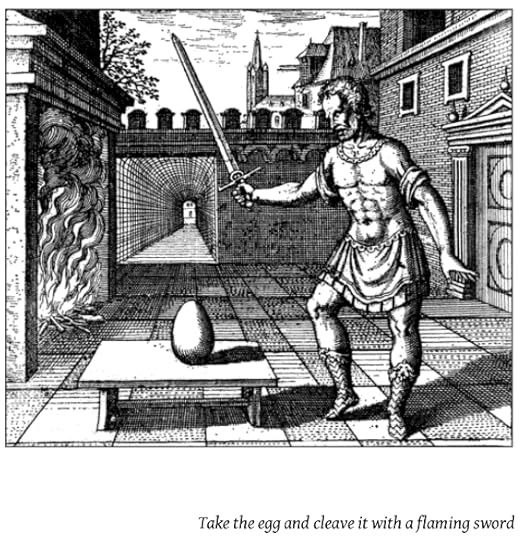
And the novel is illustrated by various engravings from the 17h century alchemical handbook Atalanta Fugiens.
It all adds up to a heady and impressive mix, and for me more successful that the rather sketchy Awake, albeit a book that isn't for readers in search of a linear plot.
Read 22-23 December, 4 stars
Each has his own occupation. Mine is the heavens. Erik has his preposterous gold-making. Falk Goye, beyond preposterous, has his commentary on the Apocalypse.
Sublunar (2023) is Johanne Sorgenfri Ottosen's translation of Harald Voetmann's Alt under månen (2014)
This is the second of what the UK publisher, Lolli Editions, describes as an "erudite and grotesque trilogy about humankind's inhuman will to conquer nature", after Awake (2022) from the same translator from the original Vågen (2011) - my review.
Whereas Awake was focused on Pliny the Elder (AD 23/24 – 79) and his nephew Pliny the Younger, Sublunar is centred around the Tycho Brahe (1546-1601), the last major figure of the pre-telescope era of astronomy. Voetmann explained the reasons for this choice in an interview with his publisher, Denise Rose Hansen of Lolli Editions.
Tycho Brahe had the same urge to control nature. In one of his poems, he writes about capturing the Muse of Heaven (Urania) and imprisoning her in his castle that was called Uraniborg. Nature personified as a woman and then this figure of the male conqueror. But, unlike Pliny, Tycho made real changes and his work had enormous consequences, shattering the whole vision of the universe of his day, and challenging the notion of eternity. There was a doubleness to him as well. He was both the exact scientist and a mystic; an astrologer and an alchemist.
The final part of the trilogy, Syner og fristelser (2015) is based on the eleventh-century German mystic Othlo of St. Emmeram, and will appear in 2024 in English provisionally titled isions and Temptations.
A more recent interview with the publisher, focused on Sublunar, can be found here, where he describes the form of the novel:
When I found the Meteorological Diary, I knew I had to write about [Brahe]. It consists of meteorological notes taken by Brahe’s assistants over a span of 15 years on the island of Hven. It is mostly about the weather, but occasionally there are glimpses of life in Brahe’s castle Uraniborg. That book gave me the form [...] I wanted to follow the year, month by month, in the style of a Renaissance almanack. These almanacks often contained illustrations, poems, and stories in between the descriptions of the months of the agricultural year, so it gave room for different narrators and styles.
The main section of the text comes from monthly chapters titled 'The Year of the Assistants' which draw on the metrological journals from the island of Hven, given to Brahe by the Danish King so that he could establish an observatory for his research.
Southeasterlies, still and clear into night, then it started clouding over and was rather cold and overcast. Last night Tyge's sister Sophia arrived. On the same day an unusual fish was caught near Kronborg and exhibited. Southeast, sun and wind, dingy fog at night and vapors everywhere on the horizon. Dark and clear commixed, mist from time to time, coming off the beach it seems, southward still. Fog, rising from the soil it seems, from the beds and fields and meadows, from plow furrow and mud pool, blending smoothly with the mist rolling ashore. The two mists weave closely around us. Brine and loamy earth pervade our every breath, and though the joint effluvia of both elements can be contained in the air they have reached no clear agreement; the air is quarrelsome, caught in the strife of her sisters' brawl. This is called healthy sea air.
But Sublunar begins with a translation from Latin (via Danish) of an elegy written by Brahe in 1572 to his twin brother who died in the womb, where Brahe imagines his twin pitying him for having to endure the suffering of mortal flesh, and other chapters titled 'Letters from Uraniborg' (the name of the observatory he built) have Brahe addressing his sibling.
Brother of my heart,
My sight is yet unclouded but my eyes ache with recurring pains.
Many visitors this summer: Erik Lange, Falk Goye, Sophi.
Work at night, then discourse in the summer rooms throughout the early morning as dawn breaks and damp covers Uraniborg's gardens below.
Each has his own occupation. Mine is the heavens. Erik has his preposterous gold-making. Falk Goye, beyond preposterous, has his commentary on the Apocalypse.
And Sophi — Sophi sleeps at night and spends the day strolling the garden or studying her nativity book. She prunes the roses and draws horoscopes for the servants. Womenfolk possess a certain coolness of manner, the methodical cool which at first glance may seem suited to scientific pursuits but seldom is. Their manner is not founded on the mastery of passion, does not stand in opposition to anything. It is the mere absence of passion, and so to women any occupation is as good as the next. Such is the case for most women at least. I do not doubt Sophi's abilities, but her urge to uncover nature's mysteries is weak and such a task would give her no more pleasure than the pleasure a kitchen maid gets from the careful cleaning of a rabbit, the chopping of its meat into cubes for a pie.
And as this quote suggests, there are three other key characters, Sophia Brahe, Tycho's sister, whose scientific researchers were more advanced (and given more public credit by her brother) than this note would suggest, and two fellow nobles trying to decode the world's mysteries, but whose research fell, unlike Brahe's, the wrong side of the arcane-mystical / academic-scientific divide, Falk Gøye, who in the novel dabbles with the apocryphal (his theory that the world will end its days as glass) and Erik Lange, who lost his fortune on alchemical speculation but ended up marrying Sophie. Another section has Falk Gøye's theories in his own words, and a further section commentary from a travelling companion on Erik Lange's journey around Europe, which suggests his depleted fortune also resulted from excessive drinking and whoring.
And the novel is illustrated by various engravings from the 17h century alchemical handbook Atalanta Fugiens.
It all adds up to a heady and impressive mix, and for me more successful that the rather sketchy Awake, albeit a book that isn't for readers in search of a linear plot.
Read 22-23 December, 4 stars

Read
December 31, 2023This the second volume of a trilogy in progress. The first dealt with Pliny the Elder and his study of the natural world. This one follows Tycho Brahe and his search of the heavens. The style is the same, meaning there are various speakers, not always named, often epistolary. By my count, there were fewer grotesqueries in this one, but enough dwarfs and whores to keep things moving. I was often lost but would be awakened by some pearl of a sentence, like: One can only conclude this structure must be an institute for botched and bungled learning where the manna of wisdom is boiled to a gruel slurped by edentulous bookworms.
Still, I am glad I persevered, because the last fifteen pages, Of Erik Lange's Travels, was a delight of rollicking depravity. A nice way to end the year.
_____ _____ _____ _____
There are, it's been noted, coincidences in our reading journey, how one book may dovetail or lead to another. Well . . .
Two days ago, I was reading a section that began: On Walpurgis Night . . . A few sentences later there was a Walpurgis bonfire. I had never heard of Walpurgis Night or its bonfires before, despite a long life, but it didn't seem important enough to open up the laptop and seek a definition. Yesterday, still reading this, a ubiquitous big blue van delivered a CD of Octets by Mendelssohn and Bruch. There was a painting on the front, so I turned the CD over to see what it was.
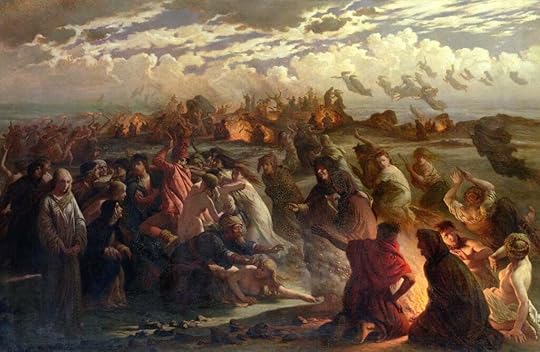
Walpurgis Night, by Gustav Adolph Spangenberg.
Spooky.
Still, I am glad I persevered, because the last fifteen pages, Of Erik Lange's Travels, was a delight of rollicking depravity. A nice way to end the year.
_____ _____ _____ _____
There are, it's been noted, coincidences in our reading journey, how one book may dovetail or lead to another. Well . . .
Two days ago, I was reading a section that began: On Walpurgis Night . . . A few sentences later there was a Walpurgis bonfire. I had never heard of Walpurgis Night or its bonfires before, despite a long life, but it didn't seem important enough to open up the laptop and seek a definition. Yesterday, still reading this, a ubiquitous big blue van delivered a CD of Octets by Mendelssohn and Bruch. There was a painting on the front, so I turned the CD over to see what it was.
Walpurgis Night, by Gustav Adolph Spangenberg.
Spooky.
Read
February 2, 2024
Everything under the Moon is in uproar, is undone. She distils us, sorts the soul from the bloody shreds, from the crotches' sediment, from the body's devilry. Eye against eye, pubic bone thrust against pubic bone. An eternal now, not frozen in being but in beginning and end. With its teeth sunk in and its member pounded into flesh, smashing and spluttering. Entangled and self-devouring, merely mirrored in the pale eye above. Never seen.
(Original title: Alt under Månen - Everything under the Moon)
As in the first part of his trilogy, Awake, Voetmann gives the reader an experience that is close to time travel. You are whipped away from the comfort of your armchair and transported to a visceral world of cold, of pain, of confusion, of drunkenness and disease and debauchery.
And why, indeed, should it be clear and cogent to us, this world of astronomical observations living alongside alchemy and speculation on how the world will end? Of course it's barely comprehensible. For we think in binary categories: you are either a magical thinker or a scientist. Read any information about Tycho Brahe and you are likely to light on the accuracy of his observations, how he realised that wind or the movement of buildings might influence readings, thus insisted on mounting the massive sextants and quadrants directly on the bedrock. An astronomer, before the telescope was invented, who later worked with Kepler in Prague. A scientist?
All well and good, yes, but he still had to interpret those observations. And his interpretations, well, they are a product of his 16th century mind.
I have perused the sky and seen a light presaging blood and flames. It shone brightly and unmistakably. It proves that now more than ever is the time to drink. Hasten to meet your end before you are forced to learn what the new light portends. Cannons are cast in the furnaces of heaven, and soon their thunder will split your ears. For every light in heaven, a disease germinates below, soon to emerge from the bottom of the cesspool named Hafnia Metropolis.
Thus speaks he who alone among you has perused the sky. It was you who ignited the treacherous flame now predicting your funeral. So wrap your lips around the mouth of a bottle and reach for the kitchen maid's lap.
(Original title: Alt under Månen - Everything under the Moon)
As in the first part of his trilogy, Awake, Voetmann gives the reader an experience that is close to time travel. You are whipped away from the comfort of your armchair and transported to a visceral world of cold, of pain, of confusion, of drunkenness and disease and debauchery.
And why, indeed, should it be clear and cogent to us, this world of astronomical observations living alongside alchemy and speculation on how the world will end? Of course it's barely comprehensible. For we think in binary categories: you are either a magical thinker or a scientist. Read any information about Tycho Brahe and you are likely to light on the accuracy of his observations, how he realised that wind or the movement of buildings might influence readings, thus insisted on mounting the massive sextants and quadrants directly on the bedrock. An astronomer, before the telescope was invented, who later worked with Kepler in Prague. A scientist?
All well and good, yes, but he still had to interpret those observations. And his interpretations, well, they are a product of his 16th century mind.
I have perused the sky and seen a light presaging blood and flames. It shone brightly and unmistakably. It proves that now more than ever is the time to drink. Hasten to meet your end before you are forced to learn what the new light portends. Cannons are cast in the furnaces of heaven, and soon their thunder will split your ears. For every light in heaven, a disease germinates below, soon to emerge from the bottom of the cesspool named Hafnia Metropolis.
Thus speaks he who alone among you has perused the sky. It was you who ignited the treacherous flame now predicting your funeral. So wrap your lips around the mouth of a bottle and reach for the kitchen maid's lap.

October 31, 2023
135th book of 2023.
I don't see the Danish writer Voetmann around much but here he is with the second installment of his allusive trilogy. New Directions and Lolli are releasing his translation, both of which are great publishers. I read the first book, Awake, last year whilst in Denmark. That book dealt with Pliny the Elder and Younger and was a strange amalgamation of biographical fragments, strange sex, weird digressions and, generally, a completely uncoherent narrative. The same is true of the second book, now focusing on (as focussed as a Voetmann novel can be) astronomer Tycho Brahe. It is another kaleidoscopic narrative that swims with lyrical prose but utter confusion. An observatory, an island, a dwarf, lots of drunkenness, piss, weird sexual practices (akin to Pynchon-sex), beatings, descriptions of the stars and the sky, and numerous narrators, letters, and other forms thrown in. It's a pain to read because most of it makes no 'sense', but it's a pleasure to read with its wildness, originality and peculiarity. Rumour has it that the final book in the trilogy will focus on a German mystic of some description, so I await that with bumbling and befuddled breathing.
I don't see the Danish writer Voetmann around much but here he is with the second installment of his allusive trilogy. New Directions and Lolli are releasing his translation, both of which are great publishers. I read the first book, Awake, last year whilst in Denmark. That book dealt with Pliny the Elder and Younger and was a strange amalgamation of biographical fragments, strange sex, weird digressions and, generally, a completely uncoherent narrative. The same is true of the second book, now focusing on (as focussed as a Voetmann novel can be) astronomer Tycho Brahe. It is another kaleidoscopic narrative that swims with lyrical prose but utter confusion. An observatory, an island, a dwarf, lots of drunkenness, piss, weird sexual practices (akin to Pynchon-sex), beatings, descriptions of the stars and the sky, and numerous narrators, letters, and other forms thrown in. It's a pain to read because most of it makes no 'sense', but it's a pleasure to read with its wildness, originality and peculiarity. Rumour has it that the final book in the trilogy will focus on a German mystic of some description, so I await that with bumbling and befuddled breathing.
January 22, 2025
Grotesque Visions of Renaissance Denmark
Review of the Lolli Editions UK paperback (November 2023) as translated by Johanne Sorgenfri Ottosen from the Danish language original Alt under månen (Everything Under the Moon) (2014).

Detail from a 1586 portrait of Tycho Brahe by Jacques de Gheyn. See full image at Wikipedia.
I steeled myself to tackle Sublunar after having read the earlier Awake which I reviewed as Grotesque Visions of Ancient Rome. This latest translation centres on the life of Danish astronomer Tycho Brahe (1546-1601) but is again told in disjointed segments which often horrify with either their emphasis on bodily fluids, ejaculations and excretions, or on the torment and death of either fish or people (mercifully not animals this time).
The narrative here jumps from weather reports written by Brahe's servants (with interjections on their nocturnal activities), Brahe's own letters to his dead twin brother, stories of various associates such as Falk Gøye (who recites from a despicable manual instructing on the method of raping peasant girls) and the rather hapless alchemist Erik Lange, later husband of Brahe's sister Sophia who drove them into poverty with his delusional experiments. The end result of a liaison between one of the servants and a maid results in a torture execution of a local madam who provided shelter to the expectant mother.
You would think that it would all be leading up to some sort of climactic event where King Christian IV eventually banishes Brahe and his depraved gang from the island estate which had been granted to him by the previous king. But no, it just all fritters away and ends without any major drama. You can read the historical ending at Wikipedia.
Anyway, it was pretty much as distasteful as the first one in the series. Since that was a 1.5 rounded up to a 2, this one will be a 1.5 rounded down to 1 to balance things out. The .5s are for the historical curiousity value, not because it is enjoyable reading.
I read Sublunar as the November 2023 selection from the Republic of Consciousness Book of the Month (BotM) club. Subscriptions to the BotM support the annual Republic of Consciousness Prize for small independent publishers.
Trivia and Links
Sublunar is the second book of a historical fiction trilogy by Danish author Harald Voetmann to be translated into English. It was preceded by Vågen (Awake) (2010) which centres on the life of ancient Roman naturalist Pliny the Elder (AD 23/24–79) and it was followed by Syner og fristelser (Visions and Temptations) (2015) which centres on the life of the monk Othlo of St. Emmeram (1010-1072).
Review of the Lolli Editions UK paperback (November 2023) as translated by Johanne Sorgenfri Ottosen from the Danish language original Alt under månen (Everything Under the Moon) (2014).
I only saw Master Brahe in the seated position, but it is my impression that he is at once fat and hunched, thus manifesting the worst traits of both the noble and the learned. His speech is nasal, even shrill, perhaps as a consequence of his having lost part of his nose in a duel, a section now patched with a leaf made of bent metal and smeared in rosy ointment.
Detail from a 1586 portrait of Tycho Brahe by Jacques de Gheyn. See full image at Wikipedia.
I steeled myself to tackle Sublunar after having read the earlier Awake which I reviewed as Grotesque Visions of Ancient Rome. This latest translation centres on the life of Danish astronomer Tycho Brahe (1546-1601) but is again told in disjointed segments which often horrify with either their emphasis on bodily fluids, ejaculations and excretions, or on the torment and death of either fish or people (mercifully not animals this time).
The narrative here jumps from weather reports written by Brahe's servants (with interjections on their nocturnal activities), Brahe's own letters to his dead twin brother, stories of various associates such as Falk Gøye (who recites from a despicable manual instructing on the method of raping peasant girls) and the rather hapless alchemist Erik Lange, later husband of Brahe's sister Sophia who drove them into poverty with his delusional experiments. The end result of a liaison between one of the servants and a maid results in a torture execution of a local madam who provided shelter to the expectant mother.
You would think that it would all be leading up to some sort of climactic event where King Christian IV eventually banishes Brahe and his depraved gang from the island estate which had been granted to him by the previous king. But no, it just all fritters away and ends without any major drama. You can read the historical ending at Wikipedia.
Anyway, it was pretty much as distasteful as the first one in the series. Since that was a 1.5 rounded up to a 2, this one will be a 1.5 rounded down to 1 to balance things out. The .5s are for the historical curiousity value, not because it is enjoyable reading.
I read Sublunar as the November 2023 selection from the Republic of Consciousness Book of the Month (BotM) club. Subscriptions to the BotM support the annual Republic of Consciousness Prize for small independent publishers.
Trivia and Links
Sublunar is the second book of a historical fiction trilogy by Danish author Harald Voetmann to be translated into English. It was preceded by Vågen (Awake) (2010) which centres on the life of ancient Roman naturalist Pliny the Elder (AD 23/24–79) and it was followed by Syner og fristelser (Visions and Temptations) (2015) which centres on the life of the monk Othlo of St. Emmeram (1010-1072).
June 8, 2025
Man jau pradeda kelti įtarimą šis susižavėjimas nelinijinio pasakojimo tipo knygomis, psychonalyse this, kaip sakoma. Beet.. bandymas perteikt šešiolikto amžiaus mintį? Šito įkvėpta pradėjau skaityt tokį spekuliatyviai istorišką Huizingos veikaliuką "Viduramžių ruduoViduramžių ruduo" ir ten kaip tik taikli frazė papuolė pirmuose 50 psl., ji čia visai tinka:
Šiuolaikinis žmogus paprastai neįsivaizduoja, į kokius patrakusius ekscesus linkusi ir kaip greit užsiplieskianti buvo viduramžių siela.
Tai ir šitoj knygoj netrūksta patrakusių ekscesų, grotesko, poezijos, melancholijos, liepsnos plieskiasi kaip reikiant..
Knygos pagrindas - Tycho Brachės meteorologiniai dienoraščiai ir mįslinga jo paties figūra. Čia be jo veikia dar du jo draugeliai mistikai, kuriuos jis šiek tiek niekina. Knyga pamėnesiui aprašo metus Danijos saloje siaučiant marui, taip pat yra keli laiškų ir šiaip ekskursų intarpai. Galima niršti, kad tai nerišlu, bet galima tam keistumui, originalumui atsiduoti... ir būti supurtytam kokio skalsiai bjaurybinio įvykio. Iliustracijos, simboliai perteikia viduramžių knygelės dvasią, o lotyniškos frazės suteikia viskam gluminančio gašlumo, aišku, nepasieinama ir be subtilių juokelių.
Perfrazuojant ir meniškai apibendrinant: Naktį užsimerkus aš vis tiek matau ir po to valgau savo ašaromis sūdytą sriubą.
Žvaigždę atėmiau už vieną silpnesnį skyrių (vieno iš mistikų sapalionės apie apokalipsę). Čia tipo trilogija (pirma knyga apie Plinijų, antra apie Brachę, o trečia apie vokiečių mistiką Emmeramą), o aš pradėjau nuo antros dalies. Na, ir kas. Buvo faina, visą paveikslą galėsiu ir vėliau sudėlioti.
Šiuolaikinis žmogus paprastai neįsivaizduoja, į kokius patrakusius ekscesus linkusi ir kaip greit užsiplieskianti buvo viduramžių siela.
Tai ir šitoj knygoj netrūksta patrakusių ekscesų, grotesko, poezijos, melancholijos, liepsnos plieskiasi kaip reikiant..
Knygos pagrindas - Tycho Brachės meteorologiniai dienoraščiai ir mįslinga jo paties figūra. Čia be jo veikia dar du jo draugeliai mistikai, kuriuos jis šiek tiek niekina. Knyga pamėnesiui aprašo metus Danijos saloje siaučiant marui, taip pat yra keli laiškų ir šiaip ekskursų intarpai. Galima niršti, kad tai nerišlu, bet galima tam keistumui, originalumui atsiduoti... ir būti supurtytam kokio skalsiai bjaurybinio įvykio. Iliustracijos, simboliai perteikia viduramžių knygelės dvasią, o lotyniškos frazės suteikia viskam gluminančio gašlumo, aišku, nepasieinama ir be subtilių juokelių.
Perfrazuojant ir meniškai apibendrinant: Naktį užsimerkus aš vis tiek matau ir po to valgau savo ašaromis sūdytą sriubą.
Žvaigždę atėmiau už vieną silpnesnį skyrių (vieno iš mistikų sapalionės apie apokalipsę). Čia tipo trilogija (pirma knyga apie Plinijų, antra apie Brachę, o trečia apie vokiečių mistiką Emmeramą), o aš pradėjau nuo antros dalies. Na, ir kas. Buvo faina, visą paveikslą galėsiu ir vėliau sudėlioti.

Did Not Finish
September 14, 2023too much piss for me babes

January 2, 2024
Dark rain almost the entire day; evening sky red after ☉ had set, though dark at night, southeast. I walked down to the beach with Jakob at sunset. We skipped stones under the smouldering clouds and played bare-foot, gathered shells and pebbles to make patterns near the waterline, and screamed at the waves when they took away our designs. [51]

February 1, 2024
I'm breaking the rules here, as this is the second in a trilogy, from which I have not yet read the first.
The books concern the son of a Danish nobleman, Tycho Brahe gained royal funding to build an astronomical observatory on an island tin the sixteenth century, known as Hven. He also pursued alchemical projects and had a dwarf jester named Jeppe. The first in the trilogy was to do with Pliny the Elder, but the plot is very much secondary to the antics of Tycho and his entourage, so I doubt reading them in the wrong order matters at all.
Voetmann has a unique disjointed style, with a lyrical touch to his writing that occasionally produces stand-out sentences. These make day to day life on the island compelling in its grotesqueness; a man frozen dead with his trousers and underwear round his ankles mid-defecation has “excrement only halfway expelled from his bowels.” Children are beaten with birch branches on Good Friday to commemorate Christ’s suffering, while for most of the year the island is shrouded in mist, “no other place on Earth has such poor visibility.”
Its Python-esque at times, though not entirely written for laughs. I'm left with the feeling that sooner or later Voetmann will get it right, that blend of humour / character sketch / plot and produce something exceptional.
The books concern the son of a Danish nobleman, Tycho Brahe gained royal funding to build an astronomical observatory on an island tin the sixteenth century, known as Hven. He also pursued alchemical projects and had a dwarf jester named Jeppe. The first in the trilogy was to do with Pliny the Elder, but the plot is very much secondary to the antics of Tycho and his entourage, so I doubt reading them in the wrong order matters at all.
Voetmann has a unique disjointed style, with a lyrical touch to his writing that occasionally produces stand-out sentences. These make day to day life on the island compelling in its grotesqueness; a man frozen dead with his trousers and underwear round his ankles mid-defecation has “excrement only halfway expelled from his bowels.” Children are beaten with birch branches on Good Friday to commemorate Christ’s suffering, while for most of the year the island is shrouded in mist, “no other place on Earth has such poor visibility.”
Its Python-esque at times, though not entirely written for laughs. I'm left with the feeling that sooner or later Voetmann will get it right, that blend of humour / character sketch / plot and produce something exceptional.

December 31, 2023
This was weird. I still don't know what I have read; I don't know what it is about; I don't know what it wants. And yet I could not put it down. It is confusing, it is brilliant, and at times I simply felt that Harald Voetmann had deliciously lost the plot. There is a lot of weather in the book, there is sex and death and - I don't want to write this, but I have to - dwarf semen. There are orgies and original poems written by Tycho Brahe to his dead twin, there are stars and kings and travel logs.
I'd like to give you a clear and concise summary, but as I said - I don't really know what I read. But I enjoyed reading it, and I may even try to read more of Voetmann's prose. Who knows? Maybe next time I'll understand more.
I'd like to give you a clear and concise summary, but as I said - I don't really know what I read. But I enjoyed reading it, and I may even try to read more of Voetmann's prose. Who knows? Maybe next time I'll understand more.
April 6, 2015
Det forekommer mig at der er mange nutidige danske forfattere, der ikke helt kan få greb om stil, og hvordan man bruger den. Voetmann har stil som ingen anden. Voetmann forstår det danske sprog. Jeg er uendeligt imponeret.
Jeg havde dog en anelse besvær med at få greb om historien i sig selv. Det første lange stykke tid gik det ikke op for mig, at der var tre fortællere (det var der måske heller ikke). Jeg bliver nødt til at læse denne bog igen, men det er noget jeg vil gøre med glæde.
Jeg havde dog en anelse besvær med at få greb om historien i sig selv. Det første lange stykke tid gik det ikke op for mig, at der var tre fortællere (det var der måske heller ikke). Jeg bliver nødt til at læse denne bog igen, men det er noget jeg vil gøre med glæde.

July 25, 2024
I’m troubled trying to assign a rating. I read this book out of interest in Tycho Brahe and found a meandering nightmare. It was very successful at summoning a mood from the dank pit of Earth but tarried too long in the outright abject for me. Some truly wonderful sentences though and commentary on the genesis of a different cosmology.

January 21, 2015
skind. Der skides, smaskes, savles og spyttes. Der fryses og sultes. Der bliver drukket, horet og begået alle slags utugt og trolddomskunster. Børn og dyr bliver pint og plaget, dværge og krøblinge ydmyget og latterliggjort, kvinder torteret, tyende tævet til døde.
Velkommen til Tyge Brahes Uranienborg på Hven anno sidst i 1600-tallet, hjemstedet for renæssancens danske lys, inkarnationen af den ypperste videnskab – som der ser ud i Harald Voetmanns vellykkede, sorte og groteske vision Alt under månen.
Læs min anmeldelse her: http://bognoter.dk/2014/12/25/harald-...
Velkommen til Tyge Brahes Uranienborg på Hven anno sidst i 1600-tallet, hjemstedet for renæssancens danske lys, inkarnationen af den ypperste videnskab – som der ser ud i Harald Voetmanns vellykkede, sorte og groteske vision Alt under månen.
Læs min anmeldelse her: http://bognoter.dk/2014/12/25/harald-...

November 2, 2023
Incredibly interesting parts that never manage to add up to anything beyond a grotesque collage. Still, a hell of a collage

May 19, 2024
Completely over my head, I'm afraid. My only takeaway was that the pristine heavens could be mapped from a cloudy, filthy, babbling place on earth.
March 19, 2025
Voetmann has the fascination with Brahe and Renaissance-era science that reminds me of Borges, and the prose itself is often remarkable. It's a seductive, swimming style that glides the reader along in a not-quite-enchanting picture of early modern depravity. I may soften towards this novel with time, but I have a few serious problems. First, Voetmann mistakes style for substance, which, in an alchemical satire, seems to miss the point. There's not much intellectually to hold onto, expect for the novelty of these historical episodes, resulting in a dalliance that, once concluded, seems a little pointless. Or, the point is bawdy grotesqueness. Second, the novel becomes, increasingly, a list. It lacks any kind of logical build (which, I don't think is required for a novel, but the absence here is notable), resulting in an ending that feels abrupt and exceedingly dull. Reader, the book just ends. I read through this as an e-book; on the last page I, indeed, meant to turn the page, and came upon the completion indicator. There's no sense of closure (which, again, I don't think is necessary -- but is noticed). Finally, Voetmann layers in obscenities and vulgarities which I ordinarily wouldn't object to, provided they accumulate in some kind of purposeful direction. They don't. So there's the sense that we've experienced assault, but to no end. Or, to revel in it. To play about in the disquieting cruelty.
I think the worst feature of Voetmann's novel, however, is how clearly indebted he is to writers like Borges, who would have taken the same subject, but written a novel (or, in the case of Borges, a short story) so much more artfully. Voetmann simply cannot compete with the writers he seems to want to ape.
Perhaps this review is in bad faith. This is the second novel in a triptych, which I haven't read (nor do I plan to, after this attempt).
I think the worst feature of Voetmann's novel, however, is how clearly indebted he is to writers like Borges, who would have taken the same subject, but written a novel (or, in the case of Borges, a short story) so much more artfully. Voetmann simply cannot compete with the writers he seems to want to ape.
Perhaps this review is in bad faith. This is the second novel in a triptych, which I haven't read (nor do I plan to, after this attempt).
August 25, 2025
A dour delight. You wouldn't think that such a small book where the modal word was "dark" could be so packed with energy, but the prose really rippled from page to page.
The writing quality is so so good, like in Awake but with really no dropoff. Despite the lack of a conventional plot, Voetmann grabs you by your (prosthetic?) nose and whips you around a medieval laboratory with cutting prose that both left me in my feels and had me frequently cackling. Just so impressive to do so much with so little in terms of wordcount.
That is not to say that nothing happens throughout the book, so much happens, whole worlds, microepics within pages: births, deaths, generational discoveries, life-nadirs all abound and are all so uniquely interesting in Voetmann's world.
There's also something that feels fresh in the quasi-nihilism that i'd be normally be inclined to get bored of. The triptych's world has a maw so gaping, so ravenous, and the people are so small and feeble, like a thousands of krill that exist in one instant but are instantly devoured by a blue whale the next, and the whole ocean, the universe continues without them apace like they were never there. Why is it so compelling? I don't know! I feel like it shouldn't be, i feel like Voetmann nudges towards a Camus existentialist-absurdist turn of 'but despite all this', but through the second book he hasn't really gone there in any explicit way. But i sort of feel there's some greater subtlety. Is there? Does it matter? Am i an idiot? Who knows. All i know is that this book rips.
The writing quality is so so good, like in Awake but with really no dropoff. Despite the lack of a conventional plot, Voetmann grabs you by your (prosthetic?) nose and whips you around a medieval laboratory with cutting prose that both left me in my feels and had me frequently cackling. Just so impressive to do so much with so little in terms of wordcount.
That is not to say that nothing happens throughout the book, so much happens, whole worlds, microepics within pages: births, deaths, generational discoveries, life-nadirs all abound and are all so uniquely interesting in Voetmann's world.
There's also something that feels fresh in the quasi-nihilism that i'd be normally be inclined to get bored of. The triptych's world has a maw so gaping, so ravenous, and the people are so small and feeble, like a thousands of krill that exist in one instant but are instantly devoured by a blue whale the next, and the whole ocean, the universe continues without them apace like they were never there. Why is it so compelling? I don't know! I feel like it shouldn't be, i feel like Voetmann nudges towards a Camus existentialist-absurdist turn of 'but despite all this', but through the second book he hasn't really gone there in any explicit way. But i sort of feel there's some greater subtlety. Is there? Does it matter? Am i an idiot? Who knows. All i know is that this book rips.
January 11, 2024
3.5 stars
This was a very interesting story to read, I had never read anything quite like it, and I did enjoy it for the most part. I love his writing style, its full of such creative metaphors and poetic language that just makes me feel like my mind is constantly expanding through every sentence.
I do have to say that at times I was confused as to which character was going through the scenes and I sometimes failed to see where the story was going, but that's on me not him. I think its just a complex read, and along with his writing style, it may be harder to decipher the language.
I thought the descriptions of characters and settings were very strong, I could smell, see and hear everything that was going on and now I really want a Jester.
This was a very interesting story to read, I had never read anything quite like it, and I did enjoy it for the most part. I love his writing style, its full of such creative metaphors and poetic language that just makes me feel like my mind is constantly expanding through every sentence.
I do have to say that at times I was confused as to which character was going through the scenes and I sometimes failed to see where the story was going, but that's on me not him. I think its just a complex read, and along with his writing style, it may be harder to decipher the language.
I thought the descriptions of characters and settings were very strong, I could smell, see and hear everything that was going on and now I really want a Jester.

June 28, 2026
I'm not sure how much of this I could have taken but at 160 (very-) odd pages it gets the job done and leaves without scarring. There is an awful lot of sex and shit in this brief book. In each case some of it is more consensual than others. We're in the 16th century and Tycho Brahe has no nose. You can't begin to imagine how he smells, but the author does a great job of putting it out there. The translation work seems to be very high grade with portmanteau words and neologisms, among the rest of the 'gisms, peppering the page. There is plenty of humour, but I can't say it was a delight. The third in the loose trilogy seems to come in at under 130 pages... so that sounds promising.

June 10, 2025
A whirlwind of sex, death, filth, and, occasionally, scholarship, honor, and remorse.
While reading this I often felt on an impossible journey, one whose primary goal had long since dimmed, and now one was carrying on because it was a journey after all. I'm not sure I minded the lack of clarity, and I look forward to the third novel to see if Voetmann can deliver us to some sort of destination unscathed.
While reading this I often felt on an impossible journey, one whose primary goal had long since dimmed, and now one was carrying on because it was a journey after all. I'm not sure I minded the lack of clarity, and I look forward to the third novel to see if Voetmann can deliver us to some sort of destination unscathed.

July 11, 2025
I truly don’t think I have the brain power for Voetmann. Yet here I am.
The first in this series, Awake, is much better than this one and even then I was confused with that one too. It’s incredibly unique for sure but there were so many sexual practices happening that I felt it took away a lot from the prose. At times it made sense but most times I was thoroughly confused and alas, the writing style is fragmented so that’s on me.
Hoping the last one is better.
The first in this series, Awake, is much better than this one and even then I was confused with that one too. It’s incredibly unique for sure but there were so many sexual practices happening that I felt it took away a lot from the prose. At times it made sense but most times I was thoroughly confused and alas, the writing style is fragmented so that’s on me.
Hoping the last one is better.
August 14, 2025
I love the project, and look forward to the last volume, but this took me *forever* to get through. It just isn't as enjoyable as 'Awake' was, for me, at least. If you're really into watching people f*ck and kill each other in the mud, you might enjoy it more. If not, you might be stuck like me, admiring, but not really expecting to re-read it.

April 1, 2024
As for "Awake", "Sublunar" is a fun read in the theme of deconstructing people we consider geniuses. Kind of gets a bit lost in its own high-mindedness. Main issue relative to "Awake" is that it is a just a more dull world relative to the Roman Empire.
September 27, 2023
Dark comedy.
January 20, 2024
The scientific revolution wasn't all fun and games.

April 1, 2024
It's a hoot.
May 20, 2024
The muck and grime of (medieval) human existence and the pursuit to understand and dominate. Lyrical, gross, hilarious, tragic.

September 29, 2024
“translated from the danish” yeah no shit
October 9, 2024
Very pleasing read, I'm not sure what you call this humour but it's my cup of tea.
_-_Google_Art_Project.jpg)
October 14, 2024
nie jestem pewna o co chodziło, bo było tu dużo o pogodzie i orgiach ale niezbyt dużo fabuły
Displaying 1 - 30 of 36 reviews