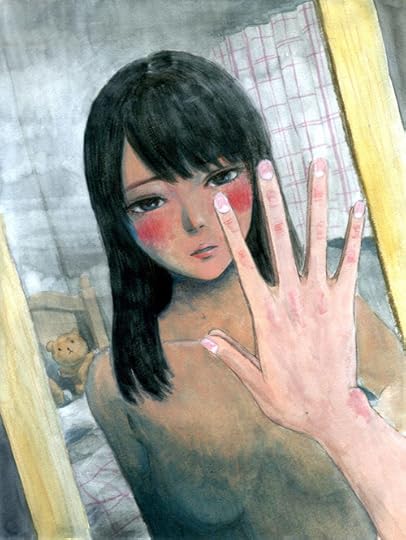
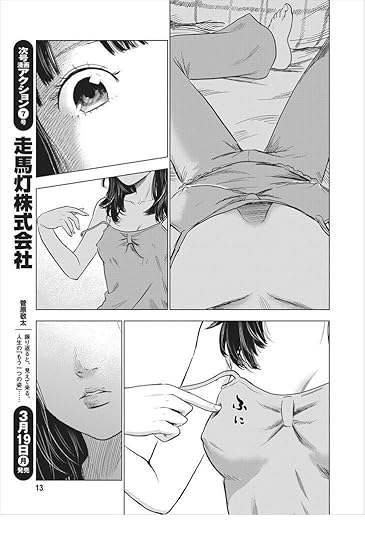
Vor einigen Jahren hegte der Studienabbrecher Isao große Träume: In einer fremden Stadt, an einer renommierten Universität, wollte er sich ein neues Leben aufbauen und in den angesehensten Kreisen verkehren. Doch seine Hoffnungen wurden schnell zerschlagen. Nun wagt Isao kaum noch einen Schritt vor die Tür. Seine einzige Freude besteht darin, der hübschen Oberschülerin Mari aufzulauern. In seiner ausufernden Besessenheit spielt Isao das Leben jedoch einen bösen Streich – und plötzlich findet er sich in Maris Körper wieder!
Shuzo Oshimi (押見修造, Oshimi Shūzō) is a Japanese manga creator. Drawn in a realistic art style, his comics tend to be psychological dramas exploring the difficulties in human relationships and often touching on disturbing situations and perversions. Oshimi debuted in 2001 with the manga series Avant-Garde Yumeko, appeared in Kodansha's 'Monthly Shōnen Magazine.' Most of his works since then have been published by Kodansha and Futabasha. Among his first successes the single volume manga Sweet Poolside (2004), later adapted into a live-action film, and the series Drifting Net Café (2008–2011), also adapted for TV. Oshimi reached international acclaims with The Flowers of Evil (2009–2014) and Inside Mari (2012–2016), both adapted into successful anime. Other notable works are Blood on the Tracks (2017–2023) and Welcome Back, Alice (2020-2023) .
Inside Mari Volume 1 is an good first instalment in a haunting, unsettling, and intriguing series. I have no idea where this story will go, but I'm excited to pick up volume 2 and catch up on the series..
Incredibly disturbing, this has to be one of the more interesting mangas I've read so far this year. The premise screams "cutesy cutesy", but this is far from cutesy. It's probably going to turn into one of the most disturbing series I'll read this year, but I definitely recommend it.
This is one of those mangas I come across semi-randomly (someone in an "Oyasumi Punpun" Facebook group mentioned it) and I end up wondering why I didn't follow up on the author's other works from the beginning. It is a "body swap" story written by the author of the legendary "The Flowers of Evil" (click for my review of the first couple dozen chapters of that story), one of the most affecting and disturbing psychological dramas I've read, and that became one of my favorite mangas. I don't think there's a single "body swap" story that I've disliked, and I knew that with this author, stuff was going to get disturbing quickly.
As our protagonist we have a broken young adult who went through his entire childhood up to high school unable to connect with people, grasping unconsciously at the hope that once he got into college things were going to be different. He was going to meet interesting, more intelligent people, and he would finally find someone he could relate to and who would want to be around him. Predictably enough, in college he found himself alone again. Although he struggled for a while, he had the realization that the pattern would repeat for the rest of his life no matter what aspect of society he would end up dealing with. There was no real point in fighting so hard to fit in a society that didn't have a place for him. He ended up dropping out and, while living in the apartment his out of town parents pay for, wasting his days playing videogames and masturbating (not unlike Satou from the magnificent "Welcome to the NHK" (click for my review). Around two or three years later, hopeless and suffering from extreme alienation, he starts noticing a high school girl who shops in his convenience store. As extremely alienated men suffering from depersonalization tend to do, he ends up obsessing over this idealized, mostly imaginary female who also needs to be appropriately beautiful. Day after day he stalks her from a distance, hoping to learn anything about her. One of those evenings, as he's following her, she stops and turns her head with a strange smile on her lips. Next thing he knows, he wakes up in Mari's home inhabiting her body.
Some of what anyone would expect of a story involving a stalker suddenly inhabiting the object of his affections happens: However, it's mostly subdued. The guy despises himself, and hates that the person the body belongs to disappeared. He focuses on keeping this girl's life together while searching for any clue about where the real Mari might have gone. The first twist of the story is part of its concept, and a significant part of what makes this "body swap" story different from any other I've read. As something of a spoiler for the first volume: when the protagonist visits his former self expecting to find the actual Mari inhabiting him, he finds out that the guy has no idea what the protagonist is talking about, and doesn't recall ever having seen this girl before. So now what? Where is the person Mari's body belongs to? Did she disappear? Does she inhabit the body of a third party?
What unfolds is a psychological drama in which a broken person has to hold together a life he has no business being involved with, while trying to figure out how to return it to its original owner.
Along the way we meet the person who in narrative terms is called the "impact character": another main character that forms an us vs. them relationship with the protagonist, and who mirrors the protagonist's plight to a certain extent. It's a female classmate of Mari who knows her from a single poignant interaction years ago, and that otherwise has spent the last years hoping from afar to enter a relationship with Mari. This other girl is very conflicted with herself and disturbed to a similar extent than the protagonist is, but in her case she also has to deal with her hard to acknowledge homosexual desires. Along the way they also tangle the guy that the protagonist's consciousness seems to have become a copy of; he doesn't believe in the girl's story, but is more than content feeding their delusions if that means hanging out with this beautiful high school girl. Unfortunately for him, things get very complicated.
Quite a ride with plenty of twists, disturbingly intimate moments, psychological derangement and tear jerkers. As in the case of "The Flowers of Evil", the author touches on fakeness, on acting as is expected of you, and how in that way a person's real self could remain unseen forever. As a minor gripe, I wasn't entirely on board with the reasons why this whole "body switching" situation started as they pertain Mari's motives. At times it felt a bit heavy handed. It's not as good as "The Flowers of Evil", but that one was clearly one of those "once in a lifetime" works of an author that leaves them dry and unwilling to attempt the same thing again.
As a personal note, even while I was writing my last books what seems like a million years ago, I found myself unable for the most part to connect with the novels I attempted to read. They seemed like a waste of time, and I couldn't relate to their problems nor desires. It's no wonder that I gravitate towards stories such as this one (been there, done that, bought the t-shirt). Still, for the last few months I had resorted to lengthy non-fiction books on history or science, because nothing else seemed worth the effort. I shouldn't have to mention that most movies and TV shows produced in the West these days are ideologically tainted garbage. However, it had to be a manga again which reminded me of how powerful storytelling can be, and how you can lose yourself in the plights of its characters, feel their pains and hope with them. Even as a child I knew that nobody does it like the Japanese. Bless you land of the rising sun.
This is a review for the entire series - I'm most certainly not going back to figure out which chapters belong to which book! That's the downside to reading it all in one fell swoop online. I found myself absorbed by this once I started reading it, though, so I'm very glad that I was able to read it this way!
Please be warned, this review will contain spoilers for the end of the series. I've gone ahead and put the entire thing behind a cut.
Okay, no more spoilers from here on out!
The only reason I can't give this series five stars is because it is, in the end, drawn for a male audience, inviting the reader to identify with Isao as he struggles with being Mari, and some of the scenes did leave a bad taste in my mouth. Less so on reflection once I finished and realized the intent, but it is an uncomfortable read at times!
I was also pretty disappointed with how the relationship between Isao-Mari and Yori ended. While it's ambiguous, it seemed to imply an inevitable heterosexuality.
However, this is still a really good manga, and I'm glad to have read it. I definitely recommend it if you're able to sit through uncomfortable scenes of nudity, assault, and some general creepiness.
Oshimi really brings out the suspense in this manga. Just like "Flowers of Evil" I really found this one to really look into characters and their mind. Komori and Mari are very different and yet their loneliness and lack of identity are just as similar. Now the bizarreness of the story itself is based on the suspense of the "body change/transfer identity" and I really find it interesting how Oshimi delivers that identity is so human-made and truly artificial and therefore identities are neither real or fake.
Also the Oshimi's afterword is something else too!
Started this series a little cautiously, always waiting for that moment where Oshimi will finally let me down... well, this wasn't it.
Loved it from start to end and had to control myself from picking up the next volume immediately.
Really curious to see where this is going.
In the back of the book it said “Inside Mari is currently the standard for the body-swap genre.”. I fully agree with it and I haven't even finished the series. 😅
Oshimi writes a lot of weird series yet somehow he gives a interesting voice to a lot of his characters. Similar to flowers of evil, this is a strange book. A guy, who was following a girl home every couple of days, wakes up one day inside the girls body. Creepy, huh? But the thing is that he tries his very best to be respectful to this woman Mari. Not even looking at her body parts once he is inside her body. Which feels odd as he was a creepier before this.
The story is basically that. He goes to school in her body and one of the student knows it isn't the real Mari. Tus the whole volume is basically set up for the series. It has some interesting choices, dialogue is solid enough, and the art is solid. But nothing out of the ordinary in the whole switch body things. Guess we'll see what happens next. A 3 out of 5.
I’m not familiar with the tropes of ‘body-swap’ manga except inasmuch as I can guess some of the ickier ones. This means some of the point of Inside Mari might be lost on me, as for much of its length this 9 volume series feels like it’s interrogating those tropes. But it also means I wasn’t steeped enough in the genre to second guess the manga’s elegant ending, which makes the story make a whole different kind of sense.
Our protagonist is Isao Komori, a friendless college dropout who wakes up in the body of a high school girl he’s been watching from afar. So far so grim, but Oshimi thankfully doesn’t play anything for laughs and refuses to let our stalker protagonist off any hooks - Inside Mari turns into a psychological thriller as Komori tries desperately not to ruin Mari’s life and find out what exactly has happened, since Komori’s own body is still inhabited by Komori, but a Komori who has no idea who Mari is. Complicating matters is Yori, a geeky classmate of Mari’s who is the only person to believe Komori - but who has her own complicated feelings for Mari.
Oshimi’s skill with this story is to create a constant sense of unease: Komori-as-Mari has no idea who to trust and as a reader I found myself constantly re-evaluating characters’ motives and actions. As Mari’s family and social life starts to disintegrate under the pressure of the change in her you’re tempted to blame Komori’s own failings, but you’re also getting more and more information about the stresses that already ran through Mari’s apparently happy existence. Oshimi is particularly good on non-communication - the stuff damaged people won’t or can’t say and how others (including the reader) miss the clues to it.
With all that said it’s a marvel that Inside Mari is ultimately such an optimistic story, convinced of the potential for people to change - and that this optimism feels earned and fair even at the end of an often dark story.
This entire review has been hidden because of spoilers.
Conoscevo l’autore per Blood on the Tracks, una delle poche opere horror capaci di disturbarmi davvero, creando un disagio profondo e sottile che rimane addosso anche dopo aver chiuso il volume.
Avevo intravisto qualche immagine sparsa di Inside Mari, e scoprendo che fosse relativamente breve (80 capitoli in tutto), ho deciso di leggerlo. Mi ha preso così tanto che l’ho finito tutto in una sola serata.
La premessa è già di per sé intrigante: il protagonista è un NEET, isolato e apatico, che sembra vivere solo per osservare ogni sera una studentessa che entra ogni sera puntualmente nel supermercato della zona. Una sera, però, succede qualcosa di inspiegabile: l’uomo si risveglia nel corpo della ragazza. Da lì, la storia prende una direzione tutt’altro che prevedibile.
Il manga affronta con sorprendente sensibilità temi legati all’identità, al disagio interiore, alle apparenze e ai ruoli sociali, arrivando a sfiorare momenti di autentico horror psicologico. È una lettura che, al di là della premessa insolita, riesce a toccare corde personali e universali allo stesso tempo. Molto consigliato, potrebbe farvi venire dubbi esistenziali.
This is my third Shuzo Oshimi series and I just fall too deep in his strangeness.
Sensei writes the most nastily noble, perversely pure, and oddly relating characters pining for a higher being that is a woman in a bizarre yet familiar world of his creation. In Shuzo Oshimi series, everything is not just black and white, but rather the blurring thin line that separates the two, before a burst of colors came out in the finale—which makes it gripping and a page-turner. A definite must-read.
Isao Komori, a dropped-out college student is pining for Mari Yoshizaki, a regular high school customer in a convenience store. One day, he decided to follow the girl all the way to her home and found out that Mari actually knew she was being followed. There is a notable strange smile plastered on her face. But that is the only thing he can remember. The next morning when he woke up, he was trapped inside the body of the high schooler. Thinking that he must have switched bodies with Mari, he went and looked for his body and learned that his old self is still him. Apparently, it was only a one-way switch. Now, where could Mari be?
I loved that there could be a blooming homosexual relationship between the real Mari and the glasses girl. I haven't read any shoujo-ai series and I don’t plan to, but I think I'll actually like it. I think I'll hang around and finish this. Oshimi is goat, that's all I can say.
What if you swapped bodies? What if you found yourself in the body of the person you most admired, the “angel-like” school idol who you pass every night (and possibly stalk)? Well that’s what life has install for Komori Isao, a hikikomori who lives for no one else but himself, playing games and masturbating endlessly on repeat. Until he becomes Mari of course.
Oshimi explores gender expectations, and the complex fabric of social hierarchy and friendships, which Komori must now maintain as Mari. Moreover, Oshimi utilises the “body swap” to question the idea of self- at one point the protagonist admits they are no longer either Isao or Mari, but Mari-Isao. A character with both the memories and minds of Isao and Mari. Through the double lens of Mari-Isao, the original “Isao” is able to gain deeper insights into the world and into relationships, that they would not have been able to make, if not for the unbelievable situation.
Inside Mari is an interesting twist on the body swap trope, that provides commentary on social and philosophical issues. However, I would warn readers that it contains nudity, sexual scenes and suggestions of abuse, in case that is something you would like to avoid.
Inside Mari is available to read on Crunchyroll premium member and is still currently being published in Japan. Fan translations can also be found online.
Extra: From what I have read, in the manga and on forums, I believe Inside Mari is also an exploration of psychological issues and mental disorders.
Extra: I think the characters are better fleshed out than in Aku no Hana, however, that may just be the skewered perception of my memories. I think Aku No Hana was very impressionistic- it created direct and forceful scenes that were vivid and playful, deviant and repulsive. There are less explosive moments in Inside Mari, it speaks to you more directly (or so I feel).
I agree with other fans who say that Inside Mari is Aku No Hana graduated. Although again, the fallibility of memory.
(placeholder for all 9 volumes) there are some things you expect when reading a “body-switching” manga: one person feeling the other up, wacky misunderstandings and then ultimately some kind of realisation that “huh, maybe people are different and that’s good”. i thought that was what i was getting into here, but it’s decidedly not. the reality of “body-switching” is that it’s a nightmarish idea, which is well-explored here. the fun, racy idea of a man inhabiting the body of the woman he desires reaches its inevitable outcome as he now is imprisoned in this “desirable” body. he sees through himself, and is disgusted by what he finds. it’s clear via the few authors notes that the author of the manga has a blurry sort of gender identity and this translates well into the text and art. all in all, this is a manga that takes a tired old trope and finds the disturbing, kafka-esque core that was always there.
I can see why this is a classic, if problematic, trans text. There’s a lot to like, and a lot of trans femme wish fulfilment, but it has so much internalized transphobia. Like that even if you were suddenly transported into the body of a cis woman people would still be able to clock you. You’ll never be a ‘real’ woman, you’ll always have the mind of a man. And it’s just kind of depressing on top of the psychological body horror and incel stuff
Also, the author’s note at the end is heartbreaking. I want to shake and hug them and tell them they can do it. They can be “a woman in both body and mind” if they just let themselves accept it. That it’ll be okay ❤️
After watching RickiHirsch’s fantastic video essay “Queer Horror: Understanding Gender as Body Horror,” I had to read this from the context she had described it from. This was a fascinating inversion of your typical leering pervert’s idea of a body-swapping story—what, realistically, would happen if you did swap bodies with someone you were creeping on?
Literally, you would have to immediately view that person as a whole entire person and not an idealized, romanticized object of desire. Because you are now that person and have to deal with that person’s life now. The horror of being trapped in a body that isn’t yours with no concept of how to be the person everyone around you expects you to be feels particularly reminiscent of the kind of social, mental, and physical dysphoria a trans person may experience.
This is working for me as an exercise in exploring gender dysphoria through a genre trope that covers a lot of ground in terms of speculative examinations of Self and Sociology. Also, first volume was a super quick read! Thank god for Internet Archive.
Not sure if this premise is a nod to Kafka–a college dropout – Isao Komori – holed up at home all day (a 'hikikomori' as the Japanese call such young adult males or adolescents who avoid social contact and stay holed up in their place), wakes up one morning in the body of a high school girl – Mari Yoshizaki – whom he sees every evening at the local department store and has been stalking her since. And nope, this isn't one of those classic rom-com tropes involving boy-girl body-swap fall-in-love numbers. Isao Komori, despite his fascination for Mari, whose body he now occupies, respects her privacy (he is also careful that he's not being a pervert about it, which is kinda cool for a stalker). Further, he's determined to find the real Mari's self, of whose whereabouts he is completely clueless – is she occupying his body in turn? As usual, Shuzo Oshimi crafts another compelling manga with a dark and disturbing plot exploring some mind-numbingly terrifying possibilities.
At first I thought it was going to be a body swap, like freaky friday or your name but this a bit different.
Our male lead wakes up to find himself, in a girls body that he's been crushing on. Only to find out that the person he has switched with isn't inside his body, so where is Mari? The girl who's body he's in.
What I really liked about this, was how easily people could tell something was off with Mari. It doesn't usually happen in body swap stories, people just accept that the person they know is completely different, I'd notice if that happened to me. There are a few twists in this as well, I'd expect no less of Shuzo Oshimi, he's a great mangaka. His afterword in the back is interesting as well, talking about guys fantasy to be in a girls body, he's got a unique perspective.
There is no way to a describe psychotic disorder any better than Shuzo Oshimi did in this manga. At first sight it seems like the author lures us into a fantasy fiction, but that was not the case, just a tricky move against our mind. Suddenly it turned into a psychological drama. Most of the times I was confused and things happening in some chapters seemed pretty inadequate and random. I felt like I was lost in the story, rereading parts of the chapters again and again. But... It was just so beautiful how all those strange things gathered up in the end of the story, how everything could be explained logically and how those random facts and things were strongly related. Do you wanna experience the deep layers of beautiful confusion? Then you should take a ride on this Ferris wheel of human complexities, Fumiko...
NOTE: I read the simulpub version of this manga on the CrunchyRoll subscription service, not the French or original Japanese trade publication. Actually, given the information I was able to find on this book, I effectively read as much manga as would have filled 7 volumes of collected issues last night. This certainly covers some very interesting ground, and I'm really looking forward to where the series ultimately goes. Volume One covers the introduction to the premise of the series and the cast of characters. Not a lot of character growth here, but some very good foundation laying.
Okay this was one of the most interesting mangas i've read so far, theres actually no clear plot line involved but theres a concept, and the concept is stretched and pulled in different directions and dimensions. Watching the plot mold and twist in such extraordinary proportions is mind boggling, and the deep rooted message of this manga had really touched me. This is one of the few gems hidden in a vast multitude of gender bending and eechi mangas which speaks about the most important lesson of all, how to love yourself.
Inside Mari Volume 1 is a really strong first volume in a series that’s haunting, discomforting, and curious all the same. I have no clue where this story will go, though I’m eager to pick up volume 2 and get current with the series. Isao and Mari’s body switch, as well as the mystery of why it happened, is an intriguing hook that will keep fans of mystery and drama eagerly waiting to see how things unfold.
This story features a college drop out who follows a high school aged girl home every night, and suddenly finds that he has BECOME her. The only gender bent series I know is Ranma, so I was curious about this series.
This first volume has all the sort of predictable stuff (who am I, what is happening to me, etc). So I am hoping that this will pick up in the next few volumes.
So I will read those and see how I feel about everything after.
Shuzo Oshimi excels at drawing out the feeling one has with being uncomfortable with oneself -- or at least he does that well here and in Flowers of Evil. This doesn't have quite the same slow opening burn as FoE, but I have a feeling it'll take a sharp turn further down the line. Only wish it weren't 2 months before I could get my hands on the next one. Thanks, Denpa.
I remember giving this manga a try around the time I started reading Oshimi’s other work Flowers of Evil, and the one thing this series shares with that one is the psychological bent that tells you that you’re reading something...special. Not necessarily enjoyable, but thought-provoking.
Really good so far ! I'm excited to see what actually happened to Mari-san and looking forward to whatever the explanation will be. It's so odd that his former self is just walking around, not really knowing anything. SO weird. I assume Yori is in love with Mari or something. It will be interesting watching him try to blend in as Mari. To Volume 2 !!
[rating for whole series, volumes 1-9] I will praise Oshimi for his portrayal of depression, shame, and a shattered identity. All this was represented creatively and authentically. The reason for my low rating is not for a lack of intrigue or profundity, but because there is a fetishization of teenage girls that underlies the entire series, making Mari's role in her own story unconvincing to me. You can interpret this however you want but the author himself at the end of many of these volumes, admits to what he finds erotic about girls and even details his exposure to pornography (disturbing to say the least). Of course, there are many unnecessarily sexualized images of the characters' bodies beyond the actual explicit sexual content. While I don't mind noticing the limitations of an authors perspective in art, what upsets me about this is that the text itself is meant to be about sex(uality) and gender. We are supposed to be convinced that this story is in part a girl's story. Yet Mari is overtaken by Isao, a male character who also often fails to see her as a person (even when they are the same person) because of her female body. Whoever Mari becomes at the end is a Self overriden by Isao, and by the reader's understanding of her through his and the author's eyes. Again, this is supposed to be a commentary at least in part, about sex and gender, and it seems to resonate with trans audiences, but I cannot get past this overtly objectifying lens with which Oshimi writes, and which I believe marrs the sincerity of his message. As a result, I am unconvinced that Mari's story is at any point her own.
This entire review has been hidden because of spoilers.