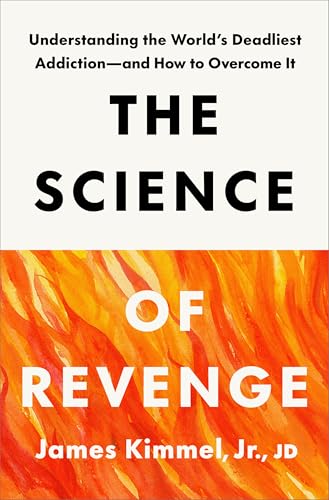
In this definitive book on revenge, a Yale psychiatry researcher exposes the unseen neurobiological cause of violence—a compulsive desire for retribution—and offers a profound new understanding of human behavior and breakthrough framework for making our lives and communities safer.
There is a hidden addiction plaguing humanity right now: revenge. Researchers have identified retaliation in response to real and imagined grievances as the root cause of most forms of human aggression and violence. From vicious tweets to road rage, murder-suicide, and armed insurrection, perpetrators almost always see themselves as victims seeking justice. Chillingly, recent neuroimaging studies of the human brain show that harboring a personal grievance triggers revenge desires and activates the neural pleasure and reward circuitry of addiction.
Although this behavior is ancient and seems inevitable, by understanding retaliation and violence as an addictive brain-biological process, we cancontrol deadly revenge cravings and save lives. In The Science of Revenge, Yale violence researcher and psychiatry lecturer James Kimmel, Jr., JD, uncovers the truth behind why we want to hurt the people who hurt us, what happens when it gets out of hand, and how to stop it.
Weaving neuroscience, psychology, sociology, law, and human history with captivating storytelling, Dr. Kimmel reveals the neurological mechanisms and prevalence of revenge addiction. He shines an unsparing light on humanity’s pathological obsession with revenge throughout history; his own struggle with revenge addiction that almost led him to commit a mass shooting; America’s growing addiction to revenge as a special brand of justice; and the startlingly similar addictive behaviors and motivations of childhood bullies, abusive partners, aggrieved employees, sparring politicians, street gang members, violent extremists, mass killers, and tyrannical dictators. He also reveals the amazing, healing changes that take place inside your brain and body when you practice forgiveness. Emphasizing the necessity of proven public health approaches and personal solutions for every level of revenge addiction, he offers urgent, actionable information and novel methods for preventing and treating violence.
Wow. I came away from reading this book with a renewed perspective. I had no idea that revenge even could be addictive. I also had no clue how to help someone make a different choice than revenge.
I'm a survivor of someone who enacted a vengeance campaign for almost all of my teen years after I told the authorities what she'd done. I've never understood how or why she and her enablers would do that, but this book has answered my questions. It was about revenge. I think that the abuse I endured from her was about revenge as well.
Life is complicated, and people have many motivations. Something most--if not all--of us have thought about at least is revenge when we're hurt. This book includes a way for us to satisfy our cravings for revenge and increase empathy. Research has been and continues to be done on this strategy, and it may not work for everyone. However, it gives me hope.
I have hope that if more people read this book, violence will decrease.
As a teacher, I highly recommend other teachers read this.
One of the most fascinating read recently. A mind blowing new theory and practice that atrocities are committed (mass shooters, dictators, etc) based on their uncontrollable addiction to revenge. It’s also fascinating that the author himself escaped becoming a mass shooter when he was bullied in Highschool, addiction to revenge made him a cold blooded lawyer, then found peace in dedicating time helping others trapped in rage of revenge addiction. Highly recommend it!
Who knew that revenge could be addicting? I never thought of it that way, but when thinking about being hurt, sometimes we can sit in our heads and plot revenge in our head.. it gets us all worked up, and who knows what we can be capable of.
Kimmel gives his background story on how he used to seek revenge, how we as humans see and feel revenge, and communicates his method for overcoming the issue of wanting revenge.
Thank you, Net Galley & Rodale for an advanced copy of this book.
James Kimmel Jr.’s "The Science of Revenge: Understanding the World's Deadliest Addiction – and How to Overcome It" offers a compelling reframe of revenge - not as a moral lapse, but as a neurological addiction. It blends neuroscience, psychology, history, and practical therapy to argue that revenge-seeking behavior follows the same pattern as substance abuse: it’s driven by brain chemistry, reinforced by reward cycles, and fueled by emotional pain. And like any addiction, revenge can destroy individuals, relationships, and entire societies if left unaddressed.
Kimmel begins with accessible psychological experiments, such as simulated exclusion games, to show how the brain processes rejection and retaliation. Participants who are deliberately ignored in a simple game of catch exhibit strong reactions in brain regions associated with pain, notably the anterior insula. But when given a chance to retaliate - even virtually by stabbing a doll or blasting noise - the nucleus accumbens lights up, releasing dopamine and creating a chemical sense of reward. These findings demonstrate that revenge offers a neurological 'high,' explaining why it can feel so satisfying in the moment, despite being harmful in the long term.
This isn’t limited to lab games. Kimmel recounts a conference where seasoned psychiatrists - trained to heal, not harm - voted overwhelmingly to exact brutal fictional punishment after hearing a story about a cruel act. Their emotional response shows how quickly even rational minds can be overtaken by the craving for retaliation. Once pain is felt and grievance is activated, the brain looks for resolution - and revenge offers quick but toxic relief.
But the stakes are higher than mere personal resentment. Kimmel explores how revenge addiction operates in some of history’s most devastating tragedies. He argues that mass killers - from school shooters to workplace attackers - are often mischaracterized as mentally ill in the traditional sense. While some may exhibit signs of instability, most show no clear psychosis. Instead, they share a common psychological profile: profound grievance, obsessive rumination, social isolation, and an escalating urge for violent payback. This pattern mimics the craving cycle of addiction - pain, longing, and then destructive relief.
Shooters like Seung-Hui Cho and Andre Bing didn’t just act impulsively; they left behind manifestos filled with language of exclusion, humiliation, and righteous retribution. They framed their actions as necessary, even inevitable, due to the emotional injustice they perceived. Their writings echo the addictive inner monologue of someone trying to justify a dangerous behavior that temporarily soothes but ultimately consumes them.
Kimmel pushes the argument further by applying this lens to political history. He examines dictators such as Hitler, Stalin, and Mao not just as power-hungry figures, but as examples of how revenge can scale into national policy. Hitler’s early rejections and resentments became the fuel for a long-term grievance narrative, one that cast Germany as the wounded party deserving retribution. What began as personal humiliation evolved into collective vengeance, weaponized into genocide. Stalin, steeped in paranoia and raised amid violent feuds, used state apparatuses to scratch his psychological itch - torturing perceived traitors not just for control, but emotional satisfaction. Mao institutionalized revenge, turning ordinary citizens into agents of retaliatory violence under the guise of class warfare.
These leaders created societal feedback loops that reinforced revenge on a massive scale. When personal craving is paired with political authority, the result is catastrophic. What’s terrifying is that their compulsions mirror the same cycle seen in domestic abusers and mass shooters - only the scale and consequences differ.
Kimmel argues that this revenge loop has shaped human history for millennia. The desire to get even is hardwired, older than civilization itself. From fossil records suggesting early acts of revenge killing to religious texts filled with retaliatory commandments, the pattern repeats. Ancient stories like Cain and Abel reflect the same emotional dynamic seen in modern mass killings: grievance, pain, retaliation. Historical atrocities - from the Crusades to inquisitions and genocides - are frequently fueled by vengeance narratives cloaked in ideology or religious duty.
Despite the moral framing often attached to these acts, Kimmel insists that revenge should be understood first and foremost as a neurological condition. Much like how humanity once misattributed the bubonic plague to sin or sorcery before discovering bacteria, our understanding of violence has long been clouded by misdiagnosis. If revenge is recognized not as 'evil' but as a chemical compulsion, we can start to treat it - and interrupt it - more effectively.
So how do we escape this loop? Kimmel doesn’t advocate for simply 'being the bigger person.' He roots the path to recovery in neuroscience. Forgiveness, far from being a moral favor, is a cognitive and emotional strategy that physically alters brain function. It shifts activity from the reward system to areas in the prefrontal cortex associated with emotional regulation and impulse control. This rewiring suppresses the craving for retaliation and soothes the original emotional injury in a way revenge cannot. Forgiveness, then, becomes a kind of neurological antidote to the addictive effects of revenge.
Brain scans in studies using tasks like the ultimatum game show that individuals who forgive don’t suppress anger blindly. Instead, they consciously reframe injustice, which engages cognitive control networks and reduces both emotional distress and the urge to punish. The long-term effects are tangible: lower rates of anxiety and depression, improved physical health, and better stress management. These outcomes suggest that forgiveness isn’t weakness or surrender, but an evolutionary survival mechanism for emotional resilience.
To help people practice this shift, Kimmel introduces the concept of the Nonjustice System. This is a guided visualization that functions like a mental courtroom, giving people a safe space to process grievance and the desire for retaliation without acting destructively. The individual plays all roles - victim, offender, judge, executioner - and walks through every step of a justice scenario until reaching the emotional endpoint. In the final stage, participants are asked whether they want to remain trapped in the courtroom or choose to walk away. It’s a therapeutic simulation aimed at providing emotional closure and reducing the compulsion for revenge.
This tool isn’t a miracle cure or a replacement for professional therapy, especially for trauma survivors. But it’s a practice that recognizes the craving for justice as real and urgent - and tries to satisfy it in a way that doesn’t perpetuate harm. For people trapped in revenge loops, this kind of structured inner work can offer relief and release.
In the end, Kimmel’s thesis is as bold as it is compassionate: revenge isn’t a character flaw, but a brain-based condition that can be understood, treated, and interrupted. Recognizing revenge as an addiction reorients our approach to conflict - from punishment and retribution to healing and regulation. It invites a rethinking of criminal justice, political rhetoric, and even personal relationships, urging a shift away from cycles of harm toward cycles of repair.
"The Science of Revenge" isn’t just a psychological deep dive - it’s a call to action. In a world increasingly polarized and driven by grievance, Kimmel offers a road map to breaking the habit of retaliation. Through neuroscience, forgiveness, and tools like the Nonjustice System, he shows that peace is not only possible, but achievable - if we’re willing to understand our cravings and choose something better.
Last week, I spent a morning with James Kimmel, Jr. Well, sort of. I spent the morning reading his book, 𝘛𝘩𝘦 𝘚𝘤𝘪𝘦𝘯𝘤𝘦 𝘰𝘧 𝘙𝘦𝘷𝘦𝘯𝘨𝘦. As I worked my way through the pages, the image of Khan Noonien Singh came to mind. More than once. That character, portrayed so brilliantly by the late Ricardo Montalban, is the living essence of #vengeance in the film, 𝘚𝘵𝘢𝘳 𝘛𝘳𝘦𝘬 𝘐𝘐: 𝘛𝘩𝘦 𝘞𝘳𝘢𝘵𝘩 𝘰𝘧 𝘒𝘩𝘢𝘯.
If you thought you understood #revenge, Kimmel's book will prove enlightening.
Framed as both memoir and scientific inquiry, the book argues that revenge is not merely a moral failing or social phenomenon, it’s a neurological addiction. Drawing from neuroscience, psychology, and his own experience as a “revenge-dealing lawyer,” Kimmel makes the case that our brains are biologically wired to crave #retribution, often at the expense of empathy, reason, and peace.
Three key themes emerge throughout the book:
𝗥𝗲𝘃𝗲𝗻𝗴𝗲 𝗮𝘀 𝗮𝗱𝗱𝗶𝗰𝘁𝗶𝗼𝗻. The brain’s reward circuitry is activated when we fantasize about or enact revenge. This dopamine-driven feedback loop mirrors the neurochemical patterns of drug addiction, making revenge feel gratifying even when it leads to destructive outcomes.
𝗧𝗵𝗲 “𝗖𝗼𝘂𝗿𝘁𝗿𝗼𝗼𝗺 𝗼𝗳 𝘁𝗵𝗲 𝗠𝗶𝗻𝗱.” A compelling metaphor Kimmel draw on in the book is the internal trial we conduct when wronged. In this mental courtroom, we play every role: victim, prosecutor, judge, and executioner. These imagined proceedings can escalate into real-world violence if left unchecked.
𝗙𝗼𝗿𝗴𝗶𝘃𝗲𝗻𝗲𝘀𝘀 𝗮𝘀 𝗹𝗶𝗯𝗲𝗿𝗮𝘁𝗶𝗼𝗻. While revenge may offer temporary relief, forgiveness is the only sustainable path to healing. Kimmel advocates for mental health strategies that interrupt the revenge cycle, allowing individuals to reclaim agency and emotional clarity.
The book challenges readers to rethink justice... not as punishment, but as restoration. By understanding revenge as a biological compulsion, we can begin to treat it like any other addiction: with compassion, intervention, and systemic support.
I'll leave you with one quote to get your thought processes cooking: "In our unconscious we daily and hourly do away with all those who stand in our way, all those who have insulted or harmed us."
As your old first sergeant used to tell you, "Payback is a..."
You have them, I have them. They permeate and operate in the background of our daily activities. While we are generally aware of them we don't always understand their impact on our choices. The very scary thing is that sometimes we do understand their impact and their price, we decide that IT'S WORTH IT.
This is the Science of Revenge.
I consider myself a fairly nice person, but one that is not going to take abuse or tolerate bullies. I don't think I generally go out of my way to exact revenge but tend to remove myself from spaces I deem toxic. I suspect now that it is also a form of revenge but cling to the belief that it is sometimes necessary.
This is a fairly new idea as a science and something the author became aware of when he, working as divorce lawyer, was taking just a bit too much pleasure punishing the other party and enjoying opportunities to make their lives harder.
The book goes on to explain the neuroscience of how the brain perceives revenge as justice and a way to balance the scales as well as relieve pain. It even activates the reward centers of the brain but is eerily similar to the brain activities of an addict. The sad part is how often this turns into an unfortunate endeavor that creates more pain, strife, cost and triggers what he calls the Revenge Cycle.
Next he begins to make a case for some of the most murderous authoritarian dictators and how they appear to have been trapped in this cycle. It's not an excuse but an educational (for me) exploration of what may have driven these men to be so vindictive and cruel. I found this section extremely interesting not knowing much about Mao or Stalin.
When the book started I didn't think it was for me because I had no interest in hearing the manifestos of mass killers in the US but skipped ahead and no I'm not sorry. I still got his message. Every one one of these people had grievances they clearly stated and felt like they were justified in their actions. Chilling.
That last part of the book looks at the chemical brain changes with forgiveness or letting some things "slide". I am fascinated with the concept of the "Courtroom of the Mind". Where we act as victim, perpetrator and judge. This all plays out in our head with sometimes dire consequences. The book also calls for a change in our society, something like what Robert Sapolksy does in Determined. Humans are not often dealing with grievances well or in a way that is helping us grow through them and helping humanity or the planet. I'm adding the planet part because to me it implies that what we do here matters and our tendencies affect the Earth.
He has developed a tool I am still thinking about trying. I'd say learning all this has changed me already but perhaps this is more helpful and quicker. We shall see. I think there will be more studies and interest in this topic going forward and I will definitely follow it.
Right out of the gate, if you haven't yet read Matthew Potts monumental work "Forgiveness: An Alternative Account," do yourself a favor and run out and get it. Yes, it has a distinct and specific Christian concern, but along with deconstructing certain theologies it also applies readily to this discusison of revenge, crossing the fields of different disciplines.
What's interesting about Kimmel's work is that preceding this book he apparently wrote an entire work on the spiritual component of revenge. I haven't read it, but I am deeply curious to pick it up, as the author outlines this part of this journey (how the spiritual interest preceded the scientific interest), but doesn't really hint here towards how this continues to shape or guide his conclusions and his thinking.
Which it should be said is completely fine. If Kimmel wants to write a book focused specifically on the science then one would expect it to narrow in on the science. But as with any book of such nature, the science is never divorced from our prior commitments. How we understand and approach the why questions have to be addressed for a book to say something, anything, of revlance, and usually where books like this are concerned it comes out in particular unjustified assumptions.
For example, in a later chapter he takes a stab at drawing out a narrative view of history from the lens of revenge addiction, beginning in prehistory and ending with America (because of course this is how the myth of progress tends to go). What he fails to justify in this particular narrative is why such a depiction isn't and shouldn't just be seen as a necessary part of our evolution as a species. This is how the natural world operates, its how humans operate, and in many ways this "revenge addicition" can be seen as a necessary survival mechanism every bit as much as one can draw out some qualified harms.
And, after all, any adherence to the myth of progress, which inevitably depends on upholding a narrative of us versus them (see the book The Invention of Prehistory), all of this supposed harm brought about the West. And the West is seen as the point of it all, right?
To be fair to Kimmel, he's not as bad as others in perpetuating this common fallacy. I suspect it might be because he has some other allegiances driving his narrative that give him that authorative foundation. He just never cites what that is. He leaves it lingering in the background.
What he offers in terms of the science, which is an operative theory that looks at revenge from the perspective of the brain and addiction, is interesting. Here he straddles a line between (perhaps bravely) sytematically defining revenge and its often qualifying acts of retribution and violence, as being a product of the disease and not the person, and abruptly qualifying that along the way by ensuring his readers he is not advocating for a rejection of personal responsibility. In fact, I think he doesn't go near far enough in letting his theory, which is a good one, lead the way. I suspect it might be because he can't quite let go of that American, Western sense of justice (see Pott's book mentioned above for a robust rejection of that form of justice). Which is ironic because the central tool he gives us for treating the addiction is called the non-justice system, a system that tackles the problem at its root- in the mind with the appropriate knowledge of brain chemistry and how to manipulate it (and subsequently leans on the science of forgiveness as an antidote).
What lies underneath the non-justice system is something that Pott's make central, which is that revenge, which for Potts is a qualified defintion of forgiveness as punishment type justice, can never actually satisfy what the brain wants. It cannot bring about actual justice. Which is why forgiveness, reimagined apart from punishment type justice, can only work to address the problem (or deal with it) if it is rooted in a hope that lies elsewhere. The key: forgiveness cannot be the withholding necessary justice. That view perpetuates the problem inherent in western forms of justice and its systems. Forgiveness also cannot mean that rhe problem goes away. That corrupts the process as well. Rather, forgiveness can be reimagined as an act of withholding revenge, or retribution.
Putting my cards on the table, I approached this book as a Christian and with an openness to the sceince. There is another later chapter in the book, also in the section where he writes a narrative history of the world from the lens of revenge, in which he writes a narrative (mythic) history of the good book (the Bible) from the lens of revenge. Here he starts with God taking revenge on Adam, and then moves through God's response to Cain's kililng of his brother being to protect him through the threat of revenge. Something Lamech takes up by saying he's going to go even further with his promised revenge, followed by God's one upping Lamech by taking revenge on the whole of humanity, which then leads to a success story of perpetual revenage on Israel's enemies, Egypt and onwards, until the final judgement.
Woah, back up that train a bit as you've ridden it entirely off the tracks. Yes, there is a theological stream that reads the bible through the lens of revenge, namely a theology called penal substitutionary atonement. But here's the thing: this reading is not the scriptures themselves but rather those who read it through the lens of western Empire and its form of justice (read: the enlightenment). It is the fact that he reads the Adam story and the Cain story so wildly out of step with the context that he ends up with such a wildly corrupted version of the story. So let me clairfy my objections here: The movement from the garden to outside of the garden is not a punishment. It is not an act of revenge. That would be woefully misreading the narrative. It is in fact a grace note.
The mark of Cain is not, as he presupposes, the threat of revenge on God's front towards anyone who harms Cain. That to me is a bizarre rendering of that narrative movement. It is in fact the opposite. It is expresely in the narrative as a response to the problem: revenge. It is intended to STOP the pattern of revenge, not perpetuate it. The narrative actually supports his science. This is underscored by the way in which the problem is manifested through Lamech, through whom we see this patterned rooted in the furthering act of revenge. Lamech restates the phrasing in a way that then "fills the world with violence." The flood is not a revenge story in response to this problem, it is, properly read, a redemption story that seeks to bring about new creation.
If this was his starting point he would be forced to draw a very different narrative. What he keeps applying to God applies to the state of creation addicted to revenge. This is why the blood actively cries out on the ground, not for revenge but for the opposite. This is the entire point of the temple rituals. Jesus becomes the answer to this problem. In fact, I would argue it is the only narrative in which forgiveness gains an appropriate definition apart from revenge. It is the true non-justice system, only it doesn't just get contined to the human brain. it applies to the whole of the created order. Any other narrative of forgiveness, which Kimmel rightly notes is the only true antidote, falls prey to a justice of revenge.
I do really like how Kimmel advocates for a reclaiming and redeeming of the concept of addiction, sometthing that has been villified and stigmatized in the world as well as in the scientific fields. The word addiction seems to carry this sense of fear for some that our sense of order will be eroded. We need to be able to deem people good and evil and dole out responsiblity and employ forms of punishment justice. This kind of hiearchal view is the only way social order can be maintained and sustained, especially where we see ourselves as the winners. This is where I felt Kimmel didn't fully trust his own theory to lead the way. I think that same fear gets in the way of his great ideas having their full say.
And the way he helps explain revenge in such simple and coherent terms was also really helpful. It's not only that it makes us feel good (whcih it does by tapping into our reward system). It is not only that it is addiction (which it is: by tapping into that reward system we crave it). It's that we justify it through the narratives our brains construct. We are constontly holding court in our heads all the time prior to any revenge action. We are making these senteences and judgments by way of a percieved justification of necessary punishment. Thus why his non-justice system begins by tackling those narratives head on, precisely by taking control of the courtroom in our heads. The way to counter addiction is through the redirection of our habits. To experience the reward of forgiveness is to experience something more true than the temporary fix of revenge, but we can't will ourselves into such a thing, it has to be conditioned. Patterns have to be broken. Which is always a difficult process. But one thing that can help sustain such movements and efforts, certainly in a far more effective way than appeals to the western myth of progress and human accomplishment, is to actually locate a narrative that can hand us real hope of new creation. To be able to anchor ourselves in a narrative that can make the why questions truly rational. A narrative that can stand over and above the reality of a revenge soaked world and claim the genuine promise of a world where such a world is libserated from those forces.
That doesn't negate getting into the trenches and witnessing to that promised new reality. Rather it equips us to do just that. We can attend to the addiction of revenge precisely because we have a hope that this enslaving force has an answer. And that answer isn't the science alone. Science is a tool. A way of exploring a world that is informed and defined by that larger narrative. Without that narrative it becomes reductionism, something Kimmel objects to early on for good reason.
- use solutions outlined by Anna Lembke in "Dopamine Nation"
- use narrative therapy (my label for it) with a thought experiment/story-generating exercise called "the nonjustice system," "the courtroom of the mind," or "the miracle courtroom"
Heard him on Armchair Expert and loved the topic and subject matter. The book gets a little too academic and bogged down. His premise and theory/hypothesis is very interesting and seems like it could check out
Yet another amazing book that manages to get so high on its own supply that it just gets ridiculous. I’ve personally been very curious about the topic of revenge and other bad human behaviors, so this seemed interesting. When the book started, I was hooked and couldn’t put it down. Then, I couldn’t put it down because it just got silly.
James Kimmel’s theory is that revenge triggers the same reward system as addiction. I found this interesting because I’m a recovering addict with 13 years sober. He sells it pretty well, too, and I think he’s onto something. Not only does it make sense because people get obsessed with revenge, but Kimmel has done a ton of studies showing how it affects the brain.
The issue with this book comes in the second half of the book where he just says everything is due to revenge addiction. It starts off with some theories like Hitler and Stalin being addicted to revenge, but then Kimmel just reaches so far that you can’t help but laugh. For example, he says the Atlantic Slave Trade was the result of revenge addiction…what? It was capitalists getting free labor and dehumanizing people. This is just one example where it was a reach, but there are dozens more.
Aside from the whacky theories that tried to make everything fit within his “revenge addiction box”, I was really bummed out that he didn’t touch on status at all. Status is another topic I’m super interested in, and many people crave revenge after their status has been challenged or taken away.
Overall, there are some good ideas throughout the book, but you’ll need to weed through some of the ridiculousness later on.
In his introduction, James Kimmel tells an attention-grabbing story that surely could only have originated in America. After years of bullying, when he was 17 the local kids thought it would be funny to come over in their pickup one night and shoot his dog. A couple of weeks later, they blew up his mailbox. In Kimmel's words 'I grabbed a loaded revolver from my father's nightstand, jumped in my mother's car and tore off [after them] into the night.' He corners the evil kids, grabs the gun and is about to get out of the car to kill them when the realisation of what he's about to do and its implications hit him.
He might have suppressed his immediate urge for revenge, but he claims it then grew in a general driving force of his life, the reason he became a lawyer. 'Within a decade, my revenge addiction had nearly destroyed me and my family.' It wasn't just his work but 'I threatened retribution against just about anyone for the slightest offense - including my wife and kids.' This is genuinely shocking stuff. Unfortunately, I'm not sure the bulk of the book manages to carry on the impact.
Kimmel first takes us through the science of revenge. When American medical doctors write books they have a habit of putting MD after their name, thinking this makes them a scientific source - I was a bit thrown that Kimmel has JD instead, never having seen the abbreviation, but assuming it was some obscure medical qualification as he is a lecturer in psychiatry, but actually it means he's a doctor of law. The science is vaguely interesting in the 'this chemical affects this bit of your brain' and psychology experiments sense, but much of the research seems firmly in the replication crisis era and very little seems to be the result of large scale, quality trials - I would least expect the limitations of the research to be emphasised.
There are plenty of powerful stories to back all this up - so much of it seems to be based on on American culture, I did wonder if it's not so much the science of revenge as the science of the problems with US culture that should be examined more. (There are examples from elsewhere, but these tend to be less everyday occurrences and more evil regimes.) However, we go on finally to how to kick the revenge habit, leading to Kimmel's invention, the 'nonjustice system for revenge addiction', which is about realising the harm you are doing to yourself by seeking revenge rather than offering forgiveness and mentally putting those you would otherwise seek revenge on though an imaginary trial.
Interestingly, before letting us begin putting this into practice we are told to consult our doctor to confirm it is safe and appropriate for us, and asked to note Kimmel's limited licence disclaimer. That's encouraging. Kimmel does give some academic justification for the system, but it still feels that he is attacking the symptoms, rather than a cause that makes gun control impossible and shootings commonplace.
Overall, an odd book as a mix between social science overview, legal viewpoint and self-help. It wasn't for me, but it should have a genuine appeal for those whose lives are damaged by this culture.
Exacting revenge is a natural human instinct, but the extreme form of it must be viewed as an addiction and/or mental disorder. Yale violence researcher and psychiatry lecturer James Kimmel Jr. has uncovered the truth behind why we want to hurt the people who hurt us, what happens when it gets out of hand, and how to stop it. Weaving neuroscience, psychology, sociology, law, and human history with captivating storytelling, Kimmel reveals the neurological mechanisms and prevalence of revenge addiction.
He shines an unsparing light on humanity’s pathological obsession with revenge throughout history; his own struggle with revenge addiction that almost led him to commit a mass shooting; America’s growing addiction to revenge as a special brand of justice; and the startlingly similar addictive behaviors and motivations of childhood bullies, abusive partners, aggrieved employees, sparring politicians, street gang members, violent extremists, mass killers, and tyrannical dictators.
Kimmel also reveals the amazing, healing changes that take place inside your brain and body when you practice forgiveness. Emphasizing the necessity of proven public health approaches and personal solutions for every level of revenge addiction, he offers urgent, actionable information and novel methods for preventing and treating violence.
I was lucky enough to hear James Kimmel discuss his book in a Zoom webinar, under the auspices of UCLA’s Semel Institute for Neuroscience and Human Behavior, on November 6, 2025. A recording of this webinar is available on Semel Institute’s Web site.
Attorney and adjunct professor of psychiatry at Yale School of Medicine, James Kimmel does a deep and meaningful dive into the neuroscience of revenge seeking in today's culture and through out history. Arguing that revenge behaviors are analogous to and utilize the same brain circuitry and neurochemistry as addiction, Kimmel describes how forgiveness has been used throughout history to counter revenge impulses and proposes what he calls a "non-justice" trial of the mind model for addressing thoughts that might lead to violent revenge behaviors. Kimmel has taught this model to prison inmates and many others with apparent success. As an attorney he recognized that he would need to have his theory about revenge as an addiction validated by professionals in the field of psychiatry and neurobiology, which he has done in abundance. An interesting look at this very human impulse and what we as people affected by this behavior can do to not just forgive wrong doing but prevent future acts of violent revenge seeking behavior.
There ARE a few pictures of lolcats hidden in here if you can find them. Lolcats are a palliative which make everything else go down easier. If you don't like cats, there are some dogs as well, around the same spot.
If you want to focus on social justice, the images are only around the beginning and overall nonobtrusive to the primary message, as far as I could tell.
It describes how Mao ordered his army to slaughter the Guomindang, so they fled to Taiwan. It uses the word "multicide" and describes in a chart the primary motives for twenty groups of people in history.
There are some surprising stories of how people can be unfair and cruel to one another so you have to be careful when reading it and not get attached to anyone he describes.
It has towards the end what to do if you or someone else may be experiencing a "revenge attack." [Call for help: 911 or 988 which is the Suicide & Crisis Lifeline, he describes in this book.]
Reading this book made me stop and take a hard look at how much resentment I’ve been carrying—and how it’s been quietly damaging my health and peace of mind. Kimmel does a powerful job of explaining the deep psychological and physiological toll that holding onto revenge can take, and it hit home in a way I wasn’t expecting. What I especially appreciated was how practical the book is—it's not just theory. The book also gives practical strategies to deal with your feelings if you've been wronged, in particular, it gave me a clear, doable way to shift my thinking in the moment. It’s a thoughtful, grounded guide for anyone who wants to let go of anger and actually feel better—mentally, emotionally, and physically.
I’m not a scholar, I requested this book because in today’s world there seems to be so many incidences of revenge over minor things. I was hoping for a better understanding of the neuropsychological factors that feed feelings of vengeance.
This book included sveveral interesting studies, historical events, and social sciences to explain how each can impact a persons response to feeling slighted. What’s really interesting is how their addiction to revenge often grows beyond the individual to include groups (including political groups).
In addition to showing the evolution of revenge behavior, James Kimmel offers some skills to mitigate when others are feeling so angry that they are on the path to vengeance. What an incredible insight.
Over a great message BUT SOOOO repetitive. I couldn’t help but find this book very annoying. Obviously written by a lawyer who has zero medical training. The author makes up his own acronyms. He refers to the brain as a stop and go controller and then goes on to make a non justice system (njs) that could be helpful to visualize forgiveness. I’m gonna need to work on forgiving him for these transgressions.
My mom summarized way better in less than 15 words.
“You can’t control what others say or do to you. But you can control yourself”
Overall it was a great book that views violence from a different path - revenge. Revenge is a valid reason why so many people want to act out in form of violence. A note: Chapter 3 does a deep dive on the anatomy which would be good for anatomy minded individuals but not me. Also the stories and looking at the history of violence through the lenses of revenge makes allot of sense why people react the way they do. Lastly it outlines the steps for forgiveness and working through the process how to resolve it. Looking forward to more science and research along with prevention of it.
Excellent book explaining the brain activity of revenge as an addiction. This book helped me understand why we are violent and how to stop the vicious cycle of revenge via the addiction model of mental illness and treatment. I highly recommend this book to anyone who had a grievance against another person that elicited feelings of revenge or has been the victim of bullying or violence. This book will save lives.
This book won me over in the end. I did not find the neuroscience portions to be thorough or as conclusive as Mr. Kimmel would like them to be, considering the book claims to be a scientific one. I do however think it is rare and important to introduce a perspective on violence that acknowledges emotional motivation for crime regardless of the crime’s magnitude or depravity. Overall excellent ideas to think on.
In depth analysis about the neuroscience behind revenge seeking behaviors. There was a lot of interesting information about how revenge affects the brain, and how it may be lumped into other behavioral issues such as gambling. Lots of interesting case studies too. The weakest part of the book was its latter chapters because the intervention discussed may not be practical for everyone.
Author is an attorney, pyschiatrist and reseacher who ties a number of areas of the human mind to better understand why we instinctivly want revenge and how we can combat that urge by thinking more. Also discusses how society needs to change to move away from revenge as a first reaction.
VERY difficult book to read. Solid argument for a change in the world of mental health - of many of us, of politicians especially. But as someone who still cannot forgive an ex-husband, it has not achieved what I had hoped even in my case. But I may try to work through it again.
Horrid. Don't bother. If you know anything about threat assessment or risk mitigation strategies, this book is simply ridiculous. And to fathom revenge as an addiction ...no words to describe.