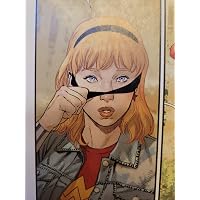
The wild storm begins! What could five strangers have to do with the fate of the world? Find outas Captain Atom goes rogue, threatening to destroy the planet he once swore to protect. Canany hero stop him? Well, it may take the most unconventional of them all…Jenny Sparks, the onewoman tasked with keeping ALL the heroes in line, no matter the cost.The Spirit of the 20th Century returns for the 21st in this action-packed trade collectingJenny Sparks #1-7 by Eisner Award-winning writer Tom King (Wonder Woman, of Tomorrow) and artist Jeff Spokes
I imagine that those who find King's writing tics irritating won't like Jenny Sparks. Trauma, silent panels and repetition galore in this mini-series, you've been warned. I admit, I'm a sucker for these when they're well done, and that's often - not always, but often enough - the case with King.
So Jenny Sparks has to deal with a crisis of the highest order involving Captain Atom gone postal and a bunch of civilians. Everything rests on Jenny's shoulders of course, so well written you could swear King was English. Her biting irony sweeps away everything in its path and makes the title a real treat, but the secondary characters still manage to make their mark.
The pace is - very - slow, there's little action and it's all dialogue and extraordinary storytelling that uses the comic book medium to its full potential that make the difference.
Jeff Spokes is the artist. The truth? I'd never heard of him until now. And yet the guy is a killer! The drawing is excellent, with very natural poses and lots of nuanced expressions.
Tom King drags us through 9/11, the financial crisis, Trumpism, and the COVID-19 pandemic, to mock the hollowness of our admiration of superheroes. As he has often done in the past, he achieves his goal at the expense of a B-list superhero, Captain Atom in this instance.
Captain Atom has gone over the edge and taken five (only five?!?!) people hostage to demand that everyone in the world acknowledge him as God. Jenny Sparks has been authorized as the watchman who watches the watchmen, so she's on the scene to see the Justice League fail and carry on the battle -- if you can call a string of snarky conversations a battle -- against a man who can kill anyone with a gesture.
King mashes together pieces from Alan Moore's Swamp Thing and Neil Gaiman's Sandman with his own Heroes in Crisis to create a cynical and drawn out storyline that isn't as clever as he thinks and left me feeling like the sixth hostage. I've never been a big fan of Jenny Sparks, so that probably contributed to my boredom.
King can be a little hit or miss for me, especially when he looses his negativity, but I'll definitely pick up his books every time.
FOR REFERENCE:
Contains material originally published in single magazine form as Jenny Sparks (2024) #1-7.
Tom King's "Jenny Sparks" is a high octane hard hitting resurrection of the classic Wildstorm character. OG fans will not be disappointed, the Spirit of the Twentieth Century is back and she is as foul mouthed, iconoclastic and fierce as ever. Expect the same white hot intensity for social justice as before, some well earned cynical world weariness, more than a few well placed jabs at self righteous capes and an unusual but absolutely terrifying villain.
Note: I read this in single issues and will amend my review as needed once the trade comes out.
Jenny Sparks returns, experiencing the 21st century despite being the spirit of the 20th. When Captain Atom goes rogue, the Justice League call her in for assistance - but how do you stop a man with the powers of a god?
Tom King's 'taking a character apart and putting them together again' thing comes in handy here, but it's more of a study of Captain Atom than Jenny herself, I think. She has some cool stuff to do (other than just yell for a cigarette and swear), but it's the quieter moments of this book that shine more than the bigger ones. The ultimate conclusion is poignant, but there's definitely a sense, at least for me, that this was meant to be more of a Captain Atom book and Jenny's just kind of along for the ride.
Jeff Spokes is the closest thing to interior Adam Hughes art I've seen in a very long time, and as far as I'm aware there weren't many delays on these issues coming out in single form, so that bodes well. The character acting is great, the level of detail's solid, and the colours pop each and every page. This alone adds an extra star to the rating.
Beautiful art, a half-decent story. Not King's best work, but easy on the eyes at least.
I’m a big fan of Tom King’s writing but this was the first story of his I didn’t really enjoy (although the ending was nice). The reason for this was that he fell into a Garth Ennis-like ‘aren’t superheroes stupid’ hole with this one. Like Ennis always does, King did this by turning the superheroes in the story into morons. It’s tiresome, frankly.
Look, guys, the vast majority of superhero fans know full well superheroes wouldn’t work in the real world and that the concept is a bit silly. We don’t need you to tell us, as if we’re going to be shocked by the ‘revelation’. We are well aware. The genre is a harmless bit of escapist fun.
The artwork was really very good, though, hence the relatively high overall rating.
2 stars for the old Jenny Sparks this is a whisper of. Man, it is not easy being a DC completist when it means squinting through Tom King's tiresome bleeped expletives and virtually unmoving "plots."
As base & bereft as King's *Rorschach* is, it has a creativity & unexpectedness wholly absent from his *Jenny Sparks*, which travesties both Moore's & Gibbons's *Watchmen* & Ellis's & Hitch's *Authority*. Hard to believe this is the same writer as *Gotham Y1* or *Human Target*
Not my cup of tea. Tom King has a theme that he returns to again and again: post traumatic stress, the kind experienced by people in the military or spy agencies. My take is that he’s working through some of his own issues. I am getting tired of it in superhero comics. King has used this in Mister Miracle, Strange Adventures, and now Jenny Sparks. Although Jenny isn’t the one with these problems. It’s the antagonist, Captain Atom, who wants to worshipped as a god, and has taken hostages in an LA bar. Seven issues, where Captain Atom has these hostages and the Justice League is ineffective. Enter, Jenny Sparks, a character I do really like, but I think it could as well have been John Constantine in this story. King does have an interesting thing about Captain Atom, exploring his God like powers, which is similar to Dr Manhattan from the Watchmen (Manhattan was extrapolated from Captain Atom in Alan Moore’s conception). But ultimately I could see the final story play out from the first chapter, and it was boring. I got tired of King’s usual gimmick of flashbacks every two pages. I do like King’s stuff like The Human Target or Gotham City Year One.
Ann Patchett's Bel Canto except with D-list superheroes. Tom King does his usual thing, replacing action with repetitive dialogue, yet the plot chugs along nicely even as it all feels a bit same-y.
Jenny Sparks is "the Spirit of the 20th Century," which is a pretty meaningless moniker to me - and to her too, it being 2026. Despite still being alive past her prime, she's been tasked with taking on the toughest of superhero tasks: taking down powerful supes who have gone awry. Case in point, Captain Atom, who has taken a handful of hostages in a Los Angeles bar and demanded that everyone acknowledge him as God.
Replace all the superheroes with regular folks and the narrative wouldn't change too much. Of course, Atom demonstrates his powers a few times in amusing fashion (i.e., killing everyone at a glance, then resurrecting them). Jenny's sarcastic, nihilist take on the world is amusing at first, but wears after seven issues. The whole plot does, really. We're all hostages here.
The art is quite good, especially as Jeff Spokes is forced to draw basically the same thing for 200 pages. Not Tom King's best work, but certainly one of his most "Tom King" works.
O Capitão Átomo enlouquece e resolve colocar cinco reféns em um bar e exterminá-los se suas exigências de se tornar um ser divino não forem atendidas. A trindade de super-heróis do Universo DC envia Jenny Sparks, o espírito do século XX, para detê-lo. Com exceção de flashbacks, a história se passa toda no bar, ao estilo Contos de Canterbury, Noites na Taverna e o arco Fins dos Mundos de Sandman. A personalidade de Jenny Sparks é bem trabalhada aqui por Tom King e os desenhos de Jeff Spokes são muito bons. No entanto, todo o resto é meio confuso. King não parece saber se está lidando com o Capitão Átomo ou com o que sabemos sobre o Dr. Manhattan de Watchmen, que foi baseado naquele personagem. Alguns dos cinco reféns colocados no bar não têm muita serventia para a narrativa, principalmente depois da virada final. Então, no fim das contas, Jenny Sparks não é o quadrinho de reinvenção mais legal de Tom King, talvez um dos mais confusos, na verdade. E quando King quer ser confuso, acredite que ele será.
with art that jumps from beautiful to stilted and stuff, and a story that jumps all over time like he's being paid by the time change, nothing feels as super important, deep, or consequential as it tries to be.
Tom King, for me, either knocks it out of the park or whiffs completely. This was not a home run. I'm giving it two stars instead of one because I did quite like the art. I've noticed King always works with excellent artists, I'd want to do that too if I wrote comic books. Not every writer has that luxury, must be nice. I was not familiar with the Jenny Sparks character beforehand, reading this did not generate any interest in the character whatsoever, her origins are glossed over and her personality in this is superficial and tiresome, the sassy reluctant hero trope is not very original anymore. Also, someone , either the writer or the artist, seems to have a smoking fetish, it's way overdone, a ridiculous amount of the "action" in this consists of the titular character either smoking a cigarette or about to do so. Unlike the titular character, I am quite familiar with and like the Captain Atom character immensely, and while the idea of him as a villain is compelling, it's been tried already and isn't well executed here. His godlike powers are derivative of Dr. Manhattan, and don't suit his character, seems paradoxical to say that, given Dr. Manhattan is literally a facsimile of Captain Atom, but it's true, Alan Moore went in an entirely different direction with Manhattan and the characters are very different both in terms of powers and personalities. Personally, Captain Atom is a far more interesting character and I would have preferred the focus to be on him and his origins than on the Jenny Sparks herself, whose powers and personality are very one dimensional. A character that has lived over a hundred years should be interesting, and in this story she simply isn't. I never really cared for Cary Bates as a writer, but his post crisis origin for Captain Atom was excellent, I'd love to see King write a longer version of that, it has potential. Much more than this.
When I'm in the mood to read an unconventional super-hero comic, I can usually depend on writer Tom King to provide that. One thing is for sure - - I won't have an indifferent reaction. As with so many readers of his work, King's superhero comics provoke strong reactions, either one way or the other.
At the core of this story is one powerful superhero (Captain Atom) going bonkers, declaring himself a god, and expecting to be recognized as such and the lone superhero (Jenny Sparks) who decides to take a non-physical approach to resolving the conflict.
For me, I really liked this story despite these flaws. 1) The story seems to be padded and could easily have been a four or five issue miniseries instead of seven. Especially when you'll have to shell out $35 at $5 per issue, which I did (reading these in the individual monthly issues). 2) It lacks action, although there are a couple quick-paced scenes. 3) King portrays the other super-heroes as mostly dumb, sure to offend loyal DC fans.
I hadn't read any of the older 1990's STORMWATCH and THE AUTHORITY books which featured Jenny Sparks, so I didn't know anything about this character coming in. She apparently has control of lightening/electricity and has previously died and been resurrected - - so she may be immortal. She's a chain-smoking, irrelevant, independent-minded hero and her interactions with the Justice League are fun to view. Her best ability, in my mind, is to keep the conversation going and try to talk others into sharing her viewpoints.
Superhero pop philosophy. It’s also, I think, Tom King revisiting Heroes in Crisis which, ah, somewhat infamously, got hijacked by flummoxed readers. Now that fewer people are worrying what Tom King thinks about what you’re allowed to do with superheroes, much less pretty-well-established ones, he tells the same story, on a much vaster scale, using Jenny Sparks, an old character from one of the newer superhero communities, to take a look at the past hundred years or so, and wonder how it is we keep going. We live in a cynical age. But there’s more to life than that.
Tom King siendo Tom King como si hiciera de Tom King escribiendo algo que escribiría Tom King. Quiero decir, si Tom King te gusta, este cómic te gustará. Lo de siempre, rescate de personajes ya olvidados, trasfondo político y social, y tacos y cigarrillos y más &€#¥$% tacos y más #€&£¢ cigarrillos. Que el capitán Atom se crea Dios le va al pelo, pero es que la Liga de la Justicia parece un grupo de #€&¥$¢ de los €#&)/?! que les #€&€/)( por €&)/)(#!
This that good Tom King shit I crave. This book conceptually had so much that could have snagged and held it back, and yet King uses all of what its got to his advantage and pulls it of in spite of all of its potentially eye rolling qualities. It most certainly won't be for everyone, but I had a good time with it.
Obscure DC/Wildstorm character, Jenny Sparks, the ghost of the 20th century, walks into a bar to have a conversation with God. It seems like the beginning of a bad joke, but it’s actually how this book starts. See, our kinda god (played by other obscure DC character, Captain Atom) is going through an identity crisis. He wonders if it really would just be easier to wipe the map clean and start over or just take up being real God as his day job.
He kills the Justice League in about a page and a half almost at the beginning of the story, and in doing so, neutralizes pretty much all potential threats to his ascension. Some 20th century ghost brought back to life by the power of DC wanting to make money off side characters has very little chance to stop him. So Jenny and Atom talk in a bar, while five innocent lives hang in the balance, all because they just happened to want a beer right at the same moment this kinda god went bananas. I guess even gods don’t want to be alone at the end of the world. Obscure characters talking about equally obscure things shouldn’t work…. But of course Tom King finds a way to make it incredibly entertaining if nothing else. It’s interesting to think that even the most powerful characters can lose a sense of purpose and place in the world. No matter what reality ending scheme they stop, they can still be forgotten, brought back from extinction and forgotten all over again. So… it’s not much in terms of action, but the ideas Tom King proposes are grand and the characters he writes are both grounded and real despite such an absurd setup.
I recommend this story but ONLY for people who have a deeper knowledge of DC and enjoy the occasional philosophy session in their superhero comics instead of a bat-a-rang.
"I am who I always was. Just a girl searching for the light."
I read this comic expecting to hate it.
Even though it is a female-led superhero comic, it appeared too gritty and edgelord (edgelady?) to me. Plus I had never heard of the superheroine of this one beforehand. But I decided to give it a go anyway, and then move on with my life, never thinking about it again.
'Jenny Sparks: Be Better' did start out frustrating, confusing and boring to me, as I'd predicted. The key words here are 'start out'. I started it thinking it was yet another typical gritty realism style of superhero comic, done far too many times and just as often failing at it. I wasn't into it, and I didn't care about any of the characters.
But then I was into it, and I did care. The further I read, the more I realised and understood what Tom King was trying to accomplish. In my opinion, he mostly succeeded.
By the end of the journey, the test of endurance, I was left breathless and speechless.
'Jenny Sparks: Be Better' might be a modern superhero comic masterpiece.
It's like an updated 'Watchmen'.
Benefitting from how it's a lot shorter and in fact easier to digest than 'Watchmen'. Not mention more accessible, fresh, and progressive. It has intersectional feminism, and it deconstructs toxic masculinity!
Okay, I'm getting ahead of myself.
*Ahem*
I won't give away too much detail. I won't dare to spoil anything. Nothing crucial, anyway. But holy &&@@*$$%*!, Batman! 'Jenny Sparks' is a very relevant superhero comic that isn't really about superheroes. It's about people, and, as the volume's subtitle straight-up states, their capacity to be better. Do better. If they just try. To do what's right. Always. Throughout history. No matter what horrible, *&&*%!*£ up !%&@£ that humanity pulls, in each century, each generation.
It is like if the heroes in the DC universe were transplanted in the real world. It references real life wars, tragedies, recessions, and politics. It holds no punches in its commentary on what's been happening in the world for the past several years (pre-2024... and good !&^@&%*! I'm depressed again), and how we as a species have truly $£@!*! ourselves up. We have learned nothing. We have not improved ourselves. We have wasted everything. We have let apathy, inertia, boredom, not caring about anything, and reactionary politics destroy us as a society.
But maybe as individuals we can improve? Try to make others' lives better, as well as our own? To achieve something good? To be selfless, and care, and act on it? To actually be happy?
I'm not entirely sure if this was Tom King's intention, but he seems to be saying that superheroes in reality would not, in fact, make it better; that the world would be more or less the same, and that superheroes are, in the grand scheme of things, £%^$!@ing useless. Not if they don't attempt to change the status quo.
Well, maybe it's lucky for us then that Jenny Sparks is no superhero. Or, she is perhaps the most unconventional superhero I have ever seen. No costume, no flash and bang (except with her lightning powers), no pretension, no ego, no @$*%@s given, she's a semi-immortal woman who has lived and seen far too much, and it is extremely hard for her not to be cynical. In that, the reader sympathises with the extremely coarse and rough woman.
Jenny Sparks, the Spirit of the 20th Century, has learned much in her long life, too. Perhaps she will save the day - save the world - perhaps she won't. But she will do it her way, without the need for any costumed vigilantes and "gods". Without the ineffectual "Justice" League.
Superpowered people, who in real life would be exploited, taken advantage of, abused, ignored, forgotten, traumatised, and/or burnt out, might end up becoming more of a danger to society and humanity than its saviour...
Jenny Sparks did not seem to be a heroine I would like, despite her being a British (like moi!) antiheroine in a DC comic. She smokes - and I mean she's always smoking, it's her gimmick - and she's borderline suicidal (that she can't die is more of a tragedy than a second chance kind of epiphany for her), and she swears on nearly every page and panel she's in. Quite hilariously, DC censors every swearword in the volume, despite its 17+ rating, and there is a lot of cursing, so it can get annoying and irksome. Just look at how I've been doing it in this review so far, to prove my point, and even then I'm restraining myself.
*Ahem*, anyway:
But hey, I'll forever praise unconventionality in heroines. I appreciate and admire how honest, carefree (in her personal life, that is), and snarky Jenny is. She really does not give a $£@* what anyone thinks of her. She's over a hundred and twenty years old, why would she care about being "unlikeable"? She's fed up with everything, she's cynical as all $!"&@, but she isn't heartless. In fact, she cares deeply. She knows what's what and where's where, and she won't allow herself or anyone else to go too far off the deep end - when it comes to surviving a "civilised" society. Both self-destruction and the deconstruction of others (deliberate or not) are a slippery slope. And they can be connected.
Jenny legitimately tells it like it is, and is not afraid to mouth off any superhero. She's not afraid to tell them off, to challenge any of them on how they do things.
Keeping heroes in check and making sure they don't fall from grace and lose their way and become monsters is pretty much Jenny Sparks' job in the DCU. She's like the world's most knowledgeable, yet reluctant and weary therapist. A wise, deadpan, cranky woman with a cigarette, who can make lightning with a snap of her fingers.
She wants everyone to be better, for !%*&'s sake. That's her immortal life's purpose, no matter how fruitless it proves to be, again and again.
British, chain-smoking, foulmouthed, dressed like a Spice Girl, and too human to be described as a thunder goddess - Jenny Sparks is a very unique antiheroine.
'Jenny Sparks: Be Better' - what a comic for our times. The crassness, the blatancy, the shocks (in more than one sense), the violence, the depression, the rage, the intensity, the political, economical and social critiques. It is an edgelordian superhero comic with brains and a point, and a catharsis the end. It holds nothing back. It is a wakeup call for us all. It is a common sense relief from the insanity.
It is brutally true to life, yet hopeful.
It takes a while to get invested in, and it is a slow-burner, but it is worth it. It contains Tom King's trademark wordy and bordering-on pretentious dialogue, where people talk like they know they're in a story and so try to be as impressive and obvious in their speeches as possible. But it's not so bad here.
Plus, Tom King has been busy lately, hasn't he? Uncommonly so. He's been hired to write for comics everywhere now. Nothing against him personally, but why is this white guy with a mixed bag writing career suddenly, seemingly writing every comic? He's on 'Trinity: Daughter of Wonder Woman' at the moment, WTF? Why? Seriously, it's like he never sleeps.
'Jenny Sparks', for a comic meant to introduce readers of 2024 to the titular character, who was originally created in 1996 for the 'Stormwatch' comic series by WildStorm, in the DCU, it doesn't really explain how Jenny became immortal, nor why she looks young despite first dying when she was ninety-nine years old. Is it to do with her lightning powers? How does that work? What's that about? Is she really supposed to be Charles Darwin's great-granddaughter?
Oh well, who gives a @$£!%?
'Jenny Sparks: Be Better' contains poignant LBGTQ+ themes, and pop culture as well as historical analysis themes, to boot. It is epic.
I shall, finally, sign off here.
As Jenny Sparks would say: Bloody hell, she don't half talk a lot of bollocks, does she? What a writing windbag! Fuck! (You got a light?)
(I love everyone. I love you all. Take care of yourselves. Bye.)
This is the brilliant thing King does. Take a C level character, make it literally, make it philosophical…and make it the most relevant thing that it can be!
There was a Justice League piss-take team called The Authority at the end of the ‘90s created by Warren Ellis and Bryan Hitch. Both The Authority and Ellis have been cancelled, in different meanings of the word, since then (Hitch is still knocking around) and one of the founding members of that team was Jenny Sparks, the Spirit of the 20th Century.
One of the least interesting characters in the group, she nevertheless featured in a pretty decent one and done spin-off by Mark Millar and Frank Quitely, back when that pair took over The Authority after Ellis/Hitch moved on to bigger and better things. And that was the last I thought about the character.
The Authority has been brought back in different iterations since then - New 52 Stormwatch (the earlier sort-of version of The Authority) and The Wild Storm - with varying success but no lasting impression or big enough sales to keep it in print for long. Jenny may have been in those titles but I don’t remember.
Anyhoodles, Tom “Brings Back Obscure Characters And Does Crap Comics About Them” King has brought back Jenny Sparks in this rather crap comic with artist Jeff Spokes. He pits her against an even more unknown character, Captain Atom. The Captain is missing a few electrons because he’s decided that he’s God, taken several hostages in a bar, and will destroy creation. Somehow, Jenny Sparks - an immortal with electricity powers - will be able to defeat a being even the Justice League - yes, including Martian Manhunter, Wonder Woman, Green Lantern, and SUPERMAN - can’t.
I’ve read a lot of DC Comics and don’t think I’ve ever read a single Captain Atom - not that there’s all that many of them out there. Maybe that general lack of knowledge in the average comics reader informed the choice of Atom as villain. Because it doesn’t seem likely that he would be able to withstand simultaneous attacks from so many god-powered characters like Superman and Wonder Woman, but he does, and maybe he is just that more powerful than everyone. Maybe that’s why he’s not all that popular a character - he’s way too overpowered?
What actually did happen to The Authority - why is Jenny on her own? No idea. If she’s the Spirit of the 20th Century, why is she alive in the 21st - and if she is, shouldn’t she be a baby/child in the flashbacks to the early ‘00s? No idea. What about her relatively unimpressive power profile makes her best suited to being a cop for superheroes? No idea. Hmm. This general lack of explanation is partly why the comic is garbage.
The main reason is that the story is so bleeding boring. The characters sit in one location and natter on. And on. And on. Occasionally there’s a fight scene. Then more nattering. On. And on. And neither Jenny nor Atom are interesting speakers. Meanwhile we have lofty flashbacks to the significant events of the 21st century thus far - 9/11, the Iraq/Afghanistan war, the ‘08 crash, Bin Laden’s assassination, Trump, and COVID - to no real effect besides “America’s done some bad stuff and been through some shit”. Deep.
In King’s hands, Jenny herself just isn’t a compelling lead. She smokes constantly, she’s cynical, she has a potty mouth - therefore she’s kewl! … No, she’s a gassed-up mid who can’t carry her own book. At least not one written by late-career Tom King.
Oh and speaking of potty mouth - DC Black Label. Remember what that was supposed to be? A line of comics meant for adults. Where you could show excessive violence and gore, nudity, adult situations, Batman’s peen, and print swear words, all without censorship. So why publish Jenny Sparks under the DC Black Label if you’re going to replace swear words with grawlix on every @#%$ing page?! It’s not @#%$ing funny, it’s so @#%$ing annoying and only becomes more @#%$ing annoying as the book goes on! @#%$ you DC for being utter pansies about swears in your “grown-up” line of comics.
Jeff Spokes’ art isn’t bad. A little too static for my taste but certainly not bad. And the style of the comic is good - you can tell that Tom King knows how to write a good comic because the presentation and tone is all there on the page; he’s written some great comics in his career - but King used to deliver great content along with the style and that’s entirely missing nowadays in his work.
Now, all you get is a lot of boring blather. A lot of boring action. Unmemorable, disjointed scene after scene. Seven issues of instantly-forgettable nothing. I’m not even sure how Jenny Sparks bested Captain Atom at the end. Or even if she did! That’s how fucking (that’s how it’s done “Black Label”) awful the story is.
It’s genuinely astonishing to me how everything King’s written outside of Batman is so underwhelming-to-poor. Jamie S. Rich, his editor on Batman, must’ve done a shit load of heavy lifting to get his scripts into the top tier Batman comics they became. That’s the only explanation I can see for this discrepancy.
And so it goes with Jenny Sparks - a spark-less, lifeless, DOA comic not worth your time. The Spirit of the 20th Century, like The Authority, is a thing best left in the past because it simply doesn’t work in more modern times.
Jenny Sparks' ugly, beautiful, petty, sacrosanct nihilism is the best (cleanest) summation of the 21st century's dispensation of situational ethics. Humanity is killing itself. What privileges of ego lie in wait when one's external precedents (heroism) and internal ambitions (victimhood) merge?
JENNY SPARKS is the kind of comic book one usually reads about in the footnotes of academic papers or non-fiction literature on the role of comics narration in an evolving cultural milieu. It's the kind of book whose narrow focus, limited cast, and decadent dialogue is best read in a single sitting. And it's the kind of book that's difficult to recommend in good faith, due to the eternally unanswerable question of, "Will they get it?"
Sparks is an immortal Brit whose abilities include harnessing lightning, her biting wit, and a credulous disdain for humankind's ongoing inability to learn its lesson (i.e., being 124-years-old, she tends to bear witness regardless of her intentions). This combination of traits may not seem like much, but Sparks' fierce denialism of the virtues of being a superhero means that superheroes only turn to her when they absolutely need her. And goodness, do they hate it when they need her. Because when the hero community needs Jenny Sparks, it means a lot of bad things are coming down the pike.
In JENNY SPARKS, Captain Atom is in the middle of a psychotic break. He's reached the farthest logical extent of his physical powers (e.g., manually annihilating and reconstituting the atomic structure of the world around him), and folks are universally convinced the guy needs to be stopped before he destroys everyone and everything. And that's where Sparks comes in.
Whether Sparks kills the man or merely incapacitates him enough to haul him back to the hospital is not entirely irrelevant; more importantly, the book focuses on Sparks' ability to cajole, talk around, and maneuver into the mind of a man whose nascent godhood is a threat. There's plenty of physical fighting in this comic book. But Sparks' specialty lies beyond crushing foes with lightning. Sparks' specialty rests in her ability to expose people's indulgences, eviscerate their vulnerabilities, and humor their piousness for that crisp, dreamy moment before it all comes crashing down.
Captain Atom, in the present case, is one such superhero in need of a reality check. The problem, however, is that it's difficult to get a man to refocus on reality when the man, himself, is capable of rewriting the laws of physics. A man scarred by his service in the American war in Vietnam and the subsequent socio-political undercurrents that swept him under its backlash, Captain Atom is a duteous fellow whose sense of patriotism and sense of betrayal are deeply intertwined.
JENNY SPARKS takes place, largely, in a single downtown bar. The bar's occupants include a handful of urbanites with their own assortment of domestic issues, many of which reflect or refract the world's multipolar and multicultural shifts over the past half-century. The fact that Captain Atom may well use these individuals as hostages until the world acknowledges his increased madness as godhood is not coincidental. The world has changed. The world continues to change. Who will change with it?
Comics fans have previously encountered conversations on the salience of superheroes whose sanity and morality clashed with their mortality in characters such as Sentry (Robert Reynolds), Mar-Vell, and others. Captain Atom's instability is similarly ripe for exploration. The book's creative team wisely chose Sparks as the investigator for this destroyer of atoms because the woman's listless jawing, indifference to violence, and disgust for truths that go nowhere make her part-executioner and part-therapist. Which role will Jenny Sparks inhabit when the time comes?
The writing is sharp, but almost overly so. The book's pacing is very particular, and readers unaccustomed to more academically-minded comics may not grasp the title's deliberate, idiosyncratic pauses or repetitions (e.g., cutting between multiple scenes/locations; dramatically shifting the visual perspective of a tightly wound conversation). Much like how the story takes a circuitous route to expose readers to the world through Sparks' eyes (e.g., market crashes, elections, terrorist events, pandemics), so also, one finds, the story requires patience to view the world through the eyes of Captain Atom (and his hostages). JENNY SPARKS is about perspective.
The challenge, of course, is that readers must embed with Sparks' distaste for the corruptive institutions that push humans forward (without ever truly enriching them), while at the same time convincing themselves that Sparks is intelligent and resilient enough to defeat a man with the power to remake the fabric of the universe. Sparks isn't fearless, she's just pissed off. She's defiant, yes, but not because humans don't deserve better; Sparks is defiant because she knows humanity will probably never earn it for itself.
“Just hurry up and murder me. I’m bored to death with all the &$?!23 chat”--Jenny Sparks, nearing the end of a volume where we might well agree with her
I messed up some details--some of them important--in my review of this comic, but with the help of a true comics scholar, Goodreads Great Rod Brown, I am rewriting this review to better reflec King's intentions, and at least try to clear up at least a bit of my confusion about what is going on.
Jenny Sparks is a minor DC character revived in the way Tom King does, placing her in the space of Batman and Superman in an effort to defeat another minor DC character, Captain Atom (not Doctor Atom, as I had originally written), who wants to be God, and is engineering a hostage situation about it with Jenny in a bar. You know what a hostage situation involves right? A lot of talking, a lot of stalemate, with almost nothing happening except (a lot of!) talk, Tom King’s favorite aspect of writing comics.
Jenny speaks of the Captain as "My Captain," calling forth a nineteenth-century poem by Walt Whitman last revived in the media-verse by Robin Williams in The Dead Poet's Society:
O Captain! my Captain! our fearful trip is done, The ship has weather’d every rack, the prize we sought is won, The port is near, the bells I hear, the people all exulting, While follow eyes the steady keel, the vessel grim and daring; But O heart! heart! heart! O the bleeding drops of red, Where on the deck my Captain lies, Fallen cold and dead.
King, Rod clarifies for me, has in mind a link from Catian Atom to Alan Moore's Doctor Manhattan, who also wanted to be God. Moore takes oin the limitations of superheroes in Watchmen, as does Warren Ellis, who worked with the character of Captain Atom in his run of The Authority. Now I'm not exactly sure all the reasons why King uses this poem, which Whitman meant as an ode to Abraham Lincoln. You tell me how that works here, except perversely. I was going to give this volume three stars but as I write this I am disappointed enough to take a point off for this issue alone. Okay, Lincoln's death in some ways could be seen as foretelling the violent ___show of the twentieth century wars and genocides, that continue unabated into this century, but what does this have to do with Captain Atom? An ironic reference, as he has become an anti-hero?
I finally got to this because I am a sorta Tom King completist, as I like him usually a lot, but this one was just okay for me, though I did like artwork and the depiction of badass Jenny, even if she doesn’t really do much with that badassery here.
Jenny Sparks is on every page looking for a light, for always another cig. She is, after all, “the spirit of the twentieth century” whatever that means, (born in 1900, died in 1999, back alive in the 21st for some reason) when heroes like Bogie and James Dean always had a cig hanging out of their mouths because they were supposed to look tough [I really, really hope this volume does not revive this idea in the youth of the twenty-first century]. So the joke is, Jenny Sparks can manipulate electricity, but she can’t get a "spark" by herself to light a cigarette. I guess this is supposed to be a joke, but there's a lot of that here. On every freaking page, so it gets old.
My research did help me find a largely unexplored connection between the former quantom technician Allen Adam, who was atomized in a rocket sent into space that exploded. Captain Atom's body is now coated in a substance that enables him to generate vast amounts of nuclear energy and makes him virtually immortal [like Dr. Manhattan, yeah].This energy makes me think of Jenny Sparks' ability to harness huge amounts of energy through electrical currents. Jenny was also the god daughter of Albert Einstein, so there's this quantum energy connection there.
Her dying words and last will in some previous life-ending comic were: "Save the world. They deserve it. Be better. Or I'll come back and kick your heads in.” Ooooh. But superheroes seem ineffectual here in the light of the world’s problems, ala Watchmen, and also weak with respect to this particular minor character Captain Atom threatening the annihilation of etcetera. She he is back from the dead to kick heads in, folks, but does she fulfill her promise? Well, she does win out in the end. For now.
Jenny swears a lot but for some reason in this volume, which is not only for teens, the publisher makes King uses %^#?! for swear words. And Jenny swears a lot, so that is tiresome, trying to imagine the swear words she might have used.
The pace is very slow, there's almost no action and it's all talk. I still like aspects of it, though I keep wavering between two and three stars. 2.5, rounded down for the confusing aspects of the Whitman ref. Thanks to Rod for the help, and to others who know thisworld better such as the inimitable Sam Quixote.
En realidad serían dos estrellas y media. La verdad es que no soy muy fan de Tom King. En su momento disfruté mucho de su miniserie de Vision para Marvel (que fue lo que catapultó su carrera), pero cuando hice una relectura la verdad es que ya no me gustó tanto. Y su trabajo en DC a mi no me ha convencido demasiado. Creo que es un escritor pretencioso que busca "dejar su huella indeleble" en lo que toca (y en algunos casos lo ha logrado, como con Batman donde mató a Alfred y este sigue en ese estado). Sin embargo en las historias que ha publicado fuera de continuidad siento que su trabajo es aún peor. Creo que su intención es llevar al límite a los personajes hasta hacerlos irreconocibles. Y, para mi, eso es muy molesto. Ahora, debo decir que, otra vez, para mi, en este caso la situación era peor. He leído muy poco de "The Authority" y lo que todos consideran una obra maestra (lo de Warren Ellis y Bryan Hitch) honestamente jamás me ha llamado la atención. No soy fan de estas historias "realistas" y violentas de finales del siglo pasado y principios de este y teniendo tantas cosas que leer y tan poco tiempo la verdad es que jamás ha pasado ni por mi cabeza hacerlo. Así que, pues sabía muy poco (digamos que nada) de este personaje. Entonces, si no me gusta mucho Tom King y aquí no había algún personaje que me interesa ¿cual fue la razón por la cual tomé esta mini-serie? Ni yo mismo lo se.
De todas las que ha escrito Tom King para Black Label esta es la peor de todas. En ella vemos no nada mas a Jenny Sparks (la protagonista, obvio) sino a otro grupo de héroes de DC en particular Superman y Batman enfrentándose a una amenaza mayor, Captain Atom. Aunque tampoco soy fan de Captain Atom (bueno, en verdad que hacía leyendo esto) honestamente sentí que la manera en que Tom King ha tratado a muchos de los héroes clásicos no ha sido la adecuada. Si se orinó horriblemente en Ice en su mini-serie de Human Target, aquí hasta defecó en el personaje. Y es que la verdad me choca que los vuelvan locos y megalómanos nada mas porque si. Me parece que, habiendo tantas historias interesantes que se podrían escribir de estos personajes, el cambiar tanto su status quo es cansado. A lo largo de los siete números (si, en algún punto agregaron un número mas) jamás nos interesamos en conocer mas de Jenny Sparks. Solo sabemos que es nieta de Charles Darwin y que supuestamente tiene 125 años aunque también insisten en que murió en 1999. Jamás se explica como revivió, a no ser el hecho de que al parecer no puede morir su otro poder tiene que ver con los rayos y obvio jamás se explica la razón por la cual Batman y Superman deja que ella los trate como si fueran héroes de tercera y porque decidieron que ella fuera una especie de policía para los súper héroes.
Honestamente, lo único bueno de la misma fue el arte. Siento que como en su momento pasó con Jeph Loeb, DC lo está cobijando con dibujantes muy buenos y aquí no es la excepción. Jeff Spokes lo hace bastante bien. Pero fuera de eso la verdad es que para mi fue una mini-serie que no podría decir cansada (la leí en dos noches pero mas por falta de tiempo, lo pude haber hecho en una) pero si desgastante, donde el personaje principal para ser "edgy" y "real" fuma y dice malas palabras todo el tiempo. Si la intención de DC (que lo dudo) era que uno se acercara a encarnaciones previas de este personaje, en mi caso no lo logró.
This entire review has been hidden because of spoilers.
It may be lazy and reductive to call Tom King's writing a near-equal mix of Alan Moore and Brian Bendis, but it's also not entirely inaccurate. And this has arguably never been more the case than in King's latest limited series, Jenny Sparks. While it's hard not to notice how almost the entire comic is told through "widescreen" panels that pays homage to the character's Authority roots, it's a book that is very much informed most by Moore's willingness to play with form (in this case the book's non-linear storytelling) and subtext, along with a certain... cuteness and idiosyncrasy in the dialogue and characterization that is clearly influenced more by Bendis than Ellis - even if Jenny's cynicism is very much in keeping with Ellis' characterization of the character. Though, certainly, the Moore influence wins over in his very Dr-Manhattan-like depiction of Captain Atom (who was, of course, the direct inspiration for Dr Manhattan in Watchmen).
Which is all to say that if you don't generally vibe with King's writing, I can't imagine you not despising this book. It is the most Tom Kingy book to come along in a while. So much so, that even I, an avid Tom King fan, found it a bit too cute for its own good at times. And, if you really break it down, the actual plot here is extremely simple and can easily be accused of being decompressed (hello again, Mr Bendis) - even if I think it easily gets away with it as this is clearly a character- and theme-driven book.
I do, however, take issue with what one of the other reviewers said about the book: that it's just King indulging in his favourite subject - PTSD - yet again. That's clearly not the main theme underlying this story. What it is, is an exploration of Jenny Sparks as "the spirit of the 20th century" and how her still existing in the 21st century plays into how this century has so far been an extension of the last - and possibly just a darker reflection of it. King's apparent claim that the general forward momentum of Western society that defined the mid to late 90s was, in retrospect, a much less appropriate fit for anti-heroes like the Authority than the 2020s - and indeed the entire 21st century has been. More importantly, it's especially heartbreaking to notice so much of the hope of the '90s squandered on a quarter century that has seen some progress, yes, but in other respects has either regressed society to the worst times of the 20th century or invented all new horrible things with which we might destroy ourselves.
It's genuinely thought-provoking, if at times quite bleak, stuff, but it's also a very entertaining read (though, as always with much of King's work is better when read as being out-of-continuity or even as an Elseworlds title) with some wonderful, Adam-Hughes-like art by Jeff Spokes. It's neither King's most accessible work nor his very best, but it is a nice reminder of King's status as a superhero writer who understands their potential for allegory and as a comics writer that takes the medium itself very seriously.
This would be a half star if I could.....My thoughts on each issue are under each,,,,,, but I think I can sum up my thoughts on this as this really could have been a 3 issue MAX story. And instead its drawn out and all that filler space is full of Tom Kingisms that drive me batty. I don't know why they decided she is John Constantine without a trench coat (Blonde, abrasive, British and smokes is where their similarities end really) but they did and I think it shows a fundament misunderstanding of her character , which is wild since she is in a limited number of issues so doing your homework on her should have been achievable. I had so many questions throughout the volume and none of them were ever answered, like why is Jenny even here ? if you needed a Jenny character you had Jenny Quantum spirit of the 21st century sitting right there. how did Jenny come back? where is the rest of her team ?? why didn't you write her as an exhausted old woman trapped in a young body ?? and why did you instead write her as a bratty young woman who cant connect with another human person if her life depended on it?? what happened to captain atom to start all this???? was it the war?? did he read the bible for the first time ??? what drove him over the edge ? why did we pick these civilians to be in the bar?? what narratively made them special (or are you trying to say that the point is they are not special??? because like everything in this run I found this to be unclear). I hated the power scaling we did with the Captain, just cause he's a "God" doesn't necessarily mean he can conjure and create life from nothing and if something happened to make that a reality for him it would have been helpfully if you let us the audience know. Another example is how many people consider Superman and Wonder Woman akin to a God, we also have Mr. Miracle one of the New Gods or even Darkseid and by the measure of Captain Atoms power in this book he could take all of them on and easily win...........I personally don't think that makes sense and I don't think the story telling justifies this apparent power upgrade either. I did not like this volume and don't see that changing if I ever picked it up again. Spokes art is a sliver of shining light in this dumpster fire of a tale, I'll end on this....the ending is left open in a way that more stories could be written. I hope they never are. Jenny is near and dear to me and the fact that she was butchered like this??? it's actually horrifying what they did to her and I found the whole affair to be painful to partake in.Tom King
Jenny Sparks is a tough one. This book is a Tom King book through and through with a compelling conceit: some believed the fall of the USSR heralded an "end of history" with US hegemony, but 9/11 and the ensuing chaos of the twenty-first century quickly dispelled that notion. King decided to comment on all of this using Jenny Sparks, who embodies the twentieth century and wishes she could have passed away at that century's close. If you have no interest in reading King comment on current events, avoid this book. However, I was intrigued and impressed by how candidly DC allowed King to cover topics from the 2008 financial crisis to the 2020 pandemic.
Beyond its political edge, Jenny Sparks is stylistically aggressive in a way that will delight some (as it generally did for me) and frustrate others (as it occasionally did for me). The storytelling heavily employs repetition - both in dialogue and visuals - with frequent use of the nine panel grid and extremely thin horizontal panels. Artist Jeff Spokes (with whom I was unfamiliar beforehand) deftly pulls off this approach with a keen sense of how to direct the reader's eye. His linework is crisp and detailed. His color pallettes are pleasing and contribute to the precise storytelling.
Sparks herself could likewise grate on readers. She is cynical, sarcastic, and constantly asking for a light to smoke cigarettes. She swears with every other word and takes the piss out of Superman, Batman, and other heroes. Readers have to detect a lot of what she means fron subtext, but King and Spokes put in the work to peel back the layers of what makes her tick. As someone who is likewise very cynical, I got a kick out of Sparks and found her tragic but hopeful. Despite the fact that this book falls under the adult-oriented DC Black Label, it oddly uses typical comic book @$#$* symbols to swear rather than the words themselves. I wonder if this was a choice or a limitation - King has fun with the device by having Sparks curse so much at times that her dialogue consists entirely of those silly symbols.
Overall, I enjoyed this book and its unapologetic storytelling. I think readers will either love it or hate it, and I fall into the former camp. I wouldn't recommend it without heavy qualifiers though.
Tom King se disfraza (extremadamente mal) de Alan Moore para contarnos por nonagésimo sexta vez lo jodidos que están los súpers. Esta vez, le toca el turno al bueno del Capitán Átomo, un personaje de tercera que no le importa absolutamente a nadie, que se convierte en... el Doctor Manhattan. ¡Guau! ¡Qué metaficticio todo! ¡Como Moore no pudo utilizar al Capitán Átomo en Watchmen creó al Doctor Manhattan, y como King (supongo) no puede utilizar a Doc Manhattan...! Lo han adivinado, usa al Capitán Átomo.
Vale. Una reverencia y a hacer puñetas, porque esta historia la he leído chorrocientas veces, y cada vez es peor. Sparks está ahí como podía haber estado Mary Marvel, por poner un ejemplo aleatorio, pero le permite a King sacar a una tía fumando y diciendo tacos (bueno, más bien diciendo asteriscos, ampersands y cosas así). Además, Batman y Superman quedan como un par de capullos, y ¿qué mola más que eso? ¿No sacarlos como unos capullos? Nah... que este tebeo es como muy adulto y tal, y los súpers o están como cabras o son gilipollas. Justo como nos enseñó Moore.
Solo que Moore sabía hacerlo bien, y King (que generalmente me gusta, as seen in previous reviews), solo pone el cazo para que le den pasta y pone la creatividad en piloto automático. ¿Y el dibujo? Pues tan excelente como estamos acostumbrados últimamente en DC. De ahí las tres estrellas, porque el cómic es un medio visual y las ilustraciones son parte esencial del mismo.
King, tú un uno y media por esta mierda que NO te has currado, que lo sepas. Y, señores de DC, metan todo el &%# universo Wildstorm en el sótano más profundo del edificio Warner de una *$& vez, por favor.
Unfortunately, this was mid. Look, I think Tom King's comics are MASSIVELY overhated by people (and also immediately dismissed bc of his time in the CIA? like bro are you just now finding out that sometimes good art is made by people who are perhaps not the best?) and while King is hit or miss for me, I generally like the Tom King-isms he employs. I like the exploration of trauma, which is why I was so let down by Heroes in Crisis throwing that away to be a generic murder mystery. I like his use of paneling, which was done phenomenally in Mister Miracle. And while I'm not super well-versed in StormWatch or the Authority, I do like what I've seen of Jenny Sparks. I just found this one to be pretty dull and not super interesting, and Jenny always felt like a bit of a cliche. I never bought the reasoning as for why Captain Atom went bad, and I also didn't think it was adequately explained as to why Jenny Sparks, the SPIRIT OF THE 20TH CENTURY, was in the 21st century when her WHOLE THING as a Century Baby is that she is only alive for her century. I get the intended commentary but it falls apart since Jenny Crisis AND Jenny Quantum both are there as Century Babies for the 21st century, and the reason given seems to be "Jenny Sparks came back bc 9/11" which. dude. Could have been much better if it had been set during the 20th century or maybe been some sort of multiversal or time-travel story with Crisis and Quantum there too.