Jump to ratings and reviews
Rate this book

Wangari Maathai: The Woman Who Planted Millions of Trees

Rate this book
“Trees are living symbols of peace and hope.” –Wangari Maathai, Nobel Peace laureate

Wangari Maathai changed the way the world thinks about nature, ecology, freedom, and democracy, inspiring radical efforts that continue to this day. This simply told story begins with Green Belt Movement founder Wangari Maathai’s childhood at the foot of Mount Kenya where, as the oldest child in her family, her responsibility was to stay home and help her mother. When the chance to go to school presented itself, she seized it with both hands. She traveled to the US to study, where she saw that even in the land of the free, black people were not welcome.

Returning home, Wangari was determined to help her people and her country. She recognized that deforestation and urbanization was at the root of her country’s troubles. Her courage and confidence carried her through adversity to found a movement for peace, reconciliation, and healing. 

Aurélia Fronty’s beautiful illustrations show readers the color and diversity of Wangari’s Africa—the green trees and the flowering trees full of birds, monkeys, and other animals; the roots that dig deep into the earth; and the people who work and live on the land.

45 pages, Hardcover

First published January 1, 2011

6 people are currently reading
917 people want to read

About the author

Franck Prévot

27 books3 followers

Ratings & Reviews

What do you think?
Rate this book

Friends & Following

Create a free account to discover what your friends think of this book!

Community Reviews

5 stars
326 (46%)
4 stars
263 (37%)
3 stars
95 (13%)
2 stars
17 (2%)
1 star
1 (<1%)
Displaying 1 - 30 of 158 reviews
Profile Image for Abigail.
7,985 reviews265 followers
March 11, 2021
Author Franck Prévot and illustrator Aurélia Fronty join forces in this lovely picture-book biography of Kenyan environmental activist and Nobel Peace Prize-winner Wangari Maathai, originally published in France. Following Maathai from her childhood during Kenya's colonial days, when she received an education - very atypical for young girls in this period - the narrative explores her experiences as one of six hundred students invited to study in the United States in 1960, and her activities once she returned to her own land, and discovered the state of environmental degradation there, as a result of widespread deforestation. Maathai's activism, her founding of the Green Belt Movement to replant trees, her opposition to the tyrannical government of President Daniel arap Moi - these are all covered. The book concludes with an extensive afterword that gives a timeline of Maathai's life, a discussion of Kenya today, and of the importance of forests, worldwide...

Originally published in French as Wangari Maathai, La femme qui plante des millions d'arbres, this is the fifth picture-book biography of Wangari Maathai that I have read, following upon Donna Jo Napoli and Kadir Nelson's Mama Miti: Wangari Maathai and the Trees of Kenya , Jeanette Winter's Wangari's Trees of Peace: A True Story from Africa , Claire A. Nivola's Planting the Trees of Kenya: The Story of Wangari Maathai and Jen Cullerton Johnson and Sonia Lynne Sadler's Seeds of Change: Wangari's Gift to the World . I am glad that I bothered to track it down, despite having read all of the foregoing titles, as it is, without a doubt, the best of the lot. The illustrations from Aurélia Fronty are absolutely gorgeous - beautiful color palette, fascinating stylized trees, an interesting overall visual composition on each page - but then, the artwork in many of these other titles is also lovely. No, what sets Wangari Maathai: The Woman Who Planted Millions of Trees apart from its counterparts is that it gives a much fuller account of its subject's life, touching upon the realities of colonialism when Maathai was young, the fact that she was imprisoned multiple times for her activism, and the fact that her behavior was considered atypical for women, in her culture. The portrait created here for young readers is a much richer one, I think, than that available in the four American picture-books mentioned above, and I am glad therefore, that it was translated. Recommended to picture-book readers who enjoy biography, or who are interested in environmental activism and/or stories of inspirational people.
Profile Image for Brenda Kahn.
3,811 reviews60 followers
March 11, 2015
Back in 2008, a very lovely picture book biography of Wangari Maathai was published. It was a perfect blend of succinct but beautiful writing and pleasing, folk-style illustration. Do we need another? Yes! This one is for slightly older readers. There's a bit more text, more detail, including the feminist aspects of Wangari's activism. The illustrations are gorgeous, lush, striking, evocative and beg the eye to linger. I want to swim in the palette.
Profile Image for SaraKat.
1,977 reviews38 followers
September 29, 2024
Beautiful art accompanies the story of an absolute inspiration of a woman. I hadn't heard of her before I picked up this book, but she is a very worthy African woman to feature in Women's history displays.
Profile Image for Mary Ann.
1,485 reviews315 followers
March 22, 2015
Maathai's political activism shines through in this biography, in her determination to reverse environmental damage caused by large, colonial plantations and empower local villagers--especially women--to improve their local conditions. Prévot begins by introducing young readers to Maathai's legacy:
"It's almost as if Wangari Maathai is still alive, since the trees she planted still grow. Those who care about the earth as Wangari did can almost hear her speaking... Wangari encouraged many village women. She dug holes with them in the red soil--holes in which to plant hope for today and forests for tomorrow."

As Prévot tells Maathai's story, he emphasizes how her childhood and her education shaped Wangari, especially, in a time when very few African women went to school or learned to read.

This biography allows students to develop a deeper understanding of the political, economic and social structures Maathai stood up against. I love being able to share with students the value of reading more than one book on a subject, seeing how different authors draw out different details. I would start by reading Seeds of Change, by Jen Cullerton Johnson, and watching a short video. If you build background knowledge, students can then dig into statements such as this:
"The government officials who built their fortunes by razing forests try to stop Wangari. Who is this woman who confronts them with a confident voice in a country where women are supposed to listen and lower their eyes in men's presence?"
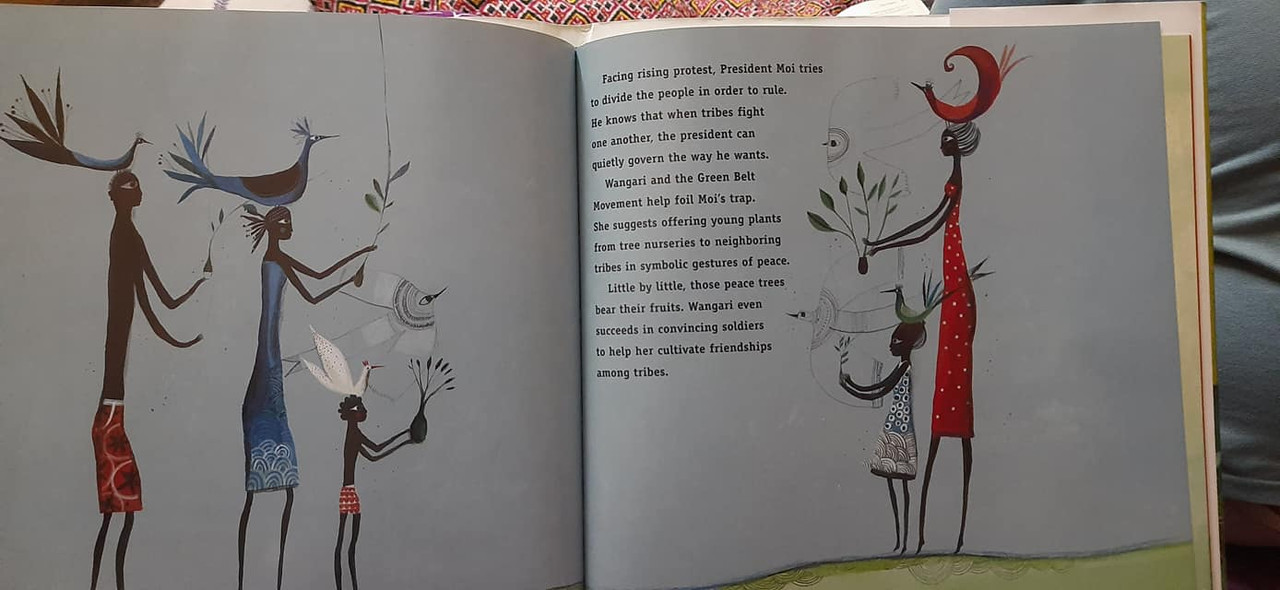
The illustrations are striking and stylized, lush and vibrant. I especially noticed how Fronty varies the rich, saturated background colors on each spread, adding to the emotions.

This is truly an outstanding picture book biography. Prévot finishes with a detailed timeline of Maathai's life, illustrated with several photographs. This background material is both easy to access, written in short chunks, but also detailed to give a rich picture of her struggles and achievements.
Profile Image for Linda .
4,191 reviews52 followers
July 22, 2015
I've read other books about Wangari Maathai, but this gives the most information, perhaps most interesting and inspiring for middle grade students who might be studying those who have changed the world. This book covers her entire life, her ideas, her perseverance. Even facing death threats, enduring prison and many enemies in her country of Kenya, she does not stop working for her dream, to plant trees. She was told by her mother, "a tree is worth much more than its wood", and she never forgets it. The extraordinary art by Aurelia Fronty accompanies Franck Prevot's story of Mama Miti with colorful collages that celebrate this beautiful life. Prevot adds extensive back matter, a timeline, important photographs of her life, and a map of Africa.
Profile Image for Edward Sullivan.
Author 6 books225 followers
April 10, 2015
One of several recently published picture book biographies about the Nobel Peace Prize-winning founder of the Green Belt Movement in Kenya, and this one stands out for its gorgeous, lush illustrations and a clear, concise narrative notable for linking her activism to feminist and human rights issues during her lifetime. Originally published in France.
Profile Image for Danielle.
Author 2 books267 followers
April 6, 2016
Beautiful book with several breathtaking illustration spreads.

More books about Wangari Maathai? Yes, please. And this one focuses on her beginnings as well as her significant struggles with opposition, which I found to be a new take.


"...a tree is worth more than its wood."
Profile Image for Anushree.
231 reviews104 followers
September 4, 2020

I think it was about a year or so back that I came across Wangari Maathai's video in which she told the story of the hummingbird, Dukdukiya.

When a great forest caught fire, as all animals big and small started to flee their homes to find a safe space, little Dudukiya decided she would not abandon the forest, and would do all that was possible from her end. And so Dukdukiya picked a single drop of water in her tiny beak, and flew back and forth, back and forth, back and a more tiring but resilient forth, dropping the drop of water on the raging fire.

Learning about Wangari Maathai, also introduced me to a new word. "Mottainai" - a Buddhist word that embraces the practice of not wasting resources and of using them with respect and gratitude.
Wangari's life was that of different firsts. First African woman to win the Nobel Peace Prize, first woman in East and Central Africa to earn a PhD, first woman in Nairobi to be appointed as senior lecturer in anatomy in 1975, chair of the Department of Veterinary Anatomy in 1976 and associate professor in 1977.

At a time when women were not allowed to speak their mind, or educate themselves, Wangari had managed to get educated, and ruffle powerful political feathers, as she rallied for the cause she truly believed in. She was made of a different mettle than most women then. She continued to develop her ideas that took the form of the Green Belt Movement (GBM), the main focus of which was poverty reduction, women emancipation and environmental conservation through tree planting.

This little book, that was on our wishlist since ages, sent by our dear friend Vijayalakshmi Harish, speaks about her personal and professional life in a very succinct manner. It is a fun book to get kids (reading level 6 years and above) introduced to the ideas of forests, tree plantation, a bit of democracy and tiny bits about women's rights.

You will see the quality of illustrations (they are gorgeous and manage to capture the essence of elements of African art) of this one in the pictures I have shared, but the language is also very moving. It tells us about Wangari's birth, her schooling that was hugely because of her brother and her mother, her struggle with the powers that be in Kenya, her personal life, and her moments of triumphs and courage. It made my eyes moist with the way it spoke of how Wangari never gave up despite facing immense troubles for being a woman with a voice - one more story that filled me with gratitude and admiration for women who carved the paths for many women like us.


She lived her whole life with the words of her mother “a tree is worth more than its wood.” And Wangari's words, "I will be the hummingbird and I will do the best I can", have stayed with me as a motto for life. They define me as a person and while I may not have reached the best possible place yet, and may not be doing the best possible things yet, I know I am doing the best I can at this moment.

Sometimes that is all you can afford to or have the capacity for and other times when I give up, Dukdukiya continues to send little drops of strength from her little beak, when the fire of despair threatens to burn me down.

For the Flight of the Hummingbird story - https://www.amazon.in/dp/1553653726/r... or check it online- www.vidyaonline.net › hum...PDF
Web results
FLIGHT OF THE HUMMINGBIRD (A Parable for the Environment) and Wangari's video is here - https://youtu.be/IGMW6YWjMxw
25 reviews19 followers
December 9, 2018
Prévot, F., Fronty, A., & Clément, D. (. (2015). Wangari maathai: The woman who planted millions of trees (First US ed.). Watertown, MA: Charlesbridge.
Recommended grade level: K-3
Format: Biography
Themes: Environment, biography, earth, care, animals, democracy
Major Awards:
• Children's Africana Book Awards Best Book for Young Children
• Bank Street Best Children’s Books of the Year 2016 - outstanding merit
• Booklist Top Ten Biographies for Youth
• USBBY Outstanding International Books
• IRA Notable Books for a Global Society
• Amelia Bloomer Project List
• CBC-NCSS Notable Social Studies Trade Books for Young People
• Santa Monica Public Library's Green Prize for Sustainable Literature
• ILA Teacher’s Choices Reading List


Summary:
In the book Wangari Maathai: The Woman Who Planted Millions of Trees the author tells a story about Wangari’d childhood. The story starts off at Mount Kenya which is located at the foot of a volcano. Wangari was the oldest child in her family, therefore, she had to stay home to help her mother around the house. One day, she was presented the opportunity to go to school and she took it right away. She went to the United States to study in the 1960s. She realized that the United States was considered the land of the free but she did not feel so free because there were many places in the United States where black people were not welcomed. When Wangari returned back home, she realized that she wanted to help her people. She found that the problem occurred in the environment.


Personal Response:
I really enjoyed this book because it contained a deep meaning about the nonviolent struggle to bring peace into the African culture through reforestation. The writing in this book is very clear and concise with strong cultural connections to the environment. The book allows the readers to start their research on her beginning life and how she connects to the political turmoil of a corrupt Kenyan government. This book also talks about the Green Belt Movement, planting trees, protecting the environment, and promoting women’s rights.

Illustrations:
The illustrations in this book show the reader the power of diversity in culture and environment and how the two correspond. The illustrations showed green trees, flowering trees that were filled with birds, monkeys, and other animals. The illustrations are done with paint to create bright and beautiful images that draw the reader into the story. Without the illustrations, the meaning of the book would not be as powerful.

Reader Response/Classroom Connections
The overarching message of this book was the nonviolent struggle that Wangari went through to bring peace and democracy into Africa.
Art: Students could create their own paintings about how their home life and environment correspond with one another.
Language Arts: Students could talk about the book in terms of cultural diversity.
History: The teacher and the students could talk about all of the movements that were portrayed throughout the book.
Science: Talk about how the environment plays a role in the success of a country.
Profile Image for Elke de Echte.
217 reviews6 followers
August 11, 2020
This beautifully illustrated book tells the story of the 2004 Nobel Peace Prize winner Wangari Maathai (1940-2011), born and raised in Kenya and the first woman in East Africa to earn a PhD in 1971. Notwithstanding significant struggles with opposition, Maathai perseveres in putting her knowledge into public service, which is to plant trees. “A tree is a treasure that provides shade, fruit, pure air, and nesting places for birds, and that pulses with the vitality of life.” Indeed, as her mother taught her: "a tree is worth more than its wood." Originally published in French in 2012, Franck Prevot pays tribute to this remarkable woman whose legacy breathes through every single tree planted with the Green Belt Movement.
Profile Image for Lynn.
3,389 reviews71 followers
March 13, 2020
A very moving picture book about Wangari Maathai, the Nobel Peace Prize winner of 2004. She grew up in Kenya and is chosen for a program in the United States that brings people from Africa to learn at American universities, (Barack Obama’s father came to the US this way too). She sees the British and then the Kenyan government cutting down trees for the British tea trade and having learned about peaceful disobedience, exercise it. After many years of harassment and imprisonment. This is a picture book for older and more sophisticated kids, it is meaningful and great.
Profile Image for Jennifer.
1,148 reviews
May 22, 2025
This is a really good summary of all the work that Wangari Maathai did in her life to create the Green Belt Movement, done in a way that's easy for kids to understand. Would recommend to any parent or teacher who want to teach about important environmental figures.
Profile Image for SaranjaH.
19 reviews
October 18, 2020
I had an extremely difficult time finding copies of international books that fit the criteria for class. However, I stumbled upon Wangari Maathai: The Woman Who Planted Millions of Trees on the Children's Africana Book Awards (CABA) website. I then searched for it on the ALA website, and also went to the publisher's website to get even more information. I was impressed with the number of awards it has received, as well as great reviews. I ended up purchasing a digital copy of the book, through Kindle, because it was otherwise difficult to find copies of the books I was interested in reading.

Prevot's book about Wangari Maathai presents a wonderful telling of the story of her life in a way that young readers can understand and find inspiration in, particularly girls. Prevot does a fantastic job connecting her childhood experiences to that which she would experience as an adult, from the meaning of her name coming into fruition, to the symbolic seeds of possibility that were planted when Maathai's brother questioned why his sister was not allowed to go to school as a girl. Through the author's characterization of her, the reader is able to understand what motivated Maathai to plant millions of trees, become involved in government, and work tirelessly on behalf of those who are often voiceless, including animals and trees. In addition to the story, I was struck by the beautiful illustrations and the fluidity of the images. The trees flow into one another. In one illustration, the bodies of the women overlap as they stand together. We see birds comfortably sitting atop of people's heads. In an illustration at the beginning of the book, we see Maathai's body rounded over in a way that appears as if she has no bones in her back, as she plants a tree. The images help tell the story of a recurring literal and symbolic theme in Maathai's life, which is that a tree is worth more than its wood. Both the text and it's images give the reader a sense of the interconnectedness of everyone and everything, as Maathai came to recognize. Through the author's telling of her story, the reader also gets a strong sense of Maathai's belief that we are much more powerful than we, and others, sometimes realize.

According to the book's publisher, Charlesbridge Publishing, the book is intended for children ages 6-9, grades 1-4. As a teacher, I would even recommend it for grade 5. Kirkus Reviews goes further and recommends the book for students up to 12 years of age. The vibrancy of the illustrations would certainly appeal to young readers of all cultures, as well as its messages about perseverance, hope, and one's personal power to change reality for themselves as others. The book mentions Maathai's inability to attend school, initially, because of her sex, and documented her expressed dismay for the ways in which women and girls are sometimes treated. Yet, it highlights the ways in which she fought for change and ultimately triumphed. For these reasons, I think the book would be especially appealing to girls. However, there is also a message in the story for boys because it was Maathai's brother who planted the proverbial seed that lead to her being able to finally go to school, which also was the first time Maathai recalls witnessing how one act could pave the way for life-altering possibilities. Further, the message to boys, as well as girls, and children of color, lies within the power of all the ways in which Maathai refused to be limited by sex or race. Moreover, children of all cultures can relate to the messages that lie within Maathai's experiences, if not the experiences themselves, because much of the world's population has dealt with some form of oppression. This book would be a great addition to any classroom library as a highly engaging biography, or a wonderful supplementary source for a social studies unit on human rights.

The book has won several awards, including the Children's Africana Book Awards Best Book for Young Children, USBBY Outstanding International Books award, and the IRA Notable Books for a Global Society award. The book has received starred reviews from Kirkus Reviews, Booklist, Publishers Weekly, and School Library Journal.
Profile Image for Payal Sachdeva.
173 reviews22 followers
October 8, 2020


Wanted to read something light and breezy .. read this .. it’s a good graphic book on the life of Wangari Maathai... just a 10 minute read but illustrations are beautiful! The importance of forests and planting trees so poignantly written and illustrated !
5/5 just for the illustrations...
Profile Image for RileyC.
22 reviews
October 15, 2020
I found this book on a peer’s Goodreads profile. After having a lot of trouble finding books for myself, I went to look for what my classmates were reading. I was able to read the book after finding it available on the MLS Commonwealth eBook Collection. I prefer to read ebooks from this collection whenever possible. The quality is stunning. I can access it due to my connections with Cambridge Public Schools, but many other schools around the country have access as well. This book was awarded with a spot on the Amelia Bloomer Book list in 2016 the year after it was published.
The story is non-fiction. It follows the life of Wangari Maathai, a brilliant activist for environmental growth. She also fought for women’s rights and democracy. This book hits multiple more mature themes of racism, sexism, democracy, colonialism, and violent politics. Because of the inclusion of all these themes in one book, and because of the presence of multiple weapons clearly seen in the illustrations, I would recommend this book to older audiences that have more foundational knowledge on and experiences in discussing these topics. In my opinion, readers should be roughly 4th to 7th grade depending on the unique students.
The text begins and ends with paragraphs in italics representing the true nature of the story and preparing the reader for the narrative telling. The illustrations are absolutely beautiful in color and texture. The painted brush strokes under the detailed line work encourage the reader to feel the power of the story in more ways than one. A real picture of Wangari Maathai is included in the afterword with more details about her life as well as additional resources for learning more about her and her impact.
This book could be used in connection with a number of teaching topics, even multiple topics at the same time. Wangari recognized and faced systemic injustice against women, race, democracy, and the environment. I found it a wonderful source for describing how deep injustice can run in a country. Wangari is also a powerful African leader and the first African woman to receive a Nobel Peace Prize. It is important to include stories like hers in our classrooms to see that all cultures and countries are represented and celebrated. Furthermore, her story isn’t just about Africa. She strived to make changes that would impact the whole world, and she did. I highly recommend this book!
Profile Image for Barbara.
15k reviews316 followers
January 25, 2016
Lush illustrations dominated with various shades of green fill the pages of this book, a tribute to Wangari Maathai, the environmentalist who gave birth to the Green Belt Movement and helped restore the forests to her native Kenya. Some of the illustrations almost spring to life, showing roots and leaves and seedlings springing from a woman's hand. Although the book contains more text than some of the other books that tell her story, this one contains details that the others omit, for instance, describing the impact of her mother's approach to life on Wangari and her efforts on behalf of democracy in her country. There are even photographs, a timeline of her life and important events in Kenya, and a map to provide context. Share this with other titles about this courageous, determined woman, including Jen Cullerton Johnson's Seeds of Change: Wangari’s Gift to the World, Donna Jo Napoli's Mama Miti: Wangari Maathai and the Trees of Kenya,
Claire A. Nivola's Planting the Trees of Kenya: The Story of Wangari Maathai, and Jeanette Winter's Wangari’s Trees of Peace: A True Story from Africa. All add something to what is known about a woman who saw a need for change and then acted.
Profile Image for Kelsey.
2,354 reviews66 followers
December 6, 2018
Age: 2nd-5th grade
Loaction: Kenya, Africa
Nonfiction: Biography

An excellent read-aloud choice for middle elementary-intermediate classrooms that would pair well with extension activities on activism, feminism, environmental protection, and African empowerment. That being said, I wish the illustrations were more suited for reading aloud but most of the illustrations are a bit too intricate and not quite as eye-catching for a classroom. The supplementary material provides a timeline, photographs, a map of Africa and its different climates and vegetation, a brief bio of Kenya, a brief blurb on deforestation, and direct quotes from Wangari.
Profile Image for Cara Dore.
16 reviews2 followers
Read
December 8, 2016
Title: Wangari Maathai The Woman Who Planted Millions of Trees
Author: Franck Prévot
Illustrator: Aurélia Fronty
Genre: Biography (K-2)

Theme(s): Environmentalism, Corruption, Discrimination, Perseverance, Justice

Opening line/sentence: It’s almost as if Wangari Maathai is still alive, since the trees she planted still grow.

Brief Book Summary: Prévot’s telling of Wangari Maathai’s biography begins in her childhood, the daughter of a plantation worker in Kenya and one of few women to learn how to read or to graduate high school. After attending university in the U.S. during the Civil Rights Movement, Wangari fights deforestation and corruption in Kenya. As an activist, Wangari empowered women, fostered democracy, fought an authoritarian regime, protected endangered species, reduced pollution, and founded the Green Belt Movement in Kenya. There are more trees in Kenya today than there were when Wangari Maathai started her work. She received the Nobel Peace Prize in 2004 and was the first African woman to receive the award.

Professional Recommendation/Review #1:
Kirkus (Kirkus Reviews, November 1, 2014 (Vol. 82, No. 21))
Wangari Maathai's biographical details, including, of course, her creation of Kenya's Green Belt Movement, are explicitly linked to feminist and human rights issues during her lifetime in this picture book. After an introduction to Wangari Maathai as a woman who "carried out her important work with important people"—and an immediate, affirming reference to "village women" as important people—the text moves into a present-tense description of the life and times of Wangari, "she who belongs to the leopard." Every double-page spread features striking, stylized artwork in lush colors, enhancing a thoughtful text. Predominant Kenyan attitudes toward women are boldly laid out: "Who is this woman who confronts them [Kenya's governing males] with a confident voice in a country where women are supposed to listen and lower their eyes in men's presence?" Similarly, the United States is indicted for its treatment of blacks during Wangari's years of education there, and President Daniel arap Moi is exposed as both an anti-environmentalist and a man "who orders police to shoot at crowds of demonstrators." The effects of British colonialism and tribal differences are also economically folded in. The biography officially concludes with Maathai's Nobel Peace Prize and is followed by an abundance of further information. This slim but emphatic biography stands out among others about Wangari Maathai with its well-crafted treatment of political issues. 2015, Charlesbridge, 48 pp., $17.95. Category: Picture book/biography. Ages 7 to 12. Starred Review. © 2014 Kirkus Reviews/VNU eMedia, Inc. All rights reserved.
(PUBLISHER: Charlesbridge (Watertown MA:), PUBLISHED: [2015])

Professional Recommendation/Review #2:
Amina Chaudhri (Booklist, Feb. 1, 2015 (Vol. 111, No. 11))
Starred Review* A French import, this inspired new biography of Wangari Maathai has both aesthetic and educational qualities that make it a classroom must-have. Maathai, a Kenyan political activist known for her environmental work, is very much alive in Pr vot s present-tense narrative that highlights the personal and political forces that caused Maathai to form the Green Belt Movement. An eventual Nobel Prize winner, she not only planted trees but also defied the sexism that kept girls out of school, raised alarms about colonial farming practices that cut down trees to make room for British coffee plantations, and fought local land developers and a corrupt Kenyan government, ultimately relying on the solidarity of women as activists and workers who strove to make democracy grow like trees. Evocative, lush, and sometimes surprising images illustrate. In exquisite detail, Fronty inscribes the life and texture of trees on every page, leaving readers with no doubt that, as Maathai s mother told her, a tree is worth more than its wood. Grades 3-5
(PUBLISHER: Charlesbridge (Watertown MA:), PUBLISHED: [2015])

Response to Two Professional Reviews: I whole-heartedly agree with the Kirkus review that Prévot has expertly presented the story of Wangari Maathai, including complex political and human rights issues. This book does not shy away from concepts which often are glossed over in children’s books such as colonialism, feminism, torture, and racism. I am pleased that Chaudhri included in her review comments on the evocative illustrations: they do leave the reader believing that “a tree is worth more than its wood.”

Evaluation of Literary Elements: Prévot accurately and expertly describes Wangari’s story as a result of and in spite of the socio-political issues surrounding her life. The illustrations by Fronty are equally masterful: the colors are vibrant, the figures textured, and these both elicit different reactions on each page. There are many vocabulary words which would be new to an audience as young as K-2.

Consideration of Instructional Application: I think Wangari Maathai The Woman Who Planted Millions of Trees would also make a strong foundation for a biographical unit in a younger classroom. After reading this book, the class could determine which political and social forces restricted Wangari and how she overcame those challenges. Then, I would challenge students to do research on another person who overcame similar challenges, either in the United States or elsewhere in the world. Students could dress up as their choice and present themselves to the class.
Profile Image for Melissa.
2,721 reviews40 followers
November 16, 2015
Beautiful, colorful illustrations and a more comprehensive explication of Wangari's activism that explicitly links it to women's rights and anti-corruption protests. The tone feels more conceptual than specific. It begins with the conceit that Wangari is still alive and is set in the present tense. Back matter includes photographs, a timeline, brief introductions to Kenya and the biological importance of forests as well as a handful of quotes from Maathai.
Profile Image for Sarah.
1,771 reviews114 followers
March 30, 2016
The art is luscious and Wangari Maathai is clearly an amazing woman, but something about this book doesn't really gel. It doesn't have a strong plot or hook for children and while the art is fantastic from an art pov, it often doesn't gel with what's written on the page. I would rather see a nonfiction book about her and her life since the nonfiction resources at the back were the best part of this book. In the end though I doubt it will inspire children in the way that the authors hoped.
Profile Image for Jason.
3,956 reviews25 followers
October 30, 2015
Incredible story about a woman in Africa who planted lots and lots of trees, even against strong opposition. One person *can* make a difference!
Profile Image for Prabhat  sharma.
1,549 reviews23 followers
July 21, 2021
Wangari Mathai by Franck Prévot Jane Johnson, Sonia Lynn, Hindi Translation by Deepak Thanvi- Wangari from Kikiyu Kenyan tribe was born in British ruled Kenya. Wangari’s mother took her to a local forest huge fig tree named Mumogo. She asked her to hug the tree. Trees are our life. She taught her daughter. In her village they sowed and grew Millets, batata edulis, beans during rainy season. There were Arrowroot plants on banks of Wangari river which flowed from near her house. She saw tadpoles growing to frogs during rains. Her brother’s friend Diretu and her brother Naditu went to school while she did not. Her brother requested his parents to admit Wagari to school. She joined local school. At the age of 11 years, she was admitted to School in Nairobi. For further education, she got Kennedy scholarship to study in Kansas, USA. After independence of Kenya, British took the best and cultivable land to grow tea and coffee in their plantations. In 1960, she found that in USA also blacks were not provided equal rights as to the white population. After independence, people of her country also cut and sold trees to make money. Forests, animals, plants, birds were destroyed. Spate in rivers took away the soil each year, thus, drought was caused. She understood the importance of trees and vegetation. She had a job of teaching. In 1977, she initiated Greenbelt Movement” of planting trees. She travelled round Kenya and educated rural folk about the importance of tree plantation. As she could talk in their local language, her talks were effective and the Greenbelt movement picked up. Newspapers, handbills and media brought international recognition and finance for her green Kenya project. Rural women were made in-charge of plant nurseries. This lady was provided salary plus bonus on each plant which grew up. Government opposed her project but she continued on her project. She faced President Daneil Erup Moi who wished to cut a large forest and establish his statue in that area. A public movement started and ultimately aborted this project. Next, the President planned to initiate a housing project near Karura, a forest area. Rare species of monkeys would end, if this project was started. Another public movement, and the President had to abort this project also. The President got her arrested, tortured and tried to bring in fear of the administration in her. But she fought with guts. After her release from prison, she took shelter outside Kenya. She did not appreciate this idea for long. She returned and joined a political party. She and her husband contested for membership of Parliament. In order to demoralize her, President encouraged other warring tribes to fight against Wangari. Wangari provided nursery plants to other tribes and developed harmony and friendship with them. Army was encouraged to fight her. She asked the army to oppose the policy of divide and rule. In 2002, President lost the election while Wangari was elected as a member. New Government appointed her Assistant Minister of Forests, natural resources. In Africa, Congo Basin is second largest tropical forest. Wangari planned and grew 3 million trees in this area. On 8 October 2004 she was awarded Nobel Peace Prize. She is the first African woman to be awarded Nobel Prize.
Profile Image for Megan Willome.
Author 6 books12 followers
Read
July 12, 2022
Wangari Maathai: The Woman Who Planted Millions of Trees Franck Prévot

“A tree is a little bit of the future,” the text says in Wangari Maathai: The Woman Who Planted Millions of Trees by Franck Prevot, illustrated by Aurélia Fronty.

This picture book biography is about Wangari Maathai, who won the Nobel Peace Prize in 2004. The book includes a bibliography, a timeline, a map, and quotations from both Maathai’s autobiography, Unbowed, and from her Nobel lecture. The book won the 2016 Children’s Africana Book Award.

When Maathai was growing up in Kenya, in a Kikuyu community, one of her chores was to gather firewood. But her mother made sure she did not gather wood from the fig tree. In a 2006 interview at On Being, Maathai said her mother gave this explanation:

"That is a tree of God. We don’t cut it. We don’t burn it. We don’t use it. They live for as long as they can, and they fall on their own when they are too old.”

Only later did Maathai understand one of the vital services those uncut trees provided: They prevented landslides. It was one way she learned how an environmental issue is often a human issue. Maathai would spend her life fighting tyranny by planting trees.

Early in the story we learn that British colonists cut down trees in Kenya to plant tea. (Tea remains a major Kenyan export.) Prevot writes, “Wangari remembers the first trees she saw fall.”

The book chronicles Maathai’s education — some of which took place in the United States — and her return to Kenya. She finds the colonists have gone, but the people are still not free. They continue to suffer because the lack of trees affects the animals, the rivers, the soil, the women who gather water, and the children who gather firewood.

"The country is free, but the trees are not — they still cannot grow in peace.”

So Maathai plants trees. She starts by planting seven; five die. She does not give up. The Green Belt Movement she began has resulted in the planting of more than 52 million trees.

Although this picture book is a biography, it’s illustrated more like a fairy tale. The color-full images evoke emotion rather than solely convey facts. Some of the illustrations are a bit surreal.

For example, in the pages that describe Maathai’s Green Belt Movement, the people are drawn elongated, each with a bird atop his or her head. From these figures three pen-and-ink birds emerge, as if they are an entirely new species — perhaps birds of peace that can neither be contained nor explained.

"Trees are hideouts for insects and provide inspiration for poets.”

The world needs trees. The world needs insects. The world needs poets, and some of them will write about trees.

Trees

I think that I shall never see
A poem lovely as a tree.

A tree whose hungry mouth is prest
Against the earth’s sweet flowing breast;

A tree that looks at God all day,
And lifts her leafy arms to pray;

A tree that may in Summer wear
A nest of robins in her hair;

Upon whose bosom snow has lain;
Who intimately lives with rain.

Poems are made by fools like me,
But only God can make a tree.

—Joyce Kilmer, published 1914
Profile Image for Lexi.
56 reviews10 followers
November 17, 2017
This colorful picture book tells the story of Wangari Maathai, a woman from Kenya who eventually became one of the most accomplished environmentalists in the world. Not only does this book highlight the importance of standing up for what you believe in (in Wangari's case, the preservation of rainforests in Africa), but also the importance of education. If Wangari's brother never asked their mother why his sister didn't get to go to school, Wangari wouldn't have had the opportunity to make the difference that she did. While I found lots of golden lines when I was reading, my two favorites are : "a tree is worth more than its wood" and "a tree is a little bit of the future". In a world where it seems everything is driven by money, it is refreshing to know there are people out there trying to change the way we view nature from an economic opportunity to a beautiful thing to cherish. I found Wangari to be inspring: she even stands up to the government to prevent a construction project from destroying a part of the forest! Not only did she become the first East African woman to earn a PhD, but she won a Nobel Peace Prize, launched the Green Belt Movement, and was elected as a member of Parliament. In the back of the book there is even a timeline of Wangari's life/accomplishments, a list of references, a "Kenya Today" page, and websites to access for further education. I will for sure have this book in my classroom as the learning opportunities are endless.
50 reviews3 followers
April 15, 2020
Wangari Maathai grew up in Kenya, Africa. As a young girl she had been given the responsibility of attending to a garden, which would be a key event that would play a role in her love of trees. In her area, many trees had been chopped down, and she noticed the detrimental effect this had on the people and the environment. Upon seeing this, she went to action to reverse this and plant trees, and later won a Nobel Prize for her efforts and contributions. This book was extraordinarily well done. Not only was the story told wonderfully, but the illustrations were relevant to the culture. The story itself was told in a narrative, which I feel can engage readers more than informational text. It is easy to follow but is not overly simple. Details are added when necessary and are not overbearing. Some of these include small facts about Kenyan culture. Through this, the reader gains insight into a different culture that they may not have known about before. The illustrations of this book are high quality and very visually appealing. The illustrator utilizes color, shape, and composition in a way that is true to Kenyan culture. This book would be great to use in a classroom because of these factors. Not only is it an interesting story, but it could prompt discussion about different cultures, the environment, as well as women in leadership positions.
Profile Image for Raf.
21 reviews
January 31, 2018
Wangari is a Kenyan folk hero who has not only been a tremendous driving force for environmental protection in her country but the whole continent of Africa. Wangari's story is one that describes the importance of trees. People most often associate trees with wood and fruit they offer but do not realize how important they are for stopping desertification. Wangari Maathai is a tremendous mentor text for students of world cultures, ecology, environmentalism and ethnic studies and history of sub-Saharan African countries. Wangari is a great model who has won a Nobel Peace Prize, has fought for democracy in Kenya, worked to stabilize Kenya after British colonization, was a pioneer for women's rights and education, social justice warrior who fought against corruption and most importantly, she and her supporters started an effort which snowballed into what is today called the Green Belt or the Great Green Wall of the Sahel region which is now responsible for stopping the process of desertification affecting sub-Saharan countries. The book has tremendously colorful, artistically painted pictures, maps, and timelines, educating the students about the history of Kenya and the region as a whole. The book is appropriate for junior high school-aged students of social studies.
Profile Image for Debra.
2,074 reviews11 followers
May 7, 2017
In this tale of Wangari Maathai's life we see more of the background of her life. Who her parents were and how she able to come to the United States to pursue her college studies. She returns home after Kenya obtains their independence from Great Britain and discovers how little wildlife there is now and how the small farms are gone that fed the people. She is able to use her studies to show that "a tree is worth more than its wood". She starts the Greenbelt movement to encourage villagers to create tree nurseries across Kenya. This version of her life includes how her actions angered government officials who see their fortunes threatened by her and the president himself who wants to build a 60 story building in the heart of Uhuru Park in Nairobi. She succeeds in many things, but her continued actions get her beat up and imprisoned several times.
This book is a little more gritty than Seeds of Change and would be a good follow-up story for older children. This is a great way of encouraging children that standing up for the right thing is worth the cost for the greater good.
Profile Image for McKenzie Richardson.
Author 68 books66 followers
March 26, 2025
For more bookish opinions, visit my blog: Craft-Cycle

Originally published in French, this wonderful picture book biography celebrates the life of Wangari Maathai and her impact on the world.

The book follows Maathai's childhood in Kenya, her atypical education, founding the Green Belt Movement, and her activism to promote environmentalism, democracy, and women's empowerment. The narration is text-heavy but it is quite engaging and would work well for older readers.

I especially appreciate the focus not just on Maathai's impact on the environment, but also in changing the political landscape of Kenya. From running for elected office and creating the Mazingira Green Party to uniting people to strengthen their cause and being elected to Parliament.

Features additional resources at the end including a timeline of events, more information about Kenya and the importance of forests, and quotes from Maathai herself.

A fantastic read that is both engaging and informative.
Displaying 1 - 30 of 158 reviews

Can't find what you're looking for?

Get help and learn more about the design.