

What do you think?

Fighting the Great War at Sea: Strategy, Tactics and Technology
The overriding image of the First World War is the bloody stalemate of the Western Front, but although much of the action did occur on land, the overall shape of the war - even the inevitability of British participation - arose out of its maritime character. It was essentially a struggle about access to worldwide resources, most clearly seen in the desperate German attempts to deal with the American industrial threat, which ultimately levered the United States into the war, and thus a consequence of British sea control. This radical new book concentrates on the way in which each side tried to use or deny the sea to the other, and in so doing it describes rapid wartime changes not only in ship and weapon technology but also in the way naval warfare was envisaged and fought. Combat produced many surprises: some, like the impact of the mine and torpedo, are familiar, but this book also brings to light many previously unexplored subjects, like creative new tactical practices and improved command and control. The contrast between expectation and reality had enormous consequences not only for the course of the war but also for the way navies developed afterwards. This book melds strategic, technical, and tactical aspects to reveal the First World War from a fresh perspective, but also demonstrates how its perceived lessons dominated the way navies prepared for the Second.
320 pages, Hardcover
First published January 1, 2001
About the author
Norman Friedman
102 books32 followersNorman Friedman is a prominent naval analyst and the author of more than thirty books covering a range of naval subjects, from warship histories to contemporary defense issues.
Ratings & Reviews
Friends & Following
Create a free account to discover what your friends think of this book!
Community Reviews
Displaying 1 - 12 of 12 reviews

March 15, 2022
Investigation and discussion of the naval technology, tactics and operations that evolved over the Great War (1914 – 1918) at sea between the Entente (primarily Britain) and Central (primarily German) powers.
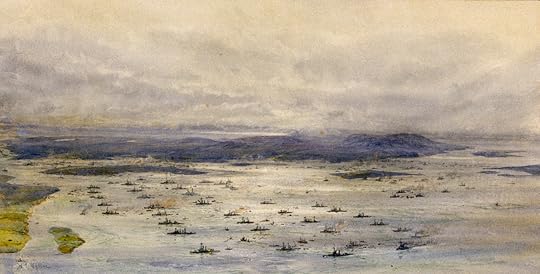
'The Grand Fleet in Scapa Flow'. National Maritime Museum, Greenwich, London, Caird Collection
My dead pixels version was 416-pages. It had a UK 2014 copyright. This book includes Footnotes, Notes and “sources" (bibliography, et al.).
Norman Friedman is an American author, analyst, strategist, and historian. He has written and co-authored more than 30-books on naval and other military matters. The last book I read by him was Submarine Design And Development .
This book is an advanced work. It’s strongly recommended having a background in: late 19th to early 20th century maritime history, world naval history, and the military history of World War I before reading this book. Familiarity with period naval tactics and doctrine would be helpful. In addition, some parts of this book are quiet technical. An understanding of engineering, naval engineering and maritime concepts would be helpful.
TL;DR
Fighting the Great War at Sea: Strategy, Tactics and Technology is an important adjunct read for someone with both a strong background and a keen interest in the history of the Great War at sea, specifically from the perspective of the Royal Navy and the Kaiserliche Marine (Imperial German Navy). A navy is made-up of Men, Machines, Organizations, and Military Doctrine. In great detail this book goes through the technology, the evolution of naval doctrine and to a lesser extent the organizational behavior of the navies in conflict. Note this book contains no blow-by-blow description of any battle, other than to point-out the: doctrinal, organizational, or technological reason for victory or defeat. Having read this book, I received no great revelations on the history of WWI “at sea”. However, it gave me a deeper understanding of the naval battlespace at the beginning of the 20th Century.
The Review
In general, the book was well edited. Its prose was good. Although, I did find some replication of prose. It was technically dense. For example, Ship's Systems and Controls are discussed in detail. Likewise, period naval tactics, techniques and procedures were discussed in detail. In addition, the high-level strategy of the powers and the geography of the Atlantic theater’s naval conflict and their affect was discussed. The presentation was very even throughout in its high level-of-detail, although not every aspect of naval operations was discussed. In general, information was conveyed in a clear and unambiguous fashion.
Note, I read this in e-Book format with connection to the internet. There was a great advantage in being able to search both the book and the internet for supporting information.
Use of maps was non-existent. A familiarity with the Atlantic theater was assumed. An Atlas should be kept on-hand to reference geographical features particularly in the North Sea.
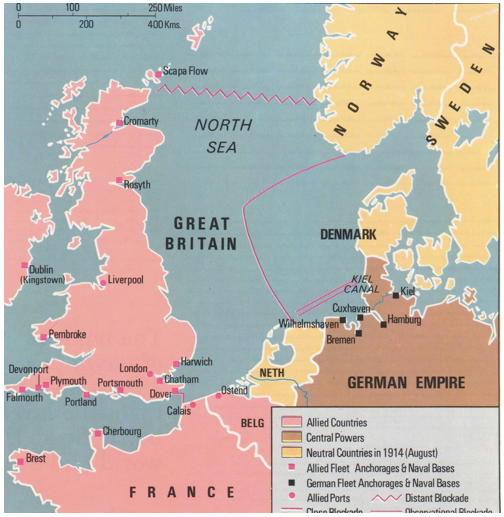
Reference Map North Sea I used. Note, not shown are Zeebruge and Ostend, in occupied Belgium, which were operating bases for German submarines, destroyers, minelayers and torpedo boats.
Use of diagrams was non-existent. Line diagrams would have been greatly appreciated, although their need was substantially offset by a very large number of photographs. There almost appeared to be a period photo of every hull mentioned in the narrative. I spent several hours poring over and manipulating the digital pictures included in my version of the book.
Chart and graph usage was non-existent. Their usage would have benefited the reader, in particular given the technical nature of much of the narrative. At several points, I wished the author had read, Tufte’s The Visual Display of Quantitative Information
Friedman wrote this book to describe the British and Imperial German navy organization, the fleets and their supporting infrastructure (bases, floating docks, etc.), technology of the fleet’s construction (ships and ship’s systems), strategies and tactics employed by both sides. To a large extent, he was successful. Fleet strategy and their component capital ships and their specification, construction, technologies and tactics (the line of battle) were well laid out. Also, the invention of the aircraft carrier, the early usage of aircraft, and Zeppelins both for reconnaissance and offensive operations was covered. In particular, this book provides an astounding amount of technical detail on the British Naval Blockade of the Central Powers. In particular there are important details on: submarines and submarine warfare, mining and anti-mine warfare, period anti-submarine warfare, and the light vessel surface warfare that prevailed in the latter half of the war.
Friedman only occasionally used historical military and diplomatic events in the descriptions of the success or failure of naval: doctrine, organization, or technology.
However, for the general reader this book will be difficult.
There was very little context of the General History of the war provided. The reader was expected in already be familiar with Admiral of the Fleet Jellicoe, Admiral of the Fleet Fisher, Großadmiral von Tirpitz, and Admiral von Hipper, the importance of The Dogger Bank and the Thames Estuary, as well as a military history of the war, and the general state of technology in the early 20th Century.
Even naval professionals, and close students of the war may have some difficulty.
Firstly, there is a noticeable weighting of the narrative toward the British. Although the imbalance is not extreme. There are also some highly technical discussions on period technology. For example, period Signals Intelligence, radio networks, including the period radio transceiver technology and antenna design, as well as ship’s systems which have evolved out of modern usage, such as torpedo blisters. Another issue, was that The Great War was a World War. Friedman tightly restricts his narrative to the conflict between the Grand Fleet and the Hochseeflotte (High Seas Fleet) and their subordinate and dependent formations in the seas around northern Europe (properly The Atlantic Theatre). Subordinate and dependent formations include the blockade squadrons, aircraft squadrons, U-boat flotillas, etc. Actions in other seas and riverine actions are only rarely mentioned. I write this fully understanding that (for Germany) the war was lost on the Western Front (which included the Atlantic Theater). Friedman also 'picks his battles'. Actually, his topics. For example, the author is an expert on submarines. That discussion is extremely through. Not everything comes under the microscope. I would have liked to have seen a more in-depth compare and contrast in the usage of compartmentalization in German vs. British hull designs. (The German hulls were more robust.) An annoyance to me, was that occasionally, Friedman would break the historian’s Fifth Wall and relate an innovation (tactic or technology) in a more modern context like, The Cold War.
This book was a story of: men, machines and organizations in contention. Its focus was on the conflict between the Royal Navy, and to a lesser extent the American Navy and the Imperial German Navy in the Atlantic Theatre during a period of rapid innovation. Neither fleet fought the war they prepared for. (Their capital ships were to become an enormous sunk cost to both navies.) If anything, it describes the naval conflict becoming 3-dimensional, with sub-surface, surface and above surface dimensions. Each fleet was under a different set of constraints. This forced them to innovate both technologically and tactically in different ways during the scant 4-years of the conflict. At about 400-pages of narrative, this was still a slim work considering its scope. To a certain extent, the book is worth reading, for the ship pictures and their descriptions. I personally would have wished the author had invested more effort in Data Visualization given the quantitative nature of much of the narrative. However, I came away happy with the content of the book. It addressed several known unknowns and quite a few unknown unknowns. It’s a worthwhile read for someone who already has a background in 20th Century military and diplomatic history, particularly naval military history and won’t bored with the discussion of the superiority of German diesel power plants used in U-boats.
Readers of this book may also be interested in: A Naval History of World War I by Paul G. Halpern, Castles of Steel by Robert K. Massie and The Rise and Fall of British Naval Mastery by Paul Kennedy.
'The Grand Fleet in Scapa Flow'. National Maritime Museum, Greenwich, London, Caird Collection
My dead pixels version was 416-pages. It had a UK 2014 copyright. This book includes Footnotes, Notes and “sources" (bibliography, et al.).
Norman Friedman is an American author, analyst, strategist, and historian. He has written and co-authored more than 30-books on naval and other military matters. The last book I read by him was Submarine Design And Development .
This book is an advanced work. It’s strongly recommended having a background in: late 19th to early 20th century maritime history, world naval history, and the military history of World War I before reading this book. Familiarity with period naval tactics and doctrine would be helpful. In addition, some parts of this book are quiet technical. An understanding of engineering, naval engineering and maritime concepts would be helpful.
TL;DR
Fighting the Great War at Sea: Strategy, Tactics and Technology is an important adjunct read for someone with both a strong background and a keen interest in the history of the Great War at sea, specifically from the perspective of the Royal Navy and the Kaiserliche Marine (Imperial German Navy). A navy is made-up of Men, Machines, Organizations, and Military Doctrine. In great detail this book goes through the technology, the evolution of naval doctrine and to a lesser extent the organizational behavior of the navies in conflict. Note this book contains no blow-by-blow description of any battle, other than to point-out the: doctrinal, organizational, or technological reason for victory or defeat. Having read this book, I received no great revelations on the history of WWI “at sea”. However, it gave me a deeper understanding of the naval battlespace at the beginning of the 20th Century.
The Review
In general, the book was well edited. Its prose was good. Although, I did find some replication of prose. It was technically dense. For example, Ship's Systems and Controls are discussed in detail. Likewise, period naval tactics, techniques and procedures were discussed in detail. In addition, the high-level strategy of the powers and the geography of the Atlantic theater’s naval conflict and their affect was discussed. The presentation was very even throughout in its high level-of-detail, although not every aspect of naval operations was discussed. In general, information was conveyed in a clear and unambiguous fashion.
Note, I read this in e-Book format with connection to the internet. There was a great advantage in being able to search both the book and the internet for supporting information.
Use of maps was non-existent. A familiarity with the Atlantic theater was assumed. An Atlas should be kept on-hand to reference geographical features particularly in the North Sea.
Reference Map North Sea I used. Note, not shown are Zeebruge and Ostend, in occupied Belgium, which were operating bases for German submarines, destroyers, minelayers and torpedo boats.
Use of diagrams was non-existent. Line diagrams would have been greatly appreciated, although their need was substantially offset by a very large number of photographs. There almost appeared to be a period photo of every hull mentioned in the narrative. I spent several hours poring over and manipulating the digital pictures included in my version of the book.
Chart and graph usage was non-existent. Their usage would have benefited the reader, in particular given the technical nature of much of the narrative. At several points, I wished the author had read, Tufte’s The Visual Display of Quantitative Information
Friedman wrote this book to describe the British and Imperial German navy organization, the fleets and their supporting infrastructure (bases, floating docks, etc.), technology of the fleet’s construction (ships and ship’s systems), strategies and tactics employed by both sides. To a large extent, he was successful. Fleet strategy and their component capital ships and their specification, construction, technologies and tactics (the line of battle) were well laid out. Also, the invention of the aircraft carrier, the early usage of aircraft, and Zeppelins both for reconnaissance and offensive operations was covered. In particular, this book provides an astounding amount of technical detail on the British Naval Blockade of the Central Powers. In particular there are important details on: submarines and submarine warfare, mining and anti-mine warfare, period anti-submarine warfare, and the light vessel surface warfare that prevailed in the latter half of the war.
Friedman only occasionally used historical military and diplomatic events in the descriptions of the success or failure of naval: doctrine, organization, or technology.
"There seems to be something wrong with our bloody ships today" – Admiral of the Fleet Beatty RN, at the Battle of Jutland.
However, for the general reader this book will be difficult.
There was very little context of the General History of the war provided. The reader was expected in already be familiar with Admiral of the Fleet Jellicoe, Admiral of the Fleet Fisher, Großadmiral von Tirpitz, and Admiral von Hipper, the importance of The Dogger Bank and the Thames Estuary, as well as a military history of the war, and the general state of technology in the early 20th Century.
Even naval professionals, and close students of the war may have some difficulty.
Firstly, there is a noticeable weighting of the narrative toward the British. Although the imbalance is not extreme. There are also some highly technical discussions on period technology. For example, period Signals Intelligence, radio networks, including the period radio transceiver technology and antenna design, as well as ship’s systems which have evolved out of modern usage, such as torpedo blisters. Another issue, was that The Great War was a World War. Friedman tightly restricts his narrative to the conflict between the Grand Fleet and the Hochseeflotte (High Seas Fleet) and their subordinate and dependent formations in the seas around northern Europe (properly The Atlantic Theatre). Subordinate and dependent formations include the blockade squadrons, aircraft squadrons, U-boat flotillas, etc. Actions in other seas and riverine actions are only rarely mentioned. I write this fully understanding that (for Germany) the war was lost on the Western Front (which included the Atlantic Theater). Friedman also 'picks his battles'. Actually, his topics. For example, the author is an expert on submarines. That discussion is extremely through. Not everything comes under the microscope. I would have liked to have seen a more in-depth compare and contrast in the usage of compartmentalization in German vs. British hull designs. (The German hulls were more robust.) An annoyance to me, was that occasionally, Friedman would break the historian’s Fifth Wall and relate an innovation (tactic or technology) in a more modern context like, The Cold War.
This book was a story of: men, machines and organizations in contention. Its focus was on the conflict between the Royal Navy, and to a lesser extent the American Navy and the Imperial German Navy in the Atlantic Theatre during a period of rapid innovation. Neither fleet fought the war they prepared for. (Their capital ships were to become an enormous sunk cost to both navies.) If anything, it describes the naval conflict becoming 3-dimensional, with sub-surface, surface and above surface dimensions. Each fleet was under a different set of constraints. This forced them to innovate both technologically and tactically in different ways during the scant 4-years of the conflict. At about 400-pages of narrative, this was still a slim work considering its scope. To a certain extent, the book is worth reading, for the ship pictures and their descriptions. I personally would have wished the author had invested more effort in Data Visualization given the quantitative nature of much of the narrative. However, I came away happy with the content of the book. It addressed several known unknowns and quite a few unknown unknowns. It’s a worthwhile read for someone who already has a background in 20th Century military and diplomatic history, particularly naval military history and won’t bored with the discussion of the superiority of German diesel power plants used in U-boats.
Readers of this book may also be interested in: A Naval History of World War I by Paul G. Halpern, Castles of Steel by Robert K. Massie and The Rise and Fall of British Naval Mastery by Paul Kennedy.
July 3, 2019
Hands down one of my favorite books on the Naval War during the First World War. Very technical and in-depth. Friedman proposed some interesting arguments, especially in regards to Gallipoli, and I disagree with him a bit in his final conclusion when he makes some shortsighted comments about the war on land. Alas, nothing is ever pefect.
But, that is a minor complaint and doesn't take up nearly any time in this book.
To say I'm thrilled with this book would be an understatement. If you like technical naval history, this is for you. It's Friedman at his best.
But, that is a minor complaint and doesn't take up nearly any time in this book.
To say I'm thrilled with this book would be an understatement. If you like technical naval history, this is for you. It's Friedman at his best.

November 20, 2021
This is a behemoth of a book. 400 or so very big pages. There are plenty of photos and that helps to break up the text and for one to visualise what is being discussed.
This book concentrates upon the British experience, mostly that in the North Sea and especially topics other than capital ship actions. Hence, German operations in the Baltic, commerce raiders, Black Sea kerfuffles, French and Italian actions in the Med, only get a mention when they impact upon what is occurring in the North Sea. Whilst battleships and battlecruisers are mentioned, as is Jutland, you come away with the strong opinion that Friedman is deliberately avoiding making them the centre piece of this work.
That's no bad thing, either. Most people interested in this area could probably outline the events of May 31st 1916, list the particulars of the capital ships and so a book that deals with other areas is more than welcome. Unlike Castles of Steel by Massie, the interface of high politics and naval questions isn't at the heart of this book. Instead, it is the small ship operations. Anti-submarine warfare, trade protection, mining and economic warfare.
It's a very interesting, if long read. Just holding the book up will help anyone develop their upper arm muscles.
This book concentrates upon the British experience, mostly that in the North Sea and especially topics other than capital ship actions. Hence, German operations in the Baltic, commerce raiders, Black Sea kerfuffles, French and Italian actions in the Med, only get a mention when they impact upon what is occurring in the North Sea. Whilst battleships and battlecruisers are mentioned, as is Jutland, you come away with the strong opinion that Friedman is deliberately avoiding making them the centre piece of this work.
That's no bad thing, either. Most people interested in this area could probably outline the events of May 31st 1916, list the particulars of the capital ships and so a book that deals with other areas is more than welcome. Unlike Castles of Steel by Massie, the interface of high politics and naval questions isn't at the heart of this book. Instead, it is the small ship operations. Anti-submarine warfare, trade protection, mining and economic warfare.
It's a very interesting, if long read. Just holding the book up will help anyone develop their upper arm muscles.

August 23, 2017
A great book covering all aspects of Naval Warfare in WW1, with Friedman's usual detailed, understandable analysis. Easily the best book I've read this year. Emphasizing his usual foundations of Naval Warfare (networks, command & control, and attrition), Friedman has three themed areas interspersed through the book: fleet battles, amphibious operations, and submarine warfare. The amount of detailed data Friedman presents is commendable, presenting a conflict far different from the North Sea stalemate and Gallipoli disaster which tend to dominate this topic. He lays out a direct line of evolution of WW1 technical and tactical developments through WW2 and the Cold War, all the way to the present. He presents a unique argument that WW1 was a maritime conflict, but that this fact was not realized at the time; ending the book with a comparison with WW2 which supports this theory. The lessons for today are deep and relevant. Highly recommended for anyone interested in the strategic to tactical domains of Naval Warfare; especially useful as a complement to The Rules of the Game.

June 3, 2020
An excellent book about the technological and strategic considerations of the First World War at sea. It's very important to note that this book is NOT a narrative, so it does not read "like a story." If you want to read a great narrative of the naval rivalry between Great Britain and Germany during this period, I suggest "Castles of Steel" by Robert K. Massie.
Friedman's book delves into the various naval technologies available to, and developed by, the various naval powers in the First World War and how these affected the strategies and outcomes of the war. A great book for serious students, but perhaps a bit dry for someone looking for a good naval yarn.
Friedman's book delves into the various naval technologies available to, and developed by, the various naval powers in the First World War and how these affected the strategies and outcomes of the war. A great book for serious students, but perhaps a bit dry for someone looking for a good naval yarn.
April 24, 2021
As others have noted, this is a dense, fact-filled book. The level of detail is simply stunning. Want to understand every model of mine used by the Royal Navy? It’s in there. How about the development and deployment of hydrophones, successful and unsuccessful? Got that too. I appreciated the explanations of how the technology drove (and limited) tactics. The discussion of how early radio was utilized was new to me and very interesting. Overall, a great book. Just one warning: assumes some knowledge of the period and definitely not narrative history.

November 3, 2024
Friedman details the technology and tactics of Great Britain and Germany.
Why I started this book: I knew very little about the sea battles and strategies of the First World War.
Why I finished it: The structure of this book lead to repetition and consequently I didn’t pay close attention which also lead to my confusion. Very long and detailed, and I will look for another book on the subject. I definitely got lost in the forest because Friedman spent so much time explaining each tree. Interesting about the troubles when the Army and Navy aren’t working together.
Why I started this book: I knew very little about the sea battles and strategies of the First World War.
Why I finished it: The structure of this book lead to repetition and consequently I didn’t pay close attention which also lead to my confusion. Very long and detailed, and I will look for another book on the subject. I definitely got lost in the forest because Friedman spent so much time explaining each tree. Interesting about the troubles when the Army and Navy aren’t working together.

June 30, 2020
Highly Technical
Although the book was not what I expected, it is a great resource and I will consult it during other readings regarding this topic.
The book is very technical and not much of a narrative. Photo captions and notes are fantastically researched, but takes considerable processing time.
It took me a long time to finish reading the book. I did learn a great deal about The Great War naval technologies.
Although the book was not what I expected, it is a great resource and I will consult it during other readings regarding this topic.
The book is very technical and not much of a narrative. Photo captions and notes are fantastically researched, but takes considerable processing time.
It took me a long time to finish reading the book. I did learn a great deal about The Great War naval technologies.

January 30, 2020
In the middle of research on Sir John Fisher and his battlecruiser, I found the OED of WWI naval information in this truly discursive source. It belong on the selves of any 20th Century Naval Historian. Superbly illustrated, as well!!!
March 14, 2021
I read a lot of Friedman. This was interesting but somewhat rambling and often repeated itself. I was never quite sure what the overall aim of the book actually was. There are many great nuggets in there, but not his most focussed work. Obviously comes with a ton of great photos.

May 6, 2019
Many interting ideas and observations. Thorough to the point of tedium.

April 24, 2015
What an absolute beast of a book. Had a massive impact on my understanding of both the development of naval technology and the course of world war 1. Dense as hell though and takes a long time to chew through.
Displaying 1 - 12 of 12 reviews