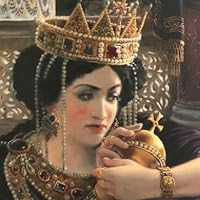
This book tells the remarkable life of Balthild of Francia (c. 633-80), a seventh-century Anglo-Saxon slave who became a queen of France. Described in contemporary sources as beautiful and intelligent, she rose to power though her marriage to the short-lived King Clovis II. As regent for her young son, she promoted social and political reforms in Francia that included the rescue and rehousing of Christian slaves who, like Balthild herself, had been caught up in the human-trafficking practices of the mid-seventh century.
Implicated in the violent politics of the era, Balthild spent the remainder of her life in the convent of Chelles where a unique cache of surviving relics and personal items, including her hair, were protected and dispersed as relics over the following centuries. In the nineteenth century, Balthild's anti-slave trade policies were recalled for new audiences when she was adopted as an icon for the cause of the abolition of the slave trade and installed as one of the twenty illustrious women whose statues are situated in the Luxembourg Gardens in Paris.
Although critical to her age, because of the remote time period and the specialized nature of the sources, Balthild is little known today. This book will correct this oversight by shining a light on a fascinating and courageous figure whose legacy long outlived the era to which she belonged.
I knew the basis of Balthild's life and I have seen her statue in the Jardin du Luxembourg (so great to see all these depictions of queens). So I was glad to learn more about her. Especially since she was truly an exceptional figure, of the likes of Empress Theodora. A slave who became regent and enacted anti-slavery policies.
I appreciated the way the author fleshed out Balthild's world and highlighted her reception and impact. I got a clear view of her career and contributions. That's a very important work since Balthild deserves more attention.
However, this was a mixed bag. There were many repetitions. Like, I understand that there aren't many available sources and that the author was trying to hit the word count, but this was just clumsy and redundant. Yes, Balthild had strawberry gold hair, I know, that's probably the third time I'm reading about it.
Some assessments lacked nuances. For instance, she depicts Radegund as a recluse monastic while it wasn't exactly true, she was still a political character. And then, she tells us that Radegund used her contacts with the Eastern Roman Empire to obtain a fragment of the True Cross. So which is it?
Some statements were also clumsy or downright insensitive. One was particularly gross: "slave work often included sex work." Sorry??? We aren't talking of "work" here, but of abuse. Slaves were often abused because they weren't a position to refuse or consent. Apparently, the author struggled with naming things for what they are, so let me do it instead: it's called rape.