Jump to ratings and reviews
Rate this book

A Green and Ancient Light

Rate this book
A gorgeous fantasy in the spirit of Pan’s Labyrinth and John Connolly’s The Book of Lost Things.

Set in a world similar to our own, during a war that parallels World War II, A Green and Ancient Light is the stunning story of a boy who is sent to stay with his grandmother for the summer in a serene fishing village. Their tranquility is shattered by the crash of a bullet-riddled enemy plane, the arrival of grandmother’s friend Mr. Girandole—a man who knows the true story of Cinderella’­s slipper—and the discovery of a riddle in the sacred grove of ruins behind grandmother’s house. In a sumptuous idyllic setting and overshadowed by the threat of war, four unlikely allies learn the values of courage and sacrifice.

1 pages, Audio CD

First published June 7, 2016

81 people are currently reading
5130 people want to read

About the author

Frederic S. Durbin

17 books122 followers

Ratings & Reviews

What do you think?
Rate this book

Friends & Following

Create a free account to discover what your friends think of this book!

Community Reviews

5 stars
624 (36%)
4 stars
698 (40%)
3 stars
307 (17%)
2 stars
62 (3%)
1 star
19 (1%)
Displaying 1 - 30 of 346 reviews
Profile Image for Philip.
574 reviews846 followers
February 8, 2017
4.5ish stars.

A sweet, beautifully-written, wistful book with the heart and charm of a classic that's emotionally and intellectually accessible for people of all ages. There are the obvious comparisons to books like Narnia (kid is shipped off to the house of a relative he doesn't know during wartime where he finds magic in an unexpected place), The Last Unicorn and The Secret Garden (and more than just because there's an actual secret garden) because this book exquisitely captures the innocence and wonder of childhood as well as the wisdom and melancholy that comes with aging.

I'll be honest, there aren't any genre-changing revelations here or edge-of-your-seat thrills, but the purpose of this book was not to make a big statement. I think the purpose of this book was to illustrate and encapsulate the magic and discovery of youth. In that, Durbin absolutely fulfills every wish anyone could have going into this experience. While upon initially finishing the book it might have seemed light and fun and somewhat insubstantial, further rumination on the themes, relationships and final outcomes revealed that A Green and Ancient Light has its own emotional heft.

I'll further be honest and confess that there isn't a ton of magic present in the traditional sense. It took nearly half the book for me to fall under its spell because I was waiting for more fantasy elements to present themselves. By the end I found that I couldn't complain. My experience in the sacred grove felt complete and satisfying and I was grateful for every fantastical morsel I was given.

It's been a long time since I've known characters as real and complete and easy to love as the four friends at the heart of this novel. I was emotionally invested in my relationships with these people. How impressive it is for an author to be able to give a perfectly believable voice to a nine-year-old boy and an equally believable voice to his grandmother (what an incredible woman!)

I hope everyone takes the chance to read this because it deserves all the exposure and recognition it can get. I hope you fall in love with it the same way I did. :)
Profile Image for John Mauro.
Author 7 books983 followers
November 17, 2023
Part of my Review Roundup on Before We Go Blog.

Reading A Green and Ancient Light feels like watching Pan's Labyrinth but with all the darkest scenes removed. The setup for A Green and Ancient Light is essentially the same: a child narrates a fairytale-like story with mythical creatures against the backdrop of a World War II-type setting.

Frederic S. Durbin captures the same sense of childlike awe as in Pan's Labyrinth, but with the darkness knob turned down several levels. The story starts and finishes very strong, but the middle part of the book left me craving the much weirder, darker world of Guillermo del Toro.

3.5 stars, rounded up because of the strong ending.
Profile Image for Donna.
544 reviews234 followers
December 5, 2016
This is an unusual book in that it blends a realistic coming of age story with fantasy and a dash of historical fiction. Though I'm not sure if it could be considered historical fiction as much as a universal story from the past about life during wartime as seen through the eyes of an unnamed nine year old boy. I can't tell you his name or the names of any characters in this book except for one of them since everyone is only referred to by their initials. That's because the boy, acting as narrator, and now an adult, wanted his childhood story to be any child's story, conceivably about any child living in any country at any particular time in history. That way, anyone reading this account who had experienced similar circumstances in which their life had suddenly been turned upside down by war, could pretend it was written about him or her. What an unusual concept to build this book around. And just as unusual is much of the story's setting and the special friend of the boy's grandmother, Mr. Girandole.

The young boy came to live with his grandmother for the span of one spring and one summer when he was nine. He didn't really know his grandmother since he had been living far away in the city with his parents and now with his newborn sister. But as the war hit closer to home and cities were being bombed, his father, who was serving in the army, sent him to live with the boy's grandmother where it was supposedly safer in the countryside, the mom remaining behind in the city to continue working at her new job and caring for the baby. But when a bullet-ridden enemy plane flies low over the grandmother's little fishing village and then crashes into the sea, the boy and the other residents aren't sure how safe it is there anymore, especially when there's evidence that the pilot survived the crash and might be among them.

The boy is soon drawn into this intrigue and drawn into a riddle posed by the gardens in the woods behind his grandmother's house. They are filled with monstrous and beautiful statues with cryptic inscriptions that might or might not solve an age old question. With help from his grandmother and her special friend, plus an unexpected source of aid, the boy is determined to learn the secrets of the garden during his time there.

What I enjoyed most about this book was the beautiful and detailed writing, and the wonderful characters and their relationships. The boy and his grandmother are virtual strangers at the beginning, bonded only by their love of the boy's father, the grandmother's son.

"It's a strange thing to spend your days with a person connected to you by the link of someone you hold dear, but the young one they knew is not quite the same as the older one you know. It's like talking to someone through a hedge. Now and then, you see an outline, the edge of a face between leaves. You can only walk along in search of a gate."

But day by day, through trial and error, the bond strengthens between the boy and his grandmother, independent of the father and shared bloodlines. Now, the two of them share secrets, along with their meals and a common purpose as their idyllic life along the seaside is slowly invaded by the heavy cares of the outside world and the war. But to convey this, the writing is always subtle and never sentimental to the author's credit. The characters' emotions are true and affecting, their relationships handled in a sensitive way.

"Grandmother looked up with her typical restrained smile--a smile that seemed to look beyond the reason for smiling to the next ache or nuisance or grief, and still farther behind that--a long telescope of foresight."

"I had reached a way-marker on the path to adulthood--the first dividing of my heart. To live in this world, I realized, is to leave pieces of your heart in various places; and to move toward any place is to move away from another."

Besides the wonderful writing and characters, I also enjoyed exploring with the boy the "garden of the monsters" in the woods inspired by the real life Garden of Bomarzo in Italy. Here's a link for anyone wanting to view some of the statues that inspired those in this book. If you care to, take a look at the Villa of Wonders, or skip over this link for now, so if you read the book, you can let your imagination color in the details instead:

http://www.bomarzo.net/index_en.html

So this was a wonderful book filled with mystery and humanity. My only complaints would be that at times I felt the blending of fantasy and realism was an uneasy alliance, and little happens for a while in the middle of the book. But it ended on a perfect note that wouldn't have been nearly as effective or affecting in less capable hands. This story works especially well as a young adult book for ages 12 and up, or a book for adults who don't mind a heavy dash of fantasy in their realistic fiction.

Favorite quote:
"There's pain and there's misery. We can't avoid pain, but misery is always a choice."
Profile Image for Celeste.
1,216 reviews2,547 followers
June 14, 2017
Full review now posted!
Original review can be found at Booknest.


Sometimes you stumble onto a book that is unexpectedly beautiful. That takes your breath. And that’s what I found in Durbin’s novel. It was just lovely. It was sweet and mellow and sad and hopeful. I would have never found it if it hadn’t been laying in wait for me on a shelf at my library. The title was mysterious and charming and I couldn’t walk away from it, even though I had more books to read than I’ll ever finish and this was a book by an author who was unheard of to me. I’m glad I couldn’t walk away, because I would’ve missed something magical.

There were no chapters in this book; just occasional extra spaces between paragraphs to serve as breaks. There were no names in this book. Just a nameless war, a nameless village, and nameless occupants of that village, referred to as Mrs. D—— or Major P——. This could have been anywhere, on either side of any large war after the invention of airplanes and before televisions were common in small, rural villages. Our main character could have been any nine-year-old boy visiting his grandmother for the first time.

“It is a strange thing to spend your days with a person connected to you only by the link of someone you both hold dear, but the young one they knew is not quite the same as the older one you know. It’s like talking to someone through a hedge. Now and then, you see an outline, the edge of a face between the leaves. You can only walk along in search of a gate.”

This spring and summer spent with our narrator’s grandmother in the little village by the sea rocked his world. He had been born and bred in a city, and he had no idea that life could be like this. With streets that wandered and meandered like lazy streams between open shop fronts and quaint house, with benches scattered about in an open invitation to sit and chat with neighbors around every corner. “There were no posted names, no numbers on doors or lanes.” Everyone simply knew where to find whoever they wanted to talk to. It was a slower, fuller life than our main character had ever experienced.

“After a few weeks in the village, our city began to feel like a distant dream. I knew it was real, that if I rode the train again, it would be there, and its bricks would become the reality once more, and this village would be the dream. One person, I’d come to understand, was actually many people—people of different ages, people who lived in different surroundings; these people had the same name and knew something of each other, but lived entirely separate lives.”

These were all things our protagonist learned before the main action of the story began. Before there was an enemy pilot in need of rescuing. Before he stumbled upon the grove of monsters, a garden of splendid statues and secrets. Before he met Mr. Girandole, the one and only character named in the book, who is his grandmother’s best friend and is more than human. The grove of monsters houses a riddle that, if solved, will unlock the door to Faery and Mr. Girandole’s way back home. But the garden is wild, and the riddle is muddled beneath vines and thorns and age. Does the riddle left behind by the vanishing duke even possess a solution?

The writing here was exquisite. When I first started reading, I was afraid that the lack of chapters and proper names would make reading the book tiresome, but that was never the case. The book unwound around its mystery as the grove of monsters did, beautifully and mysteriously and in its own time. Durbin did a phenomenal job of dropping just enough clues for the reader to understand pieces of the riddle just a few pages before his characters drew the same conclusions, letting readers feel as though they were making discoveries of their own.

This book walked the line between fantasy and magical realism, and I’m still not sure which of those genres it fits best. It reminded me of Gaiman’s The Ocean at the End of the Lane, and of what Beagle’s Summerlong could have been. I loved it, and am so glad I happened upon it. If you need something sweet and moving and filled with wonder, this is the book for you.
Profile Image for Carlos.
672 reviews304 followers
July 19, 2017
3 1/2 stars for this magical and cute story, this book is as simple as it gets , basically what we have here is a fairy tale for an adult population. We have a magical garden , a magical creature and legends that the forest is Haunted, sounds familiar? ... regardless what really redeemed this book was its idyllic setting, the author chose to present the forest in a way that you felt you were actually there, everything is left up to the imagination of the reader , no name of a country is mentioned , no character's name are mentioned so basically this story could had happened anywhere (which I guess was the aim of the author) . There is a moment of adventure in this book followed by a tender goodbye , it is a nice story, just lacked complexity which is not so bad if you want to fast read a book or you just looking for a fun read .
Profile Image for Jennifer.
550 reviews312 followers
September 18, 2020
Yes, there is a magic portal. No, you do not get to go through it. This is very much a book about living in the complex and compromised real world. Even a few fantastical elements - a faun, a garden of mysterious and grotesque statues - do not change the facts that wars suck, growing up is hard, and difficult choices are inevitable.

There is a war going on, unnamed but bearing close resemblance to WWII. The nameless nine-year-old narrator is sent away from the city to stay with his grandmother in the countryside. It is a fine place for a boy, with its friendly townspeople and an overgrown sculpture garden in the woods with inscriptions that almost, but do not quite, make sense. Then an enemy pilot crash-lands in the woods near the grove, his grandmother makes a decision to not leave an injured man to die, and some very old and rather painful secrets begin to come to light. Starting with her friend, who is a faun, and the statues, which may be a portal.

A Green and Ancient Light is really a story about a boy's last few weeks of true childhood and innocence that, viewed in retrospect by the nameless narrator, become all the more shimmery and bittersweet. The tone is convincingly that of a curious and likable nine-year-old, neither precious nor excessively adult, and the grove of grotesque and enigmatic statues is almost a character in itself (also apparently based on a real garden). The book moves at a stately pace in keeping with this somber and quiet story.

I got a bit impatient toward the latter third because a) the realization that I wasn't going to get to see what was through the portal had just started to sink in (wait, what??); and b) I thought the pace was going to pick up, and it didn't. My hypersensitive atheist nose also picked up a whiff of religion that I really didn't appreciate and yanked me out of the story. (Really, a reminder that 'God doesn't make mistakes' in a story about war, which is all about people dying pointlessly and horribly? Does it really make anyone feel better to think that a supposedly benevolent and supposedly omnipotent deity was presiding over something as horrible as war? But I digress.)

Most of it was enjoyable. If I remember nothing else about this book in a few years, I might remember the atmosphere: a small town and a forest of wonders, experienced through the eyes of childhood.
Profile Image for Dannielle Insalaco.
446 reviews17 followers
June 14, 2016
I think this is the best book I've read in 4 years! I'll never be able to do it justice with a review. it's like putting on a comfy sweater on a crisp fall day, walking in the woods and sitting on a log, stopping to eat a pb sandwich and then finding yourself in Narnia! I know!!! Right?? Then to find out that the garden in the book is based on an ACTUAL GARDEN! Trust me!! You'll love it!
Profile Image for Glory.
350 reviews55 followers
October 4, 2016
Страна - предположительно Англия. Годы - предположительно сороковые. Война - предположительно Вторая Мировая.
И рассказчик, не желающий называть ни свое имя, ни деревню, в которой он тогда отдыхал. Все, что мы знаем - в то время ему было девять, и он гостил у бабушки.

Эта история начинается с подбитого самолета, а заканчивается письмами. Или не заканчивается вовсе, потому что... ну как может закончиться магия?
Это магический реализм настолько кружевной и прекрасный, что даже жутко. Он не захватывает с первых строк. Может не захватить и с сотых. Но в какой-то момент ловишь себя на мысли, что уже заплутал в этом волшебной саду, в этой чаще монстров, полной каменных изваяний и загадок.

Итак, безымянный герой, безымянная деревня и множество ее жителей, о которых известны лишь инициалы. Миссис Д. Мистер Н. Даже бабушку свою герой нарек буквой. Лишь таинственный мистер Жирандоль удостоился полного имени, хотя по сути является самым мистическим персонажем. Он помнит все, он знает все - даже кем на самом деле была Золушка и почему туфелька подошла только ей. Именно он подталкивает героя в путешествие по неизведанному, он заставляет разгадывать загадки и узнавать этот мир.

Черт, о сюжете говорить бессмысленно. Это не самая сложна книга в мире. Вообще, она скорее атмосферная, чем сюжетно закрученная. Но пазл собирать придется. И взрослеть вместе с героем. И видеть, насколько прекрасен и ужасен наш мир. И тосковать о прошлом и о будущем.
Роман сравнивают с "Лабиринтом Фавна" (ну еще бы, война и магия), и что-то в этом сравнении есть, хотя эта история куда мягче. А еще по моим личным ощущением она скорее похожа на "Вино из одуванчиков" Брэдбери.

Прекрасный язык, яркая и живая картинка. И никакого деления на главы.
4.5 звезды
Простите за сумбур)
Profile Image for Rebecca.
Author 12 books28 followers
October 23, 2016
I wanted to like this book. The premise was fantastic -- a young boy is sent to live with his grandmother while his country is at war and, while there, discovers a gateway to the faerie world. This story has everything: strong characters--a tough-as-nails grandmother, a curious 9 year old boy, an injured enemy pilot, a faun named Mr. Girandole--beautiful writing, an intriguing setting, etc. but it was dull. The pacing of the story was agonizingly slow.

Something exciting would happen--the discovery of the garden of stone statues in the woods--and the action would grind to a halt while the kid and grandma took a 20 page journey on a ferry just to dump the enemy soldier's gun. I found myself thinking 'I'm bored' on every page.

It was sad to see poor execution of such a good idea.

Not recommended.

Profile Image for Anya.
763 reviews181 followers
May 5, 2016
Absolutely beautiful. I can't do this book justice, but I highly recommend it. It is slower paced but with beautiful writing and imagery. It had me sobbing while smiling and wanting to turn back to the first page.
Profile Image for Denise.
381 reviews41 followers
October 4, 2016
3.75- maybe I should round it up. A sweet slowly paced story of magic statues and a young boy's summer in the country with his grandmother during WWII.
Profile Image for Gabe Dybing.
1 review1 follower
June 16, 2016
I had the good fortune to read this book twice: first, years ago, in manuscript and now in its perfect form as published novel. I don't use the term “perfect” lightly. This book is perfect.

There are few books to which I eagerly return again and again. They are classics from my youth, or works that remind me of these classics: Tolkien's and C.S. Lewis’s books, of course; “The Adventures of Tom Sawyer”; Natalie Babbit's “Tuck Everlasting”; “The Once and Future King”. Books discovered outside of my youth would be William Hope Hodgson’s works, Hope Mirrlees’s “Lud-in-the-Mist”, H.P. Lovecraft’s and Robert E. Howard’s tales.

Fred’s latest book is shelved with these.

It does feel a bit weird to be friends with someone who now has written one of my classics, though it can't be much different than how C.S. Lewis might have felt after reading “The Hobbit” or “The Lord of the Rings”. Fred’s book is a classic in that it not only is a deeply engrossing story but that it teaches wisdom. I have learned a lot this summer, with this book, and through my friend. And I expect I will learn even more through the years, as I age, as I reread.

This is not lightly worded. Just like the grove of monsters -- a mysterious, overgrown garden whose brushes and brambles occlude many an awe-inspiring statue -- this book hides elements of wisdom, reflections and observations about much of life's experiences. You might have to look for them. More often they seem to jump right out of the thickets at you, surprising and astounding, while you only were making your way, drawing aside vines and foliage while you were trying to find a path through the brake.

One of these surprises is the nature of Faery (Fred’s spelling) itself. In my forty-some years of reading, I have become a scholar of the faery in literature. I would expect that I had no more to learn, and yet Fred taught me more.

A strength of this book is that the magic is kept right on the marge of faery land. To stay too long in that magical realm--or to start one's crossing at noon rather than at the right twilight time--is dangerous. Because Fred mutes these elements, the magic conversely becomes all the more real. Because Faery IS real. It's in aspects of the natural world all around us, and if anyone fully goes to the other land, as in this book, that person doesn't come back. Anyone claiming to do so and describing more than just glimpses and rumors is telling stories.

I have seen that some readers have been put off by the redacted names in this book--a device not all that uncommon in eighteenth century literature but perhaps alienating for the modern reader. Many reviewers have recognized the benefit of this feature: that Fred's story, though real, is universal in its experience, mythic in its scope. Fred's refusal to specify time and place and people makes it a story for all of us. For indeed, as he says, there is no us and them, no enemy and ally, in the sacred wood.

And yet the clues are there! If a reader truly wants to, why not speculate on the when and where and who of it all? This book contains a puzzle and there are clues for its solution. Similarly, in true literary tradition, the book itself might be read as a puzzle. This is the definition of the literary concept of form equals function. Besides, all names, all letters, are mere signifiers anyway. Is it really all that different or difficult to identify a character through R---- rather than, say, Roderico?

Fred's latest work is a literary masterpiece and, in my library at least, permanently categorized in the mythopoeic canon. Read it.
Profile Image for ambyr.
1,073 reviews100 followers
March 8, 2017
Sort of like a kinder, happier version of Pan's Labyrinth. I enjoyed the puzzle and the descriptions of the woods, and I loved the Grandmother character and Durbin's willingness to give her an active role in the story. Books with child protagonists often seem to feel compelled to get the adults out of the story to give the children more space; this does a great job demonstrating that intergenerational adventures are possible, and gives space for both child and adult to shine.

Durbin's decision to leave everyone and everything nameless, though, gave the place and characters a sense of vagueness that made it hard for me to connect emotionally. Also,
Profile Image for Jamie Dacyczyn.
1,927 reviews114 followers
July 29, 2019
I'll give this one 3.5 stars. It felt like a more vague, less exciting version of "Pan's Labyrinth". The two stories are very similar: a young child during WWII in Spain/Italy comes across some ancient stone wonders in the woods, and then befriends a faun.

In this tale, the main character is a nine-year old boy. We don't learn his name or anyone else's name because apparently the author wanted this story to be one that anyone could have experienced? Or something? Anyway, the boy is sent to live with his grandmother at a seaside village which happens to border some woods. These woods hold spooky statues of mystical creatures and characters from mythology. They also happen to have some words carved on them, like a riddle. Apparently these statues were commissioned by a duke about four hundred years before, for some mysterious reason.

Solving the riddles on the statues are one part of the plot, and the other part is that an enemy plane crashed into the sea nearby, and the pilot apparently parachuted down into the woods. The faun leads the boy and his grandmother to where the pilot landed, and they rescued and hid him so that the local army wouldn't find him. So, there's that.

Overall....I guess I liked this book, but I wasn't wowed by it. Not very much happens in a lot of it except the boy and his grandmother trying to puzzle out the meaning of the carved words, convinced that they'll lead to a door into the fairy world so that the faun can return to his kind. Aside from the faun, there's really no magical elements to this story. Still, the writing was lovely, and the description of the woods and the statues will probably stick with me for a while. I'm not sure if there was enough fantasy in here for me to ever revisit this book, but it was all right. I think this would have worked better as a middle reader book.
Profile Image for Will.
557 reviews21 followers
May 16, 2023
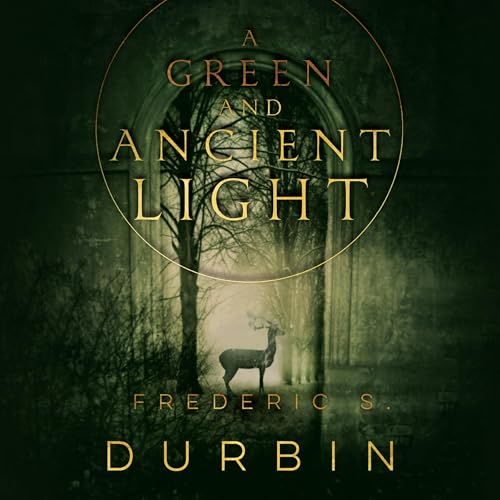
Sometimes you run across a book that defies expectations. When judging a book by its cover—which I do with some frequency, despite the old adage—you have to remember that the artist that designs the cover and the author that writes the book are very rarely the same person. So, when confronted by a cover that is the dark green of an old-growth forest, a smattering of trees and bushes that confirm this, a translucent gate that invokes thoughts of Tolkien, and a hind which is framed in a strange and haunting light: it is tempting to think that perhaps someone just read the title (in this case A Green and Ancient Light) and went from there, not bothering to read the actual story. In many such cases, despite my tendency to judge books by their covers, I find this to be true. In this case however, it is not.


A Green and Ancient Light
by Frederic S. Durbin

This book was haunting, a beautifully crafted piece that awakened in me thoughts of childhood, Tolkien, and dreams of a mysterious and fantastic world.
This is a book written by Frederic S. Durbin, an author whom I’ve never read anything else by, never seen referenced by any other author I’ve read, and well, never even heard of, really. Though it took a little to get acquainted with his writing style (at least, that which is featured in this novel, and which I’ll get more to later), this was a sublime read, with an imaginative plot and beautifully crafted prose. I’d compare it to the likes of The Boy With the Porcelain Blade by Den Patrick, and The Star-Touched Queen by Roshani Chokshi, which—while they suffered from multiple problems—were two of the most beautifully written books I’ve ever read. But A Green and Ancient Light (AGaAL) fails to cave beneath these same issues. Instead it excels, becoming (so far) my favorite read of the year.
While I said that this invokes Tolkien, it does so not for his writings, exactly, but instead for what I relate to him. My childhood was a bit dark, a bit lonely. But it was mine. And honestly, I liked it that way. Tolkien—more specifically, The Hobbit—taught me to dream of the fantastical and unknown. It is of this that I think when reading AGaAL.
The story follows a young boy living in Europe, just after the outbreak of the second World War. I won’t give away the country; Durbin doesn’t either, keeping everything about it secret until the… well, until after the end of the story, in his post-reading remarks (how he does this I’ll get to in a minute). In all intents and purposes, however, the country doesn’t matter. The story is not about the war at all, but about the people—the regular, common folk—and something else, something in the wood. Something that most have forgotten.
The boy travels from the city to a seaside village, to visit his Grandmother for the summer. His father is, of course, off fighting in the war. His mother remains at home in the city with his younger brother (?).
Now we get to the heart of my problem with this book—and, really, my only problem: the use of names. And it’s not what you think.
The novel just doesn’t use any.
Like, none.
Instead, in place of a person’s name, the narrator simply uses a ______. Like Mrs. B______ or Colonel D________ or Postmaster R_________.
This made it really hard for me to keep track of who was who, especially in the early going. I ended up just making up names to fill in each blank just so I could keep the characters straight. Don’t get me wrong—I have every idea why Durbin does this, and it is a good reason at that.
He does it to protect the country’s anonymity. Why does it matter so much? Well, depending on which nation this boy is from, the reader my find it difficult to keep from judging him, his father, his people. And Durbin doesn’t want this. To quote a passage from early on:

‘I won’t tell you my name or that of the village where I spent that spring and summer when I was nine. I won’t because you should realize there were towns just like it and boys just like me all around the sea—and in other countries beyond the mountains, and all over the world.’

And he’s right. It legitimately does not matter. I mean, I had my suspicions throughout the text. I even figured it out somewhere around halfway through. But this didn’t change anything. The boy is a boy. His father is his father. The people are still just people. Everything else, it doesn’t matter.
This book was sublime. From the cover, to the text, to the story, to the feelings it invoked in me. To the one thing I didn’t like. I read it once and then quickly read it again. And I’m unashamed to say I teared up both times.
If you enjoy fantasy, or even if you don’t really, this is a must read. I will say though, I have met people who didn’t care for this book. I don’t get why, but I’ll attempt to explain. My friend is really into Dark Fantasy; I suppose this wasn’t grim enough for her. My dad is weird; the reasons he likes or dislikes books no longer surprise me. So, yeah, I guess it is possible for you to not enjoy this. Hypothetically.
If you’re not sure just read an excerpt at the library or the bookstore or on a kindle. If you don’t hate it give it a try. If nothing else, it has one hell of a cover.

My Rating

5 / 5 stars , best of the year thus far. A must read for fans of Tolkien, Tad Williams, C. S. Lewis and any fans of a more classic fantasy style.
Profile Image for Hannah.
141 reviews
August 25, 2017
I picked up this book because I freakin' love Pan's Labyrinth. Both stories portray this ancient beautiful magic set against the horrors of war and loss. In the film this beauty and mystery are encapsulated by the old stone maze; in this book, it's a strange grove of stone monsters.

You can make a lot of comparisons and references with this story. Narnia, The Secret Garden, even The Boy in the Striped Pajamas (narrative speaking) etc. . .but for me this book just didn't live up to that potential. It has all the elements for a larger more terrifying journey: a sassy tough grandma, a kindly magical creature, a crazy riddle, and the interference of the army. I was particularity intrigued when the story of Cinderella is retold from a rather different point of view. However, the plot is rather straight forward and not much detracts our characters from succeeding in it. If I could trace my emotional scale on a graph it would be little more than a small hill. It is a beautifully well crafted story. The imagery of the stone garden is superb. The relationship between the boy and his grandma is really sweet. But there just wasn't any bang! for me. It needed more suspense, horror, surprises, something to punch it up. I would recommend it for its beauty and visual appeal, but the story was not my favorite.
Profile Image for Audrey.
1,367 reviews220 followers
October 8, 2017
This book captures the beauty and simplicity of childhood that can never be recaptured. The writing is lyrical and poetic. If that appeals to you, you’ll love it. If it sounds kind of boring, you’ll be bored. The plot here is very simple.

It’s sort of an alternate world, I guess. It feels like World War II. A boy is sent to his grandmother’s in the country for the summer. She lives near a forest with a grove of statues and nonsensical engravings that the boy thinks is a puzzle to solve. An enemy soldier is shot down over the forest, and that’s about it for the plot. The fantasy elements in the book are so sparse, I can’t even call it a fantasy.

All the characters and place names are given only an initial: The main character is G——, the neighbor is Mrs. F——, and so on. I believe this is to avoid giving away any nationalities, but it was annoying, and I made up names for everyone.

I noticed only one editing error.
Profile Image for Ruth.
1,438 reviews45 followers
July 10, 2016
This book is beautiful. The prose is luminous. It holds your attention and makes you linger over the words. It's a little bit Narnia, a little bit Gaiman, a little bit The Westing Game. It's about puzzles and family and war and the moments that you never get to experience again.

The story is a simple one. A young boy is sent to live with his grandmother during the war, while his father is off fighting and his mother is recovering from childbirth. An enemy pilot is shot down in the forests behind the grandmother's home. What do you do? Does it make a difference when a faun is involved, and the forest is the home for a garden of monsters and mystery and maybe magic?

I wasn't sure if I should shelve this as adult or young adult or middle-grade, because it's timeless. This is one of those books you'll go back to repeatedly, and get something different out of it each time you read it.
Profile Image for Emily.
74 reviews
May 4, 2016
Part historical fiction part fantasy. A 9-year old boy forges a charming relationship with his grandmother while staying in her village during the war (which war is never stated, but we can assume it's a World War). A garden of statues - some beautiful and some grotesque - in the mountains holds the key to the land of Fairy, and the two of them are determined to solve the puzzle. An atmospheric and bittersweet tale with a leisurely enough pace to fit gardening and naps in nicely between the action.
Profile Image for Mary.
1,779 reviews2 followers
August 1, 2016
Probably more like 3.7 stars.
What I loved best about this book was the setting of the mysterious overgrown sculpture garden out in the middle of the forest. I also enjoyed the relationship between the young boy and his grandmother and the quirky characters in the village. For me, the rest of the book was somewhat disappointing. I read it because of the comparison to Book of Lost Things, which is one of my favorite books ever - but it didn't live up to that measure.
Profile Image for Laura A. Grace.
1,961 reviews301 followers
March 12, 2017
Solid 3.5 stars

I have a lot of mixed feelings about this book. I enjoyed it for the most part, but I did find the book slow going in many parts until about halfway through. However, I found the monsters very intriguing as well as the “real” story of Cinderella. Talk about a different take on a classic story!

The mystery surrounding the monsters was extremely fascinating and was definitely my favorite part. It really had me intrigued as well as the soldier’s songs and kept me turning pages. The last quarter of the book really had me on the edge of my seat followed by almost crying. I didn’t expect certain events to unfold as they did, which left me feeling just as sad as the main character.

Overall, a good story that had a very intriguing mystery leaving you cheering for a young hero to solve it with the help of his grandmother and fellow friends.
Profile Image for David.
81 reviews1 follower
August 26, 2016
Despite the fantasy elements, I found this book extremely boring and stopped reading after about 80 pages. The book nothing more than one long chapter with only infrequent section breaks to break things up. It makes the book hard to read because there is no break. Another thing is the lack any specifics. Its clear that the story takes place in the English countryside during WWII, but nothing has any name. One particular point is the use of M------- instead of peoples names. Coming across these in the text really breaks the immersions. Phrases, like "How are you doing today, M-------" the grandmother clearly has a name so why don't you tell us?

Overall this book is a big disappointment. Fortunately, I got it from the library so it didn't cost me anything.
Profile Image for Narmeen.
500 reviews42 followers
January 19, 2021
"Ignorance multiplies itself better than yeast. If we could make bread out of rumors, no one in the world would go hungry."


It is quite obvious that this book is a by product of visual sorcery. The careful imagery depicted within the sentences in telling of this magical tale is immaculate. I found myself completely lost in the world and its characters. A heart warming-beautiful creation!

A Green and Ancient Light was a perfect combination of two of my favorite genres. A story set in the period of war, where magical realities help characters transcend from the gloomy tragedies of conflict to a life of tranquility.
Profile Image for Colleen.
119 reviews5 followers
May 7, 2019
3.5 stars
A little slow to start but really a lovely story of a young boy pulled from his family in London, beginning to know his grandmother and life in the country.
I would give it 4 stars but it didn't take long for the use of Mr. G_____ and Mrs. F_____ and Ctn. P______ ad nauseum to become annoying.
Profile Image for Sarah (thegirltheycalljones).
520 reviews302 followers
January 20, 2021
What an enchanting, bittersweet book. Bittersweet with an extra dose of bitter, methinks, and that's what made it a 4 stars book and not a direct 5, but let me a couple of days to digest everything and it may change for the better.
I have a weird relationship with some stories, like the animated movie Up, which let me in a miserable state (and not for the reason that made the world cry at the beginning of the movie) despite everybody else feeling great when getting out of the theatre. So don't mind my broodiness, I may only need some time to be entirely satisfied with the ending (I'm talking about the epilogue but I'm not sure it's labelled as "epilogue" in the book?).

Anyway, I really loved that book.
I'm usually not that receptive to books with unnamed places and characters (a decision to make it a common place, and an action that could take place anywhere), mainly because I find initials painful for the eyes and confusing when trying to remember who's who, but past the first few pages it wasn't a problem anymore.
The main characters are fleshed enough that you don't need a name to make them whole, and the other ones are fine but distant enough that it doesn't really matter anyway, as the real shiny star of this book is the stone garden.
Don't get me wrong, the boy, Grandmother, R and Mr Girandole - the brilliantly only named character, as he's the uncommon one - are wonderful characters that grew on me very fast, and that felt like family by the end of the book.
The writing is wonderful, and the ambiance of ancient and discreet magic, with what seems to be WWII as a not-so-distant background was artfully done.
But what hooks you and make your wandering go off course, and doesn't let you go, is the garden. This weird place, with its gigantic eerie stone statues and their obscure writings, the mystery - and solution - of their existence were, for me, breathtaking.
How many times did I dream about a place like this without even knowing it? I would have loved to wander in this garden, and would have probably never left.

The idea of it came to the author after hearing about Bomarzo's garden in Italy - a place my mother told me we visited many years ago but, ironically, I was too young to remember - which is indeed a spectacular place of wonder, and what he did by stealing this real place is brilliant. He gave it one of the stories it deserves.

You can't help but think about Narnia too, mostly for the best but also because there's a whiff of religion that was also very present in C.S. Lewis' books. I'm not overly fond of that, but I just rolled with it, as it wasn't too heavy nor patronizing.

I've read that some people were disappointed by the book being "not fantasy enough", and I totally understand, as it's totally not the right label for this book. I think "magical realism" or "fairytale-like" fits it much more and would be less misleading.

I want to hug this book like I used to hug my cuddly toy, and will hope that the state of yearning it abandoned me with will slowly fade, or maybe I'll hope it will never fade at all.
Profile Image for Lizzytish .
1,840 reviews
March 28, 2017
What an exquisite book! I do not generally give out 5 stars. I can't do a proper review and give it the justice it deserves. . So many others have stated it well.
It's about life as seen by a nine year old boy who is sent to live with his grandmother during war time. It encompasses love, grace, loss, fear, and courage.
There is a garden with statues that present a puzzle. The garden is based on one in Italy. Don't look at the website until after you read the book!
There is a wonderful faun you must meet.

One of the many things I got out of this book is the frailty of life and the marching of time. Make every moment count. The moment you just had, you will never have again.

I must own this book.

Some quotes: Ignorance multiplies itself better than yeast. If we could make bread out of rumors, no one in the world would go hungry.

To live in this world, I realized, is to leave pieces of your heart in various places; and to move toward any place is to move away from another.
Profile Image for dandelion.
289 reviews15 followers
June 5, 2017
One person, I'd come to understand, was actually many people--people of different ages, people who lived in different surroundings; these people all had the same name and knew something of each other, but they lived entirely separate lives.
Profile Image for Terzah.
574 reviews24 followers
October 11, 2016
A few weeks back I read the new Peter S. Beagle book and walked away disappointed. This book, on the other hand, was almost everything I am looking for when I pick up a fantasy grounded in the real world. Mystery, romance, danger, coming of age.....it's all here. And it's well-written too. It wasn't perfect--some of the characters were underdeveloped--but in this case that was a small flaw. It's motivated me to keep trying new fantasy authors.
Profile Image for Kelly.
616 reviews167 followers
August 19, 2019
3.5 stars.

A war is raging, and a young boy is sent to spend the summer with his grandmother in her small country village. His life changes forever when she decides to rescue a downed enemy pilot and nurse him back to health. While helping her tend to the injured man, the boy also meets Mr. Girandole, a faun, who was once his grandmother’s love and is still her dear friend.

She knows just the place to conceal the pilot while he convalesces: a crooked little tower in an overgrown sculpture garden in the woods. Throughout the summer, the boy explores the garden, which was built long ago by an eccentric Duke who lost his beloved wife. The garden is reputed to contain a riddle that, if answered, will open a door to Faery.

See more at Fantasy Literature.
Displaying 1 - 30 of 346 reviews

Can't find what you're looking for?

Get help and learn more about the design.