What do you think?
Rate this book


347 pages, Kindle Edition
First published June 3, 2025
“But why must a country be bombed before we care about it?”
“If I really focus, I can end the war.
In its beginning, while chanting “NATO! Close the skies!” at downtown Vancouver rallies, I knew how I’d end it: a solid iron shield would slide over Ukraine, protecting its people and land from Russia’s incessant bombardment.
But why cut Ukraine off from the sun?
No, I’d cover Russia. A sarcophagus built over the entirety of Russia, much like the one built over the radioactive remains of the Chernobyl disaster, so that Russians could stop wreaking havoc on neighboring countries. Let them figure themselves out, their mysterious bottomless souls, within their own borders.
Or, another way to end it: each missile shot from Russia would stop midair, spin around, pummel into its exact point of origin.”
“My first book? The irony is that it was also about Ukraine—about Soviet Ukraine, that long-gone Ukraine I’m more familiar with, since that’s the place I left—and for the book’s release I had written op-eds to be printed in newspapers, essays about growing up in Ukraine, the language politics, but they got canned when the pandemic hit. Now those same newspapers are calling me, asking me to write about Ukraine again, promising to actually publish this time, probably canning other writers’ pieces because now “my” cause is more important. I’m getting calls for magazine interviews, photo shoots, radio appearances I’d only dreamed of when my book first came out. I’m trying to be grateful. But why must a country be bombed before we care about it?”
Summarize in one sentence how you will ensure safe working conditions for yourself and others through proper Covid-19 safety protocol. This summary will be used in the CAF’s official reporting.
A quote from a Ukrainian MP: “One upside of this war is that we’ve finally vanquished Covid.”
Further describe how you will ensure safe working conditions for yourself and others through proper Covid-19 safety protocol.
As of the time of writing, Russian troops are withdrawing from Kyiv to focus their assault on the eastern region of Donbas, thereby rendering access to Covid-19 testing clinics possible again, if any remain. I pledge to adhere, with unwavering commitment, to any and all local Covid-19 prevention guidelines—in extraordinary instances where there are none, I will be only too pleased to observe CAF’s own—in addition to being inoculated with the latest and finest booster vaccine available. Should I find myself sheltering with members not of my household during an air raid, I will maintain the appropriate social distance of six feet and will actively assist those around me to do the same; no moment is inopportune for a little public health education. The possible malfunction or detonation of the Zaporizhzhia nuclear power plant, currently being occupied and shelled by Russians, may pose additional challenges, but in case of a nuclear incident, should I find myself experiencing a medical exigency I will alert the emergency operator if I have, or suspect I have, Covid-19, and will be sure to don a mask when help arrives.
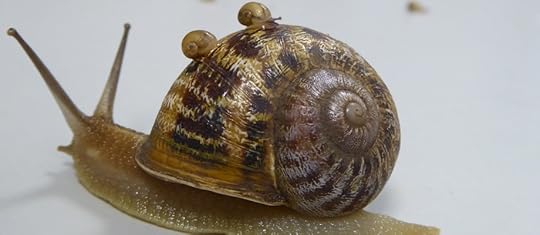
“Snails weren’t pandas — those oversize bumbling toddlers that sucked up national conservation budgets — or any of the other charismatic megafauna, like orcas or gorillas. Snails weren’t huggy koala bears, which in reality were vicious and riddled with chlamydia. Nor were snails otters, which looked like plush toys made for mascots by aquariums, despite the fact that they lured dogs from beaches to drown and rape them.“
As I complete revisions on this book, it’s Day 914 of the war. In Kherson, the few remaining residents traverse the streets under the cover of trees, constantly on alert for any buzzing. A grenade or mortar might drop from the sky at any moment. Russian drone operators stationed across the Dnipro are using the region as live target practice. These targets, many of whom are elderly or disabled and move slowly, must be easy prey. I haven’t made it back to Ukraine. At this point, I’m not sure when that’ll be. Years ago, my grandfather invited me to come live with him for three months so that we could spend our days just talking. He’d tell me about his favorite writers, his favorite books, the ones he’d spent a lifetime collecting. He’d tell me more about his life under Soviet rule, more than what I’d already recorded during previous visits, which flew by, each a couple of weeks at most. No, this time we’d take our time. Every day we’d sit down for tea, or light beer with salty fish. He likes to talk, can talk endlessly. Usually I get tired of it, start to squirm, ache to go outside and stretch my legs, but in this other scenario, this other fantasy, I won’t. I’ll sit and listen hour after hour as the sun arches over the kitchen window and the shadows circle, as the acacia leaves fall and regrow.



Art is supposed to provoke reaction