

What do you think?

Insectopolis: A Natural History
Award-winning cartoonist Peter Kuper transports readers through the 400-million-year history of insects and the remarkable entomologists who have studied them.
This visually immersive work of graphic nonfiction dives into a world where ants, cicadas, bees, and butterflies visit a library exhibition that displays their stories and humanity’s connection to them throughout the ages. Kuper’s thrilling visual feast layers history and science, color and design, to tell the remarkable tales of dung beetles navigating by the stars, hawk-size prehistoric dragonflies hunting prey, and mosquitoes changing the course of human history.
He also illuminates pioneering naturalists, from well-known figures like E. O. Wilson and Rachel Carson to unheralded luminaries like Charles Henry Turner, the Black American scholar who documented arthropod intelligence, and Maria Sybilla Merian, the seventeenth-century German regarded as the mother of entomology.
Galvanized by the sixth extinction and the ongoing insect crisis, Kuper takes readers on an unforgettable journey.
This visually immersive work of graphic nonfiction dives into a world where ants, cicadas, bees, and butterflies visit a library exhibition that displays their stories and humanity’s connection to them throughout the ages. Kuper’s thrilling visual feast layers history and science, color and design, to tell the remarkable tales of dung beetles navigating by the stars, hawk-size prehistoric dragonflies hunting prey, and mosquitoes changing the course of human history.
He also illuminates pioneering naturalists, from well-known figures like E. O. Wilson and Rachel Carson to unheralded luminaries like Charles Henry Turner, the Black American scholar who documented arthropod intelligence, and Maria Sybilla Merian, the seventeenth-century German regarded as the mother of entomology.
Galvanized by the sixth extinction and the ongoing insect crisis, Kuper takes readers on an unforgettable journey.
256 pages, Hardcover
First published May 13, 2025
About the author
Peter Kuper
131 books148 followersPeter Kuper is an American alternative comics artist and illustrator, renowned for his politically charged, socially conscious, and often autobiographical work. He co-founded the influential anthology World War 3 Illustrated, and is best known for his long-running reinvention of Spy vs. Spy for Mad magazine from 1997 to 2022. Kuper has produced numerous graphic novels, including award-winning adaptations of Franz Kafka’s Give It Up! and The Metamorphosis, as well as autobiographical works like Stop Forgetting To Remember and Diario de Oaxaca, documenting life, travel, and social struggles. His illustration work has appeared on covers and in publications such as Time, Newsweek, The New Yorker, Rolling Stone, and The New York Times. Kuper’s style often merges comics and illustration techniques, with both wordless narratives and text-driven storytelling, reflecting his belief that the two disciplines are inseparable. He has traveled extensively across Latin America, Europe, Africa, and Southeast Asia, often documenting these experiences in sketchbook journals. Kuper has taught courses on comics and illustration at the Parsons School of Design, the School of Visual Arts, and Harvard University’s first class on graphic novels. He has received numerous awards, including recognition from the Society of Newspaper Designers, the Society of Illustrators, and Eisner and NCS awards for his work. His comics combine sharp political commentary, personal observation, and inventive visual storytelling, establishing him as a prominent figure in contemporary alternative comics and illustration.
Ratings & Reviews
Friends & Following
Create a free account to discover what your friends think of this book!
Community Reviews
Displaying 1 - 30 of 229 reviews

August 27, 2025
My best friend holds graphic novels in the highest esteem. As I have noted previously, he earned a PhD on such. He routinely buys them for me. my reactions vary. This one didn't come from him but rather was retrieved as a result of the lovely review from Rebecca Foster. The local library happened to have it, and I picked it up gladly, if uncertain about what to expect. I obviously failed to imagine the emotive impact. There's a quote from Nabokov who appears within where he regards a coupling of beauty and pity as a workable definition of art.
The synopsis is simple: in a post-human future insects investigate the Museum of Natural History and contemplate the entomological exhibits and ponder on the relationship between insects and humans. Humboldt, Darwin and Carson all appear as well as some lesser-known figures. It is a beautiful story although one veined with the tragic and contemptible.
The synopsis is simple: in a post-human future insects investigate the Museum of Natural History and contemplate the entomological exhibits and ponder on the relationship between insects and humans. Humboldt, Darwin and Carson all appear as well as some lesser-known figures. It is a beautiful story although one veined with the tragic and contemptible.
May 15, 2025
Generally, I tend to judge nonfiction books by whether they a) inspire me to put down the book and research something from it on my own, and b) are captivating enough that I pick the book back up soon after. While reading Insectopolis, I stopped to look something up and read more about it at least ten times, and every single time I ended up having to bookmark the topic I was looking up because I wanted to get back to Insectopolis so badly that I couldn't focus on anything else.
In turns funny, sad, unpredictable, and poignant, and beautiful in both artwork and writing all throughout, Insectopolis is a book that I would readily recommend to anyone who has ever come into contact with a bug, or anything scientific, or the natural world. This book made me appreciate mosquitoes.
In turns funny, sad, unpredictable, and poignant, and beautiful in both artwork and writing all throughout, Insectopolis is a book that I would readily recommend to anyone who has ever come into contact with a bug, or anything scientific, or the natural world. This book made me appreciate mosquitoes.
June 1, 2025
Beautifully illustrated and interesting as well as funny. Some pages were a little overwhelming with busy illustrations and text, but I think that’s more of a me problem

November 15, 2025
RE-READ UPDATE: Just as delightful the second time around! A real gem, (or at least a scarab beetle 😁).
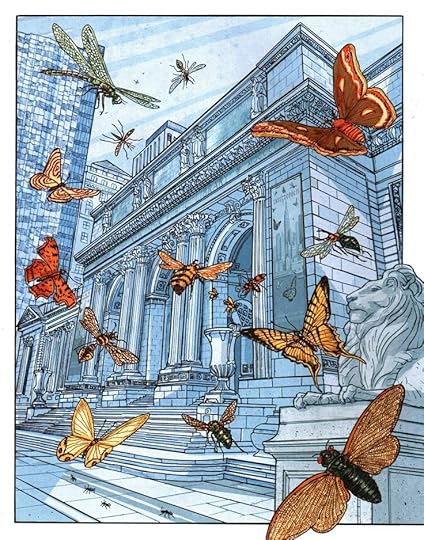
ORIGINAL REVIEW: Absolutely stunning book that gets off to an admittedly slow start, but then is just page after page of beautiful, largely duochromatic illustrations and endlessly fascinating "I never knew that" information. Based on a fictional insect exhibition at the famous New York Public Library (combined with an equally fictional — or at least not happened yet — sudden extinction of the human race), Kuper explores the insect world through swarms of tiny visitors intent on learning about themselves:
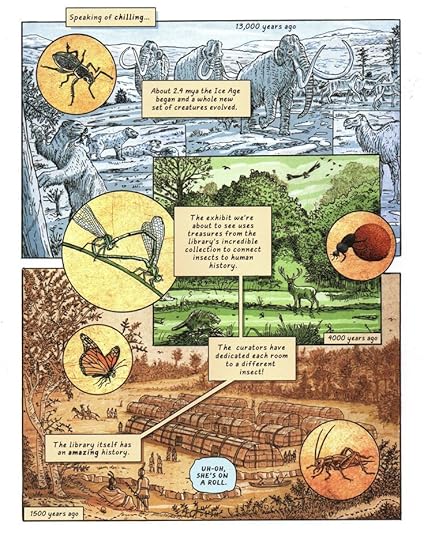
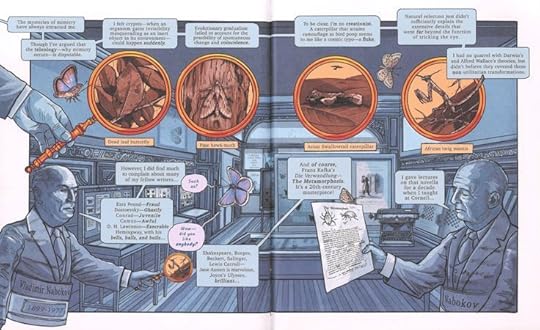
This is one of those books that is just so endlessly informative, I can only review it by randomly listing just a few of the MANY things I learned here; about insects of course, but also a surprising number of peripheral topics as well:
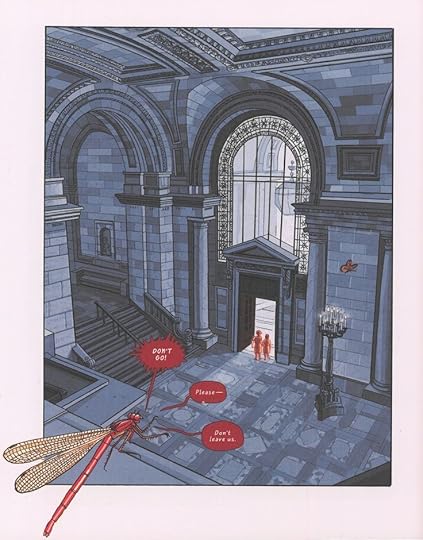
On top of everything else, Kuper is just an exquisite draftsman. Bugs aside, his detailed 3-point-perspective architectural studies of the library are miniature masterpieces:
…and in a way remind me of the "artist's conceptions" we used to draw at Singer Link back in the '70s, as a marketing tool to show what proposed simulator rooms would look like, (included here mainly because I found it funny to revisit just how many rows of mainframe computers were required to do what could probably be done with a laptop today):

ANYWAY: Absolutely could not rate this book higher — a must read for any fan of illustration, natural history or just "ooh ahh" in general.
ORIGINAL REVIEW: Absolutely stunning book that gets off to an admittedly slow start, but then is just page after page of beautiful, largely duochromatic illustrations and endlessly fascinating "I never knew that" information. Based on a fictional insect exhibition at the famous New York Public Library (combined with an equally fictional — or at least not happened yet — sudden extinction of the human race), Kuper explores the insect world through swarms of tiny visitors intent on learning about themselves:
This is one of those books that is just so endlessly informative, I can only review it by randomly listing just a few of the MANY things I learned here; about insects of course, but also a surprising number of peripheral topics as well:
• 80% of all global species are insects, with estimates that there are ten quintillion (a 10 with 18 zeroes) of the little suckers, or 1.25 billion insects for each human on Earth…and just SO much more. The book includes mini-biographies of folks like Alexander von Humboldt, Rachel Carson, Margaret Collins (of both termite and civil rights fame), and — surprisingly — Vladimir Nabokov, who before writing Lolita was a serious researcher of butterflies and nearly became a full-time entomologist (which would have totally ruined The Police's "Don't Stand So Close To Me"). And don’t get me started on the Great Cochineal Heist of 1776, (which again, ended in death by malaria).
• Silverfish are the earliest insect, going back well over 400 million years
• Along with 96% of all marine life, trilobites were wiped out in the Permian Extinction, after having survived for 521 million years — which is sad, but also seems…oddly specific? How did scientists come up with exactly 96% and 521 million…?
• Hey, and now I know the difference between Batesian and Mullerian mimicry!! (Look it up yourself)
• Scarab beetles, which were worshipped by the Egyptians, were the first animal to navigate by the stars; they're also the world's strongest insect
• MOSQUITOS: There are thousands of species of mosquitos (which are actually a type of fly), only a few of which bite or carry disease; they are also important pollinators. That said, of the 108 billion people who have ever lived on Earth, it's estimated that almost half have been killed by mosquito-borne diseases. Indeed, the battles of Yorktown and Vicksburg were decided by mosquito-borne malaria; malaria defeated both Alexander the Great and Attila the Hun; and the natural immunity to malaria found in certain African tribes contributed greatly to the slave trade. Mosquitos were also one of the world's first biological weapons, when in WWII the Nazis reflooded the swamps around Rome and released mosquito larvae in an attempt to spread malaria among the advancing Allied troops.
• Flies are the world's #2 pollinator, and biting midges (those annoying little #@$!s) are the only insect small enough to pollinate the tiny cacao flowers, and so play a key role in the chocolate industry, which provides livelihood for 50 million people worldwide
• After centuries of inbreeding, domestic silk worm moths are both blind and flightless, as they're bred solely for their silk — which is also kinda sad :(
• The water boatman is the loudest creature relative to its size in the animal kingdom
• SEX: Wow, insects are seriously into the rough stuff; but you'll have to read about that yourself
On top of everything else, Kuper is just an exquisite draftsman. Bugs aside, his detailed 3-point-perspective architectural studies of the library are miniature masterpieces:
…and in a way remind me of the "artist's conceptions" we used to draw at Singer Link back in the '70s, as a marketing tool to show what proposed simulator rooms would look like, (included here mainly because I found it funny to revisit just how many rows of mainframe computers were required to do what could probably be done with a laptop today):
ANYWAY: Absolutely could not rate this book higher — a must read for any fan of illustration, natural history or just "ooh ahh" in general.
December 12, 2025
What a strange, beautiful and educational journey this is...This starts off as a fictional trip to the museum and ends...well you'll see if you read it. Either way the detail of the drawing can be quite exquisite at times, the powerful colours and anatomical accuracy really animating the creatures, allowing them to spring to life in a wide range of forms and flight - ensuring that this makes a really worthwhile and engaging read for YA and adults alike.

March 13, 2026
The first graphic non-fiction I come across, and I really did enjoy this medium of science communication. The comic had a lot of interesting facts coupled with cool artwork and a somewhat interesting narrative style. But, it suffered from a Great Men of historiographical methodology that always leaves a sour taste in my mouth. Furthermore, the narrative style although interesting feels a bit convoluted and a bit unnecessary. I still recommend checking it out though, for it is a quick read that packs a lot of information.

May 15, 2025
Nearly a decade ago, I reviewed Kuper’s Ruins, which features monarch migration and has as protagonist a laid-off Natural History Museum entomologist. Here insects have even more of a starring role. The E. O. Wilson epigraph sets the stage: “If all mankind were to disappear, the world would regenerate back to the rich state of equilibrium that existed ten thousand years ago. If insects were to vanish, the environment would collapse into chaos.” We follow an African American brother-and-sister pair, the one dubious and the other eager, as they walk downtown to the New York Public Library. The sister, who holds a PhD in entomology, promises that its exhibition on insects is going to be amazing. But just before they reach the building, a red alert flashes up on every smartphone and sirens start blaring. A week later, the city is a ruin of overturned cabs and debris. Only insects remain and, group by group, they guide readers through the empty exhibit, interacting within and across species.
It’s a sly blend of science, history, stories and silliness. I loved the scenes of mosquitoes and ants railing against how they’ve been depicted as villainous, and dignified dung beetles resisting scatological jokes and standing up for their importance in ecosystems. There are interesting interludes about insects in literature (not just Kafka and Nabokov, but the Japanese graphic novel The Book of Human Insects by Osamu Tezuka), and unsung heroines of entomology get their moment in the sun. The pages in which Margaret Collins, an African American termite researcher in the 1950s, and Rachel Carson appear to a dragonfly as ghosts and tell their stories of being dismissed by male researchers were among my favourites. Informative and entertaining at once; what could be better? Welcome our insect overlords!
Originally published, with images, on my blog, Bookish Beck.
It’s a sly blend of science, history, stories and silliness. I loved the scenes of mosquitoes and ants railing against how they’ve been depicted as villainous, and dignified dung beetles resisting scatological jokes and standing up for their importance in ecosystems. There are interesting interludes about insects in literature (not just Kafka and Nabokov, but the Japanese graphic novel The Book of Human Insects by Osamu Tezuka), and unsung heroines of entomology get their moment in the sun. The pages in which Margaret Collins, an African American termite researcher in the 1950s, and Rachel Carson appear to a dragonfly as ghosts and tell their stories of being dismissed by male researchers were among my favourites. Informative and entertaining at once; what could be better? Welcome our insect overlords!
Originally published, with images, on my blog, Bookish Beck.

May 14, 2026
The way this was presented threw me off a little bit, but overall it was incredibly fascinating and educational, but also quite sad at times.

August 23, 2025
I'm still scared of bugs
September 15, 2025
This gorgeously-illustrated book takes a fun pop-sci look at the world of insects--particularly how the behaviors and presence of bugs have shaped human history.
It is true, the haphazard inclusion of cursing and naughty jokes seems to be trying a little too hard to shout to the reader, "Bug facts are for adults, too!" but this is a small quibble when compared to the overall joy INSECTOPOLIS is to read and look at.
It is true, the haphazard inclusion of cursing and naughty jokes seems to be trying a little too hard to shout to the reader, "Bug facts are for adults, too!" but this is a small quibble when compared to the overall joy INSECTOPOLIS is to read and look at.
June 29, 2026
Very pretty and lots of fun facts. My favorite part was the bibliography. ;)

February 15, 2026
Una introducción a la entomología en novela gráfica. Buen dibujo.

July 17, 2026
Very informative about select insects and illustrated to a mind blowing degree.

July 5, 2026
WOW!!! what a stunning read. i love bugs and learning more about their role in our ecosystem, and this book was a brilliant homage to our smaller neighbors. the illustrations were beautiful, and the writing was laugh-out-loud funny. hiiighly recommend!

December 25, 2025
Somehow I thought this was going to be a little surreal or something. But really it's just a gimmicky way to teach us about insects and how amazing they are. Granted, it's gorgeous. But I learned nothing new except a couple of scraps of trivia. I recommend it especially for kids in middle school, and of course also for curious teens & adults who aren't very knowledgeable yet.

Read
September 16, 2025Insectopolis is a fun, informative, and very inventive graphic portrayal of how important insects are in natural and human history. Also, if you read it literally, how likely they are to shortly take over our habitat.
The first half establishes the setting of an exhibit about insects in the New York Public Library, and covers the scope and evolution of insect life. It sets a cheeky tone in an effort to pull in teen readers, I think. Don’t know how well that succeeds. But it did lead me to caution my daughter that it was probably a bit too colorful for her 8 and 10 year old kids. I would say 12 and up, maybe.
The premise is that after humans are exterminated in an unspecified mass extinction event on an early page, the insects come en masse to tour the exhibit and comment extravagantly on their species.
From the first page Kuper impresses with the scale, detail, varied perspectives, and design of the graphics. Some views up staircases and along hallways remind the reader of the drawings of Renaissance artists like Francesco di Giorgio Martini and, later, those of Escher.
Some sections of the first half are interesting. There is a quick flyover of famous entomologists (more later). Also ‘fascinating facts’ about the biology and ecological aspects of bees, mosquitos, and dung beetles. But I was flagging a bit by mid-book.
The second half I found much more interesting. Here Kuper brings the ghosts of famous entomologists/ecologists into the conversation. He captures both facts and personality. E. O. Wilson, Nabokov, Alexander von Humboldt, Maria Sibylla Merian, Rachel Carson, and Margaret Collins make appearances.
I was especially intrigued by Merian, a German woman born in 1647 who spent years studying insects. In 1699, age 52, travelled alone to Suriname because of the remarkable plants and animals said to populate the colony. She made incredibly beautiful and detailed drawings of the insects she found, which depicted the life cycles of a class of animals that had not been well understood previously (according to Kuper). She is called the mother of entomology. Merian returned to Europe and published a magisterial volume with her drawings, hand colored, just before she died.
The last half also has multi-page coverage of the social life of ants and evocative portrayals of the life cycles of cicadas and monarch butterflies. The portrayal of a seventeen-year conversation between a tree and the cicada living in its roots until bursting into the open air is lovely.
I will try to add a link to images at a museum or similar institution? in Bologna. I don't know if Goodreads will allow it. http://bimu.comune.bologna.it/bibliow...
The first half establishes the setting of an exhibit about insects in the New York Public Library, and covers the scope and evolution of insect life. It sets a cheeky tone in an effort to pull in teen readers, I think. Don’t know how well that succeeds. But it did lead me to caution my daughter that it was probably a bit too colorful for her 8 and 10 year old kids. I would say 12 and up, maybe.
The premise is that after humans are exterminated in an unspecified mass extinction event on an early page, the insects come en masse to tour the exhibit and comment extravagantly on their species.
From the first page Kuper impresses with the scale, detail, varied perspectives, and design of the graphics. Some views up staircases and along hallways remind the reader of the drawings of Renaissance artists like Francesco di Giorgio Martini and, later, those of Escher.
Some sections of the first half are interesting. There is a quick flyover of famous entomologists (more later). Also ‘fascinating facts’ about the biology and ecological aspects of bees, mosquitos, and dung beetles. But I was flagging a bit by mid-book.
The second half I found much more interesting. Here Kuper brings the ghosts of famous entomologists/ecologists into the conversation. He captures both facts and personality. E. O. Wilson, Nabokov, Alexander von Humboldt, Maria Sibylla Merian, Rachel Carson, and Margaret Collins make appearances.
I was especially intrigued by Merian, a German woman born in 1647 who spent years studying insects. In 1699, age 52, travelled alone to Suriname because of the remarkable plants and animals said to populate the colony. She made incredibly beautiful and detailed drawings of the insects she found, which depicted the life cycles of a class of animals that had not been well understood previously (according to Kuper). She is called the mother of entomology. Merian returned to Europe and published a magisterial volume with her drawings, hand colored, just before she died.
The last half also has multi-page coverage of the social life of ants and evocative portrayals of the life cycles of cicadas and monarch butterflies. The portrayal of a seventeen-year conversation between a tree and the cicada living in its roots until bursting into the open air is lovely.
I will try to add a link to images at a museum or similar institution? in Bologna. I don't know if Goodreads will allow it. http://bimu.comune.bologna.it/bibliow...
February 16, 2026
This book will educate you about the amazing and secret lives of insects we encounter in our day-to-day life. My fascination for entomology started from my childhood. I used to collect and try to embalm insects from the flower gardens near my home, Butterflies, moths, beetles, rainy season velvet mites, termites, crickets, Treehoppers, grasshoppers, stink bugs and occasionally scorpions! were part of my specimen collection during the rainy season. But I failed miserably in preserving them properly as I did not have the knowledge or means to do so. I simply put them in glass Rasna essence empty vials. So, naturally when I came across this illustrated book, I immediately picked it up as it is one of my favorite subjects and format.
This author is not a stranger to me. I have read his other books like Ruins and Journal of Oaxaca which are equally good. This book covers lot of ground in etymology including evolution of insects, Doyens (Vladimir Nabokov's butterfly fascination, Osamu Tezuka insect catalogue was a surprise) of etymology and characteristics of common insects.
Lots of unknown interesting information and facts are in this book. Bees, Mosquitos, Flies, Dung Beetle, Lac Bug, Cicadas, Butterflies, Moths, Fireflies and Cochineals were some of the insects covered in this book. There are some adult jokes in this book which might not be appropriate for children. Other wise it is a great natural history book.
Highly recommended for natural history and/or entomology enthusiasts.
This author is not a stranger to me. I have read his other books like Ruins and Journal of Oaxaca which are equally good. This book covers lot of ground in etymology including evolution of insects, Doyens (Vladimir Nabokov's butterfly fascination, Osamu Tezuka insect catalogue was a surprise) of etymology and characteristics of common insects.
Lots of unknown interesting information and facts are in this book. Bees, Mosquitos, Flies, Dung Beetle, Lac Bug, Cicadas, Butterflies, Moths, Fireflies and Cochineals were some of the insects covered in this book. There are some adult jokes in this book which might not be appropriate for children. Other wise it is a great natural history book.
Highly recommended for natural history and/or entomology enthusiasts.

September 19, 2025
Aside from the ✨ STUNNING ✨ illustrations, there is so much about insects I never knew could blow my MIND. From the positives of mosquitoes to ants carrying the weight of the unthinkable to a variety of incredible humans who dedicated their lives to entomology! Just, wow!! I highly recommend this one for someone who is curious about the impact of insects or who just wants to see some crazy awesome artwork 😍🖤

March 4, 2026
This is a coffee table size graphic novel about insects. The humans are there at the beginning. Then…something…happens. And the insects are left to explore a museum exhibit in the New York Public Library about themselves. Children and adults both can enjoy reading this. Even if you already know a good bit about the topic, it takes it in interesting directions. And the bibliography at the end gives a lot more books to explore. There are also seven QR codes linked to audio features provided by the NYPL.

October 23, 2025
Gorgeous and fascinating with an interesting (and somewhat troubling) structure. Insectopolis opens with a brother and sister excitedly sharing insect facts as they head to an insect exhibit at the New York Public Library. cut to insects flooding the museum with their own, often self-absorbed musings about the exhibit.
If the framing story is a bit odd, the facts are splendid and mostly new to me. I think a younger reader will get a kick out of the strange format and really dig the way that the individual insects are processing all these cool ideas. As an older reader, it all sent me straight to Wikipedia.
If the framing story is a bit odd, the facts are splendid and mostly new to me. I think a younger reader will get a kick out of the strange format and really dig the way that the individual insects are processing all these cool ideas. As an older reader, it all sent me straight to Wikipedia.
February 7, 2026
A Redditor recommended Insectopolis in some comment section. I decided to give it a shot, even though a non-fiction graphic novel on insects didn’t exactly seem exhilarating to me . . . But I’m really glad I did! It’s great!
There is a bit of plot here and it’s darkly humorous. An entomologist and a friend go to the New York Public Library to see an insect exhibit . . . only there’s some cataclysmic event an humans go extinct! The story picks up a few pages later when insects take over the world and, more specifically, the exhibit at the NYPL. The insects then go from exhibit to exhibit commenting on the information presented there. There’s references to history, literature, philosophy, religion, comics, you name it as they intersect with insects.
The art here is stunning. Beautiful use of colors. Novel uses of panels and speech bubbles alike (honeycomb shaped bubbles for bees’ speech bubbles!). The whole book is just so cleverly done. Even the bibliography is cleverly done as a bookshelf in the gift shop!
There is a bit of plot here and it’s darkly humorous. An entomologist and a friend go to the New York Public Library to see an insect exhibit . . . only there’s some cataclysmic event an humans go extinct! The story picks up a few pages later when insects take over the world and, more specifically, the exhibit at the NYPL. The insects then go from exhibit to exhibit commenting on the information presented there. There’s references to history, literature, philosophy, religion, comics, you name it as they intersect with insects.
The art here is stunning. Beautiful use of colors. Novel uses of panels and speech bubbles alike (honeycomb shaped bubbles for bees’ speech bubbles!). The whole book is just so cleverly done. Even the bibliography is cleverly done as a bookshelf in the gift shop!

October 5, 2025
A lovely marriage of art, science, and history. Post apocalyptic insects visit an entomology exhibit and ponder their relationship with humanity. (It's unclear to me why they care about what we cared about, but it's a worthwhile assumption to get to the premise.) Completely worth a read.
November 22, 2025
some truly stunning pages in here - got a little overwhelmed with so much information though, but i think a younger reader could really benefit from it. i would have loved more scenes like the cicada
March 3, 2026
Very neat! Learned a lot, and the illustrations were beautiful.

October 27, 2025
Beautifully illustrated, fascinating information delivered with macabre humor.

November 1, 2025
Informative, fun, approachable, and beautiful.
Just go out and buy this book.
Read it in a day, and learn something new.
It’s amazing!!
Just go out and buy this book.
Read it in a day, and learn something new.
It’s amazing!!
June 10, 2026
Des insectes colorés dans un monde post-apocalyptique gris bleu dans lequel les humains ne sont plus. Les insectes héros de l'histoire visitent la New York Public Library et s'intéressent principalement à une exposition qui leur est consacrée.
Le procédé de visite de l'exposition permet de lire dans le décor, ce qui n'arrive que très rarement dans le format de la bande dessinée. On se retrouve en pleine lecture de BD, à lire des écriteaux d'une exposition imaginaire qui reprend tous les codes de la muséographie (j'ai creusé et en 2022, une exposition de ce roman graphique a eu lieu dans la NYPL, bien joué, les gens !). On visite donc un musée du point de vue des insectes ! Le contraste des couleurs engendre un réalisme chatoyant, c'est souvent très beau.
Seulement 4 étoiles parce que l'ouvrage est didactique (c'est bien nécessaire), mais peut-être un peu trop ? Je n'ai pu me départir de lire certaines pages avec la tonalité de ma maman en vacances lorsqu'elle me lisait le guide du Routard dans n'importe quelle église que nous visitions...
Le procédé de visite de l'exposition permet de lire dans le décor, ce qui n'arrive que très rarement dans le format de la bande dessinée. On se retrouve en pleine lecture de BD, à lire des écriteaux d'une exposition imaginaire qui reprend tous les codes de la muséographie (j'ai creusé et en 2022, une exposition de ce roman graphique a eu lieu dans la NYPL, bien joué, les gens !). On visite donc un musée du point de vue des insectes ! Le contraste des couleurs engendre un réalisme chatoyant, c'est souvent très beau.
Seulement 4 étoiles parce que l'ouvrage est didactique (c'est bien nécessaire), mais peut-être un peu trop ? Je n'ai pu me départir de lire certaines pages avec la tonalité de ma maman en vacances lorsqu'elle me lisait le guide du Routard dans n'importe quelle église que nous visitions...
This entire review has been hidden because of spoilers.
June 21, 2026
Ça faisait longtemps que je n'avais pas fait un câlin à un livre après l'avoir fini. Je ne m'attendais pas à ce que ça m'arrive avec une BD. Je ne m'attendais pas non plus à prendre autant de notes.
Absolument magnifique (dans tous les sens du terme), cette BD est réussie sur tous les plans : représentation, faits sélectionnés, storytelling, justesse du récit, rythme, dessins, design des pages..! Je la recommande à tous les amoureux de la nature <3
Absolument magnifique (dans tous les sens du terme), cette BD est réussie sur tous les plans : représentation, faits sélectionnés, storytelling, justesse du récit, rythme, dessins, design des pages..! Je la recommande à tous les amoureux de la nature <3

July 22, 2025
I was starting to like this book then the bugs started talking, it became more fantasy, and things no longer had a clear focus. Instead you're given a brief amount of information before jumping to something else. It feels disjointed from the first part where the information is more focused, in depth, and easy to follow. If the author had done this for the whole book I would have enjoyed it more.
November 1, 2025
Pretty fun! The larger story that ties all of the small stories together is a little silly, and I wish the beginning had been longer, but the illustrations are done with a lot of care and charm, and it comes together in a very enjoyable experience.
Displaying 1 - 30 of 229 reviews