Chacun de ses mouvements découvrait ses jambes maigrichonnes de vieille femme enfilées dans des bas illusion couleur chair qui faisaient démodé mais riche, ornementés qu'ils étaient de brillants minuscules sertis entre les mailles de soie et qui pétillaient de mille éclats, crépitaient, palpitaient, grouillaient à même la peau comme de la vermine pour milliardaire. Elle avait acheté cette paire de bas unique au monde à un anarchiste espagnol, un réfugié politique rencontré dans un bar de Montmartre, qui les avait arrachés en septembre 1936 à Notre-Dame de Guadalupe de Badajoz, en Estrémadure, dépouillant la statue miraculeuse de la Madone.
Frédéric Louis Sauser, better known as Blaise Cendrars, was a Swiss novelist and poet naturalized French in 1916. He was a writer of considerable influence in the modernist movement.
His father, an inventor-businessman, was Swiss, his mother Scottish. He spent his childhood in Alexandria, Naples, Brindisi, Neuchâtel, and numerous other places, while accompanying his father, who endlessly pursued business schemes, none successfully. At the age of fifteen, Cendrars left home to travel in Russia, Persia, China while working as a jewel merchant; several years later, he wrote about this in his poem, Transiberien. He was in Paris before 1910, where he got in touch with several names of Paris' bélle époque: Guillaume Apollinaire, Modigliani, Marc Chagall and many more. Cendrars then traveled to America, where he wrote his first long poem Pâques à New-York. The next year appeared The Transsibérien.
When he came back to France, I World War was started and he joined the French Foreign Legion. He was sent to the front line in the Somme where from mid-December 1914 until February 1915. During the attacks in Champagne in September 1915 that Cendrars lost his right arm. He described this war experience in the books La Main coupée.
After the war he returned to Paris, becaming an important part of the artistic community in Montparnasse. There, among others, used to meet with other writers such as Henry Miller, John Dos Passos and Ernest Hemingway.
During the 1920's he published two long novels, Moravagine and Les Confessions de Dan Yack. Into the 1930’s published a number of “novelized” biographies or volumes of extravagant reporting, such as L’Or, based on the life of John August Sutter, and Rhum, “reportage romance” dealing with the life and trials of Jean Galmont, a misfired Cecil Rhodes of Guiana.
La Belle Epoque was the great age of discovery in arts and letters. Cendrars, very much of the epoch, was sketched by Caruso, painted by Léon Bakst, by Léger, by Modigliani, by Chagall; and in his turn helped discover Negro art, jazz, and the modern music of Les Six. His home base was always Paris, for several years in the Rue de Savoie, later, for many years, in the Avenue Montaigne, and in the country, his little house at Tremblay-sur Mauldre (Seine-et-Oise), though he continued to travel extensively. He worked for a short while in Hollywood in 1936, at the time of the filming of Sutter’s Gold. From 1924 to 1936, went so constantly to South America. This life globertrottering life was pictured in his book Bourlinguer, published in 1948. Another remarkable works apparead in the 40s were L’Homme Foudroyé (1945), La Main Coupée (1946), Le Lotissement du Ciel (1949), that constitute his best and most important work. His last major work was published in 1957, entitled Trop, C’est Trop.
All those Cendrars' verve and insight in this novel "burn the boards" by depicting the world of the Parisian theatre. To say that I found this book on the "eroticism" shelves at a second-hand bookshop is nothing less than derogatory towards this novel.
Cendrars last book is an exhausting romp to the end that is primarily involved with the story of an aging star burning out her last minutes with a blast that will leave nothing standing. It seems as if Cendrars was re-examining his relationships with his female characters at the end of his life. Cendrars uses that oh so unfashionable symbolist-like depiction of women as whore/devil/chimera that will be off-putting to most sentient people. However if you overlook some of those hopefully anachronistic sentiments there is much to enjoy here. As always - Cendrars writes books like a musician would make films. There is a loose concept of story telling that takes a back seat to the verbal fireworks that will engage most word-lovers. It's more about pitch and effect (affettuoso in this book) than structure or plot delivery and this can be very challenging to follow at times. There is nothing feminine about Cendrars - almost as if he was writing books for men that might feel reading fiction was unmanly. This isn't a man writing to his sons - this is an uncle taking his nephew whoring with the art crowd. A Cendrars book should be carried in a pocket not generally used to carry books and it should be decorated with stains as much as possible - if your copy is new - take it out drinking for a few nights before you bother to start reading. This pocket is described to perfection in the penultimate chapter - won't spoil it. If you can steal a copy instead - do that. When you are done - give it to a friend with no explanation at the end of a night of drinking.
I will admit that is almost impossible for me to read Cendrars and not think about Abel Gance films. Of course the two worked together and Cendrars appears with his one empty sleeve at the end of J'Accuse! - an image I will take to my grave for certain. Although Cendrars could have never drawn a portrait like the Rose of the Rails (La Roue) he does share Gance's keen social intelligence. Each image in every Cendrars book appears in my head through the lens of Gance and while potentially limiting - it is also very illuminating. The chaos, beauty and masculinity of Gance's Napoleon is present in all of the Cendrars I've read so far (Dan Yack, Confessions of Dan Yack, Moravagine and now this) and I feel no need to apologize for my unreserved praise of every inch of Napoleon but there are moments when Cendrars makes me cringe a bit. Openly mocking an aging woman's vagina is only one example of the gender negotiation on display here. Cendrars offers such images not as mere banal misogyny but more of an acceptance of the failures of humans in general. The main difference I've seen with his gender roles is that men seem to stride off like Chaplin instead of lingering like Bernhardt. This makes sense when you consider that his youngest son and many male friends died in war while the women were left at home to nurse the would of others then themselves. Writing at the end of his life with the experience of artists like Modigliani, Gance, Soutine, Picasso and others in his immediate circle of friends would require little need for reminders of mortality. This element places Cendrars, for me at least, among the last symbolist writers. Once you understand the correlation of aggregated signification that is absolutely dizzying at first glance his work starts to resonate with a steady and mellifluous resonance that elevates the experience for the initiated. Like watching J'Accuse - when you know that the extras were all dead within weeks - killed on the very battlefields that were shot as fiction - the experience becomes the ultimate in cinematographic engagement; Cendrars's fiction is just a suggestion of the reality that you know he experienced.
So is it cool to dig on the macho artist launching verbal bombs with little regard for who is left standing? I think there's nothing wrong with it if you can keep it in historical and cultural perspective. I'd like to think that the women in my life can be more than whores, paid or otherwise and enjoy life outside of a male-defined role. But I'd love moreso to think that people, all people, can enjoy the richness of experience without spending too much time worrying about who might be offended. If you're one of those folks that measures their life in terms of ranking your experiences with others - most of the people in Cendrars' life and books will leave you with the shorter stack. But if you're the type that can revel in the lives of others and vicariously enjoy whaling, whoring, boxing and boozing it up until closing time now and again - you're going to enjoy Cendrars. In fact - getting horribly drunk and reading a chapter a night at a late-night establishment would be a great way to appreciate what is being offered here. Cendrars is a European Al St. John, smashing his way into your conscious with a devilish grin and a sprightly hop into history. He's going to get you dirty and you're going to thank him for it.
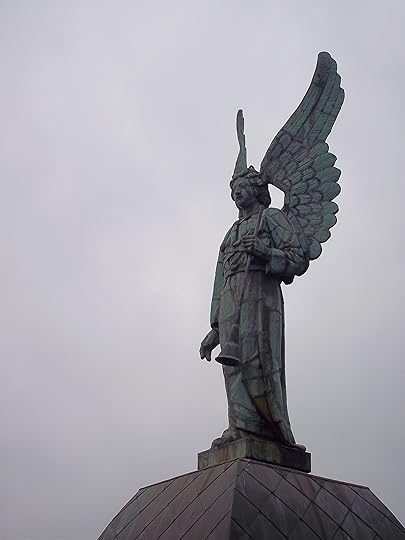
Uma curta-metragem, distribuída por 55 cenas, contada em 30 páginas num livro com 11,5 x 18,5 cm. Um delicioso relato do apocalipse que me fez rir e, também, um friozinho na barriga, nos momentos em que me esqueci que era uma paródia. Deus Pai, administrador, convoca os vários chefes de secção para que lhe façam o balanço do ano: a Grande Guerra rendeu mil milhões de mortos; não foi mau, mas tudo encareceu e há que pensar noutra coisa. E porque não realizar as profecias do apocalipse? Foram convocados os Profetas e alguns "tratantes do velho Testamento" e decide-se que ao toque da trombeta do anjo da Notre-Dame de Paris, se inicie o espectáculo de acabar com o mundo...
I fine enough novel. There's a whole lot of theatre in here (and for whatever reason I tend to tune out when theatre pops up in novels, nothing against theatre). There's a murder (mystery). There's some far=out characters. The prose tends to produce some lovely lists. But for all the good here it's just not my bag, post-war French. Not where my heart goes bump. But I'm reading Cendrars cuz he does make Bursey's heart go bump (although Miller also bumps Bursey's heart so there's some slippage here, no?).
{NYRB was kind enough to reissue Cendrars' Moravagine ; but you've got to always check ;; should they could they've reissued more of the man? probably}
Henry Miller said he was the greatest amongst contemporary writers the world over...so naturally, I had to read this.
Cendrars has a crazy sense of logic that runs throughout this novel. At times, I was wondering where he was going with this and at other times, it made crystal clear sense. His ironic and very satricial writing fits the post-war France era in all its ramshackle glory.
In 2007 I read a grand total of 35 books. Probably the most memorable of them all was Blaise Cendrars's *Moravagine*... Because I enjoyed that so much, I leapt at the chance to read *To the End of the World* (and now I'm looking forward to reading Cendrars' *Dan Yack* novels that I recently bought...)
*To the End of the World* was Cendrars's last novel and is even better than *Moravagine* in my view. Certainly it is a more tightly knit and controlled piece of work. It concerns the meeting of two worlds that seem to be antipathetical but have a lot more in common than might at first be supposed -- the world of the Theatre and the world of the French Foreign Legion.
Most of the action takes place in Paris. The main character, Therese, is an ageing actress who is inspired by her meeting with Poxy, a Foreign Legion deserter, to turn her last role into the greatest performance of her entire life. The plot encompasses comedy, tragedy, absurdism, satire, mysticism, hedonism, an unsolved murder and almost everything else! A remarkable achievement! An extraordinary novel!
C'est dans un passé bientôt lointain, il y a presque un siècle, dans un Paris d'après-guerre où les désirs font désordres, la liberté se crie à chaque coin de rue, que nous transporte Emmène-moi au bout du monde !...
C'est l'un des derniers romans écrits par Blaise Cendrars avant sa mort. Lui qui a tant vu et tant vécu, il nous transporte encore dans une autre de ses histoires, cette fois-ci fictive. Thérèse Églantine est une comédienne à l'apogée de sa carrière. Elle s'apprête à jouer dans la pièce qui fera d'elle l'un des piliers de la comédie, si ce n'est la meilleure actrice qu'il soit.
Il n'y a pas vraiment de fil conducteur, ni d'intrigue, si ce n'est un mystère, une sale affaire de meurtre, qui ne sert qu'à justifier le procédé narratif employé par le texte. Chaque chapitre, bien que ne faisant que suivre les péripéties de Thérèse, se concentre sur un personnage. Il peint son portrait, entame sa biographie, cible ses pensées, noie ses désirs profonds et intimes dans de dégoûtants aveux physiques.
Qui sont les gens qui peuplent Paris après la Seconde Guerre mondiale ? Comment sont-ils arrivés à être cela, à ce moment précis, dans la ville ? Quel est leur avenir ? Beaucoup meurent, car indéniablement le temps passe. Ce sont des vies complexes, façonnées de souvenirs révélateurs. Et cette Thérèse, ah ! si comique !
Malgré tout, il est quelque peu difficile, par moment, de trouver du sens à certains mots, certains passages. Cendrars s'applique par moment à des digressions, sur le théâtre, sur la vie, même parfois sur un sujet anodin. Bien qu'intéressant, il finit par se perdre dans ses phrases, toujours plus longues, comme si les mots allaient finalement lui venir, sans succès.
Set in recently liberated Paris in the year of the end of the war, the novel opens with the central character of the novel, Therese Espinosa, a 79 year old actress engaged in a murderous coupling with the man she calls Poxy, a deserter from the French Foreign Legion. Therese likes it rough. She pays younger men to beat her. The Legionnaire, to her great joy, kicks her in the jaw, setting her false teeth rolling across the room.
The manic narrative follows the adventures of this decrepit, female Don Juan as she prepares for her greatest triumph on the stage. The novel abounds with eccentric and vain characters, each one dedicated to their own aggrandizement. As the action ranges from Theresa’s glorious fornication, to a mysterious murder that threatens to disrupt the play, we hear her sometimes disjointed, ebullient tale of a life lived to the max.
Cendrars’ comedic novel is a tour de force of language in which the reader is propelled at high rates of speed through digressions that detail a lost age of romance, frivolity, obsession and passion. For Cendrars, there is little difference between the action on the stage and life itself.
“…tragedy, drama, comedy and farce are all manifestations of everyday life, and…rules mean nothing, that among all peoples at all times all art forms are permissible and that the theater is an acceptance, a common submission of men and the stars in heaven to the obscure laws of creation, a taking part in the joys of living, a game of chance, come good luck or bad, and that the individual’s destiny in isolation has no meaning beyond that of the comic, the caricature, and that all together, actors and public, are bound to each other in the delirium or enchantment that possesses them.”
The tale is ribald, earthy, tragic and comic. Its language is elegant and brisk, down to earth and carnal. Theresa’s Legionnaire lover is said to have, “The axe man’s guide mark on his neck.” Theresa at one point is described as being “…as happy as an honest woman compromised for the first time in her life with a lover in a public place.” She admonishes another character, “Don’t shit higher than your nose, it falls back.”
As for the play which serves as the central structure of the novel,
“The play seemed to have bee written with bursts from a sub-machine gun. Nothing was sacred. Blood, shit and tears. One long raspberry. With much more tragic laughter than social message. Contempt for humanity. Respect for nothing. Foolery. And an atomic brilliance and fire and pace. It couldn’t have been better. Only new plastics used in the décor. Pure colors. Distorted perspective. Worthy of cubism. And the whole bathed in a stupefying, unreal light.”
Clearly, this book is not for the casual reader. It’s hard work to keep your concentration as the words and phrases come hurtling by. The book apparently took Cendrars seven years to write. One senses him pouring over his work, shoehorning in the fast paced narrative. I recommend the book highly for the serious reader.
"The use of a crapulous vocabulary is the last and only indulgence left to an old woman who since her menopause feels herself forsaken by God and soon to be once and for all forsaken by men, but still doesn't want to give up. I'd rather die than bite my tongue."
Extraordinary writing. Makes you realise that being experimental isn't all about grammar and formatting. Full of largely pointless digressions, endless tirades about multiple subjects, abrupt changes in point of view and plot direction, yet somehow remaining utterly compelling.
Emmène-moi au bout du monde! est un livre trés agréable, spiritueux et énergique, écrit sous l'influence évident de Balzac et les surrealistes. Je pense que le bout de ce livre aurait profité de ralentir son rythme, pour nous dire plus à propos de l'intrigue initiale. Peut-être, il est comme ça parce que Cendrars était dans la bout de sa santé.
Pardon moi pour quelques erreurs, je suis un débutant en français.
FAVE LINES: "Every actor of genius must lead a double life so as to be imbued with the 'aura' of his part; and if he is unwilling to suffer this sea-change he is nothing" and "The universe is a process of digestion. Living is an act of magic. Living."
J’ai eu un peu plus de mal à me mettre dans cette lecture. Je ne comprenais pas tout de suite la tournure qu’allait prendre l’histoire, mais au fur et à mesure que j’ai appris à connaître Thérèse, tout s’est éclairci ! J’aime beaucoup le sarcasme et l’humour de Cendrars qui contrastent avec ce qu’on attend d’une dame de théâtre au XXème siècle.
O fim do mundo é ditado pelo anjo de Notre-Dame quando Deus está entediado e se lembra de cumprir as profecias após uma visita à feira das religiões em Marte. Um curto guião para um filme apocalíptico que nasceu numa passagem nocturna de Blaise e da sua namorada da altura por Notre-Dame.
J'ai eu du mal à rentrer dans l'histoire et j'ai décroché sur la fin. C'est cependant un roman très riche : j'ai l'impression qu'il est comme Thérèse. Je pense qu'il serait intéressant que je le relise pour mieux le saisir et l'apprécier davantage.
Drôle d'oiseau que ce Cendrars. Faute de nous emmener au bout du monde (et ne fantasmons pas trop sur ce qu'est le bout du monde, il n'est pas bien loin mais on ne le quitte plus. Ici c'est le Père Lachaise) Cendrars nous balade pendant 300 pages sans que l'on ne comprenne très bien où il nous emmène mais le voyage est agréable, violent, drôle, vulgaire, irréel, surprenant. Une histoire de théâtre, de cinéma, de légion étrangère, de gynécées, de voyous, ...
This entire review has been hidden because of spoilers.
Strongly recommended by Henry Miller Cendrars' life reads like a roman a clef. This is a masterful tale of the triumph of age over adversity. Enthralling!