Rhiannon Garth-Jones explores Rome's enduring legacy through three core religion, empire, and culture. Each chapter examines how Rome’s history, governance, and mythology have been reimagined throughout centuries, and how these interpretations continue to shape our modern world.
Rome is not merely a city—it’s an enduring idea, a symbol of identity, power, and legitimacy that has shaped the course of history for over 1,500 years. This book embarks on an exploration of how the concept of Rome has been invoked by emperors, modern governments, religious leaders, and even pop culture icons, all using it to assert authority and influence society. Each chapter explores how Rome’s history, governance, and mythology have been reimagined throughout centuries, and how these interpretations continue to shape our modern world. By delving into Rome’s influence, readers gain a deeper understanding of the forces shaping today's global landscape.
For readers of all things Roman, e.g. Emperors of Rome by Mary Beard, Rubicon, Dynasty and Pax by Tom Holland as well as The A New History of Old Idea by Naoise MacSweeney and The Map of Knowledge by Violet Moller.
Yes, we all know the meme that men think about Rome A LOT. I am very much guilty of this having consumed all of "The History of Rome" podcast and am working my way through the back catalog of "The History of Byzantium", but it turns out this is not a recent phenomenon.
Rome has been used as a reference point for all sorts of things by nations and Empires. Jones walks through the history of what Rome has meant to people across the centuries, how the view of Rome as changed, how it was adapted to serve contemporary needs, and what is missed with these comparisons. Rome spanned more than a thousand years and changed radically over that period. There is a little bit of something for everyone, from "A Third Rome" in Russia to the Founding Fathers of America to modern neo-fascists and everything in between.
I think Jones does a good, if not so deep, exploration of the idea of Rome across time and space, explaining how people of their time adopted various trappings of Rome or how the prevailing view of Rome influenced how nations and Empires behaved. It is a really good book to understand why ideas of Rome still echo in the modern world.
Pretty interesting read. Picked it up at the Capitolini Museum in Rome and read it while taking breaks from walking around, waiting at restaurants during my solo travels, etc. I thought her explanation of how people at the time didn’t consider the fall of Rome (the city) to be a momentous occasion because at that point the Roman Empire was in understood to be based in Constantinople was a good reminder of high school history. It was fun to see various monuments she discussed from the Renaissance in real life around the city as I was reading. The part about how the Ottomans, Holy Romans and Russians variously tried to claim a legitimate heritage to Rome was super interesting and new to me. I found the part about the British Empire and modern Russia to be a little bit of a stretch/harder to follow her argument exactly. But then maybe that’s the part of history that allows the direct thread of heritage to Rome to be lost, allowing the USA to reinvent the same concept (conquering empire + republic = good) as “western civilization.” Overall I’d give the first half of the book 5 stars, and the whole thing was a great explanation of how history and our understanding of it has always been adapted to meet the narrative of those studying it.
I have to say this was a pretty interesting book. I have yet to get used to the form of putting footnotes at the end of the chapter rather than one large section to hold them all. Is this a technique that is new in casual historical long form paragraph reports that state a belief and then support it with various excerpts to prove said point? I think that is a quibble that I came up with. The book itself is different because it is a history of an idea. This idea then shapes reality. If that idea is based in reality, it does not have any legs, because the book itself is about how the idea of Rome through different forms, shapes reality based on the remembering/misremembering of it. it is also based on the intentional misremembering it as it is used for a country. I have to say, because this is a history of an idea and its many forms based on the countries that have 'discovered' it, it justifies its own tone, because the idea is a different thing. The idea is flimsy because that is what it is. I found it to be really interesting because the book does credit some of the podcasts that I am aware of. It is all about the idea and the most recent thing that caught my interest was the section about Islam before the religious movement gave birth to certain people in that religion creating an empire and then needing a model for said empire to come about. Naturally, Rome came about, and then - there was a lack of footnotes because that section was about buildings, which Rome built. It is this long logical idea pattern that I was very impressed at. The other section, that I loved, was the question on how one can compare a version of Rome to the US and which version can be used. The author cleverly stated the barriers of which Rome the author is citing and went on to prove her point. I have to say, for a casual history of the idea of Rome, this book was rather neat.
This book appears to have been written at least in part as a response to the meme about thinking about Rome. However it is considerably more than that, with an extensive exploration of the influence of the concept of Rome from early successors through to modern Russia and the United States. What struck me is that on looking back at the concept of Rome and Roman identity, successive generations have picked out the parts which support their own beliefs. This is often done by taking the idea out of context and re-shaping it to fit the desired concept. Perhaps the simplest example is that of erasing the concept of colour with Roman statuary and imagining everything as pure white, who is the reality was much more colourful. The model of imperialism has been used, perhaps most recently by the British in places like India, where the idea of English civilisation as inherently superior, because of its alleged classical underpinning, was imposed on the local culture. I suspect some readers may find this a challenging concept. I was reminded of this by recently rereading A Passage to India by EM Forster, which deftly explores the issues between Indians and the English. I suspect some readers will be challenged by the models of Roman civilisation which have been used to justify concepts such as slavery, fascism and colonialism. But in examining the past, we must ensure that we look more widely than a few heroes like Augustus or Julius Caesar. We need to remember the slaves, the women, the captured soldiers and the ordinary people in the streets, and understand how they also moulded Roman life. It is dangerous just to pick out the parts which suit your world of view and impose them on society. Read this book if you want to challenge your existing ideas!
“Robbers of the world, having by their universal plunder exhausted the land, they rifle the deep. If the enemy be rich, they are rapacious; if he be poor, they lust for dominion; neither the east nor the west has been able to satisfy them. Alone among men they covet with equal eagerness poverty and riches. To robbery, slaughter, plunder, they give the lying name of empire; they make a wasteland and call it peace.”
Very interesting read, although I disagreed with certain conclusions made!
Expected this to be about Rome's lasting influence into the present day. Instead it's mostly a survey of how past empires where influenced by Rome and tried to succeed it.
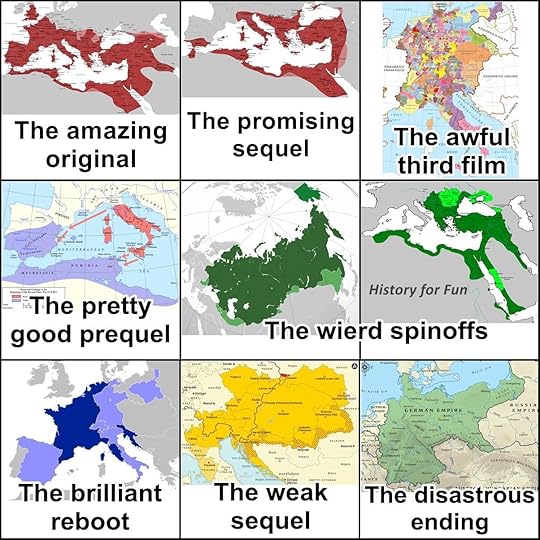
So less TikTok trend ("How often do you think about the Roman Empire?"), more this historical map meme:
This book is less about Rome than it is about ways that Rome influenced other cultures, and, at times, ways that other cultures have less to do with Rome. I don't know, I feel the topics meandered to a detrimental degree. The writing was also particularly dull.
This was perhaps not what I expected and took a bit of time to get into, but it was a really interesting overview of how appeals to ‘Roman-ness’ have been used at different times and places in history
Fascinating look at how the idea of "Rome" - often at odds with the reality - has influenced the world, from the civilisations that existed alongside it to America and modern day Russia.