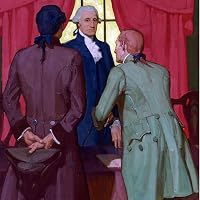
This volume tells about considerably more than half George Washington's life, the forty-three years that elapsed from his birth to his acceptance, at the outbreak of the American Revolution, of the command of the Continental Army.
James Thomas Flexner was an American historian and biographer best known for the four-volume biography of George Washington that earned him a National Book Award in Biography and a special Pulitzer Prize. A cum laude graduate of Harvard University, Flexner worked as a reporter for the New York Herald Tribune from 1929 until 1931, after which he worked as an executive secretary for the New York City Department of Health before leaving the job the following year in order to devote his full energies to writing.
Excellent book about the first half of George Washington's amazing life! This is the first of four volumes by James Flexner, and covers Washington from birth up to the eve of the Revolutionary War in 1775. It ends with him being chosen to be the supreme commander of the as-then-nonexistent American Army. Washington was selected to be General before he even had any troops to command!
Flexner's writing style is somewhat removed from that of a standard biographer in that he does not shy away from using exclamation points and frequently asking rhetorical questions - sometimes even in the footnotes. His writing is engaging and humanistic - he does a good job of balancing between the professional and personal aspects of Washington. It seems that quite often a biographer will skimp on the personal side of things in favor of devoting significantly more time to the person's career. Flexner does not do this. Despite Washington's wife, Martha, selfishly burning all of their letters to each other after his death, Flexner has a mountain of material to work through as Washington kept an extensive - if somewhat dry - journal, as well as his voluminous correspondents with so many people throughout his life. It seems like the man was constantly writing and/or reading letters.
While I do get the sense that Flexner - overall - admires Washington, he never lets that get in the way of the story that he is telling. This work is assiduously fair: Flexner does not shy away from pointing out Washington's flaws such as his impetuousness and brashness when he was a young Colonel in the 1850s, or his owning of slaves. I especially liked how he treated the subject of Washington himself being childless. Since Martha had four children by her first husband, it seems doubtful that she was the cause of her and Washington not producing any offspring. Therefore, most likely is that Washington was sterile, although he himself would not openly - or perhaps even privately - accept that. Flexner concludes with the speech that Washington gave to the Continental Congress in 1775 when he was selected General of the Army, in which he declined to accept any salary and only wished to be reimbursed his expenses. In that same speech, Washington also goes out of his way to admit that he does not believe his skills and abilities are up to the great task ahead of him, but that he will spare no effort in exercising his duties. This is a great ending point for the first volume, and I look forward to reading the next one.
Years ago I decided to take up the common challenge of reading a biography for each US president. I made it all the way to Jefferson. Sure I enjoyed my picks for Washington (His Excellency: George Washington) and Adams (John Adams), but I got bogged down in a bio on Jefferson I don't even really remember reading anymore. But I recently discovered a great resource: The Best Presidential Biographies blog. So I decided to give it another try.
I decided to be a little ambitious for Washington, and chose this 4 volume biography, which despite its age, was rated highly by the author of the blog. I don't know if I just haven't read that much about pre-Revolutionary War Washington, but this volume felt pretty comprehensive. It was a learning experience, but I could tell I was enjoying it. I would randomly bring up facts I was learning with my family, a habit I had back in school whenever I was learning about a subject I liked.
The book did feel slow when covering the years between the French and Indian War and the Continental Congress, mainly because there's not a lot of action to cover. Still, the author did a great job showing what Washington's domestic, peace-time life was like. Interesting that this book, one quarter of the series, covers more than half of Washington's life. Good reading about the "Forge of Experience" he went through before even entering the path to become a Founding Father. Bring on volume 2!
Having been written a few decades ago, surprisingly readable and quite engaging. An easy read in under a week. I enjoyed Flexner's style of writing, it was as engaging as McCullough but his research seemed to have a sense of being slightly more accurate (McCullough occasionally allows more personal conjecture to slip into his writing than he'd probably admit). Although the years covered may be considered by most to be the least important of Washington's life since they are so far removed from the Revolution, I personally disagree because these are the formative years that created the man who became the revolutionary father of our country. There was an element of excitement as I read this book for that very reason, it covered a period of time and presented information with which we are not very familiar. The experience was like that of watching a newly released extended edition of a favorite movie; you are already somewhat familiar with the original, but now you finally get more juicy back story that really allows the story to flourish into something more grand and full than before.
I forget what is in books that I have read years ago. So I was surprised at what I learned from George Washington: The Forge of Experience 1732-1775. He did fight in the French and Indian War, not always successfully and quit the Army prior to the major battles taking place. Was greedy for land and kept buying more acres during his 17 years as a farmer. And though wealthy, he was usually in debt. But the book did bring out some very positive traits of his character: Humility, always helping people often to his detriment, and always keeping a promise.
This was the first in the famous four book biography of Flexner covering the life of George Washington. This first volume takes the reader from Washington's birth through his appointment as General of the Continental Army. It goes into great detail about Washington's participation as the leader of the Virginia militia during the events of the French and Indian War and I learned a great deal about the struggles he had not only in managing a militia for many years, but not receiving the respect or appointment he felt he deserved as an officer in the regular British Army. I particularly enjoyed the chapters on the 17 years Washington spent at Mount Vernon after resigning his Virginia military commission before the Revolution broke out. Learning how he improved Mount Vernon to make it profitable, how he dealt with English traders and creditors, and how his relationship with his wife Martha and his first true love Sally Fairfax took place were fascinating and enlightening for me. I was not naive to think of Washington as having lived a perfect life in terms of character, but taking the time to read these details in a book about his early life is something that all fans of Washington need to be sure to do.
"...[how happenings would] terminate is known only to the great ruler of events; and confiding in his wisdom and goodness, we may safely trust the issue to him, without perplexing ourselves to seek for that which is beyond human ken, only taking care to perform the parts assigned to us in a way that reason and our own consciouses approve of."-George Washington
So I've never read a presidential biography in my life. I'm starting at good old #1 and will continue, on and off, probably until some of the more modern presidents. I don't know if I want to read modern presidential biographies before history has had a chance to stew on them. After some googling I came upon this as one of the "best" biographies on Washington.
This is the first in a four-volume biography, and takes us through Washington's early life up until his appointment by congress as the Commander in Chief of the Continental Army.
George has been mythologized and immortalized by historians and by the people of this country for so long that the authors even-handedness is refreshing. George was far from perfect, as he would be the first to tell you.
His father died when he was eleven, and his relationship with his mother was "strained," to put it mildly. He was sort of a romantic, love-sick teenager. He quite apparently fell in love with one of his dear friends wives, and that love seems to have stayed with him throughout his entire life.
At sixteen he was venturing West to learn the craft of surveying: When, after an idyllic feast, the sixteen-year-old boy wandered the wild meadow that some mysterious hand had mowed; looked up at the towering mountain ledges on both sides; saw, as if stretched between them, a sky full of stars; and heard the rushing of water near his feet; when he sensed the vastness, the newness, the great power and future prosperity of this land, George Washington gave to the West of the North American continent a part of his heart that he was never to regain."
The author is prone to beautiful passages of clarity like that - but not constantly.
An Indian tried to kill him once, which I didn't know about: Through this suddenly visible space, the Indian sprinted forward, wheeled at about fifteen paces, and raised his gun. The sharp sound of a shot! Thus strangely history moves. The bullet, fired by an anonymous savage and aimed for motives unascertainable, speeding in a glade geographers had not found; this little lead pellet, whining through midwinter desolation and loneliness, carried enough insensate venom to change the history of the world. For a second, destiny hung poised. Then Washington shouted, "Are you shot?"
Washington refused to kill that Indian, sparing his life.
He basically sparked the powder keg that turned into the French and Indian War when he and the half-king ambushed some Frenchman, one of which happened to be an Ambassador Jumonville - supposedly on a peaceful diplomatic mission. It became known as the "Jumonville Affair." Concerning that "little skirmish," Voltaire was to write (exaggerating the ordinance involved), "Such was the complication of political interests that a cannon shot fired in America could give the signal that set Europe ablaze." Washington had, indeed, shed the first blood in the Seven Years' War, a conflict which, according to Frederick of Prussia, cost the lives of about 853,000 soldiers plus civilians by the hundreds of thousands.
The French and Indian War was not friendly to Washington. Following his surrender at Ft. Necessity, the author writes: The effects of Washington's first campaign on his immediate career in the French and Indian War, and on the long-range development of his character and military skill, were profound. If this has too often been overlooked or misunderstood, it is because the light thrown backwards by his later achievements has been allowed to gild over how grievously Washington blundered when, at the age of twenty-two, he was put by his own energy and the default of others into a position of conspicuous and complicated leadership for which, as he himself realized and stated, he was not ready. Washington had failed on three levels: with the Indians, with the French, and as the functioning Commander of an expeditionary force. In any case, Washington was now and international figure. As the muse of history notes the name of the twenty-two-year-old already engrossed on her pages, she may well wonder whether this premature appearance will smooth or roughen his future path.
After further frustrations in this conflict, along with the realization that he'd never become an officer in the "regular" British Army, he retired from military service. He was married, elected to the house of burgesses, and spent 17 years between conflicts attending to business at Mount Vernon and trying to acquire large tracts of land in the West he so loved.
As eluded to in the opening quotation, Washington wasn't a traditionally religious man: Washington was, like Benjamin Franklin and Thomas Jefferson, a deist*. On Sundays, Washington was less likely to go to church than to write letters. *The reader should be warned that the forgers and mythmakers have been endlessly active in their efforts to attribute to Washington their own religious acts and beliefs...
He was a quiet and rather reserved man...definitely not of the "political" cloth of some of the other founders: That Washington was a poor public speaker is a favorite part of the anti-legend that exists as a reaction to the legend of his perfection; and the conclusion receives backing from the testimony of those who thought of public speaking exclusively on terms of such spread-eagle oratory as Patrick Henry employed. The English traveler, Nicholas Cresswell, wrote that Washington was "always looked on as too bashful and timid for an orator."
Another interesting thing I found revolved around his childlessness. He married a wealthy widow who already had two kids. Because there has been so much written and unwritten gossip on the subject, it should be added that these brief paragraphs summarize everything that is known for certain about Washington's childlessness. There is as little reason (none) to believe that he ever had a child by another woman, as that he was impotent. It seems probable that, despite his natural unwillingness to accept the fact, he was sterile. However, it is possible that Martha suffered some injury during Patsy's birth or thereafter which brought an end to her childbearing. Should one believe, as Washington himself did, that a beneficent destiny ruled the affairs of men, it would be logical to conclude that - as the saying goes - Providence kept George Washington from having any children of his own so that he could better be the father of his country.
I really liked this author. I really liked this book. I assume it will only get better as we move into the Revolution. On to Volume 2!
This first volume (of four) on Washington's life covers events up to mid-1775 or so. If this were a television show or movie, I'm guessing people would call it a cliff-hanger as it ends with Washington's appointment as commander in chief of the non-existent Continental Army not long after hostilities got underway in Boston.
I found this a very clear and readable book. When reading biographies, I'm often concerned that the author becomes such a fan of his subject that he is reluctant to fully explore less favorable parts of the story. I'm not a big fan of hagiographies, and, of all the US presidents, Washington might be the one most susceptible to that treatment. I don't sense that here: Flexner seems to be even-handed, not casting GW always in a favorable light.
The main topics here are his youth, his service in the French and Indian Wars, and the early development of his Mount Vernon plantation. I think, if you ask most Americans about GW, you'll get answers like "wooden teeth", he couldn't tell a lie, and something about a cherry tree. So far, we haven't learned anything about GW's dental problems, we find he could tell lies (and would probably recommend telling "little white lies"), and that the cherry tree incident was pure fiction.
Most interesting, to me, was his military history. Or, to be more correct, his very limited military experience. Those days (and for some time after), militias were raised by the wealthy landowners in the area. And they made themselves the officers. In GW's case, he began as a Major and made Colonel after a short while. One problem he faced, though, was that a colonial Major was lower in rank than a British Captain, and he felt this was unfair. He was outspoken on logistics and tactics and was often wrong. Looking at his service in the French & Indian Wars, one is certainly justified in wondering if he had what it took to be successful as commander in chief of the Continental Army. I look forward to reading about the growth of his military aptitude in the next volume.
When reading whole-life biographies, I am often less than satisfied with the mix between the subject as a historical figure and his personal and family life. Sometimes authors say almost nothing of the person while others go into far too much trivial detail. My other common complaint is that authors often don't give the reader the proper amount of historical context: what was going on in the world that made our subject's decisions good or bad? I think Flexner does a very good job in both areas.
Includes an index, a number of pictures, a map on the inside covers, and endnotes, but lacks a bibliography.
Life is breathed into this man of marble in James Thomas Flexner's elegant, florid, and easily accessible first volume of a four-part series. Though the prose seems dated and excessively passonate at certain points, Flexner captures a side of George Washington that rarely comes across in textbooks, memorials, or July 4th paeans: the young Washington's joviality, hot temper, aggressive instincts, and, ultimately, the enormous accomplishment achieved in reining such impulses in on the eve of Revolution.
In this volume, Washington grows up in the throes of the Virginia gentry, becoming a successful landowner, speculator, and, most notably, continental celebrity for his service in the beginning stages of the French and Indian War.
Most striking is Washington's utter fumbling through the campaigns on the frontier and his own impulsiveness and seeming lack of strategy against the French and Indians at Fort Duquesne (present-day Pittsburgh). Washington is not so much a Bonaparte-on-the-make as a rash youth that scoffs, more and more, at the high-handed treatment of British regulars serving with Colonials in the Virginia hinterlands.
Washington, much to his dismay, will ultimately accept the commission of commander-in-chief of the Continental Army. Importantly, as Flexner brilliantly relates, Washington is made a symbol of the Revolution, an entire year before the Declaration of Independence is written down, before a Continental Amy exists, before a cause exists. Washington becomes the apex, to which all eyes are drawn and hearts and minds are tethered. The story may be well-known, but the matter of how Washington arrives at that spot in history, before the Continental Congress, is often shrouded in needless mythologizing. America may not have an army; or a navy; or a set of defining principles - but it has Washington, for better and for worse.
This is volume I of a IV part biography of George Washington. George Washington: The Forge of Experience, 1732-1775|254309]
This book is heavily sourced, well documented, and superbly written, and gives a well rounded view of the former President from his birth to the end of the second Continental Congress.
The picture that emerges is one of an honest, forthright young man, who though not an intellectual or philosopher, was rigorous in his self discipline, personal integrity, and deeply immersed in the physical world. His skill as a frontiersman, surveyor, soldier and leader are clearly outlined in this book. He was a man that learned from his mistakes and failures, experimented empirically to explore better options, and observed people around him to understand their motives and thoughts.
All these traits made him an ideal leader both militarily and politically. What I found interesting was that his enemies generally disliked him from jealousy, envy and self interest. His one fault seemed to be his naive trust in others before it had been proven or earned. This actually became a strength, as his judgment of a person's character was valued and respected by those around him due to his own high moral character.
If you want to understand George Washington better and the appreciate his accomplishments fully, this book is an excellent starting place. If you enjoy American history, this is also a terrific read, and I strongly endorse reading it.
The Forge of Experience is an excellent examination of George Washington’s character - the events that shaped it, and the events it was going to shape.
Flexner avoids idolatry throughout the text, this intention stated explicitly in the foreword; Washington’s failures and subsequent successes are highlighted equally to their deserved magnitude.
I highly recommend this book for those curious about the man behind the legend of George Washington, those interested in American history, and those in search of ideals to hold themselves to.
I have owned and repeatedly read the one-volume version over the decades since the two miniseries, and decided to tackle reading the 4-volume set. Volume 1 covers the period from birth to his departure to take command of the colonial army in the American Revolution. There are more details (and interesting, although less about Sally Fairfax than I expected from the 1st mini). I expect the pace of the action will pick up in Volume 2's coverage of the Revolution.
I really enjoyed this book. The beginning and end of Flexner's story are very strong, it calls the reader to continue Washington's story, while also being very conclusive (considering the reader already knows what will happen next). Although there are some boring parts sprinkled into the story that was really a slog to get through (there was an entire chapter devoted to the American market) the interesting details vastly outweigh the tedious parts of the book.
This was a very thorough, well-researched biography of the George Washington before the Revolutionary War. Flexner's writing style is, at times, challenging as he appears to have adopted some phrases, syntax and expressions of the era. Nonetheless I highly recommend it as a source to learn about Washington's youth and early adulthood and particularly his experiences in the French and Indian War.
I think this book is a good book for a person that likes history. The book is slow at first then it got into the war and what George Washington did in the war for us then after that it was boring.
Loved this book on Washington. It creates a more dynamic character that gambled and gave monies to his neighbors to his detriment. He fails, succeeds, and loves someone he should not, his best friends wife. I highly recommend.
Very matter-of-fact biography that presents the first 2/3 of Washington's life with dignity, if occasionally wanting in details (I'm not convinced Flexner is as interested in a personality study as he claims to be in the introduction).
Yes, I finally finished reading this book! It is probably the best biography there is on the early years of George Washington. If you love biographies, especially as the first leader of our nation, this is highly recommended!
Despite historical acclaim, this series is not particularly well-read these days, perhaps owing to the popularity of more modern (and shorter) reads, Flexner’s excellent single-volume synopsis of the series published as “Washington: The Indispensable Man” and the relative difficulty of obtaining the four books economically. However, I presumed no other source would lay the groundwork on Washington as rigorously.
“George Washington: The Forge of Experience (1732-1775)” covers roughly the first two-thirds of Washington’s life, ending at the earliest stages of the American Revolution. The book was written with an often dry, now-dated style but provides a remarkably thorough account of Washington’s formative years, tracing his steps in detail from early childhood into his mid-40s. This was a fascinating period for Washington, and his first four decades make my own seem rather bland by comparison.
It quickly becomes clear to the reader that the biography was scrupulously well-researched, though it occasionally lapses into too much detail on seemingly trivial matters. But for me, this isn’t where the pace occasionally became plodding: that was reserved for those not infrequent moments when I had to pull out my dictionary…
Besides telling the story of Washington’s early accomplishments and tribulations, this volume provides liberal doses of insightful analysis and interpretation, but without being haphazardly laced with the author’s bias or opinion.
Particularly interesting was the relationship between Washington and his mother (she could hardly be described as a supportive, empowering role model) and his often inept attempts to promote his burgeoning military career with the assistance of various Virginia politicians of the day. One hardly suspects a future president in the making when eavesdropping on Washington’s awkward pleas, admonitions and diatribes with various colonial officials and military superiors.
Overall, this volume is not intended as a fast-paced review of Washington’s early life. For someone looking for an easy read-on-the-beach, this book may not be the right choice. But for the committed reader intent on getting to know Washington during his earliest and most formative years, this is a terrific book.
This book is the first in a series of 4 that appears to be the most comprehensive of our first president. The author goes into great detail of how Washington become the leader of the Continentel Army. I found it fascinating that his reputation from his early years was probably greater than what he actually accomplished. The book contains information about his first love (a married woman) and briefly tells the story about he and Martha.
The information on his early life is sketchy but he did come from a very dysfunctional family and inherited most of his property. However, he did enter into some good business deals and had a nose for making money. His early political career is discussed and he really did not make a lot of effort with it. He consistently only showed up when it mattered locally and not on the bigger issues the colonies were facing.
Not a bad beginning to the year. Vol 1 of a 4 volume biography and it is refreshing to read about Washington without the hero-worship that inevitably shows up (looking @ you Chernow). This first volume covers 40 years and hits on the successes and mistakes (of which there were plenty) and ends with him accepting the command of an army that didn't yet exist, to protect a nation that didn't yet exist.
This is the first in a four volume biography of George Washington. This volume covered his life from his childhood up to his nomination and acceptance as commander in chief of the continental army. This book did a good job of presenting Washington without much of the author's opinions shining through.