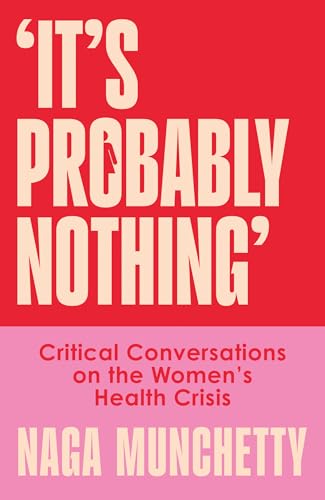
Throughout history, women's pain and health issues have often been dismissed and viewed simply as an innate part of being female. Whether blamed on a wandering womb, witchcraft or still, to this day, being 'all in our heads' – women's health has been consistently misunderstood. As a result women have, and still are, missing out on receiving the healthcare they deserve.
In ‘It’s Probably Nothing’, Naga Munchetty explores the difficulties of being heard, diagnosed and treated. She writes candidly about her own experience of poor care and speaks to women directly affected by undiagnosed and untreated health issues. Speaking to doctors and experts at every step of the way, Naga will uncover what people need to know and ask for when advocating for themselves and their loved ones.
Women deserve to be heard and have the healthcare they need to live full lives. This book places much overdue focus on how the system has been built without women in mind and the urgent need to balance the scales.
It’s the book you’ll want to press into everyone’s hands.
Fantastic! a must read for any woman who has felt like they weren't being listened to with regards to their own body. Full of useful anecdotes and information about how to ge the help you need. Empowering
I am not quite sure what this book is doing. But, the stories contained within, and the challenges those interviewed have faced with their health are at times distressing, profound and sadly all to be expected. My worry with it, is that it could easily be used by those looking to dismantle our health system and move to an insurance based service, which I am strongly against.
As someone with a chronic gynaecological health condition I can all too easily relate to the experiences contained within. But as a woman, I can also see how we have been continually let down by a health care system which prioritises research on men, male conditions and also not looking holistically to understand how our body's systems interact. I have my own stories to tell in this regard, some horrendous health care professionals, and some fantastic.
The book was very focused on the English health system, which was a shame and made some of it irrelevant, and it also made little to no mention of the ability of women to look beyond conventional treatments for alternative methods of managing symptoms, pain and their conditions. Whilst mindfulness and exercise did get a mention in specific places, I think more could have been discussed - or signposting to other sources which could have enabled women reading this book access other opportunities for their health care. I speak from experience of using dietary and herbal medicine to make a profound difference to the management of my endometriosis as well as learning to exercise smarter and when I am able to.
I appreciate all Naga has done to stimulate conversation around women's health care and how her interventions are changing practice for the better!
A good read, but not brilliant. I was so excited for this book as I have endometriosis and adenomyosis among other chronic illnesses and so thought this would be an interesting read. Bear in mind I have read pretty much ever women's health and endometriosis book that is out there.
Unfortunately this just didn't give the level of medical information or depth that I was hoping for. I also felt the book leaned too heavily on case studies of women that had shared their stories, which became rather repetitive. I also generally didn't like how some of the medical information flowed. At one point it read saying that adenomyosis isn't cured by a hysterectomy (which it is), whereas what Naga Munchetty must have meant is that her case wouldn't be cured as it looks like she has endometriosis too. So it wasn't quite right.
This is a perfectly good book for women or especially young women who have little knowledge about women's health and illnesses and the current women's health crisis. Sadly for me though, I found it lacking and that there are other much better similar books out there.
Hmmm this book is full of insight but also quite heavy.
As someone who wants children, I found the chapters on fertility and pregnancy particularly tough to read. The stories shared were eye opening but also left me feeling a bit anxious. This might not be the best choice for people with existing health anxieties, as it doesn’t shy away from the harsh realities many women face when navigating the healthcare system!
One thing that stood out to me was how many of the people interviewed had to turn to private healthcare. What happens to all the people who can’t afford to go private? I think that’s part of the point the author is trying to make but at times it felt like the book wasn’t fully representative of the broader population.
Being a woman in today’s healthcare landscape is no easy task. This book is a powerful reminder of that and while it’s not exactly a comforting read, it is an important one.
‘i don’t want to be angry any more. i want to be heard without having to cry, beg or be made to feel weak. i want to be listened to. so many women before us have fought to be heard. so many continue to do so. we don’t choose to fight. we’d rather not fight’
an absolutely incredible book. so well researched and written with so much care and respect
Naga Munchetty’s book entitled ‘“It’s Probably Nothing”: Critical Conversations on the Women’s Health Crisis’ is essential reading for everyone. Recounting her own experiences being discarded, gaslit and not taken seriously by countless medical professionals, Munchetty highlights just how challenging it is to be a woman at the best of times, but particularly when trying to self-advocate for our health.
Upon receiving her diagnosis of adenomyosis, Munchetty has become a voice and spokesperson for women’s health, and how important it is to take women’s health seriously, from sexual and menstrual health, to our mental and general, physical wellbeing. Throughout this book, she speaks with medical professionals, hearing from those who work first hand in the medical field, what it takes to advocate for oneself and loved ones, and how women’s health is not just ‘in our heads’.
What I particularly liked about this book was how inclusive it was. Despite the focus being around women’s health, she also focuses on the struggles that transgender, non-binary and members of the LGBTQIA+ community face too, when it comes to their health and wellbeing. Overall, this book was incredibly well-researched, taking the time to cater for all voices and making sure that everyone would feel represented within this book.
Such an important and empowering book for women. It's from a British perspective so references the NHS a lot, but the health system in New Zealand is quite similar so a lot of the advice and issues are incredibly relevant and applicable. The entrenched patriarchy in medicine is so concerning and I didn't realise how bad it was until: 1. I started working in healthcare and saw how many women are struggling for support from the health system. 2. A surgeon tried to talk me out of getting a surgery because I'm a young woman so having a scar on my stomach might bother me more than the pain the surgery was going to fix.
This book was helpful and insightful in a time I've felt quite despondent with healthcare. I thought it might go more into the lack of research around women's health, but still really enjoyed the more personal angle and general advice on how to get the most of GP appointments, advocating for yourself, hormones, etc.
I'm recommending this daily to the women around me.
"We are not men minus a penis and with a few female bits added on." Wow this book was a journey. It takes you through the medical research and diagnosis gap in women.
"The health service was designed by men for men. Women have been an afterthought." It does not read like an encyclopedia but more as a conversation with a very well researched bestie, and with loads of letters from actual people, that make you feel so much lesser alone. Disclaimer: this book is NOT written by a doctor, please visit a doctor for any diagnosis.
"The vagina is commonly seen as having 2 functions: accomodate a penis, expel a baby." The book goes through the experience of visiting doctors, women's health issues, hormones, periods, childbirth, infertility, menopause, mental health etc.
"Women are being told that symptoms such as heavy bleeding I so resonated eith the experiences of people who have PMDD and face suicidal thoughts on a monthly basis, I felt so much more heard and less crazy. Like many, I have never been officially diagnosed as well despite suffering several physical and mental symptoms, its always dismissed as "oh thats normal for women". And apparently not visiting a doctor when you don't feel right, and "toughing it up" is a universal women experience.
If you live in UK this book is a great source of NHS. tips and helplines.
In my opinion, this is essential reading for all women and anyone who works in healthcare (particularly in the UK as this where information and case studies have been gathered from). I gasped out loud multiple times when hearing some of the experiences of other women and I am now motivated to be more self-aware in order to enable better self-advocacy for my own healthcare in the future. I’ll also apply my learning to my work.
Overall, the contents were very informative, however I feel as though this book is just the beginning when it comes to actually progressing from outdated views, reducing gender bias and researching more into women’s health. In terms of the writing style, a lot of the information felt simplified, or as if it had been copied and pasted from other sources, and the actual structure of the book felt quite disorganised. I’d say it’s not the most well-written book, however it holds an important place and is worth a read.
An excellent and impactful read. I love how this book is structured, guiding the reader through the often-overlooked realities of women’s health with clarity and purpose. Munchetty shines a powerful light on the systemic issues that continue to affect how women are heard, treated, and supported within healthcare.
I found myself thinking about my own experiences, as well as my mum’s recent health challenges, and considering how I can better support my daughter as she grows up navigating these same systems.
It’s also a genuinely intersectional feminist work, drawing on a wide range of voices and experiences from women across the UK. At the same time, it remains deeply personal with Munchetty’s own story woven throughout.
I’d strongly recommend to anyone interested in women’s health, equality, and the lived experiences behind the statistics.
Wow! So many women I know, flashed through my mind as I read this. Naga Munchetty is putting women’s health on the radar, calling out a lack of funding, resource and education. What we don’t have language for, we can’t call out and get treated. Using her own, and other women’s experiences, she sheds light on the impact of this disparity in treat men on young girls from menstruation, all the way through to womanhood with contraception, fertility, pregnancy and the menopause all discussed.
An interesting, but anger inducing book all about women's health and the issues that come across when things go wrong Naga has really researched well, talking the professionals, but also providing advice on how to advocate for yourself and where to find your own guidance. The was a few repetitive sections, but it was informative and was quite emotional in places.
5 star topic, 3 star read - loving the general explosion of attention going to the gender health gap, but not quite sure what this book was trying to be. Accessible read, but the structure - part case studies, part guide on not being dismissed - felt jumbled. And I wish the focus went beyond just obs & gynae!
A profoundly open, honest and critical discussion on women’s health and the challenges faced by women of all ages relating to sexual and reproductive health. A must read for anyone who has a woman in their lives that they love.
Thank you Naga for giving me the best education on women’s health ever !! not sure it’s what I expected the book to be but was interesting none the less, some bits felt a lil rushed and could have had a bit more depth but all in all very interesting !!
A good handbook for anyone suffering with the conditions detailed, full of practical advice for handling appointments with unhelpful GPs. I think it would have benefitted from some more discussion of wider systemic issues around women's health, but that's just me being greedy. Munchetty compassionately documents a range of experiences and weaves her chapters together well.
This is 100% a must read, women’s healthcare is so massively under looked but I genuinely believe that this book will help me in the future if I ever need to represent myself in a healthcare setting.
An absolutely critical book about advocating for yourself in medicine, medical misogyny and misogynoir as well as how to support those around you who need advocating for as well. A must read.
A must read. Could have been more in depth and scientifically-backed, for a deeper understanding of women’s health issues, but I think that wasn’t the aim of this book. Naga’s own experiences are combined with tens of other women’s stories, and these are further backed by medical personnel’s expertise. It’s very encouraging and it does a great job raising awareness on how historically women’s bodies and their health issues have been neglected and their medical needs have gone unmet.
Everyone should read this! Even though 'It's Probably Nothing' is written by a British woman referencing British institutions like the NHS, it's still applicable to all. This would be a good book to study in schools during PSHE (Personal, Social, Health and Economic Education). I wish I'd had this book when I started my periods, for some that can be as early as 9 years old.
Naga Munchetty is surprisingly open and honest, non-judgemental and is adamant that no one should feel shame or embarrassment.
'It's Probably Nothing'covers medical misogyny and the medical conditions most commonly experienced by women over the course of their lifetimes, citing patient case studies from both men and women, anecdotes, and the doctors who treat us. It addresses the discrimination experienced due to age, race, gender, disability, class, and sexual orientation. It also highlights the lack of funding and research into female health conditions because men tend to control the purse strings and decide what can be researched. Although it covers a broad range of medical conditions, it gives enough detail about symptoms and treatments to be a good launchpad to start your own journey in identifying your own medical issues and seeking help for them.
My own experiences I found within these pages. From the strange girl-only talk at school about periods, to my own struggles to be diagnosed for possible fibroids (my mother and aunt have them), and advocating for my mother during health appointments for the past 13 years (the stories I could tell!). My problem is that I tend to push harder for my mother's health than I do my own.
Some may be shocked and upset by the case studies within; however, I've also had my fair share of appalling treatment by health professionals, so I sadly believed all of them.
'It's Probably Nothing' is the antithesis of The Age of Diagnosis: How Our Obsession with Medical Labels Is Making Us Sicker. Naga Munchetty's book is a breath of fresh air in comparison. More than a dozen doctors are cited, with their credentials listed in the acknowledgements. Patient experiences are valued. Mental health and neurodiversity are more accurately explained. The studies and statistics were better used and referenced in the endnotes, so that I trusted what I read. The irony that 'It's Probably Nothing' is written by a lay person and The Age of Diagnosis is written by a medical doctor is not lost on me.
This is an exceptional book in not only being educational, but also helping women to no longer feel alone, embarrassed and ashamed, and empowers them seek help when previously they may have been gaslit, told there is nothing wrong with them, or that no treatment is available.