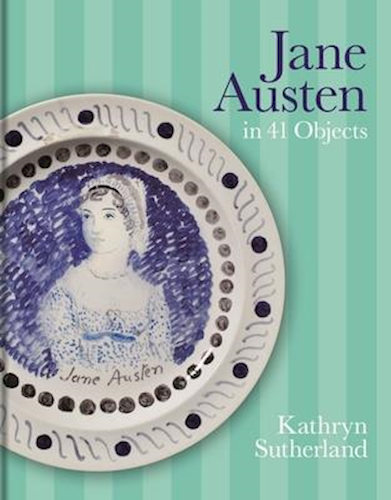
More than 200 years after Jane Austen’s death at the age of just forty-one, we are still looking for clues about this extraordinary writer’s life. What might we learn if we take a glimpse inside the biographies of objects that crossed her path in life and afterwards – things that she cherished or cast aside, or that furnished the world in which she moved, or that have themselves been inspired by her legacy?
Among objects described in this book are a teenage notebook, a muslin shawl, a wallpaper fragment, a tea caddy, the theatrical poster for a play she attended and the dining-room grate at Chawton Cottage where she lived. Poignantly, the last manuscript page of her unfinished novel and a lock of hair kept by her devoted sister, Cassandra, are also featured. Objects contributing to Jane Austen’s rich cultural legacy include a dinner plate decorated by Bloomsbury artists Vanessa Bell and Duncan Grant, Grayson Perry’s commemorative pot from 2009 and Mr Darcy’s wet shirt, worn by Colin Firth in the 1995 BBC adaptation.
This is a different kind of biography, in which objects with their own histories offer shifting entry points into Jane Austen’s life. Each object – illustrated in colour – invites us to meet Jane Austen at a particular moment when her life intersects with theirs, speaking eloquently of past lives and shedding new light on one of our best-loved authors.
An enjoyable read for the Austen aficionado. The tone is academic, but not too dry if you're already interested in the subject. I would describe the writing as incisive and unsentimental. Sutherland is skilled at keeping the reader clear on what we know and where there are gaps. She repeatedly points out how much distance lies between Austen and today's reader, how much distortion we are vulnerable to, and how motivated historical figures have been to canonize Saint Jane (see one of the objects, a literal cathedral window). In most cases there is a pleasing acknowledgment of the object's provenance (e.g., through which line of the Austen family an object traveled). Letters are reproduced at a legible size. It left me motivated to read Austen's juvenilia.
Here’s an interesting take on biography…41 objects. Whether you’re a Janeite or not, this gently deep look into Austen in 41 short, well-done chapters with lovely photos to accompany - this is the way to do it.
An interesting exploration of different objects, this book provides a glimpse of Jane Austen's life but leaves me wanting more. Excellent references to other sources that I will have to explore.
Interesting concept. A look at Austen through the lense of objects related to her, be it her likeness, her words, objects tied to her or works inspired by her, etc. Each chapter is given maybe four pages or so with an image of the object in question and tightly explains the providence, use, how it ties into Austen and what it's cultural connotations are.
A bit dry with the academic tone but certainly interesting when in the right headspace, and gives a lot of references for those who're interested in diving deeper.
As fan of Jane Austen I felt it was appropriate to read this book in the month of her birthday, and on the 250th anniversary of her birth. Jane Austen died at the age of 41, so this book by Sutherland collects 41 objects that were significant in her life, or significant in her subsequent legacy.
The objects collected here range from household objects from Jane's final residence, to items created in her memory after her death. Sutherland provides context and commentary around these items, as well as their history. This book was not as enjoyable to read, however, as I was hoping as Sutherland goes off on quite academic tangents regarding the knowability of Jane as a person and what her legacy means now. I understand wanting to provide a greater analysis of Austen than just a list of objects, but it makes the book read more like a textbook than something for Austen fans.
Quote from book: “Jane Austen invented a new voice for fiction: conversational and intimate.”
A review of “Jane Austen in 41 Objects” in 100 words by Catherine Stover
Jane Austen, born 250 years ago, was the first to write novels based on the everyday objects, language, routines, and concerns of women. Her books are realistic, observant, witty, and avant-garde. I have a feeling that she would have loved this biography. It doesn’t try to “explain” her life; rather, it offers “shifting entry points” into her life. Her stuff ignites my curiosity in a way that traditional historical information does not. I think it supports the point that the poet William Carlos Williams made when he said, “No ideas but in things.” This quirky collection of objects has enchanted me.
Work cited: Sutherland, Kathryn. Jane Austen in 41 Objects. Bodleian Library Publishing, 2025, p. 78.
This book was a magical transcendence into the world of Jane Austen. 41 objects are shared in brief chapters, complete with photos and descriptions. There are plenty of insights new to me into Austen, her life, her writings, and the legacy she has left behind.
And the best part? The author provides many opportunities for rabbit trails to explore other authors, artists, books, and museums. I appreciate walking away from this charming book with a more insatiable appetite and resources to quench that need for more Austen.
This book is both gorgeous and erudite. Sutherland spotlights 41 objects important to Jane Austen's life and work. Objects she touched like her little writing table, letters she wrote, a pelisse she wore, an unfinished manuscript, the grate where she made toast for breakfast, her tea caddy. These are relics of her life. Then there are the relics of her afterlife, including the white shirt Colin Firth took off to dive into the pond at Pemberley. Sutherland's astute commentary accompanies beautiful photographs of the objects. What emerges is a beautiful collage portrait.
A lovely look at a wide variety of items that were part of Jane Austen’s life and the life of the books that flowered after her young death, at 39. From one of her first letters (that survived) to her beloved sister, Cassandra, stretching clear to the iconic white shirt that clings so beautifully to Mr Darcy (Colin Firth) as he emerges from the lake at Pemberly. And so much in between. Delightful.
3.5 An interesting read, each chapter looks at a specific object in light of its connection to Austen, her family, her writing, her place in literature. So, both pictorial and brief text chapters on things like her writing desk, an Austen family quilt, wallpaper from the Austen home, and more with the author looking at the history and drawing connections.
Looks like a coffee table book and instead is a deeply intelligent use of objects as windows into cultural and environmental biography. Which makes a wonderfully interesting book sound like a staid cultural criticism, but it really is a book for the intellectually curious. Instead of 'here is Jane Austen's....", or "this is a play that J attended", it is "here is [X]...and the author expands on the meaning of the theatre at the time culturally, and how society at the time responded to the pressures of war, and the state of publishing and comparative incomes of novelists, and...and the fact that Mansfield Park is named after the abolitionist judge, and lots of other interesting points of view. Even the inclusion of costumes from 20th century adaptations was a springboard for discussion of the different 'ideal' of Darcy that developed to cater to modern audiences ...Yes, I loved this book.
Very interesting. Many of the objects highlighted here are currently in the Jane Austen museum/house in Chawton. I think it is fascinating that so many objects have been retrieved and saved for all of us to enjoy. Wouldn't Jane be tickled?
At times it was a little of a slog but it wasn't too bad. There was a couple of bits that were interesting, but I tabbed more things relating to the Bronte's rather than Jane herself. At least I know what colour the walls were at Steventon.
Very interesting read, helping to flesh out the largely unknown life of Jane Austen through objects she owned or that were common in her day and for her societal class.
One winds one’s way along the path of Austen’s life stopping off at various objects and discussing their meaning. I read this as part of Jane Austen July. Very enjoyable.
When we are gone, what objects do we leave behind that tell others who we were? 🕰️📚
This book explores forty-one objects connected to Jane Austen✍️. Published last year for the 250th anniversary of her birth 🎉, it’s fantastic. It moves from items that belonged to her to objects that shaped how she was perceived—like the only surviving drawing of her 🖼️. Apparently, she disliked the portrait, so we can’t be sure it truly reflects her or was simply her sister’s sketch.
The book offers insight into her novels and the social anxieties woven through them 👒💌. It also highlights how deeply she loved writing and how attached she was to her books—her “babies”—especially Emma ❤️📖.
I truly love this book and highly recommend it ✨. It’s beautifully illustrated 🎨 and full of rich, accessible information.