

What do you think?

A Wonderland of Words: Around the Word in 101 Essays
Words are power. Words are magic. Words are fun. Words are sexy. Words can move you to tears. Words can make you laugh. And words can show you the world and everything in it with clarity and depth as few other things can. In this gloriously entertaining book, one of our greatest wordsmiths (and self-proclaimed bibliophile) Shashi Tharoor takes us on a tour of the words, concepts, and particularities that constitute the sublime (and sometimes mystifying) wonderland of the English language.
He demystifies punctuation, guides us through the arcane rules of spelling and grammar, and explains a wide array of essential components of the language including acronyms, bacronyms, contronyms, oxymorons, kennings, metaphors, similes, idioms, euphemisms, palindromes, and much much more. He delves into the history and evolution of English, delights in its quirks, embraces its geographical variants, provides hilarious examples of its misuse around the world, is awed by the way in which the masters of literature use it, and revels in its beauty and grandeur. Passionate, learned, funny, and brilliantly readable, A Wonderland of Words is a book that will enchant and educate all those who delight in the English language.
He demystifies punctuation, guides us through the arcane rules of spelling and grammar, and explains a wide array of essential components of the language including acronyms, bacronyms, contronyms, oxymorons, kennings, metaphors, similes, idioms, euphemisms, palindromes, and much much more. He delves into the history and evolution of English, delights in its quirks, embraces its geographical variants, provides hilarious examples of its misuse around the world, is awed by the way in which the masters of literature use it, and revels in its beauty and grandeur. Passionate, learned, funny, and brilliantly readable, A Wonderland of Words is a book that will enchant and educate all those who delight in the English language.
470 pages, Hardcover
Published August 30, 2024
About the author
Shashi Tharoor
84 books3,153 followersShashi Tharoor is a member of the Indian Parliament from the Thiruvananthapuram constituency in Kerala. He previously served as the United Nations Under-Secretary General for Communications and Public Information and as the Indian Minister of State for External Affairs.
He is also a prolific author, columnist, journalist and a human rights advocate.
He has served on the Board of Overseers of the Fletcher School of Law and Diplomacy at Tufts University. He is also an adviser to the International Committee of the Red Cross in Geneva and a Fellow of the New York Institute of the Humanities at New York University. He has also served as a trustee of the Aspen Institute, and the Advisory of the Indo-American Arts Council, the American India Foundation, the World Policy Journal, the Virtue Foundation and the human rights organization Breakthrough He is also a Patron of the Dubai Modern High School and the managing trustee of the Chandran Tharoor Foundation which he founded with his family and friends in the name of his late father, Chandran Tharoor.
Tharoor has written numerous books in English. Most of his literary creations are centred on Indian themes and they are markedly “Indo-nostalgic.” Perhaps his most famous work is The Great Indian Novel, published in 1989, in which he uses the narrative and theme of the famous Indian epic Mahabharata to weave a satirical story of Indian life in a non-linear mode with the characters drawn from the Indian Independence Movement. His novel Show Business (1992) was made into the film 'Bollywood'(1994). The late Ismail Merchant had announced his wish to make a film of Tharoor’s novel Riot shortly before Merchant’s death in 2005.
Tharoor has been a highly-regarded columnist in each of India's three best-known English-language newspapers, most recently for The Hindu newspaper (2001–2008) and in a weekly column, “Shashi on Sunday,” in the Times of India (January 2007 – December 2008). Following his resignation as Minister of State for External Affairs, he began a fortnightly column on foreign policy issues in the "Deccan Chronicle". Previously he was a columnist for the Gentleman magazine and the Indian Express newspaper, as well as a frequent contributor to Newsweek International and the International Herald Tribune. His Op-Eds and book reviews have appeared in the Washington Post, the New York Times and the Los Angeles Times, amongst other papers.
Tharoor began writing at the age of 6 and his first published story appeared in the “Bharat Jyoti”, the Sunday edition of the "Free press Journal", in Mumbai at age 10. His World War II adventure novel Operation Bellows, inspired by the Biggles books, was serialized in the Junior Statesman starting a week before his 11th birthday. Each of his books has been a best-seller in India. The Great Indian Novel is currently in its 28th edition in India and his newest volume. The Elephant, the Tiger and the Cellphone has undergone seven hardback re-printings there.
Tharoor has lectured widely on India, and is often quoted for his observations, including, "India is not, as people keep calling it, an underdeveloped country, but rather, in the context of its history and cultural heritage, a highly developed one in an advanced state of decay.". He has also coined a memorable comparison of India's "thali" to the American "melting pot": "If America is a melting pot, then to me India is a thali--a selection of sumptuous dishes in different bowls. Each tastes different, and does not necessarily mix with the next, but they belong together on the same plate, and they complement each other in making the meal a satisfying repast."
He is also a prolific author, columnist, journalist and a human rights advocate.
He has served on the Board of Overseers of the Fletcher School of Law and Diplomacy at Tufts University. He is also an adviser to the International Committee of the Red Cross in Geneva and a Fellow of the New York Institute of the Humanities at New York University. He has also served as a trustee of the Aspen Institute, and the Advisory of the Indo-American Arts Council, the American India Foundation, the World Policy Journal, the Virtue Foundation and the human rights organization Breakthrough He is also a Patron of the Dubai Modern High School and the managing trustee of the Chandran Tharoor Foundation which he founded with his family and friends in the name of his late father, Chandran Tharoor.
Tharoor has written numerous books in English. Most of his literary creations are centred on Indian themes and they are markedly “Indo-nostalgic.” Perhaps his most famous work is The Great Indian Novel, published in 1989, in which he uses the narrative and theme of the famous Indian epic Mahabharata to weave a satirical story of Indian life in a non-linear mode with the characters drawn from the Indian Independence Movement. His novel Show Business (1992) was made into the film 'Bollywood'(1994). The late Ismail Merchant had announced his wish to make a film of Tharoor’s novel Riot shortly before Merchant’s death in 2005.
Tharoor has been a highly-regarded columnist in each of India's three best-known English-language newspapers, most recently for The Hindu newspaper (2001–2008) and in a weekly column, “Shashi on Sunday,” in the Times of India (January 2007 – December 2008). Following his resignation as Minister of State for External Affairs, he began a fortnightly column on foreign policy issues in the "Deccan Chronicle". Previously he was a columnist for the Gentleman magazine and the Indian Express newspaper, as well as a frequent contributor to Newsweek International and the International Herald Tribune. His Op-Eds and book reviews have appeared in the Washington Post, the New York Times and the Los Angeles Times, amongst other papers.
Tharoor began writing at the age of 6 and his first published story appeared in the “Bharat Jyoti”, the Sunday edition of the "Free press Journal", in Mumbai at age 10. His World War II adventure novel Operation Bellows, inspired by the Biggles books, was serialized in the Junior Statesman starting a week before his 11th birthday. Each of his books has been a best-seller in India. The Great Indian Novel is currently in its 28th edition in India and his newest volume. The Elephant, the Tiger and the Cellphone has undergone seven hardback re-printings there.
Tharoor has lectured widely on India, and is often quoted for his observations, including, "India is not, as people keep calling it, an underdeveloped country, but rather, in the context of its history and cultural heritage, a highly developed one in an advanced state of decay.". He has also coined a memorable comparison of India's "thali" to the American "melting pot": "If America is a melting pot, then to me India is a thali--a selection of sumptuous dishes in different bowls. Each tastes different, and does not necessarily mix with the next, but they belong together on the same plate, and they complement each other in making the meal a satisfying repast."
Ratings & Reviews
Friends & Following
Create a free account to discover what your friends think of this book!
Community Reviews
Displaying 1 - 30 of 41 reviews

December 17, 2025
This was my 4th Shashi Tharoor book, and one thing I can say for sure that I've thoroughly enjoyed
each one of them. Tharoor, both as an orator and as a writer possesses a rare blend of profound eloquence and pithy cogency.
Regarding this book, I had purchased it last year, but it had been languishing (so called - learning new words - kudos Mr. Tharoor ! ) in my 'TBR' case since then.
I started reading it last month and it has really been an excellent read for me. The book is titled
'A wonderland of words' and it not just deals delightly with words and language in the form of 101 magnificently crafted essays, but parallelly captures the nuances, idiosyncrasies, and exceptions
of the language that make it all the more fascinating.
I hold Tharoor's writings in very high regard ( and off-course as an inspiration) and every time you read one of his works (or listen to one of his speeches), you're bound to become an inch more intelligent, and an inch more informative, and an inch more humorous and an inch more witty....
5/5 !
each one of them. Tharoor, both as an orator and as a writer possesses a rare blend of profound eloquence and pithy cogency.
Regarding this book, I had purchased it last year, but it had been languishing (so called - learning new words - kudos Mr. Tharoor ! ) in my 'TBR' case since then.
I started reading it last month and it has really been an excellent read for me. The book is titled
'A wonderland of words' and it not just deals delightly with words and language in the form of 101 magnificently crafted essays, but parallelly captures the nuances, idiosyncrasies, and exceptions
of the language that make it all the more fascinating.
I hold Tharoor's writings in very high regard ( and off-course as an inspiration) and every time you read one of his works (or listen to one of his speeches), you're bound to become an inch more intelligent, and an inch more informative, and an inch more humorous and an inch more witty....
5/5 !

March 18, 2025
What a book! A pure delight for the logophiles of the English language! This book, ‘A Wonderland of Words: Around the Word in 101 Essays’, by Shashi Tharoor as the name indicates is the compilation of hundred and one essays that were written by him in The Khaleej Times. The book entertains the reader by capturing the nuances, idiosyncrasies, and exceptions among other things that are found in the language, which has become the lingua franca of the world. It’s truly a ‘Wonderland of Words’.
I bought this book after watching Karan Thapar’s show on The Wire, interviewing the author, Shashi Tharoor, about the book. I read it slowly, around a couple of chapters daily, like someone who would go on to relish a dessert after a meal. Reading the book was similar to having one’s favorite ice cream, or a cake 😂. Not only did I learn about the origins of a number of new words, increasing my vocabulary, but also the tales behind the prevalent idioms in the language. This is the book that I plan to pick up every now and then to entertain myself with the intricacies that are found in the English language. It’s the first book that I read by the author and I plan to read more of his work. I give the book ⭐⭐⭐⭐⭐
I bought this book after watching Karan Thapar’s show on The Wire, interviewing the author, Shashi Tharoor, about the book. I read it slowly, around a couple of chapters daily, like someone who would go on to relish a dessert after a meal. Reading the book was similar to having one’s favorite ice cream, or a cake 😂. Not only did I learn about the origins of a number of new words, increasing my vocabulary, but also the tales behind the prevalent idioms in the language. This is the book that I plan to pick up every now and then to entertain myself with the intricacies that are found in the English language. It’s the first book that I read by the author and I plan to read more of his work. I give the book ⭐⭐⭐⭐⭐

June 28, 2025
A book about words, with various origins and stories behind them. Bits of history is thrown in with signature cheeky Tharoor bite.

November 7, 2024
WOW ! It's the kind of book, I have been waiting for all these years, and finally my wait is over. It's not just a book , it is a treasure house in wonderland. Great collection, indeed, of different words, their origins and their usage in different situations. Looks as if this is how the the words ornate any language. I am so thrilled by the book, that I want to read it again and again. Thanks to the wordsmith, for creating a book, words-worth ! !
It is right food for a language maven or any word nerd who can easily devour nearly a book of 500 pages.
It is right food for a language maven or any word nerd who can easily devour nearly a book of 500 pages.
December 18, 2024
What a fun read! The power of language - to express the rarest of situations, certain tricky nuances, to influence fellow languages and make an indelible mark. A beautiful journey through the landscape of words in English language.
November 18, 2024
Tharoor's dedicated columns in the Khaleej Times are the major source of these essays and with this compilation, Tharoor has sweetly encashed on his inflated reputation as a vocabularist.
If you're a 'milver' or you know someone who is, this book is for you or could be an ideal gift to them. Tharoor writes in the introduction about his father as his 'milver' (a person who shares a strong interest in words with others) for invoking in him an indefatigable love for English neologisms. I liked the first section Borrowed Plumes the most in which he shows the porosity in English language as it constantly borrows words from other languages. He shows the litany of foreign words in English – from Irish (eg. the most obvious ones being Whiskey, bog, shamrock, then the less famous ones like galore, hooligans and other phrases like 'chancing your arm' are deeply rooted in the Irish culture and geography), German words (schadenfreude , bildungsroman, zeitgeist ,angst, wanderlust, realpolitik, hinterland etc to name a few) , French words' domination in the vocabulary of politics and economics ( like money, treasury, exchequer, finance, commerce or even tax and the famous political terms like coup d'etat, diplomacy, alliance, accord etc) French words dynamically range in cuisine and art too, Japanese words (tsundoku- the big pile of books one buys but doesn't read, honcho, majime, karaoke and even rickshaw to name a few) to other languages like apartheid from Afrikaans, algebra from Arabic, gung-ho from Chinese , jukebox from Gullah, grammar from Greek apart from thousands of other borrowed Greek words, flamingo, brinjal from Portuguese, hurricane from Spanish etc . He shows the historicity, shares anecdotes and myths behind the etymologies of many words and idioms, even shows the regional variation in English, making it a language whose “commonality” ironically divides. For instance how you need to 'mail' letters in the US while you must 'post' letters in the UK.
With this unique flexibility and accommodative qualities, English is rightly the Esperanto of the times.
He even talks about how one could also find English , when compared to other languages, incapacitated to describe certain feelings as it doesn't have adequate words for it.
In the next sections, he talks about the idiosyncrasies of the language from its grammar, to spellings, to punctuations , to it's vagaries like ablautreduplication.
Then he has devotedly written about typos and misprints and the infamous crash blossoms of famous newspapers that have been indelibly recorded in the annals of literary history. The anecdotes are embarrassingly funny and, on certain occasions, unrequired. His own long career as a diplomat has led him to include chapters on Diplo-speak, legalese, war words and environmental terminologies. With climate change all set to irreversibly change the environment and AI to touch human lives in deeper and more intricate ways, it's obvious that the future lexicon shall see itself brimming with climate and techno terms. Then he talks about the euphemisms, the dysphemisms, the inappropriate words, the hated words, the insulting words, the insinuations. Then about the prized literary devices of the language, the nefarious acronyms and the tickling word plays in anagrams, aptagrams , the paraprosdokians and the widely known puns and metaphors, devices routinely employed in political speeches. A few chapters like Spoonerism, Bacronyms, Ambiguity felt unnecessary. The colonial heritage of English has even led some narcissists to an entitlement for their stupid misreadings. Spoonerism is one of them and it wasn't necessary to deliberate on those. At times, the chapters even read like a 'Did you know?', like an assortment of unrelated and unrequired facts.
Since he talks at length about literary devices, therefore there are copious references of writers that flourished during and after the industrial revolution, who should be lauded for enriching the language and at the same time, rendering it with an artificiality and superfluousness. Tharoor’s formative years are evidently influenced by them and hence the profusion of such references. He has a deep veneration for Wodehouse too and the Wodehousian legacy of breaking the basic tenets of the language.
Then he takes up a more serious venture, talking about the language of equity and inclusion. While I do partly understand his POV on wokeism which at times is ineffectually outstretched but on certain occasions, I disagree with him too. For instance , he finds the usage of gender neutral terms like parent over mother and father stupid. He finds the latter terms innocuous and naturally ordained in the language but he is unaware on how these words especially 'mother' is a carrier of centuries of undistributed burden of parenting on the bearer of the term, how in the garb of an innocuous language, there can be an irreversible culture of imposing unreal expectations amounting to unpaid labor which hideously works through patriarchal schemes. If the person themselves consents to be called a mother/father, there should be no objection but I think it's high time we prefer to use gender neutral terms. In other instances, when Tharoor talks, for example, about the Stanford guide to language of equity, there are rules which are far-fetched and can even lead to curbing genuine expressions. I agree on that front.
Also, I am not fond of the style in which he ends the chapters. It might sound atrociously funny and witty in his head but are unfortunately not translated with the same candour. His humour, at times, borders casual sexism and more than that is septuagenarian. At some points when he perfectly retrieves an old joke, the text reads funny.
I am also amazed he doesn't talk about pronouns during a time when identities are striving towards their emancipation. At the same time, he is abreast with the gen z and gen alpha terminologies.
Finally, to build a rich vocabulary, one has to be consistently reading and despite people claiming that children or young adults of the current generations are reading way more than their previous ones for they are always exposed to a screen , Tharoor reminds us of the caveat on how their rapid consumption of content allows them only to read rapidly, carelessly and superficially which has its own deleterious effects.
I am an old millennial born in such an eventful intersecting times when my entire life has been a witness to transitions so much so that I feel the injunction of the times to stay well informed. To be well informed is to be well armed ,as my generation believes. And at the same time, I struggle against a forgetfulness and legologica that the times invariably lead one to. In this book, I found little savouries of language, some information I can't promise to preserve and some relatability in words like bibliosmia, delitrium, book-bosommed , librocubicularist and then, just as English borrows terms from Russia to name a void, razbliuto - the vaccuous feeling that lingers when one doesn't feel love for something one once loved, a perpetual feeling me and my generation constantly struggle with.
If you're a 'milver' or you know someone who is, this book is for you or could be an ideal gift to them. Tharoor writes in the introduction about his father as his 'milver' (a person who shares a strong interest in words with others) for invoking in him an indefatigable love for English neologisms. I liked the first section Borrowed Plumes the most in which he shows the porosity in English language as it constantly borrows words from other languages. He shows the litany of foreign words in English – from Irish (eg. the most obvious ones being Whiskey, bog, shamrock, then the less famous ones like galore, hooligans and other phrases like 'chancing your arm' are deeply rooted in the Irish culture and geography), German words (schadenfreude , bildungsroman, zeitgeist ,angst, wanderlust, realpolitik, hinterland etc to name a few) , French words' domination in the vocabulary of politics and economics ( like money, treasury, exchequer, finance, commerce or even tax and the famous political terms like coup d'etat, diplomacy, alliance, accord etc) French words dynamically range in cuisine and art too, Japanese words (tsundoku- the big pile of books one buys but doesn't read, honcho, majime, karaoke and even rickshaw to name a few) to other languages like apartheid from Afrikaans, algebra from Arabic, gung-ho from Chinese , jukebox from Gullah, grammar from Greek apart from thousands of other borrowed Greek words, flamingo, brinjal from Portuguese, hurricane from Spanish etc . He shows the historicity, shares anecdotes and myths behind the etymologies of many words and idioms, even shows the regional variation in English, making it a language whose “commonality” ironically divides. For instance how you need to 'mail' letters in the US while you must 'post' letters in the UK.
With this unique flexibility and accommodative qualities, English is rightly the Esperanto of the times.
He even talks about how one could also find English , when compared to other languages, incapacitated to describe certain feelings as it doesn't have adequate words for it.
In the next sections, he talks about the idiosyncrasies of the language from its grammar, to spellings, to punctuations , to it's vagaries like ablautreduplication.
Then he has devotedly written about typos and misprints and the infamous crash blossoms of famous newspapers that have been indelibly recorded in the annals of literary history. The anecdotes are embarrassingly funny and, on certain occasions, unrequired. His own long career as a diplomat has led him to include chapters on Diplo-speak, legalese, war words and environmental terminologies. With climate change all set to irreversibly change the environment and AI to touch human lives in deeper and more intricate ways, it's obvious that the future lexicon shall see itself brimming with climate and techno terms. Then he talks about the euphemisms, the dysphemisms, the inappropriate words, the hated words, the insulting words, the insinuations. Then about the prized literary devices of the language, the nefarious acronyms and the tickling word plays in anagrams, aptagrams , the paraprosdokians and the widely known puns and metaphors, devices routinely employed in political speeches. A few chapters like Spoonerism, Bacronyms, Ambiguity felt unnecessary. The colonial heritage of English has even led some narcissists to an entitlement for their stupid misreadings. Spoonerism is one of them and it wasn't necessary to deliberate on those. At times, the chapters even read like a 'Did you know?', like an assortment of unrelated and unrequired facts.
Since he talks at length about literary devices, therefore there are copious references of writers that flourished during and after the industrial revolution, who should be lauded for enriching the language and at the same time, rendering it with an artificiality and superfluousness. Tharoor’s formative years are evidently influenced by them and hence the profusion of such references. He has a deep veneration for Wodehouse too and the Wodehousian legacy of breaking the basic tenets of the language.
Then he takes up a more serious venture, talking about the language of equity and inclusion. While I do partly understand his POV on wokeism which at times is ineffectually outstretched but on certain occasions, I disagree with him too. For instance , he finds the usage of gender neutral terms like parent over mother and father stupid. He finds the latter terms innocuous and naturally ordained in the language but he is unaware on how these words especially 'mother' is a carrier of centuries of undistributed burden of parenting on the bearer of the term, how in the garb of an innocuous language, there can be an irreversible culture of imposing unreal expectations amounting to unpaid labor which hideously works through patriarchal schemes. If the person themselves consents to be called a mother/father, there should be no objection but I think it's high time we prefer to use gender neutral terms. In other instances, when Tharoor talks, for example, about the Stanford guide to language of equity, there are rules which are far-fetched and can even lead to curbing genuine expressions. I agree on that front.
Also, I am not fond of the style in which he ends the chapters. It might sound atrociously funny and witty in his head but are unfortunately not translated with the same candour. His humour, at times, borders casual sexism and more than that is septuagenarian. At some points when he perfectly retrieves an old joke, the text reads funny.
I am also amazed he doesn't talk about pronouns during a time when identities are striving towards their emancipation. At the same time, he is abreast with the gen z and gen alpha terminologies.
Finally, to build a rich vocabulary, one has to be consistently reading and despite people claiming that children or young adults of the current generations are reading way more than their previous ones for they are always exposed to a screen , Tharoor reminds us of the caveat on how their rapid consumption of content allows them only to read rapidly, carelessly and superficially which has its own deleterious effects.
I am an old millennial born in such an eventful intersecting times when my entire life has been a witness to transitions so much so that I feel the injunction of the times to stay well informed. To be well informed is to be well armed ,as my generation believes. And at the same time, I struggle against a forgetfulness and legologica that the times invariably lead one to. In this book, I found little savouries of language, some information I can't promise to preserve and some relatability in words like bibliosmia, delitrium, book-bosommed , librocubicularist and then, just as English borrows terms from Russia to name a void, razbliuto - the vaccuous feeling that lingers when one doesn't feel love for something one once loved, a perpetual feeling me and my generation constantly struggle with.

March 3, 2025
Just a book of trivia for those who love the English language.

August 14, 2025
The humour and non-preachy tone makes his writings interesting. Though some essays I already read before as (part of) articles or in Tharoorosaurus, it was mostly engaging anyways. As he gave meaning of words and phrases, I didn't have to scurry to look up words every 2mins (except for the latter essays). The essay on words for emotions that doesn't exist in Eng language was my fav one in this collection. Ngl, holding up his book gives you amused looks from other readers.

March 10, 2025
This is a delightful book about the many charms of the English Language. Tharoor's writing is playful, witty and always readable. Even when the topic veers towards the abstruse, he manages to hold the reader's interest. This book is best taken in small morsels. However given the quality of writing, you may end up taking more than a mouthful.

September 6, 2024
Oh man I love nerds but word nerds are my favourite. I say this because I am one.
May 25, 2025
A Deep Dive into the History and Lesser-Known Facets of the English Language
I had previously read books about books, but this was my first that focused solely on the words of the English language. We often take the words and phrases used in everyday conversation for granted and rarely pause to consider their etymology. The author compels you to do just that—and manages to keep things engaging without becoming overly technical (or shall I say esoteric, since this book is bound to expand your vocabulary with fancier words).
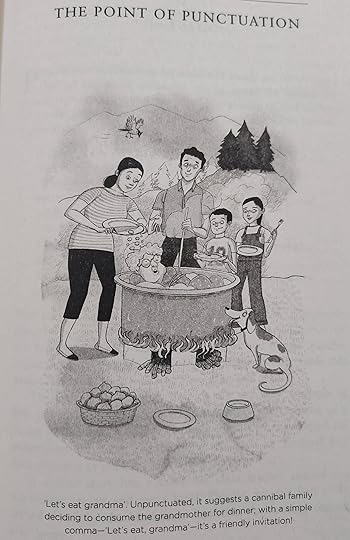
Each essay is typically 2–3 pages long, and you can easily read four or five at a stretch, especially if you're in the habit of bedtime reading. Although many of these essays were originally written for a regular column in the Khaleej Times, the book doesn’t feel disjointed. Each of the 12 chapters begins with a witty illustration—the following one on the importance of punctuation is sure to stay with me for a long time!
Most essays are full of previously unknown language insights. You'll discover the origin of the phrase “The buck stops here” and learn how English has borrowed words from across the globe. There are essays on intriguing linguistic categories like “kangaroo words,” “unpaired words,” and “plastic words.” The book is also peppered with memorable quotes such as this one from Rumi: “Raise your words, not your voice. It’s the rain that grows flowers, not the thunder.”
Highly recommended for anyone with a flair for linguistic history.
I had previously read books about books, but this was my first that focused solely on the words of the English language. We often take the words and phrases used in everyday conversation for granted and rarely pause to consider their etymology. The author compels you to do just that—and manages to keep things engaging without becoming overly technical (or shall I say esoteric, since this book is bound to expand your vocabulary with fancier words).
Each essay is typically 2–3 pages long, and you can easily read four or five at a stretch, especially if you're in the habit of bedtime reading. Although many of these essays were originally written for a regular column in the Khaleej Times, the book doesn’t feel disjointed. Each of the 12 chapters begins with a witty illustration—the following one on the importance of punctuation is sure to stay with me for a long time!
Most essays are full of previously unknown language insights. You'll discover the origin of the phrase “The buck stops here” and learn how English has borrowed words from across the globe. There are essays on intriguing linguistic categories like “kangaroo words,” “unpaired words,” and “plastic words.” The book is also peppered with memorable quotes such as this one from Rumi: “Raise your words, not your voice. It’s the rain that grows flowers, not the thunder.”
Highly recommended for anyone with a flair for linguistic history.

May 16, 2026
A Wonderland of Words begins with the kind of effervescent, sesquipedalian exuberance that makes one briefly surrender to its linguistic grandiloquence without resistance. The earlier essays possess genuine wit and intellectual playfulness, not merely flaunting obscure vocabulary but animating it with anecdote, historical asides, and that distinctly patrician conversational cadence which Tharoor has almost turned into a literary signature. There are moments where the prose feels delightfully recondite yet oddly companionable, as though one were listening to an impossibly well-read raconteur wandering through the labyrinthine bylanes of the English language after dinner.
But the enchantment gradually diminishes. Somewhere in the latter half, the book ceases to feel exploratory and starts resembling a compendium of lexical curios arranged with increasing self-awareness. The essays become more classificatory than evocative, more interested in the taxonomy of words than in the worlds they might illuminate. One begins to sense accumulation instead of discovery. The prose remains impeccably ornamented, certainly, but ornament alone can induce a kind of rhetorical satiety.
Which is perhaps why I kept thinking of how much more compelling he can be elsewhere. His finest work has always emerged when his formidable verbal dexterity is tethered to narrative, history, politics, or personal anecdote. Here, too often, the words themselves become both subject and destination. Pleasant in fragments, undeniably learned, but ultimately less memorable than the stories he is capable of telling when he allows language to serve something larger than itself.
But the enchantment gradually diminishes. Somewhere in the latter half, the book ceases to feel exploratory and starts resembling a compendium of lexical curios arranged with increasing self-awareness. The essays become more classificatory than evocative, more interested in the taxonomy of words than in the worlds they might illuminate. One begins to sense accumulation instead of discovery. The prose remains impeccably ornamented, certainly, but ornament alone can induce a kind of rhetorical satiety.
Which is perhaps why I kept thinking of how much more compelling he can be elsewhere. His finest work has always emerged when his formidable verbal dexterity is tethered to narrative, history, politics, or personal anecdote. Here, too often, the words themselves become both subject and destination. Pleasant in fragments, undeniably learned, but ultimately less memorable than the stories he is capable of telling when he allows language to serve something larger than itself.

November 25, 2024
Wonderland of Words by Shashi Tharoor is a delightful exploration of the intricacies of the English language, offering readers a vibrant and humorous journey through words, grammar, and all the peculiarities that make the language so fascinating. As a well-known orator and wordsmith, Tharoor brings his passion for language to the forefront, revealing not just the beauty of English but also its quirks and idiosyncrasies.
In this book, Tharoor skillfully demystifies grammar, spelling, and punctuation, all while maintaining a witty and engaging tone. He tackles concepts like acronyms, palindromes, oxymorons, and metaphors, making them accessible even to readers who may not be language enthusiasts. What sets this book apart is the author’s deep appreciation for the flexibility and fluidity of English, evident as he embraces its geographical variations and marvels at its evolution through time.
While the content is educational, the playful approach to language ensures that it remains an entertaining read. The book also comes in a visually stunning package, though some readers might find the physical page quality lacking. However, this minor flaw does not detract from the overall value of the book. In summary, Wonderland of Words is a must-read for anyone who revels in the magic of language, offering both enlightenment and entertainment in equal measure. Shashi Tharoor, as always, lives up to his reputation.
In this book, Tharoor skillfully demystifies grammar, spelling, and punctuation, all while maintaining a witty and engaging tone. He tackles concepts like acronyms, palindromes, oxymorons, and metaphors, making them accessible even to readers who may not be language enthusiasts. What sets this book apart is the author’s deep appreciation for the flexibility and fluidity of English, evident as he embraces its geographical variations and marvels at its evolution through time.
While the content is educational, the playful approach to language ensures that it remains an entertaining read. The book also comes in a visually stunning package, though some readers might find the physical page quality lacking. However, this minor flaw does not detract from the overall value of the book. In summary, Wonderland of Words is a must-read for anyone who revels in the magic of language, offering both enlightenment and entertainment in equal measure. Shashi Tharoor, as always, lives up to his reputation.
December 8, 2024
Shashi Tharoor's A Wonderland Of Words is a collection of essays, most of which were previously published in his column in Khaleej Times but have been 'touched up' for this book. It is a very fun read, and as expected, witty and well written
I liked the first section - borrowed plumes - a lot. It talks of the various languages that have influenced English and how the language itself has evolved differently in various parts of the world.
Ablautreduplication , OSASCOMP, pleonasm and zeugma - were just some concepts that while I knew practically (and am often guilty of using or misusing, as the case may be) I fascinatedly learnt the words/terms that exist for them!
I can't say every essay was particularly exciting or interesting (eg. The Language Of Love, Mixed Metaphors), and tbh (one of the acronyms Mr. Tharoor groused with) the content of some were fairly elementary (Red Herrings, Hyberbole, etc).
Yet, I enjoyed most, and my favourites were
Literary Insults (in which Tharoor related some of literature's greatest insults; how I wish I was witty enough or had the vocabulary to be able to use or come up with even one of them), Books And Reading (many beautiful words for readers) and Misprints (badly worded headlines in newspapers).
I recommend this book to anyone who enjoys the English language. And an added bonus, my bookworm 10-years old is also thoroughly enjoying it now!
I liked the first section - borrowed plumes - a lot. It talks of the various languages that have influenced English and how the language itself has evolved differently in various parts of the world.
Ablautreduplication , OSASCOMP, pleonasm and zeugma - were just some concepts that while I knew practically (and am often guilty of using or misusing, as the case may be) I fascinatedly learnt the words/terms that exist for them!
I can't say every essay was particularly exciting or interesting (eg. The Language Of Love, Mixed Metaphors), and tbh (one of the acronyms Mr. Tharoor groused with) the content of some were fairly elementary (Red Herrings, Hyberbole, etc).
Yet, I enjoyed most, and my favourites were
Literary Insults (in which Tharoor related some of literature's greatest insults; how I wish I was witty enough or had the vocabulary to be able to use or come up with even one of them), Books And Reading (many beautiful words for readers) and Misprints (badly worded headlines in newspapers).
I recommend this book to anyone who enjoys the English language. And an added bonus, my bookworm 10-years old is also thoroughly enjoying it now!

July 27, 2025
🌟 Review: A Wonderland of Words by Shashi Tharoor 🌟
⭐️⭐️⭐️⭐️☆ (4/5)
In A Wonderland of Words, Shashi Tharoor delivers yet another masterclass in language, wit, and erudition. This collection is a delightful tribute to the richness of the English language, blending Tharoor’s trademark eloquence with humor and insight. Whether you’re a lover of etymology, a fan of literary flair, or simply intrigued by the curious quirks of English, this book has something to offer.
The essays and short pieces range from reflections on word origins to musings on the evolution of Indian English, all stitched together with a love for language that’s both infectious and illuminating. Tharoor’s extensive vocabulary and unapologetic verbosity might feel dense at times, but that’s part of the charm—he celebrates complexity rather than shies away from it.
What stands out most is Tharoor’s ability to be both playful and profound. He doesn’t just show off big words; he makes a case for why they matter, how they enrich our thinking, and how language shapes our world. A few chapters might feel more like linguistic indulgence than structured essays, but the overall effect is one of joyful scholarship.
Recommended for: word nerds, Tharoor fans, linguaphiles, and anyone who enjoys being both entertained and educated.
⭐️⭐️⭐️⭐️☆ (4/5)
In A Wonderland of Words, Shashi Tharoor delivers yet another masterclass in language, wit, and erudition. This collection is a delightful tribute to the richness of the English language, blending Tharoor’s trademark eloquence with humor and insight. Whether you’re a lover of etymology, a fan of literary flair, or simply intrigued by the curious quirks of English, this book has something to offer.
The essays and short pieces range from reflections on word origins to musings on the evolution of Indian English, all stitched together with a love for language that’s both infectious and illuminating. Tharoor’s extensive vocabulary and unapologetic verbosity might feel dense at times, but that’s part of the charm—he celebrates complexity rather than shies away from it.
What stands out most is Tharoor’s ability to be both playful and profound. He doesn’t just show off big words; he makes a case for why they matter, how they enrich our thinking, and how language shapes our world. A few chapters might feel more like linguistic indulgence than structured essays, but the overall effect is one of joyful scholarship.
Recommended for: word nerds, Tharoor fans, linguaphiles, and anyone who enjoys being both entertained and educated.

May 7, 2025
This is a delightful book to read, a few chapters or essays at a time. It is arranged in 13 logical chapters.
I mentioned this book when I had an overseas speaker on the phone: "Oh, I know Shashi Tharoor. He is a very famous man in India."
English is the number one foreign language learned throughout the world and it is the official language in many countries. I can text my friend in Ghana, discuss our gardens with another in India. I worked in shipping. A ships manifest must be in English so that port captains would know what was being carried in the vessel. Would we fly internationally on a plane with a pilot who did not know English to communicate with the officers in an airport tower? No country liked being an English colony but thanks to the British, they gave us a means of international communication.
But really, my friends, English is such a difficult language to spell, to pronounce, to use. Perhaps people learn it because it is a challenge. It certainly is a "Wonderland of Words."
I mentioned this book when I had an overseas speaker on the phone: "Oh, I know Shashi Tharoor. He is a very famous man in India."
English is the number one foreign language learned throughout the world and it is the official language in many countries. I can text my friend in Ghana, discuss our gardens with another in India. I worked in shipping. A ships manifest must be in English so that port captains would know what was being carried in the vessel. Would we fly internationally on a plane with a pilot who did not know English to communicate with the officers in an airport tower? No country liked being an English colony but thanks to the British, they gave us a means of international communication.
But really, my friends, English is such a difficult language to spell, to pronounce, to use. Perhaps people learn it because it is a challenge. It certainly is a "Wonderland of Words."
March 8, 2026
Finding My Limen in a Desert of Data
Reading Shashi Tharoor’s A Wonderland of Words felt less like a literary task and more like a thalassic plunge into a sea of hidden meanings. In an era of linguistic paucity, where our communication has become increasingly laconic and bleached of color, this book arrived as a true refocillations—a restoring of the soul through the magic of language.
To open this book is to experience a sense of eunoia (beautiful thinking). Amidst the dry, repetitive desert of modern jargon, Tharoor has cultivated a lush viridarium of expression. Each chapter felt like stumbling upon a hidden petrichor—that distinct, earthy scent of ancient wisdom meeting fresh curiosity. It is an apricity for the mind, providing that rare, warm-sun-in-winter feeling that only the perfect word can evoke.
I emerged from this perambulation through the lexicon feeling less like a reader and more like a chrysalis—transformed, expanded, and utterly ebullient. (To write this review I took the help of Gemini, as I wanted to do justice to it) 😍
Reading Shashi Tharoor’s A Wonderland of Words felt less like a literary task and more like a thalassic plunge into a sea of hidden meanings. In an era of linguistic paucity, where our communication has become increasingly laconic and bleached of color, this book arrived as a true refocillations—a restoring of the soul through the magic of language.
To open this book is to experience a sense of eunoia (beautiful thinking). Amidst the dry, repetitive desert of modern jargon, Tharoor has cultivated a lush viridarium of expression. Each chapter felt like stumbling upon a hidden petrichor—that distinct, earthy scent of ancient wisdom meeting fresh curiosity. It is an apricity for the mind, providing that rare, warm-sun-in-winter feeling that only the perfect word can evoke.
I emerged from this perambulation through the lexicon feeling less like a reader and more like a chrysalis—transformed, expanded, and utterly ebullient. (To write this review I took the help of Gemini, as I wanted to do justice to it) 😍
August 26, 2026
It was alright, I guess.
I was clearly not the target reader. I was expecting something on the lines of an etymology book. This book tries to cover as much width as possible, but it literally falls flat when it comes to the depth. And the assortment did not make much sense to me either. Tharoor would highlight some figures of speech, while neglecting many other. Some chapters would pickaxe to the extent of origins, while some barely touch the surface. And frankly, two or three pages would not do justice to any chapter that he has decided to tackle.
Overall, quite a disappointing read. But like I said, I was probably not the target reader. There are some gems strewn here and there throughout the book nonetheless. I'd say this is more of a children's book and would make for a great gift for introducing a kid to the 'wonderland of words'.
I was clearly not the target reader. I was expecting something on the lines of an etymology book. This book tries to cover as much width as possible, but it literally falls flat when it comes to the depth. And the assortment did not make much sense to me either. Tharoor would highlight some figures of speech, while neglecting many other. Some chapters would pickaxe to the extent of origins, while some barely touch the surface. And frankly, two or three pages would not do justice to any chapter that he has decided to tackle.
Overall, quite a disappointing read. But like I said, I was probably not the target reader. There are some gems strewn here and there throughout the book nonetheless. I'd say this is more of a children's book and would make for a great gift for introducing a kid to the 'wonderland of words'.
April 19, 2025
I wanted to read the book the moment an excerpt of the Introduction chapter in a LitFest about the Pirosh letter (would recommend reading this letter even if you are not planning to read this book). I used to think that I had a fairly extensive English vocabulary before I read this book & found that there are so many other words I had not heard of. Some of my favourite chapters were words from other countries/languages - words that are so ingrained in the English language that you forget that they are not of English origin & even after borrowing so many words the words that don't exist in English, silent letters , Absurdities etc., I also felt that a lot of chapters were written purely to add to the essay count and had nothing substantial to add in terms of story/usage.
September 1, 2025
101 mini essays on words. Some of which are very interesting, and some of which are rather tedious.
My main gripe was that I found the author's style a little pompous; he has a bit of a tendency to over explain things. A lot of what he was saying was not news to me. That's of course very personal, maybe for a younger reader or someone for whom English is not their first language this would be more informative. But roughly every 3rd chapter I found interesting. So, whilst I'm not exactly recommending this book, I am also not not recommending it. Instead, I would suggest keeping this book in your toilet, and reading one per poo, picking out the subjects that interest you most, and skipping over anything that doesn't.
My main gripe was that I found the author's style a little pompous; he has a bit of a tendency to over explain things. A lot of what he was saying was not news to me. That's of course very personal, maybe for a younger reader or someone for whom English is not their first language this would be more informative. But roughly every 3rd chapter I found interesting. So, whilst I'm not exactly recommending this book, I am also not not recommending it. Instead, I would suggest keeping this book in your toilet, and reading one per poo, picking out the subjects that interest you most, and skipping over anything that doesn't.
January 26, 2025
What a treasure, an ode to the English language - had to start keeping count of all the words I have never heard of before - high even in a few pages! Am very, very impressed with Tharoor - he is clearly extremely intelligent. The book is a collection of brief essays on words and the English language and its brilliant - origin stories, words borrowed from other languages, words on particular topics, silent letters, spellings, turns of phrase, lost words. Tharoor should be much more widely read than he is! This was a delightful - highly, highly recommended.
October 4, 2025
I had heard that , to read a book written shashi tharoor, it's necessary to keep a dictionary close by and it certainly turned out to be true. I found myself searching for meanings of words I haven't heard and probably will not hear again. The book itself is very interesting, I learnt so much about why certain things are named in a particular way, how the language has evolved over the course of time. It's a fun little read with enough tidbits to bring into conversation to make it interesting. Only critique would be that it's dry in certain sections.
9/10
9/10

February 5, 2026
If you love the English language, that’s all the prompting you need to read this book. I’ve always loved English and literature, and I’ve learned more in this book about the intricacies of the English language than I ever could anywhere else. This has everything anyone could want in a book about a language: etymology, explanations of where phrases come from, different aspects of the language broken down, its origins, etc. Bits of history are thrown in, and Shashi Tharoor’s writing is both humorous and entertaining. A fun read!
March 25, 2026
Shashi Tharoor infuses this book with a dose of infectious passion of the logophile in him and that inevitably rubs off on the reader. His extensive knowledge helps him showcase the beauty as well as the quirks of the English language in a way that is both fascinating and enriching. He does all of this with his tongue firmly in cheek as demonstrated by the homage he pays to Gen Alpha in the concluding chapter.

February 23, 2025
As a logophile, I was thrilled to read my scrollmate Tharoor's new book, A Wonderland of Words. I'm not a bibliobibuli, but as a bibliophagist, I highly recommend this book to all word nerds. At the very least, you can add it to your tsundoku pile and savor it in bed if you're a librocubicularist like me.
March 23, 2025
Great Book Tharoor's writing is fresh and full of life. He explores the English language, Linguistics and different words in a fun manner. I really enjoyed it. Before this I had read his book "Ambedkar a Life" and it also was written in a very readable style. If you are looking to expand your vocabulary and English skill this is a great book.

June 9, 2025
If you have a fascination for etymology or origin of words like I do, this is a must read! It's no hidden fact that Tharoor is proficient in English, so it doesn't come as a surprise that he's authored a book on the English language & the words in it. Especially after he's already written Tharoorosaurus.
February 27, 2026
a decent overview and a useful read. some of it may come across as condescending if you are a professional proofreader or something. these are articles rewritten or edited and anthologized from the khaleej times and possibly elsewhere, so very doable and worth a revisit from time to time. a good one for the shelf.

May 30, 2026
Shashi Tharoor takes you on a virtual tour of the wonderful world of English language. Part of it gave me a feeling of having gone back to Grade 6/7, when your English teachers taught you synonyms, antonyms, metaphors etc. Thoroughly enjoyed reading it. Must read
Displaying 1 - 30 of 41 reviews