

What do you think?

The Invisibles: Deluxe Edition
Os Invisíveis: Livro Um
O mundo não é o que parece. Por trás das cortinas da existência mundana, uma vasta e profana conspiração está em ação, torcendo e distorcendo a realidade para preparar terreno para uma colonização por terríveis poderes extradimensionais. Entre a humanidade e essa ameaça está um movimento de resistência risivelmente pequeno, espalhado pelo tempo e pelo espaço – um punhado de subversivos conhecidos como Os Invisíveis.
Essa silenciosa guerra de guerrilha está acontecendo por milênios, moldando a própria estrutura do universo. Mas a contagem regressiva para a batalha final começou, e em breve todos terão que fazer uma escolha: uma conformidade opressora e que dilacera a alma, ou a liberdade radical e anárquica? De que lado você está?
Essa silenciosa guerra de guerrilha está acontecendo por milênios, moldando a própria estrutura do universo. Mas a contagem regressiva para a batalha final começou, e em breve todos terão que fazer uma escolha: uma conformidade opressora e que dilacera a alma, ou a liberdade radical e anárquica? De que lado você está?
328 pages, Hardcover
First published February 18, 2014
About the author
Grant Morrison
1,814 books4,677 followersGrant Morrison has been working with DC Comics for twenty five years, after beginning his American comics career with acclaimed runs on ANIMAL MAN and DOOM PATROL. Since then he has written such best-selling series as JLA, BATMAN and New X-Men, as well as such creator-owned works as THE INVISIBLES, SEAGUY, THE FILTH, WE3 and JOE THE BARBARIAN. In addition to expanding the DC Universe through titles ranging from the Eisner Award-winning SEVEN SOLDIERS and ALL-STAR SUPERMAN to the reality-shattering epic of FINAL CRISIS, he has also reinvented the worlds of the Dark Knight Detective in BATMAN AND ROBIN and BATMAN, INCORPORATED and the Man of Steel in The New 52 ACTION COMICS.
In his secret identity, Morrison is a "counterculture" spokesperson, a musician, an award-winning playwright and a chaos magician. He is also the author of the New York Times bestseller Supergods, a groundbreaking psycho-historic mapping of the superhero as a cultural organism. He divides his time between their homes in Los Angeles and Scotland.
In his secret identity, Morrison is a "counterculture" spokesperson, a musician, an award-winning playwright and a chaos magician. He is also the author of the New York Times bestseller Supergods, a groundbreaking psycho-historic mapping of the superhero as a cultural organism. He divides his time between their homes in Los Angeles and Scotland.
Ratings & Reviews
Friends & Following
Create a free account to discover what your friends think of this book!
Community Reviews
Displaying 1 - 30 of 164 reviews

March 13, 2017
It’s possible that I’m dumber than a fence post.
Not that it’s necessarily fair for me to impugn the intellect of the average fence post, mind you, having never spent a considerable amount of time conversing with such stolid support structures—and for purposes of comparison, let’s assume we’re talking about an average fence post, as I’m sure there are some exceedingly gifted fence posts that are highly intellectual and who choose a life of physical labor and stoically standing in a field simply because they feel it’s their highest and best use, and not necessarily because it’s the only job they could get; it’s just that one assumes (perhaps unfairly) that fence posts are, by and large, intellectually unremarkable.
But, I just didn’t get The Invisibles. Granted, this is not exactly a new phenomenon for me with Grant Morrison’s work, though if it’s the case that I rarely catch all of Mr. Morrison’s pitches, in this instance, I caught even fewer than normal; I felt like a one-legged catcher working with a knuckleballer. Who The Invisible are, what their purpose is, who they oppose…having now read hundreds of pages about them, I still don’t feel like I could satisfactorily answer those questions, which means I couldn’t really bring myself to care whether they succeed or not, though I’m given to understand that the Invisible are fighting some sort of secret intellectual oppressors and their success is paramount to our ability to have free thought and expression. I know that primarily from reading summaries of The Invisibles, though, not the text itself, which is troubling.
(Warning: holier-than-thou moralizing and soap boxing ahead!)
That said, there’s another reason I’m hanging a 2-star rating on this book, and that’s due to Morrison’s use of the Marquis de Sade as a character in the tale. It’s not that I object to the use of de Sade generally; what I object to is that, at the end of the brief arc in which he appears, de Sade seems to be standing in as a noble representation of being anti-establishment/authoritarian hegemony and is tasked by The Invisibles with helping to create a future where all—even the deviant—can be happy.
I’m intellectually astute enough to recognize that Morrison was using de Sade as shorthand for libertine philosophy and a counterculture counterpunch against the systemic influence of the Man—I get that. But, when using historic persons in creative works, a storyteller should consider all aspects of that person and what message their inclusion might send to the reader. Let us not forget that de Sade was a serial rapist and pedophile. He had serious mental issues and was a sexual deviant of the worst and most damaging kind. Look, I’m no prude (as most of you know); I’m all in favor of two consenting adults engaging in whatever floats their respective boats under circumstances in which the boundaries are sufficiently clear that there’s no danger of harm (emotional, mental, or physical) to either party, even if that involves an inflatable cat, a nine-iron, and kumquats. But, lionizing a man who routinely tortured women (without consent, I might add) and sodomized children is, at best, a careless storytelling faux pas.
I suspect that Grant Morrison is an enlightened and progressive individual, and I highly doubt that he would in any way condone de Sade’s horrific real-life acts. But, I think he could have made a better storytelling choice here. There are ways he could have achieved the same end without making at least one reader step outside the story and begin to wonder why on earth Morrison would be suggesting that such a horrible example of humanity should be held up as a savior, a distracting mental foray that may explain, in part, why I had no idea what the hell was going on most of the time (though I suspect that would have been the case with or without our friend the Marquis, give my aforementioned (average) fence-post intellectual wattage). de Sade’s relatively brief appearance isn’t the primary reason for the low rating, but it certainly didn’t help the situation, and I’m in no way inclined to continue forward with this series, though I’ll give Morrison another shot at some point.
For those who have read the book, I’d be curious to hear your take on it—it goes without saying that my point of view is by no means the “right” one or the only acceptable one, though I’ll say that you are one smart fence post if you’re scooping up everything Morrison is pooping out here.
Not that it’s necessarily fair for me to impugn the intellect of the average fence post, mind you, having never spent a considerable amount of time conversing with such stolid support structures—and for purposes of comparison, let’s assume we’re talking about an average fence post, as I’m sure there are some exceedingly gifted fence posts that are highly intellectual and who choose a life of physical labor and stoically standing in a field simply because they feel it’s their highest and best use, and not necessarily because it’s the only job they could get; it’s just that one assumes (perhaps unfairly) that fence posts are, by and large, intellectually unremarkable.
But, I just didn’t get The Invisibles. Granted, this is not exactly a new phenomenon for me with Grant Morrison’s work, though if it’s the case that I rarely catch all of Mr. Morrison’s pitches, in this instance, I caught even fewer than normal; I felt like a one-legged catcher working with a knuckleballer. Who The Invisible are, what their purpose is, who they oppose…having now read hundreds of pages about them, I still don’t feel like I could satisfactorily answer those questions, which means I couldn’t really bring myself to care whether they succeed or not, though I’m given to understand that the Invisible are fighting some sort of secret intellectual oppressors and their success is paramount to our ability to have free thought and expression. I know that primarily from reading summaries of The Invisibles, though, not the text itself, which is troubling.
(Warning: holier-than-thou moralizing and soap boxing ahead!)
That said, there’s another reason I’m hanging a 2-star rating on this book, and that’s due to Morrison’s use of the Marquis de Sade as a character in the tale. It’s not that I object to the use of de Sade generally; what I object to is that, at the end of the brief arc in which he appears, de Sade seems to be standing in as a noble representation of being anti-establishment/authoritarian hegemony and is tasked by The Invisibles with helping to create a future where all—even the deviant—can be happy.
I’m intellectually astute enough to recognize that Morrison was using de Sade as shorthand for libertine philosophy and a counterculture counterpunch against the systemic influence of the Man—I get that. But, when using historic persons in creative works, a storyteller should consider all aspects of that person and what message their inclusion might send to the reader. Let us not forget that de Sade was a serial rapist and pedophile. He had serious mental issues and was a sexual deviant of the worst and most damaging kind. Look, I’m no prude (as most of you know); I’m all in favor of two consenting adults engaging in whatever floats their respective boats under circumstances in which the boundaries are sufficiently clear that there’s no danger of harm (emotional, mental, or physical) to either party, even if that involves an inflatable cat, a nine-iron, and kumquats. But, lionizing a man who routinely tortured women (without consent, I might add) and sodomized children is, at best, a careless storytelling faux pas.
I suspect that Grant Morrison is an enlightened and progressive individual, and I highly doubt that he would in any way condone de Sade’s horrific real-life acts. But, I think he could have made a better storytelling choice here. There are ways he could have achieved the same end without making at least one reader step outside the story and begin to wonder why on earth Morrison would be suggesting that such a horrible example of humanity should be held up as a savior, a distracting mental foray that may explain, in part, why I had no idea what the hell was going on most of the time (though I suspect that would have been the case with or without our friend the Marquis, give my aforementioned (average) fence-post intellectual wattage). de Sade’s relatively brief appearance isn’t the primary reason for the low rating, but it certainly didn’t help the situation, and I’m in no way inclined to continue forward with this series, though I’ll give Morrison another shot at some point.
For those who have read the book, I’d be curious to hear your take on it—it goes without saying that my point of view is by no means the “right” one or the only acceptable one, though I’ll say that you are one smart fence post if you’re scooping up everything Morrison is pooping out here.

March 20, 2017

The weirdest comic I've ever read, even from Morrison. A social commentary on consciousness, good and evil, incorporating religion, occultism, witchcraft, philosophy, art, and literature. A slipstream blend of cerebral, light horror, science-fiction, and spy adventure. There's astral projection and time travel, zombies, demons, gods. And well known historical figures like writers Percy Bysshe Shelley, Lord Byron, and philosopher Marquis de Sade.
For those blubbering about the inclusion of de Sade, I didn't know the man, but he was a philosopher of freedom who undeniably influenced modern society (psychology, philosophy, literature and sexuality), and whose character of rebellion works perfectly for what Morrison does here. So get over it. It's fiction.
Our protagonists are King Mob, Ragged Robin, Boy, Lord Fanny, and Jack Frost. A ragtag and diverse group of goofy but fascinating characters written by a psychedelically-fueled and hyper-creative 90s Grant Morrison. They aren't the deepest characters yet, Jack Frost aside, but that's due more to pacing and the grand vision of this work.
This is Morrison's most indulgent work and I applaud him for just going for it, fuck the critics. It's not inaccessible as much as it is holistic, not wandering as much as it is voyeuristic. Scenes are longer than needed, or sometimes not needed at all, yet they somehow circle around and enhance the overall vision of rebellion, of an unconscious world buried under a mass psychic hallucination called capitalism and conformity, naivety and ignorance, greed and hatred. You don't always know where the story is going, but you're pleasantly surprised when it gets there.

The artwork is dated at twenty years old, but it's still great. Most of the time artwork this old is a chore to read, but I found myself impressed at moments, even with the huge lineup of illustrators. Because there was clean lines, great figure and facial drawing, bright and sometimes arbitrary colors, and solid panel progression. The psychedelic moments, especially with Tom O'Bedlam, were fantastic. And the covers by Brian Bolland (Killing Joke) are absolutely epic.
If The Invisibles is one thing it's different for the sake of it. I can't name any comic today that does what this does, blending all of these elements so masterfully, and creating a unique reader experience. As long as you're in no rush and are willing to partake in this experimental work, you'll enjoy yourself, because it's quite the trip.
A Short Note on the Deluxe Edition...
I totally forgot to review the edition itself. Considering it's from Vertigo it's actually pretty badass. Sturdy gloss cover in bright orange, wrapped in a thick matte dust jacket with Bolland's covers. The glued binding is moderate, some minor gutter loss, but it stays fairly flat. My only complaint is the paper...typical hardcover paper, thin and semi-gloss, but not a deal breaker. It's durable and oversized, I say go for it, unless you really want the behemoth omnibus.

October 29, 2024
Ґрант Моррісон задумував своїх «Невидимих» як практичну реалізацію двох магій — хаосу і популярних символів. Весь графічний роман він планував зробити «динамічною мініатюрною моделлю всесвіту чарівника, голограмою, мікрокосмом або «лялькою вуду», якою можна маніпулювати в реальному часі, щоб викликати зміни в макрокосмічному середовищі «реального» життя». Для автора «Невидимі» не були черговим коміксом, а амбітною спробою «пояснити існування» на основі шаманського прозріння, яке з ним сталося в Катманду. Не дивно, що в 1990-х тоді навіть брати Вачовські надихалися цим проєктом Моррісона, у першій частині своєї «Матриці» творчо «сплагіативши» його образи й ідеї (томик «Невидимих» навіть зауважили на знімальному майданчику фільму). Хоча Ґрант Моррісон і сам переосмислив сотні різноманітних джерел: від коміксу Джека Кірбі «Хлопчики-командос» до кінотрилогії британського режисера Ліндсі Андерсона про Міка Тревіса. Втім, у наші часи вже давно стало очевидно, що посередності запозичують, а генії крадуть. Усе заради того, щоб вам було цікаво читати книгу, яку ви тепер тримаєте в руках, та і як занудьгуєш, коли тут поруч на сторінках є лорд Байрон і Лорд Фенні, Маркіз де Сад і Персі Біші Шеллі, «Магабгарата» і Джон Леннон, лавкрафтівські монстри, ацтекські боги та навіть сам Rex Mundi.
September 28, 2014
Terrorism Can Be Fashionable And Fun

[Spoilers... sort of.]
This is Grant Morrison with the handcuffs off, unshackled from the Superhero chain-gang. Like Alan Moore, Warren Ellis and Neil Gaiman, Morrison never got properly edu-ma-cated at a University or whatnot, and like his fellow Brit comic-book super-writers, he possesses an imaginative genius that puts many-a serious novelist to shame. After penning some ground-breaking stories for DC like Batman: Arkham Asylum - A Serious House on a Serious Earth(a psycho-drama with elements of Gothic Horror, in which Morrison gets very upstaged by the painted art of Dave McKean), Morrison soon became recognized as one of the more exciting comic innovators (there were 2 at the time), unafraid of scaring readers off with his nifty 'experiments' on runs of Animal Man and Doom Patrol, breaking the fourth wall & whatnot, all taken for Granted nowadays. The Invisibles' letter pages are now slightly legendary for establishing Morrison's brand of fucked-up, one that is profoundly interested in finding and making and peeking through the cracks in mundane reality, searching for the treasure-maps and books bound in human flesh, tucked into the walls between multiversal apartments by some romantic alchemist. There was ritual magic gobbledygook, as he tried to coordinate a cosmic circle jerk to save 'The Invisibles' from cancellation. Seriously. He asked every fan to masturbate at a certain time & concentrate on saving The Invisibles. It worked, I guess.
One of Brian Bolland's stellar covers from the third iteration, and 2 pages from the re-colored first story-arc by Yeowell:

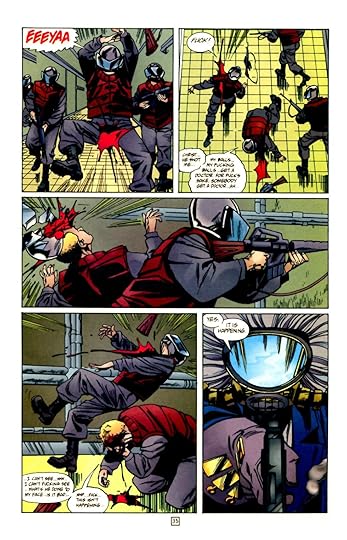

When Vertigo emerged in the wake of The Sandman's success, offering mature-reader, creator-owned titles, Morrison was an obvious fit, happy to create his own series, which would explore his many fascinations. It was clear from the start that The Invisibles would be something revolutionary, and Morrison took it seriously (whatever you think of the guy, he's never been one to grind out a half-assed script). It's a very fucking 1990's comic-book. If it seemed a touch anachronistic after 9/11, by 2024 it's already spent decades vacillating between metatextual relevance, irrelevance & super-relevance, though I doubt it could pass any narrow-minded Woke purity-test, now that the one-time saviors of free speech on the Left like the ACLU have become more pro-censorship & puritanical than the actual Right-wing puritans. This tug-of-war between the forces of order & the forces of chaos speaks very much to the illiterate idiocracy of intolerance we're currently facing, & the conciliatory synthesis that the mysterious Barbelith represents is not something the ideological zealots of Identity Marxism & Champagne Socialism, Trump's braindead cult of personality, the hardcore Christians, the fanatically psychopathic Theocrats of fundamentalist Islam, or insular, quietly bigoted Jewish & Asian sects, are willing to accept. The series' anti-heroes are libertarian anarchist-terrorists, waging a guerrilla war against the forces of darkness and order; in this case, these forces happen to be the demonic agents of another universe, seeking to infect our world with their custom-made virus of conformity and submission. They exist unseen and unnoticed by most of the population, but agents of order are everywhere: in the government, the churches, the schools. Surgically altered, their eyes and genitals removed by their masters - the imposing, monstrous Archons - these barely-human minions, able to generate their black insectoid nano-armor out of the air itself, are tasked with Inferno-forming planet Earth, making of it a subservient, sterilized Hell suitable for the Archons... in particular 'The Grand Archon - The King-Of-All-Tears'. Miss Dwyer is his twisted right hand, along with the reprehensible Sir Miles, a slimy aristocrat & secret political puppet-master. He has resisted being changed by The Archons, supposedly to better interact with the uninitiated, but is forced to 'take communion' from the black & purple-veined tits of Miss Dwyer, slurping the toxic milk from her beetle-shell nipples.
Meet your local Archons: The-King-Of-All-Tears, The-King-In-Chains-Unborn-And-Barren, and... Orlando. He kind of got fucked over in the name and title department. No wonder he's so pissy. Yeah, they're a lovely bunch, courtesy of Quitely, Yeowell and Thompson:


Against the forces of Order and Conformity stand The Invisibles, agents of Chaos, Imagination and Freedom. King Mob is the cool, charismatic leader at the beginning of the story, charged with initiating a new recruit into the Mysteries of the Invisible College, and doing his best to stick a monkey-wrench in the gears of the Apocalyptic-machine. The cell is rounded out by 'Boy', a black woman from Chicago who was once a cop, 'Lord Fanny', a transvestite sorceress from the slums of Rio de Janeiro, and 'Ragged Robin', who might be from the future (a question answered definitively by series end). After losing a member to a typically atypical Invisibles-brand insanity, they track down a rebellious young thug from Manchester named Dane McGowan, who will soon be known as 'Jack Frost'.
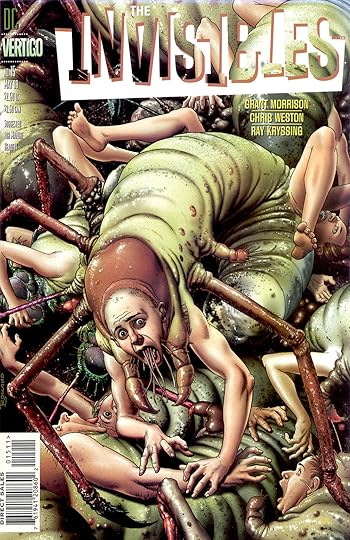
The second volume of The Invisibles introduced Phil Jimenez as the regular artist, whose sharp linework was well-matched to the surgically precise renderings of regular cover artist, Brian Bolland. His then-recent switch to digital art, with a mix of pixelated and hand-painted colors, resulted in some of his best cover work:


This first book deals with the trials that Dane must endure before he can understand the true nature of the world, as opposed to the manufactured reality that convincingly passes itself off as empirical data. King Mob leaves him in the hobo-shaman hands of Tom O'Bedlam, who serves as Obi Wan Yoda to Morrison's little foul-mouthed Skywalker. This story was repurposed by the Wachowski Brothers (now the hideous Wachowski Sisters) for The Matrix, with Neo as Dane McGowan and Morpheus as Tom O'Bedlam, complete with the climactic leap of faith from the roof of a skyscraper. Instead of the red pill/blue pill sequence in the Matrix, The Invisibles featured a blue mold that grew on the walls of an abandoned subway station. In both cases, ingestion meant leaving behind the manufactured world of illusions, and facing a very frightening reality. Morrison was not flattered by their obvious theft, and remarked on it several times.
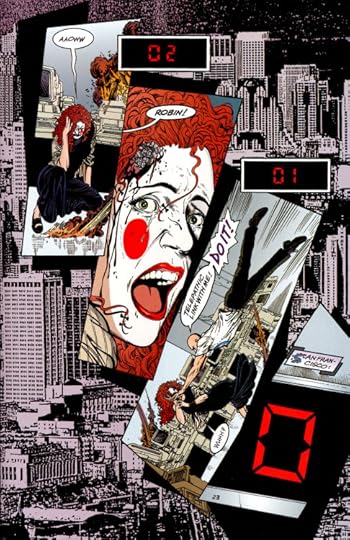
Frank Quitely's 'beginning of the end' title page, a page by Weston from the beginning, and another page by Weston from the end... terrible visions of things to come, part 1:


After making 'Jack Frost' the fifth member of their cell, they embark on a quest via Psychic time-travel, to the horrible, bloody height of the French Revolution. Robespierre & the Jacobins are keeping the Guillotine very busy, and life is very cheap, a prelude to the Napoleonic Wars, as le Grande Armee turn much of Europe into an abattoir. There are reports of corpse-devouring ghouls, possibly linked to the cell's mission: bringing 'back' the Marquis De Sade as an agent. And no, I don't give a flying fuck if De Sade was a real life rapist/pedophile piece of shit*. While their unoccupied bodies are waiting for them, a demon named 'Orlando' - from the 'land of the unfleshed'- is alerted to their location. Now defenseless against a monstrosity with a predilection for flaying his victims alive, things go very wrong...
Terrible visions of things to come, part 2, courtesy of Chris Weston, and some fine Phil Jimenez artwork; Miss Dwyer, armored and set for sidereal warfare... whatever the fuck that is.


This is one of the best mainstream comics ever made. Its one weakness was its constantly shifting line-up of artists, some very good, a couple fairly mediocre; but not bad enough to hurt what is essentially an epic made up of constantly shifting narrative perspectives, to match the changing artistic visions. It was, however, at its best with the regular creative team of artist Phil Jimenez and inker John Stokes, and Chris Weston as back-up penciler. The razor-sharp '2000 A.D.'-style, made popular by Brian Bolland, was executed brilliantly by both Jimenez and Weston, giving a solid and attractive aesthetic that made the time-travelling and multiple-level realities and invading extra-dimensional monstrosities all the more unsettling. Jill Thompson does some excellent work on her story-arc, and Steve Yeowell, while limited, acquits himself well here. For Morrison fans, this is the essential work; an uncensored trip through a powerful imagination, refusing to simplify his story, but nevertheless creating an exciting tale that is easy to appreciate. Even if you don't get every reference, or unravel every secret, it's still a thoroughly enjoyable read, and merits re-reads. The head of John the Baptist re-animated as a cryptic oracle in Revolutionary France... Aztec-Mestizo and Voodoo deities like Quetzalcoatl and Papa Guedhe... conspiracies involving the British Royal family, and a secret heir with Lovecraftian tentacles wriggling across stranger aeons into nightmare-universes that feed our sleeping dread... the richness of Morrison's 'crazy' is glorious to behold, and it makes sense, in its way. This is no Finnegan's Wake... if you survived 'Final Crisis' - which, in many respects, was stranger than 'The Invisibles' - you'll have no problems getting into it. Let chaos reign, and hail motherfucking Barbelith. But actually, Morrison also gives us a very profound, 'grown-up' conclusion; i.e. one many may find as obnoxious.
*
[Spoilers... sort of.]
This is Grant Morrison with the handcuffs off, unshackled from the Superhero chain-gang. Like Alan Moore, Warren Ellis and Neil Gaiman, Morrison never got properly edu-ma-cated at a University or whatnot, and like his fellow Brit comic-book super-writers, he possesses an imaginative genius that puts many-a serious novelist to shame. After penning some ground-breaking stories for DC like Batman: Arkham Asylum - A Serious House on a Serious Earth(a psycho-drama with elements of Gothic Horror, in which Morrison gets very upstaged by the painted art of Dave McKean), Morrison soon became recognized as one of the more exciting comic innovators (there were 2 at the time), unafraid of scaring readers off with his nifty 'experiments' on runs of Animal Man and Doom Patrol, breaking the fourth wall & whatnot, all taken for Granted nowadays. The Invisibles' letter pages are now slightly legendary for establishing Morrison's brand of fucked-up, one that is profoundly interested in finding and making and peeking through the cracks in mundane reality, searching for the treasure-maps and books bound in human flesh, tucked into the walls between multiversal apartments by some romantic alchemist. There was ritual magic gobbledygook, as he tried to coordinate a cosmic circle jerk to save 'The Invisibles' from cancellation. Seriously. He asked every fan to masturbate at a certain time & concentrate on saving The Invisibles. It worked, I guess.
One of Brian Bolland's stellar covers from the third iteration, and 2 pages from the re-colored first story-arc by Yeowell:
When Vertigo emerged in the wake of The Sandman's success, offering mature-reader, creator-owned titles, Morrison was an obvious fit, happy to create his own series, which would explore his many fascinations. It was clear from the start that The Invisibles would be something revolutionary, and Morrison took it seriously (whatever you think of the guy, he's never been one to grind out a half-assed script). It's a very fucking 1990's comic-book. If it seemed a touch anachronistic after 9/11, by 2024 it's already spent decades vacillating between metatextual relevance, irrelevance & super-relevance, though I doubt it could pass any narrow-minded Woke purity-test, now that the one-time saviors of free speech on the Left like the ACLU have become more pro-censorship & puritanical than the actual Right-wing puritans. This tug-of-war between the forces of order & the forces of chaos speaks very much to the illiterate idiocracy of intolerance we're currently facing, & the conciliatory synthesis that the mysterious Barbelith represents is not something the ideological zealots of Identity Marxism & Champagne Socialism, Trump's braindead cult of personality, the hardcore Christians, the fanatically psychopathic Theocrats of fundamentalist Islam, or insular, quietly bigoted Jewish & Asian sects, are willing to accept. The series' anti-heroes are libertarian anarchist-terrorists, waging a guerrilla war against the forces of darkness and order; in this case, these forces happen to be the demonic agents of another universe, seeking to infect our world with their custom-made virus of conformity and submission. They exist unseen and unnoticed by most of the population, but agents of order are everywhere: in the government, the churches, the schools. Surgically altered, their eyes and genitals removed by their masters - the imposing, monstrous Archons - these barely-human minions, able to generate their black insectoid nano-armor out of the air itself, are tasked with Inferno-forming planet Earth, making of it a subservient, sterilized Hell suitable for the Archons... in particular 'The Grand Archon - The King-Of-All-Tears'. Miss Dwyer is his twisted right hand, along with the reprehensible Sir Miles, a slimy aristocrat & secret political puppet-master. He has resisted being changed by The Archons, supposedly to better interact with the uninitiated, but is forced to 'take communion' from the black & purple-veined tits of Miss Dwyer, slurping the toxic milk from her beetle-shell nipples.
Meet your local Archons: The-King-Of-All-Tears, The-King-In-Chains-Unborn-And-Barren, and... Orlando. He kind of got fucked over in the name and title department. No wonder he's so pissy. Yeah, they're a lovely bunch, courtesy of Quitely, Yeowell and Thompson:
Against the forces of Order and Conformity stand The Invisibles, agents of Chaos, Imagination and Freedom. King Mob is the cool, charismatic leader at the beginning of the story, charged with initiating a new recruit into the Mysteries of the Invisible College, and doing his best to stick a monkey-wrench in the gears of the Apocalyptic-machine. The cell is rounded out by 'Boy', a black woman from Chicago who was once a cop, 'Lord Fanny', a transvestite sorceress from the slums of Rio de Janeiro, and 'Ragged Robin', who might be from the future (a question answered definitively by series end). After losing a member to a typically atypical Invisibles-brand insanity, they track down a rebellious young thug from Manchester named Dane McGowan, who will soon be known as 'Jack Frost'.
The second volume of The Invisibles introduced Phil Jimenez as the regular artist, whose sharp linework was well-matched to the surgically precise renderings of regular cover artist, Brian Bolland. His then-recent switch to digital art, with a mix of pixelated and hand-painted colors, resulted in some of his best cover work:
This first book deals with the trials that Dane must endure before he can understand the true nature of the world, as opposed to the manufactured reality that convincingly passes itself off as empirical data. King Mob leaves him in the hobo-shaman hands of Tom O'Bedlam, who serves as Obi Wan Yoda to Morrison's little foul-mouthed Skywalker. This story was repurposed by the Wachowski Brothers (now the hideous Wachowski Sisters) for The Matrix, with Neo as Dane McGowan and Morpheus as Tom O'Bedlam, complete with the climactic leap of faith from the roof of a skyscraper. Instead of the red pill/blue pill sequence in the Matrix, The Invisibles featured a blue mold that grew on the walls of an abandoned subway station. In both cases, ingestion meant leaving behind the manufactured world of illusions, and facing a very frightening reality. Morrison was not flattered by their obvious theft, and remarked on it several times.
Frank Quitely's 'beginning of the end' title page, a page by Weston from the beginning, and another page by Weston from the end... terrible visions of things to come, part 1:
After making 'Jack Frost' the fifth member of their cell, they embark on a quest via Psychic time-travel, to the horrible, bloody height of the French Revolution. Robespierre & the Jacobins are keeping the Guillotine very busy, and life is very cheap, a prelude to the Napoleonic Wars, as le Grande Armee turn much of Europe into an abattoir. There are reports of corpse-devouring ghouls, possibly linked to the cell's mission: bringing 'back' the Marquis De Sade as an agent. And no, I don't give a flying fuck if De Sade was a real life rapist/pedophile piece of shit*. While their unoccupied bodies are waiting for them, a demon named 'Orlando' - from the 'land of the unfleshed'- is alerted to their location. Now defenseless against a monstrosity with a predilection for flaying his victims alive, things go very wrong...
Terrible visions of things to come, part 2, courtesy of Chris Weston, and some fine Phil Jimenez artwork; Miss Dwyer, armored and set for sidereal warfare... whatever the fuck that is.
This is one of the best mainstream comics ever made. Its one weakness was its constantly shifting line-up of artists, some very good, a couple fairly mediocre; but not bad enough to hurt what is essentially an epic made up of constantly shifting narrative perspectives, to match the changing artistic visions. It was, however, at its best with the regular creative team of artist Phil Jimenez and inker John Stokes, and Chris Weston as back-up penciler. The razor-sharp '2000 A.D.'-style, made popular by Brian Bolland, was executed brilliantly by both Jimenez and Weston, giving a solid and attractive aesthetic that made the time-travelling and multiple-level realities and invading extra-dimensional monstrosities all the more unsettling. Jill Thompson does some excellent work on her story-arc, and Steve Yeowell, while limited, acquits himself well here. For Morrison fans, this is the essential work; an uncensored trip through a powerful imagination, refusing to simplify his story, but nevertheless creating an exciting tale that is easy to appreciate. Even if you don't get every reference, or unravel every secret, it's still a thoroughly enjoyable read, and merits re-reads. The head of John the Baptist re-animated as a cryptic oracle in Revolutionary France... Aztec-Mestizo and Voodoo deities like Quetzalcoatl and Papa Guedhe... conspiracies involving the British Royal family, and a secret heir with Lovecraftian tentacles wriggling across stranger aeons into nightmare-universes that feed our sleeping dread... the richness of Morrison's 'crazy' is glorious to behold, and it makes sense, in its way. This is no Finnegan's Wake... if you survived 'Final Crisis' - which, in many respects, was stranger than 'The Invisibles' - you'll have no problems getting into it. Let chaos reign, and hail motherfucking Barbelith. But actually, Morrison also gives us a very profound, 'grown-up' conclusion; i.e. one many may find as obnoxious.
*

September 7, 2019
Not knowing what the invisibles is about, I sure was taking my time till I had somewhat of a clue what genre or even what setting it is in. That cover was all I had to go on at first, which as great as it is, did not help much with explaining anything. So I bought this purely based on the fact that it is written by Grant Morrison.
But guess what I would recommend everyone to read it like this, just because it adds so much to the mystery of the story itself.
That also serves me as a good excuse to not write an overly long review, just that it is the usual Morrison weirdness and occasional greatness I've grown to love.
4.5 stars out of 5. (the last collected issue was closer to a 5)
But guess what I would recommend everyone to read it like this, just because it adds so much to the mystery of the story itself.
That also serves me as a good excuse to not write an overly long review, just that it is the usual Morrison weirdness and occasional greatness I've grown to love.
4.5 stars out of 5. (the last collected issue was closer to a 5)

February 12, 2017
PRE-READ: I fucking hate what I've read of The Invisibles with a seething passion, but these new editions are super attractive and I LOVE BRIAN BOLLAND SO GODDAMN MUCH. So I may end of trying it again.
--
Okay, so I finished this book. Did I hate it as much as I hated reading Say You Want a Revolution many years ago? No. It might in fact be impossible for me to have hated a book as much as I hated that one. Part of the impetus for trying again with a larger compendium was that I thought maybe a few different story arcs, with some different artists, would force me to give the book more of a chance, and this was pretty much right.
The other reason I didn't hate The Invisibles as much this time around was my lowered expectations: the thing is, everyone you know who's read The Invisibles needs to also tell you how it's the best comic of all time, sort of like how people talk about David Foster Wallace, or Saga or like, Arrested Development. I don't know why certain pieces of media inspire everyone who likes them to turn into mansplaining twats (technical term), but The Invisibles is just one of those things.
Anyway, going in with the acceptance that the book is not in fact good and your friends are not terrible people for having bad taste makes reading the whole thing easier. There are parts of the book -- some character designs, mainly -- that are kind of cool, actually. It's just that the whole thing is sort of a plotless ripoff of a bunch of other books that are better, which is a very Grant Morrison problem, and also a very young-writer-y problem. Morrison tends to do best with established properties that provide him some kind of framework to inject with hippyzappy new age anti-capitalist mumbo whatsit, but when he's given the responsibility of providing a framework too, he just borrows from Alan Moore and Neil Gaiman, which (aside from random new age anti-capitalist mumbo whatsit books) may be the only authors he's ever read.
So anyway, the plot of this book is There's A Conspiracy and although one character has been included specifically to ask "What is the nature of said Conspiracy, pray tell?" no one really has an answer, and we are supposed to be sort of delighted by this, I think, or maybe spooked out by the unknown spookiness, depending on the mood. And then when the question "And what are we fighting the Conspiracy for?" is asked, the first answer is sort of "Freedom!" and the other answer is "So we can dance!" and this is fairly literal as the characters then start dancing.
So the rampant weirdness of this book is most like Morrison's Doom Patrol, except that series had, like, narrative goals and this one really doesn't, and that book seemed genuine and this one seems like when that guy you knew in college put on eyeliner and lipstick in order to be "challenging" but it was really just a little sad because that's all he could come up with.
The book is about magic, which is sometimes kind of fun and there's a whole standalone issue with a side character in which the magic and plot and weirdness are all balanced and totally work, and it sort of feels like an issue of Hellblazer and maybe that's what this book wants to be, sometimes? There's some creepy villains and horror bits that make me think Morrison would have written a really good Hellblazer, but instead we have this.
There's one four-issue arc where they go back in time and visit/rescue/I'm actually not sure what with Marquis de Sade, and I think it's mainly there to prove that Morrison can do research and read books, because other than being sort of like a creatively-interpreted book report on the French Revolution, it doesn't seem to make any sense why it's there.
But there's also one issue where a minor character who was killed about ten issues prior gets a full backstory told in montage, and that story is pretty interesting and shows some of the fun things Morrison is able to do with nonlinear narrative, which is absolutely one of his specialties. It also suggests that maybe The Invisibles isn't really supposed to be about anything, and it's more like a sandbox for Morrison to try things out in, and I'm honestly more fine with that than with any other interpretation of the book I can think of.
Anyway, the next paperback volume of this omnibus series isn't out til December, and I think I can absolutely give that volume a shot also, even if I'm pretty sure the book isn't actually good. It's just good enough, and I need to have said I've read it.
But don't make me watch Arrested Development. Just get over it already.
--
Okay, so I finished this book. Did I hate it as much as I hated reading Say You Want a Revolution many years ago? No. It might in fact be impossible for me to have hated a book as much as I hated that one. Part of the impetus for trying again with a larger compendium was that I thought maybe a few different story arcs, with some different artists, would force me to give the book more of a chance, and this was pretty much right.
The other reason I didn't hate The Invisibles as much this time around was my lowered expectations: the thing is, everyone you know who's read The Invisibles needs to also tell you how it's the best comic of all time, sort of like how people talk about David Foster Wallace, or Saga or like, Arrested Development. I don't know why certain pieces of media inspire everyone who likes them to turn into mansplaining twats (technical term), but The Invisibles is just one of those things.
Anyway, going in with the acceptance that the book is not in fact good and your friends are not terrible people for having bad taste makes reading the whole thing easier. There are parts of the book -- some character designs, mainly -- that are kind of cool, actually. It's just that the whole thing is sort of a plotless ripoff of a bunch of other books that are better, which is a very Grant Morrison problem, and also a very young-writer-y problem. Morrison tends to do best with established properties that provide him some kind of framework to inject with hippyzappy new age anti-capitalist mumbo whatsit, but when he's given the responsibility of providing a framework too, he just borrows from Alan Moore and Neil Gaiman, which (aside from random new age anti-capitalist mumbo whatsit books) may be the only authors he's ever read.
So anyway, the plot of this book is There's A Conspiracy and although one character has been included specifically to ask "What is the nature of said Conspiracy, pray tell?" no one really has an answer, and we are supposed to be sort of delighted by this, I think, or maybe spooked out by the unknown spookiness, depending on the mood. And then when the question "And what are we fighting the Conspiracy for?" is asked, the first answer is sort of "Freedom!" and the other answer is "So we can dance!" and this is fairly literal as the characters then start dancing.
So the rampant weirdness of this book is most like Morrison's Doom Patrol, except that series had, like, narrative goals and this one really doesn't, and that book seemed genuine and this one seems like when that guy you knew in college put on eyeliner and lipstick in order to be "challenging" but it was really just a little sad because that's all he could come up with.
The book is about magic, which is sometimes kind of fun and there's a whole standalone issue with a side character in which the magic and plot and weirdness are all balanced and totally work, and it sort of feels like an issue of Hellblazer and maybe that's what this book wants to be, sometimes? There's some creepy villains and horror bits that make me think Morrison would have written a really good Hellblazer, but instead we have this.
There's one four-issue arc where they go back in time and visit/rescue/I'm actually not sure what with Marquis de Sade, and I think it's mainly there to prove that Morrison can do research and read books, because other than being sort of like a creatively-interpreted book report on the French Revolution, it doesn't seem to make any sense why it's there.
But there's also one issue where a minor character who was killed about ten issues prior gets a full backstory told in montage, and that story is pretty interesting and shows some of the fun things Morrison is able to do with nonlinear narrative, which is absolutely one of his specialties. It also suggests that maybe The Invisibles isn't really supposed to be about anything, and it's more like a sandbox for Morrison to try things out in, and I'm honestly more fine with that than with any other interpretation of the book I can think of.
Anyway, the next paperback volume of this omnibus series isn't out til December, and I think I can absolutely give that volume a shot also, even if I'm pretty sure the book isn't actually good. It's just good enough, and I need to have said I've read it.
But don't make me watch Arrested Development. Just get over it already.

January 30, 2026
«Запалив червону свічку. Ввійшов у нескінченний час, годину кладовища. Холодна плоть храму зомбі.
Приплив сексуальної енергії в хребет, що запалює силові точки примарної драбини, яка веде в мій мозок. Хребет стає чорним каменем.
Я — не я. Я лишив себе говорити з телевізором. Я — не я, але я — більше, аніж я. Божественний Вершник осідлав мене і поїхав на мені в край примар».
Відкриваючи «Невидимих» мав дивне відчуття, ніби зараз мене або посвятять у таємне братство, або просто розкрутять на красиву конспірологію. І, чесно, Моррісон робить і те, й інше. Інколи в межах однієї сторінки. Тут реальність не тріщить по швах, вона відразу склеєна скотчем з чужих цитат, окультних натяків, панк-люті й дуже людської розгубленості. «На чиєму ти боці?» — питання звучить майже як виклик у підворітні.
Перші випуски — це вербування, струс, удар у міжлопаткову зону, після якого раптом бачиш місто зверху. Невидимі — не «круті супергерої», а партизани сенсу, які бігають між епохами й символами так, ніби це станції метро. Мені сподобалось, як Моррісон підсовує підлітка Дейна (майбутнього Джека Фроста) в умовне пекло Безумця Тома. Там ініціація більше схожа на приниження, ніж на мотиваційну лекцію. Ти читаєш і ніби чуєш: «ти хочеш свободи? тоді спершу зламай себе».
Команда теж максимально дивна, на скільки це може бути. Кінґ Моб — харизматичний, але небезпечно самовпевнений лідер. Лорд Фенні — магічна стихія, що одночасно смішить і лякає. Розхристана Робін — суцільна загадка з присмаком майбутнього. А «Бой» тримає цю божевільну зграю заземленою. Мені подобається, що вони не романтизовані. У них є пафос, але поруч бруд, травми, нерви й відчай. Через це змова виглядає не «великим лихом у небі», а чимось, що лізе в щоденність через державу, релігію, секс, збочення, страх, політику і звичку слухатися.
Так, інколи я просто плавився. Хтось говорить про гностицизм, через кадр уже відбувається бойовик, а потім тебе ставлять перед маркізом де Садом і кажуть: «розбирайся». Але в цьому хаосі є ритм. Він схожий на нічне радіо: половину не розумієш, зате кожна фраза чіпляється й потім довго турбує тебе. І коли раптом ловиш певний омаж (від Джорджа Орвела, Джона Ленона, Роджера Желязни до окультних «дверей Місяця») відчуваєш себе не генієм, а просто людиною, якій дали на секунду підглядати за механікою світу.
Візуально том, як колаж із різних снів та світів. Зміна стилів тут не «мінус», а відчуття багатовимірності: ніби камера щоразу налаштовується під нову частоту реальності. Часом ловив себе на тому, що перечитую сторінки повільніше, ніж зазвичай, просто щоб встигнути роздивитися, як художники передають паніку, екстаз або той специфічний моррісонівський гумор, коли смішно, незрозуміло і страшно одночасно.
Найбільше мене вразило, що під усією магією і маніпуляціями з реальністю в голові ховається проста річ: страх стати гвинтиком і бажання втекти — хоч у свободу, хоч у танець, хоч у бій. «Невидимі» не гладять по голові й не пояснюють «що тут відбувається» людською мовою. Це комікс, який просить відчинити двері й пройти крізь них. Я пройшов і тепер трохи підозріло дивлюся на буденність, ніби вона теж може бути лише декорацією.
Я люблю складні речі, але «Невидимі» все одно часто вибивали ґрунт з-під ніг: робиш паузу, дивишся пояснення наприкінці видання чи шукаєш певне ім’я, повертаєшся, знаходиш новий сенс. Це не історія «на вечір», а скоріше маршрут, інколи класний, інколи виснажливий. Звісно, моя порада братися за цей комікс, але вам прийдеться трохи постаратися, щоб зловити хоч якийсь сенс у цій всій катавасії.
Приплив сексуальної енергії в хребет, що запалює силові точки примарної драбини, яка веде в мій мозок. Хребет стає чорним каменем.
Я — не я. Я лишив себе говорити з телевізором. Я — не я, але я — більше, аніж я. Божественний Вершник осідлав мене і поїхав на мені в край примар».
Відкриваючи «Невидимих» мав дивне відчуття, ніби зараз мене або посвятять у таємне братство, або просто розкрутять на красиву конспірологію. І, чесно, Моррісон робить і те, й інше. Інколи в межах однієї сторінки. Тут реальність не тріщить по швах, вона відразу склеєна скотчем з чужих цитат, окультних натяків, панк-люті й дуже людської розгубленості. «На чиєму ти боці?» — питання звучить майже як виклик у підворітні.
Перші випуски — це вербування, струс, удар у міжлопаткову зону, після якого раптом бачиш місто зверху. Невидимі — не «круті супергерої», а партизани сенсу, які бігають між епохами й символами так, ніби це станції метро. Мені сподобалось, як Моррісон підсовує підлітка Дейна (майбутнього Джека Фроста) в умовне пекло Безумця Тома. Там ініціація більше схожа на приниження, ніж на мотиваційну лекцію. Ти читаєш і ніби чуєш: «ти хочеш свободи? тоді спершу зламай себе».
Команда теж максимально дивна, на скільки це може бути. Кінґ Моб — харизматичний, але небезпечно самовпевнений лідер. Лорд Фенні — магічна стихія, що одночасно смішить і лякає. Розхристана Робін — суцільна загадка з присмаком майбутнього. А «Бой» тримає цю божевільну зграю заземленою. Мені подобається, що вони не романтизовані. У них є пафос, але поруч бруд, травми, нерви й відчай. Через це змова виглядає не «великим лихом у небі», а чимось, що лізе в щоденність через державу, релігію, секс, збочення, страх, політику і звичку слухатися.
Так, інколи я просто плавився. Хтось говорить про гностицизм, через кадр уже відбувається бойовик, а потім тебе ставлять перед маркізом де Садом і кажуть: «розбирайся». Але в цьому хаосі є ритм. Він схожий на нічне радіо: половину не розумієш, зате кожна фраза чіпляється й потім довго турбує тебе. І коли раптом ловиш певний омаж (від Джорджа Орвела, Джона Ленона, Роджера Желязни до окультних «дверей Місяця») відчуваєш себе не генієм, а просто людиною, якій дали на секунду підглядати за механікою світу.
Візуально том, як колаж із різних снів та світів. Зміна стилів тут не «мінус», а відчуття багатовимірності: ніби камера щоразу налаштовується під нову частоту реальності. Часом ловив себе на тому, що перечитую сторінки повільніше, ніж зазвичай, просто щоб встигнути роздивитися, як художники передають паніку, екстаз або той специфічний моррісонівський гумор, коли смішно, незрозуміло і страшно одночасно.
Найбільше мене вразило, що під усією магією і маніпуляціями з реальністю в голові ховається проста річ: страх стати гвинтиком і бажання втекти — хоч у свободу, хоч у танець, хоч у бій. «Невидимі» не гладять по голові й не пояснюють «що тут відбувається» людською мовою. Це комікс, який просить відчинити двері й пройти крізь них. Я пройшов і тепер трохи підозріло дивлюся на буденність, ніби вона теж може бути лише декорацією.
Я люблю складні речі, але «Невидимі» все одно часто вибивали ґрунт з-під ніг: робиш паузу, дивишся пояснення наприкінці видання чи шукаєш певне ім’я, повертаєшся, знаходиш новий сенс. Це не історія «на вечір», а скоріше маршрут, інколи класний, інколи виснажливий. Звісно, моя порада братися за цей комікс, але вам прийдеться трохи постаратися, щоб зловити хоч якийсь сенс у цій всій катавасії.

March 16, 2016
If you're in the mood for a teenager imitating Alan Moore that somehow managed to get a writing deal with Vertigo, your dream, well then Grant Morrison's "The Invisibles" is for you. Where Moore delves deep into his themes and offers layered storytelling with wonderful subtext, Mr. Morisson only name drops--the occult and the like receives lip service and not a lot more, the real life people who pop up in the story are rendered shockingly distasteful and could've just been left out, and any political or social critique comes in the form of bland dialogue. And, on the subject of dialogue, this book is inundated with the type of dialogue that you wouldn't expect to find in the first draft of someone absolutely uninterested in comics, or writing, and has only taken up the hobby for money and enjoys yelling nonsensical, chic anarchistic messages and believes themselves to be just so goddamn punk, man. The writing in this collection is so surprisingly asinine and unbelievable that the one upside to it all is that you'll finish reading it feeling as if you, even if you hardly can string a sentence together, can be a published author--by Vertigo, no less. So, Vertigo, I offer you my services - I make no show of having one iota of writing talent but I do have some interests that I can certainly name drop and I do love Alan Moore so, you know, I can steal from him and just be lazy as fuck and forget all the stuff that makes his work so powerful, and I can also throw in some scenes with wild sex and drugs (I assure you I've taken more than Grant here, who seems unable to grasp some very basic biological facts about crack cocaine, a drug I've never tried nor will ever but I can feign experience) and I, too, have read Lovecraft and Burroughs and can type . . . like this . . . flashing images of money coming my way in streams of green neon . . . squid-faced men in astronaut suits sip absinthe with . . . losing interest in writing and thinking about the cosmic nothingness of Morisson's work and . . . pulsing jissim leaping through dank corridors positively more attractive than reading "The Invisibles" . . .

February 16, 2020
I picked up Book One of The Invisibles on a whim and I have to say I am glad that I did. I found that many of the characters were difficult to sympathize with as a result of their demeanor or just how they were presented. However, I thoroughly enjoyed the final chapter of the book that humanized a nameless guard that was present in the early chapter of the book. Overall, it was an interesting read and I will be picking up Book Two when I get the chance!!!

August 17, 2024
Grant Morrison, as an author, tends to run the gamut between brilliant and putrid. "The Invisibles" falls securely into that second category. From the artwork, to the characters, to the dialogue it is a case study of pretentious stream-of-thought nonsense being pedaled as a tight plot and prose.
The Invisibles are a group of weirdos who seem to be the only ones who can see through the lies of society, which has been controlled by an alien force that dominates reality. The character of Dane McGowan is a miserable little shit and thus a poor representative for a hero. His homeless mentor is a pretentious windbag who has dialogue that is borderline painful to read.
So this little shitbag (and he is a scumbag) wanders around finding out about reality. he will meet a bevy of weird characters including the Marquis De Sade. This character gets a sympathetic portrayal from GM. I wonder if Morrison knew that the Marquis was a violently deviant sexual psychopath? The horrid things he did to unwilling women and children make me question the level of education truly needed to become a writer. Maybe he thought the Marquis was some proto-leftist anti-establishment figure versus just a truly disturbed deviant (is there a difference?).
Morrison has written some great comics. This is not one of them. My advice? Pass on this.
The Invisibles are a group of weirdos who seem to be the only ones who can see through the lies of society, which has been controlled by an alien force that dominates reality. The character of Dane McGowan is a miserable little shit and thus a poor representative for a hero. His homeless mentor is a pretentious windbag who has dialogue that is borderline painful to read.
So this little shitbag (and he is a scumbag) wanders around finding out about reality. he will meet a bevy of weird characters including the Marquis De Sade. This character gets a sympathetic portrayal from GM. I wonder if Morrison knew that the Marquis was a violently deviant sexual psychopath? The horrid things he did to unwilling women and children make me question the level of education truly needed to become a writer. Maybe he thought the Marquis was some proto-leftist anti-establishment figure versus just a truly disturbed deviant (is there a difference?).
Morrison has written some great comics. This is not one of them. My advice? Pass on this.

January 19, 2025
Графічний роман, у якому можливо все. Але чи можна назвати все – хаосом? Мабуть, що так. Але може і ні. Сюжет «Невидимих» складається з багатьох сюжетних ліній, які базуються на культурних відсилках, історичних періодах, поетах, міфологічних персонажах. Тож якщо це хаос, то він усе ж залежить від культурної ноосфери людства, хай навіть такої, що виходить поза межі позитивістського знання. Також можна говорити про інший аспект хаосу у «Невидимих» – є фундаментальне протиборство між силами зла (хаосу?) і силами добра. Звісно, що з першої частини не до кінця зрозуміло, ким є Невидимі, але, здається, це хороші хлопці. Отже, тут викристалізовується, скажімо, гностичне протистояння – зло активно працює, щоб перемогти. Боротьба Ахура-Мазди з Анґрі-Манью переходить зі скотарських племен зороастрійців на терени сучасної Америки, а ще – революційної Франції (Сартр надто нудний для Моррісона, напевне, тому тут Маркіз де Сад), на діалоги Байрона з Персі Біші Шеллі та інший вимір Лондона, де, наприклад, стоїть пам'ятник Урізену. Нецензурна лексика аж кишить у графічному романі, як щупальці лавкрафтівських істот, але виринає вона з уст хорошого хлопця, що виглядає як підліток-засранець.
Перший том «Невидимих» – гарне осмислення культури разом з багатьма "езотеричними" аспектами у сучасних декораціях. Чекаємо на продовження українського перекладу!
Перший том «Невидимих» – гарне осмислення культури разом з багатьма "езотеричними" аспектами у сучасних декораціях. Чекаємо на продовження українського перекладу!

September 10, 2016
This wasn't on my initial list of comics to try as an introduction to the genre. It probably didn't belong in it, considering how odd it is. I didn't hear of it until I read Neil Gaiman's The View from the Cheap Seats in which he made a mention of Invisibles and how Grant Morrison got most of the stuff in it from aliens who abducted him while he was in Kathmandu. This sounded suitably bizarre, and more than a little interesting and I had to read it immediately. Of course I had to.
I binge read comics for two days while sick, beginning with some Batman (not Grant Morrison), and ending with this first deluxe edition. I wasn't woozy anymore from the meds I took, but this still felt like something that came from an alien. I liked the start, Dane as the disaffected youth, old Tom his mentor. It took me a while to get used to the comic, and the art, all too vibrant and utterly creepy. Arcadia is the main story line (I think), and it starts just after Dane joins the Invisibles as Jack Frost, and the 5 of them go traipsing off to rescue the spirit of Marquis de Sade while a demon called Orlando hunts for their bodies that they left behind. And I loved this too, it's uncomfortable, and it's great. There is a story about Jim Crow, another Invisible that King Mob's group are said to be in touch with, and a bunch of big pharma wankers.
And these are all great. But the two that really hit a nerve were the last two. Royal Monsters, about an Invisible spy in the house of the bad guys, whose job is to kill the monster moonchild who's supposed to be the next king of England, but fails, and fails and fails again. Best Man Fall, is a life flashing before your eyes kind of story, it's how a young man with promise ends up in a particular place at a particular time. It's perfect. I'm not sure if it's the best recommendation, that the most affecting story happened to be only one in the entire collection without any evil otherworldly creatures in it, but I also loved how insane and weird the whole concept is.
I binge read comics for two days while sick, beginning with some Batman (not Grant Morrison), and ending with this first deluxe edition. I wasn't woozy anymore from the meds I took, but this still felt like something that came from an alien. I liked the start, Dane as the disaffected youth, old Tom his mentor. It took me a while to get used to the comic, and the art, all too vibrant and utterly creepy. Arcadia is the main story line (I think), and it starts just after Dane joins the Invisibles as Jack Frost, and the 5 of them go traipsing off to rescue the spirit of Marquis de Sade while a demon called Orlando hunts for their bodies that they left behind. And I loved this too, it's uncomfortable, and it's great. There is a story about Jim Crow, another Invisible that King Mob's group are said to be in touch with, and a bunch of big pharma wankers.
And these are all great. But the two that really hit a nerve were the last two. Royal Monsters, about an Invisible spy in the house of the bad guys, whose job is to kill the monster moonchild who's supposed to be the next king of England, but fails, and fails and fails again. Best Man Fall, is a life flashing before your eyes kind of story, it's how a young man with promise ends up in a particular place at a particular time. It's perfect. I'm not sure if it's the best recommendation, that the most affecting story happened to be only one in the entire collection without any evil otherworldly creatures in it, but I also loved how insane and weird the whole concept is.
Read
January 4, 2025Щоб ця річ потроху вкладалася у голові, потрібно:
а) відразу відкрити сторінку з примітками перекладача (класичних зірочок/зносок тут не буде, бо ж комікс);
б) не читати більше одного випуску за раз (оце вже суб’єктивне, але впевнена, що я в більшості);
в) не очікувати, що картинка складеться — це лише перша книга, фактично розігрів.
📌 «Невидимі» — фундаментальна робота шотландця Ґранта Моррісона, яка абсорбувала кількастолітні культурні надбання, захоплення автора містицизмом і релігією та найнервовіші тропи попкультури. Робота, яка природно вплинула на багатьох авторів, включно з культовими (а Вачовскі, кажуть, взагалі вдалися до прямих запозичень).
Далі упорядкую свої загальні враження.
✅ «Невидимі» — одночасно міський та антиміський комікс. Міський він локаційно, міста вростають в сюжет (ось, наприклад, один з героїв родом з Ліверпуля — вгадайте хто ще з Ліверпуля і на кого буде багато посилань).
Але разом з тим, коли інший персонаж називає міста «вірусом» світу, відразу відчуваєш у його репліках один з філософських стовпів коміксу.
✅ Кожен герой тут заслужив щонайменше на окремий том. Основні персонажі цікавіші за класичних супергероїв: сума сполучників «покидьок», «маргінал», «ідеаліст» і «філософ» — це просто невичерпне джерело для побічних історій.
✅ Моррісон не розмінюється на дрібниці й просто на сторінках коміксу починає досліджувати анархізм і революції — аж до окремих випусків з вулиць Парижа кінця 18 сторіччя.
Амбівалентність цих явищ очевидна — і це сигнал читачу, які дилеми очікують персонажів.
✅ Про релігійні та містичні посилання ви прочитаєте в примітках. Також раджу цей чудовий відгук, бо його автор на прикладах пояснює, як ці посилання працюють.
✅ Винайдення нової мови, сила мови, яка дорівнює силі розуму, вільнодумство і письменництво — це дуже цікаві складники «Невидимих» (які, буду чесною, я не до кінця розумію).
Ось вам краще цитата з прямою мовою маркіза де Сада про «перо і папір»:
«Я зробив двері зі слів і втік через них. Я хотів темряви і знищення своїм полонителям, сім’ї, богу і людству.
Я спустився в яму, я показав гниле лице продажності за розмальованою маскою держави. Я сам-один у своїй камері демонтував цивілізацію».
✅ Мені цікаво, як Моррісон розвине стару-добру змову у світі «Невидимих», але поки що вона дуже в тему лівацькому неолуддизму, який був таким популярним у дев’яності та ранні нульові. І власне далі про дев’яності.
📎 Поворотним моментом у розумінні «Невидимих» для мене стала сторінка 205:
«Кумедна штука — ось ми швидко котимося у відбійник 21-го століття, і раптом — думка: «А хто ж водій цієї їбанини?» Розумієш, про що я?»
Монолог Чарльза Менсона? Можливо, але у подиві вбивці бачиться всеохопний страх тих, хто не засуджений до довічного ув’язнення.
Майбутнє лякає окультистів і вірян 90-х своєю нумерологічною новизною і сенсовим хаосом. Майбутнє лякає тих, хто не шукає символів, але платить рахунки.
📍 Трохи контексту. У Великій Британії починаючи з 1979 і аж 1997 року правили консерватори (до 1990 — Тетчер).
Саме в їхнє правління Моррісон починає робити комікс. Політичні речі він писав і у 80-х. Наскрізь політичним (і красиво-трагічним) у «Невидимих» вийшов випуск 12 «Найкращий гине».
Чому автор пише сценарій коміксу про анархізм? Можливо, тому, що за кілька років до того в його країні заборонили страйки, узаконили штрейкбрехерство і ввели подушний податок. І нехай з відставкою Тетчер деякі з рішень були скасовані, але спробуйте змінити ставлення до влади у людей, які дорослішали під час її правління.
Будемо вважати це підсумком 🙂
Такою була моя перша книга у 2025 році, я більш ніж задоволена і вдячна 🤗
а) відразу відкрити сторінку з примітками перекладача (класичних зірочок/зносок тут не буде, бо ж комікс);
б) не читати більше одного випуску за раз (оце вже суб’єктивне, але впевнена, що я в більшості);
в) не очікувати, що картинка складеться — це лише перша книга, фактично розігрів.
📌 «Невидимі» — фундаментальна робота шотландця Ґранта Моррісона, яка абсорбувала кількастолітні культурні надбання, захоплення автора містицизмом і релігією та найнервовіші тропи попкультури. Робота, яка природно вплинула на багатьох авторів, включно з культовими (а Вачовскі, кажуть, взагалі вдалися до прямих запозичень).
Далі упорядкую свої загальні враження.
✅ «Невидимі» — одночасно міський та антиміський комікс. Міський він локаційно, міста вростають в сюжет (ось, наприклад, один з героїв родом з Ліверпуля — вгадайте хто ще з Ліверпуля і на кого буде багато посилань).
Але разом з тим, коли інший персонаж називає міста «вірусом» світу, відразу відчуваєш у його репліках один з філософських стовпів коміксу.
✅ Кожен герой тут заслужив щонайменше на окремий том. Основні персонажі цікавіші за класичних супергероїв: сума сполучників «покидьок», «маргінал», «ідеаліст» і «філософ» — це просто невичерпне джерело для побічних історій.
✅ Моррісон не розмінюється на дрібниці й просто на сторінках коміксу починає досліджувати анархізм і революції — аж до окремих випусків з вулиць Парижа кінця 18 сторіччя.
Амбівалентність цих явищ очевидна — і це сигнал читачу, які дилеми очікують персонажів.
✅ Про релігійні та містичні посилання ви прочитаєте в примітках. Також раджу цей чудовий відгук, бо його автор на прикладах пояснює, як ці посилання працюють.
✅ Винайдення нової мови, сила мови, яка дорівнює силі розуму, вільнодумство і письменництво — це дуже цікаві складники «Невидимих» (які, буду чесною, я не до кінця розумію).
Ось вам краще цитата з прямою мовою маркіза де Сада про «перо і папір»:
«Я зробив двері зі слів і втік через них. Я хотів темряви і знищення своїм полонителям, сім’ї, богу і людству.
Я спустився в яму, я показав гниле лице продажності за розмальованою маскою держави. Я сам-один у своїй камері демонтував цивілізацію».
✅ Мені цікаво, як Моррісон розвине стару-добру змову у світі «Невидимих», але поки що вона дуже в тему лівацькому неолуддизму, який був таким популярним у дев’яності та ранні нульові. І власне далі про дев’яності.
📎 Поворотним моментом у розумінні «Невидимих» для мене стала сторінка 205:
«Кумедна штука — ось ми швидко котимося у відбійник 21-го століття, і раптом — думка: «А хто ж водій цієї їбанини?» Розумієш, про що я?»
Монолог Чарльза Менсона? Можливо, але у подиві вбивці бачиться всеохопний страх тих, хто не засуджений до довічного ув’язнення.
Майбутнє лякає окультистів і вірян 90-х своєю нумерологічною новизною і сенсовим хаосом. Майбутнє лякає тих, хто не шукає символів, але платить рахунки.
📍 Трохи контексту. У Великій Британії починаючи з 1979 і аж 1997 року правили консерватори (до 1990 — Тетчер).
Саме в їхнє правління Моррісон починає робити комікс. Політичні речі він писав і у 80-х. Наскрізь політичним (і красиво-трагічним) у «Невидимих» вийшов випуск 12 «Найкращий гине».
Чому автор пише сценарій коміксу про анархізм? Можливо, тому, що за кілька років до того в його країні заборонили страйки, узаконили штрейкбрехерство і ввели подушний податок. І нехай з відставкою Тетчер деякі з рішень були скасовані, але спробуйте змінити ставлення до влади у людей, які дорослішали під час її правління.
Будемо вважати це підсумком 🙂
Такою була моя перша книга у 2025 році, я більш ніж задоволена і вдячна 🤗
December 22, 2024
"Невидимі. Том 1"
Ґрант Моррісон
Переклад Максима Нестелєєва
"До нашої мети ведуть таємні церемоніальні шляхи. Кури. Спостерігай. Чекай"
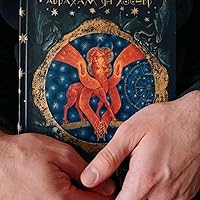
У нас катастрофічно мало складних багаторівневих книг, а коміксів і взагалі практично немає. І так сталося, що Максим Нестелєєв безстрашно перекладає мега-складні шедеври американського постмодернізму так ще й взявся за один з найскладніших коміксів в історії людства: "Невидимих" Ґранта Моррісона. Якщо чесно, то спершу я навіть не повірив, що така річ може в нас вийти друком, але книга в моїх руках. Чудовий формат, обкладинка з фірмовою гранатою, 341 сторінка гностицизму, конспірології, боївок, збочень, таємних знань та гра з різними класичними творами, сюжетами і персонажами. Це - "Невидимі", комікс не схожий ні на що з цього жанру прочитане вами до сих пір.
Моррісон майстерно розкладає свої натяки і гачки 33 сторінка: Розхристя розкладає карти стосовно малого бунтівника. Випадає "Місяць": окультні сили, видіння, приховані вороги. Тим часом на 65 сторінці Том в піземеллях Лондона каже каже Дейнові: "Колись Лондон був Луан-Дуном, містом місяця. Кажуть, Місяць - це двері. Брама воскресіння, поріг життя, поріг смерті."
Як кожен насичений покликаннями, цитатами та сенсами твір, "Невидимі" дарують неповторну насолоду кожному інтелектуалові.
Примітки від Макса стають тільки своєрідними підтвердженнями власної довершеності. З легкістю вбачаю посилання на Орвела, фразу після якої вбили Леннона, переправляю "Хепера" на "Хепрі" і бачу цю версію в коментарі. Посилання для убер-ерудитів - зачіпляючь за дивне ім'я демона: "Фліббертіджібет", ну звісно, я ж тільки тиждень тому зустрів його в фразах Едґара - старшого сина Ґлостера, котрий змушений прикидатися божевільним бурлакою, аби уникнути покарання за наклеп від свого молодшого брата в Шекспіровому "Лірі". Клац - і ще кілька цитат відразу стають очевидними. Для того, хто бачить сенси, Безумець Том стає не таким вже й божевільним.
Юрізен, Урізен, Юрайзен - статуя, що постає з вод. Треба витрати сотні годин роздивляння картин Блейка, щоб побачити його за секунду. В мене є ці сотні годин, може й більше. Отож, Юрізен - гностичний Ялдабаот, бог архітектор з пантеону Блейка. Недобрий бог. Тут - корінь гностичності цього шедеврального в усіх сенсах коміксу. Треба тільки мати зір, слух і гігабайти нагромаджених знань десь в локусі Гіпокампуса.
Впершечитаючий вирощений теликом читач бачитиме на кожному кроці знайомих персонажів, мотиви та ідеї. Бінґо! Так це ж "Матриця"! Не зовсім так. "Матриця", - це "Невидимі". Комікс був написаний задовго до сценарію фільму і брати (на той час такий в них був ґендер) надихались ним для своєї трилогії.
Прототипи Містерів Смітів у жокейських капелюхах та червоних піджаках.
Том вдаряє Дейна точнісінько в зону між лопаток, так, цей же спосіб застосував Дон Хуан на Кастанеді щоб змістити його точку збору. Після цього пацан бачить місто очима птаха, таке саме було з Карлосом після вживання herba diabolica. Бійка між Томом і Дейном, аналогічна тій що була між Морфеєм і Нео.
Це саме стосується стрибка із хмарочоса, але в Моррісона зашитий глибший контекст - перед стрибком Том цитує епізод з Біблії де диявол спокушає Ісуса на вершині гори. Психоделічна поїздка Дейна на ровері - пряме посилання на таку ж поїздку винахідника ЛСД Гоффмана.
Фраза Моба "Тримай тіньову сторону, Джеку!" - посилання на роман "Джек з Тіні" Роджера Желязни. В'язальниці перед гільйотиною - парки.
Знайшов в тексті 12 помилок різного штибу, в основному - недогляд редакторки, всі відправив Максові і в наступних тиражах їх буде виправлено. Але це аж ніяк не скасовує пророблену працю Максима над примітками і переклад фраґменту поеми "Юліан і Маддало".
"Я зробив двері зі слів і втік через них" - каже де Сад.
Магія це мова. Творіння це мова. "Глосолалія - мова ексатазу і снів. Первинна мова вогню."
В цьому епізоді Моррісон говорить те ж, що і Мур, практично слово в слово.
Бо можна безкінечно говорити про їх магічну битву,але в головному вони сходяться.
"Твоя голова, як і моя,як усі наші голови: досить велика для всіх богів і дияволів, які колись були. Досить велика для ваги всіх океанів і вертлявих зірок. Та туди цілі всесвіти помістяться!"
"У твоїй голові палац, хлопче. Вчися завжди жити у ньому."
"Невидимі" - абатуарій сенсів, магії, крові, зла, боротьби і краси.
"Є четверо воріт, що ведуть до одного палацу, підлога цього палацу зі срібла та золота, ляпіс-лазур та яшма там, та всі рідкісні аромати; жасмин і троянда, та емблеми смерті. Хай він увійде по черзі або відразу в ці четверо воріт; хай він стоїть на підлозі цього палацу. Чи не провалиться він? "
Ініціація починається тут? Ви готові розплющитися, чи й далі чипітимете в пітьмі глупоти?
Ґрант Моррісон
Переклад Максима Нестелєєва
"До нашої мети ведуть таємні церемоніальні шляхи. Кури. Спостерігай. Чекай"
У нас катастрофічно мало складних багаторівневих книг, а коміксів і взагалі практично немає. І так сталося, що Максим Нестелєєв безстрашно перекладає мега-складні шедеври американського постмодернізму так ще й взявся за один з найскладніших коміксів в історії людства: "Невидимих" Ґранта Моррісона. Якщо чесно, то спершу я навіть не повірив, що така річ може в нас вийти друком, але книга в моїх руках. Чудовий формат, обкладинка з фірмовою гранатою, 341 сторінка гностицизму, конспірології, боївок, збочень, таємних знань та гра з різними класичними творами, сюжетами і персонажами. Це - "Невидимі", комікс не схожий ні на що з цього жанру прочитане вами до сих пір.
Моррісон майстерно розкладає свої натяки і гачки 33 сторінка: Розхристя розкладає карти стосовно малого бунтівника. Випадає "Місяць": окультні сили, видіння, приховані вороги. Тим часом на 65 сторінці Том в піземеллях Лондона каже каже Дейнові: "Колись Лондон був Луан-Дуном, містом місяця. Кажуть, Місяць - це двері. Брама воскресіння, поріг життя, поріг смерті."
Як кожен насичений покликаннями, цитатами та сенсами твір, "Невидимі" дарують неповторну насолоду кожному інтелектуалові.
Примітки від Макса стають тільки своєрідними підтвердженнями власної довершеності. З легкістю вбачаю посилання на Орвела, фразу після якої вбили Леннона, переправляю "Хепера" на "Хепрі" і бачу цю версію в коментарі. Посилання для убер-ерудитів - зачіпляючь за дивне ім'я демона: "Фліббертіджібет", ну звісно, я ж тільки тиждень тому зустрів його в фразах Едґара - старшого сина Ґлостера, котрий змушений прикидатися божевільним бурлакою, аби уникнути покарання за наклеп від свого молодшого брата в Шекспіровому "Лірі". Клац - і ще кілька цитат відразу стають очевидними. Для того, хто бачить сенси, Безумець Том стає не таким вже й божевільним.
Юрізен, Урізен, Юрайзен - статуя, що постає з вод. Треба витрати сотні годин роздивляння картин Блейка, щоб побачити його за секунду. В мене є ці сотні годин, може й більше. Отож, Юрізен - гностичний Ялдабаот, бог архітектор з пантеону Блейка. Недобрий бог. Тут - корінь гностичності цього шедеврального в усіх сенсах коміксу. Треба тільки мати зір, слух і гігабайти нагромаджених знань десь в локусі Гіпокампуса.
Впершечитаючий вирощений теликом читач бачитиме на кожному кроці знайомих персонажів, мотиви та ідеї. Бінґо! Так це ж "Матриця"! Не зовсім так. "Матриця", - це "Невидимі". Комікс був написаний задовго до сценарію фільму і брати (на той час такий в них був ґендер) надихались ним для своєї трилогії.
Прототипи Містерів Смітів у жокейських капелюхах та червоних піджаках.
Том вдаряє Дейна точнісінько в зону між лопаток, так, цей же спосіб застосував Дон Хуан на Кастанеді щоб змістити його точку збору. Після цього пацан бачить місто очима птаха, таке саме було з Карлосом після вживання herba diabolica. Бійка між Томом і Дейном, аналогічна тій що була між Морфеєм і Нео.
Це саме стосується стрибка із хмарочоса, але в Моррісона зашитий глибший контекст - перед стрибком Том цитує епізод з Біблії де диявол спокушає Ісуса на вершині гори. Психоделічна поїздка Дейна на ровері - пряме посилання на таку ж поїздку винахідника ЛСД Гоффмана.
Фраза Моба "Тримай тіньову сторону, Джеку!" - посилання на роман "Джек з Тіні" Роджера Желязни. В'язальниці перед гільйотиною - парки.
Знайшов в тексті 12 помилок різного штибу, в основному - недогляд редакторки, всі відправив Максові і в наступних тиражах їх буде виправлено. Але це аж ніяк не скасовує пророблену працю Максима над примітками і переклад фраґменту поеми "Юліан і Маддало".
"Я зробив двері зі слів і втік через них" - каже де Сад.
Магія це мова. Творіння це мова. "Глосолалія - мова ексатазу і снів. Первинна мова вогню."
В цьому епізоді Моррісон говорить те ж, що і Мур, практично слово в слово.
Бо можна безкінечно говорити про їх магічну битву,але в головному вони сходяться.
"Твоя голова, як і моя,як усі наші голови: досить велика для всіх богів і дияволів, які колись були. Досить велика для ваги всіх океанів і вертлявих зірок. Та туди цілі всесвіти помістяться!"
"У твоїй голові палац, хлопче. Вчися завжди жити у ньому."
"Невидимі" - абатуарій сенсів, магії, крові, зла, боротьби і краси.
"Є четверо воріт, що ведуть до одного палацу, підлога цього палацу зі срібла та золота, ляпіс-лазур та яшма там, та всі рідкісні аромати; жасмин і троянда, та емблеми смерті. Хай він увійде по черзі або відразу в ці четверо воріт; хай він стоїть на підлозі цього палацу. Чи не провалиться він? "
Ініціація починається тут? Ви готові розплющитися, чи й далі чипітимете в пітьмі глупоти?

February 6, 2020
If you like chaos magik and anarchy, this book is for you!
This blew my mind. I recently read Doom Patrol and thought that was Morrisons wildest piece of works. Nope, Its The Invisibles. A boy on the wrong path of life falls down the rabbit hole when a old bum shows him the "real" London and tells him he is apart of a secret society that helps save the world. The Invisibles are here to fight the systems that hold mankind back; So far thats been an old Hispanic fleshless god and an evil corporation creating drugs to control the poor. Really political, lots of references to art and magik with just some ridiculous theories about what the future holds. I can also see a lot of Mark Millar's Secret Service in this story. Weather its because they use to work together or that's just how London life is, I couldn't tell you. I really liked this book and plan on reading the rest. Unfortunately I can see people not "getting"' it and that is a shame but I think a lot of people could use a story like this right now.
This blew my mind. I recently read Doom Patrol and thought that was Morrisons wildest piece of works. Nope, Its The Invisibles. A boy on the wrong path of life falls down the rabbit hole when a old bum shows him the "real" London and tells him he is apart of a secret society that helps save the world. The Invisibles are here to fight the systems that hold mankind back; So far thats been an old Hispanic fleshless god and an evil corporation creating drugs to control the poor. Really political, lots of references to art and magik with just some ridiculous theories about what the future holds. I can also see a lot of Mark Millar's Secret Service in this story. Weather its because they use to work together or that's just how London life is, I couldn't tell you. I really liked this book and plan on reading the rest. Unfortunately I can see people not "getting"' it and that is a shame but I think a lot of people could use a story like this right now.

August 24, 2026
I understood the message and the thinking behind this. I just think it was still a shit book. And that's okay, I don't have to like everything I read. It was just unnecessarily pretentious to me, it was truly as if he was just as bad as the bad guys he wrote. If I could unread this and get my time back, I would. But on the other hand I can now say I've read it and that's something.

December 13, 2024
Не уявляв, що може бути комікс подібний по потужності й грандіозності до Сендмена, але власне от. Колосальна робота, захопливий сюжет, безліч підтекстів. Дійсно епохальна праця.

March 14, 2018
Well, this is some crazyness right here!! Think I'll have to reread it to understand just a little bit more ;-)
Love all the different components in here. Everything is so well thought of and worked out.
Reread first or continue to second book?... :-P
Love all the different components in here. Everything is so well thought of and worked out.
Reread first or continue to second book?... :-P

July 16, 2021
Fuck yeah

February 23, 2014
Dead Beetles (1). A good introduction, primarily because it offers a great character sketch of Dane and suggests some of the weirdness that is to come [7/10].
Down & Out in Heaven & Hell (2-4). This is basically the story of Dane's initiation, and it's never been my favorite arc. It's too decompressed, and it's all about tearing Dane away from what's familiar to him, but it doesn't really approach the mysteries of the Invisibles, and that's just not enough to support a story line. Still, it hints at something bigger and at the time was (barely) enough to keep me reading [6/10].
Hexy. This short story from Absolute Vertigo is a little bit of nothing about King Mob, but it's nice to have it in the collection [5/10].
Arcadia (5-8). This is the arc that really opens up the strange and weird possibilities of the Invisibles. I find some of the parts with the Marquis de Sade a little too unpleasant (unsurprising) but everything else is such a weird mess that you can't help but keep reading [7/10]. 23: Things Fall Apart (9) is really a direct continuation of the action of Arcadia, and it's good action-adventure. Leaving us on a cliffhanger for several months was rather a surprise [7/10].
Season of Ghouls (10). This is a wonderful look at another Invisible, for the fact that it's so thematic and so magical. The actual story beyond that is a fun anti-corporate one [7+/10].
Royal Monsters (11). The next one-off is terrific because it gives texture to the bad guys, but it's also a wonderful story of personal horror that Morrison really hits out of the ball park [8/10].
Best Man Fall (12). Wow, this is an amazing finale to this first volume of Invisibles, both for its wonderful kaleidoscope storytelling and for its awesome interlinking with the rest of the Invisibles storyline [/10/10].
Overall, this is an interesting volume that makes you want to read more, but it's really in the single issues that Morrison excels.
Down & Out in Heaven & Hell (2-4). This is basically the story of Dane's initiation, and it's never been my favorite arc. It's too decompressed, and it's all about tearing Dane away from what's familiar to him, but it doesn't really approach the mysteries of the Invisibles, and that's just not enough to support a story line. Still, it hints at something bigger and at the time was (barely) enough to keep me reading [6/10].
Hexy. This short story from Absolute Vertigo is a little bit of nothing about King Mob, but it's nice to have it in the collection [5/10].
Arcadia (5-8). This is the arc that really opens up the strange and weird possibilities of the Invisibles. I find some of the parts with the Marquis de Sade a little too unpleasant (unsurprising) but everything else is such a weird mess that you can't help but keep reading [7/10]. 23: Things Fall Apart (9) is really a direct continuation of the action of Arcadia, and it's good action-adventure. Leaving us on a cliffhanger for several months was rather a surprise [7/10].
Season of Ghouls (10). This is a wonderful look at another Invisible, for the fact that it's so thematic and so magical. The actual story beyond that is a fun anti-corporate one [7+/10].
Royal Monsters (11). The next one-off is terrific because it gives texture to the bad guys, but it's also a wonderful story of personal horror that Morrison really hits out of the ball park [8/10].
Best Man Fall (12). Wow, this is an amazing finale to this first volume of Invisibles, both for its wonderful kaleidoscope storytelling and for its awesome interlinking with the rest of the Invisibles storyline [/10/10].
Overall, this is an interesting volume that makes you want to read more, but it's really in the single issues that Morrison excels.

June 24, 2019
Por momentos es un quilombo pero en rasgos generales la historia se va entendiendo. El tomo cierra con un par de historias independientes que amplían el universo de la serie (si eso es posible) que me gustaron mucho.
A ver cómo sigue esto.
A ver cómo sigue esto.

January 27, 2026
(13/149)
Not for me. Gross and pretentious stream of thought nonsense, I will not be finishing this series because I couldn't give a damn about any of the characters, and the main character is whiney and insufferable.
Not for me. Gross and pretentious stream of thought nonsense, I will not be finishing this series because I couldn't give a damn about any of the characters, and the main character is whiney and insufferable.

February 3, 2024
today's pick is an initial thoughts review of The Invisibles Book One Deluxe Edition by Grant Morrison, Steve Yeowell, Jill Thompson, Justine Mara Andersen, Chris Weston, John Ridgway, Steve Parkhouse, Duncan Fegredo, Daniel Vozzo, Clam Robins and Annie Parkhouse. This trade collection includes 12 issues from the original volume one and an issue from Absolute Vertigo. All of which were originally published in 1994 and 95. This deluxe edition was first printed in 2014 by Vertigo.
This is part of my vertigo readthrough, and inspired by an interest in dipping my toes back into some of Morrison's work.
Content notes for arson, gun violence, youth homelessness, queerphobia, body horror, violence against children, effigy, violence against kink, orientalism, harm to animals, sexual violence, nudity, n word, parts of bodies are cut off, and substance users are zombies,
As with almost all of Vertigo's titles, this trade is recommended for mature readers and can get pretty graphic.
Surprisingly enough, this is actually my first Grant Morrison review, although I have previously read Batman: Arkham Asylum, Batman: R.I.P. and Batman and Robin. Mostly a long long time ago. I hadn't touched them in a while because of an impression that they were perhaps super edgy for edgy's sake? To be completely transparent, I'm only feeling inspired to revisit their work because of the way Morrison's gender fuckery entered my awareness in 2020. It also seems interesting to expand my knowledge about the ways Morrison and Moore have paralleled and clashed over the years. But to actually get to a bio already. Grant was born in 1960 and had their first comic published in 1978. Some of their most popular work published pre Invisibles was Animal Man, Doom Patrol, and Arkham Asylum. Although they were very prolific both before and since, but if I listed everything we would be here all day. Wrapping things up, they are Scottish, married, and apparently have a complicated relationship with not having had children?
Keywords that came to mind? Street involved, rebellious youth, good vs evil, found family, normalcy, growing up, and horror.
The summary is "Follow the adventures of the Invisibles, a secret organization out to battle against physical and psychic oppression brought upon humanity by the interdimensional alien gods of the Archons of Outer Church!
Introducing the latest recruit into the covert action team known as the Invisibles: a teenage lout from the streets of London. Can Dane survive a mind-altering training course administered by King Mob?"
Looking at the writing, it's a lot. Lots of stuff going on and lots to digest. My complete lack of ability to review things in a timely fashion is certainly not helping either. But here we go. Published later then some of the other vertigo titles I've read of late, but earlier then others... The representation felt much better then any of them. Not perfect, but characters felt fuller and more humanized. Plus the trans woman managed to live through this volume at the very least - looking at you Sandman. Sigh... There were some parts that felt more like Sandman - vignettes scattered through time. Others felt a bit more like Constantine. There's a lot more anarchist aesthetics then I generally find in comics. And while it's not a philosophical treatise, it did feel like the story expressed enough misfit and queer nonconformity to earn it.
The art on the other hand felt much more run of the mill and standard for Vertigo. Although that's not the worst thing in the world and I generally liked it.
Class felt like the most central aspect of the story, particularly to start with when we are focused exclusively on Dane. For all the fantastical horror woven throughout, the overall experience of Dane as a kid who ends up on the streets felt relatively realistic and not particularly sensationalized or sanitized.
As the volume progressed it felt like we leaned a bit more into gender and sexuality. Dane is a homophobic little shit, but the book pushes back on him pretty hard.
Race saw a smattering of representation. We are of course served up a few pages of orientalist nonsense, although it is blessedly short. There are more Black characters who felt (to me a very white person) to be a bit more important and filled out then many Black characters in similar Vertigo titles. But I'm anything but the final judge on that and I didn't find any opinions on the representation of Voodoo. Although again, having them be on the team with the Invisibles felt better then the violent othering in either Hellblazer volume one or two. I forget which one.
And while there's a lot of body horror, physical difference felt fairly morally neutral? We do get pimple representation, which again feels a bit thin on the ground.
To conclude. Very promising. It kind of sets a new standard for the early 90s I suppose. Four very subjective stars and I'll have to keep reading.
This is part of my vertigo readthrough, and inspired by an interest in dipping my toes back into some of Morrison's work.
Content notes for arson, gun violence, youth homelessness, queerphobia, body horror, violence against children, effigy, violence against kink, orientalism, harm to animals, sexual violence, nudity, n word, parts of bodies are cut off, and substance users are zombies,
As with almost all of Vertigo's titles, this trade is recommended for mature readers and can get pretty graphic.
Surprisingly enough, this is actually my first Grant Morrison review, although I have previously read Batman: Arkham Asylum, Batman: R.I.P. and Batman and Robin. Mostly a long long time ago. I hadn't touched them in a while because of an impression that they were perhaps super edgy for edgy's sake? To be completely transparent, I'm only feeling inspired to revisit their work because of the way Morrison's gender fuckery entered my awareness in 2020. It also seems interesting to expand my knowledge about the ways Morrison and Moore have paralleled and clashed over the years. But to actually get to a bio already. Grant was born in 1960 and had their first comic published in 1978. Some of their most popular work published pre Invisibles was Animal Man, Doom Patrol, and Arkham Asylum. Although they were very prolific both before and since, but if I listed everything we would be here all day. Wrapping things up, they are Scottish, married, and apparently have a complicated relationship with not having had children?
Keywords that came to mind? Street involved, rebellious youth, good vs evil, found family, normalcy, growing up, and horror.
The summary is "Follow the adventures of the Invisibles, a secret organization out to battle against physical and psychic oppression brought upon humanity by the interdimensional alien gods of the Archons of Outer Church!
Introducing the latest recruit into the covert action team known as the Invisibles: a teenage lout from the streets of London. Can Dane survive a mind-altering training course administered by King Mob?"
Looking at the writing, it's a lot. Lots of stuff going on and lots to digest. My complete lack of ability to review things in a timely fashion is certainly not helping either. But here we go. Published later then some of the other vertigo titles I've read of late, but earlier then others... The representation felt much better then any of them. Not perfect, but characters felt fuller and more humanized. Plus the trans woman managed to live through this volume at the very least - looking at you Sandman. Sigh... There were some parts that felt more like Sandman - vignettes scattered through time. Others felt a bit more like Constantine. There's a lot more anarchist aesthetics then I generally find in comics. And while it's not a philosophical treatise, it did feel like the story expressed enough misfit and queer nonconformity to earn it.
The art on the other hand felt much more run of the mill and standard for Vertigo. Although that's not the worst thing in the world and I generally liked it.
Class felt like the most central aspect of the story, particularly to start with when we are focused exclusively on Dane. For all the fantastical horror woven throughout, the overall experience of Dane as a kid who ends up on the streets felt relatively realistic and not particularly sensationalized or sanitized.
As the volume progressed it felt like we leaned a bit more into gender and sexuality. Dane is a homophobic little shit, but the book pushes back on him pretty hard.
Race saw a smattering of representation. We are of course served up a few pages of orientalist nonsense, although it is blessedly short. There are more Black characters who felt (to me a very white person) to be a bit more important and filled out then many Black characters in similar Vertigo titles. But I'm anything but the final judge on that and I didn't find any opinions on the representation of Voodoo. Although again, having them be on the team with the Invisibles felt better then the violent othering in either Hellblazer volume one or two. I forget which one.
And while there's a lot of body horror, physical difference felt fairly morally neutral? We do get pimple representation, which again feels a bit thin on the ground.
To conclude. Very promising. It kind of sets a new standard for the early 90s I suppose. Four very subjective stars and I'll have to keep reading.

January 17, 2023
Fighting the unseen and corrupt! That’s what The Invisibles are all about. “The Invisibles” by Grant Morrison is a psychedelic revolution against oppression, both physical and metaphysical. We follow the group of people called The Invisibles, who stand against forces that are unseen and sometimes beyond human comprehension.
Let’s just get right into it. This is by far one of the weirdest books I have ever read. I have listened to a lot of Morrison’s interviews and I know about his trip Katmandu where he tried to gain enlightenment, his magic rituals to summon Lennon, and his theories about existence. It seem all those experiences were then distilled into a LSD hallucination and jammed into this book. By know means is this bad, but damn is it a lot. Classic Morrison. If you have not read Grant Morrison’s DC works, I would highly suggest checking those out before going here though. I started with some of the most tame Morrison stories and have slowly been building to this madness. I already have the next couple books in this series, but after that trip I think it’s best to take a break before diving back in.
Let’s just get right into it. This is by far one of the weirdest books I have ever read. I have listened to a lot of Morrison’s interviews and I know about his trip Katmandu where he tried to gain enlightenment, his magic rituals to summon Lennon, and his theories about existence. It seem all those experiences were then distilled into a LSD hallucination and jammed into this book. By know means is this bad, but damn is it a lot. Classic Morrison. If you have not read Grant Morrison’s DC works, I would highly suggest checking those out before going here though. I started with some of the most tame Morrison stories and have slowly been building to this madness. I already have the next couple books in this series, but after that trip I think it’s best to take a break before diving back in.

November 30, 2021
4.5
Acabo de terminar este primer omnibus del vol 1 de los invisibles de Grant Morrison y me dejó con la boca abierta este señor, no voy a mentir, los primeros números (vienen 12) se me hacia muy genérico y hasta me aburría, pero ya los últimos 5 números donde todo se conecta y wow 🤯
Morrison nos enseña perspectivas de personajes que NUNCA antes en mi vida de coleccionista/lector me había hecho y vaya que siempre estaba ahí el tema en mis narices y lo pasaba desapercibido.
Si eres fan del Sandman de Gaiman y te gusta como mezcla la historia que cuenta con la mitología fantástica del mundo aquí Morrison hace algo parecido mezclando su historia sci-fi con acontecimientos y personajes históricos a través de la historia de nuestro planeta.
Una vez más en un mundo saturado de historietas de Superhéroes (lo cuál tambien me gusta) Vértigo presenta una historia inteligente que da una bocanada de aire a los que quieren salir de su zona de confort.
*Nota: Si bien todos los artistas me gustaron, amé el arte de Steve Parkhouse no tenia el gusto de conocer sus trazos.
Acabo de terminar este primer omnibus del vol 1 de los invisibles de Grant Morrison y me dejó con la boca abierta este señor, no voy a mentir, los primeros números (vienen 12) se me hacia muy genérico y hasta me aburría, pero ya los últimos 5 números donde todo se conecta y wow 🤯
Morrison nos enseña perspectivas de personajes que NUNCA antes en mi vida de coleccionista/lector me había hecho y vaya que siempre estaba ahí el tema en mis narices y lo pasaba desapercibido.
Si eres fan del Sandman de Gaiman y te gusta como mezcla la historia que cuenta con la mitología fantástica del mundo aquí Morrison hace algo parecido mezclando su historia sci-fi con acontecimientos y personajes históricos a través de la historia de nuestro planeta.
Una vez más en un mundo saturado de historietas de Superhéroes (lo cuál tambien me gusta) Vértigo presenta una historia inteligente que da una bocanada de aire a los que quieren salir de su zona de confort.
*Nota: Si bien todos los artistas me gustaron, amé el arte de Steve Parkhouse no tenia el gusto de conocer sus trazos.
July 25, 2017
There's a lot going on in this book. At times, the amount of unexplained information can be rather overwhelming, but the world and backstory was interesting enough to draw me in. Despite not fully understanding everything that was happening, I was curious enough to press on and see what happened next. I have a feeling that this will be a series where I'll just have to accept that everything is not going to click at first, and I'll need to keep going to provide context to things I've already read. As an introduction to the series, I think it was a little intimidating, but it definitely captured my attention enough to make me want to finish the series and dive deeper into this world.
January 15, 2021
This was my first time delving into the world of Grant Morrison. I loved some of the psychedelic art, dense historical/cultural allusions and humour, but there are lots of diversions and the main story takes a long time to get going. After 12 issues, aside from some idea of anti-conformity, time travel and 90s queer and rave culture, I'm not 100% sure what the Invisibles' mission is or who they're fighting against. This collection feels like an extended prologue.
Looks like I'll have to shell out for the next one.
Looks like I'll have to shell out for the next one.

November 2, 2017
Rereading this a long time after my initial read, but this time in print rather than a computer.
With this first installment, it is reminding me of a more psychedelic Planetary, Volume 1: All Over the World and Other Stories by Warren Ellis. I think I prefer Planetary but wanted to revisit this one.
King Mob's combat outfit with the mask and wig is awesome though, as is the character of Jim Crow. I'll definitely be finishing rereading this.
With this first installment, it is reminding me of a more psychedelic Planetary, Volume 1: All Over the World and Other Stories by Warren Ellis. I think I prefer Planetary but wanted to revisit this one.
King Mob's combat outfit with the mask and wig is awesome though, as is the character of Jim Crow. I'll definitely be finishing rereading this.
April 26, 2022
Grant Morrison, youse a silly man. A silly man!
Though not quite as refined in it's edgelordship as his later work, "The Filth", I am pleased to note that this was still fairly disgusting.
I think the man is a decent storyteller, but I don't think I will be continuing the series beyond this initial volume. We shall see.
Though not quite as refined in it's edgelordship as his later work, "The Filth", I am pleased to note that this was still fairly disgusting.
I think the man is a decent storyteller, but I don't think I will be continuing the series beyond this initial volume. We shall see.

October 14, 2025
I simply did not appreciate reframing Marquis DeSade’s work into some gnostic allegory where DeSade is the good guy who joins the invisibles.
Grant Morrison is a weirdo and now having read his most explicitly chaos magyck influenced works even his Batman stuff is now tainted for me.
To think this book made The Matrix brothers throw their lives away.
Grant Morrison is a weirdo and now having read his most explicitly chaos magyck influenced works even his Batman stuff is now tainted for me.
To think this book made The Matrix brothers throw their lives away.
Displaying 1 - 30 of 164 reviews