

What do you think?

The Genius of Trees: How Trees Mastered the Elements and Shaped the World
The extraordinary story of the inventive and astonishing ways trees have shaped our natural world.
Over hundreds of millions of years, from the prehistoric forests to those standing tall over us today, trees have evolved to sculpt the environments. They split rock, change sex, spin carbon, and manipulate bacteria, animals and even humankind to achieve their ends and shape the natural world.
In The Genius of Trees, Harriet Rix takes us on a mind-expanding, globe-spanning journey into the remarkable inner lives of trees. For the first time, we see trees not as victims, but as powerful agents of change in a grand ecological narrative – as leading actors in the great drama of life on earth who have transformed our planet and offer us hope for its future.
Over hundreds of millions of years, from the prehistoric forests to those standing tall over us today, trees have evolved to sculpt the environments. They split rock, change sex, spin carbon, and manipulate bacteria, animals and even humankind to achieve their ends and shape the natural world.
In The Genius of Trees, Harriet Rix takes us on a mind-expanding, globe-spanning journey into the remarkable inner lives of trees. For the first time, we see trees not as victims, but as powerful agents of change in a grand ecological narrative – as leading actors in the great drama of life on earth who have transformed our planet and offer us hope for its future.
304 pages, Kindle Edition
First published August 7, 2025
Ratings & Reviews
Friends & Following
Create a free account to discover what your friends think of this book!
Community Reviews
Displaying 1 - 30 of 69 reviews

April 20, 2026
The Genius of Trees follows the scientific story of how trees evolved and influenced the environments and creatures around them. Rix looks at atomic-level interactions, structural engineering, growth patterns, the mechanisms by which trees draw water upward and purify air, and methods for dispersing seeds (and more).
The science goes deep. For example, Rix follows a single phenylpropanoid molecule released by Apollonias, a relative of avocado, step-by-step into cloud formation. That level of granularity will satisfy some readers and exhaust others. The highlight, for me, is Rix’s travel memoir. She visits remarkable places around the globe while researching various tree systems.
The issue with this approach is that the science is dense enough to lose a casual reader (or even an engaged reader with a genuine interest in trees). But the book isn't a textbook or a scholarly analysis, either, and the travel sections may not fit that type of audience. Still, the material is well-researched, and Rix makes a convincing case for reframing how trees operate within their ecosystems. I think it's worth reading if you're willing to work for it.
3.5
The science goes deep. For example, Rix follows a single phenylpropanoid molecule released by Apollonias, a relative of avocado, step-by-step into cloud formation. That level of granularity will satisfy some readers and exhaust others. The highlight, for me, is Rix’s travel memoir. She visits remarkable places around the globe while researching various tree systems.
The issue with this approach is that the science is dense enough to lose a casual reader (or even an engaged reader with a genuine interest in trees). But the book isn't a textbook or a scholarly analysis, either, and the travel sections may not fit that type of audience. Still, the material is well-researched, and Rix makes a convincing case for reframing how trees operate within their ecosystems. I think it's worth reading if you're willing to work for it.
3.5
January 21, 2026
This is a fascinating book that does a brilliant job of showcasing just how insignificant humans really are! I found it hard going initially even with my science A-levels but perseverance paid off and I was constantly wowed by the botanical explanations of the evolutionary journeys our trees have made.
If a revised edition is ever published I would suggest making chapter 4 (trees impacting air) the first chapter as that gave the account of how trees evolved from water onto land which felt like a better starting point. But perhaps that's just because of my lack of knowledge. I also found the copious footnotes, whilst interesting, quite distracting and disruptive to the reading experience. It still gets full marks though as a brilliant piece of science writing and storytelling.
If a revised edition is ever published I would suggest making chapter 4 (trees impacting air) the first chapter as that gave the account of how trees evolved from water onto land which felt like a better starting point. But perhaps that's just because of my lack of knowledge. I also found the copious footnotes, whilst interesting, quite distracting and disruptive to the reading experience. It still gets full marks though as a brilliant piece of science writing and storytelling.

October 4, 2025
I was absolutely captivated by this. It was like a love letter filled with truly fascinating insights.
August 1, 2026
In many ways, this is a beautiful, inspiring, thought-provoking book. I especially enjoyed the chapters about trees shaping animals and humans, and parts of the chapters covering fungus, fire and earth.
Unfortunately, this is a book that has no idea who its audience is. As someone who is not adept at biology / botany, large sections of the book were almost nonstop jargon, making it incredibly difficult to follow. It was particularly difficult in the chapters about trees shaping air and plants. The plants chapter...I could probably tell you one thing I remember from it.
I feel like anyone who understands all the botany jargon already knows everything the author is explaining. And for those of us who don't know, it could have been explained more in layman's terms. That said, I'm also tired of wishy-washy nonfiction that patronises the reader. A balance needs to be struck.
All the same, I'm glad I read it. I will never look at trees the same way again. They certainly are active creatures. This book even made me decide they're highly conscious, in their own ways, and quite manipulative. I especially liked the notion that trees and plants have domesticated us, by making us their caregivers and propagators. Fascinating stuff, just it took me ages to get through it.
Unfortunately, this is a book that has no idea who its audience is. As someone who is not adept at biology / botany, large sections of the book were almost nonstop jargon, making it incredibly difficult to follow. It was particularly difficult in the chapters about trees shaping air and plants. The plants chapter...I could probably tell you one thing I remember from it.
I feel like anyone who understands all the botany jargon already knows everything the author is explaining. And for those of us who don't know, it could have been explained more in layman's terms. That said, I'm also tired of wishy-washy nonfiction that patronises the reader. A balance needs to be struck.
All the same, I'm glad I read it. I will never look at trees the same way again. They certainly are active creatures. This book even made me decide they're highly conscious, in their own ways, and quite manipulative. I especially liked the notion that trees and plants have domesticated us, by making us their caregivers and propagators. Fascinating stuff, just it took me ages to get through it.

April 10, 2026
Strong 4.5 and for anyone who likes audios the author gives a nice reading. I’d put this a half step beneath my all time favorite science books (Ed Yong’s two for starters) but it’s brilliant. Did you know that trees use fire to outcompete each other? That they build rain clouds? That they communicate with each other underground and through the air?
The effect of trees on the planet is something I’ve not really appreciated as much as it’s obvious once it’s been pointed out. The animals who succeed do so along with the trees they depend on and serve, from worms to flies to birds, mammals and, yes, humans. The beauty of the connection is right there, and Rix does a nice job of explaining the science and its effects.
The effect of trees on the planet is something I’ve not really appreciated as much as it’s obvious once it’s been pointed out. The animals who succeed do so along with the trees they depend on and serve, from worms to flies to birds, mammals and, yes, humans. The beauty of the connection is right there, and Rix does a nice job of explaining the science and its effects.

March 10, 2026
3.5 rounded up to 4.
This was a captivating book. No doubt the author being a tree specialist, this book contains valuable information about trees. I liked the intimidating chapters and the last one with humans.
Writing style is something that was difficult for me to read this. It’s filled with scientific names and at times reads like a textbook for trees. So will advise to take each chapter perhaps in a day or two and give it a break before continuing. In that way I think it becomes enjoyable rather than a chore to continue reading.
By reading this book, I think we all will become aware how insignificant we are in this ecosystem. Trees are just magic and we have been brilliantly reducing them and facing their wrath and consequences in the name of global warming.
Overall, not all might enjoy this book given the academic writing style, nevertheless an important book to be picked up and explore the hidden wonders of the trees. And at least, with this knowledge we can be a little more decent and protect the ecosystem that have been giving us so much.
This was a captivating book. No doubt the author being a tree specialist, this book contains valuable information about trees. I liked the intimidating chapters and the last one with humans.
Writing style is something that was difficult for me to read this. It’s filled with scientific names and at times reads like a textbook for trees. So will advise to take each chapter perhaps in a day or two and give it a break before continuing. In that way I think it becomes enjoyable rather than a chore to continue reading.
By reading this book, I think we all will become aware how insignificant we are in this ecosystem. Trees are just magic and we have been brilliantly reducing them and facing their wrath and consequences in the name of global warming.
Overall, not all might enjoy this book given the academic writing style, nevertheless an important book to be picked up and explore the hidden wonders of the trees. And at least, with this knowledge we can be a little more decent and protect the ecosystem that have been giving us so much.
August 6, 2025
beautiful cover. thank you to the publisher for the giveaway I can't wait to read it.

Did Not Finish
September 30, 2025Did Not Finish - wrong time to read this book

July 6, 2026
3.5
Interesting read, though getting really scientific most of the time. There is definitely an insane amount of research and work behind the book, however my first impression wasn’t that it would turn out to be a research project.
Trees.. Trees, impressively clever and creative beings, and we should be grateful and mindful of their existence - book is a good eye opener!
Also, may be complicated to read if non-native English speaker and lack domain knowledge/vocab.
Interesting read, though getting really scientific most of the time. There is definitely an insane amount of research and work behind the book, however my first impression wasn’t that it would turn out to be a research project.
Trees.. Trees, impressively clever and creative beings, and we should be grateful and mindful of their existence - book is a good eye opener!
Also, may be complicated to read if non-native English speaker and lack domain knowledge/vocab.

December 28, 2025
This is maybe more about trees than I wanted to know, but it’s very erudite and well-written (for a book about the biochemistry of trees). I had to look up a bunch of words and didn’t look up many more concerning the chemical structure of plant proteins, etc.
This, from a footnote, says it all: “David Samson at the university of Toronto has done many studies comparing types of sleep in monkeys and the great apes. They make for fascinating reading.”
This, from a footnote, says it all: “David Samson at the university of Toronto has done many studies comparing types of sleep in monkeys and the great apes. They make for fascinating reading.”

February 10, 2026
This is a firehose of information, history, interesting facts, stories, travelogues, but fascinating. I loved it.

March 12, 2026
This is probably the BEST book I have ever read about trees! It is filled with wonder, well explained science and a lens that spans the globe and into the past. I also really liked how Rix centers women scientists and their discoveries throughout the chapters when she positions how a discovery about trees was made.
The book present trees not as passive background life, but as world-shaping forces that have transformed the planet across deep time. From the earliest evolution of photosynthesis and woody tissues to the rise of forests that altered water, soil, air, fire, fungi, plants, animals, and even humans, the book argues that trees are active engineers of Earth’s systems. Through chemistry, structure, and long evolutionary experimentation, trees created the conditions for many other forms of life while continuously reshaping the environments in which they themselves survive.
Chapter 1: Trees Shaping Water
Chapter 1 shows that trees became trees largely through their struggle to gain control over water. By growing upward into air and downward into deeper water sources, they developed powerful hydraulic systems that let them capture sunlight, cool their leaves, and regulate moisture across landscapes. Trees release huge amounts of water vapor, emit volatile organic compounds that help seed clouds, and influence rainfall patterns on local and continental scales, making them not just consumers of water but makers of rain. Their roots also stabilize soils, alter water tables, shape river channels, and create more stable floodplains, while specialized species such as mangroves demonstrate how far tree evolution has gone in mastering both fresh and salt water. Overall, the chapter argues that trees transformed the movement of water through the Earth by learning to pull it down, move it through their bodies, and send it back into the sky.
Chapter 2: Trees Shaping Soil
Chapter 2 explains how trees effectively invented soil by breaking down rock and turning it into living ground. Through roots, root hairs, acids, enzymes, and partnerships with microbes, trees extract minerals such as phosphorus and nitrogen from stone, while simultaneously feeding carbon into the earth through leaf litter, dead roots, and root exudates. This constant exchange builds the rhizosphere, a biologically active zone in which trees stabilize, enrich, and engineer their own habitat. The chapter also emphasizes that trees are not just miners of nutrients but recyclers and competitors, altering pH, controlling metal availability, and even weaponizing soil chemistry against rivals. By adding huge quantities of organic carbon underground, trees created the deep, fertile soils that support forests and much of terrestrial life, while also making soil one of the planet’s largest carbon stores.
Chapter 3: Trees Shaping Fire
Chapter 3 explores the paradox that some trees do not merely survive fire but evolve specifically to encourage it. Under drought stress, pines can produce highly flammable chemicals that increase the likelihood of burning, yet this apparent self-destruction is actually a competitive strategy: fire eliminates rivals, releases nutrients into ash, opens sealed cones, and creates ideal conditions for pine seedlings to dominate. Other trees, such as firs, instead produce substances that resist burning, showing that fire ecology reflects contrasting evolutionary strategies. The chapter presents wildfire as part of a larger chemical and ecological system involving resin, smoke, lightning, and nutrient release, with trees using fire either as a weapon, a defense, or a regenerative force. In this way, trees have not only adapted to fire-prone worlds but helped create them.
Chapter 4: Trees Shaping Air
Chapter 4 argues that trees have transformed the atmosphere more profoundly than almost any other life-form. Through photosynthesis, powered by chlorophyll and Rubisco, trees pull carbon dioxide from the air, build it into sugars and wood, and release oxygen, helping produce dramatic shifts in atmospheric chemistry across geological time. Ancient forests locked away immense quantities of carbon that later became coal, contributing both to high oxygen levels in the Carboniferous and, much later, to the modern climate crisis when humans burned those buried forests. The chapter also shows that trees shape air in many other ways: they emit volatile compounds, regulate stomata in response to carbon dioxide, trap pollutants, and may even help remove methane through associated bacteria. Trees therefore emerge as living engines of atmospheric balance, though their long history also reveals how deeply Earth’s climate is tied to forests.
Chapter 5: Trees Shaping Fungi
Chapter 5 examines the intimate and unstable alliances between trees and fungi. Mycorrhizal fungi help trees gather phosphorus, nitrogen, and other nutrients in exchange for carbon, and these partnerships can take different forms, from ectomycorrhizal fungi that remain outside root cells to arbuscular mycorrhizal fungi that enter them and closely integrate with the tree’s internal systems. Trees actively recruit and regulate fungal partners through chemicals such as strigolactones, effectively shaping underground relationships to meet their nutritional needs. At the same time, these relationships are never purely cooperative: fungal networks can support trees, compete among them, or turn pathogenic, as seen in devastating parasites like honey fungus. The chapter presents the underground forest as a dynamic and contested ecology in which trees use fungi to extend their reach, but where the line between mutual aid and exploitation is always fragile.
Chapter 6: Trees Shaping Plants
Chapter 6 shows how trees, by dominating light and space, shaped the evolution of the plants beneath them, especially the flowering plants that would later become dominant themselves. Under the deep shade of conifer canopies, early angiosperms evolved remarkable flexibility: small seeds, sprouting ability, rhizomes, rapid regeneration, and leaves designed to trap scarce flecks of light with extraordinary efficiency. Their lighter, faster vascular systems and reticulate leaf veins allowed them to respond quickly to disturbance and exploit openings in the canopy. After the Chicxulub asteroid impact, these traits became decisive, as darkness, ecological collapse, and nutrient-rich ash favored the adaptable angiosperms over older gymnosperm lineages. The chapter argues that flowering plants were first shaped by life beneath trees, and then, in one of evolution’s great reversals, many of them rose to become the next generation of trees.
Chapter 7: Trees Shaping Animals
Chapter 7 explains how trees shape animals both physically and chemically, largely by recruiting them to move pollen and seeds. Trees reward animals with fats, sugars, and stimulants, but they also manipulate them with toxins, architecture, and timing: ants defend cecropias, insects carry pollen, monkeys spread cacao seeds, and mammals bury or transport toxic fruits such as horse chestnuts. Because larger animals can travel farther, trees often tailor fruits and chemical compounds to attract or filter for particular dispersers, effectively selecting the animals most useful to them. In this chapter, animals are not separate from tree ecology but part of the trees’ reproductive machinery, molded by rewards and risks into couriers of genetic material. Trees thus shape animal behavior, diets, movement, and even evolution itself.
Chapter 8: Trees Shaping People
Chapter 8 argues that trees have also shaped humans physically, mentally, and culturally. Fruit-bearing trees helped drive primate intelligence by rewarding memory, spatial awareness, and route planning, while the physical demands of moving through branches influenced the evolution of upright posture, grasping hands, friction-sensitive fingertips, and other traits linked to arboreal life. Trees also shaped human societies more directly: people altered forests through cultivation, enriched soils such as terra preta, and built political and material worlds around wood, fruit, shade, fire, and scent. Even sensory pleasures such as the smell of books or oak-aged whisky connect human experience back to tree chemistry, especially lignin and its derivatives. The chapter presents humanity not as separate from forests but as a species deeply formed by long dependence on trees.
Taken together, this book portray trees as some of the greatest planetary agents in Earth’s history. They did not simply adapt to preexisting conditions; they created new conditions by redirecting water, forming soil, feeding or resisting fire, changing the chemistry of the air, partnering with fungi, driving the evolution of other plants, shaping animal behavior, and influencing human bodies and civilizations. The history of trees is therefore also the history of the living world they helped make. By seeing trees as dynamic architects rather than static scenery, the book invites us to understand forests as foundational systems whose past innovations still sustain life in the present.
Only thing I will say is that in the chapter where trees shaped humans, there was to me a blatant omission of trees and their links with lynching, enslaved people and plantations that just felt a bit off/a bit like a white person just not thinking to include this, which was a shame as this is absolutely part of how trees and humans have interacted.
FAVOURITE QUOTES:
“Rubisco, the most common enzyme on earth, comprising almost 50 percent of the protein in leaves, evolved 2.4 billion years ago, and enabled photosynthesizing bacteria (called cyanobacteria because they appeared blue) to store the energy they were capturing from the sun by forcing carbon dioxide molecules to form a carbon-carbon bond and enter the stable chain of life as glucose which can in turn be consumed for energy by other life-forms.”
“In the dark of the impact winter that followed the asteroid, the gymnosperms, those old evergreen trees that smothered the earth in the Carboniferous period, suffered. Their leaves, big enough when carbon dioxide levels were high and the earth peaceful, were suddenly too small, the veins bringing water and nutrients to the leaves too rudimentary for a dramatically changed climate, and their long lifespans a disadvantage in a world of chaos. They were supplanted by the angiosperms, which could cycle water quickly and drop their leaves when necessary, conserving energy until the next opportunity arose.”
“Red mangroves survive in the most inundated areas, propping themselves up on hoop-legs and absorbing air through lenticels-lung-like gaps in their bark that contain porous, spongy cells. They store the air directly in their roots for when they are inundated, and waterproof the roots with suberin, a sort of wax, which also allows the mangrove to ultrafiltrate salt out of the water it takes up.”
“Unlike animals, which can dismantle an old cell and replace it with a new cell in the same place, plants must keep their cellular structures stiff like the bricks in a wall, and are confined to laying down a new cell next to the old one. This is the reason that old trees often have a massive but hollow trunk, in which their own roots are digesting their own rotten heartwood. They can't replace tissue, only break it down to start again.
In the case of a newly growing tree, root survival involves expanding out and down and breaking up anything in the way.”
“These trees mine rock quite literally for nutrients to survive on, but they make soil by putting carbon back among the fragments of rock they have broken up. Their fine roots are constantly probing the rock around them and then dying back a little, sacrificing some complex carbohydrate to encourage the emergent ecosystem around them and make a little soil. Then they take advantage of the mutually created environment. The older the trees, the more carbon they commit to the soil, and you can see this in the vast roots of the gnarled trees said to be over a thousand years old, flaky-barked at ground level, looping over rock and through earth, twisting with the torque of centuries.”
“When companies talk of carbon sequestration by trees it is comforting to know that what you see is basically what you get. In every square foot of tree you are seeing over a half pound of carbon dioxide: a world of 3D carbon in forests and woods. Millions of trees have been using sunlight over millions of years to solidify the air, and the result has been a rollercoaster of oxygen levels throughout deep time, affecting everything from the rate at which iron rusts to the size animals can grow. From a very low start point oxygen concentrations have occasionally become very high, sometimes to the point that trees themselves have had to adapt to survive by altering the very structure of their proteins and leaves.”
“Trees don't want more carbon dioxide than they can handle inside their leaves, so they use a mechanism that is beautiful in its simplicity. High carbon dioxide levels in the leaf switch on a gene called HIC or High Carbon Dioxide, which encourages deposition of fatty acids in the stomatal pore cell.
This inhibits neighboring cells from developing into stomata, limiting gas exchange that is not essential.”
“If you tap "glutamate" into Google, Wikipedia will tell you it is the most abundant excitory neurotransmitter in the vertebrate nervous system. What it won't tell you is that glutamate is fundamental in pollen and spore germination and found in extremely high quantities in mushrooms, where it is responsible for the umami taste that makes them so irresistible.”
“Over millions of years of plant development this was the reality.
Trees covered the earth, and any other plants-anything non-woody
-eked out an existence underneath them or perched on their branches. We're so used to shady forests and dappled woodlands that we can easily forget what they mean. The green coolth of forest bathing means an almost complete blotting out of light and its life-giving energy from the ground, and therefore no carbon fixation— total starvation for plants. It took over 300 million years for a true multicanopied layer to develop in forests, but before that most plants would have had to live underneath canopies of huge conifers—a world of towering tree trunks and epiphytes with little undergrowth apart from mosses, ferns, cycads, and horsetails.”
“The soothing scent of a new book is a response to the smell of lignin in the paper, specifically a subunit, vanillin, that is also released into some whiskies aged in oak and concentrated by the vanilla orchid, which grows on trees.”
The book present trees not as passive background life, but as world-shaping forces that have transformed the planet across deep time. From the earliest evolution of photosynthesis and woody tissues to the rise of forests that altered water, soil, air, fire, fungi, plants, animals, and even humans, the book argues that trees are active engineers of Earth’s systems. Through chemistry, structure, and long evolutionary experimentation, trees created the conditions for many other forms of life while continuously reshaping the environments in which they themselves survive.
Chapter 1: Trees Shaping Water
Chapter 1 shows that trees became trees largely through their struggle to gain control over water. By growing upward into air and downward into deeper water sources, they developed powerful hydraulic systems that let them capture sunlight, cool their leaves, and regulate moisture across landscapes. Trees release huge amounts of water vapor, emit volatile organic compounds that help seed clouds, and influence rainfall patterns on local and continental scales, making them not just consumers of water but makers of rain. Their roots also stabilize soils, alter water tables, shape river channels, and create more stable floodplains, while specialized species such as mangroves demonstrate how far tree evolution has gone in mastering both fresh and salt water. Overall, the chapter argues that trees transformed the movement of water through the Earth by learning to pull it down, move it through their bodies, and send it back into the sky.
Chapter 2: Trees Shaping Soil
Chapter 2 explains how trees effectively invented soil by breaking down rock and turning it into living ground. Through roots, root hairs, acids, enzymes, and partnerships with microbes, trees extract minerals such as phosphorus and nitrogen from stone, while simultaneously feeding carbon into the earth through leaf litter, dead roots, and root exudates. This constant exchange builds the rhizosphere, a biologically active zone in which trees stabilize, enrich, and engineer their own habitat. The chapter also emphasizes that trees are not just miners of nutrients but recyclers and competitors, altering pH, controlling metal availability, and even weaponizing soil chemistry against rivals. By adding huge quantities of organic carbon underground, trees created the deep, fertile soils that support forests and much of terrestrial life, while also making soil one of the planet’s largest carbon stores.
Chapter 3: Trees Shaping Fire
Chapter 3 explores the paradox that some trees do not merely survive fire but evolve specifically to encourage it. Under drought stress, pines can produce highly flammable chemicals that increase the likelihood of burning, yet this apparent self-destruction is actually a competitive strategy: fire eliminates rivals, releases nutrients into ash, opens sealed cones, and creates ideal conditions for pine seedlings to dominate. Other trees, such as firs, instead produce substances that resist burning, showing that fire ecology reflects contrasting evolutionary strategies. The chapter presents wildfire as part of a larger chemical and ecological system involving resin, smoke, lightning, and nutrient release, with trees using fire either as a weapon, a defense, or a regenerative force. In this way, trees have not only adapted to fire-prone worlds but helped create them.
Chapter 4: Trees Shaping Air
Chapter 4 argues that trees have transformed the atmosphere more profoundly than almost any other life-form. Through photosynthesis, powered by chlorophyll and Rubisco, trees pull carbon dioxide from the air, build it into sugars and wood, and release oxygen, helping produce dramatic shifts in atmospheric chemistry across geological time. Ancient forests locked away immense quantities of carbon that later became coal, contributing both to high oxygen levels in the Carboniferous and, much later, to the modern climate crisis when humans burned those buried forests. The chapter also shows that trees shape air in many other ways: they emit volatile compounds, regulate stomata in response to carbon dioxide, trap pollutants, and may even help remove methane through associated bacteria. Trees therefore emerge as living engines of atmospheric balance, though their long history also reveals how deeply Earth’s climate is tied to forests.
Chapter 5: Trees Shaping Fungi
Chapter 5 examines the intimate and unstable alliances between trees and fungi. Mycorrhizal fungi help trees gather phosphorus, nitrogen, and other nutrients in exchange for carbon, and these partnerships can take different forms, from ectomycorrhizal fungi that remain outside root cells to arbuscular mycorrhizal fungi that enter them and closely integrate with the tree’s internal systems. Trees actively recruit and regulate fungal partners through chemicals such as strigolactones, effectively shaping underground relationships to meet their nutritional needs. At the same time, these relationships are never purely cooperative: fungal networks can support trees, compete among them, or turn pathogenic, as seen in devastating parasites like honey fungus. The chapter presents the underground forest as a dynamic and contested ecology in which trees use fungi to extend their reach, but where the line between mutual aid and exploitation is always fragile.
Chapter 6: Trees Shaping Plants
Chapter 6 shows how trees, by dominating light and space, shaped the evolution of the plants beneath them, especially the flowering plants that would later become dominant themselves. Under the deep shade of conifer canopies, early angiosperms evolved remarkable flexibility: small seeds, sprouting ability, rhizomes, rapid regeneration, and leaves designed to trap scarce flecks of light with extraordinary efficiency. Their lighter, faster vascular systems and reticulate leaf veins allowed them to respond quickly to disturbance and exploit openings in the canopy. After the Chicxulub asteroid impact, these traits became decisive, as darkness, ecological collapse, and nutrient-rich ash favored the adaptable angiosperms over older gymnosperm lineages. The chapter argues that flowering plants were first shaped by life beneath trees, and then, in one of evolution’s great reversals, many of them rose to become the next generation of trees.
Chapter 7: Trees Shaping Animals
Chapter 7 explains how trees shape animals both physically and chemically, largely by recruiting them to move pollen and seeds. Trees reward animals with fats, sugars, and stimulants, but they also manipulate them with toxins, architecture, and timing: ants defend cecropias, insects carry pollen, monkeys spread cacao seeds, and mammals bury or transport toxic fruits such as horse chestnuts. Because larger animals can travel farther, trees often tailor fruits and chemical compounds to attract or filter for particular dispersers, effectively selecting the animals most useful to them. In this chapter, animals are not separate from tree ecology but part of the trees’ reproductive machinery, molded by rewards and risks into couriers of genetic material. Trees thus shape animal behavior, diets, movement, and even evolution itself.
Chapter 8: Trees Shaping People
Chapter 8 argues that trees have also shaped humans physically, mentally, and culturally. Fruit-bearing trees helped drive primate intelligence by rewarding memory, spatial awareness, and route planning, while the physical demands of moving through branches influenced the evolution of upright posture, grasping hands, friction-sensitive fingertips, and other traits linked to arboreal life. Trees also shaped human societies more directly: people altered forests through cultivation, enriched soils such as terra preta, and built political and material worlds around wood, fruit, shade, fire, and scent. Even sensory pleasures such as the smell of books or oak-aged whisky connect human experience back to tree chemistry, especially lignin and its derivatives. The chapter presents humanity not as separate from forests but as a species deeply formed by long dependence on trees.
Taken together, this book portray trees as some of the greatest planetary agents in Earth’s history. They did not simply adapt to preexisting conditions; they created new conditions by redirecting water, forming soil, feeding or resisting fire, changing the chemistry of the air, partnering with fungi, driving the evolution of other plants, shaping animal behavior, and influencing human bodies and civilizations. The history of trees is therefore also the history of the living world they helped make. By seeing trees as dynamic architects rather than static scenery, the book invites us to understand forests as foundational systems whose past innovations still sustain life in the present.
Only thing I will say is that in the chapter where trees shaped humans, there was to me a blatant omission of trees and their links with lynching, enslaved people and plantations that just felt a bit off/a bit like a white person just not thinking to include this, which was a shame as this is absolutely part of how trees and humans have interacted.
FAVOURITE QUOTES:
“Rubisco, the most common enzyme on earth, comprising almost 50 percent of the protein in leaves, evolved 2.4 billion years ago, and enabled photosynthesizing bacteria (called cyanobacteria because they appeared blue) to store the energy they were capturing from the sun by forcing carbon dioxide molecules to form a carbon-carbon bond and enter the stable chain of life as glucose which can in turn be consumed for energy by other life-forms.”
“In the dark of the impact winter that followed the asteroid, the gymnosperms, those old evergreen trees that smothered the earth in the Carboniferous period, suffered. Their leaves, big enough when carbon dioxide levels were high and the earth peaceful, were suddenly too small, the veins bringing water and nutrients to the leaves too rudimentary for a dramatically changed climate, and their long lifespans a disadvantage in a world of chaos. They were supplanted by the angiosperms, which could cycle water quickly and drop their leaves when necessary, conserving energy until the next opportunity arose.”
“Red mangroves survive in the most inundated areas, propping themselves up on hoop-legs and absorbing air through lenticels-lung-like gaps in their bark that contain porous, spongy cells. They store the air directly in their roots for when they are inundated, and waterproof the roots with suberin, a sort of wax, which also allows the mangrove to ultrafiltrate salt out of the water it takes up.”
“Unlike animals, which can dismantle an old cell and replace it with a new cell in the same place, plants must keep their cellular structures stiff like the bricks in a wall, and are confined to laying down a new cell next to the old one. This is the reason that old trees often have a massive but hollow trunk, in which their own roots are digesting their own rotten heartwood. They can't replace tissue, only break it down to start again.
In the case of a newly growing tree, root survival involves expanding out and down and breaking up anything in the way.”
“These trees mine rock quite literally for nutrients to survive on, but they make soil by putting carbon back among the fragments of rock they have broken up. Their fine roots are constantly probing the rock around them and then dying back a little, sacrificing some complex carbohydrate to encourage the emergent ecosystem around them and make a little soil. Then they take advantage of the mutually created environment. The older the trees, the more carbon they commit to the soil, and you can see this in the vast roots of the gnarled trees said to be over a thousand years old, flaky-barked at ground level, looping over rock and through earth, twisting with the torque of centuries.”
“When companies talk of carbon sequestration by trees it is comforting to know that what you see is basically what you get. In every square foot of tree you are seeing over a half pound of carbon dioxide: a world of 3D carbon in forests and woods. Millions of trees have been using sunlight over millions of years to solidify the air, and the result has been a rollercoaster of oxygen levels throughout deep time, affecting everything from the rate at which iron rusts to the size animals can grow. From a very low start point oxygen concentrations have occasionally become very high, sometimes to the point that trees themselves have had to adapt to survive by altering the very structure of their proteins and leaves.”
“Trees don't want more carbon dioxide than they can handle inside their leaves, so they use a mechanism that is beautiful in its simplicity. High carbon dioxide levels in the leaf switch on a gene called HIC or High Carbon Dioxide, which encourages deposition of fatty acids in the stomatal pore cell.
This inhibits neighboring cells from developing into stomata, limiting gas exchange that is not essential.”
“If you tap "glutamate" into Google, Wikipedia will tell you it is the most abundant excitory neurotransmitter in the vertebrate nervous system. What it won't tell you is that glutamate is fundamental in pollen and spore germination and found in extremely high quantities in mushrooms, where it is responsible for the umami taste that makes them so irresistible.”
“Over millions of years of plant development this was the reality.
Trees covered the earth, and any other plants-anything non-woody
-eked out an existence underneath them or perched on their branches. We're so used to shady forests and dappled woodlands that we can easily forget what they mean. The green coolth of forest bathing means an almost complete blotting out of light and its life-giving energy from the ground, and therefore no carbon fixation— total starvation for plants. It took over 300 million years for a true multicanopied layer to develop in forests, but before that most plants would have had to live underneath canopies of huge conifers—a world of towering tree trunks and epiphytes with little undergrowth apart from mosses, ferns, cycads, and horsetails.”
“The soothing scent of a new book is a response to the smell of lignin in the paper, specifically a subunit, vanillin, that is also released into some whiskies aged in oak and concentrated by the vanilla orchid, which grows on trees.”

January 21, 2026
A deep dive into a beautiful topic. It's a book you can enjoy in small bites, so it took me quite a while to get through it.

November 23, 2025
Cumulatively, the earth’s trees sweepingly adjust global water flow. Trees of all 73,000 species are constantly making minute adjustments, but normally the resultant changes are subtle, deniable, and easy for humans to ignore, or, as in the Amazon rainforest, on a scale too enormous to be easily comprehended. I had gone to La Gomera because the dramatic change from desert to cloud forest is heightened by the extreme lengths to which the trees have gone, and continue to go, to maintain their clouds.
You can see the water pouring off their branches, smell the terpenes seeding the cloud, and in the tangle of dark-green leaf shapes above your head it is obvious that you are looking at cloud catchers, branches designed to scoop out the belly of a cloud. What you can’t see is the effect of transpiration—water molecules sucked up by the tree’s roots hustling minerals through the trunk, up to the furthest leaves 100 feet above, and then with a final puff of energy evaporating off and out into the air. You can, however, feel it in the cool under the trees as heat departs with the water molecules that are heading up to swell the clouds.
Excellent nature writing, really descriptive and detailed and told from a viewpoint of deep time which is such a source of wonder to me. I found myself looking up so many of the trees and plants she describes and marveling at them. I am not usually jealous of a person’s job even when filled with travel, but I think I am of this author, I would like to travel to look at some trees, too. Practical and engaging, but without the deeper side I like to see in my nature writing that approaches transcendence, but I understand its not that kind of book. Just really good storytelling and science.
In every square foot of tree you are seeing over a half pound of carbon dioxide: a world of 3D carbon in forests and woods. Millions of trees have been using sunlight over millions of years to solidify the air, and the result has been a rollercoaster of oxygen levels throughout deep time, affecting everything from the rate at which iron rusts to the size animals can grow. From a very low start point oxygen concentrations have occasionally become very high, sometimes to the point that trees themselves have had to adapt to survive by altering the very structure of their proteins and leaves.
One of the last areas of old-growth forest in the US is the Yaak old-growth forest, a soaring community of western red cedar, giant hemlock, shaggy sharp-needled spruce, western larch, lodgepole, and ponderosa pines reaching up to the sky and connecting to the 2.2 million–acre Kootenai forest. Three hundred thousand acres of this are now being logged, with the stated objective to “reduce catastrophic wildfire risk and improve forest health.”
Most eloquent is Rick Bass, who lives in the Yaak Valley and advocates for its protection as a landscape that has experienced minimal human interference. “This larch is not only meant to survive fire,” he says, “it’s meant to prosper from it. These attributes, the species diversity here, the structural diversity of the forest—they need to be studied, not clear-cut. But the forest service says that by clear-cutting a nearly 1,000-year-old forest, they’ll teach it to be resilient?”
Why did trees evolve to grow into the rock and turn it to dust? As tree roots start to grow and digest the rock that they move through, suddenly minerals are available to them that are essential for their growth (notably phosphate), for DNA, for cell membranes, and for moving energy around the plant easily. A feedback loop ensues, in which the top of the tree supplies the bottom with energy from the sun, and the bottom uses it to grind through the rock and supply the top with phosphate, which in turn helps the tree grow. Root hairs also provide a vast surface area for the osmosis of other mineral salts. Iron, zinc, magnesium, copper, cobalt, and potassium all cross from rock into the organic realm in this way.
When modern humans evolved about 40,000 years ago, there were an estimated 6 trillion trees on the planet. By the time we appeared on the scene, trees had already altered the planet’s air, changed the flow of water, used fire as a tool, and built relationships with the plants and animals around them. For almost 400 million years, trees have been some of the largest organisms on dry land, physically blocking airflows with their branches, channeling waterflows with their roots, and acting as architects for other segments of nature—a mosaic of microhabitats. We can see this above the ground when we take the time to observe closely: a tree or leaf is a condensation of the place it comes from and bears the marks of its experiences. The leaf of a ginkgo, for example, has veins optimized 385 million years ago, a broad fan-shape that nearly led to its extinction, and the pigments of a changing ozone layer. It is harder to imagine the complexity of a tree below ground, where trees are blind explorers, guided by fungi and bacteria but vulnerable to them, carrying an internal compass of gravity-sensing proteins, their only lodestar the center of the earth.
It’s not just imagination that makes angiosperms look more youthful and less staid than gymnosperms. Giant sequoias and other gymnosperms often have burls, huge shoots waiting to spring up if they hit the ground, and it is supposed that these are an adaptation to the trees being knocked over by dinosaurs. By contrast, an angiosperm will root in a thousand places—even a 100-year-old beech tree can send up shoots from its trunk if it falls over, and becomes a phoenix tree.
Genetically too, angiosperms tend to be more flexible, happily duplicating their DNA and experimenting with new chemical compounds. The ability to produce flowers and fruit, as well as shorter timescales of reproduction, meant that angiosperms shaped biotic factors—bacteria, fungi, plants, animals, and probably also humans—more than gymnosperms.
The period laurels developed into is broadly known as the Tertiary, and the trees that survived the droughts and subsequent glaciation are, like the spouses of a dead climate, sometimes known by the Dickensian term the Tertiary Relicts. About 15 million years ago, monteverde forests, the green, tropical or subtropical montane cloud forests, were widespread across Europe and North Africa, the vegetation of the Mediterranean before the ice age and subsequent onset of the hot Mediterranean summers. But as ice spread across the northern hemisphere and locked up water, the climate became drier and most of the laurel forest died off, leaving tiny reminders of itself around the shores of the Mediterranean: the fragrant bay laurel of Italy used in osso bucco, the warty Zelkova of the rain-catching White Mountains of Crete, and the maple-leaved liquidambars of humid coastal Lycia, perfume-bottles of the ancient world.
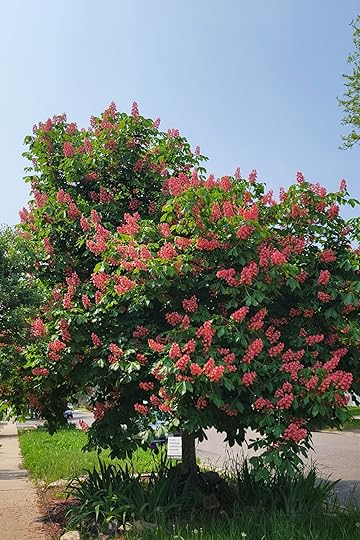
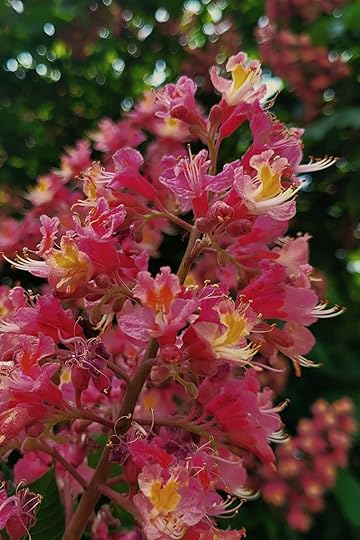
Where humans see the white candles of horse chestnuts standing out against the light green, with closer, subtle specks of yellow or red, bees see an additional dimension. The large white signal of the flowers on the valley side turns, on closer inspection, into a dazzling strobe show, with patterns of UV lights reflected from the stamens and anthers glowing deep like a pile of gold into the middle of the yellow-centered flowers. The red-centered flowers, on the other hand, will have just a small strobe on the anthers—the center of the flower—and to a bee the nectaries will be a dead black.
The strobe show of a flowering horse chestnut is created by esculin, a fluorescent molecule, and the same molecule, when used as a poison, is responsible for another dimension of horse chestnut survival in which horse chestnuts manipulate animals to move on their behalf.
Postscript:
I have lived in Denver for almost 25 years, and am a home visiting nurse, so I get to go to ever nook and cranny of it, but imagine my surprise for the first time ever, to encounter a brilliantly blooming tree like the red horse chestnut randomly across the street from a public library in a fairly impoverished neighborhood. I got all the feels, all the awe, couldn’t talk or move standing under this tree resplendent with pink and red candles and I swear I could see like a bee, I saw glitter, twinkle, glow standing there. I took photos, I wrote a poem with it in it, I associate it with a baby in my care who had been diagnosed as blind, it is connected to me now. I felt moved by the tree, manipulated to feel awe so I could protect it, and hope that others can do so also, this is what we need in our world we are killing. A few shots from that moment:
You can see the water pouring off their branches, smell the terpenes seeding the cloud, and in the tangle of dark-green leaf shapes above your head it is obvious that you are looking at cloud catchers, branches designed to scoop out the belly of a cloud. What you can’t see is the effect of transpiration—water molecules sucked up by the tree’s roots hustling minerals through the trunk, up to the furthest leaves 100 feet above, and then with a final puff of energy evaporating off and out into the air. You can, however, feel it in the cool under the trees as heat departs with the water molecules that are heading up to swell the clouds.
Excellent nature writing, really descriptive and detailed and told from a viewpoint of deep time which is such a source of wonder to me. I found myself looking up so many of the trees and plants she describes and marveling at them. I am not usually jealous of a person’s job even when filled with travel, but I think I am of this author, I would like to travel to look at some trees, too. Practical and engaging, but without the deeper side I like to see in my nature writing that approaches transcendence, but I understand its not that kind of book. Just really good storytelling and science.
In every square foot of tree you are seeing over a half pound of carbon dioxide: a world of 3D carbon in forests and woods. Millions of trees have been using sunlight over millions of years to solidify the air, and the result has been a rollercoaster of oxygen levels throughout deep time, affecting everything from the rate at which iron rusts to the size animals can grow. From a very low start point oxygen concentrations have occasionally become very high, sometimes to the point that trees themselves have had to adapt to survive by altering the very structure of their proteins and leaves.
One of the last areas of old-growth forest in the US is the Yaak old-growth forest, a soaring community of western red cedar, giant hemlock, shaggy sharp-needled spruce, western larch, lodgepole, and ponderosa pines reaching up to the sky and connecting to the 2.2 million–acre Kootenai forest. Three hundred thousand acres of this are now being logged, with the stated objective to “reduce catastrophic wildfire risk and improve forest health.”
Most eloquent is Rick Bass, who lives in the Yaak Valley and advocates for its protection as a landscape that has experienced minimal human interference. “This larch is not only meant to survive fire,” he says, “it’s meant to prosper from it. These attributes, the species diversity here, the structural diversity of the forest—they need to be studied, not clear-cut. But the forest service says that by clear-cutting a nearly 1,000-year-old forest, they’ll teach it to be resilient?”
Why did trees evolve to grow into the rock and turn it to dust? As tree roots start to grow and digest the rock that they move through, suddenly minerals are available to them that are essential for their growth (notably phosphate), for DNA, for cell membranes, and for moving energy around the plant easily. A feedback loop ensues, in which the top of the tree supplies the bottom with energy from the sun, and the bottom uses it to grind through the rock and supply the top with phosphate, which in turn helps the tree grow. Root hairs also provide a vast surface area for the osmosis of other mineral salts. Iron, zinc, magnesium, copper, cobalt, and potassium all cross from rock into the organic realm in this way.
When modern humans evolved about 40,000 years ago, there were an estimated 6 trillion trees on the planet. By the time we appeared on the scene, trees had already altered the planet’s air, changed the flow of water, used fire as a tool, and built relationships with the plants and animals around them. For almost 400 million years, trees have been some of the largest organisms on dry land, physically blocking airflows with their branches, channeling waterflows with their roots, and acting as architects for other segments of nature—a mosaic of microhabitats. We can see this above the ground when we take the time to observe closely: a tree or leaf is a condensation of the place it comes from and bears the marks of its experiences. The leaf of a ginkgo, for example, has veins optimized 385 million years ago, a broad fan-shape that nearly led to its extinction, and the pigments of a changing ozone layer. It is harder to imagine the complexity of a tree below ground, where trees are blind explorers, guided by fungi and bacteria but vulnerable to them, carrying an internal compass of gravity-sensing proteins, their only lodestar the center of the earth.
It’s not just imagination that makes angiosperms look more youthful and less staid than gymnosperms. Giant sequoias and other gymnosperms often have burls, huge shoots waiting to spring up if they hit the ground, and it is supposed that these are an adaptation to the trees being knocked over by dinosaurs. By contrast, an angiosperm will root in a thousand places—even a 100-year-old beech tree can send up shoots from its trunk if it falls over, and becomes a phoenix tree.
Genetically too, angiosperms tend to be more flexible, happily duplicating their DNA and experimenting with new chemical compounds. The ability to produce flowers and fruit, as well as shorter timescales of reproduction, meant that angiosperms shaped biotic factors—bacteria, fungi, plants, animals, and probably also humans—more than gymnosperms.
The period laurels developed into is broadly known as the Tertiary, and the trees that survived the droughts and subsequent glaciation are, like the spouses of a dead climate, sometimes known by the Dickensian term the Tertiary Relicts. About 15 million years ago, monteverde forests, the green, tropical or subtropical montane cloud forests, were widespread across Europe and North Africa, the vegetation of the Mediterranean before the ice age and subsequent onset of the hot Mediterranean summers. But as ice spread across the northern hemisphere and locked up water, the climate became drier and most of the laurel forest died off, leaving tiny reminders of itself around the shores of the Mediterranean: the fragrant bay laurel of Italy used in osso bucco, the warty Zelkova of the rain-catching White Mountains of Crete, and the maple-leaved liquidambars of humid coastal Lycia, perfume-bottles of the ancient world.
Where humans see the white candles of horse chestnuts standing out against the light green, with closer, subtle specks of yellow or red, bees see an additional dimension. The large white signal of the flowers on the valley side turns, on closer inspection, into a dazzling strobe show, with patterns of UV lights reflected from the stamens and anthers glowing deep like a pile of gold into the middle of the yellow-centered flowers. The red-centered flowers, on the other hand, will have just a small strobe on the anthers—the center of the flower—and to a bee the nectaries will be a dead black.
The strobe show of a flowering horse chestnut is created by esculin, a fluorescent molecule, and the same molecule, when used as a poison, is responsible for another dimension of horse chestnut survival in which horse chestnuts manipulate animals to move on their behalf.
Postscript:
I have lived in Denver for almost 25 years, and am a home visiting nurse, so I get to go to ever nook and cranny of it, but imagine my surprise for the first time ever, to encounter a brilliantly blooming tree like the red horse chestnut randomly across the street from a public library in a fairly impoverished neighborhood. I got all the feels, all the awe, couldn’t talk or move standing under this tree resplendent with pink and red candles and I swear I could see like a bee, I saw glitter, twinkle, glow standing there. I took photos, I wrote a poem with it in it, I associate it with a baby in my care who had been diagnosed as blind, it is connected to me now. I felt moved by the tree, manipulated to feel awe so I could protect it, and hope that others can do so also, this is what we need in our world we are killing. A few shots from that moment:

March 8, 2026
Fascinating read about how trees have shaped the world. You can really sense the authors passion for trees.

December 27, 2025
“The Genius of Trees” is a very rare book that has the potential change the way you see the world.
By taking the perspective that trees have shaped our entire planet– air, water, soil, fire, other plants, animals, and people – The Genius of Trees challenges what human beings actually know, and how comfortable can we be with the knowledge.
For this book demonstrates again and again, that nature is much more complicated and nuanced than we know, and perhaps it's more complicated than we can ever know – to paraphrase Albert Einstein.
The author, Harriet Rix, turns our thinking of humans being at the apex of a hierarchy of life. Instead, she places trees at the top of this proverbial pyramid, doing this while taking us on a global journey of what she has found studying trees around the world. She structures this great book on how trees have impacted almost everything we know, and the many things that are not apparent to most of us.
While I had some idea that trees shaped the climate around them, I didn’t know the extent they shaped water in clouds, how they transformed dust into soil, or became attractive to fires, air, fungi, plants, animals and us.
The author challenged my thinking with a very reasoned approach covering both macro and micro factors. On a macro level, she discussed at length how gymnosperms dominated the the land of Planet Earth, crowding out sunlight from other trees and plants until the Chicxulub asteroid struck the Yucatan Peninsula some 66 million years ago. This event resulted in two years of darkness and prevented the photosynthesis of the prevailing gymnosperm forests. It simultanously encouraged the growth of the flowering angiosperm trees to gain ground. The asteroid also resulted in the extinction of land-based dinosaurs.
On a micro level, she discussed how the eukaryotic cells that make up tree leaves are combinations of engulfed and mutually-reliant single cells. Some of these are chloroplasts that can transform light energy into sugars by combining it with CO2, water, and some minerals collected by the tree roots. Others are mitochondria that utilise oxygen to create energy for growth and movement of water, nutrients, etc..
In each tree leaf there are roughly 30 million cells, and within each cell there are about 40 chloroplasts and probably 300 mitochondria. The chloroplasts are consuming carbon dioxide to produce oxygen, while the mitochondria are doing the opposite. These different forces are balanced off within the cells and tree itself.
She also talked about how novel thinking throughout the book. For example, during droughts pines produces short chained hydrocarbons (like alcohols) that would burn easily, take down competitors, and create conditions for their fast-growing cones, without burning to hot to destroy everything, to open and outcompete neighbouring and slower growing fir trees.
I also hadn’t considered how trees and plants might be seen to have domesticated human beings versus us domesticated them. For example, to enjoy potatoes, people must plant, weed, fertilise, protect and keep some potato stock for further plantings. The question then arises do humans work for potatoes or the other way around.
Further, they are countless examples from around the world of trees becoming the keystone species of societies – e.g., olives, pistachios, walnuts -whole human communities organise their lives and cultures around them.
This new perspective really caught my attention, and while some of the examples were at time difficult to follow, I found this to be a revolutionary book. And I found myself re-reading many sections to better absorb the author's thoughts and words.
While the book had some photographs in its centre, the complexity and richness of the work cried out for illustrations and more photos. This is perhaps the greatest weakness and caution for those planning to read The Genius of Trees. If you choose to read it, please have a computer nearby. Google is a required partner for this read.
Overall, I loved the book and how it added to my thinking about the wonder of trees, wood, and the chemicals we derive from trees (and plants) – for medicine, perfumes, etc. – and it heightened my respect for the natural world around us.
If you love nature and the wonder of trees, this is a great book.
By taking the perspective that trees have shaped our entire planet– air, water, soil, fire, other plants, animals, and people – The Genius of Trees challenges what human beings actually know, and how comfortable can we be with the knowledge.
For this book demonstrates again and again, that nature is much more complicated and nuanced than we know, and perhaps it's more complicated than we can ever know – to paraphrase Albert Einstein.
The author, Harriet Rix, turns our thinking of humans being at the apex of a hierarchy of life. Instead, she places trees at the top of this proverbial pyramid, doing this while taking us on a global journey of what she has found studying trees around the world. She structures this great book on how trees have impacted almost everything we know, and the many things that are not apparent to most of us.
While I had some idea that trees shaped the climate around them, I didn’t know the extent they shaped water in clouds, how they transformed dust into soil, or became attractive to fires, air, fungi, plants, animals and us.
The author challenged my thinking with a very reasoned approach covering both macro and micro factors. On a macro level, she discussed at length how gymnosperms dominated the the land of Planet Earth, crowding out sunlight from other trees and plants until the Chicxulub asteroid struck the Yucatan Peninsula some 66 million years ago. This event resulted in two years of darkness and prevented the photosynthesis of the prevailing gymnosperm forests. It simultanously encouraged the growth of the flowering angiosperm trees to gain ground. The asteroid also resulted in the extinction of land-based dinosaurs.
On a micro level, she discussed how the eukaryotic cells that make up tree leaves are combinations of engulfed and mutually-reliant single cells. Some of these are chloroplasts that can transform light energy into sugars by combining it with CO2, water, and some minerals collected by the tree roots. Others are mitochondria that utilise oxygen to create energy for growth and movement of water, nutrients, etc..
In each tree leaf there are roughly 30 million cells, and within each cell there are about 40 chloroplasts and probably 300 mitochondria. The chloroplasts are consuming carbon dioxide to produce oxygen, while the mitochondria are doing the opposite. These different forces are balanced off within the cells and tree itself.
She also talked about how novel thinking throughout the book. For example, during droughts pines produces short chained hydrocarbons (like alcohols) that would burn easily, take down competitors, and create conditions for their fast-growing cones, without burning to hot to destroy everything, to open and outcompete neighbouring and slower growing fir trees.
I also hadn’t considered how trees and plants might be seen to have domesticated human beings versus us domesticated them. For example, to enjoy potatoes, people must plant, weed, fertilise, protect and keep some potato stock for further plantings. The question then arises do humans work for potatoes or the other way around.
Further, they are countless examples from around the world of trees becoming the keystone species of societies – e.g., olives, pistachios, walnuts -whole human communities organise their lives and cultures around them.
This new perspective really caught my attention, and while some of the examples were at time difficult to follow, I found this to be a revolutionary book. And I found myself re-reading many sections to better absorb the author's thoughts and words.
While the book had some photographs in its centre, the complexity and richness of the work cried out for illustrations and more photos. This is perhaps the greatest weakness and caution for those planning to read The Genius of Trees. If you choose to read it, please have a computer nearby. Google is a required partner for this read.
Overall, I loved the book and how it added to my thinking about the wonder of trees, wood, and the chemicals we derive from trees (and plants) – for medicine, perfumes, etc. – and it heightened my respect for the natural world around us.
If you love nature and the wonder of trees, this is a great book.
August 26, 2025
The Genius of Trees by Harriet Rix tells the scientific story of how trees came to be, developed, evolved and influenced the spaces and creatures around them.
In this fascinating look, Rix covers how trees-- through interactions at the atomic level, tree structure and engineering, to growth patterns—are able to draw water to themselves and support optimal moisture levels. Roots crunch through rocks developing soil for themselves, purify air through chemicals that are released, and get animals to spread their seeds so that they can develop a wider growing area. There is quite a bit beyond average science description and content. For example: “Let’s follow a phenylpropanoid molecule as it seeds a cloud. A sacrifice of Apollonius, a tree related to avocado, 2-(3-mehtoxy-4 hydroxyphenyl)-1-3-porpanediol’s structure was defined in 1995 and...it looks simple: a hexagonal ring of carbon, with one carbon arm sticking out, and various prickles of hydrogen and oxygen attached.”
This is also a travel log that takes the author to multiple amazing places around the globe as they research various aspects of trees. This is particularly enjoyable and does help to put some of the science in context.
This ultimately leads to a main issue with the book. It is more involved in describing scientific processes than a more casual reader, or even one with a great interest in trees, is likely to want to wade through. On the other hand, it isn’t a textbook or similar, so will it appeal to the scientific community? It may, but I’m not sure that they would appreciate the travel parts. It just is not clear who the audience is for this book.
Overall, this appears to be very well researched and makes some interesting points to reframe how trees work in their environment.
Thank you to NetGalley and Crown Publishing for the free eARC.
In this fascinating look, Rix covers how trees-- through interactions at the atomic level, tree structure and engineering, to growth patterns—are able to draw water to themselves and support optimal moisture levels. Roots crunch through rocks developing soil for themselves, purify air through chemicals that are released, and get animals to spread their seeds so that they can develop a wider growing area. There is quite a bit beyond average science description and content. For example: “Let’s follow a phenylpropanoid molecule as it seeds a cloud. A sacrifice of Apollonius, a tree related to avocado, 2-(3-mehtoxy-4 hydroxyphenyl)-1-3-porpanediol’s structure was defined in 1995 and...it looks simple: a hexagonal ring of carbon, with one carbon arm sticking out, and various prickles of hydrogen and oxygen attached.”
This is also a travel log that takes the author to multiple amazing places around the globe as they research various aspects of trees. This is particularly enjoyable and does help to put some of the science in context.
This ultimately leads to a main issue with the book. It is more involved in describing scientific processes than a more casual reader, or even one with a great interest in trees, is likely to want to wade through. On the other hand, it isn’t a textbook or similar, so will it appeal to the scientific community? It may, but I’m not sure that they would appreciate the travel parts. It just is not clear who the audience is for this book.
Overall, this appears to be very well researched and makes some interesting points to reframe how trees work in their environment.
Thank you to NetGalley and Crown Publishing for the free eARC.
Read
November 14, 2025تدور القصة حول تارا سيلتر (Tara Selter)، وهي تاجرة كتب نادرة وأثرية. تجد تارا نفسها عالقة بشكل غير مفهوم في حلقة زمنية (time loop)، حيث تستيقظ كل صباح لتجد أنه الثامن عشر من نوفمبر (November 18th) يتكرر بلا نهاية.
النقاط الرئيسية للرواية:
حلقة الزمن الفريدة: على عكس التفسيرات التقليدية لحلقة الزمن، فإن تارا تبدأ كل يوم جديد في المكان الذي انتهت فيه في اليوم السابق، بدلاً من العودة لنفس نقطة البداية الثابتة. هذا التغيير الفريد يضيف بعدًا جديدًا للقصة.
الشخصية الرئيسية والذاكرة: تارا تحتفظ بذكرياتها عن جميع التكرارات السابقة لليوم، بينما لا يدرك جميع من حولها، بما في ذلك زوجها توماس، أن اليوم يتكرر، ويبدأون يومهم كالمعتاد.
التأثيرات الجسدية على تارا: مع مرور الأيام المتكررة، يلاحظ أن جسم تارا يتغير ويتقدم في العمر بشكل طبيعي. على سبيل المثال، ينمو شعرها وتلتئم إصاباتها (مثل حرق أصابها)، بينما يظل زوجها توماس كما هو تمامًا في كل إعادة ضبط للوقت.
الاستهلاك والإحساس بالوحشية: هناك استثناء رئيسي لإعادة ضبط العالم اليومي؛ إذا استهلكت تارا شيئًا (طعامًا أو أي شيء آخر)، فإنه يختفي إلى الأبد. هذا يجعلها تتأمل فكرة "الوحشية" وتأثيرها على العالم، مما يضيف للرواية بعدًا بيئيًا وموضوعًا حول الاستهلاك.
الانفصال والعزلة: مع استمرار الحلقة، تبدأ تارا وزوجها توماس في الانفصال والابتعاد عن بعضهما البعض، حيث تعيش هي خارج إطار الزمن الذي يعيش فيه هو. تشعر تارا بالعزلة والألم وتلجأ أحيانًا للاختباء في المنزل.
التأمل العميق: الرواية هي في جوهرها تأمل عميق في طبيعة الوقت، والحب، والوجود، وما يعنيه أن تكون متصلاً بالآخرين.
الشكل الأدبي: الرواية مكتوبة في شكل إدخالات متقطعة تشبه المذكرات أو اليوميات، بضمير المتكلم (تارا)، وتنجح في نقل مشاعرها وتقلبات مزاجها المتغيرة.
تترك الرواية القارئ يتساءل عما إذا كانت تارا قد فقدت عقلها، أو ما إذا كانت عالقة بالفعل في "صدع في الزمن".
هل تود أن أبحث لك عن مراجعات أو تحليل إضافي لأي جزء معين من الرواية؟
النقاط الرئيسية للرواية:
حلقة الزمن الفريدة: على عكس التفسيرات التقليدية لحلقة الزمن، فإن تارا تبدأ كل يوم جديد في المكان الذي انتهت فيه في اليوم السابق، بدلاً من العودة لنفس نقطة البداية الثابتة. هذا التغيير الفريد يضيف بعدًا جديدًا للقصة.
الشخصية الرئيسية والذاكرة: تارا تحتفظ بذكرياتها عن جميع التكرارات السابقة لليوم، بينما لا يدرك جميع من حولها، بما في ذلك زوجها توماس، أن اليوم يتكرر، ويبدأون يومهم كالمعتاد.
التأثيرات الجسدية على تارا: مع مرور الأيام المتكررة، يلاحظ أن جسم تارا يتغير ويتقدم في العمر بشكل طبيعي. على سبيل المثال، ينمو شعرها وتلتئم إصاباتها (مثل حرق أصابها)، بينما يظل زوجها توماس كما هو تمامًا في كل إعادة ضبط للوقت.
الاستهلاك والإحساس بالوحشية: هناك استثناء رئيسي لإعادة ضبط العالم اليومي؛ إذا استهلكت تارا شيئًا (طعامًا أو أي شيء آخر)، فإنه يختفي إلى الأبد. هذا يجعلها تتأمل فكرة "الوحشية" وتأثيرها على العالم، مما يضيف للرواية بعدًا بيئيًا وموضوعًا حول الاستهلاك.
الانفصال والعزلة: مع استمرار الحلقة، تبدأ تارا وزوجها توماس في الانفصال والابتعاد عن بعضهما البعض، حيث تعيش هي خارج إطار الزمن الذي يعيش فيه هو. تشعر تارا بالعزلة والألم وتلجأ أحيانًا للاختباء في المنزل.
التأمل العميق: الرواية هي في جوهرها تأمل عميق في طبيعة الوقت، والحب، والوجود، وما يعنيه أن تكون متصلاً بالآخرين.
الشكل الأدبي: الرواية مكتوبة في شكل إدخالات متقطعة تشبه المذكرات أو اليوميات، بضمير المتكلم (تارا)، وتنجح في نقل مشاعرها وتقلبات مزاجها المتغيرة.
تترك الرواية القارئ يتساءل عما إذا كانت تارا قد فقدت عقلها، أو ما إذا كانت عالقة بالفعل في "صدع في الزمن".
هل تود أن أبحث لك عن مراجعات أو تحليل إضافي لأي جزء معين من الرواية؟

April 7, 2026
I consider myself to have a reasonable knowledge and understanding of the value of trees to the planet. The one thing that I am challenged by, is remembering the botanical name along side the given name many novices use instead.
This book is brilliant at not only describing the importance of certain trees to specific locations, but the symbiotic
relationship a tree has, to supporting other trees and the fungi close by. I have now discovered that there is one specific tree with the longest tap root of all the trees in the world. That Toucan’s are attracted to certain coloured fruits. That very tall trees in a forest, are able to draw moisture directly from clouds as if it were syphoning it from a bowser.
Fascinating information and facts. Humans and all life on earth depend on trees for many different reasons.
I love books like this and I would encourage others to read or listen to the audiobook to fully understand what the author is proselytising. Deforestation is of course bad for the planet, however, the planet will outlast humans and the trees will live on and continue to support other life forms.
This book is brilliant at not only describing the importance of certain trees to specific locations, but the symbiotic
relationship a tree has, to supporting other trees and the fungi close by. I have now discovered that there is one specific tree with the longest tap root of all the trees in the world. That Toucan’s are attracted to certain coloured fruits. That very tall trees in a forest, are able to draw moisture directly from clouds as if it were syphoning it from a bowser.
Fascinating information and facts. Humans and all life on earth depend on trees for many different reasons.
I love books like this and I would encourage others to read or listen to the audiobook to fully understand what the author is proselytising. Deforestation is of course bad for the planet, however, the planet will outlast humans and the trees will live on and continue to support other life forms.
September 4, 2025
I'm a tree hugger. I've read many books on trees. By reading The Genius of Trees, I learned more about trees. Between 4 and 5 stars rounding up.
Very informational. In my opinion, this book is college level classroom material. The book was well researched and intermixed with travels by the author and colleagues.
Even though I love trees and have planted 100's on our property, the book was a little deep for me and I took more "breaks" with this book than I have with most.
I do highly recommend the book; especially if you like reading about nature and trees and evolution. If I were the marketing team, I'd pursue specific horticultural professors.
Many thanks to NetGalley and Crown Publishing for approving my request to read the Advance Review Copy of The Genius of Trees: How They Mastered the Elements and Shaped the World by Harriet Rix (in exchange for an honest review). Approx 320 pages. Publication date is Sept 9, 2025.
Very informational. In my opinion, this book is college level classroom material. The book was well researched and intermixed with travels by the author and colleagues.
Even though I love trees and have planted 100's on our property, the book was a little deep for me and I took more "breaks" with this book than I have with most.
I do highly recommend the book; especially if you like reading about nature and trees and evolution. If I were the marketing team, I'd pursue specific horticultural professors.
Many thanks to NetGalley and Crown Publishing for approving my request to read the Advance Review Copy of The Genius of Trees: How They Mastered the Elements and Shaped the World by Harriet Rix (in exchange for an honest review). Approx 320 pages. Publication date is Sept 9, 2025.
November 2, 2025
I loved every page! "The Genius of Trees" by Harriet Rix is a fascinating exploration of how trees interact with their environment. The amount of information and insight packed into this book is impressive. I learned so much about the chemistry, biology, physics and ecological relationships that make trees and forests thrive.
Rix’s scientific depth is remarkable. The book is rich with detail, yet she presents it all in a way that feels clear and engaging. Her writing strikes that wonderful balance between education and enjoyment, making complex science not only digestible but genuinely pleasurable to read.
The personal touch Rix adds through interweaving stories of traveling to forests and different trees around the world, elevates the book. Vivid scenes bring her research to life and make it immersive. It’s the kind of book that makes you see nature with new eyes and want to go out to forests near and far to explore for yourself.
Rix’s scientific depth is remarkable. The book is rich with detail, yet she presents it all in a way that feels clear and engaging. Her writing strikes that wonderful balance between education and enjoyment, making complex science not only digestible but genuinely pleasurable to read.
The personal touch Rix adds through interweaving stories of traveling to forests and different trees around the world, elevates the book. Vivid scenes bring her research to life and make it immersive. It’s the kind of book that makes you see nature with new eyes and want to go out to forests near and far to explore for yourself.

March 24, 2026
When we think of trees, many of us imagine these massive, immobile, and passive things subject to the whims of the natural world around them. The Genius of Trees goes into great specifics detailing how trees actively change the environments around them as well as how they change animals and even people, shaping them for their own benefits. The book is quite detailed with its scientific information, and I did find it dry at a few points, but my overall impression was that it was fascinating. I walked away having a much deeper appreciation for and understanding of trees and how vital and dynamic they truly are. I am glad this book was nominated by the Women's Prize for Nonfiction, which put it on my radar.
Read
August 21, 2026There were certainly some tidbits in here about trees that are memorable and interesting and will alter the way I look at trees. That's enough for me to make it worth a read. It was a slog to get through and often not enjoyable for me. Rix is heavy-handed with science language. Sometimes I was looking up words but it got to be too much at times. I wish she worked with someone who was able to simplify the language sometimes, or alternatively, define her terms more often. If you already are familiar with the language she uses you will certainly not have the same difficulties I did though. Overall, it a was really interesting book, and she definitely makes clear her broad thesis that trees have deeply shaped the world we live in, even if some of the details were a bit maddening at times.

January 31, 2026
An amazing amount of detailed information. Rix presents us with a wide range of information about trees and plants of all types, along with geology, climate, evolution, ecosystems, and more. She presents it in a very readable style, easy to comprehend the details along with the big picture she wants to share.
One contention I have is when Rix criticizes Suzanne Simard's book The Mother Tree as presenting anthropomorphized trees (p. 129). Rix is doing the same in this book, is she not? She attributes deviousness to trees, as well as the ability to domesticate humans.
Overall a wonderful, enlightening book; and enjoyable read.
One contention I have is when Rix criticizes Suzanne Simard's book The Mother Tree as presenting anthropomorphized trees (p. 129). Rix is doing the same in this book, is she not? She attributes deviousness to trees, as well as the ability to domesticate humans.
Overall a wonderful, enlightening book; and enjoyable read.

March 27, 2026
Because they cannot move, we tend to look at trees as boring and inflexible. This book makes an excellent case of how dynamic they really are, having shaped the world around us for millions of years.
The book is divided into chapters on how they shaped water, soil, air, fire, fungi, other plants and animals (including homo sapiens). I had never before really thought about how different the planet once looked before trees and plant began to produce and bind soil and channel water. Also you think of fire as the enemy of trees, yet many of them actually make use of it.
At times the prose was a bit heavy on latin names and chemistry details, but it was still a fascinating read.
The book is divided into chapters on how they shaped water, soil, air, fire, fungi, other plants and animals (including homo sapiens). I had never before really thought about how different the planet once looked before trees and plant began to produce and bind soil and channel water. Also you think of fire as the enemy of trees, yet many of them actually make use of it.
At times the prose was a bit heavy on latin names and chemistry details, but it was still a fascinating read.

June 30, 2026
I had big hopes for this book, but got somewhat disappointed. There are many interesting nuggets there, but the work suffers somewhat from meandering, authoritative pronouncements, and unnecessary criticism of other works. I’m wondering what Susan Simard did to the author. I don’t see much difference in the language they both use. Rix uses the same anthropomorphic verbs, and we understand them to be metaphors. And, she cites one scholarly work criticizing Simard’s research. That’s not enough to be destroying somebody. The book is about how trees shaped the environment and life around them, but Rix somehow chooses to completely ignore the fact that trees were shaped by other species, animals and humans as well. It’s never a one way street.
3.75
3.75

July 10, 2026
I don’t think I’ll ever look at a tree in quite the same way again. The Genius of Trees takes something so familiar and reveals just how extraordinary it really is. I loved learning about the unexpected ways trees shape the world around us, and you can really feel Harriet Rix’s passion for the subject on every page.
That said, this definitely isn’t the sort of nature book you can breeze through. Some sections get very scientific, and there were times I had to slow down or reread passages to take it all in. I found the moments where Rix weaves in her own travels and observations the most engaging - they broke up the heavier science and reminded me why I was so fascinated in the first place.
That said, this definitely isn’t the sort of nature book you can breeze through. Some sections get very scientific, and there were times I had to slow down or reread passages to take it all in. I found the moments where Rix weaves in her own travels and observations the most engaging - they broke up the heavier science and reminded me why I was so fascinated in the first place.

December 24, 2025
Wonderfully written book on how trees have shaped the world including the persistent little mammals that evolved under and in their branches and then past that. My understanding was at many times just barely holding on by its fingernails, but I much prefer that to a book that dumbs things down to such an extent that it misses the immense complexity of the processes this book describes. I love a book that leaves me humbled and awed, but with a little bit more understanding. This is just such a book.

January 10, 2026
Finally a solid book on the topic of trees
Finally a solid book on the topic of trees - I've started more than a handful of books on the topic with limited success. Rix finally ended the losing streak by providing so much informative and interesting background. The concept of the wood-wide-web seemed to be somewhat overstated and Rix gives a more nuanced version here. She also balances first hand experience and scientific insight without the woo-factor that other writers on the topic can seemingly not steer away from.
Finally a solid book on the topic of trees - I've started more than a handful of books on the topic with limited success. Rix finally ended the losing streak by providing so much informative and interesting background. The concept of the wood-wide-web seemed to be somewhat overstated and Rix gives a more nuanced version here. She also balances first hand experience and scientific insight without the woo-factor that other writers on the topic can seemingly not steer away from.
January 16, 2026
It took me a couple of chapters to appreciate Rix's writing style. At times chapters feel like they meander and double-back. But once I was in step with it, I found it enjoyable.
There is so much information provided. It's wonderful. Try as I may, it is very hard to picture a world where soil did not exist yet, but trees did. Also, I've thought of animals finding a good matrixed niche to survive, but I have never thought of trees shaping animals to carry their seeds.
I also was struck by the author's comments that trees are trees, and should not be anthropomorphized.
There is so much information provided. It's wonderful. Try as I may, it is very hard to picture a world where soil did not exist yet, but trees did. Also, I've thought of animals finding a good matrixed niche to survive, but I have never thought of trees shaping animals to carry their seeds.
I also was struck by the author's comments that trees are trees, and should not be anthropomorphized.
Displaying 1 - 30 of 69 reviews