There are three great kingdoms of life – Animals, Plants and Fungi – but the fungi always come in third place. This may be because fungi seem alien to many their strange forms, their rapid appearance and disappearance, their hidden means of feeding and propagation. In Close Encounters of the Fungal Kind, acclaimed scientist and author Richard Fortey acknowledges this otherworldliness, marvels at their unique charm and boots-up as a guide through this great, mysterious Kingdom of life.
To Fortey, the strangeness of fungi is what makes them so exciting. Many people find them alien and the way so many toadstools appear so quickly and disappear with equal dispatch; their strange forms and colours; their reputation as poisoners. But for Fortey, the extraordinary nature of fungi makes him wonder, think and marvel. In Close Encounters of a Fungal Kind, Fortey leads us on a glorious literary journey, narrated through field trips to real places in search of the strangest, most extraordinary, or even most delicious fungi.
Writing with characteristic warmth, wit and wisdom, Fortey focuses on a selection of the larger fungi, the kind that might be spotted on a country walk, and a handful of microfungi that have particularly caught his attention. His enthusiasm and passion as a life-long ‘mushroom twitcher’ is infectious as he shares his own ‘close encounters’ and brings us along on his treks through this magnificent Kingdom.
The unique charm of the mushrooms themselves is centre stage in this gripping narrative that explains what fungi do in the natural world and rejoices in their profusion and diversity.
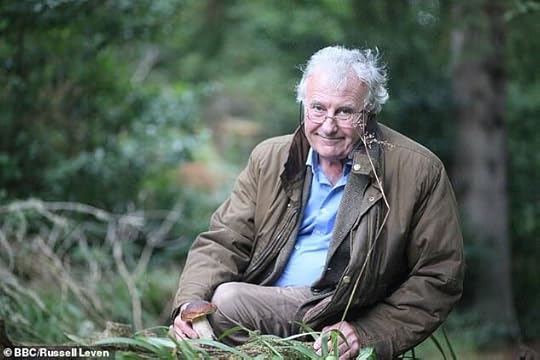
Richard Alan Fortey was a British palaeontologist, natural historian, writer and television presenter, who served as president of the Geological Society of London for its bicentennial year of 2007.
"This is a book about fungi, a biological kingdom of equal status to the kingdoms of animals and plants, but one that has never attracted blockbuster television treatments accompanied by a full symphony orchestra..."
I enjoy reading and learning about mycology, so I put this one on my list when I came across it. Although it had its moments, Close Encounters of the Fungal Kind ultimately did not meet my expectations. I put the book down ~midway through, as I wasn't prepared to spend any more time on a book I wasn't enjoying.
Author Richard Fortey is a senior paleontologist at the Natural History Museum in London and a Fellow of the Royal Society. He was Collier Professor in the Public Understanding of Science and Technology at the Institute for Advanced Studies at the University of Bristol in 2002.
Richard Fortey:
The prose here is sadly somewhat stereotypical British academic: Dry, tedious, and long-winded. I am admittedly extremely picky about how readable my books are, and this one really missed the mark for me. I also was not a fan of the formatting. I found the book lacking cohesion and flow. The writing jumps around from one species to another, in a virtually never-ending torrent that lost the forest for the trees...
********************
Ultimately, I did not enjoy this one. I have recently decided to cut my losses on books I'm not enjoying, and move on to greener pastures. 2 stars.
It was so nice to read a book about fungi by an author who lives relatively locally to me, I knew a lot of the places he mentioned. Also I was already a big fan of his palaeontology books. His enthusiasm for these organisms and life in general, as well as his questioning of concepts that are widely known and maybe oversimplified made this such an interesting read. I found the last chapter on things that are still unknown about fungi very thought provoking.
I recommend having a device on hand to look up what species look like that he mentions along the way to enhance the experience of this book. It would be great with more photos and illustrations but then it would have to become much thicker.
The one thing I will mention is that one of the photos, labelled silky pinkgill should I think be labelled silky rosegill - just in case it throws anyone.
I really really enjoyed this, I picked it up for a prompt which was 'read a book with a mushroom on the cover' and I am super pleased I took a chance as I'd never heard of this one before, or the author, and I ended up really interested in all he had to say. The author has a little forest plot where he has seen, watched and monitored mushrooms for many years. He's also a keen mushroom hunter and tour-guide, so it was a fascinating perspective to see as mushrooms, if you don't already know, are seriously resilient and cool. They have adapted in many fascinating ways, and this book just reignited my fascination with them and all the things they have adapted to be able to survive. I highly recommend this book if you have any passing curiosity about mushrooms and how cool they can be, as its very readable and easy to get into. I definitely would read more by this author, and plan to check out what else he has because he seems to have a wealth of knowledge on various subjects to do with nature. 4*s
I loved this book, but i may be biased. The book describes his many forays into the world of his local woodlands and foreign fields too. He writes amazing descriptions of all of the things he finds and discusses some of their history as well as ethical and philosophical issues, but the descriptions of the sensory experience are challenging to say the least as he notes in the book! It also ends up being bitty and jumpy in places, but this is a fair reflection of what it's like hunting for fungi: you never know what's under the next log!
Anyone that has enjoyed the book even a little bit should find their local survey group and go along to experience the textures and smells and tastes for themselves. You'll get the weird experience of tasting peppery spicy flavours, nuttiness, oddly familiar smells like cucumber and bizarre shapes and textures? Plus it's basically a treasure hunt for adults in the name of science.
An amazing read for people who love and are interested in mushrooms but are intimidated by all the complicated terms and science (AKA me!). I really enjoyed reading this and was lucky enough to meet him in person after he did a talk. You can really feel the passion he has for fungi in each page.
Nature's review: https://www.nature.com/articles/d4158... "Richard Fortey, best known as a palaeontologist, has left the fossils of extinct marine organisms behind in this lovely book about fungi and his long-standing enthusiasm for field mycology. ...
... he is sharing his love of fungi, which for him have been a “source of pleasure and perplexity for more than sixty years”. The perplexity comes from the difficulty of identifying mushrooms, although Fortey has become more skilled at this than most mycologists. He writes: “It could be said that the identification of a mushroom employs every human sense except hearing, but that has not stopped me wishing that a particularly obscure species could tell me its name.”
Richard Fortey is best known as an author (Life: An Unauthorised Biography) and palaeontologist (Trilobite!) but as his sparkling memoir A Curious Boy revealed, he's been a skilled amateur mycologist since boyhood. Now you can go on a fungus foray without ever leaving your armchair in the company of someone who really knows his Armillarias from his Amanitas. I wrote a longer review in the Literary Review here https://literaryreview.co.uk/spore-to...
A great book for a high level overview of a lot of different types of fungi. The focus on one group of mushrooms at a time allows the reader to learn about some of the traits the group shares and some differences between members. You don't need really any science background to pick the book up as the author introduces concepts like taxonomy and adaptation seamlessly into the writing without laboring too much over them.