

What do you think?

بيكيت أو شرف الله
بيكيت أو شرف الله مسرحية من أربعة فصول. مضمون المسرحية الفكري يذكرنا بأنتيجونا، أما الصنعة التي اتبعها المؤلف في بنائها الدرامي فتذكرنا بالقنبرة.
222 pages, Paperback
First published January 1, 1959
About the author
Jean Anouilh
272 books173 followersJean Anouilh was a French dramatist and screenwriter whose career spanned five decades, producing works that ranged from high drama to absurdist farce, though he is best remembered for his 1944 production of Sophocles’ Antigone, which, despite passing censorship, was widely interpreted as a critique of the Vichy regime. Born to a tailor father and a violinist mother, Anouilh absorbed the theatre from an early age, attending rehearsals and reading scripts, and began writing plays at twelve. The family moved to Paris, where he attended the Lycée Chaptal and briefly studied law at the Sorbonne before leaving to work in advertising. Early in his career he wrote comic scenes for cinema and worked as secretary to director Louis Jouvet, whose mentorship and the influence of playwright Jean Giraudoux inspired Anouilh to pursue theatre seriously. He debuted with collaborative and solo plays such as Humulus le muet, L’Hermine, and Mandarine, which, though not commercially successful, led to greater recognition with Le voyageur sans bagage in 1937. Anouilh developed distinct categories for his plays, including pièces noires, or tragedies like Antigone, exploring moral integrity against compromise; pièces roses, comedic works emphasizing fantasy and freedom; pièces brillantes, witty plays set in aristocratic environments; pièces grinçantes, darker, ironic comedies; and pièces costumées, historical dramas such as The Lark and Becket, highlighting protagonists pursuing moral paths amidst corruption. His later works, often called pièces secrètes, focused on dramatists and theatre professionals, emphasizing family and intimate relationships over conventional theatrical action. Politically, Anouilh remained largely apolitical, serving in the French Army and living under German occupation, his plays often interpreted as ambivalent reflections on resistance and pragmatism. Critically, he was recognized for blending lyrical language, precise dialogue, and structured plots, producing a prolific output for over fifty years, and winning accolades including the Prix mondial Cino Del Duca, consideration for the 1962 Nobel Prize in Literature, and the inaugural Grand Prix du Théâtre de l'Académie française. His works continued to be performed internationally, balancing existential concerns, moral dilemmas, and humor, reflecting a nuanced perspective on human nature. By the end of his career, he had influenced French theatre deeply, navigating between realism, comedy, and tragedy, and remained a vital figure in twentieth-century drama until his death, leaving a legacy of plays that explore the tension between idealism and compromise, the demands of conscience, and the pursuit of integrity in a flawed world.
Ratings & Reviews
Friends & Following
Create a free account to discover what your friends think of this book!
Community Reviews
Displaying 1 - 30 of 153 reviews

November 3, 2021
"Fate, it seems, is not without a sense of irony"
-Morpheus, The Matrix (1999)
রাজা, নাকি ধর্মীয় প্রতিষ্ঠান-রাষ্ট্রের শাসনদণ্ডটি প্রকৃত অর্থে কার হাতে থাকে? আপাতদৃষ্টিতে আমাদের কাছে রাজাই দেশের সর্বেসর্বা নায়ক হিসেবে প্রতীয়মান হন, কিন্তু কার্যত কি তা-ই? পর্দা নামিয়ে, দরজা লাগিয়ে দেশ চালনার জটিল হিসেবগুলো রাজা কার সাথে বসে করেন? রাজার ট্যাঁকে অর্থ যোগান কে? কে রাজা হবেন, তা-ই বা কে নির্ধারণ করে দেয়?
এ প্রশ্নগুলোর মুখোমুখি হলে আমরা বাকস্বাধীনতা, নাগরিকের ভোটাধিকার, জনমত-ইত্যাদি গা-জোয়ারি উত্তরগুলো দাঁড় করাতে পারি, কিন্তু আদতে কি তা-ই হয়? ধর্মীয় প্রতিষ্ঠান বা ধর্মীয় সমাজকে পাশ কাটিয়ে রাজনীতিতে যে টিকে থাকা যায় না তার প্রমাণ আমরা সভ্যতার শুরু থেকে আজতক প্রতি মূহুর্তেই পেয়ে চলেছি। আমরা জানি, ঈশ্বরের আশীর্বাদপুষ্ট পবিত্র কোন মানব রাজার আসনে আসলে আসতে পারেন না, বরঞ্চ সিংহাসনে যিনি বসেন, তাঁর জীবনাচার-বেশীরভাগ ক্ষেত্রেই-রাষ্ট্রটিতে রাজা যে ধর্মমতটি চালু রেখেছেন, তার ভালো ভালো শিক্ষাগুলোর সাথে সম্পূর্ণ সাঙ্ঘর্ষিক। রাজা শাষণে শোষণে আমাদের পিঠ ভাঙেন, কিন্তু আমরা সাধারণেরা এই ভেবে কৃতজ্ঞ হই যে, “ভাগ্যিস! ঈশ্বর এবং ধর্ম দুই-ই রাজার সহায় আছেন, ঈশ্বর নিজে ভালোবেসে রাজাকে আমাদের পিঠে ডান্ডা ভাঙতে পাঠিয়েছেন!” আমাদের বিশ্বাসের শক্তির কাছে হাজার বছর ধরে চলে আসা বৈষম্য, অনাচার, শোষণ আর অবিচারের ইতিহাস নতজানু হয়ে পড়ে এক নিমিষে। আমরা ভুলে বসি, রাজা আর ধর্মযাজক এক বিছানায় ঘুমোন, গায়ে গা লেপ্টে একে অপরের আদর খান।
একবিংশ শতাব্দীর আমরা আজ গণতন্ত্র বা নাগরিকের অধিকার ইত্যাদি কাঠের তলোয়ার-স্বরূপ অস্ত্র নিয়ে রাজার মুখোমুখি হই; আমাদের আগের শতকগুলোর মানুষের হাতে এই খেলনা অস্ত্রগুলোও ছিলো না। তারা রাজা এবং ধর্মের হাতে যুগপৎভাবে নির্বিচারে মার খেয়ে গেছে। হাজার হাজার বছরের পরিক্রমায় নাগরিকের অধিকারের বলয় যতো বেড়েছে, রাজার ক্ষমতা ততো খর্ব হয়েছে, কিন্তু ধর্মীয় প্রতিষ্ঠানের বিষদাঁত একইরকম তীক্ষ্ণ ও বিষাক্ত রয়ে গেছে; সমাজের বেশীর ভাগ, প্রায় ৯০ শতাংশ মানুষই কোন না কোন ধর্মে বিশ্বাস রাখেন বলে গণতন্ত্র একটা সময়ে কার্যত ধর্মতন্ত্রের হাতের পুতুল হয়ে পড়ে; ধর্মতন্ত্রের সিদ্ধান্তগুলোই বেশী মানুষের ভোট পেয়ে গণতান্ত্রিক সিদ্ধান্তের মুখোশ পরে প্রতিষ্ঠিত হয়। আজকের যে আধুনিক গণতন্ত্র তা প্রতিষ্ঠা পাবার আগে যাজক ও রাজা ধর্মতন্ত্র দিয়ে দেশ চালাতেন; পালা করে করে তাঁরা কখনো জল্লাদ হতেন, কখনো হতেন জল্লাদের হাতের খাঁড়া।
তবে কিছু কিছু সময় তো জল্লাদের হাত থেকেও খাঁড়া পিছলে যায়, কিংবা অধিক ব্যবহারে হাতল ভেঙে আসে। সময়ে সময়ে রাজার সাথে যাজকের সম্পর্কও প্রায়ই এমন পিচ্ছিল হয়ে উঠেছে; যে যাজক দীর্ঘকাল রাজার একান্ত বিশ্বস্ত খাঁড়া হয়ে জনগণের গলা কেটে এসেছেন, তিনি-ই শেষতক উল্টো ফিরে রাজার নাড়িভুঁড়ি বের করে আনতে চেয়েছেন। দ্বাদশ শতাব্দীতে ইংল্যান্ডের রাজা দ্বিতীয় হেনরি ও ইংল্যান্ডের ক্যাথলিক চার্চের সর্বেসর্বা আর্চবিশপ থমাস বেকেটের মাঝে ঠিক এভাবেই সংঘাত বাধে। ৮০০ বছর পর ফরাসী নাট্যকার জাঁ আনুইল ঐতিহাসিক এ ঘটনা অবলম্বনে তাঁর ‘বেকেট’ নাটকটি লেখেন।
এ নাটকের পুরো নাম ‘Becket or The Honor of God’। থমাস বেকেট ইতিহাসের এক কৌতুহলোদ্দীপক চরিত্র। প্রথম জীবনে আপাদমস্তক ভোগী জীবন যাপন করা বেকেট মূলত ছিলেন রাজা দ্বিতীয় হেনরি’র ‘পার্টনার ইন ক্রাইম’; লাম্পট্য, ফুর্তি-ফার্তা, পান-ভোজন, বিলাস-ব্যাসনে একে অপরকে ছাড়া চলতোই না এঁদের। প্রাণের বন্ধু বেকেটকে হেনরি প্রথমে লর্ড চ্যান্সেলর বানান, যা ইংল্যান্ডের সরকারী কর্মকর্তাদের সর্বোচ্চ পদ। এর খুব অল্প পরেই হেনরি বেকেটকে ক্যাথলিক চার্চের শীর্ষ গুরু আর্চবিশপ অফ ক্যান্টরবিউরি’র পদে অধিষ্ঠিত করেন। পদাধিকারের দিক দিয়ে আর্চবিশপের অবস্থান রাজার ঠিক পরেই। বেকেটের আগে যিনি আর্চবিশপ ছিলেন, সেই থিওবাল্ড রাজা হেনরির চক্ষুশূল হয়ে পড়েন, কারণ থিওবাল্ড রাজাকে অর্থসাহায্য দিতে অস্বীকৃতি জানান।
রাজার আসনে বসলে অনেকরকম খরচের নেশায় পেয়ে বসে; এখানে যুদ্ধ করতে হয়, সেখানে বাইজি নাচাতে হয়, ওখান থেকে দামী অলঙ্কার আনাতে হয় রাণীর মন ভরাবার জন্য…এমন হাজারটা খরচের উৎস। কিন্তু গরীব চাষাভুষা প্রজাদের পিঠ ভেঙে আর কতই বা নেয়া যায়? এদিকে টাঁকশাল খালি। উপায়ন্তর না দেখে শেষমেষ হেনরি আর্চবিশপের কাছেই হাত পাতেন। অতীতে অনেকবার অর্থসাহায্য দিয়ে দিয়ে যাজক সম্প্রদায়েরও আর পোষাচ্ছেনা, তাঁরা দেখে এসেছেন চার্চের টাকায় রাজা কিভাবে ফুর্তি করে চলেন। থিওবাল্ড তাই বেশ শক্তভাবে রাজাকে ‘না’ বলে দেন।
থিওবাল্ডের হঠাৎ মৃত্যুতে হেনরির সামনে সুযোগ চলে আসে, তিনি বহু যোগ্য এবং অভিজ্ঞ প্রার্থীকে ডিঙ্গিয়ে বেকেটকে আর্চবিশপ বানান। জিগরী দোস্ত বেকেট আর্চবিশপ হয়ে এবার যে দু’হাতে হেনরিকে টাকা যোগাবেন সে বিষয়ে তাঁর কোন সন্দেহ থাকে না। কিন্তু আর্চবিশপ হবার পর সব হিসেব পাল্টে দিয়ে বেকেট বেঁকে বসেন, তিনিও হেনরিকে টাকা যোগাতে অস্বীকৃতি জানান। কারণ? বেকেট এখন ঈশ্বরের সন্ধান পেয়েছেন! ঈশ্বরের ভাগের টাকায় বেশ্যা নিয়ে ফুর্তি করা কি মানায়? ঈশ্বরের সম্মান রক্ষায় দৃঢ়চিত্ত বেকেটের সাথে হেনরির দূরত্ব বাড়তে থাকে, যার শেষ হয় ১১৭০ সালে হেনরির একান্ত কাছের লোকেদের হাতে বেকেটের খুন হওয়া দিয়ে। বেকেটের মৃত্যুর পর পোপ ৩য় আলেক্সান্ডার তাঁকে সন্ত উপাধি দেন, এবং আজতক খৃষ্টান বিশ্ব থমাস বেকেটকে সেইন্ট বেকেট হিসেবেই জেনে আসছে। সংক্ষেপে এই হলো থমাস বেকেটের জীবনী ও আনুইল-এর নাটকের মূল গল্প।
এ নাটকে আনুইল-এর ভীষণ তীক্ষ্ণ উইট-এর পরিচয় পাওয়া যায়; দ্বাদশ শতকের রাজকীয় বর্বরতা, স্বার্থের দখল নিয়ে খেয়োখেয়ি, ক্ষমতাশীলদের হাতে বাক্সবন্দী হয়ে থাকা গরীব জনগণ-এই সব কিছুই টুকরো টুকরো ভাবে উঠে আসে আনুইল-এর বিষাক্ত কমেডিতে। কিছুটা চ্যাপলিনীয় স্ল্যাপস্টিক কমেডি সংবলিত এ নাটকের শেষে দেখা যায় যে ব্যারনেরা বেকেটকে খুন করেছিলো রাজা হেনরি তাদের-ই পালের গোদাটিকে বেকেট-হত্যার তদন্তের দায়িত্ব দেন। বাস্তবে বেকেট হত্যার সাথে জড়িতদের মৃত্যুদণ্ড দেয়া হয়েছিলো; বেকেটের হত্যাকারীদের কাউকে হেনরি তদন্তের দায়িত্ব দিয়েছিলেন কি না সেটি আমার জানা নেই, ইতিহাস ঘাঁটতে বসলে সে তথ্যও হয়তো পেয়ে যাবো, তবে সে ইচ্ছে আমার নেই। বাঙলাদেশের নাগরিক হিসেবে যে অমোঘ সত্যটি আমি জানি, সেটি হলো রাষ্ট্রীয় পর্যায়ের অপরাধগুলো সচরাচর নৃপতির অঙ্গুলিহেলনেই হয়, এবং অপরাধকর্মটি যিনি নিজ হাতে করলেন, তাঁকেই এ অপরাধের তদন্ত কমিটির প্রধান হিসেবে নিয়োগ দেয়া হয়।

ছবিতেঃ থমাস বেকেট ও রাজা দ্বিতীয় হেনরি। ১৪ শতকে আঁকা।
কেউ প্রশ্ন করে বসতেই পারেন, আনুইল ৮০০ বছর আগের এই ঘটনা নিয়ে কেন নাটক লিখতে গেলেন? শুধু কি ইতিহাস বলাই তাঁর উদ্দেশ্য? কিন্তু সে তো ইতিহাসের যেকোন বই পড়লেই জানা যায়। আনুইল-এর নাটকে বেশ কিছু ঐতিহাসিক ভুলও রয়েছে যা তিনি নিজেই স্বীকার করেছেন (বেকেটকে আনুইল তাঁর নাটকে স্যাক্সন হিসেবে দেখিয়েছেন, বাস্তবে বেকেট ছিলেন নরম্যান)। ঐতিহাসিক এ ঘটনাকে কেন্দ্র করে নাটক লেখার পেছনে আনুইল-এর ভিন্ন একটি উদ্দেশ্য রয়েছে, যেটি নিয়ে আলোচনা করবার জন্যই এত সময় লাগিয়ে ৮০০ শব্দের এই ফোরপ্লে।
জাঁ আনুইল কামু এবং সার্ত্রে দ্বারা ভীষণভাবে প্রভাবিত ছিলেন। এঁরা দু’জনই দর্শনশাস্ত্রের অস্তিত্ববাদ শাখাটির অন্যতম মূল বিজ্ঞাপন। দর্শনের এ শাখাটি ব্যাক্তির অস্তিত্বকে (কিংবা স্বীয় অস্তিত্বের “শুদ্ধতা”কে) সব কিছুর ঊর্ধে রাখে; এখানে ভাগ্য বলে কিছু নেই, এখানে ঈশ্বর নেই, বিচারকর্তা নেই, স্বর্গ-নরকও নেই; ভালো-মন্দ বিচার করবার দায় পুরোটাই আপনার নিজের। আপনি যদি এ পথের অনুসারী হন, তাহলে যেকোন ভালো কাজ করা এবং খারাপ কাজ এড়িয়ে চলার জন্য আপনার বিবেকই যথেষ্ঠ হওয়া উচিৎ; “ওপরওয়ালার কাছে কী জবাব দেবো?”-এই প্রশ্নটির ভীতি আপনাকে জোর করে কোন কাজ করিয়ে নেবে না। তৃষ্ণার্তকে পানি খাওয়ানো কিংবা অন্ধকে হাত ধরে রাস্তা পার করিয়ে দেয়া-ইত্যাদি কাজগুলো আপনি যদি নিজের ইচ্ছেতে না করে ঈশ্বরের শাস্তির ভয়ে করেন, তাহলে আপনার এই ভালো কাজগুলো কতটা আন্তরিক, এবং এ কাজগুলোর জন্য আপনার আদৌ পুরষ্কৃত হওয়া উচিৎ কি না-সে প্রশ্নটি নিজেকে করে দেখতে পারেন।
আনুইল তাঁর অস্তিত্ববাদের প্রপাগ্যান্ডা দিয়ে জানিয়ে দিয়েছেন, পূর্বলিখিত ভাগ্য বলে কিছু নেই, মানুষ কারো হাতের পুতুল নয়। কোন পথটি সঠিক এবং কোন পথটি বেঠিক, তা আপনি জীবনের যে কোন পর্যায়ে, যে কোন মুহুর্তে নির্ধারণ করতে পারেন, এবং সে অনুযায়ী দিক বদলাতে পারেন; আপনার গাড়ীটির চালক আপনি হবেন, নাকি চালকের হাতে নিজের ভাগ্য সঁপে দিয়ে গোটা সময়টা যাত্রীর আসনে বসে থাকবেন-এ সিদ্ধান্তটি সম্পূর্ণই আপনার। জীবনের বড় একটি অংশই ভোগী জীবন যাপন করেও শেষতক ঈশ্বরের সম্মান রক্ষার্থে বেকেট ত্যাগের জীবনকেই বেছে নিয়েছিলেন, মৃত্যু নিশ্চিত জেনেও। এ প্রসঙ্গে আব্রাহাম লিংকনের একটি বিখ্যাত উক্তি রয়েছে,
মানুষ কি পৃথিবীতে একটি সাদা খাতা (রোমান ভাষায় “Tabula Rasa” বা blank slate) নিয়ে আসে? নাকি সে কী করবে, কী হবে, কীভাবে করবে-ইত্যাদি বিষয়গুলো আগেই ঠিক করা হয়ে গেছে, তার ছাঁচে ছাপ ফেলে কৃতকর্মের খাতাটা স্রেফ ভরাট করে যেতে হয়? এ প্রশ্নটি অনেক প্রাচীন, বহু বহু দার্শনিক-বিজ্ঞানী-চিন্তাবিদ এ নিয়ে মাথা ঘামিয়ে গেছেন। প্রাচীন গ্রেকো-রোমান অনেক নাটকেও মানুষের এই ভাগ্যের পুতুল হয়ে থাকার ব্যাপারটি ঘুরেফিরে এসেছে; পৃথিবীর বেশীরভাগ মানুষই সম্ভবত নিজেদের ভাগ্যের পুতুল হিসেবে দেখতেই স্বচ্ছন্দ বোধ করেন বেশী (কারণ, দুয়ের মাঝে এটিই সহজ রাস্তা)।
জনপ্রিয় এই মতটির সাথে গলা মিলিয়ে সফোক্লিস তাঁর ইডিপাসকে নিয়ে লেখা ৩টি নাটকে ভাগ্যের পূর্বলিখনকেই ইডিপাসের কৃতকর্মের জন্য দায়ী করেছেন। শিশুবয়েসেই পিতা লাইয়াসের কাছ থেকে আলাদা হয়ে যাওয়া ইডিপাস যৌবনে তাঁর পিতার রাজ্যে সৈনিক রূপে ফিরে আসেন এবং নিজের অজান্তে পিতাকে হত্যা করে আপন মাতা জোকাস্টাকে বিয়ে করে সিংহাসনে বসেন। জোকাস্টার সাথে ইডিপাসের ৪টি সন্তান হয় (দুই কন্যা অ্যান্টিগন ও ইজমিন, এবং দুই পুত্র পলিনেসেস ও এটিওক্লেস)। ইডিপাস যখন জানতে পারেন লাইয়াস ও জোকাস্টার আসল পরিচয়, তিনি নিজ হাতে স্বীয় চোখ দু'টি নষ্ট করে সিংহাসন ছেড়ে স্বেচ্ছা-নির্বাসনে চলে যান। ইডিপাস-পর্বের দ্বিতীয় নাটক ইডিপাস অ্যাট কলোনাস-এ দেখা যায় অন্ধ, নিঃস্ব ইডিপাস কলোনাস শহরে আসবার পর তাঁর মামা (অথবা শ্যালক/ সম্বন্ধী) ক্রেওন তাঁকে তাঁর ঘৃণ্য কাজগুলোর জন্য তিরস্কার করে যাচ্ছেন। আত্নপক্ষ সমর্থনে ইডিপাস তাঁর ভাগ্যের লিখনকে দায়ী করে হাহাকার করে বলেনঃ
“নীতির আলাপ ত ম্যালাই দিলেন, আপনেই এবার কনঃ
অহন-ই যদি এক বান্দীর পোলায়
আঁৎকা আয়া চাক্কু মারবার চায়
তারে কি বুকে টাইনা কইবেন,
“খাড়ান, বাপজান! আমি কি আপনের সন্তান?”
নিজে লগে যে চাক্কুডা রাহেন, ঐডা দিয়া কি কান চুলকান?
জানের মায়া হালায়া ব্যাবাকেরই আছে।
হাততালি পাইবো ভাইবা দয়ার শইল সাইজা বহে কেউ যদি
খোদার কসম কইলাম আইজ মামা, তার মায়েরে আমি____”
"Let me ask you this, one simple question
If at this moment someone
Should step up to murder you
Would you, Godly creature that you are
Stop and say, "Excuse me sir, are you my father?"
Or would you deal with him there and then?
Ah! You love your life enough, I think
To turn on him, not look around
To find a warrant first"
দ্যা ম্যাট্রিক্স চলচ্চিত্রে মর্ফিয়াস যখন নিওকে তাঁর দলে ভেড়াচ্ছেন, সে দৃশ্যের শুরুতে মর্ফিয়াস নিওকে জিজ্ঞেস করেন, নিও ভাগ্যে বিশ্বাস করে কি না। নিও'র জবাব ছিলো "না", কারণ, অন্য কারো হাতে নিজের জীবনের রিমোট কন্ট্রোলটি দেখতে নিও'র মোটেই ভালো লাগে না। কার্যত, ভাগ্যে নিও'র বিশ্বাস নেই বলেই 'ম্যাট্রিক্স' ছবিটি আদৌ হলো। নিও যদি ভাগ্যে বিশ্বাস করে বাকী সব্বার মতই জীবন চালিয়ে নেবার কথা ভাবতো, সাতমণ তেলও পুড়তো না, নিও-ট্রিনিটির প্রেম কাহিনীও হতো না, মেশিনের বিরুদ্ধে মানুষের যুদ্ধ করাও চলতো না। এজেন্ট স্মিথই ভাগ্যসর্বস্ব সে পৃথিবী দাবড়ে বেড়াতেন।

তো, ভাগ্যের লিখন, নাকি নিজের ভাগ্য নিজে গড়ে নেয়া-কোনটি অধিকতর গ্রহণযোগ্য আপনার কাছে? সিদ্ধান্তটি সম্পূর্ণই আপনার!
-Morpheus, The Matrix (1999)
রাজা, নাকি ধর্মীয় প্রতিষ্ঠান-রাষ্ট্রের শাসনদণ্ডটি প্রকৃত অর্থে কার হাতে থাকে? আপাতদৃষ্টিতে আমাদের কাছে রাজাই দেশের সর্বেসর্বা নায়ক হিসেবে প্রতীয়মান হন, কিন্তু কার্যত কি তা-ই? পর্দা নামিয়ে, দরজা লাগিয়ে দেশ চালনার জটিল হিসেবগুলো রাজা কার সাথে বসে করেন? রাজার ট্যাঁকে অর্থ যোগান কে? কে রাজা হবেন, তা-ই বা কে নির্ধারণ করে দেয়?
এ প্রশ্নগুলোর মুখোমুখি হলে আমরা বাকস্বাধীনতা, নাগরিকের ভোটাধিকার, জনমত-ইত্যাদি গা-জোয়ারি উত্তরগুলো দাঁড় করাতে পারি, কিন্তু আদতে কি তা-ই হয়? ধর্মীয় প্রতিষ্ঠান বা ধর্মীয় সমাজকে পাশ কাটিয়ে রাজনীতিতে যে টিকে থাকা যায় না তার প্রমাণ আমরা সভ্যতার শুরু থেকে আজতক প্রতি মূহুর্তেই পেয়ে চলেছি। আমরা জানি, ঈশ্বরের আশীর্বাদপুষ্ট পবিত্র কোন মানব রাজার আসনে আসলে আসতে পারেন না, বরঞ্চ সিংহাসনে যিনি বসেন, তাঁর জীবনাচার-বেশীরভাগ ক্ষেত্রেই-রাষ্ট্রটিতে রাজা যে ধর্মমতটি চালু রেখেছেন, তার ভালো ভালো শিক্ষাগুলোর সাথে সম্পূর্ণ সাঙ্ঘর্ষিক। রাজা শাষণে শোষণে আমাদের পিঠ ভাঙেন, কিন্তু আমরা সাধারণেরা এই ভেবে কৃতজ্ঞ হই যে, “ভাগ্যিস! ঈশ্বর এবং ধর্ম দুই-ই রাজার সহায় আছেন, ঈশ্বর নিজে ভালোবেসে রাজাকে আমাদের পিঠে ডান্ডা ভাঙতে পাঠিয়েছেন!” আমাদের বিশ্বাসের শক্তির কাছে হাজার বছর ধরে চলে আসা বৈষম্য, অনাচার, শোষণ আর অবিচারের ইতিহাস নতজানু হয়ে পড়ে এক নিমিষে। আমরা ভুলে বসি, রাজা আর ধর্মযাজক এক বিছানায় ঘুমোন, গায়ে গা লেপ্টে একে অপরের আদর খান।
একবিংশ শতাব্দীর আমরা আজ গণতন্ত্র বা নাগরিকের অধিকার ইত্যাদি কাঠের তলোয়ার-স্বরূপ অস্ত্র নিয়ে রাজার মুখোমুখি হই; আমাদের আগের শতকগুলোর মানুষের হাতে এই খেলনা অস্ত্রগুলোও ছিলো না। তারা রাজা এবং ধর্মের হাতে যুগপৎভাবে নির্বিচারে মার খেয়ে গেছে। হাজার হাজার বছরের পরিক্রমায় নাগরিকের অধিকারের বলয় যতো বেড়েছে, রাজার ক্ষমতা ততো খর্ব হয়েছে, কিন্তু ধর্মীয় প্রতিষ্ঠানের বিষদাঁত একইরকম তীক্ষ্ণ ও বিষাক্ত রয়ে গেছে; সমাজের বেশীর ভাগ, প্রায় ৯০ শতাংশ মানুষই কোন না কোন ধর্মে বিশ্বাস রাখেন বলে গণতন্ত্র একটা সময়ে কার্যত ধর্মতন্ত্রের হাতের পুতুল হয়ে পড়ে; ধর্মতন্ত্রের সিদ্ধান্তগুলোই বেশী মানুষের ভোট পেয়ে গণতান্ত্রিক সিদ্ধান্তের মুখোশ পরে প্রতিষ্ঠিত হয়। আজকের যে আধুনিক গণতন্ত্র তা প্রতিষ্ঠা পাবার আগে যাজক ও রাজা ধর্মতন্ত্র দিয়ে দেশ চালাতেন; পালা করে করে তাঁরা কখনো জল্লাদ হতেন, কখনো হতেন জল্লাদের হাতের খাঁড়া।
তবে কিছু কিছু সময় তো জল্লাদের হাত থেকেও খাঁড়া পিছলে যায়, কিংবা অধিক ব্যবহারে হাতল ভেঙে আসে। সময়ে সময়ে রাজার সাথে যাজকের সম্পর্কও প্রায়ই এমন পিচ্ছিল হয়ে উঠেছে; যে যাজক দীর্ঘকাল রাজার একান্ত বিশ্বস্ত খাঁড়া হয়ে জনগণের গলা কেটে এসেছেন, তিনি-ই শেষতক উল্টো ফিরে রাজার নাড়িভুঁড়ি বের করে আনতে চেয়েছেন। দ্বাদশ শতাব্দীতে ইংল্যান্ডের রাজা দ্বিতীয় হেনরি ও ইংল্যান্ডের ক্যাথলিক চার্চের সর্বেসর্বা আর্চবিশপ থমাস বেকেটের মাঝে ঠিক এভাবেই সংঘাত বাধে। ৮০০ বছর পর ফরাসী নাট্যকার জাঁ আনুইল ঐতিহাসিক এ ঘটনা অবলম্বনে তাঁর ‘বেকেট’ নাটকটি লেখেন।
এ নাটকের পুরো নাম ‘Becket or The Honor of God’। থমাস বেকেট ইতিহাসের এক কৌতুহলোদ্দীপক চরিত্র। প্রথম জীবনে আপাদমস্তক ভোগী জীবন যাপন করা বেকেট মূলত ছিলেন রাজা দ্বিতীয় হেনরি’র ‘পার্টনার ইন ক্রাইম’; লাম্পট্য, ফুর্তি-ফার্তা, পান-ভোজন, বিলাস-ব্যাসনে একে অপরকে ছাড়া চলতোই না এঁদের। প্রাণের বন্ধু বেকেটকে হেনরি প্রথমে লর্ড চ্যান্সেলর বানান, যা ইংল্যান্ডের সরকারী কর্মকর্তাদের সর্বোচ্চ পদ। এর খুব অল্প পরেই হেনরি বেকেটকে ক্যাথলিক চার্চের শীর্ষ গুরু আর্চবিশপ অফ ক্যান্টরবিউরি’র পদে অধিষ্ঠিত করেন। পদাধিকারের দিক দিয়ে আর্চবিশপের অবস্থান রাজার ঠিক পরেই। বেকেটের আগে যিনি আর্চবিশপ ছিলেন, সেই থিওবাল্ড রাজা হেনরির চক্ষুশূল হয়ে পড়েন, কারণ থিওবাল্ড রাজাকে অর্থসাহায্য দিতে অস্বীকৃতি জানান।
রাজার আসনে বসলে অনেকরকম খরচের নেশায় পেয়ে বসে; এখানে যুদ্ধ করতে হয়, সেখানে বাইজি নাচাতে হয়, ওখান থেকে দামী অলঙ্কার আনাতে হয় রাণীর মন ভরাবার জন্য…এমন হাজারটা খরচের উৎস। কিন্তু গরীব চাষাভুষা প্রজাদের পিঠ ভেঙে আর কতই বা নেয়া যায়? এদিকে টাঁকশাল খালি। উপায়ন্তর না দেখে শেষমেষ হেনরি আর্চবিশপের কাছেই হাত পাতেন। অতীতে অনেকবার অর্থসাহায্য দিয়ে দিয়ে যাজক সম্প্রদায়েরও আর পোষাচ্ছেনা, তাঁরা দেখে এসেছেন চার্চের টাকায় রাজা কিভাবে ফুর্তি করে চলেন। থিওবাল্ড তাই বেশ শক্তভাবে রাজাকে ‘না’ বলে দেন।
থিওবাল্ডের হঠাৎ মৃত্যুতে হেনরির সামনে সুযোগ চলে আসে, তিনি বহু যোগ্য এবং অভিজ্ঞ প্রার্থীকে ডিঙ্গিয়ে বেকেটকে আর্চবিশপ বানান। জিগরী দোস্ত বেকেট আর্চবিশপ হয়ে এবার যে দু’হাতে হেনরিকে টাকা যোগাবেন সে বিষয়ে তাঁর কোন সন্দেহ থাকে না। কিন্তু আর্চবিশপ হবার পর সব হিসেব পাল্টে দিয়ে বেকেট বেঁকে বসেন, তিনিও হেনরিকে টাকা যোগাতে অস্বীকৃতি জানান। কারণ? বেকেট এখন ঈশ্বরের সন্ধান পেয়েছেন! ঈশ্বরের ভাগের টাকায় বেশ্যা নিয়ে ফুর্তি করা কি মানায়? ঈশ্বরের সম্মান রক্ষায় দৃঢ়চিত্ত বেকেটের সাথে হেনরির দূরত্ব বাড়তে থাকে, যার শেষ হয় ১১৭০ সালে হেনরির একান্ত কাছের লোকেদের হাতে বেকেটের খুন হওয়া দিয়ে। বেকেটের মৃত্যুর পর পোপ ৩য় আলেক্সান্ডার তাঁকে সন্ত উপাধি দেন, এবং আজতক খৃষ্টান বিশ্ব থমাস বেকেটকে সেইন্ট বেকেট হিসেবেই জেনে আসছে। সংক্ষেপে এই হলো থমাস বেকেটের জীবনী ও আনুইল-এর নাটকের মূল গল্প।
এ নাটকে আনুইল-এর ভীষণ তীক্ষ্ণ উইট-এর পরিচয় পাওয়া যায়; দ্বাদশ শতকের রাজকীয় বর্বরতা, স্বার্থের দখল নিয়ে খেয়োখেয়ি, ক্ষমতাশীলদের হাতে বাক্সবন্দী হয়ে থাকা গরীব জনগণ-এই সব কিছুই টুকরো টুকরো ভাবে উঠে আসে আনুইল-এর বিষাক্ত কমেডিতে। কিছুটা চ্যাপলিনীয় স্ল্যাপস্টিক কমেডি সংবলিত এ নাটকের শেষে দেখা যায় যে ব্যারনেরা বেকেটকে খুন করেছিলো রাজা হেনরি তাদের-ই পালের গোদাটিকে বেকেট-হত্যার তদন্তের দায়িত্ব দেন। বাস্তবে বেকেট হত্যার সাথে জড়িতদের মৃত্যুদণ্ড দেয়া হয়েছিলো; বেকেটের হত্যাকারীদের কাউকে হেনরি তদন্তের দায়িত্ব দিয়েছিলেন কি না সেটি আমার জানা নেই, ইতিহাস ঘাঁটতে বসলে সে তথ্যও হয়তো পেয়ে যাবো, তবে সে ইচ্ছে আমার নেই। বাঙলাদেশের নাগরিক হিসেবে যে অমোঘ সত্যটি আমি জানি, সেটি হলো রাষ্ট্রীয় পর্যায়ের অপরাধগুলো সচরাচর নৃপতির অঙ্গুলিহেলনেই হয়, এবং অপরাধকর্মটি যিনি নিজ হাতে করলেন, তাঁকেই এ অপরাধের তদন্ত কমিটির প্রধান হিসেবে নিয়োগ দেয়া হয়।
ছবিতেঃ থমাস বেকেট ও রাজা দ্বিতীয় হেনরি। ১৪ শতকে আঁকা।
কেউ প্রশ্ন করে বসতেই পারেন, আনুইল ৮০০ বছর আগের এই ঘটনা নিয়ে কেন নাটক লিখতে গেলেন? শুধু কি ইতিহাস বলাই তাঁর উদ্দেশ্য? কিন্তু সে তো ইতিহাসের যেকোন বই পড়লেই জানা যায়। আনুইল-এর নাটকে বেশ কিছু ঐতিহাসিক ভুলও রয়েছে যা তিনি নিজেই স্বীকার করেছেন (বেকেটকে আনুইল তাঁর নাটকে স্যাক্সন হিসেবে দেখিয়েছেন, বাস্তবে বেকেট ছিলেন নরম্যান)। ঐতিহাসিক এ ঘটনাকে কেন্দ্র করে নাটক লেখার পেছনে আনুইল-এর ভিন্ন একটি উদ্দেশ্য রয়েছে, যেটি নিয়ে আলোচনা করবার জন্যই এত সময় লাগিয়ে ৮০০ শব্দের এই ফোরপ্লে।
জাঁ আনুইল কামু এবং সার্ত্রে দ্বারা ভীষণভাবে প্রভাবিত ছিলেন। এঁরা দু’জনই দর্শনশাস্ত্রের অস্তিত্ববাদ শাখাটির অন্যতম মূল বিজ্ঞাপন। দর্শনের এ শাখাটি ব্যাক্তির অস্তিত্বকে (কিংবা স্বীয় অস্তিত্বের “শুদ্ধতা”কে) সব কিছুর ঊর্ধে রাখে; এখানে ভাগ্য বলে কিছু নেই, এখানে ঈশ্বর নেই, বিচারকর্তা নেই, স্বর্গ-নরকও নেই; ভালো-মন্দ বিচার করবার দায় পুরোটাই আপনার নিজের। আপনি যদি এ পথের অনুসারী হন, তাহলে যেকোন ভালো কাজ করা এবং খারাপ কাজ এড়িয়ে চলার জন্য আপনার বিবেকই যথেষ্ঠ হওয়া উচিৎ; “ওপরওয়ালার কাছে কী জবাব দেবো?”-এই প্রশ্নটির ভীতি আপনাকে জোর করে কোন কাজ করিয়ে নেবে না। তৃষ্ণার্তকে পানি খাওয়ানো কিংবা অন্ধকে হাত ধরে রাস্তা পার করিয়ে দেয়া-ইত্যাদি কাজগুলো আপনি যদি নিজের ইচ্ছেতে না করে ঈশ্বরের শাস্তির ভয়ে করেন, তাহলে আপনার এই ভালো কাজগুলো কতটা আন্তরিক, এবং এ কাজগুলোর জন্য আপনার আদৌ পুরষ্কৃত হওয়া উচিৎ কি না-সে প্রশ্নটি নিজেকে করে দেখতে পারেন।
আনুইল তাঁর অস্তিত্ববাদের প্রপাগ্যান্ডা দিয়ে জানিয়ে দিয়েছেন, পূর্বলিখিত ভাগ্য বলে কিছু নেই, মানুষ কারো হাতের পুতুল নয়। কোন পথটি সঠিক এবং কোন পথটি বেঠিক, তা আপনি জীবনের যে কোন পর্যায়ে, যে কোন মুহুর্তে নির্ধারণ করতে পারেন, এবং সে অনুযায়ী দিক বদলাতে পারেন; আপনার গাড়ীটির চালক আপনি হবেন, নাকি চালকের হাতে নিজের ভাগ্য সঁপে দিয়ে গোটা সময়টা যাত্রীর আসনে বসে থাকবেন-এ সিদ্ধান্তটি সম্পূর্ণই আপনার। জীবনের বড় একটি অংশই ভোগী জীবন যাপন করেও শেষতক ঈশ্বরের সম্মান রক্ষার্থে বেকেট ত্যাগের জীবনকেই বেছে নিয়েছিলেন, মৃত্যু নিশ্চিত জেনেও। এ প্রসঙ্গে আব্রাহাম লিংকনের একটি বিখ্যাত উক্তি রয়েছে,
আমি যখন কোন ভালো কাজ করি, আমার ভালো লাগে, যখন আমি কোন খারাপ কাজ করি, সেটির অপরাধবোধ আমাকে তাড়িয়ে বেড়ায়। এটাই আমার ধর্মভালো মন্দের বোধ আমাদের সবারই আসলে আছে, যেটি নেই, সেটি হলো সদিচ্ছা। আনুইল কি আমাদের প্রচ্ছন্নভাবে এই সদিচ্ছা প্রয়োগের জন্য আহবান জানিয়ে গেলেন? এ প্রশ্নের উত্তর তিনি নিজে বোধহয় সরাসরি দিতেন না, কারণ, ভালো মন্দ বেছে নেবার, আপনার যে কোন সিদ্ধান্ত গ্রহণ করবার ভার তো আপনার নিজের-ই!
মানুষ কি পৃথিবীতে একটি সাদা খাতা (রোমান ভাষায় “Tabula Rasa” বা blank slate) নিয়ে আসে? নাকি সে কী করবে, কী হবে, কীভাবে করবে-ইত্যাদি বিষয়গুলো আগেই ঠিক করা হয়ে গেছে, তার ছাঁচে ছাপ ফেলে কৃতকর্মের খাতাটা স্রেফ ভরাট করে যেতে হয়? এ প্রশ্নটি অনেক প্রাচীন, বহু বহু দার্শনিক-বিজ্ঞানী-চিন্তাবিদ এ নিয়ে মাথা ঘামিয়ে গেছেন। প্রাচীন গ্রেকো-রোমান অনেক নাটকেও মানুষের এই ভাগ্যের পুতুল হয়ে থাকার ব্যাপারটি ঘুরেফিরে এসেছে; পৃথিবীর বেশীরভাগ মানুষই সম্ভবত নিজেদের ভাগ্যের পুতুল হিসেবে দেখতেই স্বচ্ছন্দ বোধ করেন বেশী (কারণ, দুয়ের মাঝে এটিই সহজ রাস্তা)।
জনপ্রিয় এই মতটির সাথে গলা মিলিয়ে সফোক্লিস তাঁর ইডিপাসকে নিয়ে লেখা ৩টি নাটকে ভাগ্যের পূর্বলিখনকেই ইডিপাসের কৃতকর্মের জন্য দায়ী করেছেন। শিশুবয়েসেই পিতা লাইয়াসের কাছ থেকে আলাদা হয়ে যাওয়া ইডিপাস যৌবনে তাঁর পিতার রাজ্যে সৈনিক রূপে ফিরে আসেন এবং নিজের অজান্তে পিতাকে হত্যা করে আপন মাতা জোকাস্টাকে বিয়ে করে সিংহাসনে বসেন। জোকাস্টার সাথে ইডিপাসের ৪টি সন্তান হয় (দুই কন্যা অ্যান্টিগন ও ইজমিন, এবং দুই পুত্র পলিনেসেস ও এটিওক্লেস)। ইডিপাস যখন জানতে পারেন লাইয়াস ও জোকাস্টার আসল পরিচয়, তিনি নিজ হাতে স্বীয় চোখ দু'টি নষ্ট করে সিংহাসন ছেড়ে স্বেচ্ছা-নির্বাসনে চলে যান। ইডিপাস-পর্বের দ্বিতীয় নাটক ইডিপাস অ্যাট কলোনাস-এ দেখা যায় অন্ধ, নিঃস্ব ইডিপাস কলোনাস শহরে আসবার পর তাঁর মামা (অথবা শ্যালক/ সম্বন্ধী) ক্রেওন তাঁকে তাঁর ঘৃণ্য কাজগুলোর জন্য তিরস্কার করে যাচ্ছেন। আত্নপক্ষ সমর্থনে ইডিপাস তাঁর ভাগ্যের লিখনকে দায়ী করে হাহাকার করে বলেনঃ
“নীতির আলাপ ত ম্যালাই দিলেন, আপনেই এবার কনঃ
অহন-ই যদি এক বান্দীর পোলায়
আঁৎকা আয়া চাক্কু মারবার চায়
তারে কি বুকে টাইনা কইবেন,
“খাড়ান, বাপজান! আমি কি আপনের সন্তান?”
নিজে লগে যে চাক্কুডা রাহেন, ঐডা দিয়া কি কান চুলকান?
জানের মায়া হালায়া ব্যাবাকেরই আছে।
হাততালি পাইবো ভাইবা দয়ার শইল সাইজা বহে কেউ যদি
খোদার কসম কইলাম আইজ মামা, তার মায়েরে আমি____”
"Let me ask you this, one simple question
If at this moment someone
Should step up to murder you
Would you, Godly creature that you are
Stop and say, "Excuse me sir, are you my father?"
Or would you deal with him there and then?
Ah! You love your life enough, I think
To turn on him, not look around
To find a warrant first"
দ্যা ম্যাট্রিক্স চলচ্চিত্রে মর্ফিয়াস যখন নিওকে তাঁর দলে ভেড়াচ্ছেন, সে দৃশ্যের শুরুতে মর্ফিয়াস নিওকে জিজ্ঞেস করেন, নিও ভাগ্যে বিশ্বাস করে কি না। নিও'র জবাব ছিলো "না", কারণ, অন্য কারো হাতে নিজের জীবনের রিমোট কন্ট্রোলটি দেখতে নিও'র মোটেই ভালো লাগে না। কার্যত, ভাগ্যে নিও'র বিশ্বাস নেই বলেই 'ম্যাট্রিক্স' ছবিটি আদৌ হলো। নিও যদি ভাগ্যে বিশ্বাস করে বাকী সব্বার মতই জীবন চালিয়ে নেবার কথা ভাবতো, সাতমণ তেলও পুড়তো না, নিও-ট্রিনিটির প্রেম কাহিনীও হতো না, মেশিনের বিরুদ্ধে মানুষের যুদ্ধ করাও চলতো না। এজেন্ট স্মিথই ভাগ্যসর্বস্ব সে পৃথিবী দাবড়ে বেড়াতেন।
তো, ভাগ্যের লিখন, নাকি নিজের ভাগ্য নিজে গড়ে নেয়া-কোনটি অধিকতর গ্রহণযোগ্য আপনার কাছে? সিদ্ধান্তটি সম্পূর্ণই আপনার!

November 29, 2017
*If you don't want to read this long "review" (and I don't blame you!), skip to the asterisk at the bottom.
What I like most about this play is Anouilh's skilled weaving of contemporary politics, history, and his own message. Much like his Antigone, this play takes an already-familiar story and reimagines it to tell the story that Anouilh wants to tell.
In 1959, when Anouilh wrote this play, Charles De Gaulle wanted to weaken, if not nullify, the shared and contested world power of the United States and the USSR. He instituted a new franc and sold some of the French currency to the US in order to decrease the States' financial presence in his country. He dreamed of resuscitating the Europe of old. His famous slogan, Europe "from the Atlantic to the Urals," conspicuously left out Britain, a country that aided in liberating France from the Germans (paraphrased from Wikipedia). This political climate must have had a role in Anouilh's engendering of Becket, which has as a major sub-theme the tension between the Normans and the Saxons. In one scene, Becket finds a "petit moine," who is threatening to kill him or Henry with a knife (my French is decent but not 100%). The monk refuses to speak to Becket in French, answering his questions in English. Becket understands the monk, but he continues speaking in French. After all, his king, Henry II of England, is Norman. His is a French king of French and English ancestry, sitting on the English throne, and Becket serves this king. Becket speaks French, and it is a badge of honor that Henry's "petit Saxon" can speak it without an English accent. When Becket must leave the country because of his conflict with the king, he runs to France, of course. In a conversation with a nobleman, the French King, Louis, Henry's cousin, states, "Mon droit a faire le courtois s’arrête a l’intérêt de la France et l’intérêt de la France est de faire toutes les difficultés possible a l'Angleterre" (My duty to be courteous stops with the interest of France, and the interest of France is to make everything as difficult as possible for England), a sentiment that I'm sure De Gaulle would have agreed with. In Rome, the Pope and one of his Cardinals discuss the problems between France and England (with "bad Italian accents," according to the stage directions), including Becket, and eventually come up with a scheme to resolve the issues by duping both countries. The Pope says, "C'est tout simplement faire un geste d'apaisement dans l’intérêt de la paix en Europe" (it's simply to make a gesture of appeasement in the interests of peace in Europe), another remark that sounds suspiciously De Gaullian. The Pope makes the claim that both France and England have "a long arm" and that Rome must balance the two.
The historical inspiration and background are that Henry II was a Norman, born to a French father and an English mother. His mother helped him contest the throne of England, to which she had a right as the daughter of Henry I. Henry eventually became King of England and Duke of various French locales, including Normandy. Becket, Henry's chancellor and friend, was born in England to Norman parents. The main tension between Henry and Becket was that Becket was a clergyman, and his duty and desire were to strengthen the power of the Church, while Henry wanted to strengthen the power of the Crown. When Becket became Archbishop and took the part of Saxon monks, Henry was not pleased. The tension between Normans (conquerors) and Saxons (conquered) and the tension between the Church and the Crown are the major conflicts in the play. Becket, above all else, values order. Because he is a clergyman, his first duty is to God, and he has to fulfill it at the expense of the king's desires. Without order, nothing endures. When Henry wants to tax the Church for not sending their men out to fight, the bishops originally say no but eventually give in. Becket tells Henry that they only give in because the power of one king is temporary compared with the centuries of power the Church has established. The king uses the Church, but the Church uses the king better. Henry says to Becket: "Vous pouvez vous dire aussi que le grandeur de l’église et celle de l'Etat étant intimement liées, c'est en definitive a la consolidation de la foi catholique que vous travaillerait en me servant" (You can also say that the grandeur of the church and that of the state being intimately connected, it is ultimately for the consolidation of the Catholic faith that you would work by serving me).
What Anouilh adds to the political and historical backdrops is the story of two friends, one who loves the other unconditionally and one who loves his duty and his honor above all else. Le Roi and Becket are foils for each other. They love to hunt and make love to women, they are extravagant in their tastes (it's a big deal when Becket buys a bunch of gold forks--the king tells him, "I don't even eat from gold; I eat from silver," and he doesn't know what forks are because, apparently, B is the one introducing them to England). But the king can be vapid, clueless even, and Becket is all intelligence. The king is all too aware of Becket's superior intelligence. For instance, Becket escapes his sentence when he first disobeys the king by wearing his crucifix and other holy articles to the meeting of the king's barons because he knows that they won't touch him with the untouchable objects decorating his person. When the king hears about Becket's actions, he accepts them as inevitable, basically: "Of course Becket did that." At first, Becket serves the king loyally and wholeheartedly. He does whatever the king says, always calling him (ironically) "mon prince." But when the king makes Becket the Archbishop of Canterbury, the supreme head of the Catholic Church in Pre-Anglican England, Becket tells him (warns him) that he cannot serve both God and King, that he will have to choose, and that he will choose God. The king doesn't believe him, but Becket proves it to the extreme emotional pain of the king, who bursts out randomly after their split, when alone or in the middle of conversation with others, including his nobles, "Je l'amais, Becket, je t'aime" and various versions of the same. Once Becket makes his decision, though, he sticks to it. He wants to fulfill his duty and let God's will take over for the rest. He tells Henry, when they're on the verge of making amends, that the King must steer the boat but also be prepared for the wind to batter against it. He says, "Tenir la barre du bateau" (take the helm of the boat). Henry asks him, "Et toi qu'est-ce que tu as a faire?" (and you, what will you do?). Becket replies, "J'ai a vous resister de toutes mes forces craint vous barrer contre le vent" (I will resist you with all of my force, fearing that you will go against the wind). He thinks that he and Henry can work this out, that Henry can accept the wind beating against his boat and let it knock the boat about sometimes. Becket must rise up and push against the current, but Henry can't accept this. Ultimately, the two split for good. The play opens and closes with Becket's death and a naked Henry kneeling before Becket's grave. Despite his refusal to bend, Henry defends Becket to the end and refuses to hear anyone talk badly about him. Even when Becket has been killed by the king's own men, the king will not acknowledge his role in his friend's death and states that Becket must be mourned as a man of faith and of honor.
I realize that this more of a report/essay than a review, but I couldn't help it. This play is very wide in scope. There are so many aspects of it that I'm leaving out, like Anouilh's stage directions and intended production of the play, the women, Becket's choice of "Norman" and "Saxon" (loaded terms) over French and English, Henry's relationships with his mother, wife, and children, Henry's childlike fear, the politics in the Church and the nobility, the relationship between Becket and his "petit moine," etc.
*The review is simply this: A very good play; interesting and thought provoking as well as entertaining. I highly recommend it!
What I like most about this play is Anouilh's skilled weaving of contemporary politics, history, and his own message. Much like his Antigone, this play takes an already-familiar story and reimagines it to tell the story that Anouilh wants to tell.
In 1959, when Anouilh wrote this play, Charles De Gaulle wanted to weaken, if not nullify, the shared and contested world power of the United States and the USSR. He instituted a new franc and sold some of the French currency to the US in order to decrease the States' financial presence in his country. He dreamed of resuscitating the Europe of old. His famous slogan, Europe "from the Atlantic to the Urals," conspicuously left out Britain, a country that aided in liberating France from the Germans (paraphrased from Wikipedia). This political climate must have had a role in Anouilh's engendering of Becket, which has as a major sub-theme the tension between the Normans and the Saxons. In one scene, Becket finds a "petit moine," who is threatening to kill him or Henry with a knife (my French is decent but not 100%). The monk refuses to speak to Becket in French, answering his questions in English. Becket understands the monk, but he continues speaking in French. After all, his king, Henry II of England, is Norman. His is a French king of French and English ancestry, sitting on the English throne, and Becket serves this king. Becket speaks French, and it is a badge of honor that Henry's "petit Saxon" can speak it without an English accent. When Becket must leave the country because of his conflict with the king, he runs to France, of course. In a conversation with a nobleman, the French King, Louis, Henry's cousin, states, "Mon droit a faire le courtois s’arrête a l’intérêt de la France et l’intérêt de la France est de faire toutes les difficultés possible a l'Angleterre" (My duty to be courteous stops with the interest of France, and the interest of France is to make everything as difficult as possible for England), a sentiment that I'm sure De Gaulle would have agreed with. In Rome, the Pope and one of his Cardinals discuss the problems between France and England (with "bad Italian accents," according to the stage directions), including Becket, and eventually come up with a scheme to resolve the issues by duping both countries. The Pope says, "C'est tout simplement faire un geste d'apaisement dans l’intérêt de la paix en Europe" (it's simply to make a gesture of appeasement in the interests of peace in Europe), another remark that sounds suspiciously De Gaullian. The Pope makes the claim that both France and England have "a long arm" and that Rome must balance the two.
The historical inspiration and background are that Henry II was a Norman, born to a French father and an English mother. His mother helped him contest the throne of England, to which she had a right as the daughter of Henry I. Henry eventually became King of England and Duke of various French locales, including Normandy. Becket, Henry's chancellor and friend, was born in England to Norman parents. The main tension between Henry and Becket was that Becket was a clergyman, and his duty and desire were to strengthen the power of the Church, while Henry wanted to strengthen the power of the Crown. When Becket became Archbishop and took the part of Saxon monks, Henry was not pleased. The tension between Normans (conquerors) and Saxons (conquered) and the tension between the Church and the Crown are the major conflicts in the play. Becket, above all else, values order. Because he is a clergyman, his first duty is to God, and he has to fulfill it at the expense of the king's desires. Without order, nothing endures. When Henry wants to tax the Church for not sending their men out to fight, the bishops originally say no but eventually give in. Becket tells Henry that they only give in because the power of one king is temporary compared with the centuries of power the Church has established. The king uses the Church, but the Church uses the king better. Henry says to Becket: "Vous pouvez vous dire aussi que le grandeur de l’église et celle de l'Etat étant intimement liées, c'est en definitive a la consolidation de la foi catholique que vous travaillerait en me servant" (You can also say that the grandeur of the church and that of the state being intimately connected, it is ultimately for the consolidation of the Catholic faith that you would work by serving me).
What Anouilh adds to the political and historical backdrops is the story of two friends, one who loves the other unconditionally and one who loves his duty and his honor above all else. Le Roi and Becket are foils for each other. They love to hunt and make love to women, they are extravagant in their tastes (it's a big deal when Becket buys a bunch of gold forks--the king tells him, "I don't even eat from gold; I eat from silver," and he doesn't know what forks are because, apparently, B is the one introducing them to England). But the king can be vapid, clueless even, and Becket is all intelligence. The king is all too aware of Becket's superior intelligence. For instance, Becket escapes his sentence when he first disobeys the king by wearing his crucifix and other holy articles to the meeting of the king's barons because he knows that they won't touch him with the untouchable objects decorating his person. When the king hears about Becket's actions, he accepts them as inevitable, basically: "Of course Becket did that." At first, Becket serves the king loyally and wholeheartedly. He does whatever the king says, always calling him (ironically) "mon prince." But when the king makes Becket the Archbishop of Canterbury, the supreme head of the Catholic Church in Pre-Anglican England, Becket tells him (warns him) that he cannot serve both God and King, that he will have to choose, and that he will choose God. The king doesn't believe him, but Becket proves it to the extreme emotional pain of the king, who bursts out randomly after their split, when alone or in the middle of conversation with others, including his nobles, "Je l'amais, Becket, je t'aime" and various versions of the same. Once Becket makes his decision, though, he sticks to it. He wants to fulfill his duty and let God's will take over for the rest. He tells Henry, when they're on the verge of making amends, that the King must steer the boat but also be prepared for the wind to batter against it. He says, "Tenir la barre du bateau" (take the helm of the boat). Henry asks him, "Et toi qu'est-ce que tu as a faire?" (and you, what will you do?). Becket replies, "J'ai a vous resister de toutes mes forces craint vous barrer contre le vent" (I will resist you with all of my force, fearing that you will go against the wind). He thinks that he and Henry can work this out, that Henry can accept the wind beating against his boat and let it knock the boat about sometimes. Becket must rise up and push against the current, but Henry can't accept this. Ultimately, the two split for good. The play opens and closes with Becket's death and a naked Henry kneeling before Becket's grave. Despite his refusal to bend, Henry defends Becket to the end and refuses to hear anyone talk badly about him. Even when Becket has been killed by the king's own men, the king will not acknowledge his role in his friend's death and states that Becket must be mourned as a man of faith and of honor.
I realize that this more of a report/essay than a review, but I couldn't help it. This play is very wide in scope. There are so many aspects of it that I'm leaving out, like Anouilh's stage directions and intended production of the play, the women, Becket's choice of "Norman" and "Saxon" (loaded terms) over French and English, Henry's relationships with his mother, wife, and children, Henry's childlike fear, the politics in the Church and the nobility, the relationship between Becket and his "petit moine," etc.
*The review is simply this: A very good play; interesting and thought provoking as well as entertaining. I highly recommend it!

February 21, 2009
Roughly, Murder in the Cathedral, in French and without the poetry. It's still very good. Anouilh's big thing was saying No, and here he gets plenty of scope to work with that theme.

January 13, 2013
Originally published on my blog here in January 2002.
The relationship between Henry II and Backet is a fascinating one, particularly with the way that it changed once Becket was ordained and became Archbishop of Canterbury. Though more accessible, Anouilh's version of the story is probably less well known in English than Eliot's Murder in the Cathedral. It consists of a series of scenes from the lives of the two men, which are bookended by Henry, naked before the cathedral altar performing penance for Becket's death.
Anouilh isn't particularly interested in historical accuracy, and there are a number of errors, such as Henry referring to his father as a king. More seriously, since it plays an important part in the play, is making Becket's background Saxon rather than Norman. (One of the themes which interests Anouilh is the relationship between conquerors and conquered.)
Henry is presented more sympathetically than Becket, who is made clever but cold, obsessed with the idea of honour (not his own, but first the King's and then God's, and meaning not something chivalric but the preservation and extension of their rights). Henry, on the other hand, is passionate and entranced by the man who has shown him that there is more to life than the interests of his bestial barons: food and drink, fighting and sex. The combination of their characters - which does bear some relation to the medieval sources even if these were unlikely to think in such terms - was inevitably to prove explosive once Becket transferred his loyalty to the church.
This change of heart, the big mystery about Becket's life story, is still really left unexplained by Anouilh, though he clearly connects it to the oaths sworn on ordination. It is Henry who is the memorable and convincing character of the two even if Becket is the nominal centre of the play.
The relationship between Henry II and Backet is a fascinating one, particularly with the way that it changed once Becket was ordained and became Archbishop of Canterbury. Though more accessible, Anouilh's version of the story is probably less well known in English than Eliot's Murder in the Cathedral. It consists of a series of scenes from the lives of the two men, which are bookended by Henry, naked before the cathedral altar performing penance for Becket's death.
Anouilh isn't particularly interested in historical accuracy, and there are a number of errors, such as Henry referring to his father as a king. More seriously, since it plays an important part in the play, is making Becket's background Saxon rather than Norman. (One of the themes which interests Anouilh is the relationship between conquerors and conquered.)
Henry is presented more sympathetically than Becket, who is made clever but cold, obsessed with the idea of honour (not his own, but first the King's and then God's, and meaning not something chivalric but the preservation and extension of their rights). Henry, on the other hand, is passionate and entranced by the man who has shown him that there is more to life than the interests of his bestial barons: food and drink, fighting and sex. The combination of their characters - which does bear some relation to the medieval sources even if these were unlikely to think in such terms - was inevitably to prove explosive once Becket transferred his loyalty to the church.
This change of heart, the big mystery about Becket's life story, is still really left unexplained by Anouilh, though he clearly connects it to the oaths sworn on ordination. It is Henry who is the memorable and convincing character of the two even if Becket is the nominal centre of the play.


July 24, 2010
مسرحية رائعة بها كثير من الاحداث التي يعبر من خلالها الكاتب عن العديد من الافكار .. شخصية بكيت اكثر من رائعة عندما كان في صحبة الملك و كان اكثر من رائع عندما تحول الي كبير الاساقفة .. و يسوق لنا الكاتب في سطر لا يكاد يتخطي بضع كلمات وجه نظر بيكيت في تحوله ضد الملك او كما كان يعتقد الملك انه انقلب علية هذا لا بيكت كان يعتقد انه لا يمكن ان يخدم الملك و الرب في وقت واحد و كان اختبار بيكت بالطبع لجانب الرب ثم استمر في عرض صراع الاساقفة و الباباوات في ذلك العهد مدفوعين باطماع الملوك انفسهم سواء انجلترا او فرنسا هذا و الجميع في الاصل يقر صلاح شخص بيكيت و انة ليس شخص سىء يعمل هذا كله لأطماع شخصية
..
اعجبتني جدا في بداية المسرحية عندما كان بيكيت و الملك اصدقاء ان قال له الملك ان سر تفوقة عليهم و تمدنه و تحضره ان نصفة من اصل شرقي عربي حيث ان امه عربيه ... فهذا يؤصل لدينا و من علي لسان الغرب انه كانت سمة الحضارة و التمدن تخص العرب
خلاصة القول المسرحية رائعه فعلا كما كتب علي غلافها عدد رائع و مميز
.....
ترجمة سعد مكاوي
..
اعجبتني جدا في بداية المسرحية عندما كان بيكيت و الملك اصدقاء ان قال له الملك ان سر تفوقة عليهم و تمدنه و تحضره ان نصفة من اصل شرقي عربي حيث ان امه عربيه ... فهذا يؤصل لدينا و من علي لسان الغرب انه كانت سمة الحضارة و التمدن تخص العرب
خلاصة القول المسرحية رائعه فعلا كما كتب علي غلافها عدد رائع و مميز
.....
ترجمة سعد مكاوي

May 31, 2014
If you have never seen Becket, the movie, with Peter O'Toole and Richard Burton, you must. It's based on this play by Jean Anouilh that I had never read. I ran across the LA Theaterworks production on Audible and gave it a try. Wonderful production and play. My only complaint is that it was sometimes difficult to distinguish the voices to determine who was speaking. If you can, get a copy of the printed play to read along with the audio.
I won't bother with any kind of plot summary. Everyone knows (or should know) the story of Henry II and his stormy relationship with Thomas Becket. It has ethnic and religious conflict; dispute that remain unsettled to this day.
Another great movie related to Henry II is Lion in Winter, also with Peter O'Toole. Get both of them. You will not be disappointed.
I won't bother with any kind of plot summary. Everyone knows (or should know) the story of Henry II and his stormy relationship with Thomas Becket. It has ethnic and religious conflict; dispute that remain unsettled to this day.
Another great movie related to Henry II is Lion in Winter, also with Peter O'Toole. Get both of them. You will not be disappointed.

May 14, 2016
Because you have remained my prince.

February 1, 2026
Jean Anouilh provides us with an Introduction to Becket, to which he has given a subtitle 'or the Honor of God', which sheds some light on what to expect in this telling of the story of Henry II, Thomas Becket and Becket's murder before the altar in Canterbury Cathedral:
I am not a serious man, I wrote 'Becket' by chance. I had bought on the quays of the Seine--where, in curious little stalls set up on the parapet[bouquinistes], old gentlemen of another age sell old books to other old gentlemen and to the very young--'The Conquest of England by the Normans', by Augustin Thierry, an historian of the Romantic school, forgotten today and scrapped; for history, too, has its fashions.
I did not expect to read this respectable work, which I assumed would be boring. I had bought it because it had a pretty green binding, and I needed a spot of green on my shelves. All the same, when I returned home I skimmed through the book (I am well-mannered with old books) and I happened upon the chapters that tell the story of Becket, some thirty pages, which one might have taken to be fiction except that the bottom of the pages were jammed with references in Latin from the chroniclers of the twelfth century.
I was dazzled. I had expected to find a saint--I am a trifle distrustful of saints, as I am of great theatre stars--and I found a man.
Anouilh, one of the 20th Century's greatest playwrights, had at the center of his work, an exploration of the tension between idealism and compromise, the demands of conscience, and the pursuit of integrity in a flawed world of humanity, not saints, not gods. He did so across a panoply of styles - absurdist/comic, tragedy, epic, existentialist, and more. This play is a tragedy but so rich in humor and human frailty as well. It is nothing less than Becket's search for honor during the period of being appointed Henry II's Lord Chancellor through the circumstances leading to his becoming Archbishop of Canterbury (both were highly political moves by Henry II of course), ending not with Becket's murder, but with Henry's turning that to his advantage. Everyone is flawed, though I daresay Anouilh's portrayal of the pope and his cardinals in their one short scene was nothing short of hilariously mean. Becket comes out the best in the end, both as Anouilh presents him and of course being elevated to sainthood. As for Henry ... I'd say he comes off badly but still a shrewd powerbroker. Of course, the relationship of church and state are front and center.
Anouilh's play is rich in detail on staging and performance, making this one of the most readable plays, something for which he's renowned. I literally saw it unfolding in my head, even feeling the cold wind during Henry and Becket's final meeting on a deserted beach in Normandy, France. Contrasting with Eliot's more classically austere Murder in the Cathedral, this is rich, exploring not Becket's final days, but also the entirety of the relationship between Henry and Becket, and its destruction.
I am not a serious man, I wrote 'Becket' by chance. I had bought on the quays of the Seine--where, in curious little stalls set up on the parapet[bouquinistes], old gentlemen of another age sell old books to other old gentlemen and to the very young--'The Conquest of England by the Normans', by Augustin Thierry, an historian of the Romantic school, forgotten today and scrapped; for history, too, has its fashions.
I did not expect to read this respectable work, which I assumed would be boring. I had bought it because it had a pretty green binding, and I needed a spot of green on my shelves. All the same, when I returned home I skimmed through the book (I am well-mannered with old books) and I happened upon the chapters that tell the story of Becket, some thirty pages, which one might have taken to be fiction except that the bottom of the pages were jammed with references in Latin from the chroniclers of the twelfth century.
I was dazzled. I had expected to find a saint--I am a trifle distrustful of saints, as I am of great theatre stars--and I found a man.
Anouilh, one of the 20th Century's greatest playwrights, had at the center of his work, an exploration of the tension between idealism and compromise, the demands of conscience, and the pursuit of integrity in a flawed world of humanity, not saints, not gods. He did so across a panoply of styles - absurdist/comic, tragedy, epic, existentialist, and more. This play is a tragedy but so rich in humor and human frailty as well. It is nothing less than Becket's search for honor during the period of being appointed Henry II's Lord Chancellor through the circumstances leading to his becoming Archbishop of Canterbury (both were highly political moves by Henry II of course), ending not with Becket's murder, but with Henry's turning that to his advantage. Everyone is flawed, though I daresay Anouilh's portrayal of the pope and his cardinals in their one short scene was nothing short of hilariously mean. Becket comes out the best in the end, both as Anouilh presents him and of course being elevated to sainthood. As for Henry ... I'd say he comes off badly but still a shrewd powerbroker. Of course, the relationship of church and state are front and center.
Anouilh's play is rich in detail on staging and performance, making this one of the most readable plays, something for which he's renowned. I literally saw it unfolding in my head, even feeling the cold wind during Henry and Becket's final meeting on a deserted beach in Normandy, France. Contrasting with Eliot's more classically austere Murder in the Cathedral, this is rich, exploring not Becket's final days, but also the entirety of the relationship between Henry and Becket, and its destruction.

March 5, 2026
3.5: I really enjoyed this play about history and the characters' search for love, friendship, God, and what honor means.

January 30, 2024
Two strong characters. A Norman king vs his Saxon subject. Petulent authority seemingly laced with homoeroticism vs the moral rigor of a higher duty to God.
September 19, 2014
BECKET (Or, the Honor of God)
Becket is an excellent script of an excellent play. Set in Europe in the twelfth century, it follows the beautiful life and death of Archbishop Thomas Becket and King Henry II. The play is written in the manner of which they spoke at the time, so it might be difficult to read, but there are still many excellent lines and characters through the storm of backwards Old English. What I find so fascinating about this story is how amazingly normal the friendship between the King and Becket is. Becket is resilient in staying loyal to whatever his given responsibilities are. At the beginning, he has the job of the hand to the king, and like the king he is extremely irresponsible and has an excellent time with him, and before the end he is crowned archbishop and sees to his duties protecting the church from the uncontrolled power of the king. Seeing the King confront him near the end when Becket has disassociated himself with the King is so beautiful:
KING Becket, I'm bored!
BECKET (Gravely) My prince. I do so wish I could help you.
KING Then what are you waiting for? You can see I'm dying for it!
BECKET (Quietly) I'm waiting for the honor of God and the honor of the King to become one.
KING You'll wait a long time, then!
BECKET Yes, I'm afraid I will.
A pause. Only the wind is heard. (Anouilh 110)
The King is selfish and wants all of the power and Becket's friendship, but even though Becket also wants to become friends with the King again, he sees that his duty is far more important.
The setting of this book is not very well brought out, mainly because of it's a play and not many props or describing is done, but when it is, it is done well. The conflict and plot also play out naturally. In short, I may just like it because it has my name spelled correctly in the title, but the book Becket is excellent and fascinating to experience. I wish for you to read and experience this as well.
Just for kicks, here are two of my favorite quotes from the book.
The first is the King's reaction to the idea of forks:
KING Forks?
BECKET Yes. It's a new instrument, a devilish little thing to look at -- and to use too. It's for pronging meat with and carrying it to your mouth. It saves you dirtying your fingers.
KING But then you dirty the fork?
BECKET Yes. But it's washable.
KING So are your fingers. I don't see the point.
BECKET It hasn't any, practically speaking. But it's refined, it's subtle. It's very un-Norman.
KING (With sudden delight) You must order me a dozen! I want to see my great fat barons' faces, at the first court banquet, when I present them with that! We won't tell them what they're for. We'll have no end of fun with them. (Anouilh 16-17)
The second is the King, grumpy after Becket's departure, angry at the Queen for mocking Becket.
QUEEN At seeing your enemy perish -- Why not?
KING (Frothing) Becket is my enemy, but in the human balance, bastard as he is, and naked as his mother made him, he weighs a hundred times more than you do, Madam, with your crown and all your jewels and your august father the Emperor into the bargain. Becket is attacking me and he has betrayed me. I am forced to fight him and crush him, but at least he gave me, with open hands, everything that is at all good in me. And you have never given me anything but your carping mediocrity, your everlasting obsession with your puny little person and what you thought was due to it. That is why I forbid you to smile as he lies dying!
QUEEN I gave you my youth! I gave you your children!
KING (shouting) I don't like my children! And as for your youth -- that dusty flower pressed in a hymnbook since you were twelve years old, with its watery blood and its insipid scent -- you can say farewell to that without a tear. (Anouilh 91)
My rating system for books is I give it points out of 10 in each category based on the amount of times I'd step back and say, "I really liked that." Five being average and one being not a lot, and ten being perfect. Examples would be Martian Chronicles 48/50 (excellent), Ender's Game 43(great), Hunger Games 25 (not very good), Civics Today 0 (A textbook)
Writing: 8/10
Characters: 10/10
Plot: 6/10
Setting: 4/10
Conflict/Conclusion: 8/10
36 out of 50
(Very good!)
Thanks for reading my dialogue essay. It was fun writing it and I am looking forward to doing it again.
Sincerely Yours,
Becket Clark
Becket is an excellent script of an excellent play. Set in Europe in the twelfth century, it follows the beautiful life and death of Archbishop Thomas Becket and King Henry II. The play is written in the manner of which they spoke at the time, so it might be difficult to read, but there are still many excellent lines and characters through the storm of backwards Old English. What I find so fascinating about this story is how amazingly normal the friendship between the King and Becket is. Becket is resilient in staying loyal to whatever his given responsibilities are. At the beginning, he has the job of the hand to the king, and like the king he is extremely irresponsible and has an excellent time with him, and before the end he is crowned archbishop and sees to his duties protecting the church from the uncontrolled power of the king. Seeing the King confront him near the end when Becket has disassociated himself with the King is so beautiful:
KING Becket, I'm bored!
BECKET (Gravely) My prince. I do so wish I could help you.
KING Then what are you waiting for? You can see I'm dying for it!
BECKET (Quietly) I'm waiting for the honor of God and the honor of the King to become one.
KING You'll wait a long time, then!
BECKET Yes, I'm afraid I will.
A pause. Only the wind is heard. (Anouilh 110)
The King is selfish and wants all of the power and Becket's friendship, but even though Becket also wants to become friends with the King again, he sees that his duty is far more important.
The setting of this book is not very well brought out, mainly because of it's a play and not many props or describing is done, but when it is, it is done well. The conflict and plot also play out naturally. In short, I may just like it because it has my name spelled correctly in the title, but the book Becket is excellent and fascinating to experience. I wish for you to read and experience this as well.
Just for kicks, here are two of my favorite quotes from the book.
The first is the King's reaction to the idea of forks:
KING Forks?
BECKET Yes. It's a new instrument, a devilish little thing to look at -- and to use too. It's for pronging meat with and carrying it to your mouth. It saves you dirtying your fingers.
KING But then you dirty the fork?
BECKET Yes. But it's washable.
KING So are your fingers. I don't see the point.
BECKET It hasn't any, practically speaking. But it's refined, it's subtle. It's very un-Norman.
KING (With sudden delight) You must order me a dozen! I want to see my great fat barons' faces, at the first court banquet, when I present them with that! We won't tell them what they're for. We'll have no end of fun with them. (Anouilh 16-17)
The second is the King, grumpy after Becket's departure, angry at the Queen for mocking Becket.
QUEEN At seeing your enemy perish -- Why not?
KING (Frothing) Becket is my enemy, but in the human balance, bastard as he is, and naked as his mother made him, he weighs a hundred times more than you do, Madam, with your crown and all your jewels and your august father the Emperor into the bargain. Becket is attacking me and he has betrayed me. I am forced to fight him and crush him, but at least he gave me, with open hands, everything that is at all good in me. And you have never given me anything but your carping mediocrity, your everlasting obsession with your puny little person and what you thought was due to it. That is why I forbid you to smile as he lies dying!
QUEEN I gave you my youth! I gave you your children!
KING (shouting) I don't like my children! And as for your youth -- that dusty flower pressed in a hymnbook since you were twelve years old, with its watery blood and its insipid scent -- you can say farewell to that without a tear. (Anouilh 91)
My rating system for books is I give it points out of 10 in each category based on the amount of times I'd step back and say, "I really liked that." Five being average and one being not a lot, and ten being perfect. Examples would be Martian Chronicles 48/50 (excellent), Ender's Game 43(great), Hunger Games 25 (not very good), Civics Today 0 (A textbook)
Writing: 8/10
Characters: 10/10
Plot: 6/10
Setting: 4/10
Conflict/Conclusion: 8/10
36 out of 50
(Very good!)
Thanks for reading my dialogue essay. It was fun writing it and I am looking forward to doing it again.
Sincerely Yours,
Becket Clark

November 30, 2025
Filled with historical errors, the story follows the friendship and rivalry of King Henry II of England and Thomas Becket, afterward archbishop of Canterbury and remains quite entertaining.

January 3, 2022
لأنأى بنفسي بعيدا عن جدلية الدين والسياسة لاضع مراجعة بسيطة للمسرحية من جانبي اعتمادا على ملاحظاتي
- جان آنويه كفرنسي احسست انه لم ينسى مثل الملك لويس عداؤه لانجلترا فاظهر هنرى بمراحله الثلاث صبيا لاهيا ورجلا ماجنا ثم اخيرا ملك متآمر لا عهد له فى حين ان لويس كان اكثر حصافة ودهاء ومكر نقيضا لهنرى ابن عمومته.
- اما بيكيت الذي اظهر نقاؤه حتى ابان عهره وعربدته واوضح اتقانه وتفانيه فى خدمة الملك حين كان عاملا له وحرصه على اعلاء شرف الملك والمملكة لتثبيت عرشه واشباع رغباته اميره.، اما حين اصبح اسقفا ومنوطا بحمل كلمة الله وشرف الله لم يهمه ان يقدم روحه فداء لاعلاء الكلمة .
لكم اعشق ادب المسرح فهو المفضل عندى سابقا غيره من الوان الادب وجان آنويه افلح كثيرا وجب عليان اشكره لاشباع متعتي فيما اعشق.
- جان آنويه كفرنسي احسست انه لم ينسى مثل الملك لويس عداؤه لانجلترا فاظهر هنرى بمراحله الثلاث صبيا لاهيا ورجلا ماجنا ثم اخيرا ملك متآمر لا عهد له فى حين ان لويس كان اكثر حصافة ودهاء ومكر نقيضا لهنرى ابن عمومته.
- اما بيكيت الذي اظهر نقاؤه حتى ابان عهره وعربدته واوضح اتقانه وتفانيه فى خدمة الملك حين كان عاملا له وحرصه على اعلاء شرف الملك والمملكة لتثبيت عرشه واشباع رغباته اميره.، اما حين اصبح اسقفا ومنوطا بحمل كلمة الله وشرف الله لم يهمه ان يقدم روحه فداء لاعلاء الكلمة .
لكم اعشق ادب المسرح فهو المفضل عندى سابقا غيره من الوان الادب وجان آنويه افلح كثيرا وجب عليان اشكره لاشباع متعتي فيما اعشق.

January 12, 2021
I read this powerful play in conjunction with my study of the Middle Ages...Thomas Becket is a great model of courage for us today. And God knows we need courage in the face of all the insanity going on today.

August 11, 2018
3.5*
Great cast but I think that I liked the 1964 film with Richard Burton & Peter O'Toole based on this play better.
Great cast but I think that I liked the 1964 film with Richard Burton & Peter O'Toole based on this play better.

June 23, 2022
"we loved each other"

February 20, 2021
"Sire, we loved each other and I think he cannot forgive me for preferring God to him."
This was really great. So far the plan for my MA is to look at the cult of Thomas Becket and its influence on English society in the high medieval period. Although this was full of historical inaccuracies (Becket was not a Saxon!), it captured the spirit of Becket and Henry II's unique relationship well. I am wary of making historical reaches, however, I will say at times this relationship felt like Achilles and Patroclus... Anyway, Anouilh did a wonderful job of capturing Henry's boyish energy and envious temper, as well as Becket's internal struggle to maintain the honour of God.
I also liked that this was written to be read. Some plays read as a directive script, but this felt like a proper narrative. There are several places where Anouilh includes stage directions solely for the reader. Instead of just writing He crossed himself it reads He crosses himself. The wind of excommunication shivers through the Council. The King, awed, crosses himself too. This added commentary almost makes up for the fact that, had I been born 40 years earlier, I could have seen Becket premiere at the height of Autumn in New York City. Oh well.
Happy to give my first (non-reread) 5 stars of the year :)
This was really great. So far the plan for my MA is to look at the cult of Thomas Becket and its influence on English society in the high medieval period. Although this was full of historical inaccuracies (Becket was not a Saxon!), it captured the spirit of Becket and Henry II's unique relationship well. I am wary of making historical reaches, however, I will say at times this relationship felt like Achilles and Patroclus... Anyway, Anouilh did a wonderful job of capturing Henry's boyish energy and envious temper, as well as Becket's internal struggle to maintain the honour of God.
I also liked that this was written to be read. Some plays read as a directive script, but this felt like a proper narrative. There are several places where Anouilh includes stage directions solely for the reader. Instead of just writing He crossed himself it reads He crosses himself. The wind of excommunication shivers through the Council. The King, awed, crosses himself too. This added commentary almost makes up for the fact that, had I been born 40 years earlier, I could have seen Becket premiere at the height of Autumn in New York City. Oh well.
Happy to give my first (non-reread) 5 stars of the year :)

November 27, 2017
Short and sweet, a play about the friendship and power struggle between an English king (Henry II) and his friend Becket who turned against the king in favor of the catholic church so the king had his former friend murdered.
The king and Becket had been best friends for a long time when the story starts. The king unexpectedly makes Becket, a mere deacon, the Archbishop of England even though he was not qualified. Becket assumes his job and quickly becomes a man of God whose over-riding principle is the "honor of God" - which was the original title of this work. So the king feels betrayed and the battle begins, a power struggle between the church and the king.
I don't know if there is history to back up this story but it was entertaining. The play was only 144 pages and very readable and "meaty" at the same time. The dialogue was excellent and the characters were well done.
I wish I had first learned a bit about the history of King Henry II and I believe I would have liked this play even more. As it was, I kept feeling confused because it reminded me of King Henry VIII but this was King Henry II. It's still a good play, even if one knows nothing of English history.
The king and Becket had been best friends for a long time when the story starts. The king unexpectedly makes Becket, a mere deacon, the Archbishop of England even though he was not qualified. Becket assumes his job and quickly becomes a man of God whose over-riding principle is the "honor of God" - which was the original title of this work. So the king feels betrayed and the battle begins, a power struggle between the church and the king.
I don't know if there is history to back up this story but it was entertaining. The play was only 144 pages and very readable and "meaty" at the same time. The dialogue was excellent and the characters were well done.
I wish I had first learned a bit about the history of King Henry II and I believe I would have liked this play even more. As it was, I kept feeling confused because it reminded me of King Henry VIII but this was King Henry II. It's still a good play, even if one knows nothing of English history.

January 21, 2019
This play is a favorite subject of mine, and the play itself is skillfully written and very entertaining.
Having seen the movie more than once and now read the play, I wonder if Henry might have been better if his actions & dialog toward the end seemed less of a tantrum and more considered. He undergoes his own transformation alongside Beckett, but the play depicts him as progressing from cunning, child-like, hedonistic, and happy, to cunning, child-like, hedonistic, and disappointed. Yet, some of the dialog toward the end suggests he is less of a child and now more of a sober king, still ruthless but perhaps less cheerful about it. But other parts of his dialog at the end still suggest being child-like.
This is one of the themes of the play, of course, to contrast Henry being enmired in worldly concerns while Beckett is free of such, and had made himself free of such, even before his spirit ascends. But maybe Henry could have been shown as ending up worldly, but also more of an adult and melancholy.
Having seen the movie more than once and now read the play, I wonder if Henry might have been better if his actions & dialog toward the end seemed less of a tantrum and more considered. He undergoes his own transformation alongside Beckett, but the play depicts him as progressing from cunning, child-like, hedonistic, and happy, to cunning, child-like, hedonistic, and disappointed. Yet, some of the dialog toward the end suggests he is less of a child and now more of a sober king, still ruthless but perhaps less cheerful about it. But other parts of his dialog at the end still suggest being child-like.
This is one of the themes of the play, of course, to contrast Henry being enmired in worldly concerns while Beckett is free of such, and had made himself free of such, even before his spirit ascends. But maybe Henry could have been shown as ending up worldly, but also more of an adult and melancholy.
April 15, 2024
3.5/5
το πιο γκέι κλασσικό που έχω διαβάσει.
το setting και το vibe ήταν πολύ ωραίο. μου άρεσε επίσης το καυστικό χιούμορ ήταν πολύ on point.
το timeline ήταν λίγο δυσνόητο γιατί γίνονταν πολλά time jumps.
το προτείνω.
το πιο γκέι κλασσικό που έχω διαβάσει.
το setting και το vibe ήταν πολύ ωραίο. μου άρεσε επίσης το καυστικό χιούμορ ήταν πολύ on point.
το timeline ήταν λίγο δυσνόητο γιατί γίνονταν πολλά time jumps.
το προτείνω.

March 21, 2021
The film is better but the play is still good. How amazing it would have been to see Laurence Olivier (Becket) and Anthony Quinn (the king) star in its 1960 opening on the New York stage!
January 1, 2022
Excellent
December 11, 2024
"Fate, it seems, is not without a sense of irony."
Morpheus, The Matrix (1999)
রাজা, নাকি ধর্মীয় প্রতিষ্ঠান-রাষ্ট্রের শাসনদণ্ডটি প্রকৃত অর্থে কার হাতে থাকে? আপাতদৃষ্টিতে আমাদের কাছে রাজাই দেশের সর্বেসর্বা নায়ক হিসেবে প্রতীয়মান হন, কিন্তু কার্যত কি তা-ই? পর্দা নামিয়ে, দরজা লাগিয়ে দেশ চালনার জটিল হিসেবগুলো রাজা কার সাথে বসে করেন? রাজার ট্যাঁকে অর্থ যোগান কে? কে রাজা হবেন, তা-ই বা কে নির্ধারণ করে দেয়?
এ প্রশ্নগুলোর মুখোমুখি হলে আমরা বাকস্বাধীনতা, নাগরিকের ভোটাধিকার, জনমত-ইত্যাদি গা-জোয়ারি উত্তরগুলো দাঁড় করাতে পারি, কিন্তু আদতে কি তা-ই হয়? ধর্মীয় প্রতিষ্ঠান বা ধর্মীয় সমাজকে পাশ কাটিয়ে রাজনীতিতে যে টিকে থাকা যায় না তার প্রমাণ তো আমরা সভ্যতার শুরু থেকে আজতক প্রতি মূহুর্তেই পেয়ে চলেছি। আমরা জানি, ঈশ্বরের আশীর্বাদপুষ্ট পবিত্র কোন মানব রাজার আসনে আসলে আসতে পারেন না, বরঞ্চ সিংহাসনে যিনি বসেন, তাঁর জীবনাচার-বেশীরভাগ ক্ষেত্রেই-রাষ্ট্রটিতে রাজা যে ধর্মমতটি চালু রেখেছেন, তার ভালো ভালো শিক্ষাগুলোর সাথে সম্পূর্ণ সাঙ্ঘর্ষিক। রাজা শোষণে শোষণে আমাদের পিঠ ভাঙেন, কিন্তু আমরা সাধারণেরা এই ভেবে কৃতজ্ঞ হই যে, ভাগ্যিস! ঈশ্বর এবং ধর্ম দুই-ই রাজার সহায় আছেন, ঈশ্বর নিজে ভালোবেসে রাজাকে আমাদের পিঠে ডান্ডা ভাঙতে পাঠিয়েছেন! আমাদের বিশ্বাসের শক্তির কাছে হাজার বছর ধরে চলে আসা বৈষম্য, অনাচার, শোষণ আর অবিচারের ইতিহাস নতজানু হয়ে পড়ে এক নিমিষে। আমরা ভুলে বসি, রাজা আর ধর্মযাজক এক বিছানায় ঘুমোন, গায়ে গা লেপ্টে একে অপরের আদর খান।
একবিংশ শতাব্দীর আমরা আজ গণতন্ত্র বা নাগরিকের অধিকার ইত্যাদি কাঠের তলোয়ার-স্বরূপ অস্ত্র নিয়ে রাজার মুখোমুখি হই; আমাদের আগের শতকগুলোর মানুষের হাতে এই খেলনা অস্ত্রগুলোও ছিলো না। তারা রাজা এবং ধর্মের হাতে যুগপৎভাবে নির্বিচারে মার খেয়ে গেছে। হাজার হাজার বছরের পরিক্রমায় নাগরিকের অধিকারের বলয় যতো বেড়েছে, রাজার ক্ষমতা ততো খর্ব হয়েছে, কিন্তু ধর্মীয় প্রতিষ্ঠানের বিষদাঁত একইরকম তীক্ষ্ণ ও বিষাক্ত রয়ে গেছে। সমাজের বেশীর ভাগ, প্রায় ৯০ শতাংশ মানুষই কোন না কোন ধর্মে বিশ্বাস রাখেন বলে গণতন্ত্র একটা সময়ে কার্যত ধর্মতন্ত্রের হাতের পুতুল হয়ে পড়ে; ধর্মতন্ত্রের সিদ্ধান্তগুলোই বেশী মানুষের ভোট পেয়ে গণতান্ত্রিক সিদ্ধান্তের মুখোশ পরে প্রতিষ্ঠিত হয়। আজকের যে আধুনিক গণতন্ত্র তা প্রতিষ্ঠা পাবার আগে যাজক ও রাজা ধর্মতন্ত্র দিয়ে দেশ চালাতেন; পালা করে করে তাঁরা কখনো জল্লাদ হতেন, কখনো হতেন জল্লাদের হাতের খাঁড়া।
তবে কিছু কিছু সময় তো জল্লাদের হাত থেকেও খাঁড়া পিছলে যায়, কিংবা অধিক ব্যবহারে হাতল ভেঙে আসে। সময়ে সময়ে রাজার সাথে যাজকের সম্পর্কও প্রায়ই এমন পিচ্ছিল হয়ে উঠেছে; যে যাজক দীর্ঘকাল রাজার একান্ত বিশ্বস্ত খাঁড়া হয়ে জনগণের গলা কেটে এসেছেন, তিনি-ই শেষতক উল্টো ফিরে রাজার নাড়িভুঁড়ি বের করে আনতে চেয়েছেন। দ্বাদশ শতাব্দীতে ইংল্যান্ডের রাজা দ্বিতীয় হেনরি ও ইংল্যান্ডের ক্যাথলিক চার্চের সর্বেসর্বা আর্চবিশপ থমাস বেকেটের মাঝে ঠিক এভাবেই সংঘাত বাধে। ৮০০ বছর পর ফরাসী নাট্যকার জাঁ আনুই ঐতিহাসিক এ ঘটনা অবলম্বনে তাঁর বেকেট নাটকটি লেখেন।
এ নাটকের পুরো নাম Becket or The Honor of God। থমাস বেকেট ইতিহাসের এক কৌতুহলোদ্দীপক চরিত্র। প্রথম জীবনে আপাদমস্তক ভোগী জীবন যাপন করা বেকেট মূলত ছিলেন রাজা দ্বিতীয় হেনরি’র ‘পার্টনার ইন ক্রাইম’; লাম্পট্য, ফুর্তি-ফার্তা, পান-ভোজন, বিলাস-ব্যাসনে একে অপরকে ছাড়া চলতোই না এঁদের। প্রাণের বন্ধু বেকেটকে হেনরি প্রথমে লর্ড চ্যান্সেলর বানান, যা ইংল্যান্ডের সরকারী কর্মকর্তাদের সর্বোচ্চ পদ। এর খুব অল্প পরেই হেনরি বেকেটকে ক্যাথলিক চার্চের শীর্ষ গুরু আর্চবিশপ অফ ক্যান্টরবিউরি’র পদে অধিষ্ঠিত করেন। পদাধিকারের দিক দিয়ে আর্চবিশপের অবস্থান রাজার ঠিক পরেই। বেকেটের আগে যিনি আর্চবিশপ ছিলেন, সেই থিওবাল্ড রাজা হেনরির চক্ষুশূল হয়ে পড়েন, কারণ থিওবাল্ড রাজাকে অর্থসাহায্য দিতে অস্বীকৃতি জানান।
রাজার আসনে বসলে অনেকরকম খরচের নেশায় পেয়ে বসে; এখানে যুদ্ধ করতে হয়, সেখানে বাইজি নাচাতে হয়, ওখান থেকে দামী অলঙ্কার আনাতে হয় রাণীর মন ভরাবার জন্য…এমন হাজারটা খরচের উৎস। কিন্তু গরীব চাষাভুষা প্রজাদের পিঠ ভেঙে আর কতই বা নেয়া যায়? এদিকে টাঁকশাল খালি। উপায়ন্তর না দেখে শেষমেষ হেনরি আর্চবিশপের কাছেই হাত পাতেন। অতীতে অনেকবার অর্থসাহায্য দিয়ে দিয়ে যাজক সম্প্রদায়েরও আর পোষাচ্ছে না, তাঁরা দেখে এসেছেন চার্চের টাকায় রাজা কিভাবে ফুর্তি করে চলেন। থিওবাল্ড তাই বেশ শক্তভাবে রাজাকে ‘না’ বলে দেন।
থিওবাল্ডের হঠাৎ মৃত্যুতে হেনরির সামনে সুযোগ চলে আসে, তিনি বহু যোগ্য এবং অভিজ্ঞ প্রার্থীকে ডিঙ্গিয়ে বেকেটকে আর্চবিশপ বানান। জিগরী দোস্ত বেকেট আর্চবিশপ হয়ে এবার যে দু’হাতে হেনরিকে টাকা যোগাবেন সে বিষয়ে তাঁর কোন সন্দেহ থাকে না। কিন্তু আর্চবিশপ হবার পর সব হিসেব পাল্টে দিয়ে বেকেট বেঁকে বসেন, তিনিও হেনরিকে টাকা যোগাতে অস্বীকৃতি জানান। কারণ? বেকেট এখন ঈশ্বরের সন্ধান পেয়েছেন! ঈশ্বরের ভাগের টাকায় বেশ্যা নিয়ে ফুর্তি করা কি মানায়? ঈশ্বরের সম্মান রক্ষায় দৃঢ়চিত্ত বেকেটের সাথে হেনরির দূরত্ব বাড়তে থাকে, যার শেষ হয় ১১৭০ সালে হেনরির একান্ত কাছের লোকেদের হাতে বেকেটের খুন হওয়া দিয়ে। বেকেটের মৃত্যুর পর পোপ ৩য় আলেক্সান্ডার তাঁকে সন্ত উপাধি দেন, এবং আজতক খৃষ্টান বিশ্ব থমাস বেকেটকে সেইন্ট বেকেট হিসেবেই জেনে আসছে। সংক্ষেপে এই হলো থমাস বেকেটের জীবনী ও আনুই-এর নাটকের মূল গল্প।
এই নাটকে আনুই-এর ভীষণ তীক্ষ্ণ উইট-এর পরিচয় পাওয়া যায়; দ্বাদশ শতকের রাজকীয় বর্বরতা, স্বার্থের দখল নিয়ে খেয়োখেয়ি, ক্ষমতাশীলদের হাতে বাক্সবন্দী হয়ে থাকা গরীব জনগণ-এই সব কিছুই টুকরো টুকরো ভাবে উঠে আসে আনুই-এর বিষাক্ত কমেডিতে। কিছুটা চ্যাপলিনীয় স্ল্যাপস্টিক কমেডি সংবলিত এ নাটকের শেষে দেখা যায় যে ব্যারনেরা বেকেটকে খুন করেছিলো রাজা হেনরি তাদের-ই পালের গোদাটিকে বেকেট-হত্যার তদন্তের দায়িত্ব দেন। বাস্তবে বেকেট হত্যার সাথে জড়িতদের মৃত্যুদণ্ড দেয়া হয়েছিলো; বেকেটের হত্যাকারীদের কাউকে হেনরি তদন্তের দায়িত্ব দিয়েছিলেন কি না সেটি আমার জানা নেই, ইতিহাস ঘাঁটতে বসলে সে তথ্যও হয়তো পেয়ে যাবো, তবে সে ইচ্ছে আমার নেই। বাঙলাদেশের নাগরিক হিসেবে যে অমোঘ সত্যটি আমি জানি, সেটি হলো রাষ্ট্রীয় পর্যায়ের অপরাধগুলো সচরাচর নৃপতির অঙ্গুলিহেলনেই হয়, এবং অপরাধকর্মটি যিনি নিজ হাতে করলেন, তাঁকেই এ অপরাধের তদন্ত কমিটির প্রধান হিসেবে নিয়োগ দেয়া হয়।
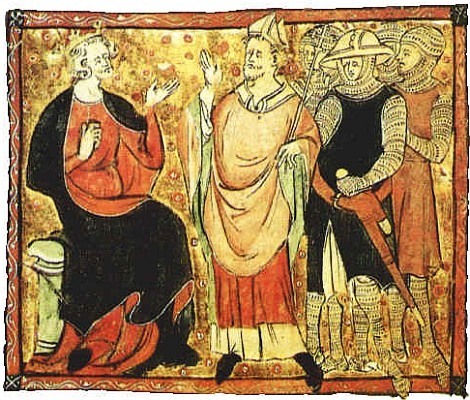
ছবি:থমাস বেকেট ও রাজা দ্বিতীয় হেনরি। ১৪ শতকে আঁকা।
কেউ প্রশ্ন করে বসতেই পারেন, আনুই ৮০০ বছর আগের এই ঘটনা নিয়ে কেন নাটক লিখতে গেলেন? শুধু কি ইতিহাস বলাই তাঁর উদ্দেশ্য? কিন্তু সে তো ইতিহাসের যেকোন বই পড়লেই জানা যায়। আনুই-এর নাটকে বেশ কিছু ঐতিহাসিক ভুলও রয়েছে যা তিনি নিজেই স্বীকার করেছেন (বেকেটকে আনুই তাঁর নাটকে স্যাক্সন হিসেবে দেখিয়েছেন, বাস্তবে বেকেট ছিলেন নরম্যান)। ঐতিহাসিক এ ঘটনাকে কেন্দ্র করে নাটক লেখার পেছনে আনুই-এর ভিন্ন একটি উদ্দেশ্য রয়েছে, যেটি নিয়ে আলোচনা করবার জন্যই এত সময় লাগিয়ে ৮০০ শব্দের এই ফোরপ্লে।
জাঁ আনুই কামু এবং সার্ত্রে দ্বারা ভীষণভাবে প্রভাবিত ছিলেন। এঁরা দু’জনই দর্শনশাস্ত্রের অস্তিত্ববাদ শাখাটির অন্যতম মূল বিজ্ঞাপন। দর্শনের এ শাখাটি ব্যাক্তির অস্তিত্বকে (কিংবা স্বীয় অস্তিত্বের “শুদ্ধতা”কে) সব কিছুর ঊর্ধে রাখে; এখানে ভাগ্য বলে কিছু নেই, এখানে ঈশ্বর নেই, বিচারকর্তা নেই, স্বর্গ-নরক নেই; ভালো-মন্দ বিচার করবার দায় পুরোটাই আপনার নিজের। আপনি যদি এ পথের অনুসারী হন, তাহলে যেকোন ভালো কাজ করা এবং খারাপ কাজ এড়িয়ে চলার জন্য আপনার বিবেকই যথেষ্ঠ হওয়া উচিৎ; “ ওপরওয়ালার কাছে কি জবাব দেবো? ”-এই প্রশ্নটির ভীতি আপনাকে জোর করে কোন কাজ করিয়ে নেবে না। তৃষ্ণার্তকে পানি খাওয়ানো কিংবা অন্ধকে হাত ধরে রাস্তা পার করিয়ে দেয়া-ইত্যাদি কাজগুলো আপনি যদি নিজের ইচ্ছেতে না করে ঈশ্বরের শাস্তির ভয়ে করেন, তাহলে আপনার এই ভালো কাজগুলো কতটা আন্তরিক, এবং এ কাজগুলোর জন্য আপনার আদৌ পুরষ্কৃত হওয়া উচিৎ কি না-সে প্রশ্নটি নিজেকে করে দেখতে পারেন।
আনুই তাঁর অস্তিত্ববাদের প্রপাগ্যান্ডা দিয়ে জানিয়ে দিয়েছেন, পূর্বলিখিত ভাগ্য বলে কিছু নেই, মানুষ কারো হাতের পুতুল নয়। কোন পথটি সঠিক এবং কোন পথটি বেঠিক, তা আপনি জীবনের যে কোন পর্যায়ে, যে কোন মুহুর্তে নির্ধারণ করতে পারেন, এবং সে অনুযায়ী দিক বদলাতে পারেন; আপনার গাড়ীটির চালক আপনি হবেন, নাকি চালকের হাতে নিজের ভাগ্য সঁপে দিয়ে গোটা সময়টা যাত্রীর আসনে বসে থাকবেন-এ সিদ্ধান্তটি সম্পূর্ণই আপনার। জীবনের বড় একটি অংশই ভোগী জীবন যাপন করেও শেষতক ঈশ্বরের সম্মান রক্ষার্থে বেকেট ত্যাগের জীবনকেই বেছে নিয়েছিলেন, মৃত্যু নিশ্চিত জেনেও। এ প্রসঙ্গে আব্রাহাম লিংকনের একটি বিখ্যাত উক্তি রয়েছে,
আমি যখন কোন ভালো কাজ করি, আমার ভালো লাগে, যখন আমি কোন খারাপ কাজ করি, সেটির অপরাধবোধ আমাকে তাড়িয়ে বেড়ায়। এটাই আমার ধর্ম।
ভালো মন্দের বোধ আমাদের সবারই আসলে আছে, যেটি নেই, সেটি হলো সদিচ্ছা। আনুই কি আমাদের প্রচ্ছন্নভাবে এই সদিচ্ছা প্রয়োগের জন্য আহবান জানিয়ে গেলেন? এ প্রশ্নের উত্তর তিনি নিজে বোধহয় সরাসরি দিতেন না, কারণ, ভালো মন্দ বেছে নেবার, আপনার যে কোন সিদ্ধান্ত গ্রহণ করবার ভার তো আপনার নিজের-ই!
মানুষ কি পৃথিবীতে একটি সাদা খাতা (রোমান ভাষায় Tabula Rasa বা blank slate) নিয়ে আসে? নাকি সে কী করবে, কী হবে, কীভাবে করবে-ইত্যাদি বিষয়গুলো আগেই ঠিক করা হয়ে গেছে, তার ছাঁচে ছাপ ফেলে কৃতকর্মের খাতাটা স্রেফ ভরাট করে যেতে হয়? এ প্রশ্নটি অনেক প্রাচীন, বহু বহু দার্শনিক-বিজ্ঞানী-চিন্তাবিদ এ নিয়ে মাথা ঘামিয়ে গেছেন। প্রাচীন গ্রেকো-রোমান অনেক নাটকেও মানুষের এই ভাগ্যের পুতুল হয়ে থাকার ব্যাপারটি ঘুরেফিরে এসেছে; পৃথিবীর বেশীরভাগ মানুষই সম্ভবত নিজেদের ভাগ্যের পুতুল হিসেবে দেখতেই স্বচ্ছন্দ বোধ করেন বেশী (কারণ, দুয়ের মাঝে এটিই সহজ রাস্তা)।
জনপ্রিয় এই মতটির সাথে গলা মিলিয়ে সফোক্লিস তাঁর ইডিপাসকে নিয়ে লেখা ৩টি নাটকে ভাগ্যের পূর্বলিখনকেই ইডিপাসের কৃতকর্মের জন্য দায়ী করেছেন। শিশুবয়েসেই পিতা লাইয়াসের কাছ থেকে আলাদা হয়ে যাওয়া ইডিপাস যৌবনে তাঁর পিতার রাজ্যে সৈনিক রূপে ফিরে আসেন এবং নিজের অজান্তে পিতাকে হত্যা করে আপন মাতা জোকাস্টাকে বিয়ে করে সিংহাসনে বসেন। জোকাস্টার সাথে ইডিপাসের ৪টি সন্তান হয় (দুই কন্যা অ্যান্টিগনি ও ইজমিন, এবং দুই পুত্র পলিনেসেস ও এটিওক্লেস)। ইডিপাস যখন জানতে পারেন লাইয়াস ও জোকাস্টার আসল পরিচয়, তিনি নিজ হাতে স্বীয় চোখ দু'টি নষ্ট করে সিংহাসন ছেড়ে স্বেচ্ছা-নির্বাসনে চলে যান। ইডিপাস-পর্বের দ্বিতীয় নাটক ইডিপাস অ্যাট কলোনাস-এ দেখা যায় অন্ধ, নিঃস্ব ইডিপাস কলোনাস শহরে আসবার পর তাঁর মামা (অথবা শ্যালক/ সম্বন্ধী) ক্রেওন তাঁকে তাঁর ঘৃণ্য কাজগুলোর জন্য তিরস্কার করে যাচ্ছেন। আত্নপক্ষ সমর্থনে ইডিপাস তাঁর ভাগ্যের লিখনকে দায়ী করে হাহাকার করে বলেনঃ
“
নীতির আলাপ ত ম্যালাই দিলেন, আপনেই এবার কনঃ
অহন-ই যদি এক বান্দীর পোলায়
আঁৎকা আয়া চাক্কু মারবার চায়
তারে কি বুকে টাইনা কইবেন,
“খাড়ান, বাপজান! আমি কি আপনের সন্তান?”
নিজে লগে যে চাক্কুডা রাহেন, ঐডা দিয়া কি কান চুলকান?
জানের মায়া ব্যাবাকের-ই আছে।
হাততালি পাইবো ভাইবা দয়ার শইল সাইজা বহে কেউ যদি
খোদার কসম কইলাম আইজ মামা, তার মায়েরে আমি__”
"Let me ask you this, one simple question
If at this moment someone
Should step up to murder you
Would you, Godly creature that you are
Stop and say, "Excuse me sir, are you my father?"
Or would you deal with him there and then?
Ah! You love your life enough, I think
To turn on him, not look around
To find a warrant first"
দ্যা ম্যাট্রিক্স চলচ্চিত্রে মর্ফিয়াস যখন নিওকে তাঁর দলে ভেড়াচ্ছেন, সে দৃশ্যের শুরুতে মর্ফিয়াস নিওকে জিজ্ঞেস করেন, নিও ভাগ্যে বিশ্বাস করে কি না। নিও'র জবাব ছিলো "না", কারণ, অন্য কারো হাতে নিজের জীবনের রিমোট কন্ট্রোলটি দেখতে নিও'র মোটেই ভালো লাগে না। কার্যত, ভাগ্যে নিও'র বিশ্বাস নেই বলেই ম্যাট্রিক্স ছবিটি আদৌ হলো। নিও যদি ভাগ্যে বিশ্বাস করে বাকী সব্বার মতই জীবন চালিয়ে নেবার কথা ভাবতো, সাতমণ তেলও পুড়তো না, নিও-ট্রিনিটির প্রেম কাহিনীও হতো না, মেশিনের বিরুদ্ধে মানুষের যুদ্ধ করাও হতো না। এজেন্ট স্মিথই ভাগ্যসর্বস্ব সে পৃথিবী দাবড়ে বেড়াতেন।

তো, ভাগ্যের লিখন, নাকি নিজের ভাগ্য নিজে গড়ে নেয়া-কোনটি অধিকতর গ্রহণযোগ্য আপনার কাছে? সিদ্ধান্তটি সম্পূর্ণই আপনার!

September 18, 2026
I remember seeing this on stage when I was young. I really enjoy Anouilh's Antigone, so I thought I'd take a look at this. Very interesting character study of Becket and the King. Now I want to check out the Peter O' Toole film.

June 19, 2011
A classic of post-war French theatre which was much loved by English audiences and was made into a film with Richard Burton and Peter O'Toole in the principal roles in 1964. It stands today as solid story-telling and good theatre but it is not a particularly deep play.
Perhaps there are shades of Sartre's comment about waiters and authenticity in this tale of a detached outsider who becomes what he is made on the whim of a king and who is martyred to a meaning he chooses to honour for reasons that are never truly made clear - but only shades.
We might wish to take it as read that he believes in God as represented by the Church or that the Church gives him a vehicle for dealing with hidden ethnic (Saxon) or personal (the loss of Gwendolyn) resentments but I am not sure it matters.
Here, the play is the thing. There are enough references to the cynicism of the world and enough signs that we should not make too much of a hero of Becket (despite superficial interpretations that raise issues of commitment and 'engagement') to suggest that Anouilh has no deep purpose.
It is a highly manipulative play, hiding its cliches well, with a dash of melodrama in Act 3 and a homo-erotic sub-text that is never developed because of the period in which it was written. It is no wonder that it translated easily to Shepperton Studios - it is film scripted from the start.
It is also easy to see why it was popular in both France (with its minor key echoes of issues of occupation and collaboration) and in England (where concerns about playing one's role and hiding one's true nature in service were very much part of the imperial and wartime legacy).
Perhaps there are shades of Sartre's comment about waiters and authenticity in this tale of a detached outsider who becomes what he is made on the whim of a king and who is martyred to a meaning he chooses to honour for reasons that are never truly made clear - but only shades.
We might wish to take it as read that he believes in God as represented by the Church or that the Church gives him a vehicle for dealing with hidden ethnic (Saxon) or personal (the loss of Gwendolyn) resentments but I am not sure it matters.
Here, the play is the thing. There are enough references to the cynicism of the world and enough signs that we should not make too much of a hero of Becket (despite superficial interpretations that raise issues of commitment and 'engagement') to suggest that Anouilh has no deep purpose.
It is a highly manipulative play, hiding its cliches well, with a dash of melodrama in Act 3 and a homo-erotic sub-text that is never developed because of the period in which it was written. It is no wonder that it translated easily to Shepperton Studios - it is film scripted from the start.
It is also easy to see why it was popular in both France (with its minor key echoes of issues of occupation and collaboration) and in England (where concerns about playing one's role and hiding one's true nature in service were very much part of the imperial and wartime legacy).

November 14, 2016
This play is a fine piece of work which draws on powerfully potent historical material, and weaves its tale skillfully around ageless themes of love, honor, loyalty, and power. I suppose that anytime I might have read it I would have rated it highly. Yet reading it at the end of this most absurd week of mid November, 2016, a week in which the world seems turned upside down and the ridiculousness of human plans and power is made clearly manifest, somehow this timing has struck a cord with me, and though it touches but tangentially on the current events which have discombobulated my equilibrium, it seems perfectly tuned to my present mood, and in an odd way, has comforted me. That's powerful stuff, and nothing less than five stars will do for this review.
It is often the little epiphanies in life that are the most satisfying. Among its other charms, this play granted me one of them. Some thirty years ago, a clever young fellow I then knew told me that what passed for morality in me was truthfully nothing more than my aesthetic. I was young, and so felt smugly complemented by this, and supposed my friend to be deucedly clever for coming up with that rare bit of wit. As I have found over the years, cleverness often consists of little more than being better read and having quick, conversational recall of the material. And so here I find, all these years later, that my friend's biting witticism was nothing more that quoting Henry's line to Becket from this play. I laughed out loud as I read it, and I toast my well read and long lost friend for coming upon this fine material so far ahead of me.
It is often the little epiphanies in life that are the most satisfying. Among its other charms, this play granted me one of them. Some thirty years ago, a clever young fellow I then knew told me that what passed for morality in me was truthfully nothing more than my aesthetic. I was young, and so felt smugly complemented by this, and supposed my friend to be deucedly clever for coming up with that rare bit of wit. As I have found over the years, cleverness often consists of little more than being better read and having quick, conversational recall of the material. And so here I find, all these years later, that my friend's biting witticism was nothing more that quoting Henry's line to Becket from this play. I laughed out loud as I read it, and I toast my well read and long lost friend for coming upon this fine material so far ahead of me.

May 20, 2015
Becket is actually the second encounter I've had with Jean Anouilh (my review of the first encounter is here). I was satisfied with Anouilh's skill the first time around, so I did have some high expectations of this play as well. And you know what I love? I love it when my expectations are completely met.
First thing's first: historical accuracy is not Anouilh's thing, although I think it's also not his style and therefore would be amiss of him to fulfill. Instead of having accuracy, Becket turns a lot of its attention towards raw emotions, the realness of changing relationships, and character development. The relationship between Henry II and Becket is just.... amazing, really. Although they end up kind of as rivals because of ideological differences, Anouilh makes sure not to forget the fact that they grew up as inseparable friends and thus still have ties which cannot be broken. This is the basis of the play which I think is brilliantly executed.
Besides this, I find that there is little more for me to say except that I have learned that there is also a novel about the same topic (Murder in the Cathedral) and I would totally love to compare the two but unfortunately, I have not read this novel. Perhaps I will need to give it a shot, because the story of Becket is certainly an interesting one.
First thing's first: historical accuracy is not Anouilh's thing, although I think it's also not his style and therefore would be amiss of him to fulfill. Instead of having accuracy, Becket turns a lot of its attention towards raw emotions, the realness of changing relationships, and character development. The relationship between Henry II and Becket is just.... amazing, really. Although they end up kind of as rivals because of ideological differences, Anouilh makes sure not to forget the fact that they grew up as inseparable friends and thus still have ties which cannot be broken. This is the basis of the play which I think is brilliantly executed.
Besides this, I find that there is little more for me to say except that I have learned that there is also a novel about the same topic (Murder in the Cathedral) and I would totally love to compare the two but unfortunately, I have not read this novel. Perhaps I will need to give it a shot, because the story of Becket is certainly an interesting one.

March 16, 2016
I started watching the Burton/O'Toole movie and was intrigued, but I never finished it, for some reason. I think I had to go to class and then had to return the DVD. When I realized it was based on a play, I was a little skeptical of what the play might be like.
It's exactly like the movie (at least, what I saw of it), only better.
Usually I have to make scenes more emotional in my head, but there was nothing in Becket that made me fend for myself. Especially Henry. What a drama queen. I loved it. Strong, pathetic, petulant, needy, compelling, cruel, prideful, emotionally exhibitionist - what a guy. I really loved the automaton feel of Becket, too, like a robot who knows how to feel but doesn't, or can't, or won't admit that he can, even to himself. Seeing that the play is named after him, I wish there had been a little more room for him to get fleshed out, because his sea change after he becomes Archbishop is a little sudden - a little out of the blue - though that's what Henry thought, too, so maybe... I don't know. I just wish he'd gotten a good monologue before the change.
But, seriously, what a good play. I need to re-check out the movie so I can watch that incredible final scene between them and scream at them to MAKE UP FOR FRICK'S SAKE, YOU NEED EACH OTHER.
It's exactly like the movie (at least, what I saw of it), only better.
Usually I have to make scenes more emotional in my head, but there was nothing in Becket that made me fend for myself. Especially Henry. What a drama queen. I loved it. Strong, pathetic, petulant, needy, compelling, cruel, prideful, emotionally exhibitionist - what a guy. I really loved the automaton feel of Becket, too, like a robot who knows how to feel but doesn't, or can't, or won't admit that he can, even to himself. Seeing that the play is named after him, I wish there had been a little more room for him to get fleshed out, because his sea change after he becomes Archbishop is a little sudden - a little out of the blue - though that's what Henry thought, too, so maybe... I don't know. I just wish he'd gotten a good monologue before the change.
But, seriously, what a good play. I need to re-check out the movie so I can watch that incredible final scene between them and scream at them to MAKE UP FOR FRICK'S SAKE, YOU NEED EACH OTHER.

February 9, 2021
بيكيت هو أحد الانجلوسكسون ويعمل لدى الملك، والملك يحارب رجال الدين لكي ويتجبر كلاً من رجال الدين والملك على بعضهم البعض يحاول كلاً منهم فرض سلطته، ولكن "بيكيت" كان شماساً في الكنيسة يجيد الحرب.
يخرج الملك ومعه "بيكيت" إلي رحلة صيد، وفي ظل عاصفة يصعب عليهما التحرك فيأويان لدى احد الفلاحين، وكاد الملك يغتصب ابنتهم ولكن "بيكيت" أراد طلبها أولاً لكي يطلق صراحها.
كان (بيكيت) خادماً أميناً للملك في بداية الامر لـ(هنري الثاني) وحتى تلك اللحظة التي يضع فيها (هنري الثاني) لـ (بيكيت) في وظيفة كبير الاسقف، ولكن عندما فعل ذلك (هنري الثاني) حذره (بيكيت) بأنه لا يمكنه أن يخدم الله ويخدمه في نفس الوقت، حيث ان (بيكيت) سوف يتحول تماماً إلي خدمة الله، وكذا فعل (بيكيت) بحيث اصبح (بيكيت) خادماً للإله.
يرسل (بيكيت) خاتمه الذي هباه له (هنري) ليعلن له انه قد انتقل إلي جوار الرب بدلاً من (هنري)، ويتقدم (هنري) ليقوم بحياكة خطة لاسقاط (بيكيت) عن طريق التحالف مع كبير اساقفة انجلترا الذي يحيك معه خطته لأسقاط (بيكيت).
أعجبتني العلاقة بين (بيكيت) و (هنري) التي يتخللها العديد من المشاعر المتضاربة، الكره والحب في نفس الوقت، ومقته لافعال صديقه دول كره صديقه وعدم قبول الاهانات من عائلته أو الاساقفة الاخرين له.
من أفضل الاقوال التي أعجبتني في هذا العمل:
- لا يمكن أن نشتري الا ما كان للبيع (على لسان بيكيت)
- أحسن الافكار هي ابسطها واغباها (على لسان هنري)
يخرج الملك ومعه "بيكيت" إلي رحلة صيد، وفي ظل عاصفة يصعب عليهما التحرك فيأويان لدى احد الفلاحين، وكاد الملك يغتصب ابنتهم ولكن "بيكيت" أراد طلبها أولاً لكي يطلق صراحها.
كان (بيكيت) خادماً أميناً للملك في بداية الامر لـ(هنري الثاني) وحتى تلك اللحظة التي يضع فيها (هنري الثاني) لـ (بيكيت) في وظيفة كبير الاسقف، ولكن عندما فعل ذلك (هنري الثاني) حذره (بيكيت) بأنه لا يمكنه أن يخدم الله ويخدمه في نفس الوقت، حيث ان (بيكيت) سوف يتحول تماماً إلي خدمة الله، وكذا فعل (بيكيت) بحيث اصبح (بيكيت) خادماً للإله.
يرسل (بيكيت) خاتمه الذي هباه له (هنري) ليعلن له انه قد انتقل إلي جوار الرب بدلاً من (هنري)، ويتقدم (هنري) ليقوم بحياكة خطة لاسقاط (بيكيت) عن طريق التحالف مع كبير اساقفة انجلترا الذي يحيك معه خطته لأسقاط (بيكيت).
أعجبتني العلاقة بين (بيكيت) و (هنري) التي يتخللها العديد من المشاعر المتضاربة، الكره والحب في نفس الوقت، ومقته لافعال صديقه دول كره صديقه وعدم قبول الاهانات من عائلته أو الاساقفة الاخرين له.
من أفضل الاقوال التي أعجبتني في هذا العمل:
- لا يمكن أن نشتري الا ما كان للبيع (على لسان بيكيت)
- أحسن الافكار هي ابسطها واغباها (على لسان هنري)
Displaying 1 - 30 of 153 reviews