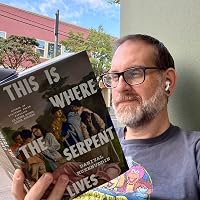
I am only vaguely familiar with the poetry and poetry-championing of Edward Hirsch. I've read some of his poetry in little magazines and anthologies, none of which I can recall at this moment. But this poem I will remember. It's an elegy, a eulogy, a keening rage of a poem about the death of his 22 year old son Gabriel, told in tercets, ten per page, 78 pages, which I began reading, aware of the subject, and then completed in one sitting. Then I read it again, a bit more slowly.
The tercets seesaw as they go, unbalanced, as is Gabriel, with several disabilities, including Tourette's Syndrome, ADHD, and what all else, also unbalancing most people he encounters. As is Hirsch, unbalanced by Gabriel's life, unbalanced by his loss. Most people failed to reach him, help him and he didn't seem to reach out to people very well, either. He was too complicated, too loud, too annoying, too crazy.
But Hirsch was Gabriel's father and he stuck with him through it all, the flow of consultants, the failed schools, the crash after burn after crash. Hirsch loved his son the way most parents love their kids, for all his faults, and grieves him for what he was and was not in this poem. One of the most powerful dimensions of this text is Hirsch citing other poets and writers who lost their children and revealing how they dealt or failed to deal with those losses. A lover of poetry, Hirsch knows the poetry of death, so he cites it in his own work that joins with the others. He knows what poetry can and cannot do as testimony to pain. His is an inquiry into the poetry of death and at once a kind of celebration of the balm it can offer.
The long, book-length poem hardly feels like a poem at all in its first third; it's prosaic, a memoir, helping us meet and understand his son in all his outrageousness. He's talking with us. And he doesn't try to prettify this boy. No one could deal with him with much success, including Hirsch and Gabriel's mother; no therapist, psychiatrist, teacher, though some had a little success along the way. Almost no one, Hirsch makes clear, could see their way into Gabriel's essential sweetness.
Being with Hirsch at the funeral is like all funerals for children, too raw, a kaddish for something cosmically unacceptable, as it would be for any of us, and Hirsch rails in the accumulating pages against a God he doesn't believe exists. Those children dead in that school at Sandy Hook, or everywhere, every day now? In each household, this rage and despair. Hirsch is a poet and speaks as (once) poet laureate of his and perhaps others's hearts.
This is Hirsch's story, about his son. But if you, like me, had two sons with serious disabilities, one at eighteen with severe autism, the other at fifteen with "psychotic episodes," you would know that a poem like this can only be read through your own life. I fear for their futures. To some extent, I already grieve for what it is they have lost or never had. When I am gone, what will happen to them? Who will care to care for them? Will the street ever be their home, as it very nearly could have been had Hirsch not been there for his kid?
Yet Hirsch also comforts me in what he shares, in certain places. The last third of his poem is rhapsodic, wildly imagistic in the way the first third was not. He shows us the power of poetry, and language, to attempt to reach the meaning of a child's death. To bring Gabriel to life through words! But though poetry may be the closest language to grief, it also falls short, and has its power in part because it falls short, gets at the unspeakable in the world, as Hirsch makes clear. In the end, and forever, Hirsch seems to say, the loss of a child is mainly a howling abyss of loss, and you take what comfort you can, if any, from memory and the power that the memory of love and language can bring. But even that's achingly painful, of course.