

What do you think?
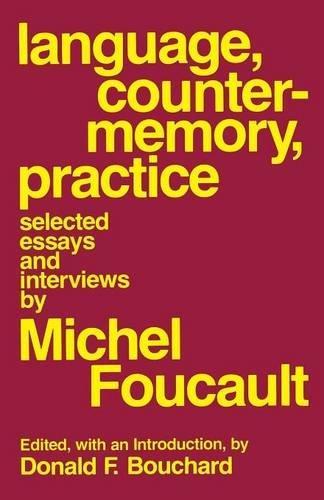
Language, Counter-Memory, Practice: Selected Essays and Interviews
Because of their range, brilliance, and singularity, the ideas of the philosopher-critic-historian Michel Foucault have gained extraordinary currency throughout the intellectual community. This book offers a selection of seven of Foucault's most important published essays, translated from the French, with an introductory essay and notes by Donald F. Bouchard. Also included are a summary of a course given by Foucault at Collège de France, the transcript of a conversation between Foucault and Gilles Deleuze, and an interview with Foucault that appeared in the journal Actuel.
240 pages, Paperback
First published January 1, 1977
About the author
Michel Foucault
810 books6,828 followersPaul-Michel Foucault was a French philosopher, historian of ideas, writer, political activist, and literary critic. Foucault's theories primarily address the relationships between power and knowledge, and how they are used as a form of social control through societal institutions. Though often cited as a structuralist and postmodernist, Foucault rejected these labels. His thought has influenced academics, especially those working in communication studies, anthropology, psychology, sociology, criminology, cultural studies, literary theory, feminism, Marxism and critical theory.
Born in Poitiers, France, into an upper-middle-class family, Foucault was educated at the Lycée Henri-IV, at the École Normale Supérieure, where he developed an interest in philosophy and came under the influence of his tutors Jean Hyppolite and Louis Althusser, and at the University of Paris (Sorbonne), where he earned degrees in philosophy and psychology. After several years as a cultural diplomat abroad, he returned to France and published his first major book, The History of Madness (1961). After obtaining work between 1960 and 1966 at the University of Clermont-Ferrand, he produced The Birth of the Clinic (1963) and The Order of Things (1966), publications that displayed his increasing involvement with structuralism, from which he later distanced himself. These first three histories exemplified a historiographical technique Foucault was developing called "archaeology".
From 1966 to 1968, Foucault lectured at the University of Tunis before returning to France, where he became head of the philosophy department at the new experimental university of Paris VIII. Foucault subsequently published The Archaeology of Knowledge (1969). In 1970, Foucault was admitted to the Collège de France, a membership he retained until his death. He also became active in several left-wing groups involved in campaigns against racism and human rights abuses and for penal reform. Foucault later published Discipline and Punish (1975) and The History of Sexuality (1976), in which he developed archaeological and genealogical methods that emphasized the role that power plays in society.
Foucault died in Paris from complications of HIV/AIDS; he became the first public figure in France to die from complications of the disease. His partner Daniel Defert founded the AIDES charity in his memory.
Born in Poitiers, France, into an upper-middle-class family, Foucault was educated at the Lycée Henri-IV, at the École Normale Supérieure, where he developed an interest in philosophy and came under the influence of his tutors Jean Hyppolite and Louis Althusser, and at the University of Paris (Sorbonne), where he earned degrees in philosophy and psychology. After several years as a cultural diplomat abroad, he returned to France and published his first major book, The History of Madness (1961). After obtaining work between 1960 and 1966 at the University of Clermont-Ferrand, he produced The Birth of the Clinic (1963) and The Order of Things (1966), publications that displayed his increasing involvement with structuralism, from which he later distanced himself. These first three histories exemplified a historiographical technique Foucault was developing called "archaeology".
From 1966 to 1968, Foucault lectured at the University of Tunis before returning to France, where he became head of the philosophy department at the new experimental university of Paris VIII. Foucault subsequently published The Archaeology of Knowledge (1969). In 1970, Foucault was admitted to the Collège de France, a membership he retained until his death. He also became active in several left-wing groups involved in campaigns against racism and human rights abuses and for penal reform. Foucault later published Discipline and Punish (1975) and The History of Sexuality (1976), in which he developed archaeological and genealogical methods that emphasized the role that power plays in society.
Foucault died in Paris from complications of HIV/AIDS; he became the first public figure in France to die from complications of the disease. His partner Daniel Defert founded the AIDES charity in his memory.
Ratings & Reviews
Friends & Following
Create a free account to discover what your friends think of this book!
Community Reviews
Displaying 1 - 27 of 27 reviews

July 14, 2014
Genealogy is history in the form of a concerted carnival.
Ever since Madonna Louise Ciccone took it over the border line, I have always felt for the transgressors, the transgressive, the interlopers. Michel Foucault began before I did. He also held the Infinite in esteem. I sigh in response. I would like to make a few points about this collection, this assemblage. I could start by questioning the validity of points or facts. Aren't they just interpretations? Don't such efforts only maintain the power relationships? Shouldn't we pursue a more abortive endeavor, an archive of missteps, missed exits and naive backtracking?
Most pieces collected between these covers were simply maddening, to be honest. I read everything at least twice. I was not looking for a distilled Foucault. My purpose wasn't to form a conceptual whole, a sweeping theory. No, totalizing wasn't on my agenda. Finding coherence was. I remain in the camp of anti-essentialist investigation, that hasn't changed. I highly recommend two essays in the book: What Is an Author and Nietzsche, Genealogy, History. The others served best to baffle and dishearten. I just told my wife that self-awareness is often a certain agent of depression. So it goes.
Ever since Madonna Louise Ciccone took it over the border line, I have always felt for the transgressors, the transgressive, the interlopers. Michel Foucault began before I did. He also held the Infinite in esteem. I sigh in response. I would like to make a few points about this collection, this assemblage. I could start by questioning the validity of points or facts. Aren't they just interpretations? Don't such efforts only maintain the power relationships? Shouldn't we pursue a more abortive endeavor, an archive of missteps, missed exits and naive backtracking?
Most pieces collected between these covers were simply maddening, to be honest. I read everything at least twice. I was not looking for a distilled Foucault. My purpose wasn't to form a conceptual whole, a sweeping theory. No, totalizing wasn't on my agenda. Finding coherence was. I remain in the camp of anti-essentialist investigation, that hasn't changed. I highly recommend two essays in the book: What Is an Author and Nietzsche, Genealogy, History. The others served best to baffle and dishearten. I just told my wife that self-awareness is often a certain agent of depression. So it goes.

March 15, 2022
If you read this, read it for:
“A Preface to Transgression”
“What is an Author?”
“Nietzsche, Genealogy, History”
Everything else, you don’t really need.
“A Preface to Transgression”
“What is an Author?”
“Nietzsche, Genealogy, History”
Everything else, you don’t really need.

February 28, 2008
theory often enters into a certain headspace that i cannot seem to follow...
a great deal of this book is nonsense...the rest is inapplicable hyper-intellectual self-indulgence that borders on the masturbatory...
i'm certain there are those who have derived a profound and deeper understanding of language and culture from this book, i am, unfortunately, not one of them...
postscript:
i'm re-reading this today for my imminent exam...
i find myself re-confirming my earlier words yet softening on them somewhat...foucault genuinely has a lot of important things to say here...it's unfortunate he feels the need to enshroud and inter his ideas in a dense and nearly indecipherable pseudo-erudite veil of turgid language...
be that as it may...
his ideas about transgression and limit are very important to modern cultural theory, as are his thoughts on genealogy...
the analysis he offers on traditional vs. effective historical sense is worth reading the book in itself...
in the end, foucault is not looked upon with such reverence for nothing...he is clearly an important theoretical voice in modernity, however, i think he must sometimes forget the rest of the world aren't all capable of following his particular brand of hyper-intellectual esotericism, which in my opinion can lead those who don't understand him to unfairly, but perhaps justifiably, dismiss him outright...
a great deal of this book is nonsense...the rest is inapplicable hyper-intellectual self-indulgence that borders on the masturbatory...
i'm certain there are those who have derived a profound and deeper understanding of language and culture from this book, i am, unfortunately, not one of them...
postscript:
i'm re-reading this today for my imminent exam...
i find myself re-confirming my earlier words yet softening on them somewhat...foucault genuinely has a lot of important things to say here...it's unfortunate he feels the need to enshroud and inter his ideas in a dense and nearly indecipherable pseudo-erudite veil of turgid language...
be that as it may...
his ideas about transgression and limit are very important to modern cultural theory, as are his thoughts on genealogy...
the analysis he offers on traditional vs. effective historical sense is worth reading the book in itself...
in the end, foucault is not looked upon with such reverence for nothing...he is clearly an important theoretical voice in modernity, however, i think he must sometimes forget the rest of the world aren't all capable of following his particular brand of hyper-intellectual esotericism, which in my opinion can lead those who don't understand him to unfairly, but perhaps justifiably, dismiss him outright...

June 11, 2011
contains the famous author-function article, which should be read, certainly, but really only in context after reviewing barthes' "death of the author," also required reading.
2026 addendum--
the initial section that is oriented toward literary interpretation is a bit too hasty & schematic for my taste, though the essay on flaubert is kickass. the middle section's nietzschean content is the main event, the reason for which the volume is read. The final section is notes and interviews. the delueze interview is solid, and the final item, foucault moderating a discussion with students, is one place where his position is manifest as 'we can't imagine the new from within the constraints of the old, so maybe it will arise from uninhibited aesthetics of sex, drugs, and rock & roll,' which is an exaggeration but barely--he does seem to suggest that personal aesthetics can be emancipatory in a way that concerted action cannot. no wonder classical marxists regard it as irresponsible. that said, there's no need to read foucault as exclusively aestheticist.
2026 addendum--
the initial section that is oriented toward literary interpretation is a bit too hasty & schematic for my taste, though the essay on flaubert is kickass. the middle section's nietzschean content is the main event, the reason for which the volume is read. The final section is notes and interviews. the delueze interview is solid, and the final item, foucault moderating a discussion with students, is one place where his position is manifest as 'we can't imagine the new from within the constraints of the old, so maybe it will arise from uninhibited aesthetics of sex, drugs, and rock & roll,' which is an exaggeration but barely--he does seem to suggest that personal aesthetics can be emancipatory in a way that concerted action cannot. no wonder classical marxists regard it as irresponsible. that said, there's no need to read foucault as exclusively aestheticist.

April 8, 2026
"For this reason, we should not be fooled by the modernized educational program, its openness to the real world: it continues to maintain its traditional grounding in 'humanism' while emphasizing the quick and efficient mastery of a certain number of techniques, which were neglected in the past. Humanism reinforces social organization and these techniques allow society to progress, but along its own lines." (221)
^^^
"The theory of the subject (in the double sense of the word) is at the heart of humanism and this is why our culture has tenaciously rejected anything that could weaken its hold upon us. But it can be attacked in two ways: either by a 'desubjectification' of the will to power (that is, through political struggle in the context of class warfare) or by the destruction of the subject as a pseudosovereign (that is, through an attack on 'culture': the suppression of taboos and the limitations and divisions imposed upon the sexes; the setting up of communes; the loosening of inhibitions with regard to drugs; the breaking of all the prohibitions that form and guide the development of a normal individual). I am referring to all those experiences which have been rejected by our civilization or which it accepts only within literature." (222)
This may be the most important collection of essays/interviews I have read so far in terms of completeness in Foucault's thought and its execution (also because he says the thing... "Perhaps one day, this century will be known as Deleuzian.")
There are a lot of places I want to start from and draw on, but I'll work democratically (which is a myth in itself but anyways):
Outside of the initial literary criticism/analysis, and drawing on language as a companion and decider of discourse, I was introduced to this work on two terms: 1) I was researching Foucault's relation to Bataille in terms of taboo & desire, so naturally I was recommended to read "A Preface to Transgression," and 2) By hearing of Flaubert's "The Temptation of St. Anthony," which is extensively focused on in the beginning. There are common themes here. However I really fell in love between parts 2&3.
Part 2's "What is an Author?" and the introduction of the "Author-function," the particular role an author plays not only as the being-author, but in the direct sense of the word Function. It has a particular dynamis in its relation to stifling discourse, as opposed to the form of a writer. The author exists within a culture and is reproduced (or not) within the milieu they are associated with. Even as the person is removed from their name, the function it serves still stands as its own mode of contribution, although non-universal, but still appropriable ("system of ownership and strict copyright rules" - 125).
(Im gonna gloss over N/G/H because I could swim in it all day but there's other stuff we gotta get to)
However Part 3, the "Practice" component of the entire compilation, is perhaps the best for last. The dialogues and outline of the History of Systems of Thought pay attention to the raw delicacy of power in play, as a "game," of knowledge as a "game." Not as an opposition of forces that exist within the space of dialectical movement, but as a philosophical/epistemic 'sphere of influence,' power controlling the production of knowledge and knowledge seeking to provide the foundation for "truth" which this power bases itself on. This reciprocity is bound up in the walls of the school, prison, hospital, and so on. It is a very dangerous thing, in my opinion. And Foucault builds on this towards the last two discussions, one with my beloved Deleuze, and the other with some people Very French people I don't know.
Of what the "intellectual" is, their role in not only dismantling these repressive institutions that siphon the truth out of knowledge for power's narrative, but to provide a solution in suggesting no alternatives. These things simply cannot exist. Foucault says something incredibly interesting towards the end, "I think that to imagine another system is to extend our participation in the present system." (231). Although he received some pushback from his interlocutor for this comment, it is still not nonetheless false. By claiming the institutions and their apparatuses must cease to exist, your model cannot be the very thing you are seeking to destroy. It is setting up the same exact conditions for what once was to occur again. It is how I feel about the "dictatorship of the proletariat." There should be no 'dictatorship' of anything. To frame the seizure of the means/mode of production in this way opens up the tunnel through which there is an overturning, not a revolution. What I like about Foucault is that he never provides a definite solution. (It is frustrating as a reader but) It is not his job to do so. He simply presents the genealogy of truth through which we are to raise suspicions and come to conclusions. To dismantle spaces of control and confinement uproot the ideologies that reinforce their structures ("Normalcy," control, discipline, regulation, hegemony, capitalism, and, of course, the play between power-knowledge). It is a failure to kill the university and then bring it back "minus the bad stuff."
Regardless, this was wonderful and everyone everywhere should read it right now thank you.
^^^
"The theory of the subject (in the double sense of the word) is at the heart of humanism and this is why our culture has tenaciously rejected anything that could weaken its hold upon us. But it can be attacked in two ways: either by a 'desubjectification' of the will to power (that is, through political struggle in the context of class warfare) or by the destruction of the subject as a pseudosovereign (that is, through an attack on 'culture': the suppression of taboos and the limitations and divisions imposed upon the sexes; the setting up of communes; the loosening of inhibitions with regard to drugs; the breaking of all the prohibitions that form and guide the development of a normal individual). I am referring to all those experiences which have been rejected by our civilization or which it accepts only within literature." (222)
This may be the most important collection of essays/interviews I have read so far in terms of completeness in Foucault's thought and its execution (also because he says the thing... "Perhaps one day, this century will be known as Deleuzian.")
There are a lot of places I want to start from and draw on, but I'll work democratically (which is a myth in itself but anyways):
Outside of the initial literary criticism/analysis, and drawing on language as a companion and decider of discourse, I was introduced to this work on two terms: 1) I was researching Foucault's relation to Bataille in terms of taboo & desire, so naturally I was recommended to read "A Preface to Transgression," and 2) By hearing of Flaubert's "The Temptation of St. Anthony," which is extensively focused on in the beginning. There are common themes here. However I really fell in love between parts 2&3.
Part 2's "What is an Author?" and the introduction of the "Author-function," the particular role an author plays not only as the being-author, but in the direct sense of the word Function. It has a particular dynamis in its relation to stifling discourse, as opposed to the form of a writer. The author exists within a culture and is reproduced (or not) within the milieu they are associated with. Even as the person is removed from their name, the function it serves still stands as its own mode of contribution, although non-universal, but still appropriable ("system of ownership and strict copyright rules" - 125).
(Im gonna gloss over N/G/H because I could swim in it all day but there's other stuff we gotta get to)
However Part 3, the "Practice" component of the entire compilation, is perhaps the best for last. The dialogues and outline of the History of Systems of Thought pay attention to the raw delicacy of power in play, as a "game," of knowledge as a "game." Not as an opposition of forces that exist within the space of dialectical movement, but as a philosophical/epistemic 'sphere of influence,' power controlling the production of knowledge and knowledge seeking to provide the foundation for "truth" which this power bases itself on. This reciprocity is bound up in the walls of the school, prison, hospital, and so on. It is a very dangerous thing, in my opinion. And Foucault builds on this towards the last two discussions, one with my beloved Deleuze, and the other with some people Very French people I don't know.
Of what the "intellectual" is, their role in not only dismantling these repressive institutions that siphon the truth out of knowledge for power's narrative, but to provide a solution in suggesting no alternatives. These things simply cannot exist. Foucault says something incredibly interesting towards the end, "I think that to imagine another system is to extend our participation in the present system." (231). Although he received some pushback from his interlocutor for this comment, it is still not nonetheless false. By claiming the institutions and their apparatuses must cease to exist, your model cannot be the very thing you are seeking to destroy. It is setting up the same exact conditions for what once was to occur again. It is how I feel about the "dictatorship of the proletariat." There should be no 'dictatorship' of anything. To frame the seizure of the means/mode of production in this way opens up the tunnel through which there is an overturning, not a revolution. What I like about Foucault is that he never provides a definite solution. (It is frustrating as a reader but) It is not his job to do so. He simply presents the genealogy of truth through which we are to raise suspicions and come to conclusions. To dismantle spaces of control and confinement uproot the ideologies that reinforce their structures ("Normalcy," control, discipline, regulation, hegemony, capitalism, and, of course, the play between power-knowledge). It is a failure to kill the university and then bring it back "minus the bad stuff."
Regardless, this was wonderful and everyone everywhere should read it right now thank you.

February 27, 2014
Important collection of essays for those wishing to engage with Foucault's work. Separated into three sections:
(1) 'Language and the Birth of Literature' - this section contains essays on Flaubert, transgression, the attempts to reach the (infinite) limits of language, and a review of a Laplanche book. Useful in considering Foucault's approach to literature, to narrative, to thought-as-practice, and language specifically, which he of course addressed separately in The Order of Things.
(2) 'Counter-Memory: The Philosophy of Difference' - as the section title suggests, this section in part explores Foucault's links with Deleuze. His famous essay - 'What is an Author?' - opens this section, in short, where Foucault claims that the author is a function of discourse. Further, one of Foucault's best essays 'Nietzsche, Genealogy, History' - which followed a sustained period where Foucault taught on Nietzsche; this essay serves as one of his best statements of his interpretation of the genealogical method. The final paper in this is the expansive and vast 'Theatrum Philosophicum' - a combined rich review of Deleuze's 'Difference and Repetition' and 'The Logic of Sense' - where Foucault enthusiastically surveys and critiques Deleuze's philosophy of difference.
(3) 'Practice: Knowledge and Power' - One of Foucault's lesser probed claims is the how he conceived of thought as an act of resistance, where theory itself already was a practice. In this section, there is a summation of his 1970-71 lecture course at the Collége de France (his Lectures on the Will to Know), outlining his broad approach in that first lecture course ('History of the Systems of Thought'). There is also a discussion with Deleuze ('Intellectuals and Power') and a discussion Foucault had with other contemporary thinkers under the auspices of the journal 'Actuel' ('Revolutionary Action: "Until Now"').
(1) 'Language and the Birth of Literature' - this section contains essays on Flaubert, transgression, the attempts to reach the (infinite) limits of language, and a review of a Laplanche book. Useful in considering Foucault's approach to literature, to narrative, to thought-as-practice, and language specifically, which he of course addressed separately in The Order of Things.
(2) 'Counter-Memory: The Philosophy of Difference' - as the section title suggests, this section in part explores Foucault's links with Deleuze. His famous essay - 'What is an Author?' - opens this section, in short, where Foucault claims that the author is a function of discourse. Further, one of Foucault's best essays 'Nietzsche, Genealogy, History' - which followed a sustained period where Foucault taught on Nietzsche; this essay serves as one of his best statements of his interpretation of the genealogical method. The final paper in this is the expansive and vast 'Theatrum Philosophicum' - a combined rich review of Deleuze's 'Difference and Repetition' and 'The Logic of Sense' - where Foucault enthusiastically surveys and critiques Deleuze's philosophy of difference.
(3) 'Practice: Knowledge and Power' - One of Foucault's lesser probed claims is the how he conceived of thought as an act of resistance, where theory itself already was a practice. In this section, there is a summation of his 1970-71 lecture course at the Collége de France (his Lectures on the Will to Know), outlining his broad approach in that first lecture course ('History of the Systems of Thought'). There is also a discussion with Deleuze ('Intellectuals and Power') and a discussion Foucault had with other contemporary thinkers under the auspices of the journal 'Actuel' ('Revolutionary Action: "Until Now"').
May 16, 2007
This is a must have for anyone interested in Michel Foucault; the book contains some of his best essays dating from the middle part of his career. The absolute essentials are "Nietzsche, Genealogy, & History" and "What is an Author?" - I have resourced these two texts time and time again. However, the hidden gem of this book for me is the published conversation between Foucault & Gilles Deleuze. The interview/conversation functions in way to usefully clarify certain similarities between the thinkers' philosophies. This is, without a doubt, a first rate collection of essays.

May 13, 2020
Read only Part II and III
Read
November 18, 2024i mean like, you know. i'm literally just a guy. not knowing anything about nietzsche was defo a detriment here.
but the usual fun foucault moves; of going up and up and above the current structure to the next level of structural awareness. his essay on the conception of the author as really just a categorization, a body of work, as opposed to a historical person was cool. his careful delineating of 'difference' as its own thing separate from a relationship with 'the same'; liberating difference from a background of uniformity; was also cool. helpful to read this series of essays right after Anti-Oedipus, just to catch the themes and echoes these thinkers had with each other, in their collabs with each other. It is very much about identifying "sinks" to me; endpoints to unidirectional flows of power -- the father, capital, harshly delineated categories like good and evil. and i think offering a similar counter that deleuze+guattari do, of distributed power, of uneven and contradictory and myriadness in the face of a totalizing/unifyingness.
the easiest to follow one was defo his spoken conversations with ... high schoolers? maybe? i was v taken (admittedly in a 'repostable insta story' way) by his observation that 'humanists' want to change ideology without changing institutions (a BLACK president is gonna drone strike weddings!); and reformers want to change institutions without changing ideology (we don't need cops but we still need prisons); and neither is revolution. it was also a fun little reversal in his convo w deleuze that they agree that theory is "regional" and "specific"; that it needs constant updating because it is deployed in situations where it is either useful or useless (in which case discard it). i don't disagree. or i like situating theory in specific situations as opposed to quoting scripture at each other to try to win through citation. or maybe in the lineage of these essays every event is specific; every person is specific; universalizing theory is intrinsically not going to work.
i was v taken by the early essays on language, on how the written or printed word forms subjects or forms subjectivity? i wasn't sure how much i followed it but i liked thinking about it. i was v fascinated by his conception (or how i took it) of the 'purpose' of language being to overcome itself, or to escape into the inexpressible, and also to overcome death. it reminded me of Carson's Eros the Bittersweet; something about striving towards a platonism that doesn't exist or something.
i was v lost but still interested in his essay called "Theatrum Philosophicum". no idea what it's about, but there's definitely a vibe that it's about history, or how to think about history in a way that again, avoids turning it into a pat story or a pat relation to modern understandings of the world and structures of power. but it also has something about maybe a different kind of subject, a less cohesive subject maybe? i got the sense that like history itself individual subjecthood is just a bunch of events strung together that randomly but repeatedly achieve consciousness. overall i feel all this french theory is finding the area under a curve by painstakingly doing a derivative by hand instead of just measuring it in one smooth fell swoop, if that makes sense. if the area under the curve is some sort of buddhist enlightenment. same themes but more complicatedly discussed imo; that subjects don't exist or the idea of a cohesive subject needs to be challenged; that the present is a complicated and uncategorizable tapestry that is more discrete and unsmooth than one thinks, that there are non-rational forms of knowledge and desire. that's the take. anyway idk it was fun! i like foucault! wahoo!
but the usual fun foucault moves; of going up and up and above the current structure to the next level of structural awareness. his essay on the conception of the author as really just a categorization, a body of work, as opposed to a historical person was cool. his careful delineating of 'difference' as its own thing separate from a relationship with 'the same'; liberating difference from a background of uniformity; was also cool. helpful to read this series of essays right after Anti-Oedipus, just to catch the themes and echoes these thinkers had with each other, in their collabs with each other. It is very much about identifying "sinks" to me; endpoints to unidirectional flows of power -- the father, capital, harshly delineated categories like good and evil. and i think offering a similar counter that deleuze+guattari do, of distributed power, of uneven and contradictory and myriadness in the face of a totalizing/unifyingness.
the easiest to follow one was defo his spoken conversations with ... high schoolers? maybe? i was v taken (admittedly in a 'repostable insta story' way) by his observation that 'humanists' want to change ideology without changing institutions (a BLACK president is gonna drone strike weddings!); and reformers want to change institutions without changing ideology (we don't need cops but we still need prisons); and neither is revolution. it was also a fun little reversal in his convo w deleuze that they agree that theory is "regional" and "specific"; that it needs constant updating because it is deployed in situations where it is either useful or useless (in which case discard it). i don't disagree. or i like situating theory in specific situations as opposed to quoting scripture at each other to try to win through citation. or maybe in the lineage of these essays every event is specific; every person is specific; universalizing theory is intrinsically not going to work.
i was v taken by the early essays on language, on how the written or printed word forms subjects or forms subjectivity? i wasn't sure how much i followed it but i liked thinking about it. i was v fascinated by his conception (or how i took it) of the 'purpose' of language being to overcome itself, or to escape into the inexpressible, and also to overcome death. it reminded me of Carson's Eros the Bittersweet; something about striving towards a platonism that doesn't exist or something.
i was v lost but still interested in his essay called "Theatrum Philosophicum". no idea what it's about, but there's definitely a vibe that it's about history, or how to think about history in a way that again, avoids turning it into a pat story or a pat relation to modern understandings of the world and structures of power. but it also has something about maybe a different kind of subject, a less cohesive subject maybe? i got the sense that like history itself individual subjecthood is just a bunch of events strung together that randomly but repeatedly achieve consciousness. overall i feel all this french theory is finding the area under a curve by painstakingly doing a derivative by hand instead of just measuring it in one smooth fell swoop, if that makes sense. if the area under the curve is some sort of buddhist enlightenment. same themes but more complicatedly discussed imo; that subjects don't exist or the idea of a cohesive subject needs to be challenged; that the present is a complicated and uncategorizable tapestry that is more discrete and unsmooth than one thinks, that there are non-rational forms of knowledge and desire. that's the take. anyway idk it was fun! i like foucault! wahoo!

February 7, 2021
A bit of a random collection of essays and excerpts of interviews undertaken by Foucault, compiled and edited by Donald Bouchard. The odd arrangement of the compilation does not aid the reader's access to what is already highly coded language, due to the constant context-switching it demands of the reader. Much of the content was not relevant to my interests, so I cannot judge it fairly, but nearly the whole of Part I was written in language so coded I found it interminably inaccessible.
There were a few good bits though, 'What is an Author' & Nietzsche, Genealogy, History' in Part II provided good critiques of structuralism, Foucault opposing the nihilistic epistemology of the structuralists, advocating a creative deconstruction and reconstruction instead (quintessential of Foucault's Nietzcheanism). The interviews in Part III were also quite interesting, if a bit superficial.
There were a few good bits though, 'What is an Author' & Nietzsche, Genealogy, History' in Part II provided good critiques of structuralism, Foucault opposing the nihilistic epistemology of the structuralists, advocating a creative deconstruction and reconstruction instead (quintessential of Foucault's Nietzcheanism). The interviews in Part III were also quite interesting, if a bit superficial.
February 8, 2019
The "Language" section in the beginning I found very hard to read. I ended up skipping around and reading whatever articles which I could get through more easily. "History of Systems of Thought," and the conversation with Deleuze are great. "Nietzsche Genealogy History" is also of course good and useful to me in attempting to understand Foucault, but I can't help but think that it's easier to read than say, "What is an Author?".
I may make another attempt at this later.
I may make another attempt at this later.

Read
March 18, 2025Read “A Preface to Transgression,” and fully thought during the first paragraph, that the Sade he was talking about was the singer Sade.
Anyways, I was particularly interested in the idea of transgression as represented through the death of god. Of course, this god is referred to along the delineations of natural history and natural-history (to use the dialectical terms), therefore containing a double meaning. What then are the limits of transgression, if it is a constant spiral that either funnels down or constantly loops around itself? Definitely something to think about, especially with Foucault’s uncertain past.
Anyways, I was particularly interested in the idea of transgression as represented through the death of god. Of course, this god is referred to along the delineations of natural history and natural-history (to use the dialectical terms), therefore containing a double meaning. What then are the limits of transgression, if it is a constant spiral that either funnels down or constantly loops around itself? Definitely something to think about, especially with Foucault’s uncertain past.

December 11, 2022
notes for self
p. 219 - school & repression / education as oppression
p. 226, 210, 204, 151 - abolitionism / prisons & power
p. 226, 209 - indignity of representation, journalism
p. 205 - praxis & Deleuze
p. 214 - reversal of power
p. 182-183, 208 - deviation
p. 186 - the failings of dialectics
p. 174 - language
p. 154 - power dynamics
p. 30-36 - transgression
*228, 124, 117,
p. 219 - school & repression / education as oppression
p. 226, 210, 204, 151 - abolitionism / prisons & power
p. 226, 209 - indignity of representation, journalism
p. 205 - praxis & Deleuze
p. 214 - reversal of power
p. 182-183, 208 - deviation
p. 186 - the failings of dialectics
p. 174 - language
p. 154 - power dynamics
p. 30-36 - transgression
*228, 124, 117,

July 31, 2018
Bought this used years ago. Never realized how well it served as a primer and introduction.

November 10, 2025
Read:
- Intellectuals and Power: A conversation between Michel Foucault and Gilles Deleuze
- Intellectuals and Power: A conversation between Michel Foucault and Gilles Deleuze
September 13, 2026
It has some very good material. Lacks some context.

October 8, 2008
A remarkable collection of essays and lectures all of which revolve around the subject of language. For Foucault, Discourse represents a context within which power relations exist. The two most noted essays in this collection are 'What is an Author?' and 'Nietzsche, Genealogy, History.'It is in the latter that one can discern the enormous impact that Nietzsche has made on Foucault's archaeological project. He engages in a discussion on the nature of history as it relates to power relations and truth. Foucault writes: "The successes of history belong to those who had used them, to disguise themselves so as to pervert them, invert their meaning, and redirect them against those who had initially imposed them; controlling this complex mechanism, they will make it function so as to overcome the rulers through their own rules" (151).
This is a remarkable collection with lectures and essays ranging from Borges and Holderlin to Deleuze. One can also find his explication of the 'History of Systems of Thought' as a discipline which would dominate his attention in the final years of his life.
This is a remarkable collection with lectures and essays ranging from Borges and Holderlin to Deleuze. One can also find his explication of the 'History of Systems of Thought' as a discipline which would dominate his attention in the final years of his life.

February 1, 2016
The task of genealogy, writes Foucault, is to "expose a body totally imprinted by history and the process of history's destruction of the body." In the essay Nietzsche, Genealogy, History, Foucault expands Nietzsche's concepts about historical meaning and outlines his own ideas about an alternative way of viewing history and knowledge. "Effective" history is one that lacks continuity, constants, unity, or a point of reference. Knowledge isn't objective, it's perspective. Most importantly, history is inscribed into and onto our bodies in unexpected, destructive ways. This essay is a great jumping off point for Foucault's series of histories.

October 11, 2014
"Writing so as not to die, as Blanchot said, or perhaps even speaking so as not to die is a task undoubtedly as old as the word. The most fateful decisions are inevitably suspended during the course of a story. We know that discourse has the power to arrest the flight of an arrow in a recess of time, in the space proper to it." From Foucault's essay 'Language to Infinity." That, and his essay 'What is an Author' were my favorites in this collection. 'Fantasia of the Library' gave me a new understanding of my long-standing longing to sleep (alone, at night) locked up inside libraries.
July 22, 2008
Why fuck with this book?
The essays "What is an Author?" and "Nietzsche, Genealogy, History" retain their salience in challenging easy thinking about shit like identity politics and speaking-truth-to-power....
The essays "What is an Author?" and "Nietzsche, Genealogy, History" retain their salience in challenging easy thinking about shit like identity politics and speaking-truth-to-power....

November 16, 2008
My first encounter with Foucault in short-essay form, and oddly enough, I fouund him a lot more tolerable this way. It's all still going to depend on how acceptable you find his ideas, but this was a pretty good format for him.

October 29, 2008
A very good introduction to Foucault's ideas.
Currently Reading
January 26, 2009fgfgh
Want to Read
November 13, 2009this dude gave me this book cause he thought a linguistics person would have a better time with it than he did. that was about ten years ago. haven't read it yet.
Read
August 17, 2012very good
Currently Reading
June 7, 2008Just started
Read
December 9, 2012very good
Displaying 1 - 27 of 27 reviews