FROM THE BEST SELLING AUTHOR OF THE EMPTY RAINCOAT AND UNDERSTANDING ORGANISATIONS.
One of the major thinkers of our times reflects on how to live richer, more contented lives, drawing on wisdom built up over a lifetime
***A Financial Times Best Business Book of 2025***
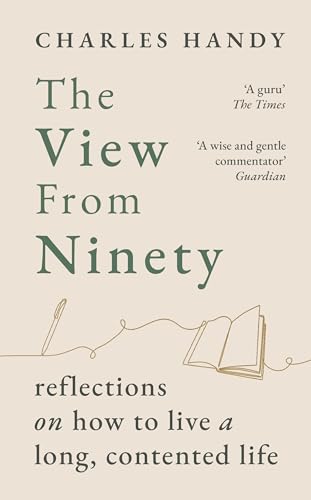
Over a span of seven decades, Charles Handy was, variously, a businessman, a writer, a philanthropist and a philosopher. Not even a stroke as he approached the age of 90 dimmed his intellectual curiosity or his immense zest for life.
In this, his final book, written from the vantage point of a contemplative old age and drawing on his articles for The Idler he shares his thoughts on the big questions with which we all
What things really matter?What daily worries should we learn to treat as unimportant?How do we become more accepting of ourselves and of those around us?How do we discover purpose in our everyday existence? How do we cope with grief and loss? Drawing in part on his own experience, in part on the wisdom of others, he sets out the principles of enjoying a fulfilled and contented life, and gently points the way to the practicalities of achieving it.
Charles Brian Handy was an Irish author and philosopher who specialised in organizational behavior and management. Among the ideas he advanced are the "portfolio career" and the "shamrock organization" (in which professional core workers, freelance workers and part-time/temporary routine workers each form one leaf of the "shamrock"). Handy was rated among the Thinkers 50, a private list of the most influential living management thinkers. In 2001, he was second on this list, behind Peter Drucker, and in 2005, he was tenth. When the Harvard Business Review had a special issue to mark the publication's 50th anniversary Handy, Peter Drucker, and Henry Mintzberg were asked to write special articles. In July 2006, Handy was conferred with an honorary Doctor of Law by Trinity College Dublin.
If Oscar Wilde wrote in paragraphs rather than stanza’s
Very thought provoking book I will certainly recommend to a few people.
Encourages considered self reflection but without being forceful
Some excerpts I highlighted:
So to my grandchildren I say this: experiment in your twenties before you have a family and a mortgage, because then if you fail it doesn’t matter and you’ll learn a lot from your mistakes. Get on whatever train you think might be interesting and see where it takes you.
So when you think you’ve got a solution, assume that it could be better, doubt that it is right. And discipline yourself to choose at least another two possible answers, to test it.
My wife led a well-lived, well-loved life. And I can’t think of anything more successful than that–more valuable than all the money in the world.
The final chapters are the most moving. The rest is gentle, and Handy’s kindness and humility shine through. But be does talk a lot about Shell…. and I’m not convinced that some of his lessons really work in today’s world.
Maybe it's the affinity of him being based in Singapore, or that he is channeling his wisdom his children, grandchildren would otherwise take time to appreciate. I enjoyed it. Easy read.
I first came across Charles Handy around thirty years ago during a low point in my career - if I can call it that - working a series of contracts for what seemed like a tranche of the worst organisations you could imagine. They seemed not to know that their staff, contracted or payrolled, were their most valuable assets.
Whenever I began a new contract, I’d venture around the town at lunch break and usually pop into the public library, mainly to see if it had an interesting record collection; CDs, vinyl and tapes. On this occasion, I thought I’d challenge myself to a deep read and going along the philosophy and business aisle, found a book by Charles B. Handy, a critique of contemporary business management. It reached out to me in those dire times, though, in truth, it was the fun sounding name, Charlie Handy, which appealed the most.
Sadly, he’s gone and this book, A View From Ninety, was his final work, published posthumously. On its last page is a note from the publisher containing a sort of apology for the writing’s lack of polish. Handy had suffered a stroke and was, as he describes himself, disabled and house bound, unable to write as he usually did, typing and editing the work over time himself. Instead, this was dictated, typed by others and read back to him. I get the impression this was a bit of self indulgence, one last go at writing for its own sake rather than from a deep insight into a subject of his expertise: business and its organisation.
Still, it has that friendly and gentle style characteristic of his more profound work. And it’s short read and each chapter is little more than a few pages in length, focussing on some random thought on life, looking back. It covers a lot of ordinary subjects like family, work, politics, education, character, behaviour; any thought we may randomly have on any particular day.
The brevity and short bite approach saves the book for me. You can read one and agree, read another and disagree, read a third and think what’s this got to do with the price of fish?!, and move along. It’s a mixed bag of gentle considerations, opinions and advice.
Really enjoyed these easy readable but often in-depth mini chapters of advice and guidance from this wise old man. Written in his 90th year, managing life well and living a good happy life which he deserved and planned for during his ever changing, often exciting life and career. Taking opportunities offered to him as he thrived in placing his family first, benefitting from the rewards of this and thus enabling his senior years to be content and harmonious. And think we all need some Jabberwocky… or Edward Lear…
"The View from Ninety: Reflections on Living a Long, Contented Life" by Charles Handy is a meditation on what truly matters when life is seen from its farthest vantage point. Written in his nineties after a stroke left him acutely aware that time was limited, the book gathers reflections shaped by urgency, honesty, and perspective. Handy looks back on a life that included corporate success, intellectual influence, friendship, love, failure, faith, and doubt, and distills what remained meaningful when ambition and status lost their grip. Rather than offering abstract philosophy, he shares lived insights about uncertainty, relationships, work, purpose, and death, refined by the clarity that comes only when the future is short and the past fully visible.
One of Handy’s central insights is that life rarely unfolds according to plan, and that what initially appears to be a mistake often turns out to be a gift. He reflects on how early career choices that felt wrong or disappointing redirected him toward work that better suited his temperament and talents. Instead of seeing detours as failures, he came to view them as experiments that revealed new possibilities. From this perspective, certainty becomes less valuable than curiosity, and doubt becomes a strength rather than a weakness. Questioning one’s assumptions keeps learning alive and prevents rigidity. Handy suggests that comfort with uncertainty, including the ability to empty the mind and tolerate not knowing, creates space for insight and creativity that relentless striving never produces.
Redefining success is another major theme. Looking back, Handy found that wealth, titles, and recognition faded in importance compared to the quality of relationships he had built. He contrasts conventional ideas of success with a quieter measure based on connection and care. Lives well lived, in his view, are marked not by possessions but by people, by friendships sustained over decades, by shared meals, conversations, and acts of kindness that ripple outward long after someone is gone. Success becomes something relational and cumulative, visible in the way one is remembered and missed rather than in external achievements. This reframing challenges younger generations to reconsider what they are optimizing for before commitments harden into constraints.
Human connection, for Handy, is not optional but essential to identity. He emphasizes that people only become fully themselves through relationships, especially with those who have known them across different phases of life. Longstanding friends hold memory and continuity, reminding us who we have been and who we still are beneath changing roles. Yet not all relationships nourish equally. Handy observes that some people energize and uplift, while others quietly drain emotional resources. Learning to recognize this difference and choosing where to invest time and attention is an act of self-respect rather than selfishness. Hospitality, openness, and generosity, he argues, create richness, while excessive privacy and defensiveness isolate. A life oriented outward, even at the cost of inconvenience, tends to expand rather than shrink.
Work and leadership also look different when viewed from the end of life. Handy distinguishes between escaping work one dislikes and moving toward work that feels purposeful. Many people pursue freedom from discomfort without defining what they want freedom for, which leads to drift rather than fulfillment. His own decision to leave corporate security for independent work was driven by a desire to create, write, and teach, even though it carried risk. Over time, he concluded that meaningful work is less about job titles and more about contribution. There is often more work to be done than there are formal jobs, and initiative matters more than permission.
In leadership, Handy learned that kindness without clarity fails, just as authority without compassion does. Being honest, even when uncomfortable, is part of respect. He also embraced the idea that decisions should be made as close as possible to where the work actually happens, trusting people rather than controlling them. Micromanagement signals distrust and weakens responsibility, while autonomy strengthens both competence and commitment. He rejected the assumption that growth is always desirable, noting that quality often matters more than scale. Doing fewer things better can be more satisfying and sustainable than endless expansion.
Wisdom, in Handy’s reflections, involves resisting false choices and oversimplified binaries. He warns against dichotomies that present life as a series of either-or decisions, which restrict imagination and foreclose creative alternatives. Reality is usually richer and more flexible than such framing allows. Related to this is his distinction between personality and character. Personality is the outward presentation, shaped and adjusted to suit circumstances, while character emerges slowly through repeated choices and reactions. In the long run, character determines the substance of a life, not charm or image.
Handy also argues that difference strengthens rather than weakens relationships and organizations. Compatibility does not require sameness. In fact, partnerships thrive when contrasting traits balance one another. Exposure to differing viewpoints improves decision-making and prevents blind spots, whether in families, teams, or governments. Empathy grows when people pause to imagine the conditions shaping others’ behavior instead of rushing to judgment. Seeing the world through another’s eyes enlarges understanding and softens certainty.
Spirituality, for Handy, became increasingly personal rather than doctrinal. Over time, rigid ideas of God as an authority figure gave way to a sense of presence woven into nature, companionship, and acceptance. Meaning was not something received fully formed but something each person must articulate for themselves. Faith, like identity, evolved rather than remained fixed, shaped by experience rather than rules.
Facing mortality brought a final layer of insight. Aging, Handy discovered, carried unexpected freedom. With ambition diminished and social pressure loosened, he felt more able to speak honestly and accept himself without constant striving. Death, once feared, came to be seen as part of a natural cycle rather than a personal injustice. He found comfort in the idea that breaking and repair are fundamental to life, not exceptions to it. Scars and failures, once integrated, add depth rather than shame. Acceptance replaced resistance, and readiness mattered more than control.
In the end, "The View from Ninety: Reflections on Living a Long, Contented Life" by Charles Handy offers guidance drawn from hindsight rather than instruction manuals. It suggests that a good life is not one without wrong turns, breaks, or uncertainty, but one that remains open, relational, curious, and accepting. Handy’s reflections invite readers to measure success by connection, to value doubt over certainty, to seek purpose rather than escape, and to make peace with the natural arc of living and dying. From the summit of a long life, his message is clear: what endures is not what you accumulated, but how you lived, who you loved, and how fully you were present along the way.
I’m a big fan of memoir style reflection novels, and this one really touched me. There is something so special about reading an authors last work in such a reflective state. Even knowing that he had to dictate his words because he physically couldn’t write them in his physical state adds extra depth. I listened to it on audiobook, and I highly recommend doing so, unless you buy the hard copy to annotate, at which would be valuable as well. It was narrated by his son, and I couldn’t have imagined consuming it any other way.
It was touching and inspiring, everything this style of novel should be. I would read again, because I don’t feel I picked up every bit of knowledge the first time around. Charles Handy is just as wise as people say. I think this is a fantastic book to read to strive in improving your own life as the inevitable draws near, and that’s coming from someone who is 21 years old and quite afraid of dying.
Mr. Handy wrote this memoir as an instruction manual for living a life of fulfillment and contentment. Among other important concepts, this author shares his wisdom: how to be accepting of ourselves and others, how to find forgiveness, how to discern what is important in life. Some of his experiences seem to be self explanatory, some less so. To me, what was most helpful were his sections on finding purpose in life and coping with grief and loss. All, though, are shared from the perspective of a man who has lived his life well and reached his nineties wanting to share al he has learned.
Every reader will find something to learn from in this book; it is both succinct and easy reading.
A 24hour read, this was an incredible insight into what matters in life from personal life, work life, friendships, family and in life and death. An incredible look into how a persons experience leaves a legacy, how culture impacts our attitudes into life and how chasing your dreams and a slower life brings joy and fulfillment. Lots of useful advice, some less useful, but overall a lovely philosophical perspective.
3⭐️ a very short read with a lot of unique lessons to navigate life. It wasn’t anything extremely moving or unknown to me, but I always appreciate the wisdom that those who have can bestow on those who have not. I found the ending particularly enjoyable, especially when it came to his letter to God and the final chapter Preparing for the Inevitable.
No rating but highly recommended. I’ve been trying as I’ve gotten older and my life has changed to listen to the people who came before me and to learn as much as k can. This is a great read to do just that.
Masterpiece. Felt like an updated take on How to Win Friends and Influence people - definitely making the recommend books list. The sort of book you want to come back to at different stages in your life
Charles Handy’s 19th and last book is not his heftiest. But it may be, in some important respects, his weightiest.
My review for the Financial Times: https://as.ft.com/r/10602856-6ddf-454... The View From Ninety by Charles Handy — final words from management’s social philosopher
So much great old wisdom in these pages. I love the subtle guidance for a positive perspective. Short chapters that are relatable and hit the nail on the head!
Good take aways on life. I listened to the audiobook of this one and thought it was a full circle moment for the audiobook narrator to be the author’s son.
Charles Handy has earned the right to reflect. At ninety years old, he is less interested in proving a point than in sharing what experience has taught him about work, organizations, education, family, faith, freedom, and the passage of time. The result is not a tightly argued thesis, but a collection of observations, stories, and wisdom gathered over a long and thoughtful life.
At his best, Handy reminds us why he is often called Europe's—or Britain's—Peter Drucker. He has a gift for exposing the hidden assumptions behind bureaucracy, management, and institutional life. His reflections on character, trust, subsidiarity, education, and the necessity of doubt are insightful and often profound. Throughout the book runs a refreshing intellectual humility: the recognition that wisdom begins with the admission that we might be wrong.
Where I part company with Handy is on economics and environmental issues. Like many intellectuals of his generation, he seems attracted to the notion that the world is running out of resources and that prosperity inevitably collides with ecological limits. I found these sections far less persuasive than his discussions of organizations and human flourishing. They overlook the role of knowledge, innovation, entrepreneurship, and human creativity in expanding resources and solving problems. Reading these chapters, I often wished he had spent some time with Superabundance.
Still, even when I disagreed with him, Handy made me think. And that may be the highest compliment one can pay an author. This is not a book of answers so much as a book of questions from a man who has spent a lifetime observing institutions and human behavior. I finished it with more notes than conclusions—and that is probably exactly what Handy intended.
Memorable Quotes
"We need young people to make things change and old people to let them change."
"I beseech you, in the bowels of Christ, think it possible that you may be mistaken." — Oliver Cromwell
"To be a proper professor, you need to have decent doubt."
"Decent doubt is the foundation of all science."
"Without the doubt, you would not need faith."
"Admit at least privately, and preferably publicly, that you could be wrong."
"Willful blindness, a reluctance to face up to awkward facts or bad news."
"We treat each child as if it were an only child."
"Don't let facts get in the way of your imagination."
"Personality is the mask you put on before the rest of the world."
"Personality, however, is no measure of character."
"Should the past be your guide to the future? I hope not."
"Education is about drawing out of people what they already know but don't understand, not putting in what they will forget immediately."
"It didn't matter how wise I was. That was of no value to them if they couldn't rely on me and trust me."
"The Irish have a saying: how do I know what I think until I hear what I say?"
"I had freedom from worry but no freedom to. I was a sort of voluntary prisoner. For some reason 'freedom from' wasn't enough for me. You can't have both, you have to choose."
"It is immoral—against moral order—for a higher authority to take decisions that properly could be taken by a lower-order body, closer to the action."
I found most of the advice to be common sense but there were a few jewels. However, while I didn't care for the left leaning commentary, I respect the author's right to make those comments.