

What do you think?

Arkadi and the Lost Titan
Created over the course of 20 years and spanning over 500 pages comes Caza's Magnum Opus: a classic sci-fi adventure with spiritual and metaphysical exploration.
It's Year 10,000 of the Still era, and Earth has stopped moving. Half of the world is plunged into frigid Night, the other is scorched in Day. Nestled in the heart of this everlasting night is Dis, the last fabled domed-city, ruled by artificial intelligence. There live the Chosen, the last biologically pure humans, who are completely reliant for their survival on cyborgs known as Titans.
In Twilight, the thin strip of habitable zone at the edge of Day and Night, survives the rest of humanity. In the small village of Accaia, a wandering warrior meets a sorceress and fathers a child, Arkadi.
It is during these trials that Arkadi will rebel against the established order and discover his true power and set forth on a quest.
It's Year 10,000 of the Still era, and Earth has stopped moving. Half of the world is plunged into frigid Night, the other is scorched in Day. Nestled in the heart of this everlasting night is Dis, the last fabled domed-city, ruled by artificial intelligence. There live the Chosen, the last biologically pure humans, who are completely reliant for their survival on cyborgs known as Titans.
In Twilight, the thin strip of habitable zone at the edge of Day and Night, survives the rest of humanity. In the small village of Accaia, a wandering warrior meets a sorceress and fathers a child, Arkadi.
It is during these trials that Arkadi will rebel against the established order and discover his true power and set forth on a quest.
528 pages, Hardcover
Published March 11, 2025
About the author
Caza
111 books21 followersCaza, the pseudonym for Philippe Cazamayou, is a French comics artist.
Caza began to publish work in Pilote magazine, starting with his series Quand les costumes avaient des dents (When Costumes had Teeth) in 1971, followed by other short work. The series of stories Scènes de la vie de banlieue (Scenes of Suburban Life) was published in 1975, followed by the L'Âge d'Ombre stories, Les Habitants du crépuscule and Les Remparts de la nuit.
With the emergence of the magazine Métal Hurlant in 1975, Caza began to supply work within the science-fiction genre, with titles such as Sanguine, L'oiseau poussière, initially working with an exhaustive black and white dot technique. This was later abandoned for a style of colour use which would become a trademark, as seen in later work such as Arkhê, Chimères and Laïlah.
Caza began to publish work in Pilote magazine, starting with his series Quand les costumes avaient des dents (When Costumes had Teeth) in 1971, followed by other short work. The series of stories Scènes de la vie de banlieue (Scenes of Suburban Life) was published in 1975, followed by the L'Âge d'Ombre stories, Les Habitants du crépuscule and Les Remparts de la nuit.
With the emergence of the magazine Métal Hurlant in 1975, Caza began to supply work within the science-fiction genre, with titles such as Sanguine, L'oiseau poussière, initially working with an exhaustive black and white dot technique. This was later abandoned for a style of colour use which would become a trademark, as seen in later work such as Arkhê, Chimères and Laïlah.
Ratings & Reviews
Friends & Following
Create a free account to discover what your friends think of this book!
Community Reviews
Displaying 1 - 18 of 18 reviews

March 2, 2025
This sprawling epic from Caza (aka Philippe Cazaumayou) is visually spectacular, and hugely ambitious in delivering a narrative that interweaves elements of Greek and Norse mythology into a grim tale of life in a future age of the Earth when our planet has stopped rotating on its axis. The multiple chapters of the story were published over a period of more than twenty years, and this collected edition reflects the author's developing graphic style over that extended period.
The genesis of this giant graphic novel stems from Caza's concerns over nuclear waste, and the long-term harms such materials can cause as they slowly decay over vast stretches of time. This somewhat humble beginning grows in all sorts of directions, and the vast scope of the tale is simultaneously breathtaking and challenging to fully decipher. For example, the myth of Orpheus and Eurydice is referenced repeatedly, but I'm not entirely clear on how Caza's story relates to that ancient source beyond a superficial level.
That said, Arkadi and the Lost Titan is still a deeply impressive work, reflecting the very best of the continental European comics tradition that so routinely generates more interesting content than we tend to get from the English-language scene. If Caza's storytelling ambition sometimes exceeds his ability to deliver a fully coherent narrative, the pure visual magic present on every page is more than enough reason to dive into this epic adventure.
The genesis of this giant graphic novel stems from Caza's concerns over nuclear waste, and the long-term harms such materials can cause as they slowly decay over vast stretches of time. This somewhat humble beginning grows in all sorts of directions, and the vast scope of the tale is simultaneously breathtaking and challenging to fully decipher. For example, the myth of Orpheus and Eurydice is referenced repeatedly, but I'm not entirely clear on how Caza's story relates to that ancient source beyond a superficial level.
That said, Arkadi and the Lost Titan is still a deeply impressive work, reflecting the very best of the continental European comics tradition that so routinely generates more interesting content than we tend to get from the English-language scene. If Caza's storytelling ambition sometimes exceeds his ability to deliver a fully coherent narrative, the pure visual magic present on every page is more than enough reason to dive into this epic adventure.

February 5, 2025
Probably one of the best comics works I've read. A really unique world, a sophisticated story that develops and raptures at the end, complex characters.
A great and inspiring sci-fi world that makes you dream on. Absolutely recommend!
A great and inspiring sci-fi world that makes you dream on. Absolutely recommend!

January 20, 2025
Arkadi and the Lost Titan is set in the distant future, more than 10,000 years hence. The Earth has become phase-locked in it’s orbit around the sun, so one side always faces the sun and the other always faces away. The catastrophe that changed Earth’s rotation also shattered the moon, leaving it a ring around the Earth. Over the millennia, what little human and animal life that survived the catastrophe has mutated and evolved.
As the graphic novel opens, we meet a tribe of survivors living near the terminator between the day and night sides of the planet. Among them is the brave, young warrior Arkas. As the sleep cycle comes upon the villagers, Arkas is assigned guard duty. Having grown complacent, Arkas allows himself to be distracted by his lover. Meanwhile, the village leader’s wife and child are kidnapped by creatures who live just over into the planet’s night side. This leads Arkas to begin a quest to get them back. When he fails, he’s forced to live a life in exile. Years later, he falls in love with a witch and has a son named Arkadi. The witch has a “magic mirror” which shows Arkas his life’s purpose. Through it, he learns about a bastion of humans and gods in the center of Earth’s nightside called Dis and leaves to seek it out.
In the meantime, Arkadi is raised by his mother, Albe. Unlike his father, Arkadi has a mutation, a vestigial head on one shoulder that has its own faint intelligence. In the culture that has developed, a mutated human can still be treated as an ordinary human through a right-of-passage ceremony. Although Arkadi is strong and willful, he fails the right of passage and is thrown into conflict with the other young people of the tribe. As he attempts to flee, he’s saved by a warrior woman named Pan-dra, sent from the city his father had left to seek. Pan-dra is on a quest to find the lost Titan, Or-phe, whose job it was to provide dream images to the people of the lost city of Dis.
It turns out Dis was built as a shelter to protect humans and technology when the great catastrophe hit the world. The Titans are great robots and cyborgs named for the Greek Titans, each tasked with jobs to help humanity survive. Pro-me was tasked with developing nuclear fusion. A-Tlas is the literal foundation and support structure of Dis. There’s the mysterious Legion, an army of robots who have a job long forgotten but of great importance. In this pantheon, Or-phe provides the content for the “dream screens,” devices that allow the few remaining protected humans to have proper REM sleep, necessary for survival.
Arkadi and Pan-dra’s quest take them on an odyssey around this changed Earth. They are eventually swallowed up by a land whale where they find a paradisiacal world, which at once tempts them away from their path even as it leads them to the object of their quest. In the end, they learn how catastrophe came to the Earth and must find a way to put it right while also assuring that Or-phe’s dreams are restored to the world.
I gather Caza wrote and drew this 510-page graphic novel over the span of some 20 years. I love the way it blends its science fiction story with themes from Greek mythology and numerous literary sources. The art in this volume is breathtaking. While I didn’t quite buy into the story’s explanation for the catastrophe that struck the world, I really appreciated the metaphor and story points that humans have a real responsibility to be good stewards of the Earth, or else suffer grave consequences. I found Caza’s epic both thought-provoking and beautiful to look at and I’m sure I’ll seek out more of Caza’s work as well as returning to Arkadi and the Lost Titan for another read.
As the graphic novel opens, we meet a tribe of survivors living near the terminator between the day and night sides of the planet. Among them is the brave, young warrior Arkas. As the sleep cycle comes upon the villagers, Arkas is assigned guard duty. Having grown complacent, Arkas allows himself to be distracted by his lover. Meanwhile, the village leader’s wife and child are kidnapped by creatures who live just over into the planet’s night side. This leads Arkas to begin a quest to get them back. When he fails, he’s forced to live a life in exile. Years later, he falls in love with a witch and has a son named Arkadi. The witch has a “magic mirror” which shows Arkas his life’s purpose. Through it, he learns about a bastion of humans and gods in the center of Earth’s nightside called Dis and leaves to seek it out.
In the meantime, Arkadi is raised by his mother, Albe. Unlike his father, Arkadi has a mutation, a vestigial head on one shoulder that has its own faint intelligence. In the culture that has developed, a mutated human can still be treated as an ordinary human through a right-of-passage ceremony. Although Arkadi is strong and willful, he fails the right of passage and is thrown into conflict with the other young people of the tribe. As he attempts to flee, he’s saved by a warrior woman named Pan-dra, sent from the city his father had left to seek. Pan-dra is on a quest to find the lost Titan, Or-phe, whose job it was to provide dream images to the people of the lost city of Dis.
It turns out Dis was built as a shelter to protect humans and technology when the great catastrophe hit the world. The Titans are great robots and cyborgs named for the Greek Titans, each tasked with jobs to help humanity survive. Pro-me was tasked with developing nuclear fusion. A-Tlas is the literal foundation and support structure of Dis. There’s the mysterious Legion, an army of robots who have a job long forgotten but of great importance. In this pantheon, Or-phe provides the content for the “dream screens,” devices that allow the few remaining protected humans to have proper REM sleep, necessary for survival.
Arkadi and Pan-dra’s quest take them on an odyssey around this changed Earth. They are eventually swallowed up by a land whale where they find a paradisiacal world, which at once tempts them away from their path even as it leads them to the object of their quest. In the end, they learn how catastrophe came to the Earth and must find a way to put it right while also assuring that Or-phe’s dreams are restored to the world.
I gather Caza wrote and drew this 510-page graphic novel over the span of some 20 years. I love the way it blends its science fiction story with themes from Greek mythology and numerous literary sources. The art in this volume is breathtaking. While I didn’t quite buy into the story’s explanation for the catastrophe that struck the world, I really appreciated the metaphor and story points that humans have a real responsibility to be good stewards of the Earth, or else suffer grave consequences. I found Caza’s epic both thought-provoking and beautiful to look at and I’m sure I’ll seek out more of Caza’s work as well as returning to Arkadi and the Lost Titan for another read.

April 1, 2025
The Earth has stopped rotating on its axis for 10,000 years now, and the hemisphere facing the sun has become a scorched desert whilst the other is a frozen wasteland. The equatorial belt separating these two regions is where the vestiges of humanity live, and where we meet Arkadi, the child of a warrior and sorceress. Pulling heavily from Greek mythology, Biblical themes, post-apocalyptic tropes and Jungian archetypes, Caza's epic Le Monde d'Arkadi series has now been translated and collected into a single omnibus volume.
An episodic saga, Arkadi and the Lost Titan serves as Caza's outlet for exploring mythological storytelling told from a fantasy and sci-fi lens. Much in line with the tradition of his contemporaries like Moebius and Druillet, Caza's vision of the post-apocalyptic Earth is that of stupendous scale and psychedelic colors. Ambitious scale is the name of the game here, but it does come at the cost of the characters, and at times, the plot itself, as being a bit inscrutable. But what you get with Arkadi and the Lost Titan is a riveting journey into a post-apocalyptic hellscape, wonderfully realized by Caza's grandiose artwork, that also seeks to explore some heady sociological and philosophical themes for the genre.
An episodic saga, Arkadi and the Lost Titan serves as Caza's outlet for exploring mythological storytelling told from a fantasy and sci-fi lens. Much in line with the tradition of his contemporaries like Moebius and Druillet, Caza's vision of the post-apocalyptic Earth is that of stupendous scale and psychedelic colors. Ambitious scale is the name of the game here, but it does come at the cost of the characters, and at times, the plot itself, as being a bit inscrutable. But what you get with Arkadi and the Lost Titan is a riveting journey into a post-apocalyptic hellscape, wonderfully realized by Caza's grandiose artwork, that also seeks to explore some heady sociological and philosophical themes for the genre.

Want to Read
March 7, 2025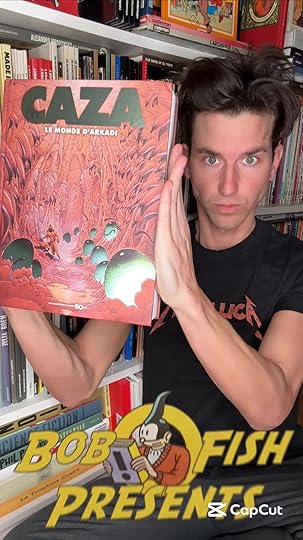
A great saga by an underrated science fiction BD auteur! Finally available and beautifully printed !
I show some images here:
https://youtu.be/bqycYc4J1Uk

January 15, 2026
One of the most interesting Euro-comics (and comics in general) I've read in a while - very glad I backed this humongous tome on Kickstarter!
Set in a future many millennia from now, after the world has suffered a cataclysm wherein the planet no longer spins and is divided into permanently icy night and scorching day sides with a narrow habitable belt in between where humans live; even the moon was torn asunder at some point and is now a rocky belt around the Earth in a low-orbit. Into this world we come and find a human race divided into two and each completely isolated from the other: the wild, radiation mutated barbarian tribes scattered in the open world and the sterile and child-like denizens of the underground techno-haven of Dis. The surface world is brutal and harsh and survival is the core of all things and the isolated Dis is by contrast a sterile haven of the pale, languid descendants of humanity who are shepherded and kept alive thanks to the "Machine Gods" that were left by their ancestors to watch over them all.
This huge harcover collection is very much an epic in scope and scale, as it collects all the chapters of this narrative, written and drawn with very visible passion by creator Caza, a creative titan in his own right. It is very much a kind of lifes-work or Magnum Opus for Caza as he has worked on this this over 500 page story and over the course of about 20 years - no small feat for any medium by any single creator.
Initially the story does a nice job setting the stage of this world, wherein we meet the Barbarian youth Arkas and his journey as he is kicked out of his tribe for his youthful folly, how he survived and met the mysterious mystic woman Albe in the village of Accaia and the "witch" has a "magic mirror" which shows Arkas his life’s purpose - Through it, he learns about a bastion of humans and gods in the center of Earth’s nightside called Dis and leaves to seek it out, leaving Albe behind with a child who grows up to be the titular Arkadi.
We then follow Arkadis' journey as a near outcast in his tribe, child of a "beyonder", and the trials and tribulations that he faces as he steps out into the world beyond and becomes a part of the events and people that will help decide the future of the planet and its inhabitants. On the way he meets several interesting characters, mutants, cyborgs, clones and more - we encounter wildly varied creatures and environs as we journey with him and the companions he meets along the way, mainly the warrior woman Pan-dra and the mutant Raddon.
The endpoint of their journey is to be the fabled city of Dis. We learn of Titans, god-like robots named for characters from mythology, each tasked with a job to aid humanities' survival: Pro-me was tasked with endlessly journeying to the sun and back carrying nuclear fuel to keep the city itself alive. A-Tlas is literally the foundation and support structure of Dis. The operations and monitoring of Dis is handled by Hel. There’s the mysterious Legion, an army of robots who have a job long forgotten but of great import. Then there is Or-phe the poet, a cyborg that travels the world beyond and weaves tales that act as dream content "Chosen" humans who reside there because they are incapable anymore of having proper REM sleep anymore.
The story is grand, sprawling, chaotic, profound, extremely ambitious, visually spectacular and quite sophisticated. In this edition I saw the background of it, seeded at a very young age in Cazas' mind through some his fears of Nuclear waste at a time when the Cold War was also raging. Born as a concept, the story was built over time and characters were added and the story refined and put out to the world in stages depending on where he was working and with which publications.
Unlike most science fiction, it felt very original to me. It is not that I have never seen anything like it, but it is a story filled with concepts and ambitious vision that may well show many influences and archetypes, but it always feels like a wholly unique story. It is not overly allegorical but does draw from things like Norse and Greek mythology (like with the cyborgs Or-phe and Uri-Di-C) as well as some spiritual concepts and even some bits from Dantes Inferno. There is all this and more, including things from old Hebrew and more Eastern philosophies/mythos. It is all none of it, directly dealing with the stories above - the story borrows whatever suits the creators vision and weaves it into the tale he is telling, be it a name, a scene a moment or an idea.
All of this is gorgeously rendered from the very first page to the last and I loved all of it. It is like a showcase of some of what makes the comics and creators of Metal Hurlant, Heavy Metal and 2000AD in some ways wholly different and more interesting than and different from the American and Japanese sci-fi that are the most ubiquitous. As with Tolkien-esque and such tropes that dominate fantasy, there are certain things endemic to mainstream science fiction. In this, when you read a book like this or the long-lived Valerian and Laureline series, you get to see a different kind of creativity when it comes to concepts of the technology explored, creature designs, aesthetics and more - it stands apart and sometimes feels bolder and more inventive in certain ways and that is strongly represented here. By this I am talking about both the art as well as the story.
One of my favourite Kickstarter projects by a long-shot. If you are a fan of fascinating science fiction that stands apart from the familiar and the franchises, I would strongly recommend checking out this book.
Set in a future many millennia from now, after the world has suffered a cataclysm wherein the planet no longer spins and is divided into permanently icy night and scorching day sides with a narrow habitable belt in between where humans live; even the moon was torn asunder at some point and is now a rocky belt around the Earth in a low-orbit. Into this world we come and find a human race divided into two and each completely isolated from the other: the wild, radiation mutated barbarian tribes scattered in the open world and the sterile and child-like denizens of the underground techno-haven of Dis. The surface world is brutal and harsh and survival is the core of all things and the isolated Dis is by contrast a sterile haven of the pale, languid descendants of humanity who are shepherded and kept alive thanks to the "Machine Gods" that were left by their ancestors to watch over them all.
This huge harcover collection is very much an epic in scope and scale, as it collects all the chapters of this narrative, written and drawn with very visible passion by creator Caza, a creative titan in his own right. It is very much a kind of lifes-work or Magnum Opus for Caza as he has worked on this this over 500 page story and over the course of about 20 years - no small feat for any medium by any single creator.
Initially the story does a nice job setting the stage of this world, wherein we meet the Barbarian youth Arkas and his journey as he is kicked out of his tribe for his youthful folly, how he survived and met the mysterious mystic woman Albe in the village of Accaia and the "witch" has a "magic mirror" which shows Arkas his life’s purpose - Through it, he learns about a bastion of humans and gods in the center of Earth’s nightside called Dis and leaves to seek it out, leaving Albe behind with a child who grows up to be the titular Arkadi.
We then follow Arkadis' journey as a near outcast in his tribe, child of a "beyonder", and the trials and tribulations that he faces as he steps out into the world beyond and becomes a part of the events and people that will help decide the future of the planet and its inhabitants. On the way he meets several interesting characters, mutants, cyborgs, clones and more - we encounter wildly varied creatures and environs as we journey with him and the companions he meets along the way, mainly the warrior woman Pan-dra and the mutant Raddon.
The endpoint of their journey is to be the fabled city of Dis. We learn of Titans, god-like robots named for characters from mythology, each tasked with a job to aid humanities' survival: Pro-me was tasked with endlessly journeying to the sun and back carrying nuclear fuel to keep the city itself alive. A-Tlas is literally the foundation and support structure of Dis. The operations and monitoring of Dis is handled by Hel. There’s the mysterious Legion, an army of robots who have a job long forgotten but of great import. Then there is Or-phe the poet, a cyborg that travels the world beyond and weaves tales that act as dream content "Chosen" humans who reside there because they are incapable anymore of having proper REM sleep anymore.
The story is grand, sprawling, chaotic, profound, extremely ambitious, visually spectacular and quite sophisticated. In this edition I saw the background of it, seeded at a very young age in Cazas' mind through some his fears of Nuclear waste at a time when the Cold War was also raging. Born as a concept, the story was built over time and characters were added and the story refined and put out to the world in stages depending on where he was working and with which publications.
Unlike most science fiction, it felt very original to me. It is not that I have never seen anything like it, but it is a story filled with concepts and ambitious vision that may well show many influences and archetypes, but it always feels like a wholly unique story. It is not overly allegorical but does draw from things like Norse and Greek mythology (like with the cyborgs Or-phe and Uri-Di-C) as well as some spiritual concepts and even some bits from Dantes Inferno. There is all this and more, including things from old Hebrew and more Eastern philosophies/mythos. It is all none of it, directly dealing with the stories above - the story borrows whatever suits the creators vision and weaves it into the tale he is telling, be it a name, a scene a moment or an idea.
All of this is gorgeously rendered from the very first page to the last and I loved all of it. It is like a showcase of some of what makes the comics and creators of Metal Hurlant, Heavy Metal and 2000AD in some ways wholly different and more interesting than and different from the American and Japanese sci-fi that are the most ubiquitous. As with Tolkien-esque and such tropes that dominate fantasy, there are certain things endemic to mainstream science fiction. In this, when you read a book like this or the long-lived Valerian and Laureline series, you get to see a different kind of creativity when it comes to concepts of the technology explored, creature designs, aesthetics and more - it stands apart and sometimes feels bolder and more inventive in certain ways and that is strongly represented here. By this I am talking about both the art as well as the story.
One of my favourite Kickstarter projects by a long-shot. If you are a fan of fascinating science fiction that stands apart from the familiar and the franchises, I would strongly recommend checking out this book.

April 28, 2025
This is quite a book.
Created by Caza back in the 1989, this story took over two decades to complete and, up until now, there's been no English translation. In that time Caza's illustrative style and techniques have changed along with the industry and the processes it uses to print. And yet this remains a cohesive, grandiose, and satisfying read from beginning to end, tying up loose ends and giving reason to the various outlandish sci-fi plot points.
Set on a future Earth where the planet has stopped revolving, half the world exists in heat and the other in freezing cold. The Earth has been like this for 10,000 years and despite the cataclysm claiming countless lives, some still exist. Although nobody's quite what we'd consider to be normal. Even the handful of biologically pure humans are struggling. Cyborgs, known as Titans, help maintain this tiny population, but it's outside, where permanent day touches permanent night, that a catalyst for lasting change is born.
Any fan of 2000AD will appreciate the epic story presented here. Its gargantuan scale, mutated masses, bloodthirsty warriors, and apocalyptic backdrop mean every turn of the page offers a new idea to explore. Caza's style, at times, reminded me of Cam Kennedy's, straying into Brett Ewins, if you need an idea of what to expect, but it's more than that, and gloriously coloured throughout. And the books presentation is utterly first class.
Considering I'd never heard of the story or the artist before I bought this, I found the entire experience hugely evocative of the comics I enjoyed growing up. A real buzz of nostalgia for something I had no right to feel nostalgic about.
Created by Caza back in the 1989, this story took over two decades to complete and, up until now, there's been no English translation. In that time Caza's illustrative style and techniques have changed along with the industry and the processes it uses to print. And yet this remains a cohesive, grandiose, and satisfying read from beginning to end, tying up loose ends and giving reason to the various outlandish sci-fi plot points.
Set on a future Earth where the planet has stopped revolving, half the world exists in heat and the other in freezing cold. The Earth has been like this for 10,000 years and despite the cataclysm claiming countless lives, some still exist. Although nobody's quite what we'd consider to be normal. Even the handful of biologically pure humans are struggling. Cyborgs, known as Titans, help maintain this tiny population, but it's outside, where permanent day touches permanent night, that a catalyst for lasting change is born.
Any fan of 2000AD will appreciate the epic story presented here. Its gargantuan scale, mutated masses, bloodthirsty warriors, and apocalyptic backdrop mean every turn of the page offers a new idea to explore. Caza's style, at times, reminded me of Cam Kennedy's, straying into Brett Ewins, if you need an idea of what to expect, but it's more than that, and gloriously coloured throughout. And the books presentation is utterly first class.
Considering I'd never heard of the story or the artist before I bought this, I found the entire experience hugely evocative of the comics I enjoyed growing up. A real buzz of nostalgia for something I had no right to feel nostalgic about.
February 23, 2025
What an amazing story! Seriously...I never write reviews because I don't have the time usually. I got an early Kickstarter copy of this book and devoured it in a couple of days, and I was just biding my time checking back to see if more reviews had been written after this was released to the general public. And still nothing more on here?!
It masterfully blended Greek mythology with a science fiction backdrop. Loved the retelling of Eurydice and Orpheus (made me think of when I read Sandman graphic novel too) and loved the play on names with a technological spin (i.e. Eurydice was named U.RI.D.C. in the story). I also loved the idea of the Titans and how they were used in this story as machine-gods, it gave it layers of mythical and religious undertones. The idea of Dis also made me think of how technology can make people way too comfortable, making one think of core questions about humanity, what it is, what it could be, what it should be. It made me think of parallels in what I've read in The Rediscovery of Man by Cordwainer Smith where the underpeople are more real and have more emotional depth than true humans at times due to their struggles being an underclass in society. And Dis is where true (untainted, in the context of this book) humans reside..but there is no virility as they had no struggle or hardship like the people on the outside, also reminiscent of The Rediscovery of Man where humanity was becoming stagnant without illness and hardships and unpredictability in life.
I saw a lot of my favorite science fiction concepts in here..cloning, the synthesis of technology with the human body (i.e. cyborgs/titans, call them what you will), memory transfer, evolution, ancient technology being used in a future more primitive time (makes me think a little bit of The Book of the New Sun by Gene Wolfe). What really resonated with me though were the mystical elements of the new future world with the jewels that Arkadi's mom and dad wore on their head, the vision of the Nocturnals, the idea of Noone (loved that it was a turtle-like creature). I particularly enjoyed the primitive nature of the future societies and seeing a peek into rites of passage (slightly reminded me of Courtship Rite by Donald Kingsbury in the sense that the story is also set in a slightly primitive future, although not entirely because some aspects of the future society were particularly advanced). Not only was it a direct story about evolution, but the characters also evolved; part of it was like Arkadi's coming of age story.
The artwork was great too! The reason I read graphic novels is first for content, and then secondly for art, so I won't speak too much on the art aspect, but I generally knew I would love Caza's art because I already loved the art style of Mœbius, which Caza's work has often been compared to. I really liked how he made good use of landscape scenes too, like the first frame is just a picture of the Earth from outer space showing its mountainous landscape with a ring of blue rocks overhead.
Anyways, I hope to see a lot more reviews and content about this one now that it's the first time it's been translated from French to English! I hope this story gets the credit and recognition it deserves..
It masterfully blended Greek mythology with a science fiction backdrop. Loved the retelling of Eurydice and Orpheus (made me think of when I read Sandman graphic novel too) and loved the play on names with a technological spin (i.e. Eurydice was named U.RI.D.C. in the story). I also loved the idea of the Titans and how they were used in this story as machine-gods, it gave it layers of mythical and religious undertones. The idea of Dis also made me think of how technology can make people way too comfortable, making one think of core questions about humanity, what it is, what it could be, what it should be. It made me think of parallels in what I've read in The Rediscovery of Man by Cordwainer Smith where the underpeople are more real and have more emotional depth than true humans at times due to their struggles being an underclass in society. And Dis is where true (untainted, in the context of this book) humans reside..but there is no virility as they had no struggle or hardship like the people on the outside, also reminiscent of The Rediscovery of Man where humanity was becoming stagnant without illness and hardships and unpredictability in life.
I saw a lot of my favorite science fiction concepts in here..cloning, the synthesis of technology with the human body (i.e. cyborgs/titans, call them what you will), memory transfer, evolution, ancient technology being used in a future more primitive time (makes me think a little bit of The Book of the New Sun by Gene Wolfe). What really resonated with me though were the mystical elements of the new future world with the jewels that Arkadi's mom and dad wore on their head, the vision of the Nocturnals, the idea of Noone (loved that it was a turtle-like creature). I particularly enjoyed the primitive nature of the future societies and seeing a peek into rites of passage (slightly reminded me of Courtship Rite by Donald Kingsbury in the sense that the story is also set in a slightly primitive future, although not entirely because some aspects of the future society were particularly advanced). Not only was it a direct story about evolution, but the characters also evolved; part of it was like Arkadi's coming of age story.
The artwork was great too! The reason I read graphic novels is first for content, and then secondly for art, so I won't speak too much on the art aspect, but I generally knew I would love Caza's art because I already loved the art style of Mœbius, which Caza's work has often been compared to. I really liked how he made good use of landscape scenes too, like the first frame is just a picture of the Earth from outer space showing its mountainous landscape with a ring of blue rocks overhead.
Anyways, I hope to see a lot more reviews and content about this one now that it's the first time it's been translated from French to English! I hope this story gets the credit and recognition it deserves..

March 17, 2025
There was war, love, poetry, and more penises then anyone would care to count.
This book had like 5 linear chapters that really made a fun adventure story, the rest felt like the ramblings of a mad man.
If you have something to say and you believe you understand it, then say it plainly. Artists try so hard to be mystical when sometimes straightforward is best.
That being said, this artist was trying to say way too much in every possible way but plainly.
Amazing art, beautiful world building, and fun likable characters (radon was my favorite). This was an epic adventure story which may have went on a bit too long.
3.5✨
This book had like 5 linear chapters that really made a fun adventure story, the rest felt like the ramblings of a mad man.
If you have something to say and you believe you understand it, then say it plainly. Artists try so hard to be mystical when sometimes straightforward is best.
That being said, this artist was trying to say way too much in every possible way but plainly.
Amazing art, beautiful world building, and fun likable characters (radon was my favorite). This was an epic adventure story which may have went on a bit too long.
3.5✨

June 21, 2025
An epic story that spanned 20 years of Caza's life to create. It's a tomb at over 500 pages and finally translated to English. This is set on a Earth 10,000 years after it has stopped spinning. The last people live in villages in the twilight demarcation between day and night. Most people have some kind of mutation. Way below the Earth exists one last city, its citizens pampered and run by an A.I. What follows is a really long adventure spanning 2 generations. It's full of things to say, never straight-forwardly, leaving you to figure out what Caza is getting at. Caza's art is really detailed, giving off a Moebius and Cam Kennedy vibe.
January 29, 2026
An ambitious and generous work, which reveals its full value when approached as a complete universe rather than in fragments however I must admit that prefer his short stories, which I find more poetic or more openly engaged with political and ecological themes.
Arkadi born from a vast cultural background, where myths, novels, and imagination constantly echo each other. In many ways, this book also feels like a tribute to the novels Caza illustrated for the J’ai Lu collection. I was also struck by certain pages packed with references to comic book history and to the great figures of Métal Hurlant—including, at times, Caza himself.
Arkadi born from a vast cultural background, where myths, novels, and imagination constantly echo each other. In many ways, this book also feels like a tribute to the novels Caza illustrated for the J’ai Lu collection. I was also struck by certain pages packed with references to comic book history and to the great figures of Métal Hurlant—including, at times, Caza himself.
May 5, 2025
A luxurious edition of the collected series of Arkadi.
A sci-fi epic playing with different mythologies and themes.
It was underway several years and the art develops over the story, but it still feels as a whole.
It is both entertaining, but also feels very dense with lots of references I probably didn't get.
A sci-fi epic playing with different mythologies and themes.
It was underway several years and the art develops over the story, but it still feels as a whole.
It is both entertaining, but also feels very dense with lots of references I probably didn't get.
August 13, 2025
Simply put, this is a masterpiece and one of the best comics I have ever read. A mix of sci-fi, fantasy, poetry, myth, rich in symbolism, and a cautionary tale about our current world and our effect on it. Great art, great writing, informed by both classic comics artists and giants of literature.

May 6, 2025
I loved this. Honestly, truly. This was a "blind buy". I'm so glad I got to delve into this story
April 21, 2026
Um dos melhores quadrinhos SciFi que já li. Sinto que descobri um novo mundo, bom demais.

June 28, 2025
Honestly, a bit disappointing.
I was really happy to hear about this project. Caza is one of my favourite artists in the early Heavy Metal issues. I even have one of his Heavy Metal covers hanging on a wall in my house!
This is his multi-decade sci-fi fantasy epic, finally collected in English. Huge scale story that starts off strong but gets bogged down and I lost interest about halfway through. The art at times is incredible, not at the level of the Heavy Metal short stories (but that'd be nearly impossible to do in a project this length).
I was really happy to hear about this project. Caza is one of my favourite artists in the early Heavy Metal issues. I even have one of his Heavy Metal covers hanging on a wall in my house!
This is his multi-decade sci-fi fantasy epic, finally collected in English. Huge scale story that starts off strong but gets bogged down and I lost interest about halfway through. The art at times is incredible, not at the level of the Heavy Metal short stories (but that'd be nearly impossible to do in a project this length).

April 14, 2026
In the ten thousand years since the earth stopped turning, one hemisphere has been plagued by the icy cold of eternal night and the other by the relentless heat of constant day. At the pole of night lies the underground city of Dis, where genetically engineered humanoids live under the protection of android Titans who provide for the citizens' every want and need. One such Titan, that satiates the imagination and mental stimulation of the public through shared dreams, absconds from his post and the fragile equilibrium of Dis begins to crumble. Thousands of miles away, a lineage of barbarians living on the narrow hospitable zone between night and day begin to experience visions that call upon them to seek out another lost Titan and find themselves on a collision course with envoys of Dis.
This was a solid sci-fi adventure with really satisfying world building and tons of killer art. Despite some rather clumsy plotting, the overarching narrative is largely coherent and a rather entertaining vehicle through which explore novel locales, mythology, and biology. We see varied radiation mutated species occupying the bifurcated wastes, a host of biomechanical gods that act as a bridge between the old world and the new, and a bevy of distinct settings and architecture for our characters to traverse through and learn about. The barbarian Arkadi and the rest of the cast are rather one dimensional but are at least quite distinct and undergo serviceable enough character arcs that add some interest while not getting in the way of the worldmaking and art which are the primary focuses.
On that note, the art is pretty darn epic. Windswept vistas, intricately rendered superstructures, and texturally rich geography fill near every background and imbue a pretty monumental scale to the compositions. Most humanoid character work is rather understated, especially among the main cast, but the Titans and associated fauna are quite elaborate by contrast. The most compelling of which serves as both character and setting, the gigantic future whale "Noone" that exists as an oasis for the creatures that occupy its belly as it scours the surface world in search of food. Layouts start off pretty traditional but get increasingly more dynamic as the book progresses with some fun micropanelling, compound visual threads, and graphic design forward elements. Not everything visually worked for me, with some dated use of motion blur and digitized compression but at least these effects are largely used in thematic ways.
This was a solid sci-fi adventure with really satisfying world building and tons of killer art. Despite some rather clumsy plotting, the overarching narrative is largely coherent and a rather entertaining vehicle through which explore novel locales, mythology, and biology. We see varied radiation mutated species occupying the bifurcated wastes, a host of biomechanical gods that act as a bridge between the old world and the new, and a bevy of distinct settings and architecture for our characters to traverse through and learn about. The barbarian Arkadi and the rest of the cast are rather one dimensional but are at least quite distinct and undergo serviceable enough character arcs that add some interest while not getting in the way of the worldmaking and art which are the primary focuses.
On that note, the art is pretty darn epic. Windswept vistas, intricately rendered superstructures, and texturally rich geography fill near every background and imbue a pretty monumental scale to the compositions. Most humanoid character work is rather understated, especially among the main cast, but the Titans and associated fauna are quite elaborate by contrast. The most compelling of which serves as both character and setting, the gigantic future whale "Noone" that exists as an oasis for the creatures that occupy its belly as it scours the surface world in search of food. Layouts start off pretty traditional but get increasingly more dynamic as the book progresses with some fun micropanelling, compound visual threads, and graphic design forward elements. Not everything visually worked for me, with some dated use of motion blur and digitized compression but at least these effects are largely used in thematic ways.

February 23, 2025
Caza's art is reminiscent of Möbius, and Druillet, but occasionally verges on 90s extreme with his
Displaying 1 - 18 of 18 reviews